

15 Flamingo Facts for Kids to Learn and Enjoy
Interesting flamingo facts for kids packed with fun, surprising discoveries, and fascinating details about these beautiful birds.




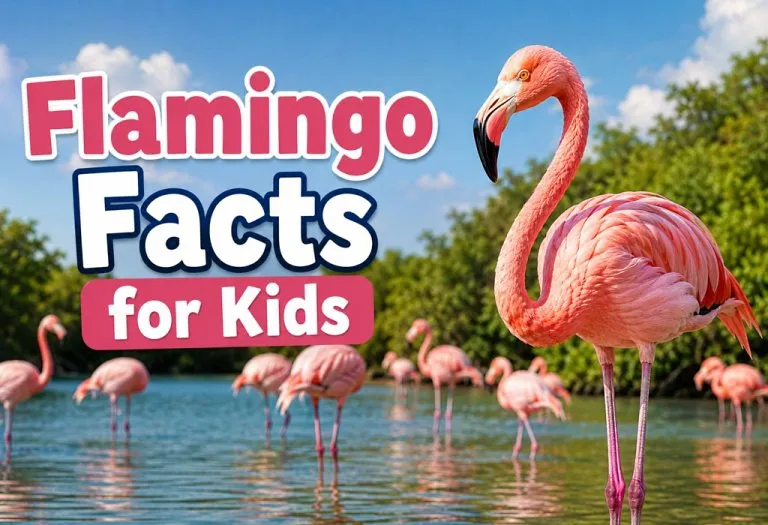
Few birds capture a child’s imagination quite like the flamingo. With its bright pink feathers, long skinny legs, and habit of standing on one foot, it looks almost too unusual to be real. If your child has ever pointed at a picture of a flamingo and asked “why is it that colour?” or “how does it not fall over?”, you already know how much curiosity this bird sparks. These flamingo facts for kids are written to answer those questions in a way that is simple, accurate, and genuinely fun to read together, whether you’re prepping for a school project, a zoo visit, or just a bedtime chat about animals.
Fun Facts About Flamingos
Think you know everything about flamingos? These graceful pink birds have plenty of surprising secrets that go far beyond their colourful appearance. Check out the fun facts below to discover what makes flamingos so amazing.
1. Flamingos Are Born Grey, Not Pink
Here’s something that surprises a lot of kids: flamingo chicks hatch with fluffy grey or white feathers. The famous pink colour doesn’t show up right away. It develops gradually over the first few years of a flamingo’s life as the bird grows and starts eating on its own (1).
For a child who has only ever seen pink flamingos in cartoons or lawn ornaments, this is a great chance to explain that animals often look very different as babies than they do as adults, just like a caterpillar becomes a butterfly.
2. Their Pink Colour Comes From Their Food
Flamingos aren’t born with pink feathers because their colour actually comes from what they eat. Their diet includes algae, tiny shrimp, and other small water creatures that contain natural pigments called carotenoids. The same pigments that make carrots orange give flamingos their pink and orange hues (2).
The more of these pigment-rich foods a flamingo eats, the brighter and pinker its feathers become. Flamingos in zoos are often fed a special diet with added pigments so their feathers stay vibrant, since they don’t always have access to the same wild food sources.
3. Flamingos Eat Upside Down
Unlike most birds, flamingos flip their heads upside down when they eat. They dip their curved beaks into water or mud, then use their tongues to pump water through comb-like structures inside their beaks. This filters out small shrimp, algae, and insects while pushing the water back out, similar to how a strainer catches pasta while letting water drain away (3).
This unusual feeding method is one of the most interesting facts about flamingos, because it means their beaks are shaped in exactly the opposite way from most birds, curving downward instead of up.
4. They Stand on One Leg to Stay Warm
One of the most recognisable flamingo behaviours is standing on a single leg with the other tucked up close to the body. Scientists believe this posture helps flamingos conserve body heat, since less of their leg is exposed to cold water or air. It may also simply be a comfortable resting position, the same way people might sit cross-legged.
Flamingos are so well balanced this way that they can even sleep standing on one leg without tipping over.
5. Flamingos Live in Huge Groups
Flamingos are extremely social birds and rarely spend time alone. They live in colonies that can range from a few dozen birds to flocks of more than a million in some parts of Africa. Living in large groups helps protect flamingos from predators, since there are many eyes watching for danger at once.
These big gatherings are also where flamingos find mates, communicate through honking calls, and even perform coordinated group displays that look like synchronised dancing.
6. There Are Six Types of Flamingos
Kids often assume all flamingos look the same, but there are actually six different flamingo species: the Greater Flamingo, Lesser Flamingo, Chilean Flamingo, Andean Flamingo, James’s Flamingo, and American Flamingo. Each species has slight differences in size, colour, and leg length, and they live in different parts of the world (4).
The American Flamingo, sometimes called the Caribbean Flamingo, tends to have the brightest reddish-pink colouring of all six species.
7. Flamingos Live on Several Continents
Wild flamingos aren’t found everywhere, but they do live across a surprisingly wide range of habitats. They can be spotted in parts of Africa, the Caribbean, South America, southern Europe, and parts of Asia, usually near shallow lakes, lagoons, and wetlands with salty or brackish water.
Because these salty environments have few other animals that can survive there, flamingos often have less competition for food, which helps their large colonies thrive.
8. A Group of Flamingos Has a Fun Name
A group of flamingos is sometimes called a “flamboyance,” a name that fits perfectly given how colourful and showy these birds look together. Other common terms for a group of flamingos include a flock or a colony, but “flamboyance” is the one that tends to stick with kids because it’s so playful (5).
9. Flamingos Can Fly Long Distances
Even though flamingos are often pictured standing still in shallow water, they are strong fliers. With their long necks stretched forward and legs trailing behind, flamingos can travel hundreds of miles in a single night when migrating to find food or better weather.
Flocks sometimes fly in a V-shaped formation, similar to geese, which helps them conserve energy during long flights.
10. Baby Flamingos Are Called Chicks
A baby flamingo is called a chick, just like many other baby birds. Flamingo parents build tall, cone-shaped nests out of mud, and the mother typically lays just one egg at a time. Both parents take turns sitting on the egg to keep it warm until it hatches.
Once hatched, flamingo chicks are fed a nutrient-rich substance called “crop milk,” which both parents produce, a trait shared with only a few other bird species like pigeons.
11. Flamingos Have Very Flexible Necks
A flamingo’s neck contains 19 vertebrae, far more than a human neck, which only has seven (6). This gives flamingos remarkable flexibility, allowing them to bend their necks into curves and angles that would be impossible for most animals. This flexibility helps them reach food at different depths in the water.
12. Their Knees Aren’t Where You Think
Many kids assume the bend in a flamingo’s leg is its knee, but that joint is actually its ankle. A flamingo’s real knee is hidden higher up, closer to its body, and is usually covered by feathers. What looks like a backward-bending knee is really the same joint humans use to flex their foot up and down.
13. Flamingos Can Live for Decades
Flamingos are surprisingly long-lived birds. In the wild, many flamingos live between 20 and 30 years, and in the safer, more controlled environment of a zoo, some have lived past 50 years old. That’s longer than many family pets, and even longer than some larger animals.
14. Flamingos Communicate Through Sound and Movement
Flamingos aren’t quiet birds. They communicate with a variety of honks, grunts, and calls that help members of a colony recognise each other, warn of danger, or coordinate group movement. Parents and chicks even learn to recognise each other’s individual calls, which helps them find one another in a crowded colony.
15. Flamingos Have Inspired Art and Culture for Centuries
Flamingos have shown up in ancient Egyptian art, were considered sacred in some early Mediterranean cultures, and remain a popular symbol in modern design, from lawn ornaments to tropical logos. Their bold colour and unusual shape have made them one of the most recognisable birds in the world, long before they became a favourite subject in children’s books and cartoons.
Flamingos are proof that nature can be just as playful and surprising as anything found in a storybook. From their grey beginnings and pigment-powered pink feathers to their upside-down eating habits and one-legged naps, these birds are full of small details that make learning about wildlife exciting for kids. The next time your child spots a flamingo at a zoo, in a book, or even on a lawn, they’ll have plenty of fun facts to share about how this bird really lives.
Also Read:
Peacock Facts for Kids
Bird Facts for Children
Butterfly Facts for Kids
Was This Article Helpful?
Parenting is a huge responsibility, for you as a caregiver, but also for us as a parenting content platform. We understand that and take our responsibility of creating credible content seriously. FirstCry Parenting articles are written and published only after extensive research using factually sound references to deliver quality content that is accurate, validated by experts, and completely reliable. To understand how we go about creating content that is credible, read our editorial policy here.
- Author


Related Articles
-

The Emperor's New Clothes Story – An Interesting Tale for Kids
-
Thomas Edison: Facts for Kids
-
50 Best First Day of School Wishes and Messages for Kids
-
30 Best Christmas Books for Kids To Read This Year
-
20+ Interesting Black Hole Facts for Kids
-
Why and How You Should Teach Your Mother Tongue to Your Child








.svg)