

















.svg)
.svg)
.png)


Safety
Suggested articles for you
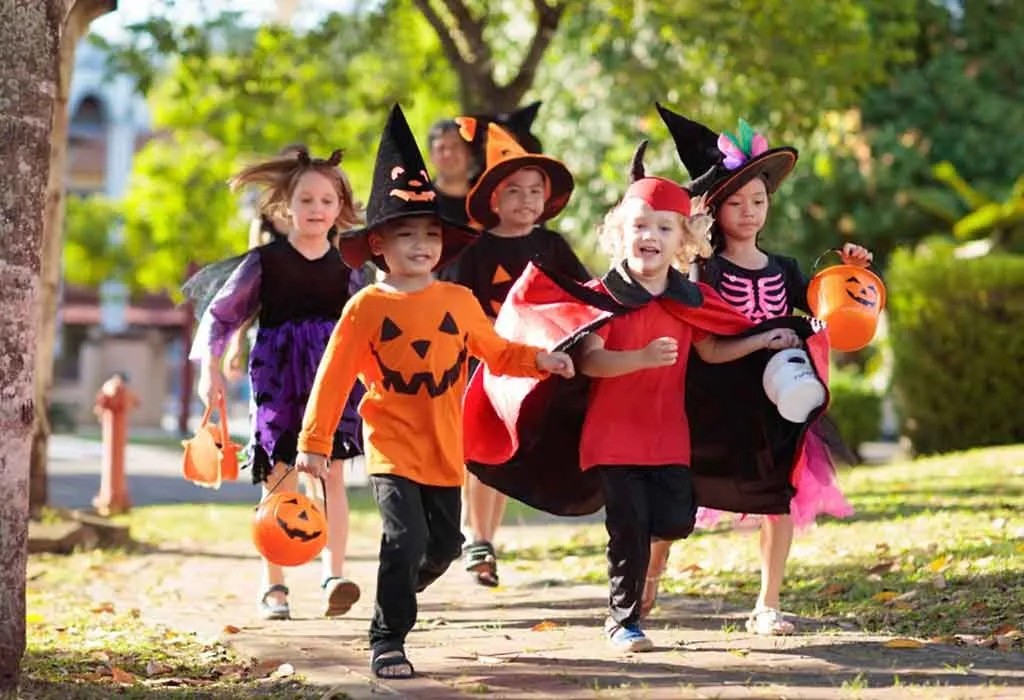
Important Tips for a Safe Halloween Celebration With Kids
Come October and everybody is running around trying to find the perfect Pumpkins, costumes and decorations to make sure their Halloween is the best one they’ve had yet. However, it is important to stay safe on Halloween. It can be easy to get wrapped up with all the fun and frolic around without a care about what is going on around us. Read on to find out tips on how to have a safe Halloween with kids.
Halloween Safety Tips According to the American Academy of Paediatrics
It’s a strange time to be living in due to the pandemic that has swept the world over. This issue could stretch on well into the next few months without a solution in place. While that may be the situation, safety should be of utmost priority for everybody. Here are some Halloween safety tips for parents as well as some Halloween safety tips for kindergarteners.
1. Safe Walking Tips
You might think that walking is easy but since it is a holiday night and many people are out and about, it is important to keep in mind tips about Halloween traffic safety.
While crossing the street, make sure that you cross at corners. While doing so, ensure that you are using the crosswalk and traffic signals. Look left and right before crossing and while you cross to be sure that there is nobody approaching you.
Be careful to watch out for cars that are backing up. Teach children to not run out into the street or run around between parked cars.
Try to take a route with the least number of crossings so that the risk for anything unforeseen is mitigated. Direct routes are generally preferred when kids are around.
Make sure to always stay on the sidewalk and only walk there. In case you find that there are no sidewalks, walk while facing traffic.
Join in on the fun with kids if they are under 12 years of age because they will require supervision. If the kids are mature enough to go trick-or-treating on their own, tell them to be in familiar areas that are lit well. Ideally, if they go in a group, it will be safe.
Try to stay away from electronic devices when you go out because it’s important to be vigilant. Make sure your head is up and that you are not running across the street.
Teach children to make eye contact with drivers before crossing to the road so that they both are aware of what they should do.
2. Costume Tips for a Safe Halloween
Safety in all aspects is important so here are some Halloween costume safety tips to help you out.
Add reflective tape to your costume if possible so that you are visible clearly in the dark.
If you decide to dress up as something with a mask, try and avoid that. Masks can partially block vision which can be a hazard after dark. Try using non-toxic makeup as a substitute.
You can hand the kids some glowsticks or small torches in order for them to cross the street.
Make sure that the costume that the kids choose fits correctly so as to prevent any falls or tripping.
Try to avoid any sharp aspects to the costume like swords or knives to prevent any injury to the kids.
Try to buy flame-resistant costumes. Usually, the costumes will have tags on them that say this.
3. Halloween Pumpkin Carving Tips for Kids
As fun as Pumpkin carving might be, it can be difficult for kids. Make sure to follow these safety tips to have a safe Halloween.
If the kids are too small, do not allow any kind of carving on the Pumpkin. Instead, hand them markers and get them to draw on the pumpkin.
Try to not use candles inside the pumpkins and replace them with glowsticks or LED candles.
Do not place any pumpkins that have candles inside them on any pathway. Make sure that they are not unattended.
In case you decide to allow the kids to carve the pumpkin, you can help with the parts that they want to carve after they have marked out the kind of design they like with a marker.
4. Halloween Candy Safety
Candy is every kid’s favorite part of Halloween. Here are some safety tips to ensure that you have a safe Halloween.
In case you find yourself in the middle of a pandemic, you can ditch the candy bowl altogether. Instead, you can lay out the candy separately on a table for kids to grab and go.
Before going out trick-or-treating, make sure that the kids have been fed. They tend to start munching on the candies throughout the evening and that is never a good idea!
Make sure to get back home and check your child’s bag of candy to throw away anything that is unwrapped, looks unsavoury or spoiled.
Halloween is definitely a fun holiday which is enjoyed equally by both, adults and kids. But like we mentioned, it is easy to get caught up in all the fun and let your guard down. Ensure that you are vigilant and aware of your surroundings at all times. This is even more important in case you are going out with kids. Many kids can be unpredictable and totally ignore safety protocols because they get too wrapped up in the evening. You must be the responsible one to make sure that everybody involved has a safe and fun evening. We hope our safety tips have helped you and that you have a happy and safe Halloween!
Also Read:
Halloween Jokes for Children
Halloween Party Games for Kids
Halloween Costume Ideas for Children
Read more




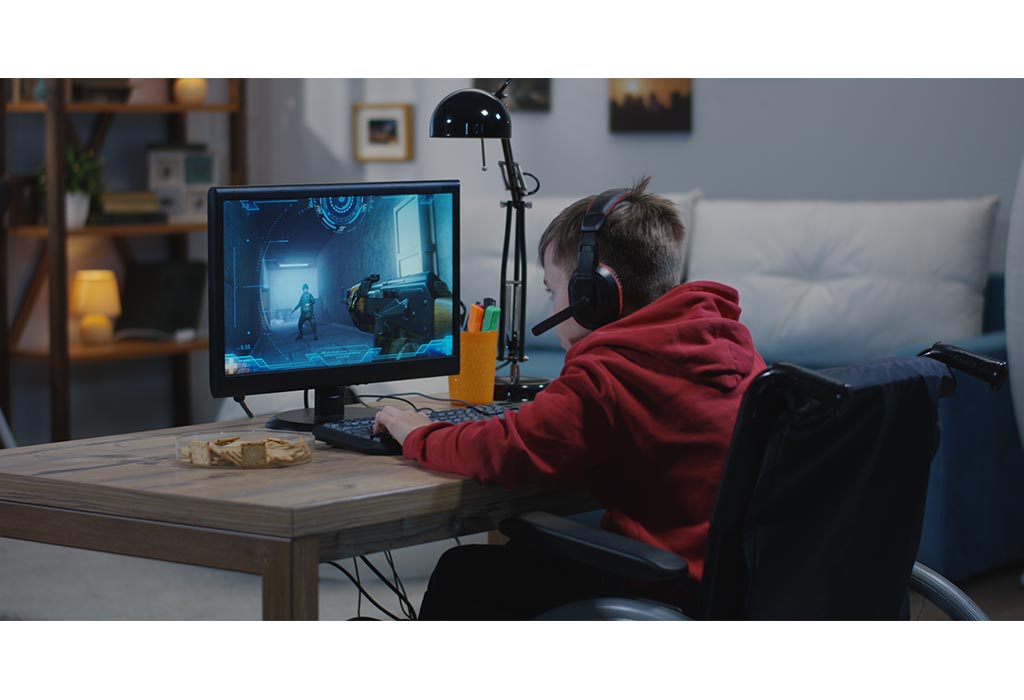
Online Gaming Risks in Children: Signs, Safety, and Solutions
There were days when games were played on the streets and courts, and now they are played on computers, mobile phones, and Xbox. With digital devices at people’s fingertips, online gaming options aren’t far away, especially for children. Persistent and excess exposure has led to online gaming addiction in kids. According to the Entertainment Software Association, at least one person in two-thirds of American households plays video games (1). Internet gaming disorder or online gaming addiction refers to the excessive use of online (internet-based) or video games that eventually leads to neglecting one’s responsibilities and physical health (2). In this article, we aim to make you aware of some surprisingly harmful effects of online games on children.
What Are Online Games?
Online games are the types of games that are available on the internet. From simple text-based games to virtual reality, online games offer a wide variety that incorporates virtual worlds, complex graphics, and goals and targets (3). You can find online games on several PC gaming platforms, like Stream, GOD, and EPIC Games, on smartphones by downloading gaming apps from the Play Store like Google Play or Apple App Store, and on websites that offer online games, like Miniclip, Armor Games, Kongregate, etc. There are several game consoles available for online gaming as well, including PlayStation, Xbox, and Nintendo Switch.
How Do They Work?
In online games, there can be a single player, two players, and even multiples in a single online game. The benefit of online games is that a player can connect to other players across the world over the internet without knowing them personally. All the players are connected to a central game server hosted by the game developer or a third-party provider. The server’s role is to manage the game and keep the actions and tabs of all players synchronised. The players connect to other players within the game through text or voice chat features.
Major Risks of Online Gaming for Children
The risks of online gaming for children cannot be missed when it comes to their he
1. Inappropriate Content Exposure
Some games can expose your child to violent or sexual content that might not be age-appropriate. Therefore, it is necessary for parents to check the age rating of games, frequently monitor what type of games their children are playing, and avoid exposing themselves to any inappropriate content.
2. Cyberbullying
Cyberbullying is very common in the world of online gaming. Instances like bullying, teasing, exclusion from games, and insults can be easily found. Teaching children how to recognise and respond to cyberbullying is crucial.
3. Sharing of Personal Information
Online gaming involves connecting with players worldwide where numerous people connect, giving frauds a window to access players’ personal information, such as name, age, location, etc., and use them to blackmail people. Teaching online safety by knowing when an where to put the information and recognising fake and legal sites is crucial to avoid identity fraud.
4. Virus and Malware Exposure
Online gaming can expose your child’s gaming devices to malware, trojans, and viruses through infected website visits, downloads, links, or ads. Teaching your child about safe downloading practices to protect your devices is important.
5. Addiction
The addiction online gaming induces in children is extremely harmful, leading some children to play excessively, which may interfere with daily life academics and activities. Addiction has taken the lives of several children, and there are several instances of children taking their own lives; in Pune, a 15-year-old boy allegedly died by suicide after jumping from the 14th floor of a building under the influence of the deadly game “Blue Whale.” The child left a suicide note which had “logout” written on it. Further investigation revealed that the child was addicted to online gaming for a few months and used to stay isolated for hours with his laptop.
Parents should set limits on gaming time and monitor their children’s behaviour to prevent online gaming addiction.
6. Scams
Several online games involve exchanging virtual currency or items to progress. These currencies can be gained through any means; thus, it is highly important to monitor your child’s online activity, teach them about such scams, and protect their parents’ hard-earned money.
7. Physical Health Impact
Excessive gaming can lead to several physical health issues in children, such as eye strain, sleep deprivation, back pain, neck pain, and hand and finger stiffness or injuries from prolonged use of controllers or keyboards.
8. Phishing Scams and Account Takeover
There are infinite numbers of hackers present in the gaming world. They may gain unauthorised access to gaming accounts through phishing scams, weak links or passwords, or sharing account information, and then, with the use of such information, they may blackmail children. Hackers also create fake login pages or send phishing emails or links to trick children into entering their personal information and revealing that to hackers. Make sure your kid understands the importance of securing their accounts by recognising basic HTML link nuances and recognising phishing scams.
9. In-game Shopping
Online games involve buying and selling dresses and accessories for their characters through in-game currencies by pitching real money. This encourages children to spend more unnecessarily.
Why Did Online Gaming Become an Addiction for Children?
The World Health Organization recognises gaming disorder in its International Classification of Diseases (ICD-11), defining it as a pattern of gaming behaviour where control is impaired, gaming takes priority over other activities, and it continues despite negative consequences (4). Similar to addictive disorders, internet gaming disorder has also revealed the activation of the dopamine reward system (5).
One of the reasons or causes of online game addiction is the release of dopamine in the brain. Dopamine is a neurotransmitter that is released when indulged in pleasurable activities, such as playing, spending time with loves ones, eating good or favourite food, etc. The feel-good hormone induces the brain to feel pleasure and repeat such behaviour and activities. When children play online games, dopamine is introduced, and they are encouraged to play more and more. As they play, they win and lose, prompting them to win more by playing more and more, developing a sense of achievement. Hence, the pattern of addiction.
Signs of Online Gaming Addiction in Children
Gaming addiction in children can get pretty serious when you least expect it. There are some signs that parents can remember to watch out for in their children and take necessary measures before it becomes more serious. Here are those signs:
Gaming habits have started to disrupt or replace daily activities like sleeping and social interaction (playing out with friends or siblings at home, engaging in convos, etc.
The child has started neglecting their academics, like homework and school projects for gaming online.
They are replacing the old hobbies they used to do and friends with online games.
The physical changes include dark circles under the eyes, fatigued and bloodred eyes, and sore backs, wrists, and fingers.
They keep focusing and thinking of online games throughout the day.
Children start feeling restless and anxious when unable to play games.
They pay less attention to their duties.
They have started relying on online games for mood boosts.
How to Diagnose Online Gaming Addiction in a Child?
The American Psychiatric Association’s Diagnostic and Statistical Manual of Mental Disorders (DSM-5-TR) lays out several materials for doctors to diagnose mental disorders, including gamic addiction, i.e. Internet Gaming Disorder (IGD).
There are different diagnoses and tests available to determine online gaming addiction in children. Your child’s healthcare provider most probably will refer you to a child psychologist or psychiatrist to diagnose the child’s behavioural patterns through medical history and daily routine. According to the American Psychiatric Association, the individual must present five or more symptoms within a year to diagnose the internet gaming disorder (1).
Let’s learn about preventing online gaming addiction in children at the parents’ level.
How to Keep Your Child Safe From Online Gaming Risks?
It is possible to keep your child away from online gaming risk without actually removing them altogether from such games. All you need to do is:
1. Select games together
Understand the world of online gaming first by learning about them on YouTube videos, article reviews, and online forums where plenty of gamers discuss different games. While choosing online games for your child, choose games from known publishers for which there are considerable downloads, reviews, ratings, and hidden malware.
2. Check the themes of games
Before finalising a game, check what the game is all about, its plot, goal, and characters. Also, check the rating; most games have a PEGI rating, which suggests the age-suitability for children. For instance, if a game is rated 7, it means it is suitable for children aged 7 and above.
3. Activate parental controls and put strong passwords
Setting up parental controls can help parents put a cap on what games children can access according to their age. Games like Fortnite and Roblox have auto-built parental controls, while some game consoles, like Nintendo Switch, Xbox, PS4, and PS5, need parental control. Parents can also put up strong and unknown passwords for logging in to games by setting up two-factor authentication (2FA) and a reliable VPN to help avoid fraudulent hacking and data leaking.
4. Monitor your child’s gaming and in-game spending
Putting up controls won’t be enough; monitoring the game your child is playing is also necessary to check what characters they are playing and how much in-game currency they are spending. Keeping the game consoles and gaming activities in the communal area or in the open is a wise move for parents to always keep a check on their child’s gaming and protect them from hackers and scammers.
5. Build a reward system
Building a reward system for children to keep their gaming limits. You can set up a reward system where every hour of physical activity like playing outside, dancing, or singing will unlock 15-20 minutes of gaming online. This will teach children the value of time and discipline.
6. Teach kids about appropriate and inappropriate content
It may not always be possible to monitor your child’s gaming, so teaching them about the right and inappropriate content on games is essential. Keep your voice gentle and teach them about the right characters, when to get out when they see a type of content they are not required to see, and provide them a safe space to tell you whenever they feel unsafe or bothered.
7. Put restrictions on games
Putting restrictions on games other than parental controls is important. One such restriction is in-game spending. Parents can block their regular use of prepaid debit or credit cards for in-game purchases and only use gift cards or prepaid kids’ debit cards for making safe purchases online, as these cards have a set limit that can help control spending. This will also prevent hackers from leaking personal and financial account information.
8. Turn on the notification
Notifications can help you keep track of what games your child is playing and for how long they are playing a particular game, making it easy for parents to detect any budding addiction.
Treatment Offered for Online Game Addiction
Psychotherapy by mental health professionals, including child psychologists or psychiatrists, is a common method of treating addiction and the negative effects of online games in children. It is a term for a variety of treatments that help identify the changes in thoughts, emotions, and behaviours of children.
1. Cognitive-behavioral therapy (CBT)
Cognitive-behavioral therapy is a structured, goal-focused therapy where a therapist helps children examine their thoughts and emotions closely. In CBT for video game addiction, the therapist’s goal is to observe harmful patterns of gaming in children and develop better habits by turning them in the right direction.
2. Group Therapy
Group therapy involves people coming together to discuss their problems under the guidance of a therapist. For children struggling with video game addiction, group therapy offers motivation and support to talk when there are more children involved.
When & Where to Seek Professional Support?
If you see the signs of potential video game addiction in your child, it is best to consult a mental health professional as soon as possible. You can consult a child counsellor in the beginning stages and if you feel your child needs exclusive counselling, then you can turn to a child psychologist.
The possible signs that should prompt you to take further action are:
Devoting too much time to gaming
Poor performance at school
Withdrawal symptoms like anxiety, irritability, instant anger, or sadness
Lying to parents for and about gaming
Decline in physical health
Setting Up Parental Control on Your Child’s Device?
Parental controls are extremely helpful in monitoring your child’s use of video games as well as online content by restricting access to non-age-appropriate websites, games, and chat rooms.
Here is the set of instructions for setting up parental controls on most gaming consoles and devices.
1. Xbox
Once you have signed up with a Microsoft account, you can set up parental control on the Xbox gaming console. Here’s how:
Open the Google Play Store or App Store and download the Xbox Family Settings app by searching for it.
Sign in to your earlier created Microsoft account and choose “Add Them Now,” then select “Create Child Account,” and select “Next.”
After creating your children’s accounts, select their profiles to set up the necessary restrictions. Now, you have the feature to block chat features, set screen limits, and even monitor their friend lists.
2. PlayStation 5 (PS5)
Prior to setting up parental controls on PS5, you are required to create separate accounts for your children and yourself. The following steps are as follows:
Turn on the console and sign in to the “Account Management.” Once signed in, go to “Family Management.”
Now, select your name and click on the checkbox provided for “Parent/Guardian.”
Once logged in, scroll to the right and select the “Settings” icon.
Go to “Family and Parental Controls,” then select “PS5 Console Restrictions,” and then set up a four-digit restriction passcode.
Now, again log in to “PS5 Console Restrictions” and then click on Parental Controls for New Users.
3. Nintendo Switch
To set up parental controls on Nintendo Switch, follow these steps:
Open the console, click on the “System Settings” tab on the Home Menu, and then click on “Parental Controls.”
Generate a four-digit PIN and then click on the “secret question.” Make sure to add the backup email address if you ever forget either the PIN or the secret question.
Now, you have access to configure settings, including access to Nintendo 3DS shopping services, restricting browser use, friend registration, online interaction, and more.
Now, click on the “Parental Control” settings according to the player’s age.
4. Personal Computer (PC)
Here are the instructions to follow to set up parental controls on the PC:
Search for “Family Options” from the Windows search bar, and click “Suggest.”
Now, open the “System Settings” and click on “View Family Settings.“
Once redirected to Microsoft’s website, create a separate account for your children.
You will be appointed as the “Organizer” to set up parental controls. Turn on the controls on your children’s accounts separately.
Once parental controls are enabled, the selected accounts will automatically accommodate the settings.
5. Mobile Gaming
The process of setting up parental controls on Mobile Gaming is as follows:
Click on the profile icon in the top right corner of the Google Play app.
Click on “Settings,” then “Family,” and then “Parental Controls.”
Turn on parental controls and create a PIN to secure the process.
You can click on different filters to restrict your child access, such as games, movies, books, or apps. Age-based filtration process is also available.
FAQs
1. Can a child get withdrawal symptoms as they reduce their gaming addiction?
If you start to reduce your child’s gaming time, they are likely to go through withdrawal symptoms, most often showing up as anxiety. This could also manifest as anger, frustration, emotional outbursts, or noticeable fear. While there’s no quick fix for these symptoms, you can encourage your child to confront the emotions they’ve been avoiding while absorbed in online gaming. Being patient with your child’s symptoms like fear and pain is important for parents at this point in time, and resolve each problem as the days progress.
Online video gaming is common among individuals of all ages, yet children are the most vulnerable. Harbouring plenty of bad effects on students, young children, and teenagers, it is imperative for parents to be extra cautious when their children play games online or physically. Do not hesitate or delay in consulting a medical expert, as the more delay there is, the long-lasting the consequences.
Never forget that your child has unlimited potential and if they fall in the trap of online gaming addiction, they can come out of it with your love and support.
References/Resources:
1. Internet Gaming; American Psychiatric Association; https://www.psychiatry.org/Patients-Families/Internet-Gaming
2. Technology Addictions: Social Media, Online Gaming, and More; American Psychiatric Association; https://www.psychiatry.org/patients-families/technology-addictions-social-media-and-more
3. What is Online Games; IGI Global; https://www.igi-global.com/dictionary/online-games/20978
4. Gaming disorder; WHO; https://www.who.int/standards/classifications/frequently-asked-questions/gaming-disorder
5. Palaus. M, et al.; Neural Basis of Video Gaming: A Systematic Review; Frontiers in Human Neuroscience; https://www.frontiersin.org/journals/human-neuroscience/articles/10.3389/fnhum.2017.00248/full; May 2017
Also Read:
Impact of Social Media on Kids
Impact of Television (TV) on Kids
Influence of Advertising on Children
Effects of Gadgets on Child Development
Factors Affecting Child Growth and Development
Harmful Effects of Using Mobile Phones on Children
Impact of Video Games on Children – The Good and the Bad
Read more
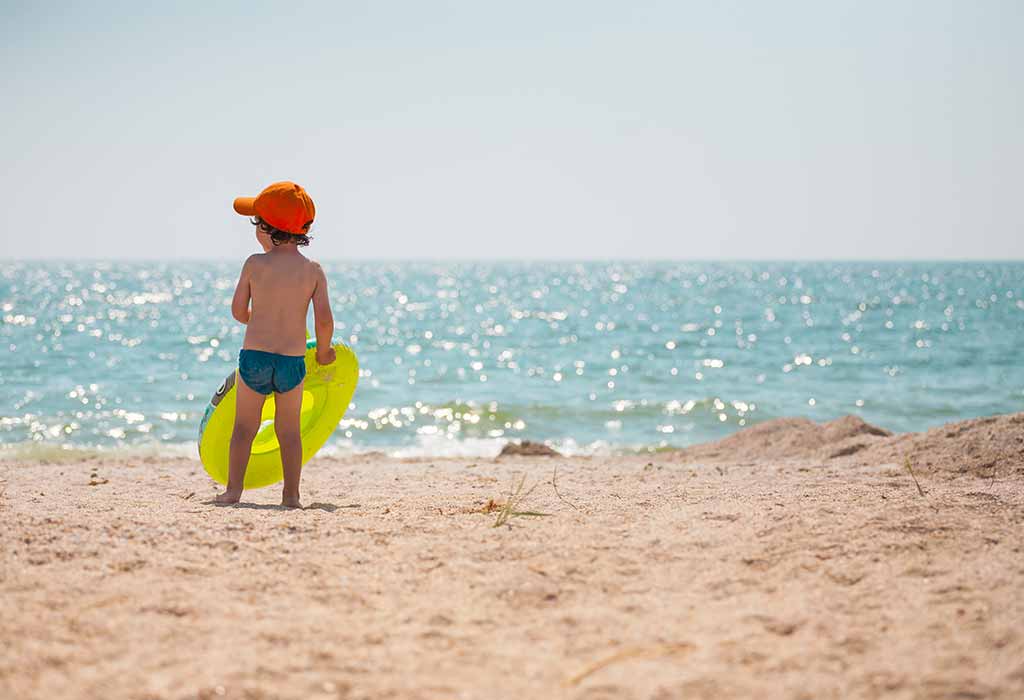
Important Beach Safety Tips for Kids
Summertime generally means hitting the beach for most families. Beaches are a great place to unwind. However, they can also be dangerous, especially if you have young kids who you have taken along. Ensuring the safety of your little ones is of utmost importance at a beach, thus keeping yourself aware with rules on beach safety for kids is essential.
A lot of families wonder, “Is it safe to go to the beach with little kids?” It is safe to head out to a beach and unwind with your little ones as long as you follow the safety precautions. Here, we give you all the water safety rules at the beach to keep your family safe this summer.
Beach Safety Rules to Keep in Mind for Children
To keep yourself as well as your children out of danger while ensuring that they still have plenty of fun, follow these rules:
1. Brush up on swimming skills
Do you wonder, “Is swimming at the beach safe?” Remember that swimming in an ocean or a sea is much different from swimming in a pool. It is a fact that swimming in an ocean or sea requires much more physical effort and skill than swimming in a pool. Also, you must remember that the water in a sea is dark and includes living creatures with absolutely no concrete sides or ladders to hold on to. For this reason, children may struggle to swim in an ocean and may also be intimidated by the waves pushing them around while they cannot see the bottom. If you are taking your child to the beach for the first time, we recommend that you prepare your child for these differences beforehand, and it might be helpful for your child to get some survival swimming practice.
2. Purchase life jackets
We recommend purchasing life jackets or any kind of personal flotation device if you plan to take toddlers or young kids to the beach (1). Remember that it just takes a second to get distracted, and your child may wander into the water. Also, having a life jacket on your little one provides you with that extra protection and peace of mind that your child won’t drown in the water easily. However, we recommend that you try the life jacket on your child and test it in a pool before using it on a beach.
3. Check the water conditions beforehand
Almost all swimming beaches have beach flags and lifeguards, which indicate the weather conditions. If these indicate a rough sea or lightning, and you witness high currents, it is best to avoid the beach that day. Also, keep the children out of the water if the current brings jellyfish inland. If there is a beach safety rope available, inform your children about it before going into the water.
4. Ensure there is a lifeguard around
A lifeguard must be close to where your children are playing in the water. Always swim near a lifeguard on duty (2).
5. Ensure the children do not touch the marine life
It is highly recommended that your children understand that they should not approach or touch the marine life around them, even if they feel it needs help (3). Instead, you can request help from a local lifeguard or the beach patrol. An injured whale, a beached seal, or a jellyfish washed up on shore can be dangerous.
6. Educate your children on the ocean currents
There are two kinds of currents one may experience at a beach. These are the rip currents and the longshore currents. Children need to stay safe from the longshore currents as these are the currents that push one towards the beach with each wave.
7. Set up boundaries
As longshore currents can slowly push the kids down the beach, we suggest that you set some limits or boundaries for the kids while at the beach. For example, you can ask your kids to be between two points while playing at the beach. You can probably select a specific distance between you and the lifeguard chair. This makes it easier for children to play without the danger of losing sight of the family, as they know exactly where to look for you.
8. Always use the buddy system
It is never a good idea to let your kids swim alone. Children must be encouraged to swim with a buddy. For younger children, you are their buddy. You can decide and take turns with your partner or group of friends to swim with your child or children. This makes stimming at the beach a lot safer.
9. Always be alert
It may be extremely tempting to take a nap as you unwind on the beach. However, if you have taken children with you, you must always be alert and keep an eye on them even if you feel that they are old enough (tweens/teens). Little ones should always be within your reach. If you have gone to the beach as a family, then take turns to watch the kids. You can never completely rely on the lifeguards to keep an eye on your kids.
10. Sunscreen and hydration
Always ensure that you and your children put on an ample amount of sunscreen to protect the skin at least 30 minutes before you all step out in the sun (4). Choose a broad-spectrum sunscreen that covers the skin entirely. You also need to make sure that you and your family stay hydrated throughout the day. Make sure to carry a cooler filled with water and keep drinking water throughout the day.
FAQs
1. What are some non-negotiable rules for beach safety for children?
Some of the non-negotiable rules on beach safety for preschoolers, elementary kids, and big kids:
Always follow a lifeguard’s instructions
Always ask parents or guardians to go in the water. Do not enter the water before notifying anybody.
When standing near the ocean, always stand facing the water.
If you have not mastered swimming, do not go in the water without any assistance like floating pads or buoys.
2. How can parents ensure the safety of their children on the beach?
When on a beach with kids, parents must always be:
Attentive
Sober
Active
Focused on the child
3. What are the different colours of flags hoisted by lifeguards, and what do they mean?
The common lifeguard flag colours are blue, yellow, green and red (5).
Blue = dangerous marine life
Green = low hazard
Yellow = medium hazard
Red = high hazard
The beach can be a great place to unwind and relax as a family. Just make sure to follow these precautionary steps to keep danger away.
References/Resources:
1. Beach Safety Tips: 5 Ways to Protect Your Kids; UNC Health Talk; https://healthtalk.unchealthcare.org/beach-safety-tips-5-ways-to-protect-your-kids/
2. Beach Safety for Families: Safe Fun in the Sun, Sand & Sea; American Academy of Pediatrics; https://www.healthychildren.org/English/safety-prevention/at-play/Pages/beach-safety-for-families-safe-fun-in-the-sun-sand-and-sea.aspx
3. Safety: Holidays and at the beach; The Royal Children’s Hospital Melbourne; https://www.rch.org.au/kidsinfo/fact_sheets/Safety_Holidays_and_at_the_beach/
4. Beach safety tips for families; CHOC; https://health.choc.org/beach-safety-tips/; June 2022
5. 4 Beach Safety Tips to Teach Your Kids; Catalina Sea Camp; https://catalinaseacamp.org/blog/4-beach-safety-tips-to-teach-your-kids/
Also Read:
Fire Safety for Children
Electrical Safety Tips for Kids
Top Safety Rules for Kids at Home
Amusement Park Safety for Children
Read more

Living With In-Laws – Is It a Boon or a Bane?
It is actually a boon if the in-laws can understand at least 10% compared to what our parents understand us. I would like to categorise in-laws as –
Educated
Uneducated But Understanding
Now, the first category is for the in-laws who are educated. It is definitely a big boon to a girl. Here are some more pros:
If you are working, then they can understand your goals and dreams, and will definitely support you in your future plans.
If you are working and have kids, they can take care of your kids’ studies, also care for their own health.
If you had to attend something important other than work, they are understanding, and you can just go ahead and be rest assured that somebody is there to take care of your kids.
If you want to spend some quality time with your partner, they know its importance and respect your privacy.
If both you and your partner were occupied with something important and had to reach home late, everything will be taken care of at home, including your kids.
If you have any misunderstandings between you and your partner, they will definitely help you solve the problem. They actually are the backbone for your family.
Some of your kids’ responsibilities can be shared by the in-laws if you are a working woman.
Let’s take a look at the second category – Uneducated but Understanding.
All of the above pros apply even though the in-laws are not educated. But only one thing is you have to put some extra effort into your kids’ studies.
Believe me; it’s a boon. More importantly, kids can learn so many valuable things from elders at home.
There will be a difference between kids who grow with their grandparents and parents, than those who grow only with parents, or those who are raised by their grandparents alone.
However, in my opinion, educated understanding in-laws make for the best parents and grandparents. Whoever is reading this whether it’s a married woman or unmarried, please make decisions maturely and wisely. Give equal importance to your in-laws as you give to your parents.
Disclaimer: The views, opinions and positions (including content in any form) expressed within this post are those of the author alone. The accuracy, completeness and validity of any statements made within this article are not guaranteed. We accept no liability for any errors, omissions or representations. The responsibility for intellectual property rights of this content rests with the author and any liability with regards to infringement of intellectual property rights remains with him/her.
Read more

Tips to Choose a Safe Bug Spray for Babies and Kids
You must be looking forward to spending some quality time with your kids by taking them for a picnic to a park (or in your backyard) or for some outdoor adventure. Your little ones can benefit from outdoor play and must take in the beauty of nature, but when nature gets a little too much and mosquitoes, ticks, and flies and other pests come out and join you, it can be downright uncomfortable for you and your kids. You want to keep your children safe and protected, but at the same time you want them to have fun, so how do you make sure your child stays safe from those pesky pests outdoors? Easy! By using bug repellents! But if you’re not sure what you should look for when buying a bug spray for kids, we are here to help. Read on to know more about bug-sprays.
Are Bug Sprays Safe for Babies?
As per the Centers for Disease Control and Prevention (CDC), bug sprays shouldn’t be used for babies under 2 months of age. The CDC recommends parents to keep insect repellents away from babies who are younger than 2 months. This is because bug spray can be really dangerous for their sensitive lungs and skin.
However, there are other solutions that parents of infants can try. To protect your little ones from bug bites, you can dress them up in clothing that will completely cover the exposed areas on the legs and arms. When the little one is in a stroller, you could consider using a see-through mosquito net to cover the exposed area.
Is it Safe to Use a Bug Spray on Toddlers and Kids?
Yes, most bug sprays are safe to use on toddlers and kids. But a bug spray should be used only once a day. If choosing chemical-based repellents, go for repellents with a low chemical concentration to avoid the harmful effects of bug spray on infants and kids. Also, read the label to see if your child is allergic to any ingredient and check if the repellent is safe for your little one. You could also check the label to see if it is the right bug repellent for toddlers with sensitive skin.
Types of Safe Bus Sprays for Children
From sprays and aerosols to liquids, sticks, and creams, efficient insect repellents come in many forms and most of them are safe for babies who are above 2-3 months old. For babies who are under the 2-months of age, it is best to not use any bug repellent on them. However, to keep the bugs away, you can place insect nettings around the baby’s bassinet or stroller. If you are considering formulations for the older children, then the four main types you can choose from:
1. Repellents With DEET
Repellents containing DEET is the most effective type of repellent for keeping the bugs away. Depending on the amount of DEET present in the repellent, the protection can last anywhere between 3 and 8 hours. Usually, 10 per cent DEET in the formulation provides protection for about 2 hours, while 24 per cent of DEET in the formulation will provide 5 hours of protection. However, most experts suggest that no matter how strong DEET is in the product, it is best to apply only once a day on children.
However, the AAP (American Academy of Pediatrics) does not suggest the use of DEET bug sprays for babies younger than 2 months old and advises against using 30 per cent DEET products on children of any age. Therefore, the safest option is to use only repellents with 10 per cent DEET in them. DEET and sunscreen may seem like a handy combo but these should not be used together since DEET can make the sun-protection factor less effective.
2. Repellents With Essential Oils From Plants
Bugs can be kept away using purified forms of plants like cedar, citronella, and soybean, though these are not as effective as repellents with DEET. The protection provided by essential oil bug sprays usually last only for a few hours, which means that you will have to reapply the repellent more often. However, these oils should not be used on babies who are below 2 months of age. Some of these repellents may contain oil from lemon eucalyptus, and this should not be used on children who are younger than 3 years old.
3. Repellents With Picaridin
Also known as KBR 3023, Picaridin is known to provide protection just like 10 per cent DEET formulations. Picaridin is usually colourless and odourless and feels light on the skin. Picaridin is also non-greasy and non-toxic, which makes it a better option than DEET but it can cause eye irritation. Furthermore, there’s not enough research done on the long-term effects of picaridin on humans, hence it’s best not used on children.
4. Repellents With Permethrin
Permethrin is a very effective chemical that can kill fleas and ticks on contact. Therefore, repellents with permethrin are ideal to protect the children against Lyme disease and other tick-borne illnesses. However, it does not protect the children against mosquitoes and other flying insects that bite. Moreover, it should only be applied on clothing or on outdoor gear like tents and sleeping bags, and never directly on the skin.
Which Bug Sprays or Repellents Must Not Be Used Around Babies and Kids?
It is best to not use wristbands soaked in chemical repellents (since these may cause localized skin irritations and reactions), ultrasonic devices that send out annoying sound waves (at-bats, birds, and pests), pills with Vitamin B1 or garlic, and bug zappers around children. These are all ineffective ways of protecting children from insect bites.
How to Choose the Best Child-friendly Bug Spray
When choosing a bug repellent for your little one, it is important to make sure that it is completely safe and harmless. Here are a few ways to choose the best bug spray for kids:
When buying a bug repellent, make sure that it either contains DEET or plant-derived chemicals that are considered to be natural bug repellent for babies above 2-3 months of age (such as oil from citronella) since they offer the best protection. Furthermore, before buying a bug spray, you should also read the product labels carefully since not every repellent is safe for children. For example, you should not use repellents with lemon eucalyptus oil for children who are under the age of 3 and you should not use DEET repellents for babies who are below 2 months of age.
Check whether or not the product you choose offers 60 minutes of complete protection after the first application since it is best to apply repellents only once per day on children.
Some repellents may cause irritation, so make sure the ingredients on the label are not known to cause problems to kids. If you are getting a DEET repellent, then it is best to go for low-concentration DEET formulations to avoid skin irritations.
Read the label of the products to make sure that it is effective on the specific insect you want to protect your child from. This is because some repellents may not work on some insects but not on others.
There are also other non-chemical options to protect the little one from insects, in case you cannot use any of these on your children. Before your little one goes outside, you can make sure that he is wearing long pants and shirts with long sleeves. Tuck the pants into their socks and make sure they are wearing closed-toe shoes.
Tips to Use a Bug Spray Safely
Here are some dos and don’ts of using insect repellent or bug spray on kids:
Spray bug repellents only on the open area because you and your child should not breathe the spray in. Also, do not spray the repellent near food.
Apply DEET and other such bug repellents only to exposed skin or clothing but never under the clothing.
Do not use any formulations near your children’s mouth or eyes, and avoid applying it on infected areas, cuts, or on irritated skin.
It is best to spray the repellents onto your hands first and then rub it on the child’s skin so that you can avoid spraying it on the child’s face. Never spray directly onto the child’s face or his hands since children might rub their hands on their eyes and mouths.
After your child comes back from outdoors, wash his hands and face with soap and water and wash the clothing with repellents before it is to be worn again.
Most importantly, follow the instructions given on the repellent before applying it on the child.
If your child happens to show any allergic reaction or has irritated skin, discontinue using the repellent.
The next time you go out with your kids for a fun outdoor picnic, do not let the pesky bugs ruin your time! Take a kid-friendly bug spray along and let your children have a wonderful and bug-free time exploring the outdoors!
Also Read:
Safe & Unsafe Mosquito Repellents for Babies
Homemade Insect & Mosquito Repellent for Infants
Pest Control with an Infant Around
Read more
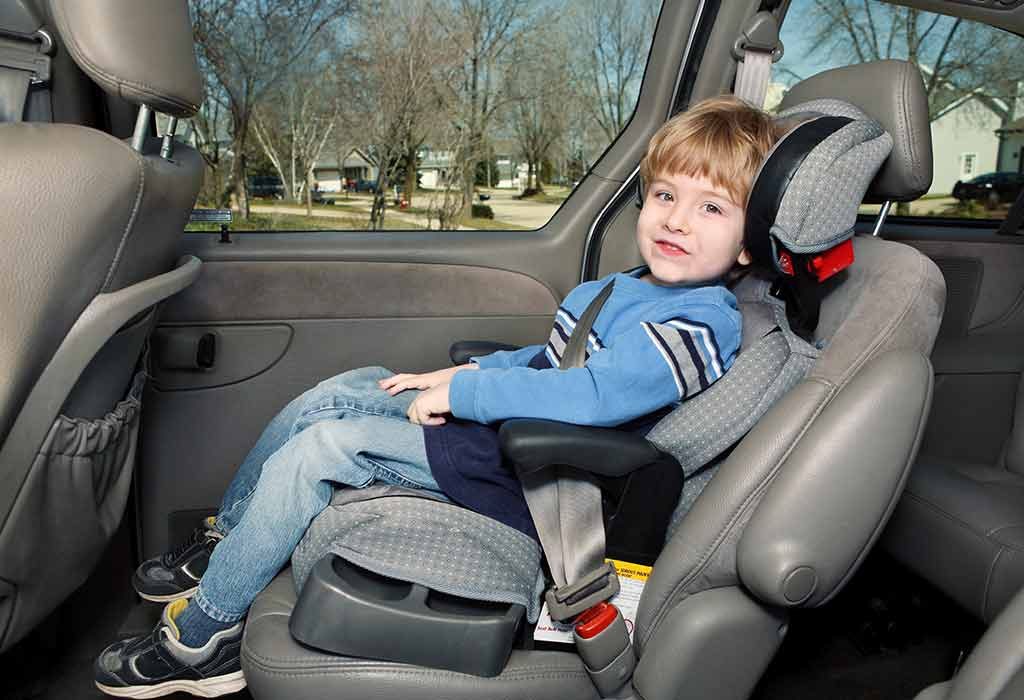
When Can a Child Use a Booster Seat?
As a parent to a toddler, whenever you make your little one sit in his car seat, you may find yourself asking if he is ready to outgrow it and make the transition to a booster seat. So, when can a child use a booster seat? If your child’s weight and height are as per his age, then you might be considering buying a booster seat for him. But before you make the big investment, find out if your little one is ready for it. If your child shows signs of readiness, you need to learn if it is safe to keep children in a harnessed seat for long.
What Is a Booster Seat?
A booster seat is a seat that helps a child stay safe in a car. Unlike a car seat (rear-facing or forward-facing) that uses a five-point harness, a booster seat uses the seatbelt restraint of the car to keep a child secure. A booster seat lets a child sit on top of the seat and ‘lift’ them up to a height where the seatbelts lie across the strong bones and pelvis of the child and keep them secure. The seat belt is designed to help adults and the booster seat acts as the additional support to match the height of an adult. The transfer to a booster seat for your child is just like a preparation to sit on the seat like an adult until they are old enough.
Types of Booster Seats
There are essentially two kinds of booster seats that you can choose from for your child, once he reaches the right age.
1. Backless Booster Seats
These seats are easy to manoeuvre from one car to another. When using a backless booster, the car must have a seat that has a back which is high enough to give support to the rear of the head. The child’s ears must be below the top of the seat or the headrest.
2. High-Back Booster Seats
As the name suggests, a high-back booster seat has a high back, which helps a child sit upright. It is a great choice for kids and can help position the seat belt on the child accurately. A high-back booster seat is perfect to maintain the posture of kids when they fall asleep during long road journeys.
When Should You Move Your Child to a Booster Seat?
What age for a booster seat seems right? If you’re planning to make a move to a booster seat, you must find out if there’s a right age to do the same. The ideal age for a child to make the move to a booster seat is five. But many parents tend to buy a booster seat early. If you’re considering a booster seat for your toddler, there are some guidelines that you can refer to if you want to assess if your child is ready for the booster seat.
Your child is at least five years of age and weighs at least 40 pounds.
The child is mature enough to sit in the booster seat for the entire journey with the seat belt fitted across the shoulder and below the hips.
The child should have outgrown the weight, height, and internal harness requirements of a five-point harness forward-facing or rear-facing car seat.
Difference Between Car Seats and Booster Seats
Car seats and booster seats are both safety devices designed to protect children in vehicles, but they serve different purposes and are used for different age groups. Here are some key differences:
Age/Size: Car seats are for infants and toddlers, while boosters are for older children.
Support: Car seats provide full support, while boosters raise the child for proper seat belt fit.
Restraint: Car seats use harnesses, while boosters rely on the vehicle’s seat belt.
Purpose: Car seats protect the child’s entire body, while boosters ensure the seat belt fits correctly.
Should You Consider a Booster Seat With a Five-Point Harness?
Keeping a child in a five-point harness seat has its own advantages. A five-point harness seat fits small children as well, and as your child starts using a booster seat they can move out of the secure seat position easily. But you must be careful when you make your child sit in a booster seat. When your little one is sitting in a booster seat, you must ensure that the shoulder belt is not behind their back or under their arm. If the child is uncomfortable then do not make the transition to a booster seat. If they are not comfortable sitting in a booster seat, stick to the car seat with a harness. There is no hurry to make the transition. Wait until your child outgrows the car seat and move them to a booster seat when they meet the statutory requirements and are old enough to understand the mechanics of sitting in the booster seat.
How to Install a Booster Seat
Booster seats are designed to raise a child in the vehicle seat so that the adult seat belt fits properly across the chest and hips. Here’s how to install one:
Choose the right seat: Select a booster seat that fits your child’s size and weight and is compatible with your vehicle’s seat belt system.
Position the booster seat: Place the booster seat in the back seat, preferably in the middle position, for maximum safety.
Secure the booster seat: If your booster seat has a vehicle seat belt lock-off, use it to prevent the seat from moving during a crash.
Buckle up: Help your child buckle the seat belt correctly. The lap belt should fit snugly across their hips, and the shoulder belt should fit snugly across their chest and shoulder, not their neck.
How Long Should You Use a Booster Seat?
It’s generally recommended to keep your child in a booster seat until they reach 4 feet 9 inches tall and are between the ages of 8 and 12 years old. However, the most important factor is ensuring the seat belt fits properly. The lap belt should lie snugly across the upper thighs, not the stomach, and the shoulder belt should lie snugly across the shoulder and chest, not the neck or face. If the seat belt doesn’t fit correctly without a booster seat, your child should continue to use one.
Choosing the Right Fit Booster Seat
If your child weighs over pounds and is still under the age of five, you might want to look for a harnessed car seat with a higher height and weight limit. You have several harness-to-booster seats available in the market today. They have a higher harness limit and later, can be used as a booster seat. This is ideal if you do want to spend twice on the same product. A harnessed car seat with a higher weight and height limit and a higher top shoulder strap will serve the purpose longer. The seat can be used longer in a booster mode too. You can now buy a car seat under your budget to keep your little one safely harnesses until he is ready to make the transition to a booster seat or perhaps longer.
FAQs
1. Can a child use a booster seat in the front seat?
While it’s generally safest for children to ride in the back seat, some situations may require them to sit in the front. If this is the case, ensure the front passenger airbag is deactivated or moved to the off position.
2. How do I know if my child is sitting correctly in their booster seat?
The lap belt should lie snugly across the upper thighs, not the stomach. The shoulder belt should lie snugly across the shoulder and chest, not the neck or face. Your child should sit upright in the booster seat with their back against the vehicle’s seat back.
3. Can a child use a booster seat with a lap-only seat belt?
No. Booster seats are designed to work with lap-shoulder seat belts. Using a booster seat with a lap-only belt can be dangerous and ineffective.
As mentioned above, you don’t need to move your child to a booster seat if he isn’t ready for it. As per the guidelines of the American Academy of Pediatrics, it is safe to keep a child in a rear-facing car seat until the age of 2. They can progress to a forward-facing car seat once they are over 22-30 pounds in weight. A booster seat is recommended only when they are over 40 pounds in weight and above the age of five years.
References/Resources:
1. Car seats and booster seats; National Highway Traffic Safety Administration; https://www.nhtsa.gov/vehicle-safety/car-seats-and-booster-seats
2. Child Passenger Safety (Pediatrics); American Academy of Pediatrics; https://publications.aap.org/pediatrics/article/142/5/e20182460/38530/Child-Passenger-Safety; November 2018
3. Car Seats: Information for Families; American Academy of Pediatrics; https://www.healthychildren.org/English/safety-prevention/on-the-go/Pages/Car-Safety-Seats-Information-for-Families.aspx
4. Booster Seats for School-Aged Children; American Academy of Pediatrics; https://www.healthychildren.org/English/safety-prevention/on-the-go/Pages/Booster-Seats-for-School-Aged-Children.aspx
5. Ma. X, Griffin. R, McGwin. G, Allison. D, et al.; Effectiveness of Booster Seats Compared With No Restraint or Seat Belt Alone for Crash Injury Prevention (Academic Emergency Medicine); National Library of Medicine; https://pmc.ncbi.nlm.nih.gov/articles/PMC3798005/; September 2014
6. Pitt. T, Howard. A, HubkaRao. T, Hagel. B; The effectiveness of booster seat use in motor vehicle collisions (Accident Analysis & Prevention); Science Direct; https://www.sciencedirect.com/science/article/abs/pii/S0001457521003274; September 2021
7. Booster Seats; Harborview Injury Prevention & Research Center; https://hiprc.org/outreach/booster/
Also Read:
Tips for Travelling with Children
The Right Age for Your Kid to Face Forward in a Car Seat
Tips to Handle Jet Lag with Babies, Toddlers and Kids
Read more
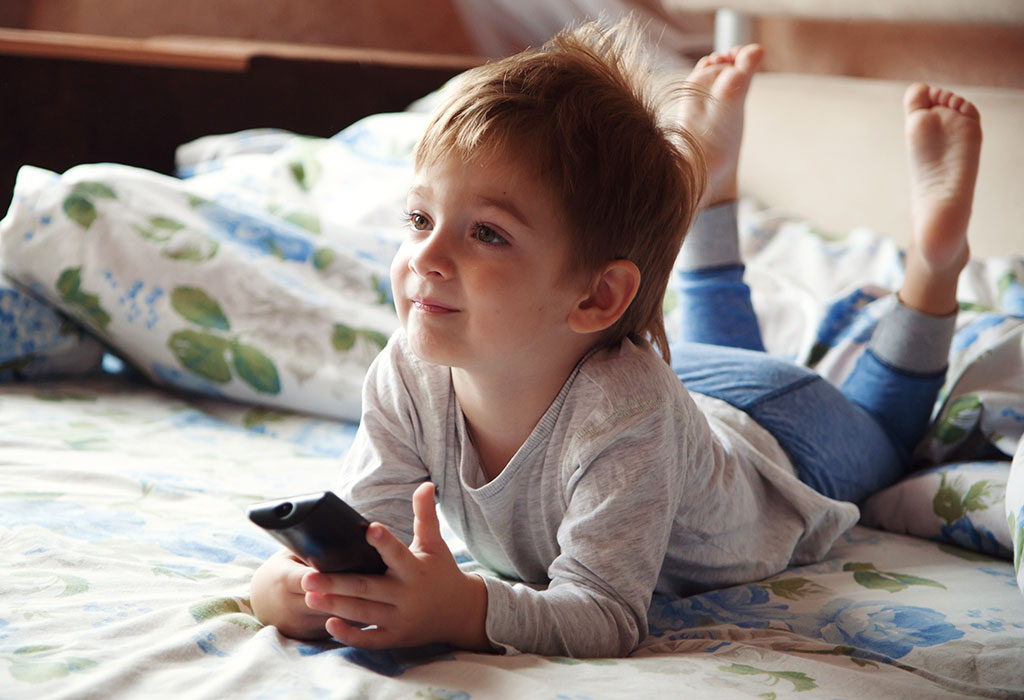
Impact of Television (TV) on Children – Positive and Negative Effects
Television is an important part of every child’s life. From witnessing the magic of superheroes to tuning into horror weekends, children go through an immersive experience through television and live in the bubble of their own world. Sometimes, this bubble becomes a cause for concern, depending on the types of shows being watched.
Television builds character and personality and even has the power to change attitudes and perspectives towards life. Taking extra care will ensure that your child enjoys TV shows without being exposed to the ill-effects of watching TV.
Video: Positive and Negative Effects of Television on Children
What Role Does Television Play in a Child’s Life?
If your child is watching crime dramas or horror flicks and has nightmares during bedtime, then you can be sure that something is wrong with his television habits. A considerable portion of children’s time is spent in front of the TV, and it definitely shapes their personality and attitude. The right kind of television programs imbue social and environmental awareness in kids and even promote social, emotional, and cognitive development holistically. Ensuring a healthy balance of TV time and play/study is important to their development since you don’t want them to turn into couch potatoes and skip healthy social and physical activities.
Positive Effects of Television on Kids
Some of the many advantages of television for children are:
1. Entertainment
From Sesame Street to Dora the Explorer and Arthur, kids’ entertainment shows teach children a plethora of skills ranging from handling emotional trauma, interacting with peers, navigating through tough situations, and stimulating their imaginations through interactive quizzes and thinking patterns. Entertainment shows keep your kids engaged, teach them new skills, and let them have fun – all in one package!
2. Education
Educational shows inspire kids to take action and engage in productive behaviours. If your child doesn’t like traditional teaching methods, then educational programs can be a great way to make him learn while having fun. Educational channels like Wild Kratts, Sid the Science Kid, Hanya Kamu, and Mickey Mouse Clubhouse teach kids problem-solving and provide them with a strong foundation in mental math and analytic thinking.
3. Sports
Watching sports shows such as football, cricket, and volleyball can be a great way to generate interest in outdoor activities. Sports shows encourage kids to be active and healthy, thus enabling them to engage in physical behaviours which, down the line, bring emotional and physical well-being.
4. Culture Fever
Does your kid enjoy exploring and travelling? Introduce them to the wonders of the world through travel and cultural shows. Learning about other cultures will enhance social learning and development skills, encouraging your child to become a holistic thinker and interact with international peers in a friendly fashion.
5. Creativity
From cooking, baking, arts and crafts to music and theatre, creativity is the cornerstone of TV shows. Art channels and shows involving music composing, drawing, and painting stimulate the mind and encourage children to answer their inner calling.
6. Improved Academic Performance
When TV is consumed in a responsible way, emotional and mental well-being follows. This leads to improved academic performance. According to researchers, children who watch informative and educational shows have been proven to outperform peers on multiple standardized tests and even perform at peak levels through middle and high school.
7. Healthy Stress Relief
TV shows provide a healthy emotional outlet for kids who go through stress in school or outdoor environments. A healthy dose of TV can do wonders for a child’s mood and emotional problems and protect him from emotional stress which can impact him negatively.
8. Learn About Technology and Latest Trends
With wide access to an ocean of content on TV, children pick up tools and techniques related to using the latest technologies and stay up-to-date with social trends. Kids become more knowledgeable and achieve informational enlightenment through the TV.
9. Language and Emotional Skills
If your child is learning a new language or mimicking speech patterns, you can assist him to understand vocabulary and sentence formation nuances through language programs and movies. Further, positive TV shows reinforce healthy emotional behaviours and teach kids social skills that are crucial to their success.
10. Keeps Them Engaged
If your child is constantly jumping around the house and can’t keep quiet for a single minute, letting him watch TV to relieve boredom is a creative solution. This will keep him engaged without harming his cognitive development. However, you will need to ensure that this is practised only occasionally and does not become a habit.
11. Encourages Social Participation
Kids who watch characters perform productively and being their best on TV try to mimic those behaviours in real life. This applies to competitive tasks and events as well. For example, if their favourite TV character is performing well in exams and participates in sports and social events, your kids will mimic those behaviours as well, thus helping with their development.
12. Develops Personality and Fosters Independent Thinking
TV shows foster independent thinking skills and teach kids to think outside the box. These skills are vital in a world that puts focus on creativity and thinking from different perspectives.
13. Inspiration
TV shows can inspire kids and encourage them to try new things. For example, a TV program about creativity show can inspire your child to try something new with clay, paints, or paper.
Negative Effects of Television on Kids
Some of the many disadvantages of television for children are:
1. Steals Time
Children who spend too much time in front of the television may miss out on life’s opportunities. If your child is spending too much time watching TV, he may lose precious time which could have been spent on more productive tasks like mingling with friends, working on homework, playing outside and other similar activities.
2. Lack of Language and Social Skills
This might seem contradictory to the positive effects of TV mentioned earlier, but it applies mainly to children under the age of two years. Babies’ brains are in the developmental stages before the age of two. This is when the brain rewires and fosters social and emotional learning. The TV does not smile, speak, or interact with your child psychologically on a personal level. This affects the child’s mental state since he is vulnerable at this point in life. Even in later years, spending too much time watching TV can limit your child’s social interaction, thus affecting language and social skills in the long run.
3. Kills Creativity and Imagination
If your child spends too much time on TV instead of going outside and exploring the real world, he will not be able to develop a strong imagination. Since ideas are presented in front of the screen, children who watch TV excessively cannot stimulate their minds or come up with fresh ideas on their own, thus passively consuming and not actively creating.
4. Lack of Focus
Kids who spend more than 2 to 3 hours in front of the screen on a daily basis often suffer from a lack of focus in classroom environments. Such kids may also have a greater likelihood of being diagnosed with ADHD (Attention-Deficit Hyper Activity Disorder). This lack of focus and low attention span bleeds into other domains besides academics, such as sports. The child may be unwilling to participate in creative and mentally calming activities like crafts as well.
5. Unproductive
Productivity is all about reaching new heights in life. If your child is constantly watching TV and not achieving milestones in their academic, social, or emotional lives, all that time spent in front of the screen is simply time wasted.
6. Obesity
Kids who watch too much TV are at the risk of developing obesity and other health disorders. It’s not uncommon to find young kids transitioning into teenage couch potatoes during their high school when they watch TV excessively.
7. Heart and Eye Health Risks
Kids who watch too much TV are at the risk of developing lazy eye syndrome. In this condition, the child experiences blurry or reduced vision that is not correctable by glasses or lenses. TV addiction also promotes a lack of exercise and a sedentary lifestyle, both of which impact the heart and the brain. This can eventually lead to cardiovascular problems and narrow arteries.
8. Negative Behaviour
According to research, watching too much TV can alter the brain structure and promote negative behaviour – especially violence and aggression. Kids who watch shows containing content inappropriate for minors are at a higher risk of this problem.
9. Affects Self-Image
TV shows exaggerate reality and provide a distorted view of the world. Shows that reveal picture-perfect lives and too-good-to-be-true scenarios may make kids feel inadequate.
10. Emotional Changes
Kids who are exposed to shows highlighting sex, drugs, and alcohol abuse are vulnerable to emotional changes. Since they are too young to understand many of these issues, they may get an altered view of reality and be influenced psychologically.
11. Poor Academic Performance
Spending a lot of time watching TV may result in a lack of participation in other activities. Kids sometimes skip school and homework because of TV, and this adversely affects their academic performance.
12. Causes Learning Problems
Learning problems due to excess TV time range from passive listening and underdeveloped listening skills to a lack of fine motor and creative skills. This occurs when kids do not engage in physically and mentally stimulating activities. Kids who develop ADHD by watching too much TV lack the ability to concentrate and focus during studies.
13. Unhealthy Eating Habits
While watching TV, there is a sense of natural desire to munch on something, and often, these happen to be junk food items like chips or sodas, resulting in bad eating habits in future.
What Can Parents Do to Protect Their Child From the Bad Effects of Television?
Parents can:
Limit the number of hours their child spends in front of the TV.
Ensure that their child is watching quality TV shows as opposed to inappropriate ones.
Watch TV with their child so that they are sure that the content being consumed is informational, educational, and interactive. This can also foster a bond between the parent and child.
Keep the TV set away from the bedroom and turn off the TV at the end of the show.
Help develop a healthy relationship between TV time and complete tasks.
Try not to make the rules too strict, as that can develop a negative relationship between the child and TV.
Should Babies and Toddlers Watch TV?
It is recommended that babies and toddlers below the age of two years avoid watching TV since their brains are developing and vulnerable. They are learning a lot of emotional and social skills, so this is the time to interact with them, care for their emotional needs, and encourage them to read, write, and draw. A major chunk of cognitive development occurs during this stage, which is why it is best that the TV is kept away from babies and toddlers younger than two years.
FAQs
1. How Does Television Influence Children’s Attitudes Towards Gender Roles?
TV shows can hugely influence children’s understanding of gender roles, as what they watch shapes their beliefs. For example, if they see a man as a doctor and a woman as a nurse, they may take it as that only males can be doctors and only females can be nurses.
2. What Are Some Ways Television Can Be Used to Facilitate Social Interaction in Kids?
If you want to facilitate social interaction in kids via TV, you and other family members should watch it along with your child and help them understand the importance of socially interacting with each other. You all can discuss what you are watching on TV.
Watching TV is an activity best done in moderation. By ensuring that your child watches quality programmes and spends his time productively, you will ensure his proper growth and development. Watching TV is a daily part of life, and if integrated with care, your child can end up learning from it!
Also Read:
Tricks To Break TV, Computer and Phone Addiction in Kids
Kid-Friendly TV Channels That Parents Should Know About
Side Effects of Watching TV While Eating on You & Your Child
Read more
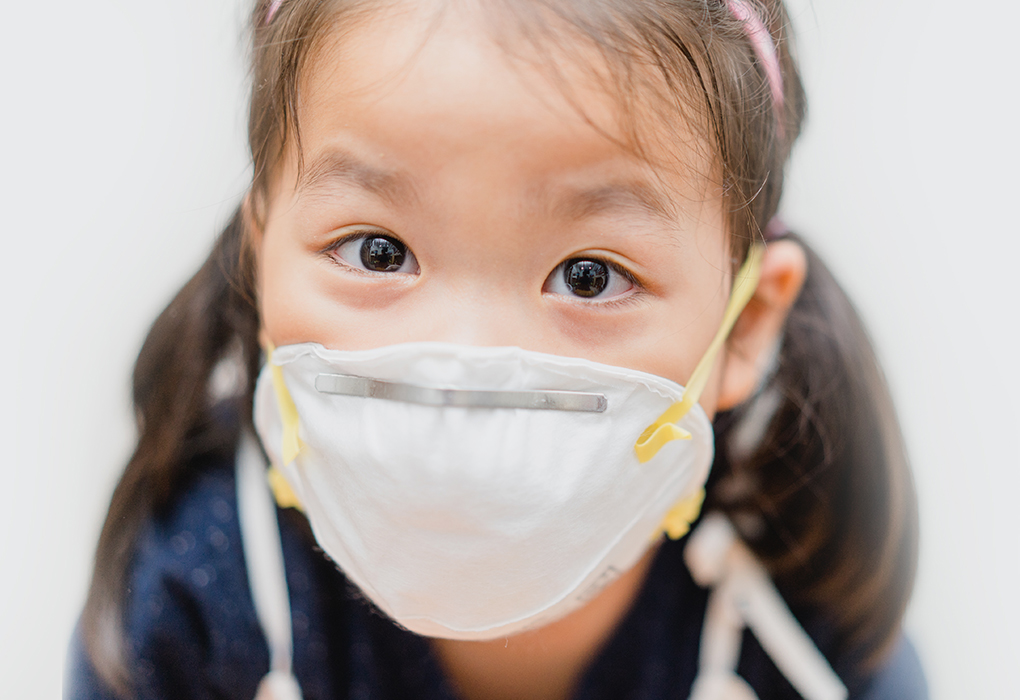
Harmful Effects of Air Pollution on Child's Health and Development
As the air quality is deteriorating day by day, it has become rather impossible to stay healthy and go without experiencing bouts of sickness for more than a couple of months. Air pollution is ruining our health, but its ill effects are more pronounced on children, as their lungs are still in a developing stage (as is their immunity). If you are a parent, among various concerns that you may have, one must be the effects of air pollution on your child’s health. We get your concern, and this is why we suggest that you read this article to understand how air pollution affects children and how you can do your best to raise your little one in a cleaner and safer environment.
Reasons Why Children are More Susceptible to the Effects of Air Pollution Than Adults
Kids are at a greater risk of developing health problems because of poor air quality. Here’s what you need to know so that you can find solutions to keep your child healthy and protected.
Children tend to breathe more rapidly, as compared to adults. This means that they can inhale or breathe in air pollutants at a faster rate than adults. These pollutants may stay in their lungs and affect not just their lung health but their overall health as well.
The lungs of a child are not well-formed at birth, and may not develop fully until he turns 6 years of age. Toddlers or kids living in polluted cities may inhale more environmental toxins and other air pollutants, which may get trapped in their lungs for a longer duration. This may affect their respiratory health and lead to other medical problems.
Another reason why children are more susceptible to developing health issues because of air pollution is that they are more exposed to toxic substances. Kids often spend time outdoors, playing and running around in playgrounds and parks, which might not always be well-maintained. The dirt and dust outside may expose them to toxic substances, thus affecting their health.
Which Air Pollutants Have Maximum Impact on Kids’ Health?
The air your child breathes in is not really conducive to his health, you already know that. But do you know the major air pollutants that impact your child’s health? Read on to find out!
1. Nitrogen Oxide
Nitrogen oxide affects lung function by causing inflammation and irritation. Long term exposure to nitrogen oxide is known to cause respiratory problems. It also affects the immune system, which may increase the occurrence of lung problems.
2. Carbon Monoxide
Carbon monoxide, when inhaled enters the bloodstream and mixes with the haemoglobin very quickly, and forms carboxyhaemoglobin. And carboxyhaemoglobin can be detrimental to a child’s health as it may restrict the flow of oxygen in his body.
3. Ozone
Ozone is a powerful oxidant which can affect the airways and trigger various health problems such as throat irritation, chest pain, coughing, etc. Short-term exposure to this pollutant may give rise to the problems related to the respiratory tract and eye health, and long-term exposure to it may permanently affect the proper functioning of the lungs.
4. Airborne Particles
Airborne particles comprise sulfates, aerosols, carbon, and nitrate. These particles may aggravate the respiratory ailments such as asthma in a child. They may also cause other respiratory problems and reduce the airflow to the lungs of the child.
5. Diesel Emission
The microscopic carbon chemicals present in diesel being very small can easily enter the lungs and may lead to nausea, dizziness, throat problems, eye irritation and other such conditions in children.
6. Sulphur Dioxide
Sulfur dioxide is a toxic gas produced from the burning of fossil fuels and smelting of mineral ores containing sulfur. This pollutant, when breathed in, may restrict the airways and irritate the throat and nose and cause coughing, wheezing, and breathing issues. However, a child exposed to sulfur dioxide will be most at the risk of developing health problems if he has asthma.
7. Lead
Lead is released in the air during the burning of coal, oil, or waste, and is regarded as a toxic air pollutant. Once it enters the body, it may affect almost all the organs as it is distributed by the blood throughout the body and accumulated in the bones. Depending on the level of exposure, it may affect a child’s nervous system and kidneys. Lead exposure, thus can result in kidney problems, cognitive development issues, impaired motor skills, and more.
How Does Air Pollution Affect a Child’s Health and Development?
The harmful air pollutants may affect your child’s health in more ways than you can imagine. If your child is constantly exposed to air pollutants, it may affect his health in the following ways:
Excessive air pollution can hamper the growth and development of a child. It may even affect the proper functioning of the lungs.
Being exposed to environmental toxins may cause infections or injuries in your child’s lungs, which may reduce the lung capacity. These adverse effects may not only be a childhood phenomenon and may affect your child’s health in adulthood too.
Being exposed to polluted air on a regular basis may aggravate health conditions such as cystic fibrosis or asthma in children.
The various air pollutants, besides affecting the respiratory system, affect the nervous system as well. Long-term exposure to air pollutants such as lead can stunt the cognitive development of a child.
Air pollution may impact the overall health of a child because medical conditions, food, water, air pollution, and other such problem-causing-factors are interlinked and together they may deteriorate the overall health of a child.
Ways to Lower the Impact of Air Pollution on a Child’s Health
Finding a one-stop solution to reduce air pollution is not possible, not now, at least. But you can find ways to protect your child from the harmful effects of air pollution. Here’s how you can help lower the impact of air pollution on your child’s health, and keep him safe and healthy.
Make sure that your child’s diet is wholesome and healthy, because a rich and nutritious diet can ensure good health and lower the risk of developing infections and severe health conditions.
Make it a point that your child engages in some kind of physical activity daily. Any form of physical activity will improve your child’s lung health and immune system, and help in maintaining a good cardiovascular system, which will give him the strength to combat health problems. And while he is at it, ensure that he is enjoying that activity in green or open spaces because exposure to fresh air will do good to his health.
If you feel like the air quality in your house is poor, use air purifiers so that the impurities and toxic elements present in the air are eliminated.
If your child falls sick constantly, consult a doctor and make sure he takes his medicines on time.
While taking your child outdoors, avoid peak hours as the air quality will be particularly poor during that time. The ideal time for outdoor play or park visits is early morning.
You can also do your bit to reduce the pollution by engaging in some healthy habits like carpooling, using public transport, cycling or walking to nearby places.
Air pollution is a major concern today and it is steadily worsening. You might not be able to tackle the problem entirely on your own but you can certainly take measures to protect your family from the harmful effects of air pollution. You could also do your bit and practice and educate others to collectively help fight air pollution! This way, you are ensuring that you’ve made a difference to your child’s future, and which parent doesn’t want that?
Also Read: Pollution Facts for Children
Read more

First-Aid for 10 Common Injuries for Kids
When growing up, kids are often running around and exploring the world in a carefree manner, making them prone to getting hurt. Knowing First Aid for children then becomes essential for every parent. It is inevitable that at some point you will encounter a situation where your child sustains a cut or a mild burn.
Video: First Aid for 6 Common Injuries in Kids
First Aid Tips For Kids
Children’s boundless curiosity and energy can sometimes lead to unexpected mishaps. Being prepared with the right first aid knowledge is crucial for ensuring their safety. In this article here are some first aid tips for kids.
1. Cuts and Scrapes
What to do right away: The first thing that needs to be done is to arrest the bleeding, which can be done by applying pressure to the cut area. Second, dab the wound with cotton dipped in warm water that is mixed with an antiseptic liquid, to sanitise the area and remove any dirt particles that might be lodged in the wound. Third, apply antiseptic cream and cover the wound with a loose bandage.
Follow-up care after first aid: Take your child to get his tetanus shots if he has not received one in the last ten years. Apply a fresh bandage every day until the wound heals.
2. Burns
What to do right away: Put your child’s hand immediately under some cool running water for approximately five minutes. There are two common mistakes made by people when treating a burn. First, avoid using ice on the affected area as it stops the blood circulation in the region, affecting the healing process. Second, avoid using grease, butter or other substances to cover the burn as it traps the heat and prevents proper healing.
Follow-up care after first aid: The experience can be painful, and the treatment is likely to cause a lot of discomfort. If the pain is too severe or unbearable, consult the doctor immediately. Do not self-medicate your child.
3. Bleeding Nose
What to do right away: Make your child sit with their back firmly against a chair. Gently pinch the soft tissue on either side of the nose bridge for about 5-10 minutes, and the bleeding should stop. If not, you can repeat the process until the bleeding stops. Two things must be avoided in such a scenario. First, avoid checking to see if the bleeding has stopped as that will only prolong the bleeding. Secondly, avoid tilting their head back as the blood could flow backwards and make them choke.
Follow-up care after first aid: Make sure your child does not pick or blow their nose for the next 24 hours.
4. Heat Stroke
What to do right away: The first thing that you need to do is find a way to lower your child’s body temperature. If you are at home, take him to the bathroom and make him take a bath in cold water. If cold water is unavailable, wrap ice in a cloth and apply it to the neck and armpits.
Follow-up care after first aid: There are instances where your child may not be able to handle the drop in temperature and start shivering. Make sure you keep them warm after the body temperature has dropped. If your child is still shivering, consult the doctor immediately.
5. Bee Sting
What to do right away: The first thing to do is remove the stinger. You could use your fingernails or bank debit or credit card to scrape it away gently. Note that using your fingers to pluck out the stinger would release more venom into your child’s bloodstream and hence is not advisable. After the stinger is removed,
Wash the affected area with soap and water.
Apply a cold compress.
Take an over-the-counter pain relievers like Paracetamol to help ease discomfort. Be sure to follow guidelines on Paracetamol for kids.
Follow-up care after first aid: Please go to a doctor if your child experiences rashes or fatigue as it could be an allergic reaction.
6. Head Injury
What to do right away: Check if your child is displaying any symptoms of severe head injury. This includes blurry vision, improper balance or memory loss. After this, look for any open wounds that may be present. If there are any, wash the area with some antiseptic liquid diluted with lukewarm water. If there is excess bleeding, apply pressure using a cloth for about ten minutes.
Follow-up care after first aid: Check if your child is displaying any symptoms of severe head injury every two hours. Take him to the doctor if he does. If he has received a deep cut, take him to the hospital for getting stitches or further care.
7. Fractures
What to do right away: In case of bleeding, use a cloth to apply pressure to the wounded area. First, make your child comfortable or let them lie down to avoid excessive movement. Second, fill ice cubes in a cloth bag and gently massage the affected area to relieve the pain. Lastly, take help of your neighbours, friends or your partner to take them to the doctor immediately. This is needed as your child must remain stationary, which can be challenging to do on the commute to the hospital.
Follow-up care after first aid: Only let them do the necessary physical activity to avoid any further damage to the bone.
8. Choking
What to do right away: Encourage your child to try to cough it out on their own. If he is unable to do it in the next three seconds, immediately perform the Heimlich manoeuvre. This is done by first placing yourself behind them. Second, wrap your arms around them in such a way that both your fists are below their navel with the thumb protruding slightly. Lastly, exert pressure in short bursts and do not stop until the food article that is lodged inside comes out. Also, see a Paediatrician as soon as possible.
Follow-up care after first aid: Educate your children on how to perform the Heimlich manoeuvre. It can even be performed alone by using the edge of a table or chair to apply pressure near the navel.
9. Epileptic Seizures
What to do right away: Gently ease your child onto the floor after clearing it of any objects so they can avoid injuring themselves. After this, you could put a folded towel or pillow under their heads.
Follow-up care after first aid: Once they recover, explain what happened to them in simple words. If the seizure lasts for more than five minutes, take them to a doctor immediately.
10. Poisoning by Bleach Consumption
What to do right away: First, using water, make sure your child cleans their mouth so that all remaining bleach is washed off. Second, change their clothes as the smell of the bleach may make them nauseous. Third, give them some milk to dilute the bleach. Lastly, avoid making them vomit as it could cause further damage to the food pipe.
Follow-up care after first aid: Take the bleach container with you to the hospital so that the doctors can get an idea if further treatment is required.
Now that you know some basic first aid for kids, you can feel prepared the next time there is a medical emergency. Presence of mind and a calm approach will not only ensure that your child receives adequate care, but will also him her deal with an injury without panicking.
Also Read: 10 Basic Life Skills for Children
Read more

Essential Diwali Safety Tips for Your Kids
Diwali is one of the most widely celebrated festivals of our nation. This festival of lights is full of vibrance and brings fun and togetherness. Diwali was an exciting time when we were kids, and it’s the same for our little ones, too! Sweets, new clothes, and delightful crackers make this festival worth waiting for throughout the year – but only if you stay safe!
On the flip side, Diwali is also the time when many accidents and injuries occur. Though it is a holiday for most people, fire brigades and hospitals are on constant alert on Diwali. A safe and happy Diwali doesn’t seem like a big deal, but every Diwali brings a fresh crop of cases involving burn injuries and freak accidents. Also, the ongoing pandemic calls for new measures to be taken by every family to ensure a safe Diwali. Here are some tips you can use to make Diwali a safe and memorable festival for you and your kids.
Safety Tips for Diwali Celebrations
The most common cause of accidents during Diwali is the mishandling of fireworks. Parents need to know the nuances of firework safety for children to have a happy and safe Diwali. For instance, you should know what type of fireworks are suitable for your child’s age. Never allow young children to handle fireworks without close adult supervision. Even the most innocent sparklers and flowerpots can cause serious injuries if basic safety measures are ignored. A fun-filled Diwali celebration boils down to a few simple ‘Dos and Dont’s. Here are some safe Diwali tips for you and your family.
Dos
Try to celebrate this Diwali at home by staying indoors to avoid exposing you or your family to the coronavirus.
Go for indoor activities, such as decorating the house, indoor games, movie nights, etc. to keep everyone entertained while indoors.
If you and your family can’t do without firecrackers, buy them only from a government licensed shop.
Always keep the fireworks in a closed safety box.
Store crackers away from sources of fire.
Keep crackers away from toddlers and babies.
Follow the instructions and the safety precautions written on the boxes.
Burst crackers only in open spaces, where you can maintain social distancing.
Wear a mask and a face shield to cover your eyes, mouth and nose.
Using a sanitiser might seem safe, but remember that alcohol is flammable, too. Special care must be taken when using it frequently, especially when you and your kids will be touching surfaces, firecrackers, etc.
While lighting ‘rockets’, ensure that they face upward and not an open window, door or road.
Light the crackers from an arm’s length distance and not any closer.
Discard the used crackers in a bucket of water.
Always keep buckets of water and blankets ready in case of an accident.
Keep a first aid kit handy when bursting firecrackers to treat minor injuries at home.
Always keep a fire extinguisher nearby to ensure safety during Diwali.
Make sure that kids are wearing appropriate footwear while lighting fireworks.
Park your vehicles in garages.
Make your kids wear lightweight and fitted cotton clothes while bursting crackers.
Consider eco-friendly alternatives to traditional firecrackers, such as noiseless fireworks or other non-polluting options.
Don’ts
Don’t burn fireworks and crackers in crowded places, narrow lanes, near sources of ignition or inside the house.
Avoid crowded places and large gatherings in order to maintain social distancing, too.
Hold the urge to shake hands and hug people while wishing them for the occasion.
Don’t let your kids burst crackers in your absence.
Don’t keep fireworks in pockets or bags.
Do not examine crackers that were lit but did not burst. Let them go and light a new one.
Don’t light crackers while holding them in your hands. Always keep a safe distance from the crackers while lighting them – exercise daredevilry in more secure and productive activities.
Avoid loose clothes as they can catch fire quickly. Do not wear clothes made of silk and synthetic material.
Do not keep lit diyas or candles near curtains or inflammable materials.
Do not light multiple firecrackers at once as it can lead to an accident.
Do not use matches or lighters to light up the crackers.
Do not experiment with firecrackers or make your own crackers.
Do not burst crackers on roads as it can cause accidents.
Do not give your younger children crackers that can explode, instead let them light sparklers and other gentler and safer fireworks.
Don’t be reckless with your mask and wear it all times.
Don’t stay outdoors for too long.
Do not burst firecrackers late at night, especially after the designated time restrictions in your area.
With a few extra safety tips for Diwali celebrations this year, you and your kids can still have a ball. You will have to look for ways to stay indoors or maintain social distancing this year, but it is possible to have as much fun. You can also consider going for an eco-friendly Diwali with no crackers, to teach your kids that the festive season can be fun and environment-friendly, too!
Also Read:
Diwali Craft Ideas for Kids
Diwali Activities and Games for Kids
Trending Styles to Dress Up Your Kid This Diwali
Read more
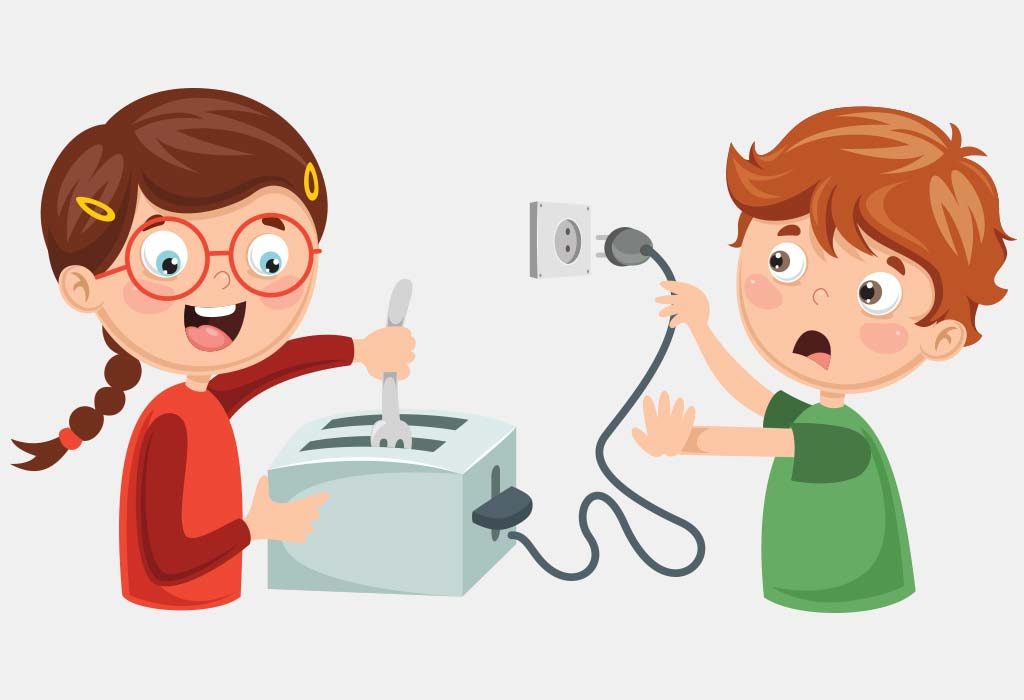
Electrical Safety for Kids – Keep Your Child Away from Shocks
Children’s curiosity is similar to a cat’s, but it can prove dangerous when it comes to electricity. From overheating gadgets to open switchboards that tempt kids to literally put in their fingers (don’t know what excites millions of children to do the same!), there lurk several electrical dangers that you need to protect them from. Since we can’t stop children from exploring their surroundings, we can, at least, baby-proof them so they stay away from hazards. Electrical safety for kids is as important as teaching them daily moral values. Teaching children about electricity and electrical power can keep them away from harm. In this article, we cover in depth how to keep your precious little one away from electrical hazards and allow them to be their creative best.
Dangers of Electricity for Children
Some of you might have come across a situation where you feel a shock when you touch the doorknob or another person. What you experienced was shock from static electricity. An actual electric shock is very painful and can even result in death.
Electricity can cause severe burn injuries, fatal shocks and even death.
The muscles in the body get tightened up, causing choking and making it difficult for the child to breathe.
It disrupts the heartbeat, which in turn constricts the blood vessels.
Electricity if not handled properly has the potential to cause severe internal damage many hours later after experiencing the shock.
All these seem scary, but they can be avoided with a little bit of knowledge and care.
Electricity Safety Tips for Kids
Human beings are a good conductor of electricity which is why electricity flows easily through our body. Our body is made up of 70% water and electricity is known to move quickly through the water. One more fact to remember is that electricity will always try to find the easiest path to the earth or ground. Look at the points below to keep your child safe.
At Home Safety
The home is the place where curiosity is at its peak for the children. Learn more about the electricity safety rules for kids when they are at home (1).
Never let them stick their fingers or any other object into the electrical outlets or allow them to light bulbs.
Baby-proof small appliances like toasters, even if they are not in use and switched off.
You should never use any electrical appliance near the sink, bathtub or any other sources of water.
Keep electrical cords away from sinks, bathtub or any other sources of water. Apart from causing shock they are a choking hazard for your child.
You should always dry your hands before you touch any electrical appliance or device, such as a light switch or toaster hair dryer.
Do not pull out the electrical plug out of the socket by pulling away its cord.
Keep your electrical appliances switched off and unplugged when you are cleaning an electrical appliance or when they are not in use.
Replace worn, torn or damaged cords immediately to prevent getting shocks.
Outdoor Safety
Outdoors are the best place for children to set on their exploration missions. Keep those busy hands safe from electrical shocks (2) (3).
Climbing trees are fine as long as they are not near power lines or they have power lines running above them. If your children love flying kites, make sure they are pretty much away from the power lines. In case the strings get entangled, the electricity from the power lines can run through the strings causing burn injuries or shocks.
Swimming should be avoided during electrical storms. Do not touch any electrical appliance if you are wet or in the swimming pool or standing in the puddle.
Do not remove anything entangled on the power line, instead call for help from the electrical board office.
Never touch wires that have broken and are lying on the ground. Maintain a safe distance from such live wires to prevent getting electrocuted.
Avoid going near electric substations and do not climb over the fence that surround the substations.
Do not throw objects like shoes or sneakers, or any other material on the electric power lines.
Do not hang any banners or signages on electric utility powerlines or poles. Never climb any utility pole or tower.
If you see anyone getting an electric shock, call for help immediately. Do not touch the person.
Other Electrical Safety Tips for Children
It only takes a small mistake to start an electric fire, but with these simple prevention tips, you can find effective solutions to this problem.
Keep clothes and other combustible items away from big electrical appliances.
Keep the power chords in good health. Replace them immediately if you notice any wear and tear.
If your child is playing with any electrical toy ensure that he is atleast 10 feet away from wet surface or water.
Never fly remote controlled airplanes or helicopters near overhead power grids or lines. Play with them only in the open spaces such as fields or parks.
How to Teach Kids About Electric Safety?
Your little explorer is ever too busy, so it is really not too early to teach them about electrical safety.
Set aside a family meeting time to start the discussion.
Use of activity sheets or books is a nice way to get them interested in the topic of electrical safety and help them learn about it. You can teach them using interactive videos as well.
To give them a hands-on lesson, buy an inexpensive chord and cut it into pieces to demonstrate what is inside the chord to build up their curiosity. Gradually you can let them know what is electricity and a circuit breaker.
Show them how the sockets are covered with plastic plugs for electrical plug safety.
Once you feel confident that they have learnt about the safe use of electricity, assess them by asking questions.
Use positive reinforcements to demonstrate the positive learning takeaway from the project.
First Aid for Electric Shock in Kids
In the unlikely event of experiencing an electric shock, follow the below-mentioned steps till help arrives, as mentioned by the American Academy of Pediatrics (4):
If possible, turn off the source of power; otherwise, remove it using a piece of cardboard, wood, or plastic.
Move the child as little as you can, as an electric shock might have caused a spinal fracture.
Begin CPR if you do not see any movement or feel any heartbeat in the child.
Meanwhile, get medical help by calling the emergency helpline number 911, your child’s paediatrician, or your local emergency number right away.
Try to prevent the child from becoming chilled.
Apply a bandage to cover any burned areas.
FAQs
1. How to child-proof your home to prevent electrical hazards?
To ensure electrical safety for children, here are some baby-proofing techniques:
Secure unused wall outlets. Plastic inserts for wall outlets can be inserted, but they can also be pulled out easily by kids. Look for non-choking safety outlets or plug covers that prevent foreign objects from being inserted or pulled out easily (5).
Block the outlets by creatively placing furniture in front of them.
Keep extension cords away from children’s reach, either using a hide-a-cord device or behind furniture.
Put bathroom and kitchen electrical appliances out of children’s reach in a cabinet with a safety lock (6).
Put electrical appliances like a DVD player out of children’s sight and reach.
2. How can damaged electrical cords harm a person?
Ungrounded or damaged cords can cause severe electrical hazards to anyone who uses them, as it could cause electrical shock and fire (7).
3. What can children do to help if they witness somebody being electrocuted?
If a child witnesses electrocution, they should be taught never to touch the person, the object that is causing the shock, or any nearby wires. They must stay away from the scene and call for help either by contacting locals or by dialling the emergency services number (8).
Remember to always use electric socket covers for child safety and child-safe electrical outlets when you have little children at home.
References/Resources:
1. Inside the Home; Energy Safe Kids; https://energysafekids.org/electric/students/be-safe-around-electricity/inside-my-home/#
2. Talk to Children about Electrical Safety; SafeElectricity.org; https://safeelectricity.org/public-education/tips/talk-children-electrical-safety/
3. 10 Electrical Safety Tips for Kids; San Patricio Electric Cooperative, Inc.; https://www.sanpatricioelectric.org/10-electrical-safety-tips-kids
4. Electric Shock Injuries in Children; American Academy of Pediatrics; https://www.healthychildren.org/English/health-issues/injuries-emergencies/Pages/Electric-Shock.aspx
5. Home Safety: Tips for Families With Young Children; American Academy of Pediatrics; https://www.healthychildren.org/English/safety-prevention/at-home/Pages/home-safety-heres-how.aspx
6. 5 Bathroom Safety Tips for Infants & Young Children; American Academy of Pediatrics; https://www.healthychildren.org/English/safety-prevention/at-home/Pages/Bathroom-Safety.aspx
7. Damaged Power Cords; Office of Congressional Workplace Rights; https://www.ocwr.gov/publications/fast-facts/damaged-power-cords-know-your-electrical-supply-cord/
8. Electric shock – low voltage current; St John Ambulance; https://www.sja.org.uk/get-advice/first-aid-advice/minor-illnesses-and-injuries/low-voltage-electrocution/
Also Read:
Fire Safety Tips for Kids
Internet Safety Tips for Kids
School Safety Rules for Children
Important Beach Safety Tips for Kids
Essential Safety Rules for Kids At Home
Important Road Safety Rules to Teach Your Children
Read more

Are Headphones Really Safe for Kids?
It is a part of keeping up with the trend these days for the kids. Gadgets have become a lifestyle statement. The more the exposure, the better the chances of adopting them and going with the flow. Headphones do look cool on your ears and if that is of a definite brand, then it is a style statement. At the same time, exposure to different media is triggering the need to have headphones for your kid. Be it music or movies, for your kids, grooving along the beats are fast becoming an integral part of life. But is it really safe? You have heard plenty regarding radiations and its adverse effects on hearing ability and brain. And as a result, you are hovering between to buy it or not to buy it for your kids.
Can Children Use Headphones?
As a parent, many prefer to keep their child engaged during a long flight or drive. What they don’t consider is the built of it. An adult headphone is not the ideal one for a kid. The ear canal of a kid is much narrower and loud music can trigger problems with hearing.
However, the negatives are not unavoidable. There are headphones specially designed for a kid. You can encourage them to listen to it by keeping the volume level within the prescribed range, that is mostly within the 60% of it. In addition, keep an eye on them just to make sure that they don’t listen to it for more than an hour at a stretch.
What are the Drawbacks of Using Headphones for Kids?
There are certain drawbacks of kids using headphones and as a parent, you should be aware of that before handing them over a cool pair.
Loud noise can adversely affect hearing.
Headphones can make your kid less cautious about his or her surrounding, which can cause harm.
It can trigger vertigo.
Sharing headphone may invite germs.
Do Kids Really Need Headphones?
There are some good sides of a headphone and they can really help your kid with his or her physical status.
Noise cancellation ability of headphones can really help your kids ears. Sometimes when you are on the street, continuous honking can affect your ears. Headphones can protect your kid from such noises.
Any day better than the in-ear audio pieces. In-ear audio pieces can directly affect the eardrum.
Headphones designed for kids has a volume control technology inbuilt, unlike earphones. Hence, a single tweak in that would help them manage the sound level.
How to Choose Safe Headphones for Your Child?
While choosing a headphone for your kid keep these points in mind.
1. Headphone Size
It should be perfect. Not too tight or loose and should sit comfortably on your kid’s head covering the ears.
2. Better be Durable
Kids tend to break things accidentally often. Hence, choose one that would last longer.
3. Look for Your Kid’s Needs
Dyslexic children or kids taking ototoxic medicines are prone to hearing impairment. You should look for headphones that can cancel out noises.
4. Noise Limiter
It is always safe to buy a headphone after going through its sound specifics. Look for the maximum noise limit and try to make sure that your kid does not get exposed to high level of sound.
5. Design
Kids look for something fancy. The headphone should be cool in design and colour-wise alluring. And if it helps, one-of-a-kind. Otherwise, your kid may soon lose his or her interest in it.
Precautions to Consider While Letting Kids Use Headphones
After all these, you should take certain precautions before letting your kid groove to the headphone’s beats.
If you can listen to the music from a meter away then its too loud. Check the volume level.
If you can preset the sound limit, opt for that and maintain the permissible level.
Ensure that your kid takes a listening break every hour.
Try to make them aware of the adverse effects it can have on their ears.
FAQs
Apart from these issues, there are certain things that you should remember while giving your kids a brand new headphone. These are questions we often tend to miss.
1. Headphones Vs Earphones Which are Good for My Child?
Headphones have this noise cancellation facility which is any day better than earphones. Earphones directly send the sound to eardrum which you should avoid at any cost. In addition, they tend to carry germs. These reasons give headphones advantage over earphones. Forget earbuds, headphones for kids are ideal.
2. Wireless or Wired Headphones Which Should I Buy for My Kid?
Wireless headphones are definitely preferable. You have to keep in mind that your kid is quite active and a wireless one can get tangled around his or her body. But wireless ones do possess quality issue if you place it far from the device. To go by recent trends, you can always opt for Bluetooth headphones that are quite effective.
3. Can Babies Wear Headphones?
Yes, they can wear headphones, provided you are taking all the precautions. There are specifically designed headphones for babies which you can use to give them the best-quality music while taking care of him or her.
As long as there are rules set on the use of headphones, the right kind of headphones can be safe for your kids. Just make sure that they aren’t blaring music away all day long to avoid damage to their ears. With babies, you’ll need to be more careful with the kind of earphones you use. Ensure that you don’t compromise on safety while giving your kids access to earphones.
Also Read:
Home Alone Safety Tips for Children
How to Ensure Kids are Safe on Swing
Effective Tips for Your Kids to Ride Safely
Read more
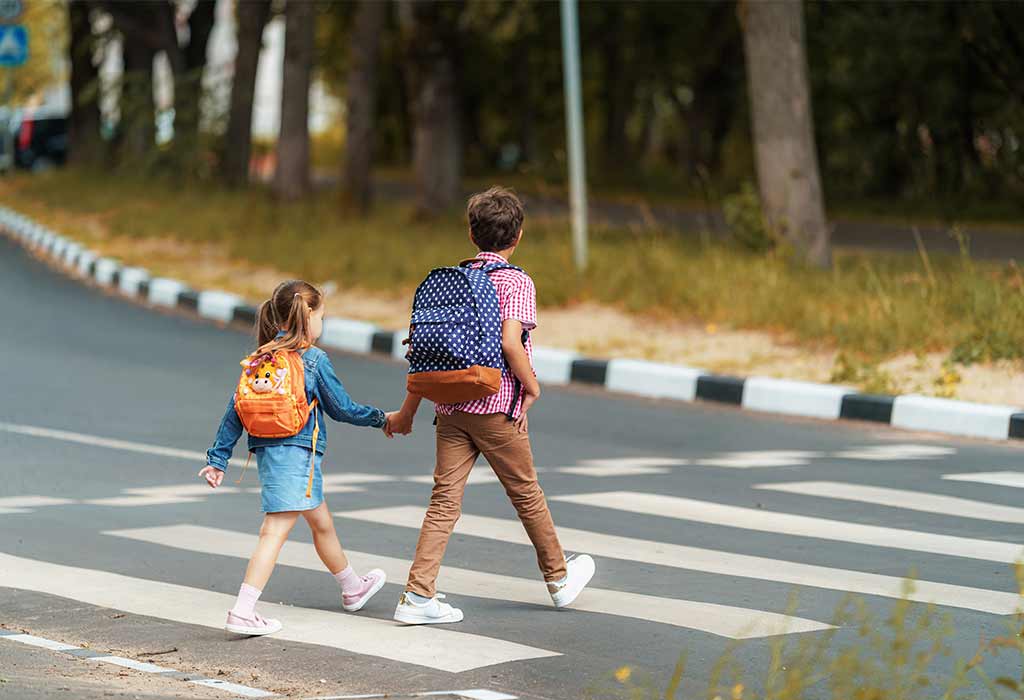
Safety Rules at School for Kids – Important Guidelines
In recent years, a disturbing surge in violence has permeated various aspects of our society, notably impacting the safety of educational institutions. The rise in gun violence globally has shattered the once-held belief in schools as sanctuaries for children. The safety issues in school premises arise from multifaceted situations, prompting a collective reevaluation of the system to enhance the protection of our children. The urgent need for proactive measures, such as improved safety rules at school classroom and mental health support, is underscored by these unsettling trends. Consequently, communities and policymakers alike are compelled to collaborate in crafting comprehensive strategies that prioritize the well-being of students.
Importance of Child Safety in School
Children are our world’s most precious gift. But as children, they may lack the skills to protect themselves. The responsibility falls on parents and schools to safeguard children and teach them these skills. It is even better to make the children aware of any situation that may be unsafe for them so that they can tackle such people or circumstances as soon as they encounter them.
A safe environment for children is also conducive to a better learning experience. Without the assurance of safety, students may be unable to focus on learning the skills necessary for a successful future. Even viewing violence while growing up can traumatise them and have detrimental effects on their health.
There was a time when violence in school would rarely top a tiff between two students that ended with adult intervention. But, the issue has escalated to such a dangerous level that in some parts of the world, school violence can be classified as an epidemic.
Tragic incidents like gun violence in schools seem to have several catalysts. So, the best way to prevent situations like this is to provide adequate support to children or people who may seem unstable. Protecting children shouldn’t occur simply as a matter of public policy. It can start from home by strengthening values and teaching them to trust their conscience. Safety in our schools is essential to support the academic and personal successes of each child in a nurturing environment.
15 Common Safety Rules at School for Your Children
Here are some safety rules for children to follow at school.
1. Help Your Child Memorise Contact Information
Ensure that young children know their full name, address, home phone number and how to use a phone. The school should have a record of emergency contact details that includes office phone, cell phone, home phone, etc. Make sure the child knows which adult to contact in case of an emergency.
2. Teach Them to be Alert and Vigilant
The child should know that he or she should not leave the school premises unattended. Children tend to lose their sense of space and time when they are playing and may easily get lost.
3. Always be Informed on Trips
In case the school is taking the children on a field trip, know where they’re going and who will be chaperoning the trip.
4. Use Indicators Instead of Names While Labeling
Be careful when writing names on a child’s possessions for identification. If confronted by an abductor, this may put them on a first-name basis with the child. Try to place a distinct label, like red stars or bright green stickers, instead of names
5. Memorize Routes and Landmarks
Show the child landmarks and safe areas between school and home, so that they have somewhere to run to in case of emergencies. Train the children to use the main roads and avoid shortcuts and isolated areas. In case they use the bus, make sure they know which one to use.
6. Awareness of Allergies
In case your child has any allergies, ensure that the school is aware of them.
7. Proper Emergency Procedure
See to it that the school has a proper plan in case of an emergency and that the children are properly trained. For example, every school should have a proper fire drill and emergency evacuation plan.
8. Be Hands-On
Don’t hesitate to get involved. With the help of other parents, organising things like neighbourhood watches can drastically reduce abductions and may even improve traffic safety. PTA meetings are a great time to address common issues that kids face. Any problems should be reported to teachers as they could aid in solving them, together with you.
9. Strangers Are a No-No
Teach children to be cautious of strangers. Teach them to walk away if any strangers approach them and ask for directions or offer them food. Kids should learn to trust their gut instinct and try to have drills or practices which would help them identify potential danger.
10. Keep Dangerous Items Out of Reach
Playing or experimenting with fire and sharp objects should be strictly forbidden be it at home, or in school. Children have to be made aware from day one that bringing weapons to school is a serious violation of safety.
11. Always Have a Point of Contact
Children should be encouraged to always check with their parents or a trusted adult for any issues that may come up. Several times, children are approached by strangers claiming that something has happened to their mother or father. Such predators thrive on the naivety of young kids. Make sure they know that if they are ever in a situation like that, they should first approach a teacher to tell them what happened.
12. Be the First to be Informed
If your child has any change of plans, make sure they know how to contact you. In case they decide to go to the park with a friend or to another friend’s house, make sure an adult you know will be present to supervise.
13. Don’t Tolerate Bullying
Teach children from a young age that bullying is an intolerable offence. To protect themselves, they need to know not to bully their peers.
14. Teach Them to Avoid Unknown Places
Children might start walking an empty street all by themselves or explore an unknown area near the school when their parents are running late to pick them up. To ensure they are safe while they are waiting for you, have a teacher or someone trustworthy from the school staff keep a watch on your child. It is always a better idea for your child to stay on the school premises until you reach.
15. Encourage Them to Trust Their Instincts
Children often struggle with trusting their instincts. Encourage them to listen to the little voice in their heads to avoid walking into a risky situation and stay safe.
FAQs
1. What happens when safety rules are violated at school?
When safety rules are violated at school, consequences typically include disciplinary actions such as warnings, suspensions, or expulsions, depending on the severity of the violation and school policies.
2. How can parents contribute to ensuring their children’s safety at school?
Parents can contribute to ensuring their children’s safety at school by fostering open communication with their children about their experiences, teaching them about personal safety, staying involved in school activities, attending parent-teacher meetings, and advocating for improved safety measures if necessary.
3. How can teachers establish a secure school environment?
Teachers can establish a secure school environment by implementing clear and consistent classroom rules, promoting respectful behavior among students, addressing bullying and conflicts promptly, conducting safety drills regularly, collaborating with colleagues and administrators on safety protocols, and fostering a supportive and inclusive classroom culture.
Keeping children safe is no easy task. It is a hard truth for parents to accept that they cannot always be around to protect their children. But knowing that they are following these rules means parents can rest easier. As your child grows, it is important for them to independently understand what situations may be dangerous. But until then, follow these rules and rest easy knowing your child is safe at school and is enjoying the learning process.
Also Read:
Life Skills for Children
Good Habits Parents Should Teach Kids
Ways to Help Your Child Succeed in School
Educating a Child About Good Touch and Bad Touch
Read more
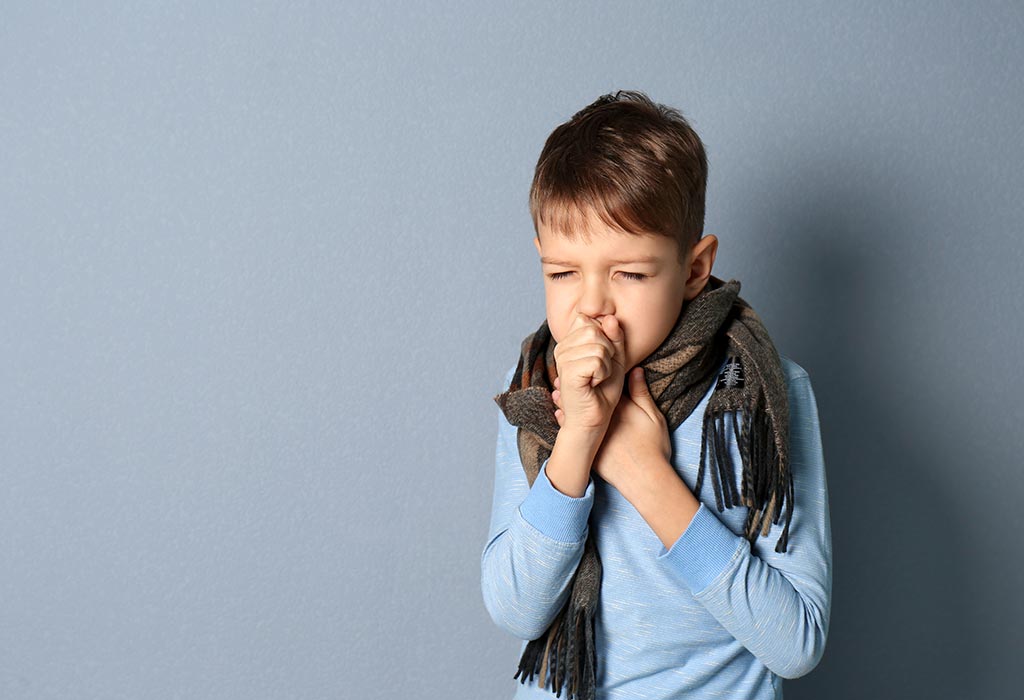
Chest Infection in Children – Reasons & Treatment
Infections are common in children, and you are sure to come across them as parents. Your child will definitely get some sort of infection at some point.
Chest infections are common in children and can be easily observed as it has many symptoms. They usually develop from a common cold or flu and can become serious if left untreated. In some cases, they can even develop into life-threatening diseases. So in this article, let us take a look at what chest infections are and how they can be diagnosed and treated.
Video: Chest Infection in Children – Causes, Symptoms & Remedies
What Is Chest Infection?
Chest infections can be classified into two types; bronchitis and pneumonia. Both are common in children, as the immune system is still developing and they are more susceptible to infections at a young age. The chest infection usually starts out as a fever or a cold, but quickly develops if it is not kept under control. The difference between the two types is that the former is caused due to a virus, but bacteria are the cause of the latter. Pneumonia affects the sacs of air in the lungs, while bronchitis results in the inflammation of the mucous membrane present in the body. Both of these can lead to bouts of spasms, restricted breathing and cough in babies.
Causes of Chest Infection in Children
A chest infection can occur as a result of many factors, which may even work in tandem in some cases. These factors are:
Changes in the weather. If the temperature around the child fluctuates extremely, it can result in the baby contracting chest infections. Heatwaves and cool winters can both cause chest infections, which is why they are more common during the monsoon season in India.
The strength of immunity. As the baby grows up, his immune system is still only developing- it is nowhere near its full strength. Therefore, it is easy for bacteria and viruses to infect the child and cause chest infections.
Bronchitis may be contracted if the child is exposed to smoke, particularly cigarette smoke, often. Pollution levels of the air around him have a telling effect on his health and can result in chest infections which stay for longer than usual.
In some cases, you might observe that your child gets infected around the same time every year. This usually means that he is allergic to something that is seasonal, like pollen of flowers. Therefore, the baby might contract chest infections due to his allergies.
Common cold. This occurs in the majority of children- a common cold develops into chest infections after some time. This happens because the cold leaves the body more vulnerable to attacks, as the immune system is weakened. Asthma also gets worse if the child contracts the cold.
Symptoms of Chest Infection in Kids
There are a few symptoms of chest infections in kids, and they are quite obvious if the child is affected by it. These symptoms are:
Cough and fever which stays for a long time
Difficulty in breathing, accompanied by wheezing
Sleep interruptions
The rise in heartbeat rates
General loss of appetite, which may be accompanied by vomiting and nausea
Chest pain, which may also affect the abdomen
Side-Effects or Complications of Chest Infection
While chest infections themselves are nothing serious, parents will find themselves worrying about the health of their child and whether the condition will develop into something more serious. Bronchitis itself is not a serious condition- however, asthma and wheezing are. Pneumonia affects the child in some rare cases and will require medical attention. If your baby already has lung or heart conditions, it might be more difficult for him to get through bronchitis quickly.
How Can Chest Infection be Treated?
The treatment for chest infection in children is fairly simple, and your child will most likely require within a short period of care. However, you should be wary so as to not let it fester into something more serious. You can follow home remedies and treatments and wait for your child to recover within a couple of weeks at most. The methods of treating chest infections are given below.
Give your child a nutritious diet of cereals, pulses, fruits, vegetables, honey, tulsi, ginger and warm liquids like soups, turmeric milk, so that his body gets the required strength to fight off the infection. It is also sure to help reduce the temperature of the body.
Medicines like paracetamol or ibuprofen in small doses can help reduce the fever and reduce the congestion in the chest. This can improve his breathing, too- although, make sure not to increase the dosage.
Using saline nasal drops, you can clear the stuffy nose and improve his breathing quickly. Also, always eat in an upright position so as to clear the nose.
Steam inhalation is another great way to reduce the stuffiness of the nose, and you can apply a bit of vapour rub on the inhaler for best results.
How to Prevent Chest Infection in a Child
Recurrent chest infection in children is a serious problem, so you must do all you can to prevent chest infection in toddlers. Some tips to prevent it are given below.
You should maintain hygiene in and around the house so that the child does not come in contact with harmful bacteria as much as possible. Also, try to keep your child away from polluted air as much as possible.
Discard off the napkins and tissues which you used while the child was infected, so as to prevent a recurrence.
Vaccination against flu can help reduce any secondary infections.
Keep your child away from anything that may cause the infection- this includes cigarette smoke and infected family members if any.
When to Consult a Doctor
If the symptoms of the condition do not improve even after prolonged care, it would be best to consult the doctor. If he has difficulty in breathing, feels disoriented or coughs up blood-stained phlegm, it is a sign that he needs the care of a medical professional.
Chest infections are commonly treated right from home, as they usually subside after a couple of weeks. However, you have to consult the doctor if the symptoms do not go away even after prolonged care.
Also Read:
Ear Infection in kids
Viral Infection in Children
Read more
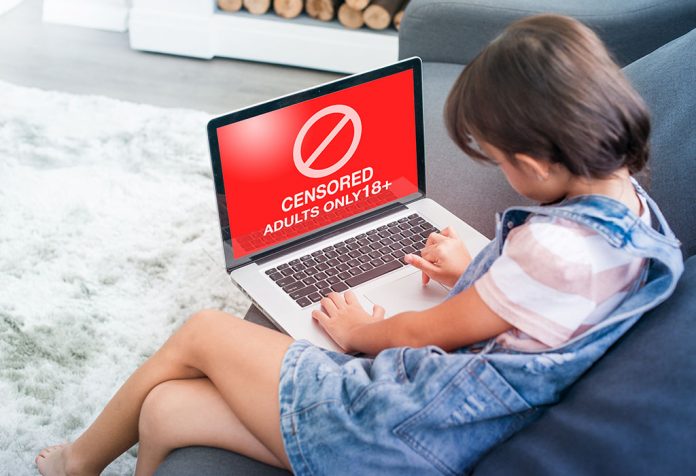
Internet Safety for Kids – Important Tips to Keep Your Child Safe
This is the digital age, where information is at everybody’s fingertips. Even young children these days have access to the internet via smartphones and tablets. They need to be made aware of the dangers of the internet and taught how to protect themselves from various online threats.
The internet is used by children as young as 5-year-olds these days. Kids go online to play games, watch movies or cartoons, interact with their peers on social media, and do research for homework assignments or school projects. However, they may not be aware of the various dangers of the internet. Children have to be educated about online threats and internet safety. Speaking openly with them is very important. In this article, we will talk about essential internet safety tips for kids every parent should know to protect their child.
Importance of Internet Safety for Children
Children are very thrilled about going online to browse shopping sites, use social media, watch movies or do research for educational purposes. However, simple mistakes online can have dangerous repercussions.
Certain search terms may lead to explicit content, and children could get duped by online marketing or phishing scams. Kids may become victims of cyberbullies, identity thieves, paedophiles or even kidnappers. One wrong click on a pop-up could cause malware to download onto the device. It is, thus, very important to teach your kids about internet safety and ensure that their time online is supervised by an adult.
Internet Safety Tips for Children
Ensuring internet safety for kids is crucial in today’s tech-driven world. Parents can make sure their children are safe while browsing online using the following tips:
1. Do Not Allow Kids to Browse Alone
Set a rule that the child should use the electronic device for browsing in the living room or in the presence of an adult. This way, the adults can ensure that the child does not view unsuitable content online, and also supervise the child’s online activities (1).
2. Teach Kids About Protecting Their Privacy
Teach your kids never to share personal information such as address, phone numbers, names, personal email addresses, siblings’ details, parents’ work details, etc. without the permission of parents (2).
3. Never Agree to Meet Online Friends
Teach the kids that the internet provides anonymity, and their online friends may not really be who they say they are. It is dangerous to go meet online friends as they could turn out to be paedophiles or kidnappers. Keep track of your kids’ online friends and report suspicious activities or people online to your local cyber-crime department.
4. Instruct Your Child Never to Click on Pop-ups or Subscribe to E-Newsletters
Clicking on pop-ups or ads could result in malware or viruses being downloaded into the device. They could also be an online scam to gather the user’s personal details. E-newsletters demand too many personal details, and it is unsafe for children to give out such details online. Teach your kids to avoid clicking on suspicious email attachments, pop-ups, ads and e-newsletters.
5. Use a Strong Password
Teach the kids the importance of using strong passwords online and why they should never disclose passwords to anyone. Passwords are tougher to crack if they are at least eight characters long, contain at least one number, one special character, one lower-case letter and one upper-case letter.
6. Set a Time Rule
Set a specific time limit for the online activities of your children. Whether it is for entertainment purposes or educational reasons, it is better to limit kids’ time online. Discuss this with your children and agree on a set time limit per day.
7. Monitor What Your Kids Post Online
Teach your children that once something is on the internet, it can never be deleted. Therefore, they should be very careful about what they post online. For example, teenagers may post pictures of themselves online or comment on social media. Make sure you monitor this and if you think a picture or post is inappropriate, ensure that it is taken down or never posted in the first place. Being open with your children and explaining your reasons will avoid conflict and make sure your children are cooperative (3).
8. Use Reliable Security Software
Make sure you install reliable security software on your device to prevent viruses, malware or spyware and ensure that you have firewalls turned on to prevent pop-ups and hackers. There are also several online protection tools that help you control your kids’ access to inappropriate content. Use these tools to ensure your child’s safety (4).
9. Do Not Allow Kids to Shop Online Unsupervised
Children should never be allowed to shop online unsupervised. They could enter credit card details on an unsecured website, causing vital financial data to fall into the hand of cybercriminals.
10. Privacy Settings
Teach your kids about the importance of using privacy settings on social media such as Facebook or Instagram. Also, teach them never to click on suspicious links and to always log out before going offline.
Word of Caution
Cyber safety for kids is of paramount importance. You need to set kids’ rules for online safety. Make sure your children do not interact with unknown people on social media or on online forums or chat rooms. These are places that child predators and cyberbullies frequent. Paedophiles often pose as children on social media and in chat rooms and encourage children to call or come and meet them. Make sure you warn your kids of such dangers and teach them never to call strangers or agree to meet anyone in person.
Invest in good online protection tools to track your children’s online activities and eliminate online threats. Internet security for kids is worth the investment. For younger children, encourage them to use child-friendly options such as Kiddle instead of Google search or YouTube Kids instead of regular YouTube.
Talk openly with your teenagers about the various online threats and tell them that you will be monitoring their activities in order to ensure their safety. Teach teenagers the dangers of posting their exact location online. Warn them about the dangers of unwelcome contacts online. This includes stalking, bullying, harassment, and grooming (making online friends for purposes of later sexual contact). Encourage teenagers to approach you if they encounter something online that makes them uncomfortable. Limit the time children spend online and prompt them to spend more time in the real world.
FAQs
1. How can schools contribute to internet safety for kids?
Schools can play a vital role by incorporating internet safety lessons into the curriculum and promoting safe online practices. Partnering with parents to reinforce these teachings at home can create a well-rounded process for online safety.
2. What is the best way to introduce social media to kids?
Start by ensuring your child meets the age requirement for the platform and explain the importance of privacy settings and respectful communication. Monitor their activity, educate them about the risks of oversharing, and discuss how to respond to inappropriate interactions.
Although the internet is a plethora of information and entertainment, there are very real dangers lurking there. Internet protection for kids is imperative these days. There have been several incidents where a lack of online safety led to situations where children were in serious danger. Open communication is the key to online safety, especially with teenagers who are secretive and value privacy. Young children should have limited access to the internet and should always be supervised. Children should take advantage of the abundant information the internet offers without exposing themselves to danger. Parents can ensure this by being aware of their kids’ online activities and educating them about the dangers of the internet.
References/Resources:
1. Online Safety; Nemours KidsHealth; https://kidshealth.org/en/parents/net-safety.html
2. Teaching kids about Internet safety; GCFGlobal; https://edu.gcfglobal.org/en/internetsafetyforkids/teaching-kids-about-internet-safety/1/
3. Keeping Children Safe Online; CISA; https://www.cisa.gov/news-events/news/keeping-children-safe-online
4. How to keep your child safe online; UNICEF Parenting; https://www.unicef.org/parenting/child-care/keep-your-child-safe-online
Also Read:
School Safety Rules
Road Safety and Traffic Rules
Top Safety Rules for Kids at Home
Educating Safe Vs Unsafe Touch
Important Beach Safety Tips for Kids
Fire Safety Rules for Kids That You Must Teach Them
Read more

How to Keep Your Bathroom Safe for Your Child
For children, bathrooms are meant to be fun places to enjoy a bath. Unfortunately, it has been estimated that 90 children die every year due to bathroom hazards like drowning in the bathtub- just 3 inches extra of water is enough to submerge a child. Parents sometimes are busy doing other chores or just fail to notice before it’s too late. Therefore, let’s talk about the bathroom safety of your child.
Bathroom Safety Tips for Your Child’s Protection
The following safety tips and precautions can keep your child protected in the bathroom:
1. Never Leave Your Child Alone in the Bathtub
The running water can make the tub overflow, thus seriously harming your child. Instead of letting your attention drift away, make sure you never leave your child alone in the bathroom, especially if he knows how to work the faucets.
2. Install Scald-Guards In Faucets
Death by scalding is another possibility besides drowning. To make sure the water temperature isn’t too high, don’t crank the geyser beyond 120 degree F. Additionally, install scald-guards in faucets since these monitor the temperature of the water and let you know if it’s too hot for your child.
3. Say Yes to Showers
If you’re unsure that your child is ready for the bathtub yet, try showering instead. There’s no drowning, everybody gets cleaned up, and it’s a win-win for both.
4. Drain Out Excess Water
You might have mastered the art of bathing your kids in the bathtub, but the floor isn’t as friendly once you’re done bathing your child, especially if he enjoys splashing around. Puddles of water on the floor lead to slips, falls and unexpected accidents. Make sure to mop out any remaining water and dry the floor before he gets out of the tub.
5. Use A Baby Gate
Children like to do things when adults aren’t watching, like going to the bathroom to do some splashing. Installing baby gates near toilet doors as bathroom safety are thus good for your child. That way, he can’t enter, which means less worrying for you.
6. Use Cushioned Covers on Faucets
Steel water faucets are dangerous as they have sharp edges. There’s also a risk of your baby bumping and hitting his head on hard surfaces. Cushioned covers absorb the shock and minimise injury in the bathtub.
7. Seal the Toilet Lids Shut
Babies and toddlers may slip and fall through the toilet lid while prancing around. Use a toilet lid lock or device to seal it during times you leave your child unattended.
8. Invest in High-Rise Shelves and Cabinets
Your shampoos and razor blades are like treasure hunting moments for your child. Looking at the beautiful pictures and sleek designs, he may be tempted to give those a try, or drink your cleaning products out of curiosity. You don’t want that, and the best way to prevent it is by keeping them tucked away from his reach on high wall shelves and cabinets.
9. Unplug the Electronics
Most of us have curling irons and blow dryers in our bathrooms. When you leave them plugged in and turn away for a moment, your child falls at risk of being severely injured by them. The solution is to unplug and turn off these devices whenever you’re with your child in the bathroom.
10. Pay Attention at All Times
Prevention is better than cure, and the best way to pay heed to this is by constantly keeping a watch. Make sure there are no choking hazards in the bathtub, and teach your child against gulping soapy water when bathing.
Additional Bath Time Safety Tips for Infants and Kids
For your child’s benefit, here are some additional bath time safety tips:
Keep cosmetics, soaps, shampoos, and medicines out of reach. Install safety locks in cabinets as extra measures.
Ask an electrician to set up ground-fault circuit interrupters for shutting down electrical appliances in an instant when they fall into the bathtub, in order to prevent injuries.
Don’t keep the water level beyond 2 to 3 inches for babies and young toddlers in the tub.
Use a kitchen sink to bathe your infant instead of a bathtub for additional safety.
Hold your baby and provide physical support while bathing to prevent slips/falls.
Baby proof the floor and cabinets, always.
Do not ever leave your baby alone in the bathroom.
Set up the bathroom doors in a way they can be unlocked from outside in case your child locks himself in.
How to Prevent Your Child from Drowning in the Bathtub?
Never leave your child beyond your arm’s reach before, during, and after bathing as a rule of thumb. Also, never leave them alone while bathing.
Following these suggestion will help keep your child safe. As a parent, remember to watch him like a hawk during bath times since anything could go wrong in an instant.
Also Read: Safety Rules at School for Young Kids
Read more

Remedies to Heal Your Child's Summertime Cuts, Bruises and Bites
Come summers and we’re sure your little one is all excited to spend time playing with his friends and relishing the holidays! While your child’s going to have the time of his life, it also means that he’s going to come back home with plenty of cuts, mosquito bites, and bruises to show for it. So it’s imperative that you ensure that none of these wounds dampen his spirit and that they’re fixed right away. And we’re here to help you figure out just how you can do that!
Effective Remedies for Your Child’s Summertime Woes
There’s no doubt about it – your kid is going to fall, get hurt, and come home crying with a bruise or a cut at some point! After all, that’s a bit part and parcel of childhood, right? Summers bring with them plenty of different ailments and problems which can afflict your child, but these few mentioned below, in particular, could be the main sources of trouble he’ll have to deal with constantly. Don’t worry though – there are simple, yet effective remedies that can help ease your child’s woes quickly!
1. Cuts and Bruises
Climbing trees, running around and on different surfaces, falling down – there will no dearth of cuts and bruises (and resulting scars) on your little one’s body. It’s important that they’re treated immediately and with great care because leaving cuts exposed in particular make them prone to infections. You don’t want your child ending up sick just because you didn’t pay attention to his wounds, do you? Of course, you don’t! While severe or deep cuts will require medical attention and probably need a few stitches, you can take care of smaller cuts and bruises at home itself.
Remedies to Try
Turmeric is the first thing that comes to mind when we think of something accessible to heal wounds! Apply a little turmeric to bleeding wounds to let the blood clot quickly. You can also apply medical-grade honey or crushed garlic cloves to the wound to help it heal. Tea tree oil is also recommended for healing cuts – for this, you can liberally spray on Aringel After Bite, a herbal spray with tea tree oil as its main component. It will help soothe your child’s pain and irritation and also help prevent infection!
2. Sunburn
The summer heat can be pretty cruel and you might see your child’s skin take on a whole new tone when he’s back home after a day of play! Red and itchy skin will give away that your child has suffered from sunburn. If it’s a more severe case of sunburn, you’ll see painful blisters on your child’s skin. Over-exposure to the sun’s rays can be harmful so it’s important that your child is covered from head to toe in sunscreen before he steps out. Even so, there’s a chance that he may still experience a sunburn for which you can try the following remedies.
Remedies to Try
Start off with cold compresses or a cool bath to provide his skin with some relief. You can use aloe vera gel, touted as one of the best remedies for sunburn. Simply keep the gel chilled, then apply on the affected areas every few hours so that your child feels soothed. Drinking enough water is also important so that your child doesn’t feel dehydrated at any point. The next time he’s out in the sun, make sure to slather on the sunscreen, to make him wear protective clothing with enough coverage and that he stays in the shade!
3. Heat Rash
Blocked sweat ducts due to hot and humid weather can lead to red bumps cropping over your little one’s body. You’re most likely to notice these bumps or rashes on your child’s neck, the creases of his elbows and knees, his inner thighs and armpits. No doubt, this can look and feel super uncomfortable, but the condition will clear up in a couple of days with proper care. But if you think that the rash might be infected or that it isn’t healing quickly enough, it would be best to take your child to the doctor.
Remedies to Try
You can depend on cold compresses, ice packs, and cool baths to relieve your child of those irritating bumps on his body. Keep him cool by seating him under the fan or in an air-conditioned room. An oatmeal bath is another way your child can experience relief – add a cup or two of oats to lukewarm water and let your child soak in this water for about 20 minutes. And of course, there’s always the almighty aloe vera gel to the rescue!
4. Mosquito Bites
Out comes the sun and out comes the bugs, are we right? Mosquitoes especially swarm around day in and day out, aiming to cause trouble. They might be small but they can cause pretty massive damage, and you don’t want your child to be at the receiving end of it! Prevention is always better than cure; so before your little one steps out to play, make sure he’s wearing clothes that offer ample coverage. You can also stick on an Aringel Mosquito Repellent Patch under his collar – it will help create an anti-mosquito shield around your child and let him play to his heart’s fancy!
Remedies to Try
If your child does get bitten by mosquitoes, there are different home remedies you can try to relieve him of irritation. First off, it’s essential that he doesn’t scratch these bites; it’s just going to worsen the irritation. Use cold compresses, medical-grade honey, aloe vera gel (of course!), or minced garlic mixed with coconut oil (apply the mixture on the affected area, then wipe it off after 10 minutes). But if your child isn’t planning to stop his fun and games over a few bites, it’s best to spray on Aringel After Bite Spray. Not only will it provide him instant relief from the itchiness and prevent allergic reactions to these bites, thanks to its herbal formulation, it’s also not going to get in the way of his fun!
5. Shoe Bites
Shoe bites are common when kids wear ill-fitting shoes; when the back of the shoe rubs against the skin on the back of their foot while they hop, skip, and jump around, the result can be a nasty shoe bite. When left untreated, they’ll form blisters, and the skin of the feet can come peeling off. Ugh! We know you wouldn’t want your kid to go through all that trouble! Ensure that you purchase shoes which fit his feet perfectly; the extra time you take to shop may seem cumbersome but at least your child’s feet won’t suffer!
Remedies to Try
When a shoe bite strikes, there are different things you can do to take good care of your child’s feet. Apply crushed ice or crush an aspirin tablet, mix it with water, and apply the paste to the affected area. Aloe vera gel, petroleum jelly and coconut oil are other things you can try to soothe the blisters. Similarly, spraying on Aringel After Bite Spray on the wound. Its antiseptic properties make it safe for use on wounds, cuts, and burns, and also, will allow the shoe bite to heal quickly and let your child get back to his activities.
Summertime means plenty of fun in the sun, at the beach, at summer camps, and just about anywhere outdoors for kids. At no point should your little one be inhibited by these concerns. So, take precautions to keep your child safe from summertime wounds – proper clothes and shoes, mosquito repellent creams and patches, plenty of water, and loads of sunscreen. His holidays are meant to be fun and fulfilling and that’s all they need to be, provided that he gets all the care he needs!
Also Read:
How To Treat Burns In Children
Types Of Chest Pain In Kids & How To Deal With It
Ways To Prevent Different types Of Head Injuries In Children
Read more
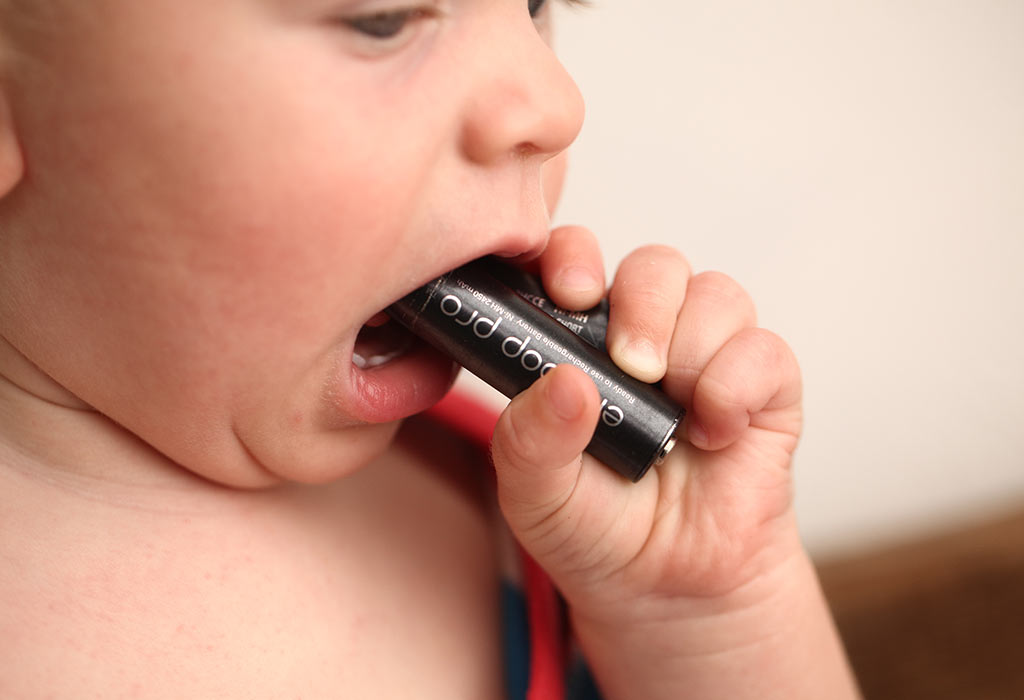
Baby Chewed or Swallowed Battery? – What You Can Do
Children who are in the teething phase are curious creatures who cannot differentiate between right and wrong, toxic and non-toxic. With that said, chewing on a battery accidentally can have hazardous or life-threatening implications. Here’s what you need to know about what to do if your kid ends up chewing or swallowing a battery.
How Dangerous is Chewing or Swallowing Batteries for Your Baby?
Chewing or swallowing a battery is extremely dangerous! Here are some of the possible implications your baby may face if she does that-
1. Internal Bleeding
Batteries contain chemicals like zinc, mercury and lithium which are harmful to the human body when ingested. These may cause internal bleeding and damage the organs.
2. Ruptures the Food Pipe
If the battery gets stuck in the food pipe when swallowed up, the pressure exerted leads to damage or rupture of the food pipe.
Why Do Children Chew or Swallow on Batteries?
Children chew on or swallow batteries because it’s human nature. Children are curious by nature. They’re at an age where they can’t label their surroundings or understand the differences between what’s toxic or non-toxic. A piece of glass, metal, plastic, or food lying around – all these look the same to them. And when they are in the teething phase, the urge to chew becomes simply irresistible.
How to know if your child swallowed a battery? Just read our list of signs and symptoms below.
How to Tell If Your Baby Has Ingested a Battery?
If your baby has swallowed a battery, these are the symptoms and signs you need to watch out for:
Pain in the abdomen
Vomiting
Gagging
Drooling often and frequently
Stools that look dark and bloody
Difficulty breathing
Choking
Sore throat
Fever
What Can Parents Do If Their Baby Has Swallowed a Battery?
If your baby has swallowed a battery, here’s what you can do.
Give her honey. The nutrients in honey have the ability to neutralize the effects of harsh chemicals leaked out by the batteries. Honey works as a protective barrier and may neutralize the damage caused to your child’s internal organs. If she has swallowed a battery, you can feed her a spoonful of honey every five to ten minutes. Keep doing this until you get her to the hospital for emergency medical attention.
If your child has swallowed a battery, remember that you have just two hours to act before the chemicals in them cause serious damage. Take her to the hospital immediately and don’t delay.
If you’ve got any batteries lying around the house, keep them away somewhere, preferably where your child cannot reach them. If there any toys that use batteries, remove those from them.
Discard any old batteries from your home. Those are just as dangerous as the new ones and lithium battery child death does happen.
Diagnosis and Treatment
Here’s what you need to do if your child has swallowed a watch battery or any other kind.
1. Take Her to the Hospital
Don’t delay it because, like we mentioned before, you have a two-hour window before things turn worse.
2. Get an X-ray Done
A chest and abdominal X-ray are most preferred. This will reveal whether the battery is lodged somewhere and let you know the extent of the damage.
3. Your Child May be Hospitalized for a While
If the damage is already underway, doctors may advise hospitalizing your child for at least two to three days. This will be the time needed for treatment to prevent further perforation or rupture to the organs from those chemicals.
4. For Cases of Lodging
If the battery is stuck in your child’s food pipe, then doctors will try to surgically remove it via instrumentation endoscopy. In this case, your child will be administered anaesthesia and taken to the operating room.
5. Oral Medications
Your child will also be given oral medications to clear up the lining and the dosage/type will depend on the doctor’s advice or prescription.
Other Important Tips and Guidelines
Here are some important tips and guidelines with regard to safety, prevention, and other aspects.
The battery has to be removed as soon as it is ingested. The size of the battery and the symptoms your baby shows aren’t reliable indicators for making out where it’s lodged. That’s why immediate medical attention and imaging are needed.
If your child is under 12 years old, seek immediate medical treatment. This is because her organs are developing and still very sensitive to the chemicals in these batteries. That also means she’s way more susceptible to damage from the electrochemical composition of these batteries.
When buying toys, check if the battery compartment is required to be opened using a screwdriver. If the compartment is loose or can be easily removed with fingers, it’s not a toy worth buying for your child.
The best step towards prevention is to remove all batteries from your child’s reach. Don’t keep any batteries in the house or in places where your child can access them.
If you have to keep batteries in the house, lock them away in shelves or cabinets which are at a height.
If you don’t have honey lying in the house for feeding to your kid after she has ingested a button battery, try using lemon juice. It has alkalizing properties and works just as well.
Saving your child is not too late after she’s ingested a button battery. Take her to the hospital and do the best you can using our preventive and safety measures. You might just make it in time and save your child’s life.
Also Read:
How to Stop Your Baby From Putting Everything in His Mouth
Ways to Keep Your Baby Safe and Protected
Tips to Buy Safe Toys for Babies
Read more
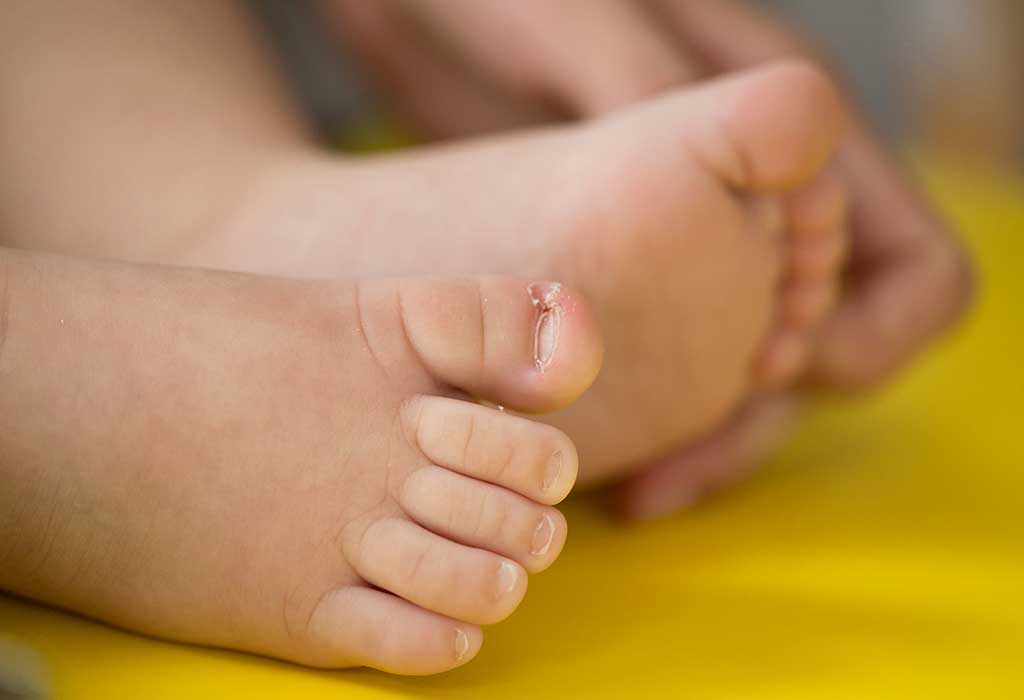
Ingrown Toenail in Children – Causes, Symptoms & Remedies
If your child’s toe looks all red and swollen, it may be because of an ingrown toenail. Ingrown toenails commonly occur in children. If your child is wearing a pair of tight socks and tight shoes, then he may have ingrown toenails.
In some cases, it is an inherited tendency. Sometimes, an ingrown toenail can cut through the skin and may lead to various infections. Certain home remedies can prove beneficial in fixing the disorder, provided you take action fast.
What is Ingrown Toenail?
An ingrown toenail happens when a toenail grows abnormally or when the corner or edge of the toenail starts curving inwards into toe’s soft skin which can trigger pain and infection due to all the bacteria that typically dwells around in and around the feet. The toe may appear red, swollen, and tender particularly around one of its corners, generally the big toe.
Causes of Ingrown Toenail in Children
Some of the causes of ingrown toenails in children include:
1. Cutting Nails Inappropriately
The most common cause of ingrown toenail is trimming nails too short. When a nail is cut too short, the surrounding skin may cover the ends of the nail, as a result, the nail may grow back in the skin. Nails which are torn instead of cut may also become ingrown as they lack defined corners. Further nails that may have been cut in a rounded form than straight across can become a reason for them to break into the soft toe skin.
2. Ill-fitting Shoes
Tight shoes are another probable cause of an ingrown toenail. If your child’s feet are growing fast and he wears the same old shoes, then he may have an ingrown toenail. A pair of ill-fitting shoes can thrust the soft skin on the corners of the nail to move over the nail, driving the nail to develop into it.
3. Toe Injuries
If your child keeps stubbing his toes frequently, then he may have ingrown toenails. Also, if a baby or toddler loses his toe due to some injury, the new nail may grow unhealthily than a prevailing one.
4. Stress on the Toe
Stressing the toe by kicking a football over and over can even result in ingrown toenails. Children who indulge in plenty of physical sports have higher chances of developing ingrown toenails because of persistent torment to the toes.
5. Heredity
If your child has ingrown toenails without any possible reason, then it may be because of heredity. Some people are born with oddly curved nails which place them at an increased risk of developing this illness often.
Symptoms of Ingrown Toenails
Common symptoms of ingrown toenails are mentioned below.
A painful toe
Swelling around the affected area
Redness around the edge of the nail
Pus formation or liquid discharge
Foul odour
A warm sensation
Home Remedies for Ingrown Toenails
If your child’s toenail is not infected, you can treat it with home remedies. You can try the following remedies for ingrown toenails:
Soak your child’s affected foot in warm, soapy water to reduce swelling and pain. Let him immerse his foot in this solution twice a day for about 20 minutes.
While the affected foot is in the water, massage the inflamed portion of the cuticle lightly away from the nail.
Apply an antibiotic ointment on the affected area to provide relief from inflammation and to prevent infection. Do this 2 to 3 times daily for a week.
You can dip a cotton bud in olive oil and use it to propel the skin gently away from the ingrown nail.
Tips to Prevent Ingrown Toenails in Your Child
Some useful tips to help avert the problem of ingrown toenails in children are given below.
Check your kid’s toenails from time to time like after baths to be able to detect any signs of an ingrown toenail.
Make sure you trim your child’s toenails properly; they should be in straight line and not too short.
Ensure that your child wears a pair of shoes that fit him perfectly. Also, take note of the shoe width along with the correct length.
Educate your child about how to maintain good foot hygiene. Ask him to keep his feet dry. Changing socks frequently is essential if your kid’s feet are prone to excessive sweating.
Refrain from digging out the nail or ripping it out as it can heighten the incidence of ingrown toenails.
When to Consult a Doctor
If you have tried the above remedies but they are not working, it is time to consult a doctor. You may want to consult a paediatrician if your baby has the problem of ingrown toenails. In case your baby has ingrown toenails, look for the following signs:
Bleeding
Oozing of pus or any discharge
Bad smell
Extreme pain
Your doctor based on the condition of your child’s foot may propose a minor surgery wherein he may be required to cut off the corner of the affected nail so that the infected tissue can heal easily. The doctor may also suggest a course of antibiotics.
FAQs
Some frequently asked questions regarding ingrown toenails are given below:
1. How Long Will Ingrown Toenail Last?
It usually depends on the severity of the case. Sometimes, a child may have ingrown toenail for several weeks. However, if there is no visible infection, home remedies may exhibit a significant improvement in the condition within a few days.
2. Will the Ingrown Toenail Come Back?
If you do not take proper care of toddler ingrown toenail, your child may face this problem again. The same stimuli that may have activated an early ingrown toenail can cause the condition to return.
If your child has an ingrown toenail, he must be in excruciating pain. Unfortunately, an ingrown toenail is a common condition in kids and can make playing, running, and even putting on shoes difficult for him. This condition can linger on for weeks and may get infected if not cared for properly.
Also Read:
Bed Bug Bites on Infants and Kids
Home Remedies for Runny Nose in Infants and Children
German Measles in Babies and Children
Read more

Parental Control on YouTube – How to Ensure Safe Search
The kids these days find the internet very helpful for their school work apart from using them as a source of entertainment. YouTube is very popular, and kids spend a lot of their time on YouTube instead of their TVs. The disadvantage is that YouTube has a lot of inappropriate content like violence and nudity which the kids should be kept away from watching. This is why YouTube has started parental controls which will help you stop your kids from enabling access to such content.
Why Is It Important to Have Parental Control Over YouTube?
YouTube is one of the largest entertainment websites. But with it, it has its dangers. You can take the example of Logan Paul, a very popular YouTube user whose channel had about 15 million subscribers. He was in some hot water because he uploaded a video that showed a dead body hanging from a tree. He took the video in a Japanese forest which is famous for its high suicide rates.
YouTube had to remove it from his channel, and Paul profusely apologised for uploading that video on YouTube. The problem was that before the video was taken down by YouTube, many people had already copied it and uploaded it on other channels. This means that the video was still accessible.
His actions caused many complaints against the service because the fact that it failed to safeguard kids from such content bothered the majority of people and most of them were parents. YouTube then removed over one million videos from its site. Investigators discovered that comments on over half a million videos were targeting kids and this was also turned off. Moreover, some comments were loaded with alleged child predators.
At the time, ads that had inappropriate content for children from about 2 million videos were removed, and YouTube officially confirmed this.
All these findings have caused a lot of parents to question if their kids should even watch videos on YouTube. This is why you should limit what your children watch, and the first step is Restriction Mode.
This is a part of parental control which the YouTube offers. With this mode, you can clean the search results on YouTube so that the adult content is taken out. Your kids will not be able to watch all the flagged videos and videos that are marked as inappropriate by other audiences. The mode will help to limit the explicit content through YouTube gives no guarantees that it is a 100 per cent adequate.
How Does Content Restriction Tools Help to Protect Kids on YouTube?
Google has come up with Safety Center tools so that parents can control their kids’ activity. With these Safety Center Tools, you can enable content filtering and other blocking features on YouTube as well as Google searches. They will also help to report questionable content you see on the internet.
Google offers the following safety centre tools
1. SafeSearch
With this tool, you can block any content or websites that are inappropriate from Google’s search results. These contents could be any violence, pornography, or any other inappropriate content.
2. Reporting and Enforcement Centre
If you ever found an embarrassing video of your children on YouTube and if you think that someone had uploaded this content, you can report it to the Reporting and Enforcement centre on YouTube, and they will help to remove this content.
3. YouTube Content Filtering
Inappropriate content can be blocked on Google search results by Google’s search thought there are other places where you can apply content filtering. You will get content filtering on YouTube to a certain level using the restricted mode.
How to Put Parental Control on YouTube?
People mostly use android or iOS these days. Here is how you can enable YouTube parental Control from various devices.
On Android Phone
Here is how to put parental control on youtube android app on your phone.
Step 1
Start the YouTube app in your phone and sign in to your account if you are not already signed in.
Step 2
After signing in to your account, click on the account icon. You will find this icon at the top right. You have then look for an option “settings” and click on it,
Step 3
After you click on the Settings, you will then find an option “General”. Click on this option. In the next page, you will find an option called the “Restricted Mode”. Select this option.
On iPhone
YouTube parental controls can also be set on the iPhone. Follow the following steps to enable this mode on the YouTube app.
Step 1
Take your iOS and open your YouTube app.
Step 2
In the upper right corner, you will find your account icon. Tap on that account icon.
Step 3
A menu will appear. From that menu, select an option called “Settings”.
Step 4
A group of options will be displayed. Select the “Restricted Mode Filtering” option.
Step 5
You will then find an option “Strict”. Select that option and exit the settings.
You could also choose an option “allowed content”. This way you can ensure that your kids download only age-appropriate content by their ratings.
On iPad
It is possible to enable safe mode in the iPad as it is also an iOS. You can use the following steps.
Step 1
Go to the official website of YouTube. On the upper right corner, you will be able to see three dots. Click on them.
Step 2
When it is clicked, a pop up is shown. Select the option “Settings” from it.
Step 3
When you are in the settings, click on the “Restricted Mode”. This will turn on the safety features.
You can also enable parental controls through the YouTube app on the iPad. The process is same as allowing the safety mode on your iPhone. You can use this method in the iPhone too.
On Web Browser
To enable the YouTube parental control on your web browser, you need to follow the steps below:
Step 1
To ensure that your kid does not see any age-inappropriate content, you will need to enable the safety mode on each browser that you use. Open your browser and enter www.youtube.com.
Step 2
In case you do not have a YouTube account, you will need to create one using the Sign In button and following the instructions. Once you have created the account, YouTube will open in your account.
Step 3
Scroll down to the bottom of the page and find the Restricted Mode Button. Click on this and select the ‘On’ option. Click ‘Save’ to save your settings. Under the ‘On’ button, you will see an option saying ‘Lock Restricted Mode on this browser.’ Click on this. This takes you to the Sign In page.
Step 4
Sign in again to lock the Restricted Mode setting. If you use more than one browser, you need to open each browser and enable the Safety mode setting on YouTube. The Safety Mode activates Safety Search, which ensures that only child-friendly results show up on any search.
Additional Tips About YouTube Parental Controls
Almost everyone uses YouTube these days as it is the best place for entertainment. But there are still some questionable content which is inappropriate for kids and because of this parents can enable some parental controls on the site so that the children do not come across any content that is inappropriate like violence or nudity. Here are some additional tips you will find useful for content filtering.
1. Lock Restricted Mode
Since you can turn the restricted mode on very quickly on the web browser, you should also be aware that likewise, it is easy to turn it off. To avoid this, the restricted mode can be locked on the web browser preventing your kids from changing that setting. Just turn on the restricted mode on YouTube by signing in to your account. You will then find a Restricted Lock mode, click on this browser. Don’t forget to save your settings. Once you are done, sign out of your account, and the mode you saved will remain on the browser. After you sign out, your kids will not be able to change the settings because they can be replaced only if the account is logged in. If you happen to use more than one browser on the computer, then the following steps should be followed on each browser.
2. Use Content Filtering App Like KidSafe Tube
Another alternative idea for the YouTube parental control is the KidSafe Tube. The advantage here is that it filters content on YouTube. This way, you can be sure that your kids are not watching any inappropriate or offensive content.
3. Install YouTube Kids
You can also replace the regular YouTube with YouTube kids and install it on the kid’s device. This app is the kid-friendly version of YouTube where there are no illicit or inappropriate contents that kids should stay away from.
It is very tough to follow and continuously monitor your kid’s activity on the internet. It is normal for parents to worry about their children because of the availability of inappropriate content on the web. Even with the above techniques, the best way to filter is by being present. You will not be able to monitor each video your kid views on the internet, but you can consider spending some time with your kids and watching the videos they like. This will undoubtedly strengthen the relationship between you and your child and will also help to surface any potential threats.
Also Read:
Child’s Pictures You Should Never Put On The Internet
Things Parents Should Avoid Sharing on Social Media
Gadgets and Apps for Ensuring Kid’s Safety
Read more
Sort By
 Latest
 Most Popular
 Trending
Please select atleast one Filter