

















.svg)
.svg)
.png)


Play & Activities
Suggested articles for you
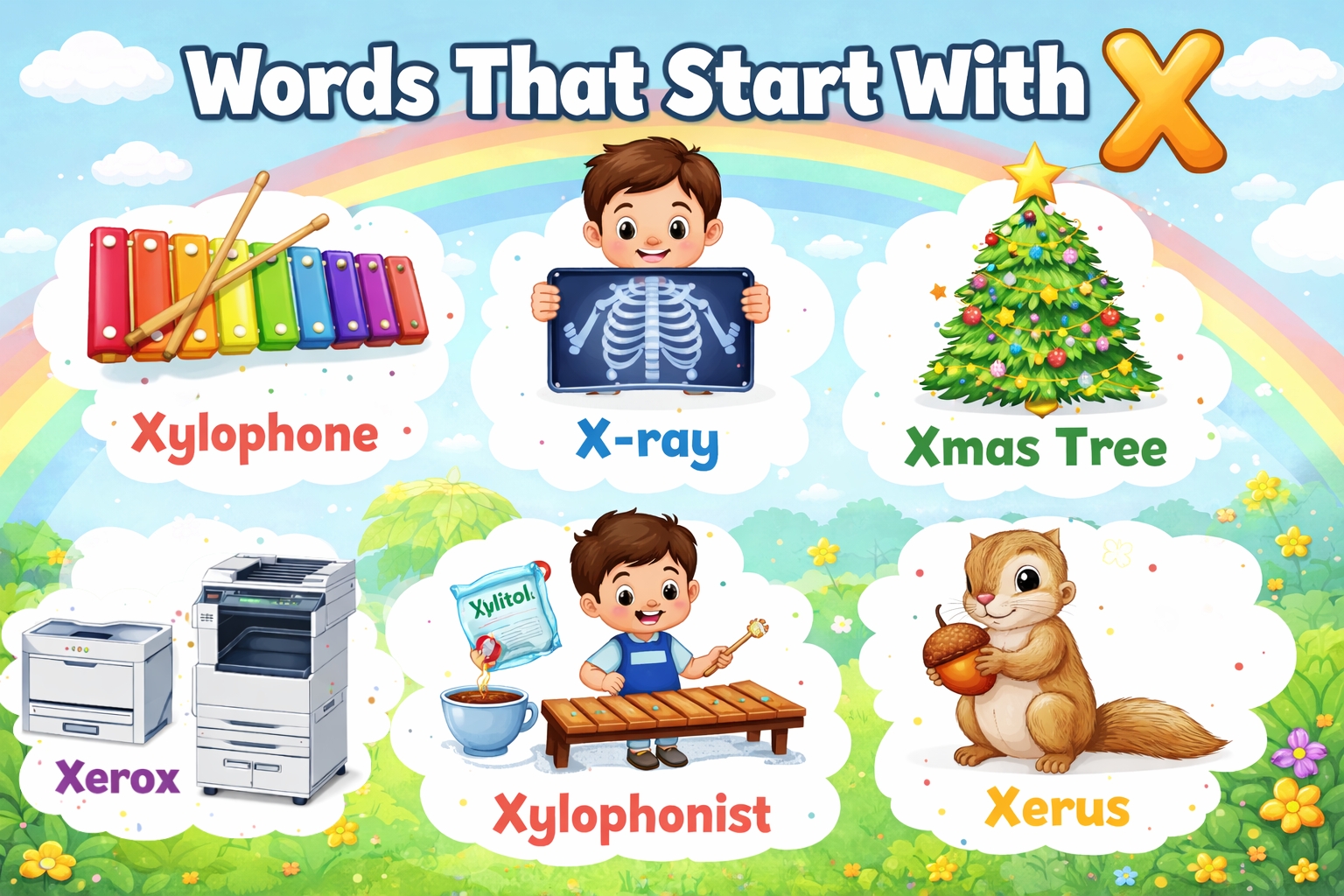
Words That Start With X for Kids to Learn
Are you trying to learn valuable skills? Perhaps you could learn some kid-friendly X words! Letter ‘X’ is one of the most challenging alphabets for kids to master. The other alphabets come naturally, but X is one of those rare specimens that takes a bit of effort to get the hang of. Parents and teachers find it frustrating, especially since spelling books don’t contain many examples of the letter ‘X’. Kids at different elementary grade levels have letter ‘X’ week for this reason, and depending on your child’s grade, you will want to try out a bunch of interactive activities. In this article, we will look at some fun and easy words that start with letter X for kids to learn and enjoy.
2 and 3 Letter Words That Start With X
While rare, there are still a few 2 and 3-letter words in the English language that begin with the letter X. These are often abbreviations or specialised terms found in science, mathematics, or casual slang. Here are a few examples of two & three letter words beginning with X:
Xi
Xat
Xu
Xis
4 Letter Words That Start With X
Four-letter words beginning with X are slightly more common and often stem from Greek origins. These words may appear in academic, medical, or scientific contexts. Given below are some four letter word beginning with X:
Xmas
Xian
Xciv
Xing
Xema
Xyst
5 Letter Words That Start With X
Five-letter words starting with X can be useful for crossword puzzles, games like Scrabble, or boosting vocabulary in niche fields. Here are a few five-letter words starting with X:
Xebec
Xylan
Xenia
Xylol
Xenic
Xylyl
Xenon
Xysta
Xeric
Xysti
Xerus
Xysts
6 Letter Words That Start With X
Six-letter X-words frequently appear in scientific texts and sometimes in casual conversation, depending on the context. They usually come from Greek or Latin roots. Listed below are some six-letter words starting with X:
Xebecs
Xenias
Xenial
Xylene
7 Letter Words That Start With X
These words are more specific and are commonly used in fields like biology, technology, or medicine. They may not be seen every day, but they hold significant meaning in their respective domains. Here are a few 7 letter word beginning with X:
Xanthan
Xanthin
Xanthic
Xenopus
8 Letter Words That Start With X
Eight-letter words starting with X are uncommon and usually academic, medical, or scientific in nature. Given below are examples of eight-letter words that start with X:
Xanthate
Xanthene
Xanthein
Xanthine
Things Names That Start With X
Naming objects or things that start with X can be challenging due to the rarity of such words. Many of these things that begin with X are either brand names, scientific terms, or uncommon nouns. Here are a few thing names that begin with the letter X:
X-ray machine
Xerox machine
Food Names That Start With X
Although limited, foods that start with X do exist, primarily in international cuisines. Given below are some food names that start with X:
Xigua ( an African watermelon)
Ximenia caffra (plum)
Xylocarp cupcakes
Xoconostle cactus fruit
Toys That Start With X
Toys starting with the letter X are often brand-specific or futuristic in nature. While not many exist, they can still be found in modern or tech-based toy collections. Here are a few toys that begin with X:
Xbox
Xia: Embers of a Forsaken Star
X-balls Juggling Balls
X King’s Gold Treasure Tomb
Nouns That Start With X
X is one of the least commonly used letters to begin nouns in English, but several exist, especially in technical or medical language. Given below are some nouns beginning with X:
Xalam
Xenurine
Xanthidium
Xeriff
Xanthopuccine
Xiphias
Verbs That Start With X
X-verbs are extremely rare and are usually borrowed from Greek. Here are a few verbs beginning with X:
Xenograft
Xxenocode
Xeriscape
Xylomance
Xerocopy
Adjectives That Start With X
Adjectives that begin with X are limited but impactful. Given below are examples of adjectives beginning with X:
Xanthous
Xenobiotic
Xenogenic
Xenocentric
Xenolithic
Xylophagous
Positive Words That Start With X
Even though X is a tricky letter, there are still a handful of positive words beginning with it that can uplift conversations or writings. Here are a few positive words that begin with X:
Xo
Xenolalia
Xenas
Xenophile
Xenismos
Xenodochial
Descriptive Words That Start With X
Descriptive X-words are helpful in academic writing or for expressive storytelling. Given below are some descriptive words that begin with X:
Xenophobic
Xerothermic
Xenophilic
Xiphoid
Xenotransplant
Xyloid
Most Common X Letter Words for Everyday Communication
While not frequently used in daily life, some X-words have managed to enter everyday vocabulary through technology, science, and media. Here are some of the most common words with X at the beginning:
Xylophone
X-ray fish
X-ray
Xerox
Xmas tree
Xbox
Xystos
X-factor
Xylem
Xylograph
Xiaosaurus (a type of dinosaur)
Xyris
Xavier
Xyster
Words That End With ‘X’ for Kids
It’s easier to pick up words that end with X. Kids respond to words much better when you make saying them aloud fun. You can read out stories with words that end in X, like fox and box, to make them memorable and engaging. The trick is not to let them feel like they’re learning and flow with it.
Here are a few X words for children that end with X:
Ox
Box
Fox
Tax
Max (a cartoon character)
Xerox
Wax
Six
Make sure you print out worksheets with pictures and clear labels under them to make the learning process easier. You could also try out a fill-in-the-blank activity to get their minds thinking and learning, thus adding an extra level of challenge.
Sentences With Words With X
Words with the letter X may seem uncommon, but they are fun and useful for building vocabulary. Below are simple sentence examples using different words that contain X, making it easier for children to understand and remember them.
1. Box – She kept her toys neatly packed inside a colourful box.
2. Fox – The clever fox ran quickly through the forest.
3. Six – I have six crayons in my pencil case.
4. Fix – Dad helped me fix my broken bicycle.
Kid-friendly Activities With Letter ‘X’
When you’re approaching Letter ‘X’ of the week, you want to ensure you’ve got tons of activities lined up for your preschooler. If you’re tired of using old ideas or running out of a bunch, it’s time you reinvent the wheel.
Here are our top recommendations for letter X preschool activities, art activities, baking, and anything else fun that involves the letter X.
1. X Marks the Spot
For this activity, you will need some chart paper, coloured foam bath letters, and pens and markers. This activity aims to go treasure hunting for the Xs on the map.
How to Do It
Draw out a map of your playroom and hide the foam bath letters in different areas.
Write down Xs on the map and ask your child to find the hidden letters. It’s going to test their map-reading skills, plus help them master the letter X
2. Make a Xylophone
Have your kids already played with the Xylophone? Well, it’s time to build their own (except with paper). You need some scissors, glue, and different coloured sheets of paper.
How to Do It
Cut out the coloured sheets of paper in the shapes of rectangles.
Make sure the cutouts are of different sizes. Ask your child to glue the sheets on one another in the correct order.
3. Classic Tic Tac Toe
Tic Tac Toe is perfect for getting 3-year-olds and above up to speed with the letter X. Here is how you play it. Get your pencils and papers ready for this.
How to Do It
Get a tiny sheet of paper and divide it into nine squares. Or use a tic-tac-toe reference grid image online for additional help. Draw it out
The rule of the game is to start by drawing an O and an X in the box.
Three Os or X’s are needed to win the game.
You draw an O, your child draws an X, and both of you will proceed to fill up the boxes until they run out.
If three X’s or Os are lined up sequentially, horizontally, vertically, or diagonally, the player wins. It’s that simple. Kids love this game because it challenges their critical thinking and decision-making skills.
4. Exercise on the X
Do you have some painter’s tape lying around the house? Then it’s time to put it to good use. And if you’ve got a carpeted floor, even better!
How to Do It
Get a carpet, or ensure you’re in a carpeted playroom for convenience.
Use the painter’s tape to make two big X’s on the floor.
Encourage your child to run from X to X, crawl, jump, hop or walk around.
He has to connect his movements from one X to the next. This is a good activity for reinforcing the letter X for preschoolers.
5. X-Ray Artist
Get ready for hours of fun and creativity with this fun activity. X-ray artist turns your young tots into budding artists, but with a twist!
For this activity, you will need the following materials:
Non-toxic paint
Paintbrushes
Paper
Q-tips
How to Do It
Help your child paint his arm or leg.
Take your time and be gentle. Guide him through the painting and let it sit out and dry when it’s done.
Once the paint is dry, challenge your child to make an X-ray photo out of the print by lining up the Q-tips on different painting sections.
This cool activity for seven-year-olds and above gets their creative juices flowing.
6. Draw the Xs
If your kids or preschoolers are itching to draw, you can make their doodling time way more fun by adding a little challenge. One can be a little more creative by drawing letter X foods.
How to Do It
Give your kids a few sheets of paper and a topic to draw about.
They can choose their subjects too.
The only rule of the game is to leave a uniform border around the edges of their drawing.
They have to fill up the border with colourful X’s using different sketch pens or markers. It’s simple, fun, and a huge hit.
7. X-ceptional Puppets
Ready for some puppet magic? Why watch Sesame Street when you can recreate your version at home? Except with Xs, of course.
How to Do It
Get your kids a couple of paper bags.
Ask them to stuff it with anything of their choice. Use a string or yarn to tie up the bottom of the bags.
Get some coloured paper cut-outs and glue. Ask your kids to customise the shapes using scissors and stick them to the bag.
They can use the cut-outs for the eyes, ears, nose, etc.
Make sure a few cut-outs resemble the letter X and set a few creative rules for the design.
When they’re done, they can add in the hair or wigs and finish.
To make it more fun, ask them to create a story or skit involving the theme’s letter X. For example, puppets travel to X-island to find a long-lost treasure.
8. X-Cooking Class
Prep up cookie dough and three-inch logs and teach your kids how to bake with this fun but delicious activity!
How to Do It
Make sure you supervise your kids when doing this before you start.
We recommend this for ages seven and up, specifically. To start, use the 3-inch logs to press the dough at the centre.
Press another 3-inch log on top to make an X-shape.
Top your dough using your favourite ingredients and put it in the oven for baking.
Once it’s done, ask your kids to say the letter X before munching on the goodies. It will help them with recall.
9. X-Racing
If your kids run around the house too much, you can put their energy to good use. Here’s how you do that.
How to Do It
Set up X-stamps on the floor.
You can set up two or three of these on the floor and draft a finish line with a long ribbon or drape at the end of the room.
Set the number of Xs depending on the number of racing players and set them nicely apart.
Ask your kids to place their feet on them, line up and get ready to race. Whoever crosses the finish line first wins the X-race.
10. X-Game
This is a fun game that involves obeying commands. The only rule is to stand with the X-pose until the orders are given. This also works on your kids’ hand-eye coordination and gross motor skills.
How to Do It
Ask your child to stand in an X-shape with their arms and legs stretched out.
They must do it as soon as you tell them to hop, run, jump, or whatever else.
Don’t give them too much downtime or breaks to make it challenging. Whoever messes up the command loses, and the last one standing wins the game!
FAQs
1. What are the easiest words starting with X for kindergartners to learn?
Some of the easiest X starting words in English for kindergartners to learn are x-ray, xylophone, and X marks the spot. These words are fun, commonly found in books or cartoons, and help children recognise the unique sound that X makes at the beginning of a word.
2. Can learning X-words help with phonics?
Absolutely! X makes different sounds like “ks” (fox), “z” (xylophone), or even “gz” (exam). Exploring these helps children improve sound recognition and reading fluency.
Remember to be patient with your kids when trying out these activities. Spend time with them and guide them through the journey of learning. When you do it together with your kids, it becomes way more fun. You can trust us on that. We hope you’ve enjoyed our list of words starting with X, and we encourage feedback. Feel free to write to us or comment below for more suggestions.
Also Read:
Words that Start with ‘A’
Words that Begin with ‘L’
Words that Start With ‘M’
Words Beginning With the Letter ‘I’
Read more




Tips to Dress up Your Kids for Navratri Festival
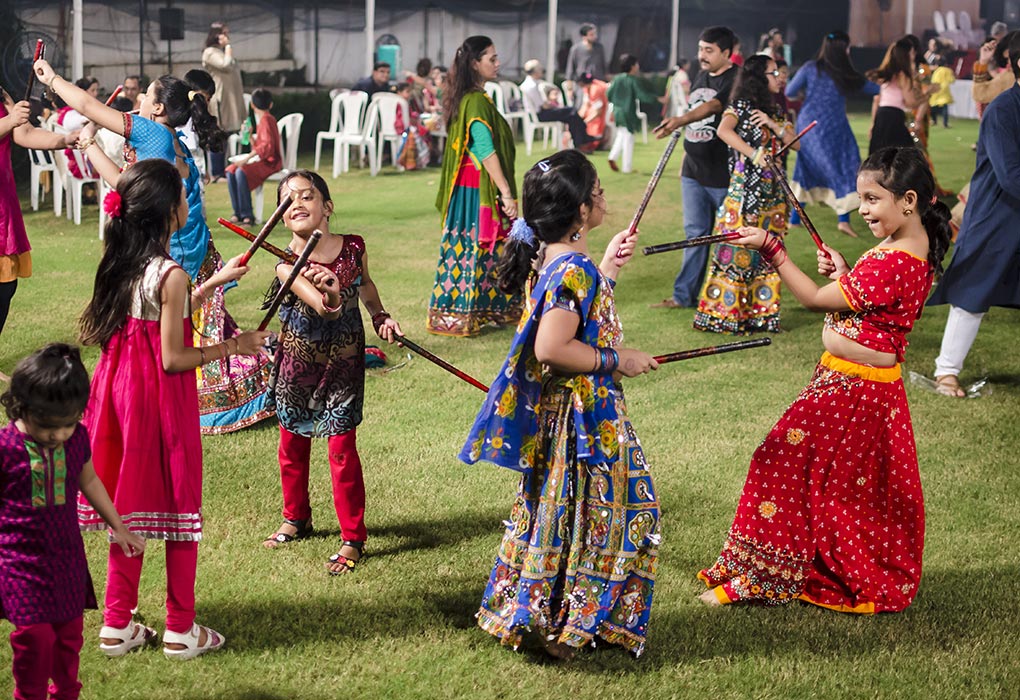
Navratri is one of India’s most colourful festivals. It is celebrated to worship Hindu Goddesses. Meaning ‘Nine Nights’, it is a festival where every night is dedicated to worshipping a different form of the Hindu Goddess. It ends on the tenth day, which is called Dusshera or Vijayadasami. This entire festival is filled with merriment and joy, and a time for even young children to get decked up in the finest traditional attire so that they can dance their tiny legs away. Let’s look at some Navratri dress ideas for kids below.
How to Dress Up Children for Navratri?
Picking out a dress for your tiny tot can be a task in itself. You want your little one to look his or her best, get compliments from all your friends and relatives and outshine all his or her peers. Make sure that what you pick out not only looks good but is also comfortable. Your child will be wearing the attire and running all around, dancing to music and playing with his friends. He will be bound to work up a sweat, and you don’t want his attire to make him itchy or uncomfortable in any way. Similarly, if you have a daughter, you don’t want to weight her down with too much fluff and jewellery. Keep it simple, attractive and comfy. Here are tips you can take inspiration from:
Garba Dresses for Girls
When it comes to dressing up little girls for Garba, the options are aplenty. Navratri, with its vibrant colors and lively dances.Here are some thoughtful Navratri dress ideas for little girls to shine during the festivities.
1. Their Dress
The traditional Garba dresses for girls is as follows: a colourful flared skirt, an embroidered blouse and a dupatta which is patterned with sequins, mirrors, shells etc. There are many varieties available which are similar to this setup, and you can mix and match. But make sure the dupatta is not too long or heavy. It needs to be light so that your daughter can handle it with ease and not trip while dancing. Also, pin it safely to her blouse with a safety pin, so it doesn’t slip off. The other tip is to find a dress which does not have sequins or mirrors which stick out. These might rub your child’s delicate skin and hurt her. Lastly, keep the dupatta as an optional item, only if your child insists on wearing it.
2. Jewellery
Usually, it is better to leave your daughter free on any jewellery which might hamper her enjoyment by irritating her or ending up getting undone and lost. She will look fantastic even without any shiny jewellery. But if she insists and if you want to adorn her with some simple accessories, opt for lightweight jewellery. Like thread necklaces or bindis on her ears instead of earrings. You can adorn her arms with a few colourful bangles as usually they do not cause much bother and are light to handle. Handmade feet jewellery like thread anklets is another option.
3. Footwear
A type of Indian footwear called ‘mojris‘ can be a comfy and attractive footwear option for your daughter. Or you can just let her wear her regular footwear. Don’t put your child in any shoes with heels on them as it can be dangerous and she may trip and fall easily.
4. Makeup
If your daughter is above 5 years of age, you can use some light make up on her face. Make sure to use a good brand which is free of chemicals and does not cause any allergy to her face. Otherwise, just apply a bit of kohl and face powder, and she’ll be ready to go!
Garba Dresses for Boys
Preparing young boys for the vibrant festivities of Garba during Navratri is a delightful endeavor.Here, we present a selection of Navratri dresses for boys.
1. Their Dress
The typical male attire for Garba is a two-piece ‘kediyu’ which is a traditional embroidered sleeveless jacket, a coloured ‘pyjama’ below and a turban or cap. Make sure it is lightweight, and it does not have any sharp sequins or pins inside which can hurt your child. You need to get the right size for him so that it doesn’t slip while dancing. The cap can be an optional item.
2. Jewellery
You can adorn your son with some oxidized lightweight jewellery like a metallic necklace, anklets and clip-on earrings. You can also go for thread accessories for the neck and feet.
3. Footwear
As for girls, ‘mojris’ for boys are the most comfortable to wear and dance in.
4. Makeup
If your son is fascinated with makeup and wants you to apply some on his face, dab a bit of lip gloss or foundation on. Make sure it is from a good brand which does not have any chemicals that can irritate your little one’s skin.
Other Accessories for Children (Boys and Girls)
Dandiya dress ideas for kids are incomplete without the extra other accessories, like
Traditional anklets, armlets, and wristlets
Embroidered purses and slings
A smart, traditional umbrella piece
FAQs
1. What should kids wear for Navratri?
Girls can wear a chaniya choli, lehenga or a colourful frock with a dupatta. Boys can wear a kurta pyjama, dhoti kurta or a kediyu with a turban. Choose bright colours and light fabrics that are easy to move in.
2. Which fabric is best for kids during Navratri?
Soft cotton is the best choice because Navratri evenings can be warm and kids dance for hours. Avoid heavy fabrics, stiff embroidery and itchy borders, as they can make children uncomfortable.
3. Do kids have to wear the colour of the day during Navratri?
No, it is optional. Many families like to follow the colour of the day for fun, but any bright, festive outfit is perfectly fine. The most important thing is that your child feels happy and comfortable.
4. Where can I buy these dresses for kids?
You can find a wide range of Navratri garba dresses for boys and girls on FirstCry, including chaniya cholis, lehengas, kurta sets and dupattas. You can browse by age, size and colour and pick what suits your child best.
Navratri can be a beautiful time to celebrate for you and your family. Especially, your kids will have a whole lot of fun. And it would be amazing to watch them running around looking like princes and princesses. Hope you follow some of the above Garba dress ideas for kids and have a happy and safe Navratri. Make sure to take many pictures for the photo albums!
Also Read:
Navratri Colours and Its Importance
Facts about Navratri and Dusshera for Kids
Navratri Quotes,Wishes and Messages for Family
Read more
15 Halloween Costume Ideas for Twins
Halloween comes once a year, and this is the time when adults and children look forward to having fun and playing dress-up. For those with a particular love for Halloween drama, preparations start a long time in advance, with the entire costume needing to be put together with care. At the same time, some prefer last-minute dress-up with easy-to-find materials.
When you have twins to dress, things can get all the more fun and exciting when deciding the costumes. You can put them in themed or matching costumes that can be so much fun to put together. If you are looking for some great ideas or inspiration for twin costumes, you have come to the right place.
15 Best Twin Halloween Costumes to Dress up Your Twins
Whether you have twin boys, twin girls or a pair of fraternal twins with one boy and one girl, we have a lot in store for you. Check out some creative twin Halloween costume ideas given below.
1. Salt and Pepper
Your little ones may be just infants, but that doesn’t mean they can’t be included in the dress-up fun! Whether they are twin boys, girls, or one of each, you can go with a salt and pepper dress for each. This idea is one of the easiest infant twin Halloween costume ideas that you can put your kids in, especially if it’s a last-minute deal.
Image Credit : Pinterest
2. Hansel and Gretel
Hansel and Gretel are two famous siblings from the Grimm brothers tales and are every children’s beloved fairy tale characters. These boy-girl twin Halloween costumes are easy to make and will make your kids the centre of attention for creativity.
3. Mandrakes
Harry Potter fans will definitely appreciate this one. Just pick up two simple, lightweight flower pots that are big enough to hold a baby comfortably. You can keep it simple, add leaves to your babies’ hats, and put them in brown suits to get the perfect twin baby Halloween costumes. As parents, don’t forget your earmuffs, just in case the mandrakes decide to wail!
Image Credit : Pinterest
4. Clark Kent and Superman
Which young kid doesn’t like to be dressed up like a superhero? Well, Superman is the most popular of all, and you have the perfect opportunity to dress up your twin boys creatively. Dress one twin as Clark Kent and give him a nerdy appearance with spectacles, and dress the other one as Superman with a cape and slicked hair.
5. Phil and Lil
‘Rugrats’ was a popular show back in the 90s, so if you are a fan of that show, then you can dress up your little twins as Phil and Lil. This costume will go great if you have fraternal twins of both genders, as this is one of the most classic twin toddler Halloween costumes of all time.
Image Credit : Pinterest
6. Peter Pan and Wendy
The one night of the year when you are allowed to escape reality is the perfect time for a trip to Neverland. If you have fraternal twins of each gender, you may want to consider giving Peter Pan and Wendy a try. This is another simple costume idea since it involves green tights, a shirt and cap, and a pretty blue dress.
7. Anna and Elsa
Frozen has become every young girl’s favourite animation, and your twin girls may love dressing up as the two royal sisters, Anna and Elsa. These twin girl Halloween costumes ensure that your girls are dressing up like the princesses, which they are.
Image Credit : Pinterest
8. Tweedle Dee and Tweedle Dum
You can use Disney’s fantastic movie – Alice in Wonderland for inspiration and dress your twin boys as Tweedle Dee and Tweedle Dum. This costume is super easy to make. All you need are red pants, yellow shirts or sweaters, blue bow ties, and red caps. These twin boy Halloween costumes work best for the more mischievous boys, who love making people guess who is who.
9. Betty and Velma
Head back to the stone age with your twin girls to dress them up as beautiful cartoon characters – Betty and Velma. It is simple enough to put together a stone age dress, so you will need one blue cloth material and one white to stitch up two easy outfits. Add a pearl necklace and an orange wig for Velma, and a simple necklace for Betty. Voila! You have two perfect little stone age darlings.
Image Credit : Pinterest
10. Woody and Buzz
Who doesn’t love the perfect chemistry of two best friends? And none can be better than these two Disney Pixar characters of the popular Toy Story movie – Woody and Buzz Lightyear. If your twins are a fan of Toy Story, then these characters are just perfect. Getting together a cowboy outfit will not be very difficult, and a Buzz Lightyear costume can always be bought or put together quickly. These two characters are very much loved by kids and show the meaning of teamwork – something twins are good at.
11. Lilo and Stitch
Lilo and Stitch are a famous Disney’s duo, loved for their teamwork, friendship, and fun-loving nature. Their colourful costumes are sure to attract everybody’s attention at the party. Lilo’s dress reflects tropical vibes; therefore, you need a red blouse, artificial flowers for the garland around the neck, and large leaves for the skirt. You can buy Stitch’s costume at any costume shop. Its blue colour is eye-pleasing, and your kid will be fantastic in it.
12. Ketchup and Mustard
Can you ever forget ketchup and mustard while eating a burger or a sandwich? Definitely not. This Halloween, dress up your twins in this popular spice-duo and add some spice to the party. You can use red and yellow/mustard-coloured onesies for your twins. To the front of the onesie, you can paste a cut-out of Tomato ketchup and Mustard ketchup.
13. Thing 1 and Thing 2
Thing 1 and Thing 2 are mischievous characters known for their distinctive red and blue outfits.To complete the look, consider adding matching blue wigs or hair accessories that evoke the playful spirit of these beloved characters.
14. Peanut Butter and Jelly
Celebrate the classic duo of peanut butter and jelly with this whimsical costume idea. One twin can be the peanut butter, dressed in shades of brown. Consider a brown shirt or jumpsuit paired with matching pants. The other twin can be the jelly, adorned in various shades of purple. A purple outfit with complementary bottoms works perfectly.
15. Mario and Luigi
Mario and Luigi are iconic video game characters known for their distinct red and green outfits. Dress one twin as Mario, featuring a red cap with an “M”, blue overalls, and a red shirt. The other twin can be Luigi, sporting a green cap with an “L”, green overalls, and a green shirt. To add authenticity, consider applying temporary mustaches using costume makeup.
Whether you love to put together outfits or are content with throwing together something from the things that you have on hand, there are infinite creative options available to choose from for your little ones. No matter what you plan on dressing them, it will require a little time to put things together, but it can be a project that you and your kids work on together. While getting their costumes ready, don’t forget to have fun and pick something that makes everybody happy. So pick your costume and get started!
Also Read:
Cute Fancy Dress Theme Ideas for Kids
Scary Halloween Costume Ideas for Girls and Boys
Pretty and Scary Halloween Makeup Ideas for kids
Read more
50+ Halloween Riddles For Kids With Answers
Halloween is a time for fun, as children look forward to games, costumes, candies, and pranks. So, what else is there to impress these young souls with? Why, Halloween riddles, of course! Riddles allow your kids to pause, think, and reason before answering the questions. The answers are often things that may be obvious but are sure to have your little ones roaring with laughter.
Of course, you will need to make sure that the riddles you pick are age-appropriate and not too difficult for your children, as this will cause them to lose interest. The key is to make it a bit of a challenge while also ensuring that the little ones have a shot at getting it right. Most of the riddles shared here are perfect Halloween riddles for kindergarten or preschoolers. Some are short and very easy, while others will make them think.
Children love riddles, and they are bound to love the riddles you choose to entertain them with this Halloween season. So, go on and choose your favorite funny or scary Halloween riddles and have fun with your kids.
Funny and Easy Halloween Riddles for Children
Here are some easy, fun, and short Halloween riddles to teach and entertain little minds this Halloween season. These will have your tiny tots howling with laughter:
1. What is it that birds give out on Halloween?
Answer – Tweets.
2. What animal dresses up and howls?
Answer – A Wear-Wolf.
3. Why are cemeteries so popular?
Answer – Everyone’s dying to get in.
4. Why was the scarecrow promoted?
Answer – He was outstanding in his field.
5. Why don’t mummies take vacations?
Answer – They’re afraid they’ll relax and unwind.
6. Why Was the Witches Broom Late?
Answer – It over-swept.
7. What’s the best thing to put into pumpkin pie?
Answer – Your teeth.
8. What is a skeleton’s favorite music?
Answer – A trom-bone.
9. Why do vampires always seem sick?
Answer – They’re always coffin.
10. Why are spiders great web developers?
Answer – They like finding bugs.
11. Why are ghosts bad liars?
Answer – You can see right through them.
12. What’s scarier than a monster?
Answer – A mom-ster.
13. What do you call two witches who live together?
Answer – Broom-mates.
14. How does a witch style her hair?
Answer – With scare-spray.
15. What happens when you cross a snowman with a vampire?
Answer – Frostbite.
16. Why don’t vampires have a lot of friends?
Answer – Because they are a pain in the neck.
17. What kind of a monster likes to dance?
Answer – A boogey-man.
18. What is a witch at the beach called?
Answer – A sand-witch.
19. Where do ghosts like to go swimming?
Answer – Lake Eerie
20. Where do werewolves store their junk?
Answer – A were-house.
21. What’s a ghost’s favorite dessert?
Answer – Ice scream
22. Where does Dracula keep his money?
Answer – A blood bank.
23. Why don’t mummies have time for fun?
Answer – They are too wrapped up.
24. How did the vampire marathon end?
Answer – Neck and Neck.
25. Why can’t Dracula play baseball?
Answer – He lost his bat.
26. What did the werewolf eat after his teeth cleaning?
Answer – The dentist.
27. What does a ghost keep in his stable?
Answer – Night-mares.
28. What room do ghosts avoid?
Answer – The living room.
29. What did the skeleton buy at the grocery store?
Answer – Spare ribs.
30. What is a ghost’s least favorite candy?
Answer – Life savers.
31. Where does the zombie live?
Answer – On a dead-end street.
32. Why don’t skeleton’s watch horror movies?
Answer – They don’t have the guts.
33. What is a vampire’s favorite dog?
Answer – A bloodhound.
34. What do you call an athletic pumpkin?
Answer – A jock-o-lantern.
35. Why do pumpkins sit on people’s porches?
Answer – Because they have no hands to knock on the door.
36. What did the ghost say to the bee?
Answer – Boo-bee.
37. Why did the zombie go to school?
Answer – He wanted to improve his dead-ucation.
38. Why did the ghost go to the party?
Answer – He heard it was going to be a boo-last.
39. What do you get when you cross a witch with sand?
Answer – A sandwich!
40. What do skeletons order at a restaurant?
Answer – Spare ribs and bone-appetit!
Hard Halloween Riddles for Kids
Some children are rather quick-witted and may figure out the easier riddles. So, if you don’t want things to be easy on your little ones, make them think with these hard Halloween riddles for preschoolers:
1. I Am Known to be Bad Luck When You See Me in the Dark
Oh How I Hate the Rain and I Don’t Bark.
What Am I?
Answer – A black cat.
2. From Head Down to Toes, Through Every Living Being I Flow.
You Might Faint When You See Me Though!
What Am I?
Answer – Blood
3. It is Rectangular in Shape, is Hollow, and has a Lid. You Might Wonder, as You Find It Six Feet Under. What is it?
Answer – A coffin.
4. I Fly Through the Night, Sleep Upside Down. Dark Places are My Home. I Do Not Have a Good Sight.
What Am I?
Answer – A bat.
5. Some Believe in Me While Others Don’t.
I Roam Around in the Nights and, Sometimes, in the Air I Float.
If You Hear a Strange Noise Underground,
Go Run and Hide from My Creepy Sound.
What am I?
Answer – A ghost.
6. I Have No Feet to Dance, I Have No Eyes to See,
I Have no Life to Live or Die but Yet I Do All Three.
What Am I?
Answer – Fire
7. What Did the Mummy Ghost Say to the Noisy Young Ghost Who Kept Interrupting?
Answer – “Spook when you’re spooken to.”
8. You Have a Match, a Jack-O’-Lantern, and Three Candles for the Jack-O’-Lantern; a Tall Candle, a Medium Candle, a Short Candle. Which One Should You Light First?
Answer – The match.
9. I’m Tall When I’m Young, I’m Short When I’m Old, and Once a Year, I Make Heavy Pumpkins Light. What Am I?
Answer – A candle.
10. What Did the Jack-O-Lantern Say to the Other Jack-O-Lantern When They Were on Their Way to a Halloween Party?
Answer – “Let’s get glowing.”
11. What Do Goblins and Ghosts Drink When They’re Hot and Thirsty on Halloween?
Answer – Ghoul-aid!
12. What is a Popular Search Engine for Ghosts?
Answer – GHOULgle!
13. What Did the Witch Say When She Fell in the Moat?
Answer – “My eels are killing me!”
14. What Happens When A Ghost Haunts a Theatre?
Answer – The actors get stage fright.
15. What Do You Get When You Cross Tinkerbell With a Werewolf?
Answer – A hairy fairy.
16. By day I’m not seen, but come the night, I’ll be around your door, but I’ll never knock. What am I?
Answer – A Jack-O’-Lantern.
17. I may have eyes but can’t see. I’m tuberous but not a tuba. Carve me and I’ll glow for thee. What am I?
Answer – A pumpkin.
18. I howl without a voice, fly without wings. I follow night but am gone by morning. What am I?
Answer – A dream.
19. I wrap around trees, houses, and creatures; often used by witches for various features. Though I’m not a snake, I can bind things tight. What am I?
Answer – A rope.
20. I cackle but I’m not a chicken. I ride but not on roads. I always travel with my broom. What am I?
Answer – A witch.
Benefits of Halloween Riddles for Children
Halloween riddles are not only enjoyable for kids but also come packed with multiple benefits. Dive into the “benefits of Halloween riddles for kids” and see how they can enhance your child’s overall development.
Cognitive Development: Solving riddles sharpens critical thinking and problem-solving skills.
Vocabulary Expansion: Through riddles, kids often encounter new words, enriching their vocabulary.
Memory Boost: Remembering riddles and their solutions can aid in improving memory retention.
Creativity Stimulation: Crafting answers or even formulating their own riddles can encourage creativity.
Social Interaction: Exchanging riddles can be a fantastic way for kids to interact and bond with their peers.
Fun Learning: Merging fun with education, riddles offer an entertaining learning experience during Halloween.
Kids always need entertaining, and during Halloween, when the excitement is in the air, getting your kids attention will be made much easier when you have a few exciting Halloween themed riddles to share! Try out a few of the amazing Halloween riddles for kids shared above to amuse your kids. Not only that, but these are simple, fun Halloween riddles that can be shared with others your age too! So, have a blast this Halloween with fun Halloween themed riddles.
Also Read:
Halloween Jokes for Children
Fun Halloween Quiz for Children
Easy Halloween Makeup Ideas for Kids
Read more
60+ Fun Halloween Quiz for Kids
Over the years, Halloween has evolved into a community-focused, kid-friendly celebration filled with costumes, candy, and lots of fun. It’s a time when children can enjoy the spooky spirit of the season with their friends and family. To make your Halloween celebration even more entertaining, why not add a twist with a Halloween quiz for kids? These fun-filled Halloween trivia questions and answers are perfect for testing their knowledge while keeping them engaged. Whether you’re planning a party or simply looking for some family fun, these Halloween trivia for kids will add an exciting element to the festivities. Let the spooky quiz begin!
Easy Halloween Trivia for Kids
Check our simple questions with all mixed halloween trivia.
Question 1. When is Halloween celebrated?
Answer: 31st October every year.
Question 2. In which country did Halloween originate?
Answer: Ireland
Question 3. In what year will the next full moon occur during Halloween?
Answer: The last Halloween that had a full moon was in 2001, and the next full moon on Halloween will be on 2039.
Question 4. Where did bobbing for apples originate?
Answer: Ancient Rome
Question 5. What is the traditional name for a pumpkin with a face carved into it, after it is illuminated from within by a candle?
Answer: Jack O’ Lantern
Question 6. What were Jack O’ Lanterns carved from before pumpkins were used?
Answer: Beats, Potatoes and Turnip
Question 7. What is the traditional Scottish name for Halloween, which derives from the name of Celtic god Samana?
Answer: Samhain
Question 8. What is the name for Halloween in Spain?
Answer: El Dia De Los Muertos (Day of the Dead or All Souls’ Day)
Question 9. Which two colours are traditionally associated with Halloween? What do they represent?
Answer: Orange representing the fall harvest, and black representing death.
Question 10. ‘Guising’ is the Scottish and Irish term for which Halloween tradition?
Answer: Trick or treating.
Question 11. Which Catholic Church holiday is Halloween linked to?
Answer: All Saints’ (Hallows’) Day
Question 12. Why did people start dressing up in Halloween costumes?
Answer: Europeans, including the Celtics, dress up in costumes to ward off evil spirits that visit Earth during Halloween.
Question 13. Which famous magician died on Halloween?
Answer: Harry Houdini
Question 14. When is Halloween thought to have originated?
Answer: 4000 B.C.
Question 15. When was Halloween first celebrated in the United States?
Answer: Around the 1840s, when Irish immigrants trying to escape from the potato famine arrived in the United States.
Question 16. What is the most popular Halloween candy in America?
Answer: Skittles
Question 17. From which continent do the round orange pumpkins originate?
Answer: North America
Question 18. Where were witches believed to fly to on their broomsticks on Halloween?
Answer: The Grand Sabbat, a gathering of witches to perform magical rituals.
Question 19. What is the word Halloween an abbreviation of?
Answer: All Hallows’ Eve
Question 20. What is the day before Halloween known as?
Answer: Mischief Night
Question 21. What does the name ‘Dracula’ mean?
Answer: Son of the Dragon
Question 22. What is the traditional name for a broomstick?
Answer: A besom
Question 23. What was Dracula’s real name?
Answer: Vlad the Impaler
Question 24. Which phobia refers to the intense fear of Halloween?
Answer: Samhainophobia.
Question 25. What is the significance of seeing a spider on Halloween?
Answer: A spider is thought to be the spirit of a loved one watching the person who spots it.
Question 26. Which country celebrates the Day of the Dead at midnight on 31st October?
Answer: Mexico
Question 27. Which ancient priest first celebrated Halloween?
Answer: Druids, the priestly class of the Celtic religion.
Question 28. Which black coloured animal was first associated with bad luck by the Puritans?
Answer: Black Cats
Question 29. In which US state is it illegal to dress like a nun or a priest?
Answer: Alabama
Question 30. Who was the First Lady to decorate the White House for Halloween?
Answer: Mamie Eisenhower in 1958
Question 31. Which fruit is often associated with Halloween and is considered unlucky to see in a dream during Halloween?
Answer: Apples
Question 32. Why did ancient people wear masks during Halloween?
Answer: They believed masks would disguise them from spirits, preventing ghosts from recognizing them.
Question 33. How did the tradition of adding lanterns to Halloween begin?
Answer: People used them to light the way for the good spirits during Samhain.
Question 34. Which famous horror movie features a masked killer named Michael Myers?
Answer: Halloween
Question 35. In the movie “The Nightmare Before Christmas”, who is the “Pumpkin King” of Halloween Town?
Answer: Jack Skellington
Question 36. What are the three witches in Shakespeare’s “Macbeth” commonly referred to as?
Answer: The Weird Sisters
Question 37. What is another popular name for a scarecrow?
Answer: Hay-man
Question 38. From which language is the word “witch” derived?
Answer: Old English – the word “wicce” which means “wise woman”.
Question 39. How many witches does it take to make a coven?
Answer: 13
Question 40. In the Middle Ages, why were owls considered witches?
Answer: People believed that witches transformed into owls and that the sound of an owl’s hoot meant someone was about to die.
Halloween Music Trivia Questions
Here are some simple halloween music trivia questions for kids
Question 1. Which Halloween-themed song by Michael Jackson is known for its iconic dance moves?
Answer: “Thriller.”
Question 2. Which movie features the famous Halloween song “This Is Halloween”?
Answer: The Nightmare Before Christmas.
Question 3. In what year was Bobby “Boris” Pickett’s song “Monster Mash” released?
Answer: 1962.
Question 4. What is the title of the Halloween-themed song from the Disney movie “Hocus Pocus”?
Answer: “I Put a Spell on You.”
Question 5. Which spooky song features the lyric “There’s something strange in your neighborhood”?
Answer: “Ghostbusters” by Ray Parker Jr.
Halloween History Questions & Answers for Kids
Here we have some fun halloween history trivia your kids.
Question 1.What ancient Celtic festival is believed to be the origin of Halloween?
Answer: Samhain.
Question 2. What was the first year Halloween was celebrated in the United States?
Answer: Around the 1840s, brought by Irish immigrants.
Question 3. In which European country did Halloween traditions, like wearing costumes, originally begin?
Answer: Ireland.
Question 4. What was Halloween originally called by early Christians?
Answer: All Hallows’ Eve.
Question 5. Why did people originally wear masks and costumes on Halloween?
Answer: To disguise themselves from evil spirits.
Simple Halloween Candy Trivia Questions
Sweeten up your Halloween with these simple candy trivia questions that will challenge even the biggest candy lovers!
Question 1. What is the most popular candy given out during Halloween in the United States?
Answer: Reese’s Peanut Butter Cups.
Question 2. Which candy, introduced in the 1880s, is known for its orange, yellow, and white layers?
Answer: Candy corn.
Question 3. Which company is famous for producing a Halloween-themed candy called “Fun Size”?
Answer: Mars, Inc.
Question 4. What candy has a slogan that says, “Taste the Rainbow”?
Answer: Skittles.
Question 5. Which chocolate candy bar is known for its crispy wafer inside?
Answer: Kit Kat.
Halloween Food Trivia Questions
Get ready to discover some tasty and spooky facts with these Halloween food trivia questions that will make your mouth water!
Question 1. What sweet Halloween treat is typically shaped like a triangle and has three layers of color?
Answer: Candy corn.
Question 2. Which fruit is commonly bobbed for at Halloween parties?
Answer: Apples.
Question 3. What flavor is most common in pumpkin-flavored Halloween treats?
Answer: Pumpkin spice (a mix of cinnamon, nutmeg, cloves, and ginger).
Question 4. What popular Halloween treat can be made by covering apples in caramel or chocolate?
Answer: Caramel apples.
Question 5. Which fall vegetable is used to make pies for Halloween and Thanksgiving?
Answer: Pumpkin.
Halloween Movie Trivia Questions
Test your knowledge of spooky films with these fun and engaging Halloween movie trivia questions that kids will love!
Question 1. In the movie “Hocus Pocus,” how many witches are resurrected in Salem?
Answer: Three.
Question 2. What is the name of the dog in “The Nightmare Before Christmas”?
Answer: Zero.
Question 3. Which Halloween movie features the Sanderson sisters?
Answer: Hocus Pocus.
Question 4. In “Monsters, Inc.,” what is the name of the little girl who enters the monster world?
Answer: Boo.
Question 5. Who directed the animated film “Coraline”?
Answer: Henry Selick.
Give your child a chance to explore their interest in Halloween’s traditions, which may enhance their ability to distinguish between fantasy and reality. Whether you follow Halloween’s timeless rituals or prefer to enjoy it casually with your family and friends, make the Halloween celebration more meaningful for your kids. Let them understand the history behind this festival by going through these insightful Halloween questions and answers for kids. You can also add some fun Halloween movie trivia to spark their curiosity about Halloween-themed films while keeping the excitement alive.
Also Read:
Halloween Jokes for Children
Delicious Halloween Drinks for Kids
Important Tips for a Safe Halloween Celebration With Children
Read more
70 Halloween Jokes for Kids That Are Spooky and Scary
To date, Halloween has been all about candies and costumes, but not anymore! Laughter is the best way to break the ice and get the kids more comfortable with each other. So why not put the lame dad jokes to rest for a while and share some funny and ghostly Halloween jokes with kids instead!
In this post, you will find some 70 funny Halloween jokes, which will definitely bring a smile to your kids’ faces. For best results, you can add some background effects to enhance the spookiness and scariness!
Best Halloween Jokes for Children
Here, we have gathered some classic Halloween puns for kids, which are a perfect combination of scary, corny, and, most of the time, silly as they should be.
1. Which monster plays tricks on Halloween?
Prank-enstein!
2. What would be the favourite subject of a witch in school?
Spelling.
3. Why didn’t the skeleton go to school?
Because its heart wasn’t in it.
4. When the werewolf saw the full moon, why did it go to the dressing room?
It went to the dressing room as it needed to change!
5. What did Frankenstein say when he got up from his nap?
“I just had a shocking dream!”
6. What did the vampire say when she saw her reflection in the looking mirror?
“It’s time to change the mirror!”
7. What’s the first thing ghosts do when they get inside a car?
Ghosts boo-kle their seatbelts tight!
8. Why do mummies make the best employees?
Because they get entirely wrapped up in their work!
9. Can you name the favourite music of a mummy?
Wrap music!
10. Which breed of dogs do vampires like the best?
Bloodhound!
11. How does it feel to be kissed by a vampire?
It’s a pain in the neck!
12. What would you call a skeleton that doesn’t work?
Lazybones!
13. Why wasn’t there any food left after the monster party?
Because in the monster party, everyone was a goblin!
14. Which type of story always begins with an “on a dark, stormy and mysterious night?”
It’s always a ghost’s bedtime story!
15. How many despicable snow monsters do you think it would take to screw in a light bulb?
Just one, but you need to believe in that first!
16. Why was the pancake made by Dracula so terrible?
Because Dracula got turned into the bat-ter!
17. Which is the favourite drink of ghosts?
It’s Ghoul-aid!
18. What do witches put on their hair?
Scare-spray
19. What would be the favourite dessert of a ghost?
I-scream!
20. What is it called when a ghost gets lost in a fog?
He is a mist!
Funny Halloween Jokes for Kids
Enjoy some silly and spooky Halloween jokes that are short, funny, and easy for kids to remember and share.
1. What can you get from a vampire in the snow?
A frost-bite!
2. In which position does a ghost play hockey with friends?
Ghoulie.
3. What would you call it when a witch goes to the beach?
A sand-witch.
4. What did the little girl ask when she had to choose between a tricycle and a bar of chocolate?
Trike or treat?
5. Where do baby ghosts stay during the daytime?
Baby day-scare centre!
6. When do you consider black cats bad luck when they follow you?
Only when you are a mouse.
7. What would you give a vampire when he falls sick?
You give him coffin drops!
8. Which fruit is most liked by a scarecrow?
Straw-berries!
9. Why do you think the skeleton could not cross the road?
Because he didn’t have guts!
10. Which type of monster or ghost, according to you, is the best dancer?
A boogieman!
11. Why did the skeleton have to climb up the tree?
Because a dog was after his bones.
12. Why can’t ghosts tell lies?
Because you can see through them.
13. What runs around a haunted house and never stops?
A fence.
14. What is a dancing ghost called?
Polka-haunt-us!
15. Who won the spooky beauty contest last year?
No body.
16. What do you call two witches living together?
Broommates
17. What does a pumpkin like to read?
Pulp fiction.
18. Why was the broom late?
It over swept.
19. What does an evil hen lay?
Deviled eggs.
20. What time is it when the clock strikes 13?
Time to get a new clock.
Halloween Dad Jokes for Kids
Enjoy some groan-worthy and funny Halloween dad jokes that kids will love! Perfect for sharing laughs with family during spooky celebrations.
1. Why don’t ghosts like rain?
Because it dampens their spirits!
2. What do you get when you cross a vampire with a snowman?
Frostbite!
3. Why did the skeleton go to the party alone?
Because he had no body to go with him!
4. What’s a ghost’s favorite dessert?
I scream!
5. Why did the vampire read the newspaper?
Because he heard it had great circulation!
6. What do you call a witch’s garage?
A broom closet!
7. Why don’t mummies take vacations?
They’re afraid they’ll unwind!
8. What do you get when you drop a pumpkin?
Squash!
9. Why did the zombie stay home from school?
He was feeling rotten.
10. What’s a monster’s favorite play?
Romeo and Ghouliet!
11. How do you fix a cracked pumpkin?
With a pumpkin patch!
12. Why did the ghost cross the road?
To get to the other side!
13. What do you call a dancing ghost?
The Boogie Man!
14. Why don’t skeletons fight each other?
They don’t have the guts!
15. What’s a vampire’s favorite fruit?
A blood orange!
16. What do you get if you divide a jack-o’-lantern’s diameter by its circumference?
Pumpkin Pi!
17. What’s a ghost’s favorite game?
Hide and shriek!
18. Why did the witch bring a ladder to the party?
She wanted to climb the social broom!
19. What do you call two witches sharing an apartment?
Broommates!
20. Why do vampires hate garlic?
Because it’s a pain in the neck!
Halloween Knock Knock Jokes for Kids
Have fun this Halloween with these spooky and silly knock knock jokes that kids will love to tell and share.
1. Knock knock
Who’s there?
Boo.
Boo who?
Don’t cry, it’s just a joke!
2. Knock knock
Who’s there?
Witch.
Witch who?
Witch one of you will give me some candy?
3. Knock knock
Who’s there?
Ghost.
Ghost who?
Ghost to show you some Halloween fun!
4. Knock knock
Who’s there?
Pumpkin.
Pumpkin who?
Pumpkin up the volume and have some fun!
5. Knock knock
Who’s there?
Zombie.
Zombie who?
Zombie ready for a Halloween party?
6. Knock knock
Who’s there?
Spider.
Spider who?
Spider your seatbelt, it’s gonna be a spooky ride!
7. Knock knock
Who’s there?
Dracula.
Dracula who?
Dracula your friends for some Halloween fun!
8. Knock knock
Who’s there?
Bat.
Bat who?
Bat-ter watch out, it’s Halloween night!
9. Knock knock
Who’s there?
Mummy.
Mummy who?
Mummy’s here with some spooky jokes!
10. Knock knock
Who’s there?
Candy.
Candy who?
Candy you hear the Halloween laughs?
The above Halloween jokes are perfect if you are looking for some Halloween humour for your kids! We hope you had a good time reading and believe that you will share these ghost jokes with kids and friends. These jokes are ideal to be shared by teachers with children of pre-school or elementary.
Also Read:
Amazing Halloween Costume Ideas for Children
Spooky Ideas To Enjoy Halloween With Children
Child-Friendly Halloween Party Games for a Spooktacular Time
Read more
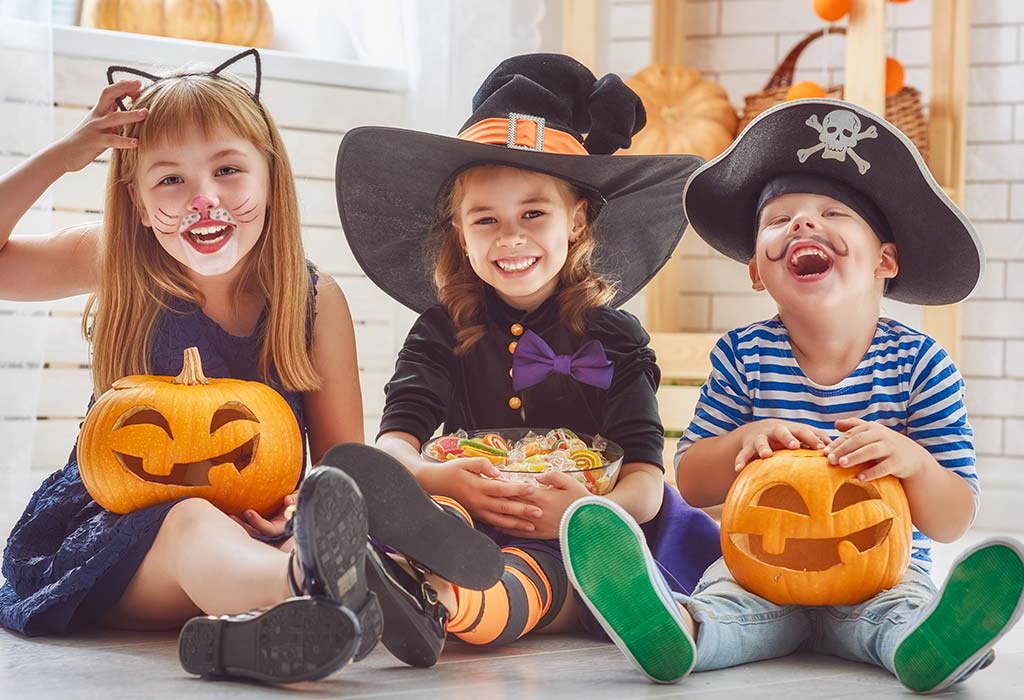
12+ Easy and Scary Halloween Makeup Ideas for Kids
Halloween is the perfect time for kids to get creative with fun and easy makeup looks that bring their costumes to life. Instead of relying only on store-bought masks, face paints and child-friendly makeup can transform little ones into adorable animals, spooky ghosts, friendly witches, or even their favorite superheroes. Parents can use simple, non-toxic paints to create designs like pumpkins, bats, cats, or skeletons without spending hours on preparation. The best part is that makeup allows room for imagination kids can mix and match colors and characters to make their looks unique. Quick designs such as a spider web on the cheek, vampire fangs with red lipstick, or glittery fairy wings are perfect for last-minute ideas. With safe, washable products and a little creativity, Halloween makeup for kids can be both fun and hassle-free, making trick-or-treating extra exciting.
How to Do Halloween Makeup for Children?
Here are some easy ideas your kids could try this year!
1. Pirate
Dress up your little boy as a young pirate!
What You Will Need
Sponge
Brown and yellow eyeshadow
Black eyeshadow for eyebrows
Pencil eyeliner (black or dark brown)
Eyebrow brush
Eyeshadow blending brush
Stippling sponge
Eyepatch
Fake moustache
Eyelash glue, liquid latex
Costume
How to Do
Start by dirtying up the face of your kid with a sponge. The cheeks, forehead, and neck should be smudged by using brown and yellow eyeshadows.
The eyebrows should be darkened using an eyeliner pencil or eyeshadow, making them look unkempt and full. The pirate will look more menacing when the eyebrows are darker and the arch is more severe.
On the eye without the eyepatch, add dark brown eyeshadow below the eye to mimic dark circles.
Add facial hair by dipping sponge into a wet brown eyeshadow or face paint then dab it on the chin and above the lip so that the pirate will have an unshaved look. You could also use a fake moustache instead of the makeup. Stick them using an eyelash glue or spirit gum. Make sure that your child is not allergic to these products.
Finally, you can put together some ripped clothing and add other accessories like a pirate hat, gold coins, or a hook.
2. Lion
Turn your little kid into a roaring lion this Halloween. This could also work for a cat Halloween makeup look.
Image Source : Pinterest
What You Will Need
Face paint kit (with the colours white, yellow, orange, brown, and black)
Wedge or circular sponges
Paintbrush (thin-detailed)
Cup of water
Makeup blending brush
Eyeshadow (brown)
How to Do
Start by dampening a sponge and then pick up some yellow face paint. When you are using dry face paint, make sure you use a wet brush or sponge before dipping into the paint.
With the use of a sponge, include the orange with the yellow paint and try and blend out to create an ombre effect. Paint the orange like brushstrokes to resemble fur.
Apply white paint using a clean sponge under the eyes. Add the colour above the top lip blending them onto the cheeks to resemble the muzzle of the lion.
With dark brown or black paint, darken the eyebrows and thicken them. Focusing on the bottom lip, paint the nose black.
The top lip should be painted black, and the colour must be extended to the cheeks. Add black dots to the white area above the lip, add whiskers, too, with short strokes near the cheek and mouth area.
A line of black paint should be painted under the eyes. This is to create cat eyes.
Shade down the nose using a blending brush and add a few strokes of white to the chin and forehead for a little definition and depth.
3. Bunny Rabbit
This is a really cute and popular type of costume.
Image Source : Pinterest
What You Will Need
White paint
Light pink paint crayons (or) wet light pink paint
Dark pink paint crayons (or) wet dark pink paint
Sponges (large and soft brushes)
Black paint crayons (or) wet black paint
Think brushes
Bunny ears
How to Do
Wash your child’s face to get rid of the grease and the dirt because the paint cannot be applied properly and dirt might mix in it which will change the colour. Make sure the face is all dry, clean, and not greasy and wash the face using soap and water.
Add white patches over the child’s eyelids after the child closes the eyes. Use wet paint and not paint cakes so that it will look blended and smooth.
It is best to use a makeup sponge or a soft, large, puffy makeup brush so that the texture is really smooth.
Add a nose patch using the same paint. For the best nose patch, use a puffy brush or a makeup pad. To add the teeth, use a paint stick or a small brush. This can also be painted with a watercolour pencil dipped in water, but it might not sometimes look very suitable for the child’s face.
When the white paint has dried, outline it with pink. You can use a thin brush, paint stick, or even a wet watercolour.
Add a pink nose and outline everything you did in black. Add little whiskers and whisker dots with the help of a thin brush. You could also add bunny ears and give cute little bunny costumes to complete the outfit.
4. Goblin
Dress your kid as a goblin this year!
Image Source : Pinterest
What You Will Need
White paint
Green paint
Green fake nose and ears (optional)
Hair doughnut
Green lipstick
Brown or green eyeliner
How to Do
Paint the face with white face paint (except for the lips and the brows). Before doing this, make sure your kid is not allergic to the contents in the paint.
Cover the neck and the face with green colour on top of the white coating.
Attach a fake nose that matches the paint colour of the green skin. Put this fake one to cover your real nose. Do the same thing for the ears. Add fake ears on top of your child’s real ones.
Tie your child’s hair into a bun using a hair doughnut on the back of the head.
You can use green lipstick on the lips and line the eyes using a green or brown eyeliner. Place three dots of green colour on the cheeks. The size does not have to be the same.
5. Cobweb Eyes
Spooky spider eyes are an entertaining makeup idea for your kid.
What You Will Need
Foundation
Eyeliner
Pencil Liner
Eyeshadow (sparkly)
Liner brush
How to do
Add a little foundation and rosy blush if necessary onto the face. The eyeliner must be applied thickly below and above the eyes to have a smoky eye effect.
For a really intense look, you can top it off with a pencil liner making sure the skin is completely covered up.
Use a sparkly eyeshadow above the eyelids. Using a fine liner brush, include some dots and then add some arches.
To create the look of cobwebs, cross-hatch the lines. You can also use black mascara for your top and bottom eyelashes.
6. Zombie
Zombie makeup for kids is very easy and does not involve much time.
What You Will Need
Gelatin (optional)
Sponge
Makeup
Pencil eyeliner
Lipstick
Fake blood
Red, green shadow
How to Do
First, prepare the face by washing it using a bar of soap and water. Remove the oil from the skin.
For a zombie-like effect, you can use gelatin to add a few wounds, bite marks, bloody gashes, and broken noses. Gelatin is really easy to work with. This should be done during the makeup process and before you start using paints.
Using a sponge or a soft makeup, cover the face with white paint. Allow the colour to dry completely. For a mottled effect, add extra colour to the white base. This can be grey for a decaying effect and red or purple to add a bruised effect. You can add yellow and green for a gangrenous effect.
Add some dark circles using a dark pencil eyeliner. Blend the edges with red or purple shadow.
Blend black powder or paint in the cheeks to create hollows and get a sunken effect.
Apply dark lipstick with some shadowy lines and draw some bloody-looking scratch using a sponge.
Finally, add some fake blood to the hairline. Splatter it on the face using a blood splatter.
7. Vampire
Vampire Halloween makeup for kids is a really popular look and is easy to create.
What You Will Need
Whiteface paint
Charcoal eyeshadow
Fake blood
Red lipstick
Red eyeshadow or blusher
Makeup sponge
Black eyeliner
Fake fangs
Black mascara
How to Do
Apply white face paint to the entire face. Don’t make it too pasty or sticky but make sure that you apply it lightly.
Use the charcoal eyeshadow on the eyelids and use it up to the eyebrows. The charcoal should be smudged under the eyes for theatrical flair.
Apply red blusher or red eyeshadow below the smudged charcoal under the eyes. Use the sponge to smear the red lightly.
Using black eyeliner, line the lower and upper eyelids. Use black mascara on the eyelashes.
Use red lipstick on the lips because the lips have to stand out from the pale skin.
Sprinkle several fake drops of blood on the edges of the lips and cover the teeth with vampire fangs.
Darken the eyebrows with an eyebrow pencil to increase a theatrical flair.
8. Clown
This one is a classic Halloween costume kid could try.
What You Will Need
Cream makeup (white, blue, pink, red, and yellow)
Flat makeup
Craft brushes
Black eyeliner pencil
Makeup sponges
Red foam nose
Red lip liner
Liquid eyeliner
How to Do
Apply white paint using a makeup sponge to just the nose and eyes. Around the edges of the face, feather the makeup so that it softly fades without having a tough makeup line.
With the help of a makeup brush, draw a half circle of blue over one eye flooring the eyebrow line. Blend the white and blue. Repeat the same design on the other eye using red paint and add yellow to the rest of the brow.
Now make a half circle above the natural eyebrow using black eyeliner. It should be thin at the edges and thick at the centre.
Make three circles of red using a craft brush on one cheek. Draw the circles in different sizes and on the other cheek use pink face paint.
To make a clown mouth, use a red lip liner outside the lips, then fill the lips. Extend the edges and add some circles using black liquid eyeliner to outline them.
Draw some lines using the eyeliner just below the lower eyelid to add some final touches.
9. Fish
This makeup is really exciting to do.
What You Will Need
Sponge
Orange paint
Paintbrush
Black eyeliner or paint
Orange lipstick
How to Do
On the side of the neck and over the cheekbones, use orange face paint using a sponge.
Draw black outlines for the orange paint using a paintbrush to make fin-like designs.
Draw scaled on the chin and the forehead. These should be U-shaped and should be orange-coloured. Outline the scale using black paint.
With a lipstick, draw an orange heart over the lips. Outline it with black paint as well.
10. Bat Mask
Let your kid go as a comic character this year.
What You Will Need
Liquid eyeliner
Black pencil
Eyeshadow
How to Do
Draw a wing using liquid eyeliner. Keep drawing a black, thick line below the eye by connecting the outer corner of the top wing to the inner corner.
Fill the bottom lash wing with shadow. Exaggerate the eyebrows to give a comical look with black eyeliner and give a smoky effect.
With a black pencil, draw the outline of the mask to the centre of the kid’s nose in a V-shape and connect the inner corners of the eye.
Do the same thing on the other side and make it look symmetrical. The black line below must be thick.
The outer corners of the hairline should be connected with your child’s hairline. Following the shape of the brow, draw a wide U-shape over the nose.
Finally, fill this mask with eye paint and outline everything else.
11. Butterfly
This one’s a total hit among girls as it’s their chance to raid mommy’s makeup kit!
What You Will Need
White pencil
Pink, yellow and blue eyeshadow
Makeup brush for each colour
How to Do
Using the white pencil, draw the outline of the butterfly from the tip of the nose upwards towards the forehead and tapering down the cheeks around the eyes.
Add white dots wherever needed to give it a realistic effect.
Use the blue eyeshadow to colour the eyelids and the area around them.
Use the pink eyeshadow and fill in the areas on the forehead and cheeks.
Now, use the yellow eyeshadow to draw semi-circles or borders at the top and base of the butterfly wings.
Complete the look by drawing cute little antennas at the top with the white pencil.
12. Witch
A classic Halloween choice, the witch makeup is both eerie and enchanting.
What You Will Need
Green face paint
Purple and black eyeshadows
Black eyeliner
Red lipstick
Sponge and brushes
How to Do
Start by applying the green face paint evenly all over your child’s face.
Using the purple eyeshadow, create a smoky eye effect around the eyelids.
With black eyeshadow, deepen the creases and add some below the lower lash line.
Draw dramatic eyebrows with the black eyeliner and create a sharp cat-eye.
Finish off with a dark red or even black lipstick for a wickedly beautiful touch.
13. Fairy
Turn your child into a magical fairy with a touch of shimmer and sparkle.
What You Will Need
Light blue and purple face paints or eyeshadows
Silver glitter
Mascara
Pink blush and lipstick
Stick-on jewels (optional)
Brushes and sponges
How to Do
Begin by applying light blue face paint or eyeshadow over the eyelids.
Blend the purple shade around the outer corners and under the lower lash line.
Apply the silver glitter over the eyelids for a magical shimmer.
Add a light coat of mascara to the lashes.
Gently dab pink blush on the cheeks and swipe the pink lipstick on the lips.
As a final touch, add stick-on jewels around the eyes or forehead for extra sparkle.
Children love dressing up for Halloween and going trick-or-treating to collect candy from all the neighbours. Use our tips to create scary looks and amazing Halloween costumes for your kids.
Also Read:
Best Halloween Costume Ideas for Children
Simple and Scary Halloween Party Games for Kids
How to Enjoy Halloween at Your Home with Kids
Read more
10+ Halloween Party Games & Ideas for Kids
Have plans to organize perfect Halloween party games to give children a spooktacular time; you have to first scour the stores for the right costume and build up a candy stash which would make Willy Wonka proud. The ultimate idea is not to make the party games scary or send the children home, terrified to go to bed. You would definitely prefer a party where the fun will be there, and memories would be cherished. The party games would involve objects that you already have at your house. Halloween games are always spooktacularly fun and are great for people of all age groups. Some Fang-tastic games for all the family members make the occasion all the more special.
Fun Halloween Party Games Ideas for Kids
Here are some ideas to organize such games that will be a huge win and will also make you a coveted party planner. A frighteningly fun Halloween party is what you would wish to throw. A list of easy –to –assemble games is given below:
1. Mummy Wrap
It can be one of the best spooky Halloween games for kids. The hilarious game gets everyone into the festive mood of Halloween. The aim here is to wrap up a person using a roll of toilet paper and to make him appear as a mummy before the other team. The children run away when the creepy, scary mummy thus created, chases them.
What You Will Need
Toilet Paper (loads of it )
Scissors (1 for each pair)
How to Play
Pair the kids off, Allot lots of toilet paper for the game to each pair
The pair that wraps the other as a mummy the quickest wins the game
It has to be done perfectly so that the body appears to be absolutely like a mummy
The team which is fastest is also awarded a prize. The game becomes interesting when the mummy tries to chase and scare the little children
2. Guess the Number
There are hundreds of ideas of Halloween games for preschool kids. This game, in particular, is sure to be a big hit for kids and adults alike. It is a great guessing game which can be played in any party. Some Dracula Teeth are kept in a container, and the children are supposed to guess the number right.
What You Will Need
A bowl or a container
Some Candy corn
How to Play
Take some candy corn (Dracula Teeth) in a container
The participants stand in a line waiting for their turn
Children are to be called one at a time to guess on how many Dracula teeth are in the bowl and the answers are to be recorded
The winner is rewarded with a prize on the basis of the right guess
It sounds like so much fun for the little kids who would play the game
3. Eyeball Toss
Many a time scary Halloween games for kids are organised to create spooktacular time. The game not only refreshes the kids but also improves the reflexes of the child. It is quick to set up and play the game involving little babies. They have to play in pairs, and one will throw the eyeball, and the other is expected to catch the same. It is a game about a good partnership.
What You Will Need
Some Solo cups
Some Green grapes (eyeballs)
Blindfold arrangement (a handkerchief or a long sock)
How to Play
The game requires two kids in each team. One child is to be blindfolded and turned around to face away from his partner
The other partner needs to hold a solo cup. The teammate who is blindfolded has to toss an eyeball over his shoulder which the other child should try to catch
The team which catches the most eyeballs is declared the winner
Very young kids can play without the blindfold. It is such an adorable game for the young kids.
4. The Witches’ Limbo
The game is full of zest and vigour which can be a hit in any Halloween party. This brilliant ghostly game is perfect to be played with all family members and friends. All vibrantly attired kids are made to go under the broom. If it happens to touch any part of the body, then the child is made to sit in a cauldron.
What You Will Need
A broom
Some Halloween decorations
Halloween music
A dark cauldron
How to Play
Kids should be dressed up in costumes, and then the Halloween music should be played
A broom should be decorated and all the kids, by turns, should be asked to line up and then they should go under the broom, one at a time
If any part of the body of the participants touches the witches’ broom, they will be asked to sit in a bubbling cauldron
A dark cauldron would be required to fit the children in
The last child who is left to defeat the lowering of the broom is announced as the winner.
5. Pirate Jack’s Right Eye
It is an entertaining indoor Halloween game for kids that help to improve balance and gait. Apart from entertainment, the game can infuse enthusiasm and zeal. The child will be expected to balance a cookie on his eyes and has to eat it with his hands at the back. What a challenge it is!
What You Will Need
Round cookies
How to Play
A round cookie is to be placed over each child’s eye
The first to eat the cookie with his hands behind the back is declared the winner
It is quite difficult to eat the cookie in one minute without using hands
The child is to be disqualified if the cookie falls off the face. It is so easy to play and so much fun to see the small kids trying to balance the cookie
6. Frankenstein’s Cafe
A game to guess and eat as well is perfect Halloween food game for kids. Any Halloween party can be so much more engaging with such kinds of games for the little ones. The little ones have to touch, feel and taste the dishes to guess the name of the dish.
What You Will Need
Creative food
A handkerchief or a long sock for blindfolding
How to Play
The kids are to be made to sit around a table where several kinds of Frankenstein’s Halloween Specials are displayed
The Specials can be Dracula Teeth made with candy corn, Toxic Waste made up of Green Macaroni and cheese, Eyeballs made of grapes and Witches finger with hotdogs
A child who is blindfolded will be served some of the Specials
The child must touch and feel and eat each Special and guess the dish
The child who is not blindfolded, i.e. the partner, has to write down all the guesses
The kid with highest right answers wins the game
The partners can be switched, and different food items can be used to continue the game
7. Pumpkin Bowling
It is a spooky Halloween game for kids which can double up the entertainment quotient. It is a perfect outdoor Halloween game for kids. The children have to bowl into the stacked pins to knock them down to keep adding points. It is quite a challenging game, but kids love to take up challenges.
What You Will Need
Some Pumpkins
A Black Marker
6 toilet paper rolls
How to Play
With the help of the white toilet paper rolls bowling pins are to be created
Spooky ghosts can be created by drawing the eyes and a mouth on the pins
Using a pumpkin, the child has to bowl into the stacked pins
The pins knocked down with a scary ghost face drawn on them are awarded 4 points, and the pins knocked down with a happy face are worth 3 points
The child who scores the highest points based on the worth of the pins knocked down is declared the winner
8. Hut Hut Hoop
This game is a lively and creative game to make the party fun memorable. It will keep all the children excitedly entertained. A zombie style football attracts children, and they love to play the game to test if they can score goals for their teams.
What You Will Need
Hula Hoops
A Toilet paper roll
How to Play
Make use of the ghostly toilet paper as a football
It is a game of football in a zombie style
Instead of making a traditional field goal, two children are to be made to stand on each end with the hula hoop
The team which scores a number of goals wins the outdoor Halloween game.
To make the game spooktacular, children can wear their favourite costume and make the game look scarier
9. Pumpkin Stack Relay Race
This game full of agility for young fitness freaks. It is a wonderful idea of a party game challenging yet easy to play. Children have to race up and down and also stack the pumpkins on reaching the table. Though not easy, it is quite a popular game for all kids to play.
What You Will Need
A table
A Table Coordinator
Some mini pumpkins
How to Play
The game requires two teams of four or more kids
A table has to be set up with 5 mini pumpkins
Each child will require to race down to the table and stack the pumpkins and race back to the starting point
If the stacked pumpkins fall, they will have to be re-stacked
The team which gets 3 or more cycles of pumpkin stacking successfully is declared the winner
The table coordinator is responsible for unstacking the pumpkins to keep the table ready for the next participant
It is a great party game idea for the little ones
10. Bobbing for Doughnuts
This is a great fun game for children to eat and enjoy the Halloween party. When both the things children love are packed in one, it becomes the most sought-after game for a Halloween party. The little ones are supposed to eat the hanging doughnuts keeping their hands at the back. Not at all an easy venture for the kids but as you know, kids love to prove their mettle in every game by trying their best.
What You Will Need
Two chairs or trees
A Rope
Some Doughnuts
How to Play
Take two chairs and tie a rope between them for very small kids
For older kids, tie a rope between two trees high enough for children to reach
Tie two doughnuts about 12 inches apart on the rope
The children need to keep their hands at the back and begin only when a signal is given
The one who finishes eating the doughnut in one minute is awarded a prize for winning
The child has to be disqualified if the doughnut falls off the rope before finishing
11. Webbed Spider Fling
A captivating blend of challenge and the Halloween aura, this game sees children flinging toy spiders onto a hand-crafted web. A delightful way to hone their aim and soak in the festivity.
What You Will Need
String (to craft a makeshift web)
Adhesive tape or thumbtacks
Toy spiders
How to Play
Design a makeshift web on a vertical surface, like a wall or board, using the string and either adhesive tape or thumbtacks.
Position the children at a designated starting line.
Offer each child three tries to land the spiders onto the web.
The objective is to secure as many spiders to the web as feasible.
Rewards await the child with the highest spider count on the web.
12. Mystical Map Quest
Nothing elevates the excitement of Halloween quite like a mystery-filled treasure hunt. Kids decode enigmatic hints to unearth the hidden ‘phantom treasure’. An engrossing activity to fuel their curiosity and sense of adventure.
What You Will Need
Mysterious hints jotted on aged paper
Halloween-themed mini prizes or treats as the treasure
Thematic props or decorations to boost the ambiance
How to Play
Scatter a series of cryptic hints around the party locale. Ensure each hint navigates them closer to the next, culminating in the grand ‘phantom treasure’.
Segregate the children into squads or allow solo participation.
Hand over the inaugural hint and let the thrilling quest commence!
A special prize awaits the child or group that first locates the treasure.
Enhance the allure by integrating thematic decorations at clue junctures or interspersing surprise elements.
Halloween Party Games are a big part of great family memories. The best part about these fun games is that they are all kid friendly and can be altered to accommodate and suit any age group. The cute costumes and lots of goodies add zing to the party. The Halloween Party Games can provide loads of joy and crank the fun up a few notches with such amazing and crowd-pleasing games.
The most awaited part of a Halloween Party is, no doubt, the bursting of a Piñata and be showered with lots and lots of candies and goodies. The Halloween Party games are a perfect occasion to bring creativity to the fore in terms of dressing up in various costumes, decorating pumpkins with lights, playing different games, thus collecting memories to cherish forever. The ghoulish games, tricks, and treats after playing the brilliant ghostly games, fill the children with satisfaction and pleasant memories.
Also Read:
Halloween Costume Ideas for Kids
Scary Halloween Makeup Ideas for Kids
Spooky Ideas To Enjoy Halloween with Your Kids
Read more
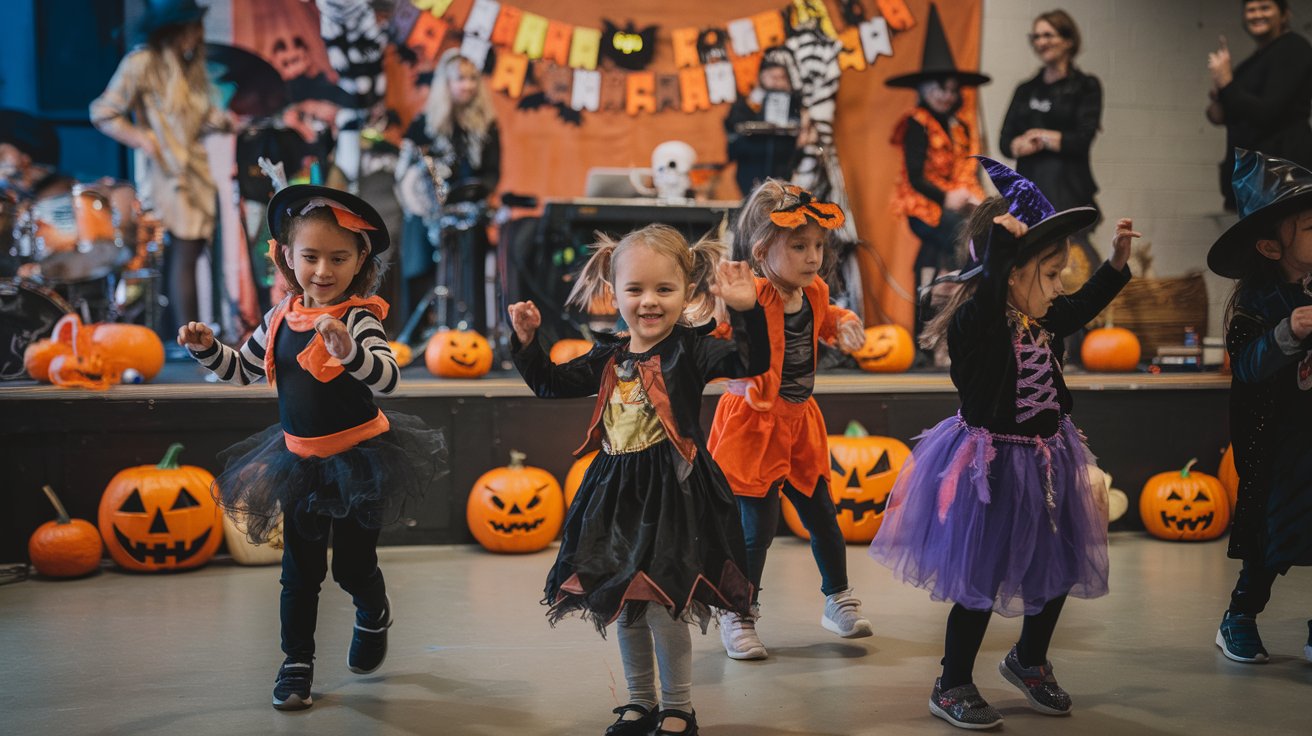
15 Best Halloween Songs for Kids That Will Be Perfect for Party
The smallest of things can get our children excited, and Halloween isn’t a tiny occasion by any means. The dressing up, candies, parties, and endless fun all make it worth waiting. The day finally arrives when you have to plan everything down to the minutest detail.🎃 From spider cookies, monster popcorns, and crispy mummies to spooky decorations and themed costumes, everything demands detailed attention. And music? A party doesn’t count until it has good music. You surely don’t want all your efforts to go down the drain because the kids thought the music at the party was lame. Fret not, as we bring you a list of spook-worthy Halloween songs for kids that can add spark to your Halloween party. These kids Halloween songs will have everyone dancing and singing along, making the party a memorable one for all!🎶👻🎵
Top 15 Halloween Songs for Kids
You can rock the skeletons out of your neighborhood with our list of Halloween kids songs. These kid-friendly Halloween songs, paired with the best Halloween music, will have everyone from ghosts to goblins dancing all night long!
1. Who Took the Candy
Source: Super Simple Songs – Kids Songs (Youtube)
‘Who took the candy’ is an absolutely adorable Halloween song for kids. It mimics the famed rhyme called ‘who stole the cookie’, which is used in the game played by kids. Clapping and jumping around this beat is going to keep the young ones thoroughly excited.
2. Baby Shark Halloween
Source: Bounce Patrol Kids (Youtube)
‘Who took the candy’ is an absolutely adorable Halloween song for kids. It mimics the famed rhyme called ‘who stole the cookie’, which is used in the game played by kids. Clapping and jumping around this beat is going to keep the young ones thoroughly excited.
3. Skeleton Dance
Source: Super Simple Songs – Kids Songs (Youtube)
‘Skeleton dance’ is a fun song that can make your kids go crazy. It is also a super informative song that teaches your children about the bones in our bodies. Educative and foot-tapping, this is a winner for sure!
4. Ten Scary Steps
Source: Katie Cutie Kids TV (Youtube)
Ten Scary Steps is a Halloween song where a woman dressed as Little Red Riding Hood is going to her grandma’s house and at each step that she takes along the way, she encounters scary things like big bad wolf, a witch, a monster etc. Your little one can join the fun by counting along with Red Riding Hood!
5. The Good Times Goose Bumps Motel
Source: Judy Pancoast – Topic (Youtube)
This is a song that you must have on the kids Halloween playlist because it is so peppy and entertaining. You cannot keep your foot grounded with this playful number about the Goose Bumps Motel.
6. Haunted House
Source: Valerie Smalkin (Youtube)
Haunted House is again a vibrant song by Silly Goose and Val from their Halloween album. You can enjoy a fun visit to the haunted house with a witch, a skeleton, and different spirits while dancing to the beats of this song.
7. Haunted House by Little Blue Globe Band
Source: Toddler World TV (Youtube)
This Haunted House is a colourful video song where a bunch of costumed children walk through a haunted house and see a skeleton, a vampire, and a witch who are friendly and invite the children to dance and eat with them.
8. Must Be Halloween
Source: Grin Brigade – Topic (Youtube)
The album ‘Crazy With Happiness’ by Grin Brigade has a lovely song called ‘Must Be Halloween’. No party is complete without explicitly dancing to this Halloween song.
9. The Addams Family Theme Song
Source: Kunio89ro (Youtube)
It is clearly not Halloween without a mention of the fabulous ‘Addams Family’. Who can forget the adorable Mr Gomez, Wednesday, or even Cousin Itt? From the classic cartoons to the 90s movies, this macabre family taught us the basics of Spooksville.
10. The Munsters Theme Song
Source: The Munsters (Youtube)
This is a popular song from the spooky album of – The Munsters’. It is a song that will appeal to all generations of paranormal and spook lovers. It will make a great start or end to your party playlist for sure.
11. Monster Boogie
Source: The Laurie Berkner Band (Youtube)
This monster song for preschoolers is a must-have song sung by The Laurie Berkner Band. When October hits, kids and families turn up to this song for the coming festive vibe.
12. Knock Knock, Trick, or Treat?
Source: Super Simple Songs – Kids Songs (Youtube)
When Halloween comes, it is evident that you will have to prepare for the decorations and costumes. This sweet song takes toddlers on a playful journey of dressing up, decorating, and trick-or-treating. This song encourages kids to do creative stuff on their own with art materials.
13. Ghostbusters
Source: Ghostbusters (Ray Parker Jr) (Youtube)
“Ghostbusters” is a lively and iconic Halloween-themed song performed by Ray Parker Jr. It was released in 1984 as the theme song for the popular movie of the same name. The song’s catchy tune and memorable lyrics, which mention the infamous “Ghostbusters” team and their mission to bust ghosts, have made it a timeless Halloween anthem.
14. Halloween Rules
Source: Car TV (Youtube)
“Halloween Rules” is a cheerful Halloween song designed for kids. It’s characterized by its catchy tune and whimsical lyrics that highlight the various aspects of Halloween festivities.”Halloween Rules” aims to capture the excitement and imagination that surrounds this holiday, making it a favorite among children during the Halloween season.
15. Casper the Friendly Ghost
Source: Star Dandy (Youtube)
“Casper the Friendly Ghost” is a beloved Halloween song that tells the story of Casper, a friendly ghost who doesn’t want to scare anyone. The song portrays Casper as a sweet and kind-hearted ghost, making him an endearing character for children during the Halloween season.
This list is a mix of songs that suits all age groups ranging from toddlers to preschoolers. You may want to do your research and tweak the playlist a bit depending on what age of children will be attending your Halloween festivities. These Halloween songs for children are perfect to set the mood for a fun and spooky celebration. Get that music going and enjoy the best ‘pumpkin party’ ever!
Also Read:
Delicious Halloween Drinks for Kids
Halloween Treat Ideas for Kids
Halloween Makeup Ideas for Children
Amazing Halloween Costume Ideas for Kids
Child-Friendly Halloween Party Games
Spooky Ideas To Enjoy Halloween with Your Kids
Read more
25 Best Halloween Movies For Kids to Watch This Year
Who wouldn’t love to watch a spooky movie on Halloween? 🎃When you have kids at home, you need something to keep them entertained. Once in a while, you can let them watch TV with their friends. There are dozens of fun kids Halloween movies that you can make your kids watch, perfect for keeping them engaged and in the Halloween spirit. From classic favorites to new releases, these Halloween movies for kids are sure to provide plenty of thrills without the chills. Continue reading to find out some fun Halloween movies!
25 Best Halloween Movies for Children
Here is a list of 25 classic Halloween kids movies that are suitable for children of all ages. These kid-friendly Halloween movies will keep your little ones entertained while capturing the spooky fun of the season🎃!
1. Hotel Transylvania
The story of this movie revolves around Count Dracula and his daughter Mavis, who is coming of age. He is the owner of a hotel called Hotel Transylvania. He invites some famous monsters to celebrate the 118th birthday of his daughter Mavis. For Dracula, monsters are not a problem. The problem starts when an ordinary guy, who is a human, comes as a guest in the hotel.
Image Credit: Pinterest
2. Frankenweenie
This stop-motion animated black-and-white movie by Tim Burton has a gloomy and creepy tone with a touch of warmth. The story is about Victor Frankenstein who attempts to bring his dog back to life after it dies in a freak accident. The grief of a dead pet is depicted realistically in the movie. The movie borders on the horror genre and is suitable for big kids.
Image Credit : Pinterest
3. Pooh’s Heffalump Halloween Movie
Pooh along with many more characters from the Hundred Acre Wood, is featured in the movie. They celebrate Halloween, learn to overcome their fear, and work together to save each other from harm. This movie is appropriate for kids of all ages.
4. Monster House
Monster House is an animated family horror movie which is a bit scary but a perfect Halloween movie. In the story, three teenagers try to unravel the secrets of their neighbour’s scary house, which is down the street. There lives a breathing monster that scoops up trespassers. It’s a touching movie but scary too.
5. Monsters, INC
Image Credit: Pinterest
The story is about two monsters, James P. ‘Sulley’ and his one-eyed friend Mike Wazowski, who work for an energy-producing factory Monsters, Inc. Their primary job is to scare kids and make them scream. They think that children are toxic but their opinion changes when a little girl enters their factory.
6. It’s The Great Pumpkin, Charlie Brown
This one is a Peanut’s classic kids Halloween cartoon movies about the popular Halloween traditions in America that appeals to people of all ages. It features the Peanuts gang that dresses up in Halloween costumes. The movie features some mild Halloween imagery such as ghosts and skeletons that are suitable for young viewers.
7. Dear Dracula
It is an animated Halloween movie which can be enjoyed by the whole family. The storyline is based on a novel and revolves around the friendship between a kind Count Dracula and a shy boy. The Dracula feels that he has lost his touch with being his usual scary self and needs someone to remind him of how to be scary. The movie involves themes of kindness and self-confidence throughout.
8. Caroline
This story is about a girl named Caroline, who is adventurous at heart. She finds an ideal world behind a secret door in her new home. But soon she realises that it has dark secrets too. Your kids will love this movie, but we suggest you watch this movie with them while the secrets are being revealed.
9. Mickey’s House of Villains
This movie is a treat for all the Disney fans and features the most wicked villains from Disney movies. Mickey hosts a cartoon fest, and all the popular Disney villains come to his house for the Halloween with plans to take over. They kick out Mickey, Goofy, and Donald. Now, it’s up to Mickey and his friends to fight the villains and earn back his house.
10. The Adventures of Ichabod and Mr Toad
This movie is the adaptation of two classic children’s literature: The Wind in the Willows by Kenneth Grahame and The Legend of Sleepy Hollow by Washington Irving. This Disney double feature has some slapstick violence in the movie, and some of the characters smoke cigars and are shown drunk and passed-out.
11. Alvin and the Chipmunks Meet Frankenstein
Alvin and the Chipmunks Meet Frankenstein is a great movie that your kids watch. The Halloween-themed animation features some spooky adventures such as the chipmunks going to a graveyard and encountering ghosts and scary bats. They also meet the monster who is misunderstood by all as malicious but is actually nice.
12. Casper
One of the most loved movies of all-time, Casper is the sweet story of a ghost who haunts a mansion. When a girl moves into the haunted mansion, he gets a friend and tries to bring himself back to life with an old machine designed to bring ghosts to life. Things don’t go according to plan, and he is forced to stay as a ghost forever.
13. Casper Meets Wendy
Casper, the friendly ghost now gets a new friend; Wendy, the good little witch. Wendy is an unappreciated young witch living with her three aunts who do not approve of her friendly and outgoing personality. The movie has a fun plot and is enjoyable by all.
14. ParaNorman
ParaNorman is a movie that features zombies, corpses, ghosts and witches making it scary for kids. However, the main story revolves around Norman, a middle-school misfit who can communicate with ghosts. He is asked to work with a motley crew to read from a special book and break the curse of a 300-year-old witch on his town and free his people.
15. Scooby-Doo! and the Goblin King
Scooby-Doo and the gang explore a Halloween carnival and are as usual sceptical regarding all the magic and monsters until a washed-up magician discovers the ancient powers of Halloween.
16. Toy Story of Terror
Bonnie and her mother are on a road trip to visit Bonnie’s grandmother. Bonnie brings along Buzz Lightyear, Woody, Rex, Mr Potato Head, and a few other toys with them. When their car gets a flat tyre, they are forced to stay at a roadside motel. As they settle in, they realize that Mr Potato Head is missing. When the others start searching him, they realise that they too are caught up in a mysterious situation.
17. The Nightmare Before Christmas
A stop-motion-animated movie, The Nightmare Before Christmas is an offbeat movie that is considered one of the best family movies out there. It is a musical animation and would be loved by your kids. The story of this movie revolves around Jack who is the king of Halloween Town. Filled with spooky creatures of the dark and a creepy villain, the movie truly captures the spirit of Halloween.
18. E.T.
A friendly Extra-Terrestrial creature, known as E.T., gets stranded on Earth after his ship leaves without him. The E.T. befriends young Elliot and his siblings. The kids fight to protect their friend and help him build a communication device to connect with creatures from his world and dress him up for Halloween. The movie is all about friendship and perfect for people of all ages.
19. Halloweentown
When Marnie Cromwell, a 13-year old, discovers that she is a witch, her life changes forever. The movie involves a few scary scenes. The storyline includes an interesting Halloween adventure and a valuable message.
20. Room on the Broom
This stop-motion animated movie is based on the picture book written by Julia Donaldson. The story is about a friendly witch and her cat. They travel on her broomstick and she invites other animals too.
Image Credit : Pinterest
21. Corpse Bride
Corpse Bride is a stop-motion animated film directed by Tim Burton and Mike Johnson. Released in 2005, it features a darkly whimsical tale set in a Victorian-era village. The story revolves around Victor Van Dort, a young man from a wealthy family who inadvertently finds himself married to Emily, the titular “Corpse Bride.”
22. The Little Vampire
Directed by Uli Edel, The Little Vampire is a family-friendly film released in 2000. Based on the popular children’s book series by Angela Sommer-Bodenburg. Filled with adventure, humor, and heartwarming moments, The Little Vampire combines elements of fantasy and friendship, offering a delightful and engaging experience for young audiences
23. Goosebumps
The Goosebumps movie is based on the popular book series by R.L. Stine. In this spooky and adventurous film, a teenager named Zach accidentally unleashes the monsters from the Goosebumps manuscripts, and he must team up with Stine’s daughter to save the town. This family-friendly movie is filled with fun scares and plenty of action.
24. Wallace & Gromit: The Curse of the Were-Rabbit
In this animated film, Wallace and his clever dog Gromit run a pest control company, and they must track down a giant rabbit that is destroying the town’s crops. Full of humor and charm, this quirky and spooky tale is perfect for younger audiences.
25. Spooky Buddies
This light-hearted Disney movie features adorable puppies who embark on a fun and spooky adventure. When Halloween hits, these puppies must stop the evil Warwick the Warlock and save their town. It’s a cute and entertaining film that’s great for younger kids who love animals.
These 25 fun movies 🎃 are sure to keep your kids occupied this Halloween season. They are great for children of all ages 🎬. From timeless classics to recent favorites, these are some of the best kids Halloween movies that will provide hours of entertainment. The movies are a perfect mix of spooky and funny scenes 👻💀. So watch these movies with your child and have a happy Halloween! 🍬
🎃👻✨𝗛𝗮𝗽𝗽𝘆 𝗛𝗮𝗹𝗹𝗼𝘄𝗲𝗲𝗻 𝟮𝟬𝟮6✨👻🎃
Also Read:
Halloween Books For Children
Best Animated Movies for Children
List of Movies for Kids on Netflix
Funny English Movies for Kids to Watch
Delicious Halloween Drinks for Kids
Halloween Treat Ideas for Kids
Simple Halloween Crafts for Children
Spooky Ideas To Enjoy Halloween With Your Kids
Kid-Friendly Halloween Party Games for a Spooktacular Time
Read more
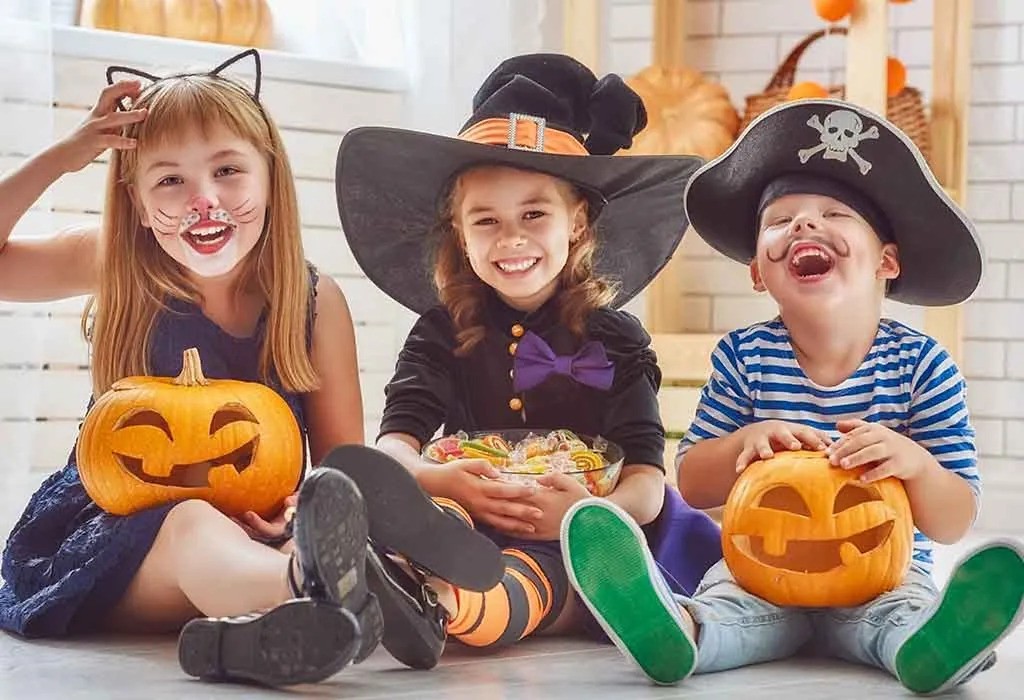
20 Creative DIY Halloween Costume Ideas for Kids
Halloween is an exciting treat for children, not just for the sweets but also for the joy of dressing up in creative costumes and going trick-or-treating with friends. While store-bought costumes can be tempting, they are often expensive, lack uniqueness, and may not last beyond one use. A fun and budget-friendly alternative is to make DIY Halloween costumes for kids, which allows you to get creative while involving children in the process. From spooky to cute, crafting costumes at home adds a personal touch and naturally makes the celebration more memorable.
Simple Homemade Halloween Costume Ideas for Kids
Here we have some easy and cute DIY Halloween costumes for toddlers and children.
1. Pineapple
Image Credit: Pinterest
Pineapple is kids’ favourite fruit and a popular one when thinking of dress-up. It is easy to make in the last minutes with few materials and easy to dress.
What You Need
A yellow T-shirt
A Green chart or poster paper
Green headbands
Instructions
Sew black upside-down Vs onto a yellow shirt. You can use black fabric paint if you don’t have time to sew. The T-shirt should be large sized.
Use green chart paper to cut out different levels to resemble spiky pineapple tops. Roll this up and use some glue to stick it onto the headband.
You can accessorise this dress with a pair of shades if you want a summer vibe.
2. Spaghetti With Meatballs
Image Credit: Pinterest
Spaghetti with meatballs. Sounds delicious! Easy to wear? Yes, definitely. This dress idea is a show-stopper and will make you famous for this idea.
What You Need
Foam balls
Beige-coloured yarn
Brown-red fabric
Glue
One old t-shirt
Instructions
Cover small foam balls with brown-red fabric to give them the shape of meatballs. If you don’t want to use fabric, you can paint the balls similar to meatballs.
For spaghetti, you will need beige yarn. Lots of it! Start glueing your spaghetti to an old T-shirt. Make sure you cover every inch of the t-shirt with the yarn, so it looks like a plate of spaghetti.
3. Witch Hat
Image Credit: Pinterest
The entire witchy outfit is pretty easy to make, and the witch’s hat is the cherry on the top.
What You Need
Witch hat
Ribbons
Black craft paper
An accessory like a brooch
Instructions
Grab a broad headband and wrap a ribbon around it.
Take the little witch’s hat that you have purchased and start decorating. If you don’t have a hat, you can make one with black craft paper.
Make a bow of any coloured ribbon you like and paste it on the hat with a glue gun.
Add a brooch to make it look fancier. Glue it to the centre of the bow.
You can also cut out a cat on the black craft paper and paste it on the headband next to the hat to give it a more witchy vibe.
4. Candy Corn Costume
Image Credit: Pinterest
Candy Corn is a delicious candy loved by every kid and teen. This costume is easy to make, and you will enjoy wearing and dancing in it. It involves some sewing.
What You Need
1/2 yard of yellow, white and orange felt
Yarn for sewing
Instructions
You will need to sew all the strips together. Make the colours in the order of yellow, orange, and white.
With a small plate, trace out a hole to cut out the space for the
Once you have stitched the three together, fold it in half and then cut out the shape of candy corn to fit your child’s body.
You will need to do the same for the piece that covers the back.
Stitch the front and back pieces together and leave holes for the arms.
5. Raining Cats and Dogs
Image Credit: Pinterest
This is one of the easiest Halloween costumes DIY for kids.
What You Need
Craft paper/ stuffed dogs and cats
Umbrella
Raincoat
Rainboot
Instructions
Cut silhouettes of cats and dogs out of craft paper or you want to save time, then you can also use stuffed toys.
Get an umbrella that suits your child’s size.
Stick or stitch the toy/toy cut-outs on top of the umbrella.
Dress your child in a raincoat with rainboots, and you have the Halloween party outfit ready.
6. Rainbow Connection
Image Credit: Pinterest
Making this rainbow costume is relatively easy to make and one of the great last-minute Halloween costumes.
What you Need
Cardboard
Paint colours
Yellow or gold craft paper
Instructions
Grab two pieces of cardboard. You will need to get sizes according to how big you want the rainbow to be.
Cut out the rainbow shape.
First, paint the cardboard white; this will help to get more vibrant rainbow colours.
Draw the rainbow on the cardboard and paint the rainbow with acrylic or poster colours.
Take another cardboard piece, cut out two cloud shapes, and paint those with white colour.
You can use hot glue to stick them to the ends of each rainbow.
Join the front and back pieces together by using a red ribbon.
Make the crown out of yellow or gold craft paper.
Cut the shape out and secure it onto a headband so that it stands still and doesn’t come off easily.
7. Lego Blocks Costume
Image Credit: Pinterest
If your kids love Lego, then this costume idea is perfect for you!
What you Need
Two big cardboard boxes (preferably one square and one rectangle)
Plastic cups
Paint Colours
Instructions
Remove any stickers, etc., from the boxes.
Cut round holes in the square box. You should cut a hole at the bottom the size of your child’s head. This will be the headpiece.
Glue four plastic drinking cups onto the top of the box.
On the rectangular box, cut a hole for the head to go through. Make the armholes here as well.
Glue some solo cups on the front side of the rectangular
Once everything has been cut and glued, paint the boxes of the Lego colour your kid likes.
8. Pac Man
Image Credit: Pinterest
Little gamer children who want to stand out will love getting dressed as PAC Man.
What You Need
Cardboard cutouts
Acrylic paint
Scissor
Glue
Instructions
Use a hula hoop to draw your large circle out on two pieces of cardboard.
Find out where the centre of the circle is and then make a mouth for your PAC Man by forming a triangle.
Make appropriate arm hole sizes on each side of your PAC Man.
You will need to measure your child’s shoulder width, so as to cut out the thickness of the PAC Man.
You will need more cardboard cutouts to glue both the side pieces together.
For the gaping mouth, your cardboard cuts should be of thicker quality.
Once you have cut and taped everything together, you can start painting your PAC Man.
9. Octopus Costume
Image Credit: Pinterest
For a little under the sea fun, you can make this simple octopus Halloween costume. It is effortless and does not involve any sewing.
What You Need
Four pairs of tights – Blue colour
Cotton (for stuffing)
Hat
Black and white paper
Instructions
You will need four pairs of tights the size of your child. Stuff three of them with cotton stuffing. Stuff them until just above the crotch area.
Lay a belt down flat and wrap the top of each pair of stuffed tights around the belt. You can keep them in place by using safety pins.
Get a hat that matches the tights. Cut out some eyes to stick onto the hat. Use white and black paper.
Get a matching shirt to go along with the four tights to look the same colour-
Once your child has worn the shirt and last pair of tights, you can fasten the belt around the waist.
Once the hat is on, you have your cute little octopus ready to go trick.
10. Snowball
Image Credit: Pinterest
A beloved costume among girls, this Snowball dress is an easy DIY.
What You Need
An oversized light sweatshirt – Light blue colour
A winter hat – Light blue colour
Styrofoam/cotton balls
Instructions
Take the Styrofoam balls and glue them on a light blue sweatshirt and matching hat.
Accessorize with matching blue shoes and white stockings.
11. Chimney Sweep
Image Credit: Pinterest
This one is a classic, and your little one will look quite charming as a chimney sweep.
What You Need
Wooden dowel
Pipe cleaners
Black trouser
White Shirt
Black suspender
Newsboy cap
Black eye shadow
Instructions
You will need a wooden dowel and some pipe cleaners.
Stick the pipe cleaners on one end of the dowel in an X shape.
Keep repeating this process but by sticking each cross on the other way.
Once you are done glueing the pipe cleaners, you should glue a black felt on the centre so that all the glue is not seen.
Spray paint the dowel in
Clothe your little one in black trousers, a white shirt with black suspenders, a newsboy cap and smudge some black eye shadow on the face to make it look like a soot-covered face.
12. Peter Pan’s Shadow
Image Credit: Pinterest
Peter Pan is a popular fictional character loved by children of all ages. Many people adorn Peter Pan’s character, but what about his shadow?
What You Need
Black felt
Black feather
Black cardboard
Black scarf
Black tights and top
Instructions
You will need to make the tunic with some black felt material.
Measure your child so you have a rough idea of the measurements you need.
Cut the neck area and feather out the sleeves and bottom to resemble Peter Pan’s tunic.
When you put it on your child, use a black sash to hold it together.
You can make the hat yourself by cutting out two triangles and glueing them together. Fold the edges and attach a black feather.
13. Olaf
Image Credit: Pinterest
This Olaf costume is an excellent pick for the fans of the Disney movie – Frozen. It is easy to make if you run out of time to arrange a costume.
What You Need
White Sweatshirt
White and black felt
Scissor
Glue
Instructions
Use some black felt material to cut out Olaf’s eyebrows.
Cut out large and small black circles with black felt and a white circle to go between the two black circles for the eyes.
Cut out the buttons with black felt and glue them on the sweatshirt.
Make Olaf’s hair with five pipe cleaners.
The nose can be made simply with orange craft paper, or you can use orange felt stuffed with cotton.
14. Hot-Air Balloon
Image Credit: Pinterest
Colourful hot-air balloons never fail to cheer up people. At this Halloween party, you can wear a unique and vibrant costume that will grab everyone’s attention.
What You Need
One big cardboard
4-5 grocery paper bags
Colourful helium balloons – 10
Scissor
Acrylic Paint
Ribbon – 2 metres, wide
Dowel rods – 4
Instructions
Cut the cardboard box’s top and bottom flaps. Make four-inch holes on the bottom of the box using a scissor or knife.
Paint the exterior of the box with a light brown colour and let it dry. After the first paint is dry, paint small boxes on the box using a different shade other than light brown. It should look like a woven basket.
Stick four dowel rods on each end of the box using wood glue.
Using another cardboard, make the top of the board and glue it to dowel rods on the upper side.
Poke two holes in the upper front of the box. Tie each end of the ribbon so that it makes a U shape that you can wear.
Using a wide black marker, write SAND on the four brown paper bags and stuff them with anything light or scrap paper.
Tie the bags with yarn or string and hang them using another string through the holes on the bottom of the box you made earlier.
Take around ten coloured helium balloons and tie them to the upper trim of the box.
15. Statue of Liberty
Image Credit: Pinterest
The Statue of Liberty is America’s pride attraction, which every traveller likes to visit when in the USA. This last-minute Halloween costume is easy to arrange.
What You Need
Foam chair pad – 2 inch
Green Styrofoam cone
Green fabric – 2 yards
Marker
Scissor
A book – any
Flashlight
Instructions
Using a headband, draw and cut out a circle at the bottom centre of the foam.
Around the cut-out circle, draw the crown of the Statue of Liberty and cut out the desired shape. You can make more detailed enhancements as much as you want.
To make the torch of the statue, take the styrofoam cone and cut a hole in the top using any pointed tool. Simply insert the flashlight in the hole.
Wrap around the green fabric and tie the ends at one shoulder. For arms, cut an opening on the other side of the fabric for the arm to come through.
Give a book in your kid’s hand, slip the crown on the head, and voila, you are ready to go.
16. Lightning Bolt
Image Credit : Pinterest
Both girls and boys, alike love this costume idea. The concept is very different from all other costume ideas and children can strike a conversation with each other on this stylish costume.
What You Need
Cardboard/foam board
Stapler
Silver material
Scissor
Instructions
Cut the lightning bold shapes out of the cardboard or foam boards. You can make as many or as few as possible.
You will need silver material to cover all the lightning bolts. The material can be stapled to foam boards or cardboard, so don’t worry if you don’t have sewing skills.
You can then staple these lightning bolts to a plain all-black outfit, so they stand out.
17. Static Electricity
If you have a glue gun at home, you will find that this is one of the quick Halloween costumes for kids.
What You Need
Glue gun
Laundry basket
Hair gel
Random clothing items
Instructions
Grab an outfit you don’t mind ruining and glue some random clothing items to it in random places.
The clothing can be colourful socks, tank tops, baby clothes. Using some good hair gel, spike your child’s hair up as though they have been shocked by electricity.
Instead of a bag, you can use a laundry basket for collecting treats.
18. Jellyfish
Image Credit : Pinterest
Jellyfish are mesmerizing creatures of the sea, and your child can become one with this DIY costume.
What You Need
A clear umbrella
Long strips of light-colored fabric (e.g., tulle or cellophane)
String or fishing line
Adhesive googly eyes
Safety pins or hot glue
Instructions
Remove the fabric from the umbrella frame, leaving just the frame intact.
Attach the long fabric strips to the edges of the umbrella frame using safety pins or hot glue, allowing them to hang down like tentacles.
Stick adhesive googly eyes onto the fabric to create the jellyfish’s eyes.
Secure the umbrella to your child’s shoulder using string or fishing line, so they can carry it like a backpack. Make sure it’s comfortable for them to wear and walk around in.
19. Mermaid
Image Credit : Pinterest
Create a magical DIY mermaid costume for kids with a shimmery tail, seashell top, and a headband adorned with pearls for the perfect under-the-sea look.
What You Need
A long, shimmery skirt or leggings in a mermaid scale pattern or a teal color
A seashell or starfish-shaped bikini top or a shimmery tank top
A long wig in a sea-inspired color like aqua or purple (optional)
Sequins, pearls, and other embellishments (optional)
Craft foam or cardboard for a mermaid crown
Seashell accessories (optional)
Instructions
Dress your child in the mermaid skirt or leggings and the seashell-shaped top.
If desired, embellish the costume with sequins, pearls, or other sea-themed decorations.
Create a mermaid crown by cutting out a crown shape from craft foam or cardboard and decorating it with seashell shapes.
If your child doesn’t have long, flowing hair, consider using a wig in a sea-inspired color.
Accessorise with seashell jewellery or other ocean-themed accessories to complete the look.
20. Mummy
Give your child a classic and spooky mummy makeover with this DIY costume.
Image Credit : Pinterest
What You Need
An old white sheet or strips of white fabric
White clothes for your child to wear underneath
Safety pins or hot glue
Face paint or makeup for a mummy’s face
Instructions
Cut the white sheet or fabric into long strips.
Dress your child in the white clothes.
Wrap the strips of fabric around your child, securing them with safety pins or hot glue to create the mummy’s bandages.
Leave gaps for your child’s eyes and mouth to see and breathe.
Use face paint or makeup to create a mummy-like face, with pale skin and dark circles around the eyes.
The above-mentioned Halloween dress up ideas for kids are super easy and fun to make. Some of the costume ideas are such that you can involve your kids in the making process. This will give them a head start for creativity. Instead of buying from the store, create memories of homemade costumes and teach your kids to be creative and innovative.
Also Read:
Best Halloween Movies for Children
Halloween Makeup Ideas for Children
Halloween Party Games Ideas for Children
Read more
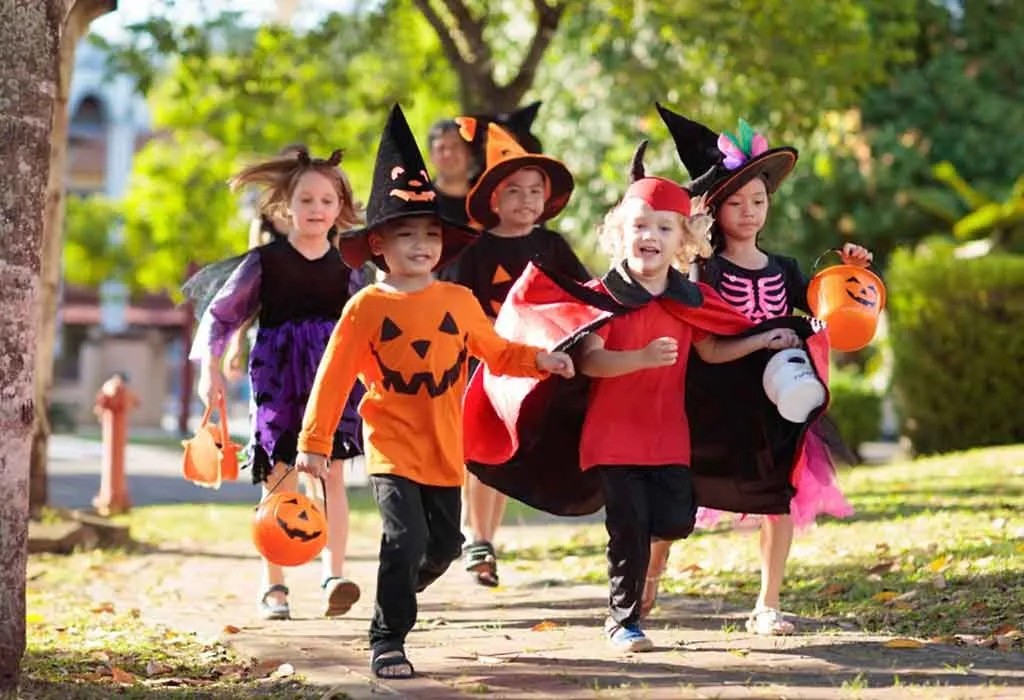
Important Tips for a Safe Halloween Celebration With Kids
Come October and everybody is running around trying to find the perfect Pumpkins, costumes and decorations to make sure their Halloween is the best one they’ve had yet. However, it is important to stay safe on Halloween. It can be easy to get wrapped up with all the fun and frolic around without a care about what is going on around us. Read on to find out tips on how to have a safe Halloween with kids.
Halloween Safety Tips According to the American Academy of Paediatrics
It’s a strange time to be living in due to the pandemic that has swept the world over. This issue could stretch on well into the next few months without a solution in place. While that may be the situation, safety should be of utmost priority for everybody. Here are some Halloween safety tips for parents as well as some Halloween safety tips for kindergarteners.
1. Safe Walking Tips
You might think that walking is easy but since it is a holiday night and many people are out and about, it is important to keep in mind tips about Halloween traffic safety.
While crossing the street, make sure that you cross at corners. While doing so, ensure that you are using the crosswalk and traffic signals. Look left and right before crossing and while you cross to be sure that there is nobody approaching you.
Be careful to watch out for cars that are backing up. Teach children to not run out into the street or run around between parked cars.
Try to take a route with the least number of crossings so that the risk for anything unforeseen is mitigated. Direct routes are generally preferred when kids are around.
Make sure to always stay on the sidewalk and only walk there. In case you find that there are no sidewalks, walk while facing traffic.
Join in on the fun with kids if they are under 12 years of age because they will require supervision. If the kids are mature enough to go trick-or-treating on their own, tell them to be in familiar areas that are lit well. Ideally, if they go in a group, it will be safe.
Try to stay away from electronic devices when you go out because it’s important to be vigilant. Make sure your head is up and that you are not running across the street.
Teach children to make eye contact with drivers before crossing to the road so that they both are aware of what they should do.
2. Costume Tips for a Safe Halloween
Safety in all aspects is important so here are some Halloween costume safety tips to help you out.
Add reflective tape to your costume if possible so that you are visible clearly in the dark.
If you decide to dress up as something with a mask, try and avoid that. Masks can partially block vision which can be a hazard after dark. Try using non-toxic makeup as a substitute.
You can hand the kids some glowsticks or small torches in order for them to cross the street.
Make sure that the costume that the kids choose fits correctly so as to prevent any falls or tripping.
Try to avoid any sharp aspects to the costume like swords or knives to prevent any injury to the kids.
Try to buy flame-resistant costumes. Usually, the costumes will have tags on them that say this.
3. Halloween Pumpkin Carving Tips for Kids
As fun as Pumpkin carving might be, it can be difficult for kids. Make sure to follow these safety tips to have a safe Halloween.
If the kids are too small, do not allow any kind of carving on the Pumpkin. Instead, hand them markers and get them to draw on the pumpkin.
Try to not use candles inside the pumpkins and replace them with glowsticks or LED candles.
Do not place any pumpkins that have candles inside them on any pathway. Make sure that they are not unattended.
In case you decide to allow the kids to carve the pumpkin, you can help with the parts that they want to carve after they have marked out the kind of design they like with a marker.
4. Halloween Candy Safety
Candy is every kid’s favorite part of Halloween. Here are some safety tips to ensure that you have a safe Halloween.
In case you find yourself in the middle of a pandemic, you can ditch the candy bowl altogether. Instead, you can lay out the candy separately on a table for kids to grab and go.
Before going out trick-or-treating, make sure that the kids have been fed. They tend to start munching on the candies throughout the evening and that is never a good idea!
Make sure to get back home and check your child’s bag of candy to throw away anything that is unwrapped, looks unsavoury or spoiled.
Halloween is definitely a fun holiday which is enjoyed equally by both, adults and kids. But like we mentioned, it is easy to get caught up in all the fun and let your guard down. Ensure that you are vigilant and aware of your surroundings at all times. This is even more important in case you are going out with kids. Many kids can be unpredictable and totally ignore safety protocols because they get too wrapped up in the evening. You must be the responsible one to make sure that everybody involved has a safe and fun evening. We hope our safety tips have helped you and that you have a happy and safe Halloween!
Also Read:
Halloween Jokes for Children
Halloween Party Games for Kids
Halloween Costume Ideas for Children
Read more
10+ Easy & Fun Halloween Crafts for Kids
Halloween crafts for kids not only keeps them happily engaged but also sparks their creativity and imagination. Making easy halloween crafts is a wonderful way to bring the festive spirit alive at home. Crafting together naturally doubles the fun, turning a simple activity into a memorable family moment filled with laughter and joy. These fun Halloween crafts can be simple and easy, requiring minimal effort, time, and often just basic supplies found around the house. From spooky yet fun decorations to playful DIY creations, kids will love showcasing their artistic side while enjoying the excitement of the season.
10 Easy Halloween Crafts for Children
Here are some enjoyable Halloween arts for children to keep them amused and entertained for Halloween.
1. Halloween Bat
You can make this amazing DIY Halloween craft using a toilet paper roll and hang it as Halloween decorations.
Image Credit : Pinterest
What You Need:
Empty toilet paper rolls
Black paint
Paintbrush
Black paper
Two googly eyes
Glue or tape
Scissors
How to Make:
Fold both ends of the toilet paper roll inwards.
Draw bat wings on black paper and cut out the shape.
Tape the toilet roll horizontally onto the middle of the cut-out bat wings.
Paint the toilet roll black.
Once it dries, paste two googly eyes on it.
2. Halloween Witch Hat
A witch hat can be one of the fun Halloween paper crafts for kids which they will enjoy flaunting!
Image Credit : Pinterest
What you Need
Black chart paper
Pencil
Scissors
Tape or glue
How to Make
Draw the figure of a witch hat on a black chart paper.
Also, draw some extra shapes like circles, bows, stripes, spiders on the paper.
Help your kid cut along the various shapes drawn.
Paste the cut-outs of bows, spiders, stripes on the hat with glue.
You can stick the hat on the wall as decoration or even wear it as part of Halloween accessories.
3. Egg Carton Spider
This cheap Halloween craft can be fashioned from an egg carton which is usually cast away as waste.
Image Credit : Pinterest
What you Need
Empty egg cartons
Black paint
Paintbrush
Thick black thread or wool
Coloured paper for making eyes
Glue
Scissors
How to Make
Cut out the cups from the egg carton to separate them.
Paint them black and allow them to dry.
Upon drying, punch four small holes on every side of each cup.
Pass through the black thread or wool string from one hole to the other on the opposite side to make the spider’s legs.
Draw two circles on a coloured paper and cut them out.
Stick them on the cup to make spider’s eyes.
4. Paper Plate Spiders
Paper plates can be employed to design spiders with ease. They make for some spooktacular Halloween decorations!
Image Credit : Pinterest
What you Need
Few small paper plates
Paint (any colour)
Googly eyes of varying sizes
Chenille stems
Paintbrush
Glue/stapler
Scissors
How to Make
Paint one side black of two paper plates and allow them to dry.
Chop four chenille stems from the middle to make 8 of them.
Curve each chenille stem a little to form a leg.
Hold the two painted paper plates together and place the chenille stem between them. Staple it down.
Similarly, staple the other legs too.
Close the remaining plates using the stapler.
Paste eight googly eyes of diverse sizes on the uppermost part of your spider.
Punch a tiny hole at the top and insert a string through it for you to hang it as desired.
5. Spider Web Craft
Kids are sure to enjoy turning out adorable spider webs. These are very easy to produce and make for delightful Halloween trinkets.
Image Credit : Pinterest
What you Need
Paint in Halloween colours
Popsicle sticks
Hot glue gun/glue
Yarn in white, black and orange
Scissors
Spider stickers (optional)
How to Make
Set two popsicle sticks in the shape of x and glue them together at the centre.
Take another popsicle stick and place it vertically. Glue the centre point.
Paint all of them black or whichever colour you prefer.
Take a long string of yarn. Tie its one end to any of the popsicle sticks.
Start wrapping the yarn around each popsicle stick.
Once the wrapping is complete, tie the loose end to any popsicle stick.
Do remember to leave a piece of yarn so that you can hang your spider web.
You can add spider stickers to your web to enhance its look.
6. Pumpkin Craft
Your little pumpkin may be superbly entertained creating this pumpkin craft with a recycled item like a toilet paper roll. You can hang it as lantern or kids may simply play with it.
What you Need
Empty toilet paper roll
Green and orange construction paper
Scotch tape/glue
Scissors
How to Make
Cut a small portion off the paper roll as this will form the pumpkin stem.
Next, wrap orange paper about the paper roll to see how much you will need to cover it.
Cut the appropriate size and stick it onto the roll using glue.
Then cut an inch broad strips which will be the pumpkin sides.
Put tiny pieces of tape on both ends of the strips and attach them to the inner side of the toilet roll.
Cut out thinner strips of the orange construction paper to fill in any gaps or openings of the pumpkin.
Be sure while sticking the strips that one side is somewhat flat around the rim so that the pumpkin can sit nicely.
Tape the part of toilet roll that was cut off initially onto the inner surface of the pumpkin.
Cut a leaf using green construction paper and paste it adjoining the stem.
7. Witch Broomsticks
Your kid is bound to get excited making these endearing broomsticks which are so apt for the occasion.
Image Credit : Pinterest
What you Need
Twigs or small sticks
Dried grass
A big stick
Rope
Scissors
How to Make
Gather twigs or small sticks along with dried grass.
Bunch them together, tying with a rope.
Take a big stick and place this bunch at one end of it.
Fasten the bunch to the stick with the rope, making a broom.
Level the ends of the broom by using scissors.
8. Hand Print Witch
This craft can work as a card or invite. You can gift it as a Halloween treat as well.
What you Need
Black, green, orange, brown construction paper
Googly eyes
White card stock
Gold glitter paper
Black sharpie or marker pen
Light brown tube cleaner
Glue stick
How to Make
Trace your kid’s hand on a folded green construction paper in a way that when the card is opened the fingers may be separated.
Cut out the trace and stick it on white cardstock.
Next, cut thin strips of orange construction paper and glue it on the top of the hand.
Cut out a hat shape from black construction paper and paste it above the hair. Be sure to make the hat pointy.
Add on googly eyes. Draw a smile and pointy nose.
Stick a thin strip of gold glitter paper on the hat.
Cut slits on a strip of brown construction paper and wrap it about a pipe cleaner to make a broom.
Paste the broom next to the thumb so that it may appear that the witch is holding it.
You can add a Halloween note inside.
9. Spooky Garland
You can make this cute ghost garland easily in just 5 minutes with easy-to-find materials.
What You Need:
White paper
Scissor
Clear tape
How to Make:
Fold the white paper into around 3-inch sections and make a cute ghost body with a pencil.
Make sure you make the arms, and those arms are connected to the edge of the paper.
Cut the respective shape and open the folded paper, which will now form a garland.
You can repeat the same process with more white sheets and attach the garlands with clear tape if you want a long garland.
10. Monster Halloween Rocks
Painting with kids is always fun. This Halloween, paint some rocks with your kids and give them a twist with a spooky face. You can place them on the dinner table, near the television, or anywhere in the house as a decoration piece.
What You Need:
Flat stones
Acrylic paint
Googly eyes
Glue
Black sharpie
How to Make:
Clean the flat stones with water (to remove any dirt) and let them dry in the open.
Once the stones are dry, paint them with your favourite colour. Let the stones dry.
Use a black sharpie to make to draw monster mouth and vampire teeth on all stones. You can use white paint for the teeth.
Paste uneven googly eyes to give them a funny look.
11. Ghostly Luminaries
Light up your house with these ghostly luminaries. They are simple and fun to create, and kids will adore the eerie glow they emit.
Image Credit : Pinterest
What You Need:
Small glass jars (like baby food jars)
White tissue paper
Mod Podge or white glue
Paintbrush
Black permanent marker
Battery-operated tea lights
How to Make:
Tear the white tissue paper into small pieces.
With a paintbrush, apply a thin layer of Mod Podge or white glue to the outside of the jar.
Stick the tissue paper pieces all over the jar, layering them slightly.
Once dry, use a black permanent marker to draw ghost faces on the jars.
Place a battery-operated tea light inside each jar to create a spooky luminary. Remember to never use real candles for safety reasons.
12. Mummy Mason Jars
Turn simple mason jars into mummified décor. It’s a fun craft activity that also serves as a Halloween decoration.
Image Credit : Pinterest
What You Need:
Mason jars
Gauze bandages or white crepe paper
Googly eyes
Glue
Battery-operated tea lights
How to Make:
Start by cleaning and drying the mason jars.
Begin wrapping the gauze or crepe paper around the jar, ensuring some layers for a mummified look.
Glue the end of the gauze or paper to keep it from unraveling.
Stick two googly eyes onto the jar, peeking out between the gauze wraps.
Pop a battery-operated tea light inside the jar to give your mummy a ghostly glow.
13. Halloween Paper Masks
Making paper masks is a fun Halloween activity for kids. Let them create spooky or funny faces and wear their handmade masks for a little Halloween fun.
What You Need:
Coloured paper
Scissors
Glue
Crayons or markers
Googly eyes
Elastic string
How to Make:
Draw a simple mask shape on coloured paper and carefully cut it out.
Cut out two small holes for the eyes.
Decorate the mask with crayons, markers, googly eyes, or small paper shapes.
Make two small holes on the sides and tie an elastic string to wear the mask.
14. Halloween Toilet Paper Roll Monsters
Turn empty toilet paper rolls into cute and colourful Halloween monsters. Kids can use their imagination to create different funny faces and spooky characters.
What You Need:
Empty toilet paper rolls
Coloured paper
Glue
Googly eyes
Markers
Scissors
How to Make:
Cover the toilet paper roll with coloured paper and glue it in place.
Add googly eyes to the front of the roll.
Cut small shapes from coloured paper to make ears, horns, or hair.
Draw a funny mouth, teeth, or other facial features with a marker.
15. Halloween Popsicle Stick Characters
Popsicle sticks can be turned into fun Halloween characters with just a few craft supplies. Kids can make little ghosts, monsters, pumpkins, or witches.
What You Need:
Popsicle sticks
Acrylic paint
Coloured paper
Glue
Googly eyes
Black marker
How to Make:
Paint the popsicle sticks in Halloween colours and let them dry.
Cut small shapes from coloured paper for the character’s eyes, hat, ears, or mouth.
Glue the paper shapes and googly eyes onto the sticks.
Use a black marker to add small details and give each character a funny or spooky face.
16. Halloween Footprint Ghosts
This simple craft lets kids turn their little footprints into cute Halloween ghosts. It is also a fun way to keep a small Halloween memory.
What You Need:
White paper
Black paint
White paint
Paintbrush
Black marker
How to Make:
Paint the bottom of your child’s foot with white paint.
Carefully press the painted foot onto a sheet of paper.
Let the footprint dry completely.
Use a black marker to draw two eyes and a spooky mouth on the ghost.
17. Halloween Paper Cup Monsters
Give simple paper cups a Halloween makeover by turning them into colourful monsters. Kids can decorate each cup with a different funny face.
What You Need:
Paper cups
Coloured paper
Googly eyes
Glue
Scissors
Markers
How to Make:
Choose a paper cup and decorate it with coloured paper or markers.
Stick one, two, or more googly eyes on the cup.
Cut paper shapes for the monster’s teeth, ears, horns, or hair.
Glue all the pieces onto the cup and draw a funny mouth with a marker.
18. Halloween Monster Bookmarks
Make reading more exciting with these cute Halloween monster bookmarks. Kids can create their own funny characters and use them to mark their favourite pages.
What You Need:
Coloured paper
Scissors
Glue
Googly eyes
Markers
Ruler
How to Make:
Cut a long rectangular strip from coloured paper.
Fold or decorate the top part to create a monster face.
Add googly eyes, paper teeth, ears, or other fun details.
Let the bookmark dry before placing it inside a favourite storybook.
19. Halloween Paper Bag Puppets
Turn simple paper bags into cute Halloween puppets that kids can use to create their own spooky stories and little puppet shows.
What You Need:
Paper bags
Coloured paper
Googly eyes
Glue
Scissors
Markers
How to Make:
Place a paper bag with the flap facing up to make the puppet’s face.
Cut out paper shapes for the eyes, ears, hair, and mouth.
Glue the shapes onto the flap and front of the bag.
Add funny or spooky details with markers and let the puppet dry.
20. Halloween Handprint Monsters
Turn your child’s handprint into a colourful Halloween monster. This easy craft is fun for younger kids and makes a cute decoration for the home.
What You Need:
White paper
Washable paint
Paintbrush
Googly eyes
Glue
Black marker
How to Make:
Paint your child’s palm and fingers with their favourite Halloween colour.
Carefully press the painted hand onto a sheet of white paper.
Let the handprint dry completely.
Stick googly eyes on the fingers and draw a funny monster mouth with a black marker.
Halloween can be an excellent opportunity to generate some fun time for the whole family by getting everyone to do Halloween-themed activities. Make sure everyone invests in equal involvement and participation to work up the Halloween magic. You can set inspiring family traditions for the holidays along with your kids to ensure the best time for your family.
Also Read:
DIY Mask Craft Ideas for Kids
Plastic Bottle Craft Ideas for Children
Fun & Easy Homemade Hat Craft Ideas for Kids
Read more
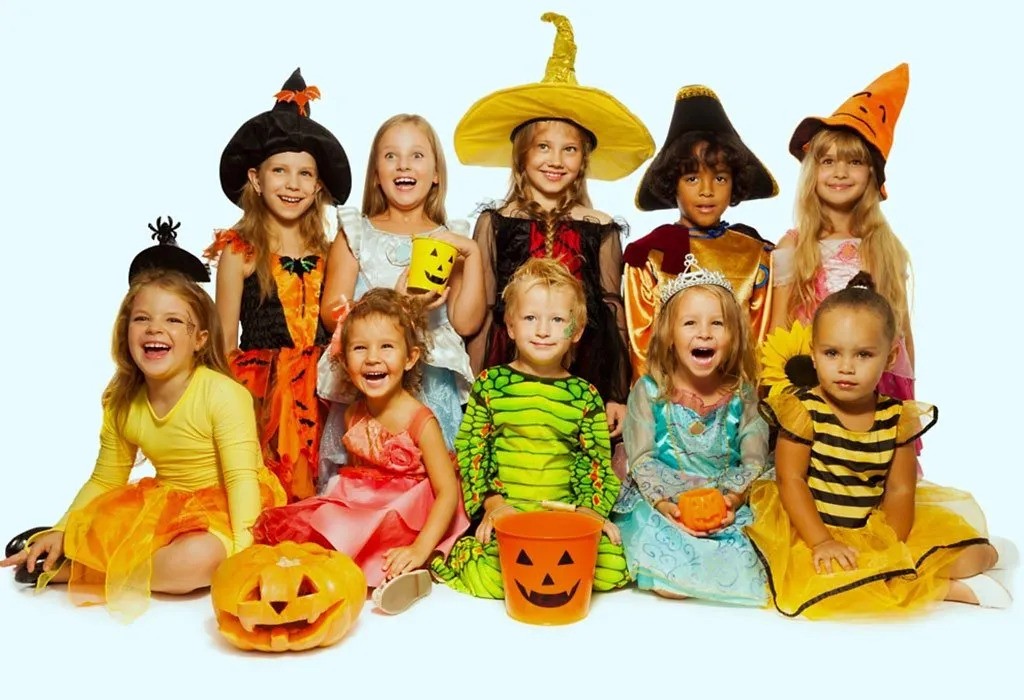
20+ Amazing Halloween Costume Ideas for Kids
When it comes to Halloween, no effort is too much. Homes are decorated to turn them into spooky manors, treats are stocked and the best of all costumes are diligently fussed over. Dressing as the scariest ghoul, banshee, or vampire is every child’s dream.
Halloween is a time for celebrating with the community and is an evening of pure fun and innocence. This holiday is something for which you and your child can work together to make it memorable.
What Is Halloween?
Halloween is celebrated across many countries. It is the shortened form of All Hallows’ Evening which is the eve of the All Hallows’ Day. This day marks the beginning of a three-day period dedicated to remembering the dead, including saints (hallows).
The tradition can be traced back to pagan times though, in recent years, it has taken a more festive and commercial spirit of activities that include trick-or-treating, apple bobbing, carving pumpkins, and of course Halloween costume parties.
Scary Halloween Costume Ideas for Girls and Boys
There are many options available for kids and adults alike when it comes to Halloween costumes. Halloween costume enthusiasts usually have two options. The first is buying a costume from a store or online. This allows for more extravagant costumes with minimal fuss, but can also prove to be generic.
The second option is to create the costume at home with whatever resources you already have. Your child’s costume will be unique and involving your child while designing her costume will give her a sense of pride and accomplishment.
Here, we bring some of the best Halloween costume ideas for children that you and your child can recreate to make a costume that is smashing.
1. Witch
One of the most classic costumes for Halloween, the witch costume has taken the fancy of many young girls especially in the wake of the hugely popular Harry Potter series. A witch costume is simple but its essence lies in the pointy hat. Many stores sell this costume, but you can also make this at home with papier mache. The hat is worn with a dress that has a cape. Stick to colours that are dark, usually black or purple. You can ask your child to help you embellish the cape or the hat or both. Think big and go for bedazzled rhinestones or sequence. Pair with a broom to get into the character.
2. Zombie
Now, this is a look your child is sure to enjoy. All you need is tattered clothes, face painting colours, and a zombie-like visage. You can involve your child in the actual face painting and decide which parts of her face, hands, or feet are decayed (not literally). Use a dark red lipstick to show lips as covered in blood. Don’t forget to master the zombie moan for the full effect!
3. Vampire
This mythical creature has seen a recent surge in popularity due to movies and TV shows that have vampires as their protagonist. There are many vampire costumes you can select from stores or you can also dress your child in a black dress will red highlights. Use powder or face paint to make your child’s face pale and add fangs. Get into the small details to work on your child’s face, like you can show fake blood, dripping from the fangs.
4. Mummy
With recent movies on this ancient Egyptian creature, the Mummy is a hugely popular Halloween character. This look can be achieved by kids easily. Use toilet paper or body bandage rolls to cover the entire body of your child. Use a kohl pencil to darken the rolls. Use a white cloth cut into strips for the head. You can go the extra mile to show organs peeking out from the gaps in the bandage.
5. Carl From Up
Any kid will look adorable when they dress up as the old man from ‘UP’. Use brown pants, white shirt, and a cardigan to get his look right. You can make a walker using pipes and tennis balls for the base. Get kid-size glasses and neatly comb down your child’s hair. Get a few helium balloons and tie them to the waistband for the full effect.
6. Princess
Almost all girls dream of being a princess and Halloween is the perfect excuse to dress up like one. Use a full-bodied flared frock, typically in pink, with embellishments and ruffles. Most stores sell tiaras but you and your child can make a unique crown at home using stock paper and lots of glitters. You can also change this princess look to an angel. Add wings to her dress at the back and make a wand with a star using thermocol.
Do not keep specific princesses like Cinderella or Sleeping Beauty in mind when creating this costume. Let your child come up with a character that she wants to be with the adornments and embellishments used to reflect the personality of this character. You could also create a backstory to keep your child more excited.
7. Katy Perry
If your daughter is a Katy Perry fan, dressing like her would be a dream come true for her. Her music is fun and catchy and she wears the most eclectic clothes. You can get a wig online or at stores with hair that is bright blue or bubble-gum pink. Take a white dress and stick some small shiny disco balls onto the dress with fabric glue. Add a prop mic for the complete look. If your child loves to sing, then encourage her to sing a few chorus lines of Katy Perry’s popular songs. This will encourage her to be more confident.
8. Harry Potter
Most kids would love to dress up as Harry Potter since he is this generation’s favourite wizard. Many stores sell the Gryffindor scarf which you can use as the focal point of the costume. You could also try your hand at knitting, especially if it is something you and your child do together. The rest of the outfit should resemble that of a prep school boy with trousers, white shirt and a sweater vest. Buy round glasses online and draw on a lightning-shaped scar on your child’s face using an eyeliner. Make a wand with a stick and teach your child a few spells from the Potter-verse. In fact, a few magic tricks can go a long way in making this costume a smashing hit.
9. Rockstar
A kid dressed as a rock star is going to look adorable no matter what. Use a dark pair of jeans and have your child sport a black leather jacket with a small guitar. If your child is already learning to play the guitar, then let her carry it with her to complete the look. You can try to portray actual rockstars, though coming up with a character along with your child will be more fun. The jacket can be bedazzled with rhinestones and sequins to add more pizzazz to the outfit.
10. Tinkerbell
This costume can be made easily if you are adept at sewing. Use green felt cloth to make the dress and use gauze and craft wire to make the wings. You can either stitch the wings onto the dress or make them removable if your child is small and will, of course, want to remove those cumbersome wings later. If your child has long hair, then pull it up to make a bun just like Tinkerbell does.
11. Rain Cloud
Making a rain cloud is a simple sewing project. This costume is cute and is perfect for toddlers. Make the cloud from simple white fabric and foam and strap onto the body with Velcro. Cut out blue raindrops from blue felt fabric and stitch onto a dark shade of pants to resemble raindrops falling from the cloud.This costume is comfortable as it is lightweight. Your toddler will not fuss with the costume and she is bound to look adorable in it.
12. Wonder Woman
A cute outfit to reflect the popularity of the DC character, this one will look great in photographs. It is a simple outfit in which you won’t have to work much on the sewing machine or shell out a lot of money. Use blue tulle material to make a tutu-like skirt for the bottom. Buy a kid-size red T-shirt with the wonder woman logo on it, or you could just paint it on any red t-shirt. Embellish the skirt with stars and stones for a glittery effect. Use a long piece of yellow yarn to make the lasso of truth and add silver bracelets to make the Bracelets of Submission.
13. Nerd
This look is easy enough to achieve. Make your child wear high-waist pants with a collared shirt or t-shirt. You can roll up the pants a few inches to show off white socks. Use suspenders to add more detail to the look. Get non-prescription classes to give the final touch to the nerd look. This look will be most effective if your child is otherwise outgoing and well-rounded. His friends are sure to find this look entertaining.
14. Minions
As one of the most beloved children’s characters in recent history, the minion outfit is sure to be a hit. Get your child to help you make this costume from cardboard. Cut out the template of a minion from the cardboard and draw the details of the minion on it. Your child can help you fill in the paint. Leave holes for the arm.
15. Rapunzel
This costume is easy to make and you can involve your child in its making as well. Use a simple dress for the body and buy yellow-coloured yarn for the hair. Use hot glue to stick the yarn together to create the head portion and then braid the rest of the yarn extra-long like Rapunzel’s. This look works best if you stick to simple ballerina shoes and a plain dress that will not grab any attention from the extra-long blond hair.
16. Red Riding Hood
This classic kids’ storybook character is a favourite among many. A red dress and a cloak is what you will need. You can make a gorgeous red cloak for your kid right at home to complete this ensemble. You can stitch this cloak using red velvet fabric or any other red fabric right at home. Make two rectangular pieces out of the fabric, one for the hood and one for the cape. Measure your kid before you cut these pieces. Fold the top ends of the hood fabric and stitch them together to resemble a hood. Now stitch the other end of the hood with the cape fabric to complete the cloak.
17. Dorothy (Wizard of Oz)
This lovely little girl from the Wizard of Oz stole many hearts along with her dog Toto. To dress your kid as Dorothy, you can get a simple white shirt and a plaid blue overalls dress. Some sparkly red shoes and a basket with a toy dog will complete the look.
18. Pirate
Who doesn’t love a pirate look? Pull some striped long-sleeved t-shirts, a black vest, tattered pants, and a pirate hat together for the perfect pirate costume. A black eye patch and a toy sword will work well to complete the costume.
19. Unicorn
Unicorns symbolize magic for most kids, and it is no doubt that your little one would love to dress like one. A unicorn costume is fairly simple if you don’t want to pick out a store-bought one. Simply dress your kid in white pants and a white sweatshirt and a headband with a unicorn horn attached to it. You should even glue a tail made of yarn to her pants for a complete look.
20. Knight
This is a creative idea that will need minimal effort. You’ll only need a grey sweatshirt, pants, your child’s bike helmet, and a shield and sword made of cardboard. You can cover the shield, sword and helmet with tin foil.
21. Mermaid
This mystical sea creature is a popular choice for many young girls. Start with a turquoise or blue-colored skirt or leggings with scale patterns. A matching top or tank top can work as the upper part of the costume. You can embellish the outfit with sequins and glitter to add some shimmer. For the hair, you can opt for a long wig, preferably in shades of blue or green. Consider adding a tiara or a headband with a starfish or shell decoration.
22. Astronaut
Let your child dream beyond the stars with this costume. Use a white jumpsuit or white pants and a white jacket as the base of your outfit. Print out or purchase NASA patches and other space-related badges to sew or glue onto the jumpsuit. A DIY helmet can be made from a clear plastic bucket with a few modifications. Don’t forget to add an American flag patch on the arm.
23. Butterfly
A butterfly costume is both colorful and beautiful. Use multi-colored leggings and a matching top. Wings can be made from lightweight fabric or felt, colored in bright, attractive patterns. Attach the wings to the back of the top using Velcro or ties. A matching antenna headband will complete the transformation from girl to butterfly.
24. Robot
Engage your child’s creative side with a DIY robot costume. Use cardboard boxes as the main body and smaller boxes or tin cans for the arms and legs. Spray paint everything in a metallic shade (like silver or gray) and attach various buttons, switches, and lights for added effect. Cut out holes for the arms, legs, and face. Finish off with metallic face paint and perhaps a voice modulator for robot-like speech.
There is no dearth of ideas that you can try for Halloween costumes for your kids. You can choose to make monsters or characters from movies, or even famous people. As long as your child is excited about the idea and wants to contribute to the making of the costume, you should be happy with the outcome. Keep the costumes so that you can modify them for next year’s outfit!
Also Read:
Kid-Friendly Halloween Party Games
Scary Halloween Makeup Ideas for Kids
Spooky Ideas To Enjoy Halloween with Your Kids
Read more

20+ Creative Grandparents' Day Crafts for Children
Grandparents’ day crafts for preschoolers make for great projects for the kids to create for their beloved grandparents! 👵👴 Watching grandparents bond with their grandchildren is simply a treat to watch! 💖 Won’t you agree? This special occasion is the perfect time to explore some delightful grandparents day art activities. Bring both the generations together with these creative and easy-to-make crafts for Grandparents’ Day that will surely leave lasting memories. 🌟📸
DIY Grandparents’ Day Crafts For Kids
Scroll down to get some inspiring ideas on grandparents day crafts for toddlers and preschoolers.
1. Handmade Card for Grandparents’ Day
Source: Pinterest
This simple and cute DIY handmade card for grandparents is just perfect for the occasion! Your little one can choose to surprise his grandparents with this cute little card, which they would cherish forever!
Materials Needed
Plain white card paper
Paint
Paintbrushes
Pencil
Eraser
Colour pens
Instructions
Get a plain white card paper and draw an image of your choice. Here we recommend drawing beautiful flowers like roses or lilies. Maybe, you can draw something, if your child is too young to draw something.
Next, use bright colours to paint the flowers, stems, and leaves using the paintbrush, and let it dry.
Once this is dry write a cute little message on the card for the grandparents using the colour pens, your beautiful card is ready!
2. Cute Little Clay Photo Frames
Source: Pinterest
These DIY clay photo frames make an excellent gift for grandparents’ day! You can also use it for other special occasions or gifting purposes. Here, we have recommended a magnet, but you can also add a stand and place it on your study table.
Materials Needed
Air-hardening clay in any colour
Decorative gems
Photograph
Card
Glue
Double-sided tape
Magnet
Instructions
Take the clay and roll it out into the shape of the photo frame you would like to make. Kids love to roll the clay so you can let them roll it easily into a flat even shape and then use a ruler if you want to make a square or rectangle-shaped photo frame. For a round shape, you can use a cookie cutter to get the perfect shape.
After you make the desired shape, make a hole in the centre that is a little smaller than the size of your photograph.
With the clay tool or an old pen write your name at the bottom of the clay and affix the decorative stones and gems onto the sides of the clay. Let it harden for a day.
Affix your photograph at the back of the dried clay photo frame with the help of the double-sided tape.
Measure and cut a piece of the card paper and attach it at the back of the double-sided tape. Now, use the glue to stick the magnet on the card paper, and the frame is ready!
3. Family Tree Craft Idea
Source: Pinterest
This family tree would serve as an excellent gift on the occasion of grandparents’ day!
Materials Needed
White card paper
Brown paint
Paintbrushes
Pencil
Eraser
Colour pens
Glue
Green and yellow colour chart paper
Instructions
Draw a large tree with branches on white paper using a pencil. The number of branches should be equal to the number of family members.
Now, let the kids paint the branches and truck using brown paint.
Cut out lots of leaves from the green and yellow chart paper, and on each leaf, draw a member of your family.
Finally, glue the leaves to the tree branches, and the family tree is ready.
4. Family Collage cum Bulletin Board
This family bulletin board is a simple craft but makes for a cute grandparents’ day craft activity.
Materials Needed
Cork notice board
Poster colours
Colour pens
Glue
An assortment of old photographs
Instructions
Use the poster colours to paint the cork noticeboard. Let the kids get creative with this one and paint tiny flowers or a simple background on the notice board. Leave some space to write cute messages here and there on the collage.
Now, help the kids glue the photographs randomly on the bulletin board, carefully avoiding the flowers and leaves.
Once the pictures are dry, the kids can write some cute messages or merely describe something about the grandparents and the photographs affixed on the board.
5. Handprint Painting
Source: Pinterest
A cute keepsake gift for your little one’s grandparents, the handprint painting is a cool and fun DIY that your kids are going to enjoy.
Materials Needed
Plain white card paper
Brown paint
Colourful stickers in the shape of leaves
Instructions
Get a plain white card paper ready. Now, comes the fun part, get the kids and cover their palms and wrists with brown paint.
Stamp firmly onto the paper with the fingers wide open to create the shape of branches of a tree. Let it dry.
Once it is dry, let the kids affix the colourful stickers like the leaves, flowers, and fruits onto the tree branches.
You may choose to frame this painting and gift it to the grandparents.
6. Footprint Magnet DIY!
Source: Pinterest
Simply adorable, these DIY footprint magnets would serve as the perfect gift for grandparents. It’s an enjoyable project to do with your child, and you can change the words on it according to the occasion!
Materials Needed
Cardboard
Chart paper
Glue
Self-adhesive magnets
Pencil
Colour pens
Scissors
Magnet
Instructions
Use a pencil to trace the tiny footprints of your little one onto the cardboard.
Cut out the cardboard in the shape of the footprint and use it to trace the footprint on the chart paper.
Cut out the chart paper and use glue to stick it onto the cardboard.
Use colour pens to write a cute message on the chart paper. If you like, you can decorate it, as well.
Now, apply a magnet to the back of the footprints, and it’s ready!
7. Grandparents’ Day Poem
This one is perfect for kids who love to read or write poems. You can help them formulate cute sentences or messages in the form of a poem or simply get a meaningful poem from the internet.
Materials Needed
Plain white card paper
Colour pens
Photograph
Paint
Paintbrush
Instructions
Get a plain white card paper and affix a photograph, probably one of your kids with their grandparents or a family photo.
Now, ask the kids to write a poem below the photograph using colour pens.
Once the poem is done, ask the kids to paint in the background to decorate it, and once the paint dries, your gift is ready.
8. Paper Plate Memento for Grandparents’ Day
Source: Pinterest
This is an excellent craft idea for toddlers and preschoolers. You may need to help them a bit with cutting the ribbon and helping them write a message neatly.
Materials Needed
Paper plate
Yellow paint
Paintbrush
Marker
Scissors
Hole punch machine
Ribbons or red construction paper
Decorations – pom poms, glitter glue, stickers, etc.
Instructions
Let the kids paint the paper plate using the yellow paint and let it dry.
Once the paint has dried, write grandma/grandpa in the centre of the paper plate.
Next, affix the stickers around the name, preferably things that the grandparents like, something related to their hobbies, interests, favourite food items, etc.
Cut out a pair of ribbons from the construction paper using a scissor. If you’re using a ribbon, just cut it into two uneven sizes.
Now, glue them onto the back of the paper plate, and the gift is ready!
9. DIY Handprint Flower Pot
Source: Pinterest
This is a perfect gift for grandparents who love to plant trees and flowers or enjoy spending their time in the garden.
Materials Needed
Terracotta pot
Acrylic colour paints
White spray paint
Paintbrushes
Varnish
Instructions
Clean the pot thoroughly so that there is no dirt or soil on it.
Next, lightly spray paint the white paint onto the pot. You can do the spray painting as it will be difficult for the kids to apply the right amount of pressure.
Once the pot is dry, cover your kid’s tiny palm with paint and firmly stamp it onto the pot. Make two-three impressions depending on the size of the pot.
The kids can add some more decorations like painting colourful dots on the brim, and you can write your little one’s name on the pot too.
Once the paint dries, your pot is ready to be gifted.
10. DIY Rock Photo Holders!
Source: Pinterest
This one is incredibly easy and absolutely adorable. A beautiful gift that your kid’s grandparents will cherish for life.
Materials Needed
Smooth flat river rocks
Acrylic paint
Paintbrush
Copper wire
Needle nose pliers
Mod-Podge
Instructions
Get the kids to paint the rocks in beautiful bright colours and let them dry. Once dry, they can use tiny brushes to make some dots or designs on the rocks.
Once it is completely dry, apply a layer of mod-podge to protect the paint from getting scratched.
Next, take a copper wire and wrap it a few times around a pen or a marker and straighten out the wire beneath the loop you created.
Wrap the copper wire a few times around the rock.
And that’s it! It’s ready now you can simply stick photos in between the loops!
11. Clay Figure
This could be a fun activity for your child, and the grandparents are bound to love it too! Nothing is more personal than making something for someone you love. No matter what your child makes, it will be special to their grandparents!
Materials Needed
Non-toxic clay
Clay shaping tools
Glitter and other powdered colours
Instructions
Give your child an array of coloured clays.
You can show them a picture or video of clay modelling and help them out if needed.
Make use of clay shaping tools which are child-safe.
Once your figurine is ready, you can decorate it with glitter or other powdered colours.
12. DIY Mud Pot
This will allow your child’s creative side to shine and be the perfect gift for their grandparents. You can either get a potted plant or an empty pot and allow your child to paint on it under your supervision. If the paint is non-toxic, let them paint with their fingers!
Materials Needed
Non-toxic and water-proof paint
Paintbrushes
Tissues
Water
Bowls
Plastic or mud pot
Instructions
Buy a new plastic or mud pot and clean it with a disinfectant wipe.
Give your child paintbrushes, water-proof paint and water.
Allow your child’s creativity to flow. Once your child has painted the pot, leave it out to dry for a few days.
You can then proceed to either add the plant to it or gift it just as it is.
13. Beaded Bracelet for Grandma and Grandpa
These beaded bracelets can serve as a heartfelt gift, made with love by your child for their beloved grandparents. Each bead can signify the beautiful memories and the bond they share.
Materials Needed
String or elastic cord
Multicolored beads
Lettered beads (optional, to spell out “Grandma” or “Grandpa”)
Scissors
Instructions
Measure the string around your child’s wrist to ensure it’s not too long or too short. It’s always better to have a little extra length.
Allow your child to thread the beads onto the string in any pattern they like. They can use lettered beads to spell out “Grandma” or “Grandpa”.
After finalizing the design, knot the bracelet’s end to hold the beads firmly.
Cut off any excess string, and the bracelet is ready to be gifted!
14. Handmade Floral Bookmarks
Craft a set of beautiful bookmarks using pressed flowers and leaves. Kids can forage in the backyard with their grandparents to collect various flower petals, leaves, and small foliage. These can be pressed and placed between laminating sheets to create stunning bookmarks that grandparents can use in their favorite books.
Materials Needed
Pressed flowers
Laminating sheets
Scissors
Hole punch
Ribbon
Instructions
Arrange the pressed flowers and leaves on one laminating sheet.
Place another laminating sheet on top and carefully seal them together.
Cut the sheet into bookmark-sized strips.
Punch a hole at the top and tie a ribbon through it for a finishing touch.
15. Handprint Apron
Source: Pinterest
Turn a plain apron into a cherished keepsake by decorating it with handprints and personalized messages. This is perfect for grandparents who love to cook or garden.
Materials Needed
Plain apron
Fabric paint
Fabric markers
Instructions
Spread the apron on a flat surface.
Have the kids dip their hands in fabric paint and press them onto the apron.
Once dry, use fabric markers to write cute messages or the kids’ names next to the handprints.
16. Family Time Capsule
Create a family time capsule that can be opened on the next Grandparents’ Day. This is a fun and meaningful activity that involves collecting small mementos, letters, and photographs.
Materials Needed
A small box or container
Paper
Photos
Small items
Instructions
Gather small mementos like family photos, letters, or tiny toys.
Place all items into the container.
Seal the container and decorate the outside.
Decide on a future date to open the time capsule together.
17. Painted Rock Garden Markers
Source: Pinterest
For grandparents who love gardening, painted rock garden markers can be a great gift. Kids can paint flat rocks with the names of herbs, flowers, or vegetables and place them in their grandparents’ garden.
Materials Needed
Flat rocks
Acrylic paint
Paintbrushes
Clear varnish
Instructions
Clean the rocks and let them dry.
Paint the rocks with bright colors and write the names of plants on them.
Seal the paint with clear varnish and let it dry completely.
18. Paper Flower Photo Frame
Source: Pinterest
Combine a love for photos with a fun craft by making a paper flower photo frame. This easy project allows kids to create a colorful frame that holds a cherished family photo.
Materials Needed
Cardboard
Colored paper
Scissors
Glue
A photograph
Instructions
Cut out a frame shape from the cardboard.
Create flowers by cutting and folding colored paper.
Glue the paper flowers around the frame.
Place a photo in the frame, and it’s ready to display.
19. DIY Polymer Clay Tray
Source: Pinterest
Create a small tray from polymer clay that can be used by grandparents to hold keys, jewelry, or other small items. This project is both functional and decorative.
Materials Needed
Polymer clay
Rolling pin
Butter knife
Oven
Instructions
Roll out the clay and cut it into the desired shape.
Mold the edges to create a shallow tray.
Bake according to the clay’s instructions and let it cool before gifting.
20. Blowing a Kiss Card
This adorable card features a handprint that represents blowing a kiss. It’s a simple, heartfelt craft that kids can make with minimal materials.
Materials Needed
Construction paper
Scissors
Glue
Markers
Instructions
Trace and cut out the child’s handprint on construction paper.
Fold the fingers down except for the thumb and index finger to create a “blowing kiss” gesture.
Attach the handprint to a card and write a message.
21. Grandparents’ Day Puzzle Art
Create a personalized puzzle using a family photo or a drawing made by the kids. This craft is not only fun to make but also offers an interactive gift that grandparents will enjoy putting together.
Materials Needed
A printed photo or drawing
Cardboard or thick cardstock
Scissors
Glue
Puzzle template or pencil to draw puzzle pieces
Instructions
Glue the photo or drawing onto the cardboard or thick cardstock.
Let it dry completely.
Use a puzzle template or freehand draw puzzle shapes on the back of the cardboard.
Carefully cut out the puzzle pieces.
Place the pieces in a decorated box or envelope for gifting.
FAQs
1. What are some fun Grandparents Day games to play at home?
To make the day extra special, you can organize simple games like a “Grandparents Trivia,” where family members answer questions about their grandparents’ lives. Another idea is a “Memory Scavenger Hunt,” where kids find items around the house that remind them of special moments with their grandparents.
2. What are some engaging craft activities for a Grandparents Day school event?
During a Grandparents Day event at school, students can engage in group crafts like creating a large family tree mural, where each child adds their grandparents’ names or photos. Another idea is to host a craft station where students and their grandparents can work together to create keepsake items like decorated flower pots or memory books.
We hope that you and your kids enjoy indulging in the National Grandparent’s Day craft ideas mentioned above. It’s also fun to involve the grandparents in making these crafts and remember, no matter what those tiny hands make, the grandparents will always treasure it!
Also Read:
Grandparents Day Activities
Importance of Grandparents in Children’s Lives
Grandparent’s Day Quotes for Your Grandma and Grandpa
Best Gift Ideas for Grandparents That Will Make Them Happy
Read more
Grandparents Day Activities – 10 Ways Kids Can Make Them Feel Special
Grandparents don’t require a special day to be remembered – every day with their wisdom and warmth is worth celebrating! National Grandparents’ Day is celebrated in several countries across the world, India excluded – but there’s no reason why it shouldn’t become a regular occurrence here as well!
Grandparents’ Day is the day to make one’s grandma and grandpa feel extra special. The guidance, knowledge and strength children derive from their grandparents are unmatchable. Grandparents and grandchildren often enjoy spending time together, so why not make a day of it? The activities can be a day-long affair, or it can be a series of short and simple activities.
10 Fun Grandparents Day Activity and Games for Children
Love and appreciation can be shown to grandparents by doing fun activities and spending quality time together. Here are a few activity ideas to choose from in order to honour the elderly members of the family. It’s important to teach little children about their grandparents’ lives – that’s how they will understand them and appreciate them more.
1. My Grandparents and Me – A Project
This is a Grandparents Day activity for preschool. The kids should be motivated to read books like ‘Just Grandma and Me’ and ‘Just Grandpa and Me’.
Let the child will speak about his or her grandparents, and an adult will write it down accordingly.
Next, they will have to draw pictures of themselves in the company of their grandparents.
They should be taught how to draw stick figures.
Exclude the head and have the body, arms and legs.
When they complete making the headless stick figures, they should draw pictures with the grandparents holding their hands.
Photos of their faces should be cut out properly and stuck to the stick figures.
The preschoolers can then add flowers or trees in the background.
The completed picture can be presented to their grandparents.
2. Grow Your Own Family Tree
This is an activity that the kids and grandparents can do together.
The kids should be given a large sheet of paper with a tree drawn on it.
The tree should have many branches.
A circle should be drawn for a girl or a square for a boy.
The one doing the activity should write his/her name on it and stick it on the trunk of the tree.
The shapes of all the present family members –grandparents, mother, father, cousins, aunts and uncles are to be stuck on the branches.
Neighbours’ and pets’ names can also be included if desired. The names of ancestors can also be added.
This sheet can be put into a memory notebook.
Let your grandparents tell you the most interesting anecdote related to the members of the family, which can be noted in the memory book.
The parents can also recount what they remember specifically about their grandparents. Thus, this can be one of the best kindergarten Grandparents Day ideas.
3. National Grandparents Day Activity
On such an auspicious day, children should be spoken to about their grandparents. At home or in school, Grandparents Day events should be organised to honour them. Children can discuss:
What makes them special?
What do they call them?
Can they draw a picture of their grandparents?
Give them an idea to make cards for them and some extra cards too for older adults living in assisted-living facilities.
Can they make a small token gift for them?
Can they make a collage out of pictures of older adults cut out from newspapers or magazines?
4. My Special Grandparents
An interesting activity is to record an interview with the grandparents. A questionnaire for it can be prepared in advance, and then the interview can be recorded at a favourite place of their choice.
Is there something about my mom/dad that makes you really proud?
At what age did you get married?
Did you like going to school?
What were your favourite subjects?
What were your favourite games/activities?
What is your advice for me?
5. Cook Together and Gift a Keepsake
It can be really fun if grandchild and grandparent can cook a dessert, meal or snack together. The interesting activity can end with a delicious treat. Grandmothers love to cook what their little grandchildren love and enjoy. The recipe can be written and stuck on a plate to treasure as a keepsake. A warm thank you card can be given to them as a gift for their love and adoration.
6. Handprint Gift Activity With Grandparents
This is another activity that children can do with their grandparents.
You will require a stretched canvas, paintbrush, paint and stencils.
The child’s palm of the left hand is to be painted and pressed near the left corner of the stretched canvas.
Since this is one of the activities for grandparents and toddlers, the paint may be spread on a paper plate, and the child’s hand may be pressed onto it.
The adult’s hand, too, should be painted and pressed near the top left-hand side of the canvas.
When the handprints dry, a lovely and memorable message can be written wishing them health and happiness.
The grandparents would love to treasure such beautiful thoughts of their grandchildren.
7. Sing Along With Grandparents
This is a fun activity that is wonderful for those who enjoy music and singing.
There are special songs written only for grandparents.
Singing the songs is great fun, and it also is full of sentiments and touches their heart.
When kids express such sentimental thoughts in the form of a song, they are filled with tears of joy.
Even better would be to sing along with them rather than dedicate the song to them.
The musical notes work wonders and strengthen the feelings of love for each other, and that is how they can be made to feel special on Grandparents Day.
8. Make it Special With a Forget-Me-Not
A fun-filled activity for grandparents would be to gift a forget-me-not plant. This plant is the official flower of National Grandparents Day. It can be made even more special by painting the child’s hand with washable paint. The handprint made on the pot can make the gift more valuable for them.
9. Family Storytelling Circle
A storytelling session is a wonderful way for kids to connect with their grandparents while learning about family traditions and history.
Ask grandparents to share funny, inspiring, or childhood stories.
Kids can also share their favorite school memories or fun events.
Use a “story stick” or soft ball—whoever holds it gets to share.
End the activity by letting kids illustrate one of the stories on paper.
10. Grandparents Day Bingo
Make the day lively and fun with a simple game of Bingo designed around family and grandparents’ favorites.
Create bingo cards with items like “grandma’s favorite food,” “grandpa’s hobby,” “family recipe,” or “favorite song.”
Call out the clues, and kids can mark them on their cards.
The first to get five in a row shouts “Bingo!” and wins a small prize.
This game gets everyone talking about shared family memories.
Grandparents give their grandkids unconditional love and knowledge. The grandkids, in turn, give purpose to the grandparents’ lives and bring them love, youthfulness, and laughter. So this Grandparents’ Day, help your child celebrate this special bond with one of the activities we have listed!
Also Read:
DIY Father’s Day Card Ideas for Kids
Creative Family Tree ideas & Its Benefit for Kids
Know The Importance of Grandparents in Your Kid’s Life
Best Games To Play On Father’s Day That Kids & Dad Will Enjoy
Read more
18 Childhood Stories of Lord Krishna for Kids
Storytelling helps parents bond with their kids and impart values in a fun and interesting way. There are many stories that parents can narrate to their children. The stories of Lord Krishna are narrated in every household, as children love him and adults adore him in all forms. Here we have mentioned some Lord Krishna stories for children that will help them learn important life lessons, and they’ll want to hear more. Your kids will surely love these stories from Lord Krishna’s childhood! Do let us know in the comments which story your little one liked the most and why!
Stories of Lord Krishna With Morals
Lord Vishnu is a Hindu god who appeared on Earth in nine avatars. Krishna is one of them. Till today, Krishna’s childhood escapades are fondly remembered. Here are short stories of Lord Krishna for kids.
1. The Divine Prophecy
Aeons ago, there lived a king named Ugrasena. He had two children – a son named Kamsa and a daughter named Devaki. Devaki was a good-natured person, but Kamsa had an evil mind. When he grew up, he dethroned his father and put him in jail.
Meanwhile, his sister Devaki married king Vasudeva. As Kamsa was escorting his sister to her in-laws’ place, a voice rang out from the skies – “The eighth son of your sister will grow up to kill you.” Kamsa wanted to put his sister to death to save his life. But Vasudeva begged Kamsa to spare his wife. He promised that he would hand over every child of theirs. Kamsa was pacified and put the couple behind bars.
Moral – You should never disrespect her parents.
2. Krishna’s Birth
Kamsa imprisoned Devaki and Vasudeva and ordered his soldiers to guard the cell. Every time Devaki gave birth to a child, Kamsa would visit the couple and take away their baby. Dashing it to the wall, he would kill it. When Devaki was pregnant for the seventh time, the foetus was miraculously transferred to Rohini’s womb in Vrindavan. Kamsa was told that it had been a stillbirth. Devaki and Vasudeva’s eighth child Krishna was born at the stroke of midnight. This special day is now celebrated as Janmashtami.
Moral – If you give your word, keep it.
3. Krishna’s Foster Home
As soon as Krishna was born, the guards manning Devaki and Vasudeva’s cell went into a deep slumber, and the locks fell open.
Placing baby Krishna in a wicker basket, Vasudeva left for Gokul. When he reached the Yamuna river, he saw that it was flooded due to the pouring rain. But he had to save Krishna’s life. So, without fearing for his own life, Vasudeva started walking across the river. With his every step, the waters receded, and Lord Vishnu’s serpent Adishesha protected baby Krishna from the rain.
When Krishna reached Nanda’s house, he saw that his wife Yashoda had given birth to a baby girl. Slowly, he picked the baby up and placed Krishna in her place. Then, he returned to the prison with the baby. Devaki and Vasudeva had hoped that Kamsa would spare the baby girl because the prophecy had mentioned Devaki’s eighth son. But Kamsa didn’t care. He snatched the baby from their hands and flung her against a wall. Miraculously, the baby transformed into Goddess Durga and informed Kamsa that Devaki’s eighth son was alive and would soon come for him.
Moral – Where there is a will, there is a way.
4. Krishna and Putana
Kamsa was desperate to kill Krishna, so he called for the fearful demoness Putana. He told her to assume the form of a beautiful, young woman and kill all the babies that had been born in the previous ten days. As this gave her an opportunity to instil fear in people’s hearts, Putana readily assented.
Putana entered Krishna’s village. When she heard everybody talking about Yashoda’s newborn, the demoness immediately knew that this was the child she had to eliminate. Distracting Yashoda, she made Krishna suckle on her poison-smeared nipples. The poison did nothing to him, but Putana died.
Moral – Never hurt a person or animal intentionally. You’ll end up paying for it.
5. Krishna’s Love for Butter
Krishna loved eating butter. As he grew older, Krishna started stealing butter from his own house and neighbours’. Yashoda hung up the butter so that Krishna wouldn’t be able to reach it. Slowly, other gopis also followed suit.
Krishna and his friends weren’t the ones to give up easily. They worked out a solution to this. The next time they raided a house for butter, Krishna made his friends form a human pyramid. He reached the top and broke the pot of butter. The friends relished it, much to the anger and disappointment of the gopis!
Moral – Focus on the solution and not on the problem.
6. Nalakuvara and Manigriva
Yashoda was so fed up of Krishna’s antics that, one day, she tied him to a mortar. To free himself, Krishna crawled to the two trees in his courtyard. Then, he proceeded to crawl through the passage between the trees. The mortar got stuck in the gap. Taking advantage of this, Krishna pulled the rope with all his strength. The trees came crashing down and two demigods Nalakuvara and Manigriva emerged. Krishna had freed them from their curse!
Moral – Believe in miracles; they do happen.
7. What’s Inside Krishna’s Mouth?
Once when Krishna and Balarama were playing, the avatar of Lord Vishnu stuffed a handful of mud into his mouth. When Krishna’s friends complained to his mother. Yashoda ran to him and asked him to open his mouth. Initially, he refused to. But when Yashoda gave him a stern look, Krishna obliged.
What Yashoda saw wasn’t mud but the entire universe. That’s when she realised that Krishna was the Lord in disguise!
Moral – Always listen to your parents.
8. Krishna and Kaliya
Every day, Krishna would take his cows to graze by the river. Suddenly, cows started dying after drinking from the river. With his divine power, Krishna realised that the ten-headed serpent Kaliya was poisoning the water with his venom.
He confronted Kaliya and asked him to stop, but the stubborn serpent refused. Krishna dived into the river and emerged dancing on Kaliya’s head. By then, all the villagers had gathered and were anxious for Krishna. Slowly, the Lord became heavier and heavier, until the serpent couldn’t bear his weight any longer. Kaliya’s wives begged Krishna to stop and they left the river, never to return.
Moral – Peace is better than war.
9. Krishna and Arishthasura
One day, a massive bull came to Vrindavan and started attacking the villagers. Nobody knew where it had come from. Everybody started running helter-skelter to save their lives. They went to Krishna for help.
When Krishna faced the bull, he realised that it was possessed by a demon called Arishthasura. Krishna managed to tackle the bull and pierce its horns! Finally, the demon left the bull’s body and bowed to the Lord. He said that he was a disciple of Lord Brihaspati and had been cursed to become a bull as he had disrespected his teacher.
Moral – Always respect your teacher.
10. Krishna and Keshi
After Krishna had defeated the demon Arishtasura, the celestial sage Narada informed Kamsa that Krishna was very much alive and would kill him. Fuming with rage, Kamsa summoned the demon Keshi and commanded him to kill the lad.
Keshi assumed the form of a fearful horse and started terrorising the inhabitants of Vrindavan. Krishna understood that the demon was challenging him to a fight. So, he confronted the horse. On seeing the young lad, the horse charged at him. Krishna, however, caught one of the horse’s legs and threw it a hundred yards away. When Keshi regained consciousness, he charged at Krishna with his mouth open. The Lord pushed his left arm into the horse’s mouth, making its teeth fall out. Then, inflating his arm, he killed it. That was the end of Keshi.
Moral – Face your fears.
11. Krishna and Lord Brahma
Once, Lord Brahma decided to test Krishna’s powers. So, he hid all the children and calves of Vrindavan in Brahma Loka. Krishna was unhappy with Brahma’s doing, and decided to teach him a lesson. So, he assumed the form of all his friends and calves and went to their homes. Nobody could even tell the difference.
When Brahma decided to check the situation in Vrindavan, he was shocked to see all the children and calves. Lord Bramha immediately realised his mistake and asked Krishna for forgiveness.
Moral – As you sow, so shall you reap.
12. Krishna and Govardhan
It was a ritual among the inhabitants of Vrindavan to worship Indra, the god of rain. Once, when preparations were in full swing, Krishna suggested that the villagers should rather worship the Govardhan hill. They assented and started worshipping the hill. This made Indra very angry, and he let his rain clouds loose over the village.
It poured cats and dogs for days on end, and everybody sought Krishna’s help. Unable to see his devotees in plight, the Lord lifted the Govardhan with his little finger. He asked the villagers to take shelter under the hill and stood in that position for seven nights. Indra realised his mistake and apologised to Krishna.
Moral – Always help someone in need, if you can.
13. Krishna and Aghasura
Once, Krishna and his friends set out on a picnic to the nearby forest. While they were enjoying, Aghasura, who was the brother of Putana, appeared at that spot. He had been sent by Kamsa to kill Krishna. The demon assumed the form of a python and made himself as long as a cave and as big as a mountain. Then, he lay in wait.
The cowherd boys, enticed by the beauty of the cave, entered it. Krishna knew that it was Aghasura and tried to warn his friends, but they were in no mood to listen. The demon had plans of closing his mouth once Krishna had entered his mouth. To save his friends, Krishna entered the cave and expanded himself. This suffocated the demon and lead to his death.
Moral – Good advice will stand you in good stead.
14. Krishna Kills Kamsa
Kamsa had been trying to kill Krishna but in vain. So, he hatched another plan. With his servant Akura, he sent a message inviting Krishna and Balarama to the wrestling match at Mathura.
Both of them agreed to attend the event. Once there, Kamsa pitted the brothers against two of his strongest wrestlers. Krishna and Balarama accepted the challenge, and easily defeated their opponents.
Kamsa lost his temper and ordered his soldiers to kill the boys. Hearing this, Krishna jumped into the stands, knocked Kamsa’s crown off his head and dragged him by the hair to the wrestling ring. Desperate to prove his might, the asura challenged Krishna to a wrestling bout. With one blow of Krishna’s hand, Kamsa fell dead. The Lord set his birth parents, Devaki and Vasudeva free, and placed Ugrasena back on the throne.
Moral – Truth and goodness always win at the end.
15. Krishna Miraculously Escapes
When Lord Krishna was a little infant, Yashoda ma had taken him to a village fair. After everyone was done with their lunch, Yashoda left Krishna to sleep underneath a bullock cart. After some time, Krishna woke up to the sound of music. He saw that all the villagers were dancing and so he too started dancing to the beats. Krishna then accidentally bumped against the bullock cart wheel which led to the cart crashing to the ground.
People rushed towards the cart expecting the little boy to be in a bad condition. Surprisingly, they found him still happily dancing to the tunes! Though this incident was one of the first that proved Krishna’s heavenly powers, it was believed that it was a miracle that the little boy was left untouched by the crash.
Moral – Miracles do happen.
16. Krishna and Varuna
Nanda, Krishna’s father, was fasting on one ekadasi. Before sunrise, Nanda went to take a dip in the holy river Yamuna. The servants of the demigod Varuna capture and present him in front of their lord, accusing Nanda of taking a bath in the river at a demonic time.
Krishna and Balrama searched for their father after his sudden disappearance. Then they heard sounds coming from the river and understood that the demigod Varuna had captured their father.
When Krishna visited Varuna, they engaged in a heartwarming conversation. Varuna realised the mistake committed by his servants, apologised to Krishna, and released Nanda immediately.
Moral – Do not take a one-sided decision.
17. Krishna and the Forest Fire
One day, Krishna and his friends went to the forest to play. They were so engaged in playing that they didn’t realise that the forest had caught fire. When they were surrounded by the fire from all sides, they asked Krishna for help. Krishna asked them to close their eyes, and he swallowed the entire forest fire within a few minutes, leaving everyone astonished.
Moral – Always be aware of your surroundings.
18. Shifting to Vrindavan
Village elders and Nanda decided to leave Gokul because Krishna had been attacked twice, once by rakshasi Putana and then by the asura Trinavarta. They decided to go to Vrindavan as they felt unsafe.
All Gokul villagers were getting cautious with repeated attacks and bad omens they had been experiencing for the last few years. Hence, they all, especially Upanand ji, suggested that the entire village leave Brij and move to Vrindavan, a very dense forest next to Govardhan mountain, which was a safer place. All the villagers agreed to the suggestion, and that is how the entire village shifted to Vrindavan.
Moral – Safety comes first and foremost.
FAQs
1. Why Is Krishna Blue?
Krishna drank the poisonous milk of the Putana, who was a demon, when he was a baby, so his skin became bluish.
2. Why Does Krishna Wear a Peacock Feather and Carry a Flute?
Krishna wears a peacock feather as it is a symbol of peace, prosperity and happiness. He carries a flute because Krishna is the God of divine love, and the flute, which is hollow, is the human heart where he plays his tune of love.
3. Why Do Children Love Krishna?
Little Krishna was a small child who was naughty, charming and a giver of love. When kids read or listen to the stories of Him, they do not connect to Him as a divine soul but feel more human and feel as if they know Him like an acquaintance.
4. What Krishna Loves to Eat?
Lord Krishna loves to eat makhan (butter).
5. At What Age Krishna Died?
On February 18, 3102 BC, Lord Krishna breathed his last on the banks of river Hiran. He lived for 125 years, seven months and six days.
Krishna story for kids is a good way to teach them about Krishna’s pastimes. Not only are they interesting, but they also instill morals and values in young minds.
Also Read:
Short Moral Stories for Kids
Story of Birth of Lord Krishna
Mythological Stories for Children
Short Stories of Ramayana for Children
Read more
12 Interesting Ganesh Chaturthi Games and Activities for Kids
Toddlers and pre-schoolers can get excited about just about anything, especially festivals. Ganesh Chathurthi is a grand festival which is celebrated in reverence of the elephant-headed Hindu God – Vinayaka. Here are things you can keep your children occupied with – Ganesh Chaturthi art and craft for kids and increase their enthusiasm about Ganapati Bappa!
Ganesh Chaturthi Activities and Games for Children
Here we list down some Ganpati games for kids and some arts and crafts to help get them into the festive spirit:
1. Lentil Ganesh Art
You can make a beautiful picture using cereals and lentils.
Source: Pinterest
What You Would Require
An outline of Ganesha printed out
3 or 4 different coloured lentils
Glue
How to Do This Activity
Apply glue on the picture of Ganesha, within the outlines.
Use different grains and lentils for different parts, and finish off with a colourful looking Gajanan.
2. Ladoo Treasure Hunt
Create an intriguing treasure hunt that ends with the children finding tasty ladoos.
What You Would Require
Ladoos for all the children.
Clues hidden in different places, leading to the treasure.
How to Do This Activity
Before you begin the ladoo hunt, you must make fun, yet ‘easy to decipher’ clues.
Write clues like ‘With my shoes, I need to wear_______?’ This would lead the child to the sock drawer for their next clue.
Cover as much ground as you can for each child to keep them occupied.
Once children decipher the last clue, they will find the hidden ladoos as their reward.
3. Ganesha – Colour the Drawing
Keep the little ones occupied with the age-old trick of colouring.
What You Would Require
Different printouts of Ganesha
Crayons, sketch pens, paints
How to Do This Activity
Have the children seated in a circle so that they can share colours
Give each one a different picture
Make sure to give them small rewards for their work when they are done
4. Your Very Own Ganesh Avatar
Get the kids to unleash their creativity using their imagination and artistic skills.
Image Source : Pinterest
What You Need
Paper
Pencil, eraser
Colours
How to Do This Activity
Give the children instructions to draw Ganapati as they would envision him in this millennium. While suggesting ideas, ensure that they are not offensive.
Ask them to draw and colour their imaginative Ganesha artwork.
5. Elephant Bookmark
Make a piece of art with symbols or a picture of Ganesha on it, that can be used as a bookmark.
Image Source : Pinterest
What You Need
Watercolour paper
Watercolours
Paintbrush
Black card-paper
Pencil
Eraser
Black Pen
Glue
How to Do This Activity
Create a sketch of Ganesha to mark the occasion.
Have the child trace over the chosen image with a black pen. A waterproof pen is preferable as he can also use paint or watercolour to fill in the details.
Let the child fill in the image with intricate patterns and designs.
Stop here to have a black and white bookmark or colour it further.
Watercolours or paint tubes makes it easier to fill in the details.
Help the child cut along the edge of the image using scissors.
Fold a piece of black card paper. Glue the image cut-out close to the fold. Cut off the excess black card paper.
Now only the image of Ganesh will be visible in the front, and the bookmark is ready.
6. Play-Doh Ganesha
Children can create their own mini Ganesha using clay.
Image Source : Pinterest
What You Need
Play-doh or modelling clay of different colours
How to Do This Activity
Make different sized balls out of play-doh using different colours.
Make Ganesha’s Pedestal by rolling a piece of Doh.
Use a big round of doh to make Ganesh’s stomach.
Use bright coloured doh to make the legs, by rolling it out like logs. Press it onto the stomach in a comfortable-looking posture.
Similarly, roll out the arms and place them on the belly piece.
Use a different coloured, small, round ball to fashion Ganesh’s head and trunk.
Have dark coloured pin sized balls for eyes.
Attach big, flat pieces to the sides of the head as ears.
Make a different coloured crown for his head.
Your child can let his imagination go wild with the various colours and designs that are used to symbolise Ganesha in art.
7. Dressing Up As Ganapati
Dressing up in a fancy costume is an activity that your children would enjoy. You could get them to enact small anecdotes from Ganesha books that they have read.
Image Source : Pinterest
What You Would Require
Trunk shaped masks
Cutouts of different things that Ganesha holds in his hands
How to Do This Activity
Drape your child in a colourful dhoti.
Put on the trunk shaped mask for the child.
Give them cut-outs of what Ganesha holds in each of his hands.
8. Storytelling from Ganesh’s Book
The beloved Vignaharta never ceases to amuse children with all his playful antics. Read some of them to your little ones.
Image Source : Pinterest
What You Would Require
A children’s book on Ganesh with illustrations
How to Do This Activity
You could read out loud from a nice book with stories of Ganesha. Choose from one of the children’s titles mentioned below:
‘Ganesha: The Wonder Years’ by Sourav Dutta and Rajesh Nagulakonda
‘Amma Tells Me About Ganesha’ by Bhakti Mathur
‘Ganesha’s Sweet Tooth’ by Sanjay Patel and Emily Haynes
9. ‘Ganesha Name’ Word Search
Make a fun word jumble that will increase your children’s knowledge about Ganapati.
Image Source : Pinterest
What You Would Require
A puzzle for each child
Pen or marker to find the names
How to Do This Activity
Create a simple jumbled puzzle with different names of Ganapati.
Write all the names on one paper and hand it out with each jumble.
Make the activity a timed one.
10. Flower Decoration for the Festival
Include children in the actual preparations for the festival. They will grow to appreciate their culture and will enjoy celebrating it even when they grow older.
Image Source : Pinterest
What You Would Require
A place from where your children can pick flowers in different colours
How to Do This Activity
Allocate different colours to each child.
Take suggestions from the children on the placement of the flowers.
11. DIY Paper Ganesha
Have hours of fun as you organise a competition to make Ganesha using craft materials.
Source: Pinterest
What You Would Require
Plain paper cup
Pencil
Scissors
Coloured paper
Decoration material
Paint
Glue
Sketch pen
How to Do This Activity
Paint the cup red colour. Now, cut the shape of the ears, trunk and crown from the yellow paper.
Decorate the crown with beads and stones.
Stick the ears and trunk on the cup.
Make eyes using a black sketch pen.
Draw details on the ears and trunk.
Your DIY paper Ganesha is ready!
12. Musical Ganesh Statues
A festive twist on the classic game of “musical statues” with Ganesha-themed music.
Image Source : Pinterest
What You Would Require
Ganesh-themed songs or traditional festive songs.
A music player or speaker.
How to Do This Activity
Ask the children to form a circle and stand apart from each other.
Play the festive Ganesha songs and let the children dance or move around.
Suddenly stop the music, and all children must freeze in their current position like statues.
The child or children who continue to move even after the music stops are out of that round.
Start the music again, and continue until only one child remains, who becomes the winner.
Make sure to reward the winner with a small prize to make it more engaging.
Ganapati is one of the most popular Hindu gods who is welcomed and sent off with much panache. Make sure that you choose crafts ideas that can be preserved and do not pollute our environment. Have fun and enjoy Ganesh Chaturthi with your kids!
Also Read:
Lord Ganesha Names for Boys
Ganesh Chaturthi Wishes and Messages
Lord Ganesha Stories for Children with Morals
Read more
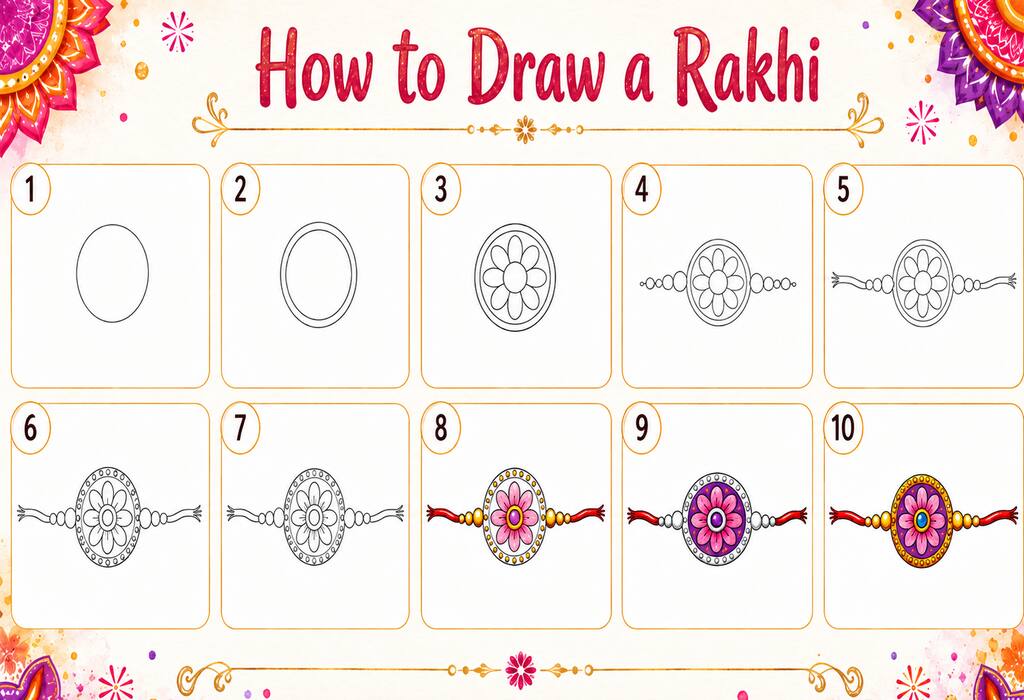
How to Draw a Rakhi: 10 Easy Steps for Kids
How to draw a rakhi is a fun and creative way for children to explore the beautiful tradition of Raksha Bandhan. A rakhi is a decorative thread traditionally exchanged during the festival, representing love, care, and the special bond between brothers and sisters.
In this tutorial, children will learn how to draw a colorful rakhi using simple shapes such as circles, petals, beads, and lines. The drawing is suitable for school projects, festival activities, greeting cards, coloring pages, and Raksha Bandhan decorations.
How to Draw a Rakhi: Easy Step-by-Step Guide for Kids
Rakhi drawing is a fun way for kids to celebrate Raksha Bandhan while exploring their creativity. In this easy step-by-step guide, children can learn how to draw a rakhi using simple shapes, patterns, beads, flowers, and decorative details. The activity is beginner-friendly and perfect for festive crafts, school projects, and coloring activities.
Materials Needed
Before you begin, collect the following materials:
Drawing paper
Pencil
Eraser
Black pen or marker
Ruler
Colored pencils, crayons, or sketch pens
Gold or silver color
Optional glitter or decorative stickers
Start with a pencil so that you can easily erase or correct the drawing.
Step 1: Draw the Center Circle
Begin by drawing a medium-sized circle in the center of your paper. This circle will become the main decorative part of the rakhi. Try to make the circle as smooth as possible. You may lightly trace around a round object if you need help.
Step 2: Add a Second Circle
Draw another circle around the first circle. This creates a border for the central rakhi design. The two circles should be close together and evenly spaced. This outer ring will later be decorated with dots, beads, or patterns.
Step 3: Draw the Flower Design
Inside the center circle, draw a small circle. Around it, add several oval-shaped petals to create a flower. You can draw six, eight, or ten petals depending on the design you want. Try to keep the petals similar in size. This flower will give the rakhi a traditional and attractive appearance.
Step 4: Add Decorative Beads
Draw small circles on both sides of the central design. These circles represent decorative beads attached to the rakhi.Beads make the rakhi look colorful and festive.
You can use different sizes:
One large bead near the center
Two medium-sized beads beside it
Several smaller beads toward the ends
Step 5: Draw the Rakhi Threads
Use two long, slightly curved lines extending from the left and right sides of the central design. These lines represent the colorful thread or ribbon used to tie the rakhi. You can make the threads straight, wavy, or braided. At the end of each thread, draw a few short lines to show loose decorative strands.
Step 6: Add Small Patterns
Decorate the outer circle with small dots, lines, triangles, or leaf shapes.
You can also add:
Small flower petals
Star shapes
Curved lines
Tiny circles
Geometric patterns
Keep the design balanced by adding similar patterns on both sides of the rakhi.
Step 7: Add Extra Details
Now improve the drawing by adding fine details.
You may draw:
Lines inside the petals
Small circles in the center
Curved patterns around the border
Lines on the beads
Decorative shapes on the thread
These details make the rakhi appear more carefully designed.
Step 8: Color the Threads and Beads
Start coloring the outer parts of the rakhi.
Bright colors work especially well, such as:
Red
Pink
Orange
Yellow
Purple
Blue
Green
You can color both threads the same color or use two different colors. For the beads, try using gold, yellow, silver, or orange.
Step 9: Color the Center Design
Color the flower and the inner circle carefully.
For example:
Use pink for the petals
Use purple or blue for the center
Use orange or gold for the outer border
Use yellow for the decorative dots
Try coloring in one direction to keep the drawing neat.
Step 10: Outline and Finish the Rakhi
When the colors are dry or complete, outline the main design with a black pen or dark marker.
Trace carefully around:
The outer circle
The flower petals
The beads
The threads
The decorative patterns
Erase any extra pencil marks. You may also add a little glitter or metallic color to make the rakhi look festive. Your colorful rakhi drawing is now complete.
Fun Ways to Decorate Your Rakhi Drawing
After drawing the rakhi, children can turn it into a complete Raksha Bandhan artwork.
They can:
Draw a gift box beside the rakhi.
Add flowers and stars around the design.
Write “Happy Raksha Bandhan.”
Draw two siblings celebrating together.
Create a Raksha Bandhan greeting card.
Paste the drawing on colored paper.
Add cotton, glitter, sequins, or small stickers.
FAQs
1. What is the easiest way to draw a rakhi?
The easiest method is to begin with a large center circle, add a smaller circle and flower petals, then draw beads and threads on both sides.
2. Which colors are best for a rakhi drawing?
Bright colors such as red, pink, orange, yellow, purple, blue, and gold work well for a festive rakhi.
3. How can I make my rakhi drawing look realistic?
Add shadows to the beads, use darker outlines, include small decorative patterns, and use gold or silver colors for the border.
4. Can this drawing be used for a school project?
Yes. It can be used for Raksha Bandhan homework, festival artwork, greeting cards, classroom displays, and coloring activities.
Drawing a rakhi is a simple and enjoyable way for children to celebrate Raksha Bandhan. By using basic shapes and following each step carefully, anyone can create a colorful rakhi design.
Start with the center circle, add the flower and beads, draw the threads, and finish with bright colors and decorative details. Most importantly, enjoy the creative process and make the design your own.
Also Read:
Story of Raksha Bandhan
Essay on Raksha Bandhan
Raksha Bandhan Gift Ideas
Rakhi Making Ideas for Kids
Read more
10+ Best Krishna Janmashtami Activities and Celebration Ideas For Kids
“Mayya Mori, Main Nahi Maakhan Khaayo…” Can you hear faint strands of Lord Krishna’s famous reprise in the backdrop? No wonder, Janmashtami, or Baal Gopal’s birthday, will soon be here on September 6! If your little one is driving you up the wall with kitchen raids, wall art and soiled clothes, try and think of it as his Baal Leela and gear up for Janmashtami!
One of the major festivals of the Hindu calendar, Janmashtami is celebrated across India. Such is the charm of Mohana or Govinda or no matter which of the 108 names you address him by! This is also an occasion you should celebrate with your children. After all, they leave no stone unturned to carve their own exciting adventures every day, no less than the playful hero of Gokul!
Krishna Janmashtami Celebration Ideas and Activities
These 15 Janmashtami celebration ideas are awesome and will make your Gokulashtami a memorable one.
1. Help them decorate the puja room
Children love bright colours and anything that triggers their creativity. Why not let them help you set up the Krishna jhoola (swing) or singhasan (throne) and decorate it with flowers, sandalwood and jasmine garlands? Your munchkins will love dressing up Krishna in a colourful outfit, complete with jewellery and a flute. You can also help them make cows of mud for the background and add some tufts of grass. Perfect Gokul setting right in your home!
Image Source : Pinterest
2. Tell them a thrilling Mahabharata story
What would Mahabharata be without the wise, mischievous and delightful Krishna? Right from his adventurous childhood, where he got the better of Putna Rakshashi (demoness) and Kaliya Naag (giant serpent), to Kurukshetra, where he was the charioteer of the brave warrior Arjuna, Krishna’s stories are full of excitement. Watch your kids be enthralled (and also learn about Indian mythology).
3. Help them draw stunning peacocks
Think Krishna and a beautiful peacock feather comes to mind. The story goes that once when Krishna was playing his flute, the melody made the peacocks dance in joy. It was then that the Peacock King offered his feathers as an offering – a gift Krishna wore ever since. Legend aside, peacocks can be fun to draw and paint as well. Guide your artists to paint some with watercolours or good old thumbprinting techniques. They can also pose with their artwork, dressed up as Krishna or Radha!
4. Whip up some Janmashtami special treats
No Indian festival is complete without special delicacies. If you fast on Janmashtami, consider whipping up some upvaas-special food that the kids will adore. A complete meal plan could be Sabudana Pakora, Jeera Aloo, Seviyan Kheer and Cucumber Raita. Also make some Shrikhand, Milk Cake and Kalakand. Krishna loved butter, ghee and all things milk. Watch the plates being devoured as “Govinda Aala Re” plays in the background!
Image Source : Pinterest
5. Prepare a skit
Everyone loves a good skit. So once you regale your children with the lovely stories of Krishna, you can help them prepare a skit portraying his birth. You can help them design the lovely costumes and write dialogues for the scenes. And that’s not all! You can even perform in the skit with your children!
Image Source : Pinterest
6. Watch the celebrations in the neighbourhood
If you live in a neighbourhood where Janmashtami is celebrated with gusto, there will be lots of confetti and light. The festival has a special charm in the cities of Mathura, Vrindavan and Dwarka, where cultural activities and the widely popular Dahi Handi take centre stage. In South India too, the day is celebrated with great joy. Go out and see the decorations with your family. You’ll get lots of click-worthy moments, not to forget memories.
Image Source : Pinterest
7. Decorate a curd pot
One of the most popular and most loved traditions associated with Janmashtami is Dahi Handi. People go all out in decorating their pots beautifully on this day with the help of flowers, beads or chalk. For your very own curd pot, you can ask your children to decorate a curd pot using their imagination, and without giving them too many instructions. You’ll be surprised to see their very creative sides!
Image Source : Pinterest
8. Dress up like Krishna or Radha
Children love playing role dress-up play games. Lift up the festival spirit by dressing your little ones as little Krishna or Radha. You can also prepare them for an act relating to the life of the two deities. Make them wear colourful traditional dresses and accessories. Play Janmashtami songs and let your children dance.
Image Source : Pinterest
9. Radha-Krishna Dance-off
Organize a dance off where kids can learn and choreograph dances inspired by Radha and Krishna’s love stories. Teach them graceful moves that capture the spirit of devotion and joy. This activity not only fosters creativity but also allows them to express their admiration for the divine love between Radha and Krishna.
Image Source : Pinterest
10. Krishna’s Scavenger Hunt
Organize a scavenger hunt inspired by Krishna’s love for nature. Provide a list of natural items like leaves, flowers, and pebbles that kids need to find in their surroundings. As they embark on this adventure, discuss how these elements connect to Krishna’s life and teachings. These diverse ideas offer engaging and meaningful ways for kids to celebrate Krishna Janmashtami, fostering creativity, learning, and connection with the spiritual essence of the festival.
11. Krishna Bhajans and Songs
Fill the celebration with music by teaching the children simple, catchy Krishna bhajans or devotional songs. Create a mini-performance where kids sing and dance along, connecting with the rhythm and spirituality of Krishna’s divine presence.
12. Rangoli Making
Let creativity blossom as children craft colorful rangolis. Provide them with materials like colored powders, rice, or flower petals. Choose a Krishna or peacock-themed design for the rangoli, encouraging the kids to collaborate and bring a burst of color to the celebration.
Image Source : Pinterest
13. Krishna’s Childhood Games
Organize games based on Krishna’s mischievous childhood. Play “Hide and Seek” to symbolize Krishna’s ability to be elusive, or “Ring Toss” with peacock feathers. These games are a fun way to engage kids while reflecting on the spirit of Krishna’s childhood pranks.
Image Source : Pinterest
14. Craft a Clay Idol of Lord Krishna
Allow kids to craft their own miniature idol of Lord Krishna using clay. This hands-on activity gives them a chance to get creative while learning about the significance of Lord Krishna in a fun and artistic way. Once the idols are complete, they can be painted and decorated, and you can even host a mini puja to celebrate their efforts.
Image Source : Pinterest
15. Visit to the ISKCON Temple
Take the kids on a spiritual trip to an ISKCON temple to experience the festive atmosphere. Let them witness the grand celebrations, chant bhajans, and enjoy the darshan of Lord Krishna. It’s an enriching experience that gives kids a deeper understanding of the cultural and religious significance of Krishna Janmashtami.
Image Source : Pinterest
The ways to celebrate Janmashtami with children are several, all of them rewarding. Bring magic home this year by going the extra mile and celebrating Krishna Janmashtami with kids. Festivals are terrific in how they bring the family together. Plus, everyone’s doubly happy when the little Baal Gopal of the house is pleased!
Also Read:
Story of Lord Krishna’s Birth
Childhood Stories of Lord Krishna
Dressing Your Baby as Lord Krishna
Child’s Safety In Dahi Handi Festival
Read more
Sort By
 Latest
 Most Popular
 Trending
Please select atleast one Filter