

















.svg)
.svg)
.png)


Baby Sleep Basics
Suggested articles for you
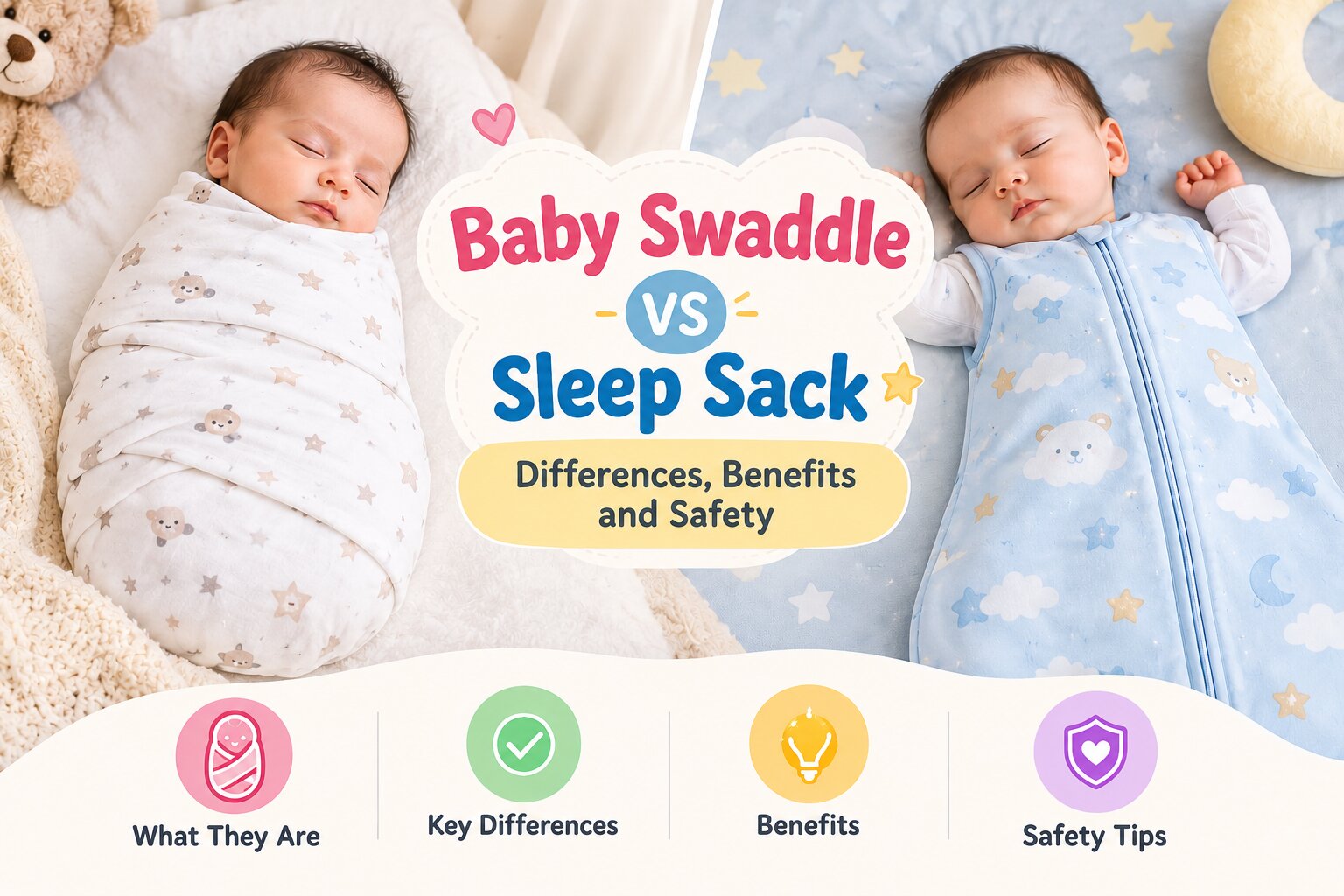
Baby Swaddle vs Sleep Sack: Differences, Benefits and Safety
Key Facts
Swaddling can help newborns feel cosy and settled during sleep.
AAP recommends stopping swaddling when a baby starts showing signs of rolling.
Arm-free sleep sacks can be used as babies become more mobile.
The NHS recommends a comfortable room temperature of around 16 to 20°C.
Parents should choose sleepwear based on the baby’s age, size, room temperature and developmental stage.
Swaddle vs sleep sack comes down to arm position and age. A swaddle holds a newborn’s arms in to calm the startle reflex, while a sleep sack leaves the arms free and stays useful after rolling begins. The American Academy of Pediatrics (AAP) says swaddling must stop at the first attempt to roll. For parents of 6 to 18 month olds, the sleep sack is the practical choice. This guide compares the two, sets out the safety limits and shows how to pick and fit a sleep sack for Indian homes.
What Is a Swaddle?
A swaddle is a thin blanket or fastened wrap that holds a newborn’s arms snug against the body. The AAP says a thin blanket wrapped snugly can resemble the womb and help soothe a newborn. Parents also use it against the Moro reflex, the startle reflex newborns are born with, which usually fades by about 6 months. In a sleep sack vs swaddle blanket comparison, the blanket also needs a wrapping technique that can loosen.
What Is a Sleep Sack?
A sleep sack, also called a wearable blanket or baby sleeping bag, is a bag worn over sleepwear that replaces loose bedding in the cot. Parents weighing swaddle vs sleeping bag are usually comparing a wrap with this product. EN 16781, the European standard, covers cot sleep bags for children up to about 24 months.
What Is the Difference Between a Swaddle and a Sleep Sack?
The difference between swaddle and sleep sack designs is arm position, age range and rolling safety. A swaddle holds the arms in for the youngest newborns, while a sleep sack leaves the arms free for as long as the baby fits. The table sets out eight points.
Typical age range
From birth until the first signs of rolling, which some babies show as early as 2 months
Newborn sizes upwards, fitted by weight; EN 16781 covers cot sleep bags up to about 24 months
Arm position
Arms held snug against the body
Arms free in arms-free designs
Primary purpose
Resembles the womb and helps soothe a newborn
Gives warmth without a loose blanket in the cot
Safe after baby starts rolling?
No. Stop at the first attempt to roll
Yes for designs that let the baby move freely; designs that compress the arms or chest must also stop
Warmth control
Set by the thin fabric, so warmth is adjusted with clothing layers underneath
Rated in TOG, where a higher number means warmer
Closure and ease of use
Wrap folds, or Velcro or zip designs
Zip or button closure with no wrapping technique
Fit as baby grows
Short window of use that ends at the first attempts to roll
Usually fitted by weight rather than age, so check the maker’s weight range
Best suited for
Newborns who startle awake and are not yet rolling
Nightly sleepwear from newborn to toddler, including 6 to 18 months
What Are the Benefits of Swaddling?
Sleep sack vs swaddle for newborn choices favour the swaddle when a baby startles awake and is not yet rolling.
Calming: the AAP says correct swaddling can calm infants and promote sleep.
Startle control: a snug wrap keeps the arms from flinging outward when the Moro reflex fires.
What Are the Limitations of Swaddling?
Swaddling has firm limits, and the evidence on risk is strongest for babies who end up on their fronts.
Position risk: the 2016 Pediatrics meta-analysis by Pease and colleagues found swaddling risk was highest for front sleeping (odds ratio 12.99) and lowest for back sleeping (odds ratio 1.93), compared with unswaddled babies in the same position. The authors note few studies and imprecise definitions of swaddling, so the figures need careful reading.
Age risk: limited evidence in the same analysis linked swaddling to a twofold risk in babies older than 6 months.
Sleep, heat and hips: the AAP says swaddling may make it harder for a baby to wake, raises the chance of overheating, and can harm hips if the legs are wrapped tight, so legs should bend up and out.
Weighted products: the AAP advises against weighted swaddles and blankets, which can press too hard on a baby’s chest and lungs.
What Are the Benefits of a Sleep Sack?
A sleep sack gives warmth without loose bedding, and its main advantage appears once a baby starts to roll.
Safe through rolling: the AAP says sleep sacks that let the baby move freely can be used as long as wanted.
No loose bedding: the AAP prefers wearable blankets to loose coverings for keeping a baby warm.
Stays put: The Lullaby Trust notes that a sleep bag helps stop a baby wriggling down under covers.
What Are the Limitations of a Sleep Sack?
Sleep sacks also have limits, and most of them relate to fit, warmth and choosing the right product.
Fit: in a sleep bag vs swaddle comparison, sizing differs, because most bags are fitted by weight and a loose neck lets a baby slip down inside.
Warmth: the NHS lists too much bedding or clothing as a cause of overheating, so a high TOG over thick clothing in a warm room is a risk.
Nest-style bags: padded carry-nest bags work as portable nests, and the NHS advises keeping pods and nests out of the cot.
Weighted bags: The Lullaby Trust does not recommend weighted sleeping bags for babies under one year.
Standard: a bag that names no standard, such as EN 16781, gives parents nothing to check.
Is a Swaddle or Sleep Sack Better for Baby?
Sleep sack vs swaddle is settled mostly by rolling stage. A sleep sack is better once rolling begins, and a swaddle only suits the youngest newborns.
1. Rolling stage
Swaddling must stop at the first attempt to roll, which some babies show as early as 2 months, so a sleep sack takes over from then. Arms-out swaddling does not change this, because the AAP says there is no evidence on SIDS risk related to arms swaddled in or out. If a baby rolls onto the front, the NHS advises moving them back onto the back until they can roll both ways alone.
2. Room temperature and TOG
The NHS advises a room of about 16 to 20°C, and says to feel the chest or back of the neck and remove a layer if the skin is hot or sweating. A lower TOG suits a warmer room, and The Lullaby Trust gives no universal TOG chart, so follow the maker’s guide. Do not double up sleep bags or add blankets over a bag, because air trapped between layers adds warmth. Where a bedroom runs warmer, for example in an Indian summer without air conditioning, choose the lightest layer; the Lullaby Trust says that above 20°C a lightweight bodysuit can be enough, so a sack is not needed on every hot night.
3. Closure and caregiver routine
For swaddle blanket vs sleep sack, closure matters. A zip needs no technique, which helps when grandparents or night carers share duties, and a swaddle that comes unwrapped can cover the face.
Newborn, no sign of rolling
Swaddling is allowed on the back with monitoring
Swaddle or arms-free sleep sack
First attempts to roll (as early as 2 months)
Stop swaddling; sacks that compress the arms also stop
Arms-free sleep sack only
6 to 18 months
Sacks that let the baby move freely can stay in use
Arms-free sleep sack sized by weight
How Do You Choose Between a Swaddle and a Sleep Sack?
Deciding on a sleep sack or swaddle takes four checks: stage, size, fabric and label.
Match the product to the stage
Knowing when to use sleep sack vs swaddle removes most guesswork: swaddle only before rolling, sleep sack after.
Check the size by weight
Most bags are fitted by weight, and the neck and shoulders should be snug so the baby cannot slide down.
Pick breathable fabric for warm months
Plain cotton in a low TOG suits Indian summers better than fleece or velour.
Read the label
Look for the standard the bag was tested to, such as EN 16781, plus a stated size by weight and a TOG.
A plain cotton zip sack in the right weight band, with a named standard and a stated TOG, passes those checks. FirstCry.com lists Babyhug’s 100% cotton sleeping bags, but most are listed for 0 to 6 months at 70 x 30 cm. For a 6 to 18 month old, use the 6 to 9 and 9 to 12 month filters, then check the product page for arm openings, TOG and weight range before buying.
FAQs
1. When Should You Stop Swaddling Your Baby?
Stop swaddling at the first sign of trying to roll. The AAP says some babies start working on rolling as early as 2 months, but every baby is different, so check daily for attempts to turn.
2. When Should You Transition From a Swaddle to a Sleep Sack?
Move to a sleep sack at the first sign of rolling, or sooner if the baby fights the wrap or has outgrown it. The AAP says sacks that let a baby move freely can be used as long as wanted, so the practical limit is the maker’s size range.
3. What TOG Rating Should You Choose for a Newborn Sleep Sack?
Match the TOG to the room. A higher TOG is warmer, and The Lullaby Trust gives no universal chart, so follow the maker’s guide. The NHS advises about 16 to 20°C and checking the chest.
4. Are Weighted Sleep Sacks or Swaddles Safe for Babies?
No. The AAP says not to use weighted swaddles or blankets, which can press too hard on a baby’s chest and lungs. The Lullaby Trust does not recommend weighted sleeping bags for babies under one year.
5. Is Arms-In or Arms-Out Swaddling Safer for a Baby?
The AAP states there is no evidence on SIDS risk related to arms swaddled in or out. Both styles must stop at the first attempt to roll, so arms-out suits babies who resist arms-in.
6. How Do You Transition From a Swaddle to a Sleep Sack?
Try one arm out for a few nights, then both arms, then switch to an arms-free sleep sack. Keep the bedtime routine and the back-to-sleep position unchanged while the baby adjusts.
7. Can You Use a Swaddle and Sleep Sack Together?
Not for sleep. A wrap under a sack is doubled-up layering, and The Lullaby Trust warns that air trapped between layers increases warmth, which is why it advises against doubling up bags. Choose one product per sleep.
8. Can a Baby Use a Sleep Sack After Learning to Roll?
Yes, if the sack leaves the arms free. If the baby rolls onto the front, the NHS advises moving them back onto the back until they can roll both ways alone.
9. What Should a Baby Wear Under a Sleep Sack?
One light layer, such as a cotton bodysuit, chosen for the room. The NHS advises removing a layer if skin is hot or sweating. Do not add blankets over a bag.
10. Can a Baby Overheat in a Swaddle or Sleep Sack?
Yes. The AAP lists sweating, damp hair, flushed cheeks, heat rash and rapid breathing as signs of a baby being too hot. The NHS advises feeling the chest or back of the neck.
11. How Should a Sleep Sack Fit a Baby?
The bag should fit well around the neck and shoulders so the baby cannot wriggle down inside. Most bags are fitted by weight rather than age, so check the maker’s guide.
12. Can Newborns Use an Arms-Out Sleep Sack?
Yes, if the bag matches the newborn’s weight. Most bags are fitted by weight, so check the maker’s guide. Startle-prone newborns may settle better in a swaddle before rolling starts.
13. Where Can You Buy Swaddles and Sleep Sacks in India?
Look for a plain cotton zip sack with a snug neck, a stated TOG and a size by weight. Check the listing for EN 16781, which covers cot sleep bags up to about 24 months. FirstCry.com lists Babyhug cotton sleeping bags, mostly for 0 to 6 months.
Sources and References
1. American Academy of Pediatrics (HealthyChildren.org)
2. Pediatrics (via PubMed, US National Library of Medicine)
3. NHS (UK National Health Service)
4. NEN (Netherlands Standardization Institute, CEN member)
5. Cleveland Clinic
6. The Lullaby Trust (UK safer sleep charity)
Read more




When to Transition to Toddler Bed
Transitioning your little one from a crib to a toddler bed is one of those parenting milestones that feels both exciting and a little nerve-wracking. Is it too early? Too late? Or will your little one decide for you by climbing out like a mini escape artist? Knowing the right time to switch can save you from sleepless nights and toddler chaos. So, how do you know when to transition to a toddler bed? Figuring out the right moment can feel like trying to predict the weather: tricky, unpredictable, and full of surprises. Keep reading because your toddler isn’t the only one who needs a good night’s sleep!
When to Switch to Toddler Bed?
There’s no exact age, but most toddlers make the move between 18 months and 3 years old (1). Trust your gut; if they’re showing signs of readiness and you’re prepared to handle a little extra bedtime freedom, it might just be the perfect moment to make the switch!
How to Know Whether Your Toddler Is Ready for Bed?
Knowing when your toddler is ready to make the leap from crib to big-kid bed can feel a bit like solving a mystery. But don’t worry; there are some clear signs to help you figure out if it’s time to make the switch (1) (2) (3) (4).
If your little one has mastered the art of crib escape, it’s definitely time to consider a safer option, like a toddler bed.
Some toddlers will actually tell you when they’re ready, especially if they see older siblings or friends with their beds and want in on the action.
If your toddler is getting too tall or cramped in their crib, it’s a good indicator that they need more space to stretch out and sleep comfortably.
If your child can self-soothe, fall asleep independently, sleep through the night, and follow basic house rules (like not jumping on the couch or throwing toys indoors), they may be ready.
How to Pick the Correct Toddler Bed?
Choosing the right toddler bed might feel like a big decision, but with a few key things in mind, you can find the perfect fit for your growing little sleeper. It’s all about balancing safety, comfort, and a bit of fun to make bedtime something they (and you) actually look forward to! Here’s what to consider when picking the right toddler bed (3) (5):
1. Prioritise Safety Features
Look for a bed that’s low to the ground, has sturdy guardrails, and meets safety standards to keep your child secure through all those wiggles and rolls.
2. Pick the Right Size
Toddler beds are designed to fit a standard crib mattress, which makes the transition easier. Make sure the mattress fits snugly with no gaps around the edges.
3. Consider the Room Space
Measure your child’s room to ensure the bed won’t overcrowd the space. Leave enough room for playtime and easy movement.
4. Think Long-Term
Some toddler beds convert into twin beds later, which can be a great investment if you want something that grows with your child.
5. Choose a Fun Design
From car-shaped beds to princess themes, picking a design your toddler loves can make the new bed extra exciting and help them adjust faster.
6. Check for Easy Assembly
Nobody wants to spend hours with complicated instructions. Look for a bed that’s simple to put together, with clear guidance and durable materials.
Tips for Transitioning to Toddler Bed
Transitioning from a crib to a toddler bed is a whole new adventure, and like any big change, it helps to have a game plan. If you’re wondering how to make this milestone feel exciting (instead of chaotic), these simple tips will help your little one settle into their new sleep space (3) (5) (6).
1. Involve Your Toddler in the Process
Let your child help pick out their new bed or choose fun bedding with their favourite colours or characters. When they feel involved, they’re more likely to be excited about sleeping in their new space.
2. Keep the Bedtime Routine the Same
Stick to your usual bedtime rituals, like bath time, storytime, and cuddles, so the new bed feels like just another part of the same familiar routine.
3. Offer Plenty of Praise
Celebrate the wins, big or small. Whether they stay in bed all night or just give the new bed a try, lots of positive reinforcement can boost their confidence.
4. Be Patient With Setbacks
It’s totally normal for there to be a few rough nights or extra bedtime visits. Stay calm, be patient, and remember that adjusting to change takes time for little ones.
5. Use a Convertible Crib
A convertible crib to a toddler bed makes the transition easier by allowing your child to adjust to a familiar sleep space with minimal changes. Simply remove one side and add a safety rail to create a toddler-friendly bed.
Safety and Guidelines to Keep in Mind for Toddler Bed
Making a move to a toddler bed is a big step, but keeping safety front and centre is key to ensuring sweet dreams (for everyone!). Before you get too excited about picking out cute bedding, here are some important guidelines to help create a safe and comfy sleep space for your growing little one (2) (7).
1. Choose a Sturdy Toddler Bed
Look for a bed that sits low to the ground with strong, stable construction. This makes it easier for your toddler to climb in and out safely and reduces the risk of injury.
2. Use Guardrails
Even if your child rarely rolls around in their sleep, guardrails are a must. These will help prevent unexpected falls and give you peace of mind during those wiggly nights.
3. Keep the Area Around the Bed Clear
Toddlers love to explore, even at bedtime. Make sure there are no sharp edges, cords, toys, or furniture close to the bed that could pose a hazard if they wander or fall.
4. Secure Heavy Furniture
Anchor dressers, bookshelves, and other heavy furniture to the wall. Curious little climbers might try to use them as a jungle gym, so it’s better to be safe than sorry.
5. Stick to a Bedtime Routine
A consistent routine helps your toddler understand that their new bed is part of the same cosy, familiar sleep process. Bath, books, and snuggles work just as well (if not better) in a toddler bed!
6. Double-Check the Mattress Fit
Make sure the mattress fits snugly in the bed frame with no gaps along the edges. A too-small mattress can create dangerous spaces where tiny hands or feet can get stuck.
FAQs
1. How long does it take for a toddler to adjust to a new bed?
Every child is different, but most toddlers take a few weeks to fully adjust. Staying consistent with bedtime routines, using positive reinforcement, and keeping their sleep environment familiar can help speed up the process.
2. Should I transition to a toddler bed if my toddler is going through sleep regressions?
If your child is experiencing a sleep regression, such as waking up frequently or resisting sleep, it may be best to wait until their sleep stabilises before transitioning. Moving too soon during a rough sleep phase can make things harder (3).
3. Can my toddler transition straight to a bunk bed?
While bunk beds may seem like a fun and space-saving option, they are generally not recommended for toddlers. The top bunk poses a fall risk; even the bottom bunk may be too high for younger children transitioning from cribs. The American Academy of Pediatrics (AAP) suggests children should be at least 6 years old before using the top bunk (5) (8).
Transitioning to a toddler bed is a big step, not just for your little one, but for you too! While the switch may come with some challenges, remember that every child adjusts at their own pace. Before you know it, your toddler will be snuggled up in their big kid bed, drifting off to sleep, ready to take on the world (or at least another day of endless energy and fun!).
References/Resources:
1. Cleveland Clinic – When to Transition to a Toddler Bed and Tips for a Smooth Move
2. Nationwide Children’s Hospital – Transitioning from Crib to Toddler Bed
3. Sleep Foundation – When to Transition From Crib to A Toddler Bed
4. Nemours KidsHealth – Sleep and Your 1- to 2-Year-Old
5. St. Louis Children’s Hospital – Tackling the Toddler Crib-to-Bed Transition
6. American Academy of Pediatrics – Big Kid Beds: When to Switch From a Crib
7. Children’s Hospital of Orange County – When should I move my toddler into a big bed?
8. American Academy of Pediatrics – Bunk Beds: Safety Information for Parents
Also Read:
How Much Sleep Do Kids Need?
Tips to Make Your Kids Sleep Alone
Tips to Make Your Children Sleep Fast
Managing Your Kids Sleep Schedule As Per The Daylight Saving Time
Read more

When Can Babies Sleep With a Blanket
There’s nothing cosier than snuggling up under a warm blanket, but when it comes to babies, that soft, fluffy comfort can actually be a safety hazard. Blankets might feel like a natural addition to your baby’s sleep routine, yet they can pose risks if introduced too early. As new parents, you’ve probably wondered, When can a baby sleep with a blanket? The answer isn’t as simple as “whenever they look cute enough to cuddle.” So, when can your baby finally snuggle up with a blanket?
In this article, we’ll break down the safest time to introduce a blanket, why it matters, and what to use in the meantime. So, before you start knitting a baby-sized comforter, keep reading; you might be surprised by what you learn!
Is It Safe for Babies to Sleep With Blanket?
As a parent, you want your baby to be warm and comfortable at night, but is it safe to tuck them in with a blanket? The short answer is not yet. Babies under the age of 12 months cannot move objects away from their faces, which means a loose blanket could accidentally cover their nose or mouth, restricting airflow and leading to suffocation. While blankets might seem like a cosy necessity, they can pose a serious risk to infants, increasing the chances of suffocation and sudden infant death syndrome (SIDS) (1) (2).
When Can Babies Start Sleeping With Blankets?
The American Academy of Pediatrics (AAP) recommend waiting until at least 12 months, ideally closer to 18 months, before introducing a blanket. By this age, most babies have developed enough motor skills to move objects away from their faces, reducing the risk of suffocation.
Other Ways to Keep Your Baby Warm Without Using Blanket
There are safer alternatives to keep your little one warm without worrying about suffocation hazards. Here are some baby-safe ways to ensure your child stays snug all night.
1. Dress Baby in Layered Sleepwear
Opt for breathable, layered clothing like pyjamas or a onesie with a sleep sack. Layers trap warmth without overheating and you can easily add or remove them based on room temperature (3).
2. Keep the Room at a Comfortable Temperature
A slightly cool room (between 68-72°F or 20-22°C) is ideal for baby sleep. Use a room thermometer to monitor the temperature and adjust clothing accordingly (4).
3. Use a Sleep Sack
Sleep sacks are a game-changer! They provide warmth without the risk of loose fabric covering your baby’s face. Choose a size-appropriate, well-fitted sleep sack for safe and cosy sleep.
4. Use a Fitted, Warm Crib Sheet
Flannel or fleece crib sheets add a layer of warmth to your baby’s sleep environment without the risks associated with loose bedding. Just make sure the sheet fits snugly around the mattress.
5. Try a Warm Bath Before Bed
A warm bath before bedtime can help regulate your baby’s body temperature and keep them warm as they drift off to sleep (5). Plus, it’s a great part of a calming bedtime routine!
Safety Sleep Guidelines for Baby
Getting your baby to sleep safely is all about creating a secure environment that reduces the risk of sudden infant death syndrome (SIDS). With so much advice out there, it can be overwhelming to know what’s best. Don’t worry! Here are some essential, expert-backed guidelines to help your little one snooze safely.
1. Always Place Baby on Their Back
The safest sleeping position for babies is on their back—every nap, every night. This reduces the risk of SIDS significantly. Even if your baby starts rolling over, continue placing them on their back when you lay them down (6).
2. Use a Firm, Flat Mattress
A soft, cushy bed might seem comfortable, but babies need a firm, flat mattress to sleep safely. Avoid pillows, memory foam, or mattress toppers, as they can increase suffocation risks (7).
3. Keep the Crib Bare
Less is more when it comes to your baby’s sleep space. Skip the stuffed animals, bumpers, and blankets. A fitted sheet is all they need; anything else can pose a suffocation hazard (8).
4. Share a Room, Not a Bed
The safest place for your baby to sleep is in a crib or bassinet in your room, ideally for the first six months to a year. While co-sleeping might seem convenient, bed-sharing increases the risk of accidental suffocation (9).
5. Offer a Pacifier at Sleep Time
Studies suggest that giving your baby a pacifier at bedtime and naptime can help reduce the risk of SIDS. If they don’t want it, no problem, just don’t force it. And if it falls out after they fall asleep, there’s no need to put it back in (10).
FAQs
1. How do I know if my baby is too cold without a blanket?
Feel the back of your baby’s neck or tummy to check. If their skin feels cool, add an extra layer of sleepwear or use a thicker sleep sack. Avoid relying on cold hands or feet, as those are often normal for babies.
2. Can I use a swaddle instead of a blanket?
Swaddling is a safe option for newborns who haven’t started rolling yet, as it keeps them warm and snug. Once your baby begins to roll over (typically around 3-4 months), it’s time to stop swaddling to avoid safety risks (11).
3. What should my baby wear to sleep in colder months?
In colder months, dress your baby in layered clothing such as a long-sleeved onesie, footed pyjamas, and a fleece sleep sack. Keep the room temperature comfortable (68-72°F or 20-22°C) to avoid overheating.
4. Can I use a light muslin blanket for my baby at 6 months?
No, a baby sleeping with a blanket at 6 months is not recommended, not even a light muslin blanket.
While blankets are a no-go for young babies, there are plenty of safe ways to keep them warm. Once your child reaches toddlerhood, you can introduce a lightweight blanket, but until then, sticking to sleep sacks and warm pyjamas is the safest choice.
References/Resources:
1. Sleep Foundation – When Can Your Baby Sleep With a Blanket?
2. American Academy of Pediatrics – Sleep-Related Infant Suffocation Deaths Attributable to Soft Bedding, Overlay, and Wedgin
3. American Academy of Pediatrics – How to Keep Your Sleeping Baby Safe: AAP Policy Explained
4. Safe Sleep Academy – How do I keep my baby safe and warm?
5. National Library of Medicine – A Warm Bedtime Bath Can Help You Cool Down And Sleep Better
6. NHS – Reduce the risk of sudden infant death syndrome (SIDS)
7. NHS – Safer sleep
8. Nemours KidsHealth – Preventing Suffocation
9. Nemours KidsHealth – Sleep and Your 1- to 3-Month-Old
10. PubMed – Do pacifiers reduce the risk of sudden infant death syndrome? A meta-analysis
11. American Academy of Pediatrics – Swaddling: Is it Safe for Your Baby?
Also Read:
Baby Sleeping on Side
Baby Sleeping On Stomach
Can Babies Sleep With a Pillow?
Bedtime Schedule for Infants
Mustard Pillow (Rai Ka Takiya) for Babies
Sleeping Positions for Your Newborn Baby
Read more

4 Baby Sleep-Related Questions All New Parents Have Answered by a Paediatrician!
Bringing a new life into the world is a life-changing event for every new parent, and as new parents, you want to ensure that you get everything right! From feeding habits to cleanliness to health and comfort, following best practices is essential to ensuring your baby’s health and happiness!
If you’ve ever struggled to create the perfect sleep routine for your baby, the internet can be your secret weapon as long as medical professionals and experts verify the information you get.
Enter renowned paediatrician and sleep expert Dr. Rajiv Chhabra who answers some of the most searched baby sleep-related questions! This article takes his expert advice and provides valuable tips to ensure your baby enjoys deep sleep every night!
4 Top Baby Sleep-Related Questions and Most Searched Tips
How Can I Make My Baby Sleep Better?
Solution:
As Dr Chhabra attests, understanding your baby’s sleep patterns and creating a nightly routine is key to ensuring your baby gets a good night’s sleep! But how can you do that? Some ways in which you can do this include:
1. Note Down Sleep Patterns
Record your baby’s sleep patterns over a week and see what times of day they fall asleep and when they have the deepest sleep.
2. Soothing Signals
Read sweet bedtime stories to your little one, sing them a lullaby or song, or rock them to sleep. These are called soothing signals and help put your baby to sleep.
3. Swaddling:
Swaddling is another comforting method that helps put your baby to sleep. This is a practice where a blanket is wrapped around the baby to resemble a womb, putting them at ease in their new surroundings and coaxing them to sleep (1).
4. Comfortable Clothing
Ensure your baby is dressed in clothing that is appropriate for the region and its weather. Breathable clothing is key, especially with the diapers you choose. Ensure they have a protective layer with natural extracts like coconut to soothe your baby’s skin and prevent rashes and irritation.
https://www.youtube.com/watch?v=hElIY6IwSXE
How Do I Get My Baby to Stay Sleeping?
Solution:
Dr Chhabra states that comfort is key to ensuring your baby is undisturbed while sleeping. Additionally, the sleeping environment is essential in soothing the baby and putting them to sleep. Here’s what you can do:
1. Comfort
Choosing the right clothes for your baby is vital to providing comfort. As mentioned earlier, they must be breathable and soft. Baby diapers with soothing properties are also an important factor to consider. In addition, the diaper’s design is essential to your baby’s comfort. Ordinary diapers have elastic bands that chafe, cause friction, and leave red marks. Additionally, they have low absorption, leading to sogginess, which can cause a diaper rash and other skin irritation.
Conversely, diapers like MamyPoko Pants Extra Absorb have deep, strong absorption properties with 60% more absorption up to 12 hours, preventing sogginess and allowing babies to enjoy deep sleep. Additionally, the diaper comes with the innovative Flexi Fit that enables it to expand gently, relieving pressure off the baby’s tummy and back. This in turn avoids any kind of rashes or irritation, skin troubles against the baby’s skin.
2. Sleep-Friendly Environment
Using dim lighting in the nursery and playing soft, soothing music can put your baby at ease and aid them in falling asleep and continuing to sleep uninterrupted.
What Are the Three Tips to Make a Newborn Sleep?
Solution:
Dr Chhabra has three invaluable tips to help you put your newborn baby to sleep:
1. Read Your Baby’s Sleep Ques
Understand tiny signs and signals your baby sends indicating they are tired and ready to go to bed! This includes simple signs like yawning, rubbing their eyes, and getting quiet, or more complex cues like kicking about, clenched fists, crying, making fussing sounds, or pulling odd faces (2).
2. Place Your Baby in the Crib
Place your baby in the crib while they are still awake. This helps them learn to fall asleep on their own and removes the fear of falling asleep in your arms only to wake up in an unknown setting like the crib (3).
3. Keep Them Comfortable Through the Night
Keep toys and plushies out of the crib, and ensure the surface is flat with the sheets tucked in snugly. Ensure they are dressed appropriately, are kept in a cool room, and have diapers with deep absorption. The Mamy Poko Pants Extra Absorb is suggested, which provides up to 60% more deep absorption for up to 12 hours without sogginess and ensures 2X protection from thigh leakage. This deep absorption is critical to ensuring your baby’s deep sleep.
What Is the Best Sleeping Method for Babies?
Solution:
A baby’s posture is vital to providing comfortable sleep, and Dr Chhabra reiterates this. According to him, the best position to lay your baby is on their back during naps or sleep. But while doing so, it is vital to ensure they have minimal to no pressure on their back and tummy. Indian babies have wider bellies, so it is essential to pick comfortable, flexible and absorbent diapers that consider their anatomy and self-adjust to relieve pressure on the baby’s tummy and back. The Innovative Flexi-fit of the MamyPoko Pants Extra Absorb diapers has been created keeping in mind an Indian baby’s anatomy and adjusts gently while spreading pressure evenly on the baby’s tummy and back, preventing any kind of discomfort while they sleep.
MamyPoko Pants Extra Absorb diapers ensure deep absorption, with 60% more absorption without becoming soggy! This allows babies to enjoy their deep sleep and comfortable nights. If you want more details on the above queries, here’s what Dr. Chabbra had to say:
We know that figuring out your newborn’s sleep routine is an exhausting journey, but its rewards are many! Try out these tips to ensure deep sleep and a happy baby!
References:
1. Swaddling: Is It Safe For Your Baby?; Healthy Children; https://www.healthychildren.org/English/ages-stages/baby/diapers-clothing/Pages/Swaddling-Is-it-Safe.aspx
2. Sleep 0-3 Months; Government of Western Australia Department of Health; https://www.healthywa.wa.gov.au/Articles/S_T/Sleep-0-3-months
3. Sleep and Your 1-3 Month Old; Nemours Kid’s Health; https://kidshealth.org/en/parents/sleep13m.html
Read more

6 Top Tips to Ensure Your Baby Gets Deep Sleep Every Day
Babies spend half of their sleep in the REM stage (light sleep stage) making it too easy to disturb them with the slightest sound! (1) Deep sleep is what ensures optimum physical and cognitive development in babies. This is why parents often stress about whether their little ones are getting enough deep sleep. If you’re one of them, you’ll find this article very helpful.
We interviewed Paediatrician Dr. Rajiv Chabbra who shared with us practical insights on how to help your light sleeper get more out of their deep sleep stage.
https://www.youtube.com/watch?v=Pd5bJbN7Txw&ab_channel=MamyPokoIndia
Easy and Practical Ways to Help Your Baby Get Good Quality Sleep
Getting your little one to snooze for even two hours straight can be challenging, but once you put the following tips to use, you will learn your baby’s sleep patterns and find what works best for them to sleep well. Your aim is to ensure that your baby gets enough deep sleep, the stage that comes after the REM/light-sleep stage, because that’s when their brains and bodies develop. To make sure they are getting deep sleep, here are some tips that work.
1. Start With a Bedtime Routine
As Dr. Chabbra suggests, the first and foremost thing to do is to monitor your baby’s sleep patterns and build a nighttime routine. Babies learn to sleep by taking cues from their surroundings. Start with keeping the bedroom quiet and peaceful by dimming the lights and restricting any outdoor noise 30 minutes before bedtime. Keep your voice low and soothing to avoid any overstimulation (2). You can introduce a routine before bedtime, like a warm bath, reading stories or singing lullabies to lull them into sleep. Be consistent and follow the routine in the same order every night, so when you take your baby into the dim and quiet room, they will know it’s time to sleep.
2. Signs of Sleepiness? Head to the Bedroom
Check for cues – quietness, disinterest in surroundings, rubbing eyes, yawning, and staring into the space (3). If you see any of these cues, start preparing them for nap time!
3. Create a Peaceful Sleep Environment
Invest in thick sound and light-absorbing curtains. Next, turn down the temperature of the room if you can, and use breathable and light bedding to prevent overheating. Make sure the mattress and the crib meet all safety standards so your baby does not have any trouble sleeping. As Dr Chabbra suggests, you can play soothing background music or white noise like a static radio or a running fan to lull them into sleep.
4. Invest in a Good, Absorbent Diaper
A soggy diaper is one of the biggest reasons for mid-sleep disturbance, and don’t get us started on the inflammation and rashes that can be caused by your baby’s soggy diaper. Your baby needs a diaper that is well-crafted with highly absorbent materials so they don’t wake up crying due to wetness or rashes. MamyPoko Pants Extra Absorb checks all the points for an ideal baby diaper with its criss-cross layer enriched with the goodness of coconut extract that can absorb urine for up to 12 hours without making the diaper soggy.
What’s more, the ‘Innovative Flexi Fit’ helps in wrapping up your baby’s tummy and back well without any red marks, rashes or skin troubles, usually caused by the tight fit of the diapers and provides 2X protection from thigh leakage.
5. Never Forget the 5S
Most babies take their sweet time to settle before bedtime. If your baby is having trouble settling down like fussing or crying before falling asleep, don’t stress. Try these 5S’ before bedtime and your baby will have restful sleep.
Swaddle: Swaddling will keep your baby snug and cosy, just like they were in the womb (4). Remember to swaddle them only when they’re going to sleep, not all the time.
Shushing: You can soothe your baby by making a loud ‘shhh’ sound, which mimics the rhythmic sounds from inside the womb. As an alternative, you can use the white noise machine that makes such buzzing sounds to soothe babies to sleep.
Swinging: Rocking your baby gently back and forth in a swing can also help them relax and drift off to sleep.
Sucking: Babies find sucking comforting. A pacifier can help satisfy this sucking reflex and allow them to self-soothe and fall asleep.
Side Sleeping: The safest way for your baby to sleep is on their back in their own crib or bassinet to avoid risks of SIDS (5).
6. Feeding Schedules
Your baby’s feeding schedules can also have an impact on their sleep. Make sure your little one is well-fed at least 30 minutes before sleep time so they don’t wake up crying hungry. At the same time, do not overfeed and/or close to bedtime, and burp them after every feeding to avoid any digestive issues while sleeping. Invest in a good, strong, absorbent diaper like MamyPoko Pants Extra Absorb, which keeps the diaper snugly in place and doesn’t leave any red marks on your baby’s delicate skin.
Patience goes a long way when it comes to figuring out life with a baby. Trust your parental instincts and give these techniques a chance to work. You will know that your baby is in deep sleep when they are very still and don’t move much. Nothing will disturb them at this stage. With the tips mentioned above, you will notice your little one is well-rested and that their development, too, is on point!
References/Resources:
1. Helping baby sleep through the night; Mayo Clinic; https://www.mayoclinic.org/healthy-lifestyle/infant-and-toddler-health/in-depth/baby-sleep/art-20045014
2. Helping your baby to sleep; NHS; https://www.nhs.uk/conditions/baby/caring-for-a-newborn/helping-your-baby-to-sleep/
3. Infant Sleep; Stanford Medicine; https://www.stanfordchildrens.org/en/topic/default?id=infant-sleep-90-P02237
4. Swaddling: Is it Safe for Your Baby?; American Academy of Pediatrics; https://www.healthychildren.org/English/ages-stages/baby/diapers-clothing/Pages/Swaddling-Is-it-Safe.aspx#:~:.
5. Kim. H, Pearson-Shaver. A. L; Sudden Infant Death Syndrome; StarPearls Publishing; https://www.ncbi.nlm.nih.gov/books/NBK560807/
Also Read:
How to Identify Whether Your Baby Is Getting Deep Sleep Every Night?
Read more

How to Identify Whether Your Baby Is Getting Deep Sleep Every Night and What You Can Do to Ensure They Are?
We know you stand and watch your little angel sleep peacefully more often than not, admiring their cute face and wondering if he’s dreaming every time he smiles or twitches.
Watch carefully, you’ll notice in about an hour, he begins to squirm or his eyelids flutter, or you may notice his muscles tighten. This is your baby entering a phase of light sleep.
As parents, we know that deep sleep is essential for a baby’s growth and development, and we’re always wondering if they’re sleeping well and enough and what we can do to ensure they have disturbance-free, comfortable sleep.
Let’s first understand the stages of your baby’s sleep cycle, how their sleep cycle differs from the adult sleep cycle and what can get in the way of your little one getting enough of it.
Your Baby Has a Shorter Sleep Cycle Than You
While adult sleep cycles last an average of 90 minutes, baby sleep cycles last 50-60 minutes. Much like adults, babies, too, have different stages of sleep. Let’s look at what these are to understand your baby’s sleep patterns better.
REM (Rapid Eye Movement Sleep)
This is the stage of light sleep where dreams occur and eyes move back and forth rapidly. Half of your baby’s sleep falls into this stage. As babies grow, the REM stage of sleep gets lesser. You will also notice your baby startle or wake up with disturbances during this sleep stage.
Non-REM sleep
There are 3 stages here:
Stage 1: Drowsiness— eyes may droop or open and close
Stage 2: light sleep— your baby may move or get startled with sounds
Stage 3: deep sleep— your baby does not move or get disturbed
Your baby goes from stage 1 of sleep and moves into 2, 3 and then goes back to 2 and finally to REM before waking up. These cycles occur several times during sleep time and babies may wake up in between sleep cycles and have trouble going back to sleep. Now, that is what you don’t want.
We asked Paediatrician Dr. Rajiv Chabbra how parents can recognise whether their babies are getting deep sleep and what we can do to ensure it.
https://www.youtube.com/watch?v=qRlsC5_PV7U&ab_channel=MamyPokoIndia
Now that we understand the science behind your baby’s sleep, let’s look at what can get in the way of your little one staying longer in stage 3 of their sleep cycle.
What Are the Reasons Behind a Baby’s Restless Sleep?
There could be many factors, environmental or physical, that could hinder their deep sleep, such as:
Babies may wake up because of a soggy diaper that could be irritating them.
Babies may not be able to settle themselves to sleep when they are tired or overstimulated.
Little ones may also have trouble sleeping due to issues like gas or constipation.
Sometimes, it can be hard to adapt to the changes in the environment like a running fan, noises in the background, or even a slight drop in the temperature.
Ultimately, it all comes down to the environment you are creating for the baby to rest in and the resources deployed for ensuring deep sleep, like proper feed and premium-quality diapers. Yes, the right (or wrong) diaper, too, has a direct impact on your baby’s sleep quality.
The right diaper is a modern-day saviour for parents, so they also get the sleep they deserve without having to factor in a mid-sleep diaper change, that both baby and parent could do without! Now, even if the baby pees in the middle of the night, a diaper with a deep absorbent feature will soak all the urine without getting soggy and help your baby to have a peaceful sleep.
As Dr. Chhabra suggested, deep absorbent diapers like the MamyPoko Pants Extra Absorb diapers aid uninterrupted deep sleep, all thanks to the deep absorption feature of the additional third layer, which absorbs the urine for up to 12 hours without becoming soggy.
Additionally, with the ‘Innovative Flexi Fit’, these diapers are flexible enough to adjust and distribute pressure evenly across the baby’s belly and back. This avoids any kind of skin troubles or irritation during the baby’s natural movements through the day and ensures a peaceful sleep through the night.
More Ways to Ensure Deep Sleep for Babies
In addition to choosing the right diaper, ensuring the following are also taken care of.
Feeding: Make sure you feed them enough for the nighttime so they do not get hungry.
Layering: Dress your baby in a comfortable diaper and breathable clothes that do not itch or chafe and disturb them while sleeping.
Atmosphere: Dim the lights and make sure there is no loud noise or clattering in the background that could hinder their sleep. Keep the room as cool as possible.
Bedding: Keep the toys and extra bedding like quilts, blankets, pillows, or comforters out of their crib, as they could potentially lead to SIDS.
For parents with newborns, ensuring deep sleep may feel like a far-fetched dream, but with time, you will find a rhythm with your little one, especially if they are comfortable. Thankfully, with advancements in technology, products such as Mamy Poko Pants Extra Absorb diapers make life easier with a baby, giving you the assurance that your little one is sleeping well. So, do the right thing for your little one’s development, and you’ll also be getting that extra shut-eye yourself! Sounds like a win-win!
Also Read:
Top Tips to Ensure Your Baby Gets Deep Sleep Every Day
Read more

15 Month Sleep Regression – Signs, Causes and What to Do
As your child grows and their development progresses, there will inevitably be sleep disturbances. Sleep regression is a common developmental milestone many parents face as their child grows. Around 15 months, toddlers may experience sleep regression, a phase where they struggle to fall asleep, wake frequently during the night, or resist napping. This can be challenging for both the child and the parents, impacting the family’s routine and rest. If you’re trying to decipher the causes and cope with sleepless nights, this article will provide the information and strategies you need.
What Is the 15-Month Sleep Regression?
The 15-month-old sleep regression refers to a phase when a previously well-sleeping baby starts waking up frequently during the night, refusing naps, or exhibiting other disruptions in their regular sleep pattern. While it can be exasperating for parents, understanding the causes and signs can make navigating this phase smoother.
What Are the Causes of 15-Month-Old Sleep Regression?
Sleep regressions can be perplexing, but they usually have underlying reasons. Here’s a breakdown of the main causes:
1. Teething
Around this age, many toddlers experience the growth of their molars. The pain can disrupt sleep.
2. Developmental Milestones
Learning new skills like walking can make babies more restless (2).
3. Separation Anxiety
Often, the 15-month sleep regression separation anxiety plays a role. Your child is becoming more aware of their surroundings and may fear being apart from you.
4. Changes in Sleep Needs
Babies might need less daytime sleep, causing disruptions at night.
5. Illness or Discomfort
Simple things like colds or ear infections can throw off sleep patterns (4).
6. Habitual Waking
Sometimes, if babies get used to being soothed back to sleep, they might wake up expecting it.
7. Dietary Changes
Transitioning to more solid foods can sometimes upset a baby’s stomach or change their sleep needs.
Signs of Sleep Regression at 15 Months?
The 15-month mark is a significant milestone in your baby’s life, packed with growth and developmental leaps. But with this comes potential sleep disruptions, commonly known as sleep regressions. It can be a perplexing time for parents, with many wondering if their child’s changed sleep patterns indicate the famed 15-month sleep regression or if they result from other factors. Recognising the signs can be the first step to better understanding and managing this phase. Here are five key signs that your toddler may be going through the 15-month sleep regression:
1. Increased Night Waking
If your previously sound-sleeping baby suddenly starts waking up multiple times during the night without any apparent reason (like hunger or discomfort), it’s a clear sign. They might cry or be restless, making it hard to settle back down.
2. Resistance to Napping
At 15 months, most babies still need a nap during the day. However, during a sleep regression, your toddler might vehemently resist nap times. This can manifest as crying when put down, shortening their nap duration, or skipping naps altogether.
3. General Irritability and Mood Swings
A disrupted sleep pattern can lead to crankiness during waking hours. If your usually cheerful baby suddenly becomes fussy, whiny, or prone to meltdowns without any apparent cause, sleep regression might be the culprit.
4. Clinginess and Separation Anxiety
One unique feature of the 15-month sleep regression is heightened separation anxiety. Your toddler might become more attached, not wanting to be away from you. This can make bedtime challenging, especially if they resist sleeping alone.
5. Changes in Sleep Patterns
Mainly because of the 15-month sleep regression separation anxiety, they might be more attached to you. If you notice a sudden shift in when your baby gets sleepy, how long they sleep, or the quality of their sleep, it might indicate a regression. This includes longer periods of light sleep, tossing and turning, or waking up earlier than usual.
How Long Does 15-Month Sleep Regression Last?
Most sleep regressions, including the 15-month regression, tend to last 2 to 6 weeks (3). However, the duration can vary depending on individual babies and parents’ handling of the regression.
How Can You Manage Sleep Regression in Your 15-Month-Old Baby?
Navigating through the 15-month sleep regression can be a trying period for both parents and babies. Suddenly, your previously good sleeper might resist bedtime, wake up often, or show signs of separation anxiety. Understandably, you might be feeling exhausted, frustrated, or even concerned. However, with the right tools and strategies, you can help your baby transition smoothly through this phase and ensure a return to peaceful nights. Below are six tried-and-tested ways to manage the 15-month sleep regression effectively.
1. Establish a Consistent Routine
A predictable bedtime routine can provide a sense of security for your baby. This routine might include reading a short story, taking a warm bath, or playing calm lullaby music. A consistent sleep schedule can signal your baby that it’s time to wind down.
2. Comfort, But Maintain Boundaries
It’s crucial to comfort your baby when distressed, especially if separation anxiety is at play. However, refrain from introducing new habits (like rocking them to sleep every night) that you might not want to continue in the long run.
3. Create an Ideal Sleep Environment
Ensure your baby’s sleeping space is conducive to a good night’s sleep. This means a dark room, a comfortable temperature, and a quiet environment (1). Consider using blackout curtains and white noise machines if needed.
4. Stay Patient and Calm
While it might be frustrating to navigate sleepless nights, remember that your baby is also struggling. They can sense and respond to your stress or agitation. Approach each night with patience, understanding that this is a temporary phase.
5. Seek Peer Advice
Sometimes, the best 15-month sleep regression tips come from other parents who’ve been there. Consider joining parent groups, forums, or social media communities where you can share experiences and solutions.
6. Avoid Big Changes
During this regression, keep everything else constant in your baby’s life. If you’re thinking about transitioning them to a new bed or room or even introducing new foods, consider waiting until the regression has passed.
What Should You Not Do During 15-Month Sleep Regression?
Many toddlers experience a 15-month sleep regression, which is often characterised by sudden wakefulness during the night, difficulty falling asleep, and general restlessness. This can be challenging for both parents and toddlers. While it’s essential to support and comfort your child during this phase, there are specific actions you should avoid to make the sleep regression smoother and more manageable.
1. Don’t Be Inconsistent: One of the worst things you can do during a sleep regression is to be inconsistent with your response or routine. Here’s why:
Confusion for the Toddler: If you sometimes let your toddler cry it out, but other times you pick them up immediately, it can create confusion. This inconsistency can make it harder for them to learn what to expect and prolong the regression.
Establishing a Routine: A consistent bedtime routine helps signal your child that it’s time for sleep. Stick to the same bedtime rituals, such as bathing, reading a story, or singing a lullaby.
2. Don’t Introduce New Sleep Crutches: During disrupted sleep, it can be tempting to introduce new methods to soothe your child to sleep. This could be rocking them, offering a bottle, or allowing them to sleep in your bed.
Temporary Fix, Long-term Problem: While these might offer a short-term solution, they could become a sleep crutch, meaning your child will begin to rely on these methods to fall asleep.
Building Independence: Ideally, you want your child to develop the ability to self-soothe and fall asleep independently. This independence is beneficial in the long run.
3. Don’t Lose Your Cool: Sleep deprivation can test the patience of even the most understanding parents. But it’s essential to manage your emotions and reactions during this time.
Creating Anxiety: If you respond with frustration or anger, it can create anxiety for your toddler, making it even harder for them to relax and fall asleep.
Seek Support: If you are overwhelmed, asking for help is okay. This could be from a partner, a family member, or a professional. Remember, you’re not alone; many parents face the same challenges.
When to Call a Doctor?
While the 15-month sleep regression is typically a normal phase, if you notice signs of extreme distress or illness or if your child’s sleep doesn’t improve after several weeks, it might be time to consult with a paediatrician.
The 15-month sleep regression what-to-do question often concerns parents. It can be challenging, but it is a normal part of your toddler’s development. You can help your child reestablish healthy sleep patterns with patience and consistency. Remember to be flexible and adjust your approach to suit your child’s evolving needs. You can help your child build a strong foundation for restful sleep and overall well-being by offering support and understanding during this phase.
References/Resources:
1. MY TODDLER ISN’T SLEEPING THROUGH THE NIGHT; University of Utah Health; https://healthcare.utah.edu/the-scope/kids-zone/all/2019/04/my-toddler-isnt-sleeping-through-night; April 2019
2. Understanding and Navigating Sleep Regressions; PENN MEDICINE LANCASTER GENERAL HEALTH; https://www.lancastergeneralhealth.org/health-hub-home/motherhood/the-first-year/understanding-and-navigating-sleep-regressions
3. Is Baby Going Through Sleep Regression? What It Is and How To Help; Pathways.org; https://pathways.org/sleep-regression/
4. Sleep Regression; Breastfeeding Support For Indian Mothers; https://www.bsim.org.in/breastfeeding-information-sleep-regression/
Also Read:
Simple Solutions to Your Child’s Bedtime Problems
Tips to Make Your Child Sleep Fast
Read more

18 Month Sleep Regression- Causes, Signs and What to Do
Sleep patterns evolve and shift as your child grows; sometimes, these shifts are more complicated than we’d hoped. The 18-month mark is one such pivotal point for many parents. The infamous 18-month sleep regression can be challenging, but understanding its causes and signs can provide you with the necessary information to navigate it confidently.
What Is the 18-Month Sleep Regression?
The 18-month sleep regression is when toddlers, who once slept soundly, start having trouble with their usual sleep routine. It’s characterised by frequent night wakings, difficulty falling asleep, and shorter daytime naps. This phase can be exhausting for parents and the child, but it is a common developmental stage.
What Are the Causes of 18-Month-Old Sleep Regression?
Sleep regressions at any age can baffle, but they don’t emerge from nowhere. There are often tangible reasons behind the 18-month regression.
1. Separation Anxiety
At around 18 months, many toddlers begin to understand the concept of permanence, making them more prone to separation anxiety. They might resist bedtime because they don’t want to be away from you.
2. Teething
The eruption of molars can be painful for toddlers. This discomfort can make it difficult for them to settle down and sleep.
3. Increased Motor Skills
As your toddler becomes more mobile, they may find it hard to settle down, wanting instead to practice their newfound abilities.
4. Language Development
With the rapid expansion of vocabulary and understanding, their brains are buzzing, making it hard to switch off.
5. Nightmares and Night Terrors
Around this age, toddlers start having more vivid dreams, which can sometimes be scary.
6. Independence and Will
Toddlers begin asserting their independence around 18 months. They might resist bedtime simply because they can.
7. 18-Month Nap Regression
With the development spurt, your toddler might resist daytime naps, leading to overtiredness and restless nights.
8. Changes in the Sleep Cycle
As toddlers grow, their sleep cycles evolve. This could mean they are more easily awakened during light sleep stages.
Signs of Sleep Regression at 18 Months
Every child’s developmental journey is unique, but some markers can help parents identify phases like sleep regressions. The 18-month sleep regression is no exception. This phase, while challenging, is a natural part of a child’s growth. Recognising the signs early can empower parents to approach the situation with understanding and proactive strategies. Let’s delve into the top five signs that indicate your toddler might be navigating the tricky waters of the 18-month sleep regression.
1. Resistance to Bedtime
Previously, your toddler might have drifted off to sleep without much fuss. However, during this regression, they might protest, cry, or even throw tantrums when it’s time to hit the bed.
2. Increased Night Wakings
Suddenly, your once peacefully sleeping toddler might start waking up multiple times throughout the night, seeking comfort, a drink, or simply refusing to return to sleep.
3. 18-Month Sleep Regression Early Waking
One of the hallmark signs of this phase is early waking. Despite going to bed at their usual time, your toddler might start to wake up earlier, often much earlier than you’d like.
4. Difficulty Napping
Your toddler might resist their usual nap times, take shorter naps, or sometimes skip them altogether. This can further contribute to their sleep deficit and make nighttime sleep more challenging.
5. Changes in Sleep Duration
Even if they do sleep, the overall duration might be shorter. They may appear restless, tossing and turning more than usual, or have difficulty sleeping deeply.
Understanding these signs can help parents approach the regression with empathy and practical strategies, ensuring a smoother transition for the child and the caregiver.
How Long Does 18-Month Sleep Regression Last?
Many parents and caregivers dread the 18-month sleep regression, but it’s essential to remember that it is, indeed, just a phase. Typically, the 18-month sleep regression lasts anywhere from 2 to 6 weeks. However, the exact duration can vary from one child to another. Factors influencing the length of this regression include the child’s overall health, their day-to-day environment, and how parents or caregivers respond to the changes in sleep behaviour.
Maintaining consistent bedtime routines and providing a supportive environment during this period is essential, as these measures can help shorten the regression’s duration. But even if you feel like you’re doing everything “right,” the regression can persist for some time due to the natural developmental changes in your toddler’s brain and body.
Patience, understanding, and flexibility are crucial during this time. Suppose the regression continues for over six weeks or is accompanied by other concerns. In that case, consulting with a paediatrician may be a good idea to rule out any underlying issues.
How Can You Manage Sleep Regression in an 18-Month-Old Baby?
Sleep regressions are unpredictable challenges that come with the roller-coaster of parenting. The 18-month sleep regression, in particular, can be a trying time, but with the right strategies, you can guide your toddler back to sound sleep. These practical suggestions help parents navigate this phase effectively, ensuring both baby and parent get the rest they need.
1. Maintain a Consistent Bedtime Routine
A regular bedtime routine can be a soothing signal for your toddler, letting them know it’s time to wind down. This could include reading a story, a warm bath, or playing soft music (3).
2. Foster Independence
Encourage independent play during the day. This will boost their confidence and make separations at bedtime easier.
3. Provide a Comforting Sleep Environment
Ensure the sleeping environment is calm, dark, and comfortable. Using white noise machines or soft lullabies can help drown out any disturbances.
4. 18-Month-Old Sleep Regression Cry-it-Out Method
Some parents find success using the ‘cry it out’ method. This method involves letting your toddler cry for specified periods before comforting them. It can be effective but must be approached cautiously, ensuring that all the toddler’s basic needs are addressed first (2).
5. Limit Stimulants Before Bed
Avoid screen time and engage in highly stimulating activities right before bed (3). Instead, opt for calming activities that prepare your child for rest.
6. Stay Calm and Patient
Remember, your toddler picks up on your emotions. If you remain calm and understanding, it can help soothe your anxieties.
7. Offer Reassurance
If separation anxiety is the root cause, frequently reassure your toddler that you’re there for them, even if it’s just through verbal reassurances from another room.
8. Seek Support
Don’t hesitate to lean on your support network. Sometimes, discussing with other parents or seeking advice from a paediatric sleep consultant can offer new perspectives and solutions.
When to Call a Doctor?
If sleep regression persists beyond six weeks, is accompanied by other health concerns, or if your toddler seems unwell, it’s time to consult a paediatrician (1).
FAQs
1. Do all babies have sleep regression at 18 months?
Not all babies experience noticeable sleep regressions, but many face disruptions in their sleep patterns around this age.
2. Can I sleep-train my baby during an 18-month regression?
Yes, sleep training can be implemented, but it’s vital to choose a method you’re comfortable with and stay consistent.
3. How much should an 18-month-old sleep?
Typically, an 18-month-old should get about 11-14 hours of sleep in 24 hours, including nighttime sleep and one or two daytime naps (2).
The 18-month sleep regression can undoubtedly challenge even the most resilient parents. While it’s a normal part of a toddler’s developmental journey, it doesn’t make the sleepless nights or the early morning wake-ups any easier. By understanding its causes, recognising the signs, and equipping ourselves with effective management strategies, we can better support our toddlers and ourselves through this temporary phase. Remember, every child is unique, and what works for one might not work for another. Always trust your instincts, maintain consistency, and know that with patience and support, this too shall pass. As with many parenting hurdles, this period is a fleeting phase in watching your child grow and evolve.
References/Resources:
1. Suni. E; 18-Month Sleep Regression; SleepFoundation.org; https://www.sleepfoundation.org/baby-sleep/18-month-sleep-regression; November 2023
2. Suni. E; How Much Sleep Do Babies and Kids Need?; SleepFoundation.org; https://www.sleepfoundation.org/children-and-sleep/how-much-sleep-do-kids-need
3. Screen Time and Children; American Academy of Child and Adolescent Psychiatry; https://www.aacap.org/AACAP/Families_and_Youth/Facts_for_Families/FFF-Guide/Children-And-Watching-TV-054.aspx
4. Bilgin. A, Wolke. D; Parental use of ‘cry it out’ in infants: no adverse effects on attachment and behavioural development at 18 months; Journal of Child Psychology and Psychiatry; https://pubmed.ncbi.nlm.nih.gov/32155677/; March 2020
Also Read:
22 Ways to Get a Child to Sleep at Night
Is Your Child Ready to Give-Up Napping?
10 Effective Tips to Make Your Toddler Sleep Fast
Read more

6 Month Sleep Regression – Causes, Signs and How to Manage
The journey of parenthood is a remarkable one filled with both beautiful moments and unexpected challenges. One such challenge that many parents encounter is the phenomenon known as sleep regression. Particularly, the 6-month sleep regression can cause considerable worry and sleepless nights, not only for your little one but also for you. This article aims to help you understand, identify, and manage six-month sleep regression so that both you and your baby can return to peaceful nights as quickly as possible.
What Is the 6-Month Sleep Regression?
According to the Cleveland Clinic, sleep regression is a period of time, often correlated with developmental milestones, when a baby who’s been sleeping well suddenly begins waking up at night and has unusual difficulty going down for naps or bedtime (1). The term 6-month sleep regression specifically refers to this sudden change in sleep pattern occurring around the six-month mark. During this phase, your little one might wake frequently during the night and struggle to fall back asleep, posing a significant challenge for both the baby and the parents.
Can Sleep Regression Happen at 6 Months?
Yes, sleep regression can indeed occur around the six-month mark, though it’s important to note that not all babies will experience this. Some babies may go through sleep regressions at different stages, and some might skip them altogether. That said, many parents report a noticeable change in their baby’s sleep pattern around the six-month period, often characterised by increased night awakenings and resistance to napping—these are symptoms typically associated with the 6-month nap regression.
How to Know if Its Teething, Growth Spurt, or 6 Month Sleep Regression?
As a parent, distinguishing between teething, growth spurt, and sleep regression in a 6-month-old can be tricky as these events may overlap.
Teething can cause discomfort and disrupt sleep, but it often also presents with additional symptoms such as increased drooling, gum swelling and sensitivity, or a desire to chew on hard objects (2).
Growth spurts, on the other hand, are usually marked by an increase in length and weight and a sudden increase in appetite, as your baby needs more energy for this phase of rapid growth (3). This could also lead to changes in sleep patterns.
With a 6-month sleep regression, there might not be any physical signs. It is more linked to developmental milestones like beginning to sit up, crawl, or recognise that they’re separate from their parents. These new skills and awareness can often interfere with sleep.
What Are the Causes of 6-Month Sleep Regression?
Several factors can contribute to the 6-month sleep regression (4):
1. Developmental Milestones
Around this age, babies often start experiencing significant physical and cognitive developments. They may start to crawl, sit up unaided, or even develop a stronger sense of separation from their parents. These exciting new skills can often disrupt sleep patterns.
2. Changes in Sleep Architecture
At around six months, there’s a shift in your baby’s sleep cycle to more mature patterns. This could lead to more frequent awakenings during the night.
3. Introduction of Solids
The introduction of solid foods can change a baby’s sleep patterns. The new digestive demands can cause discomfort and disrupt sleep.
4. Teething
The eruption of the first teeth can cause considerable discomfort for babies and may interrupt their sleep.
5. Social Awareness
By six months, babies are usually more socially engaged and aware of their surroundings, which can lead to increased resistance to sleep.
Signs of 6 Month Sleep Regression
To help identify if your baby is going through a sleep regression, here are some common 6-month-old sleep regression signs:
1. Increased Night Wakings: If your previously sleep-through-the-night baby is suddenly waking up frequently, this could be a sign of sleep regression.
2. Resistance to Naps: A noticeable change in your baby’s nap routine, particularly resisting or skipping naps, can also indicate sleep regression.
3. Changes in Appetite: Some babies might have changes in their feeding patterns, including increased appetite.
4. Unusual Fussiness: General irritability, increased fussiness, and difficulty soothing could be signs of sleep regression.
5. Wakefulness: Despite being visibly tired, your baby might fight to sleep and stay awake for long periods.
How Long Does 6-Month Sleep Regression Last?
The duration of the 6 month sleep regression can vary from baby to baby. According to Pathways.org, on average, it lasts two to six weeks (5). This period can be influenced by various factors, such as the baby’s temperament, new developmental milestones, and changes in their environment or routine.
Myths and Facts About 6-Month Sleep Regression
The 6-month sleep regression is a phase that often perplexes parents, as their once peaceful sleepers may suddenly encounter disruptions in their sleep patterns. Amidst the challenges, various myths and facts circulate about this sleep regression, leaving parents seeking clarity and guidance. Understanding the truth behind these myths can help parents navigate through this phase with confidence and ease.
Only “bad sleepers” experience sleep regression.
All babies, regardless of their previous sleep patterns, can experience sleep regression. It’s often tied to developmental milestones and changes.
Sleep regression is a sign of illness or underlying health issues.
While changes in sleep can sometimes indicate health issues, a sleep regression in a 6-month-old is typically a normal part of development.
You can prevent sleep regression with proper sleep training.
While sleep training can provide a structure and help babies sleep better, it can’t prevent the possibility of sleep regression, which is often tied to developmental progress.
How Can You Manage 6 Month Sleep Regression in Your Baby?
Managing the 6-month sleep regression can be challenging, but here are some strategies that might help (6) (7):
1. Establish a Routine
Consistency can help your baby understand what to expect, which can reduce anxiety and resistance at nap time and bedtime.
2. Provide Comfort
During this period, your baby might need extra reassurance and comfort. Hold, cuddle, and soothe your baby to make them feel secure.
3. Introduce a Sleep-Encouraging Environment
Make sure your baby’s sleep environment is calm, quiet, and dark. Using a white-noise machine might also help.
4. Watch for Sleep Cues
Put your baby down for naps or bedtime when they show signs of tiredness, like rubbing their eyes, yawning, or becoming quiet.
5. Balanced Daytime Schedule
Make sure your baby is getting enough feedings and active playtime during the day to help promote better sleep at night.
6. Practise Patience
Remember, this is a phase and it will pass. Stay patient and understand that your baby isn’t deliberately waking up – they’re just dealing with a lot of changes.
7. Self-Care for Parents
Don’t forget to take care of yourself. If possible, share night duties with a partner or ask for help from family or friends.
When to Call a Doctor?
While the 6 month sleep regression is typically a normal part of your baby’s development, it’s important to consult your paediatrician if you notice symptoms such as consistent difficulty breathing, extreme fussiness, fever, or if your baby is excessively sleepy and difficult to wake for feedings. These could be signs of a more serious issue that requires medical attention.
If the sleep disturbances persist for more than a few weeks.
If your baby experiences extreme irritability, discomfort, or signs of pain during sleep.
If there are sudden changes in feeding patterns, weight, or overall growth.
If you notice any unusual symptoms like fever, rashes, or breathing difficulties.
If you have concerns about your baby’s development or health that may be related to the sleep regression.
FAQs
1. Do all babies have sleep regression at 6 months?
Not all babies will experience a 6-month sleep regression. Some might experience sleep regressions at different ages, and some might not go through them at all. Each baby’s development and sleep patterns are unique.
2. Can a 6-month-old baby have nightmares?
While it’s possible for a 6 month old to have nightmares, it’s more likely that night wakings during this time are due to other factors such as sleep regression or teething. Infants this young do not yet have the cognitive development to experience nightmares in the way older children or adults do.
3. Can I breastfeed a 6-month-old baby at night during sleep regression?
Yes, you can certainly breastfeed your baby during night wakings in the 6-month sleep regression period. In fact, breastfeeding can help soothe your baby and help them go back to sleep. However, it’s also a good idea to avoid creating a habit where your baby becomes reliant on nursing to fall asleep.
The 6 month sleep regression can be a challenging time for parents, but it’s important to remember that this phase is temporary and is a normal part of your baby’s development. Patience, a consistent routine, and lots of comfort can go a long way in managing this period. If you have any concerns, don’t hesitate to reach out to your paediatrician. They can provide guidance and reassurance tailored to your baby’s specific needs.
References/Resources:
1. Infant Sleep Regression: What Parents Need To Know; Cleveland Clinic; https://health.clevelandclinic.org/the-4-month-sleep-regression-what-parents-need-to-know
2. Teething; Seattle Children’s; https://www.seattlechildrens.org/conditions/a-z/teething/
3. Growth Spurts & Baby Growth Spurts; Cleveland Clinic; https://my.clevelandclinic.org/health/diseases/22070-growth-spurts
4. Understanding and Navigating Sleep Regressions; Penn Medicine Lancaster General Health; https://www.lancastergeneralhealth.org/health-hub-home/motherhood/the-first-year/understanding-and-navigating-sleep-regressions
5. Is Baby Going Through Sleep Regression? What It Is and How To Help; Pathways.org; https://pathways.org/sleep-regression/
6. Helping your baby to sleep; NHS; https://www.nhs.uk/conditions/baby/caring-for-a-newborn/helping-your-baby-to-sleep/
7. Sleep Regression; Breastfeeding Support for Indian Mothers; https://www.bsim.org.in/breastfeeding-information-sleep-regression/
Also Read: How to Deal With Sleep Regression in Babies
Read more
11 Month Old Sleep Schedule – Sample, Bedtime and Nap Schedule
Setting up a sleep routine for your 11-month-old baby can be crucial to their growth and overall health. As they continue to grow and develop, changes in their sleep patterns can become apparent, making it essential for you, as a parent, to adapt and respond effectively. This guide will provide a sample bedtime and nap schedule tailored for 11-month-old babies. The information shared here will help you understand your baby’s evolving sleep needs and provide the tools necessary to foster a harmonious sleep environment. This will promote healthier sleep habits for your little one, contributing to their happiness and peace of mind.
How Much Sleep Should an 11-Month-Old Need?
An 11-month-old typically needs around 12 to 16 hours of sleep in 24 hours. This includes nighttime sleep, which usually lasts 10 to 12 hours, and daytime naps, which typically consist of two naps lasting between 1 and 2 hours each (1). Sleep needs can vary from one child to another. Monitoring your baby’s sleep patterns and adjusting their schedule is essential. Ensuring your child gets enough sleep is necessary for their growth and development.
Sample Sleep Schedule for an 11-Month-Old Baby
Establishing a regular sleep routine is advantageous for both infants and parents. Here’s a sample 11-month sleep schedule to guide you:
Time
Activity to Do
7:00 AM
Wake up and breakfast
9:30 AM to 10:30 AM
Morning nap
12:30 PM
Lunch
2:30 PM to 3:30 PM
Afternoon nap
6:00 PM
Dinner
7:00 PM
Start bedtime routine
7:30 PM
Asleep for the night
11-Month Old Nap Schedule
At 11 months, babies often take two naps a day — one in the morning and one in the afternoon. These naps can offer a beneficial rest period for your baby and for you as a parent.
Here’s a typical nap schedule for an 11-month-old baby. Remember, the exact times might vary based on your baby’s unique sleep needs and your family’s daily routine.
Naps
Timing
Morning Nap
9:30 AM to 10:30 AM
Afternoon Nap
2:30 PM to 3:30 PM
While following this nap schedule, ensure your baby is not napping too close to bedtime, as it might make it harder for them to fall asleep at night. Regularity in nap timing can also aid in maintaining a steady night-time sleep schedule for your 11-month-old baby.
Is It Possible to Sleep Train an 11-Month-Old Baby?
Yes, it is possible, and often very successful, to sleep-train an 11-month-old baby. Sleep training can be a beneficial way of helping your baby develop good sleep habits and become a self-sufficient sleeper. Here’s what you need to know about sleep training at this age.
At 11 months old, your baby is cognitively developed enough to understand different sleep associations and routines. They’ve begun to grasp the concept of object permanence, recognising that you still exist even when you’re not visible and can start to self-soothe with the help of comfort objects like a favourite blanket or soft toy.
There are several sleep training methods, and finding a technique that aligns with your parenting style and comfort level is crucial. Some popular options include the Ferber method, where you gradually increase the time between visits to your baby’s crib when they’re crying (3). The chair method involves sitting in a chair beside your baby’s crib until they fall asleep and gradually shifting the chair further away each night (2).
While sleep training, remember that consistency is critical. Before starting, ensure your baby is well-fed, comfortable, and in a sleep-conducive environment. Most importantly, know that every baby is different, and what works for one might not work for another. Sleep training is a process that may take time for your baby to adjust. It’s essential to stay patient and seek advice from a paediatrician or a sleep consultant if you have concerns or sleep training methods are unsuccessful.
Does a Baby Have Sleep Regression at 11 Months?
Yes, an 11-month-old baby might experience sleep regression. Sleep regression happens when a baby sleeping well begins waking up frequently at night, struggles to fall asleep, or has shorter naps.
Sleep regression at 11 months can be linked to various developmental milestones. Your baby is likely becoming more mobile, is starting to walk, and is experiencing a surge in brain development. These significant growth periods can disrupt sleep as your baby’s mind and body work through these changes.
Teething can also contribute during this period, causing discomfort that interrupts sleep. Additionally, an 11-month-old might be more aware of their separation from their parents, leading to increased anxiety at bedtime.
Fortunately, sleep regression is usually a temporary phase. Providing a consistent sleep environment, maintaining regular routines, and offering comfort can help your child through this challenging time. If the sleep regression persists and becomes a concern, seeking guidance from healthcare professionals may be advisable, as they can provide tailored advice and rule out any underlying health issues.
What Are Some Common 11-Month-Old Baby Sleep Problems?
Sleep problems can be common among 11-month-old babies. Let’s look at the five common ones:
1. Night Waking
Babies may start waking up during the night more frequently, often due to separation anxiety or sleep regression.
2. Refusal to Nap
Some babies may resist their daytime naps, resulting from overstimulation or under-tiredness.
3. Sleep Regression
As mentioned earlier, some babies experience sleep regression around this age.
4. Separation Anxiety
As infants become more conscious of their environment, they may feel anxious when away from their parents, impacting their sleep.
5. Transition From Two Naps to One
This transition can be tricky and may disrupt the sleep schedule for an 11-month-old.
How to Help Your 11-Month-Old Baby to Sleep?
Helping your 11-month-old get a good night’s sleep involves consistency and patience. Here are seven tips:
1. Establish a bedtime routine: This can include a bath, storytime, and a lullaby before bed.
2. Create a sleep-friendly environment: Keep the room dark, quiet, and calm (4).
3. Ensure the baby is well-fed: A full stomach can help the baby sleep better.
4. Limit stimulation before bed: Avoid active play and screen time (5).
5. Use a security object: A favourite blanket or toy can provide comfort.
6. Respond to night waking calmly and consistently: Reassure them without turning on lights or taking them out of bed.
7. Follow a consistent sleep schedule: Regular wake times, nap times, and bedtimes can help regulate their sleep cycle.
When to Call a Doctor?
If your baby is experiencing ongoing sleep issues, appears overly tired, or changes their sleep schedule suddenly or drastically, contacting your paediatrician might be a good idea.
FAQs
1. Why is my 11-month-old baby waking up at night?
Night waking can be due to various factors, including sleep regression, hunger, teething, or separation anxiety.
2. How to choose the best bedtime for your 11-month-old baby?
The best bedtime for an 11-month-old baby typically falls between 7 to 8 PM. This should allow them enough sleep before their early morning wake-up time.
1. Observe your baby’s energy levels and mood throughout the day to identify their natural sleepiness.
2. Establish a consistent bedtime routine that signals time to wind down and prepare for sleep.
3. Aim for a bedtime that enables your baby to sleep 11-12 hours each night, adjusting according to their needs.
4. Be attentive and responsive to your baby’s signals, modifying their bedtime to ensure they are well-rested and happy.
Remember, your baby’s sleep schedule may not look exactly like this sample 11-month-old sleep schedule, and that’s okay. Every baby is different. However, these guidelines provide a framework to understand what is ideal for your child.
References/Resources:
1. Sleep and Your 8- to 12-Month-Old; Nemours KidsHealth; https://kidshealth.org/en/parents/sleep812m.html#:~:text=Most%20babies%20this%20age%20should,for%20up%20to%202%20hours.
2. Bannister. I; Chair Method Sleep Training: A Guide for Sleepy Parents; WonderBaby.org; https://www.wonderbaby.org/articles/chair-method-sleep-training; July 2022
3. Summer. J; The Ferber Method for Sleep Training; SleepFoundation.org; https://www.sleepfoundation.org/baby-sleep/ferber-method
4. Carpenter. J; Baby Sleep Regressions: How to Cope Through Each Stage; Sleep Advisor; https://www.sleepadvisor.org/sleep-regression/
5. Infant Sleep; STANFORD MEDICINE CHILDREN’S HEALTH; https://www.stanfordchildrens.org/en/topic/default?id=infant-sleep-90-P02237
Also Read:
11 Months Old Baby Milestones
Your 11-Month-Old Baby’s Growth and Development
11 Month Old Baby Feeding Schedule, Recipes And Tips
Read more

2 Year (24 Month) Old Sleep Regression – Causes, Signs and How to Manage
Sleep, a crucial part of growth and development in children, can occasionally become a source of concern for many parents, especially when sleep regressions hit. As a parent of a toddler, you might be familiar with sleep regression stages and may have recently found yourself struggling with the dreaded 24-month sleep regression. This article provides a comprehensive look at the two-year sleep regression—what it is, why it happens, its signs, duration, and how to manage it effectively.
What Is the 2-Year-Old Sleep Regression?
Two-year sleep regression refers to a phase in a toddler’s life when they suddenly have trouble falling, staying, or refusing to sleep entirely. This period can be frustrating for parents, mainly if their child had previously had a healthy sleeping pattern. Although every child is unique, sleep regression at this age is quite common and, unfortunately, a natural part of a toddler’s development (1).
What Are the Causes of 2-Year Sleep Regression?
Many factors contribute to the 24-month sleep regression. Let’s explore the eight common causes:
1. Developmental Milestones
At this age, toddlers are undergoing major physical and cognitive advancements, which can disrupt their sleep (2).
2. Separation Anxiety
They might experience separation anxiety, which peaks around this age, leading to sleep disturbances (3).
3. Increased Independence
With their newly discovered autonomy, they often resist bedtime, wanting to explore more (4).
4. Nighttime Fears
Two-year-olds develop imaginations, leading to fear of the dark, monsters, and nightmares (5).
5. Disruption in Routine
Any changes in their daily routine can lead to sleep regression.
6. Toilet Training
If you are potty training, nighttime accidents or needing to go can disrupt your sleep.
7. Teething
Molars often come in around this age, causing discomfort and interrupting sleep (6).
8. Testing Boundaries
Toddlers may refuse to sleep to assert control and test boundaries.
Signs of 2-Year-Old Sleep Regression in Your Toddler
The 2-year sleep regression symptoms can vary from child to child. However, there are six signs to watch out for:
Frequent Night Waking: It could be a sign if your toddler wakes up frequently during the night.
Difficulty Falling Asleep: It may indicate regression if they suddenly struggle to fall asleep.
Shorter Naps or Skipping Naps: Changes in nap duration or avoidance can be a symptom.
Early Rising: Waking up unusually early is another indicator.
Increased Irritability: Mood changes, such as heightened irritability due to lack of sleep, are signs.
Resistance to Bedtime: If your toddler fights or resists going to bed, it’s a significant symptom.
How Long Does Two-Year Sleep Regression Last?
The duration of two years of sleep regression varies from child to child, but typically, it lasts between two and six weeks. It’s important to remember that this is a temporary phase and won’t last forever, even though it might feel like an eternity when you’re in it. The period of sleep regression can depend on several factors, including the child’s overall health, their daily routines, and how parents manage these sleep issues. While some toddlers might breeze through this phase within a few weeks, others might take longer. However, if this phase extends beyond six weeks, consulting with a healthcare professional or a sleep specialist may be a good idea.
How Can You Manage 24 Month Sleep Regression In Your Baby?
Parenting a toddler comes with unique challenges, and managing sleep regression is one of them. As a parent, you might feel overwhelmed when your previously good sleeper suddenly starts having disruptions during their sleep time. It’s important to remember, however, that this is a natural phase of your child’s development, and with patience and some practical strategies, you can help them overcome this period. Here are eight practical 2-year sleep regression tips to help you navigate through this challenging time:
1. Maintain Consistent Sleep and Nap Routines
Consistency is critical when dealing with a 24-month sleep regression. Try to keep your toddler’s sleep and nap times as regular as possible. This consistency helps regulate their internal body clock, making it easier to know when to sleep (7).
2. Provide Comfort and Reassurance
During this phase, your toddler may feel anxious or scared. It’s crucial to provide comfort and reassurance, especially at bedtime. Whether it’s a comforting cuddle, reading their favourite book, or simply talking to them softly, these actions can help your toddler feel safe and secure, promoting better sleep.
3. Offer a Security Object
A security object such as a teddy bear, a soft blanket, or a favourite toy can help soothe your toddler, especially when they wake up at night. These objects can provide a sense of safety and familiarity, helping your child settle back into sleep more efficiently (8).
4. Encourage Independence
While it’s important to provide comfort, it’s equally essential to encourage your child’s independence. Teach them self-soothing skills that will help them settle back to sleep independently when they wake up at night. This might include finding their pacifier, turning on a soft nightlight, or hugging their security object.
5. Limit Screen Time
Excessive screen time, especially before bedtime, can interfere with your toddler’s sleep. The blue light emitted by screens can suppress melatonin production, a hormone that regulates sleep (9). Ensure your child has at least an hour of screen-free time before bed.
6. Create a Conducive Sleep Environment
A good sleep environment is essential for anyone, and toddlers are no exception. The room should be dark, quiet, and at a comfortable temperature. Use blackout curtains, white noise machines, or a fan to create an ideal sleep setting (10).
7. Communicate the Importance of Sleep
While your two-year-old may not fully understand the concept of sleep, it’s never too early to start teaching them. Explain in simple, age-appropriate terms why sleep is essential. Make bedtime seem enjoyable rather than a chore.
8. Practice Patience and Consistency
Last but not least, remember to stay patient and consistent. Sleep regression can be a testing time for parents, but remember, it is a phase and will pass. Avoid resorting to old habits you’ve moved away from (like rocking to sleep) to get through the regression. Stick to your routines and the new sleep skills you are teaching.
When to Call A Doctor?
Although sleep regression in 2-year-olds is typically normal, if it persists beyond six weeks or if your child is displaying signs of illness, distress, or a significant behaviour change, it’s essential to consult a healthcare professional.
FAQs
1. Do All Babies Have 24 Month Sleep Regression?
Not necessarily. Each child is unique and may not experience all the sleep regression ages. Two years is a common time, but it can vary.
2. Is The 2-Year Sleep Regression A Myth?
No, the 2 year sleep regression is not a myth. Many toddlers experience disruptions in their sleep patterns around this age due to various developmental and psychological changes.
3. Is It Normal If My 2-Year-Old Never Had Sleep Regression?
Yes, it’s perfectly normal. Not all toddlers experience the 2-year sleep regression.
4. Does The 24 Month Sleep Regression Affect Naps?
One common sign of 2-year sleep regression is sudden resistance to naps or shorter naps.
Lastly, remember that the 2-year sleep regression, or any sleep regression at age 2, is challenging for toddlers and parents. Keeping patience, staying consistent, and using the 2-year sleep regression cry-it-out method sparingly can help you navigate this stage more comfortably.
References/Resources:
1. Typical sleep behaviour (4) – toddlers 1 to 2 years; Better Health Channel; https://www.betterhealth.vic.gov.au/health/healthyliving/typical-sleep-behaviour-nb-1-2-years
2. Sleep Regression; Breastfeeding Support for Indian Mothers; https://www.bsim.org.in/breastfeeding-information-sleep-regression/
3. Separation Anxiety & Sleeping Trouble in Young Children; Healthy Children; https://www.healthychildren.org/English/healthy-living/sleep/Pages/separation-anxiety-and-sleeping.aspx
4. 18-Month Sleep Regression; Sleep Foundation; https://www.sleepfoundation.org/baby-sleep/18-month-sleep-regression
5. Understanding the Link Between Sleep Problems and Nighttime Fears; Bristol Child Parent Support; https://bristolchildparentsupport.co.uk/understanding-the-link-between-sleep-problems-and-nighttime-fears/
6. Eisenstadt, M., Malkiel, S., and Pollak, U.; It’s Alright, Ma (I’m only Teething…) Dispelling the Myth from the Teeth; Academic Journal of Paediatrics & Neonatology; https://juniperpublishers.com/ajpn/AJPN.MS.ID.555618.php; March 2017
7. Understanding and Navigating Sleep Regressions; Penn Medicine Lancaster General Health; https://www.lancastergeneralhealth.org/health-hub-home/motherhood/the-first-year/understanding-and-navigating-sleep-regressions
8. Security Objects Offer Comfort to Young Children; Cornell Cooperative Extension; https://warren.cce.cornell.edu/family-community/parent-pages/babies-young-children/security-objects-offer-comfort-to-young-children
9. Cooper, J.A.; Screens and Your Sleep: The Impact of Nighttime Use; Sutter Health; https://www.sutterhealth.org/health/sleep/screens-and-your-sleep-the-impact-of-nighttime-use
10. Suni, E,; Light and Sleep; Sleep Foundation; https://www.sleepfoundation.org/bedroom-environment/light-and-sleep; November 2023
Also Read:
How To Get Toddler To Sleep At Night
How To Make Toddler To Sleep Alone
How Many Hours of Sleep Do Children Need?
Read more

5 Month Sleep Regression – Causes and Signs You Should Know
Parenting is a beautiful journey, filled with many joys and new experiences. However, it also comes with its fair share of challenges, one of which is dealing with a baby’s sleep pattern changes. One particular phase that can be difficult for many parents to handle is the five-month sleep regression. This term might seem alarming, especially if you’re a new parent, but understanding what it is and how to navigate it can significantly ease your worries.
What Is the 5 Month Sleep Regression?
According to Pathways.org, sleep regression refers to a period when a baby who has been sleeping well suddenly starts waking up frequently during the night and has shorter naps during the day (1). The 5-month-old sleep regression specifically refers to this phase when it happens around the baby’s fifth month. Babies go through several sleep regressions in the first two years of their life. While each baby is unique and may not follow a strict timeline, the most common sleep regression periods occur around 4 months, 8-10 months, and 18 months to 2 years of age.
Can Sleep Regression Happen at 5 Month?
Yes, sleep regression can happen at five months, although it’s important to note that not all babies will experience it. Some may go through this phase earlier, at three or four months, while others might experience it later (2). However, the five-month mark is often a time of significant developmental changes for your baby. These changes can disrupt their previously established sleeping patterns, leading to what is referred to as five-month old sleep regression.
What Are the Causes of 5 Month Sleep Regression?
Several factors can contribute to the occurrence of a 5 month sleep regression, says Breastfeeding Support for Indian Mothers (3):
1. Physical Growth: Rapid growth and physical development can cause discomfort and disrupt a baby’s sleep. Teething, for instance, can start around this age and might cause sleep interruptions due to discomfort.
2. Developmental Milestones: At around five months, babies become more aware of their surroundings and start developing abilities like rolling over, sitting up, and maybe even starting to crawl. These exciting developmental leaps can cause them to wake more frequently.
3. Changes in Sleep Cycle: As babies grow, their sleep patterns begin to resemble those of adults. This means they start cycling between deep and light sleep. This can cause them to wake up more frequently, particularly if they haven’t yet learned how to self-soothe and fall back to sleep independently.
4. Separation Anxiety: Around this age, babies begin to understand object permanence – the concept that things still exist even when they’re out of sight. This can lead to separation anxiety, especially when they wake up and find you’re not there.
5. Changes in Routine or Environment: Any major changes in a baby’s routine or environment can also lead to disruptions in their sleep. This could be anything from travelling to starting daycare or moving to a new home.
Signs of 5 Month Sleep Regression
Identifying a sleep regression can be a bit tricky, as it can sometimes be confused with other issues like illness or teething. Cleveland Clinic looking out for some common signs that may indicate sleep regression in 5 month old babies (4):
1. Frequent Night Waking: If your baby, who once slept soundly through the night, starts waking up frequently, it could be a sign of sleep regression.
2. Resisting Naptime: Difficulty falling asleep for naps, short naps, or skipping naps altogether are other signs.
3. Increased Fussiness: A baby undergoing sleep regression might be more irritable or fussy, especially during the times when they should be sleeping.
4. Changes in Appetite: Some babies might eat more due to increased periods of wakefulness. Others might have descreased appetite.
5. Clinginess: Due to potential separation anxiety, babies might become more clingy during a sleep regression.
6. Practicing New Skills: If your baby is using their wake time to practice new skills like rolling over or sitting up, they’re likely experiencing a sleep regression.
How Long Does 5 Month Sleep Regression Last?
The duration of a sleep regression can vary greatly from one baby to another. Typically, sleep regression periods last between two to six weeks. Remember, this phase is a temporary one and not permanent, although it may not feel like it when you’re in the midst of it!
How Can You Manage 5 Month Sleep Regression in Your Baby?
Getting sufficient amount of sleep during infancy is extremely important for their physical and cognitive growth and development, especially of brain (5). While sleep regression can be challenging, there are simple strategies you can use to help your baby through this phase (6):
1. Establish a Sleep Routine
A consistent bedtime routine can signal to your baby that it’s time to sleep. This routine can include activities such as bathing, reading a book, or singing lullabies.
2. Encourage Independent Sleeping
Gradually teach your baby to fall asleep on their own. This can help them self-soothe and go back to sleep if they wake up during the night.
3. Make the Environment Sleep-Friendly
Ensure the baby’s room is dark, quiet, and at a comfortable temperature. Using a white noise machine can also help promote better sleep.
4. Feed Your Baby Before Sleep
A full tummy can help your baby sleep longer stretches. However, avoid creating a sleep association where your baby needs to feed to fall asleep.
5. Offer Comfort
If your baby is experiencing separation anxiety, offer comfort but try to avoid creating new sleep associations or habits that you’ll have to break later.
6. Be Patient
Remember, this phase is temporary and part of your baby’s natural development. Be patient with your baby and yourself.
7. Take Care of Yourself
Parenting a baby going through sleep regression can be exhausting. Don’t forget to take care of your own needs and rest when you can.
8. Seek Professional Advice
If you’re struggling to manage your baby’s sleep regression, don’t hesitate to seek advice from a paediatrician or a sleep consultant.
When to Call a Doctor?
While the 5 month sleep regression is usually a normal part of a baby’s development, you should reach out to a healthcare professional if you notice any of the following:
Your baby is excessively irritable and nothing seems to soothe them.
There’s a drastic change in their feeding habits or weight.
Your baby has difficulty breathing, high fever, or shows signs of illness.
Sleep problems persist beyond six weeks or are causing significant distress.
FAQs
1. How much should 5 month old baby sleep?
At five months, a baby typically needs about 12 to 15 hours of sleep in a 24-hour period. This usually includes two to three daytime naps totalling three to four hours, with the rest of the sleep occurring during the night.
2. How can I get my 5-month-old to sleep through the night?
Establishing a consistent bedtime routine and encouraging independent sleeping can help your 5 month old sleep through the night. Additionally, making sure they’re getting enough to eat during the day and the room conditions are optimal for sleep can also help. Remember, every baby is different, and what works for one may not work for another. If you’re struggling, don’t hesitate to seek professional advice.
While dealing with a five-month-old sleep regression can be a challenging time for parents, understanding its causes and signs, and knowing how to navigate through it, can make this phase more manageable. Remember, it’s a temporary stage in your baby’s development and a sign that they’re growing and learning new skills. With patience, consistency, and a few helpful strategies, both you and your baby will be able to get the rest you need.
References/Resources:
1. Is Baby Going Through Sleep Regression? What It Is and How To Help; Pathways.org; https://pathways.org/sleep-regression/
2. Understanding and Navigating Sleep Regressions; PennMedicine Lancaster General Health; https://www.lancastergeneralhealth.org/health-hub-home/motherhood/the-first-year/understanding-and-navigating-sleep-regressions#:~:text=What%20Is%20a%20Sleep%20Regression,sleeping%20soundly%20through%20the%20night.
3. Sleep Regression; Breastfeeding Support for Indian Mothers; https://www.bsim.org.in/breastfeeding-information-sleep-regression/
4. Infant Sleep Regression: What Parents Need To Know; Cleveland Clinic; https://health.clevelandclinic.org/the-4-month-sleep-regression-what-parents-need-to-know
5. Sleep: Benefits and recommended amounts for children; Sick Kids; https://www.aboutkidshealth.ca/sleep-benefits-and-recommended-amounts-for-children
6. Sleep and Your 4- to 7-Month-Old; Nemours KidsHealth; https://kidshealth.org/en/parents/sleep47m.html
Also Read: How to Deal With Sleep Regression in Babies
Read more

4 Month Sleep Regression – Causes, Signs and How To Manage
Becoming a parent is an incredible journey full of many challenges and rewards, one of which is understanding and managing your baby’s sleep schedule. As new parents, it’s crucial to remember that your little one’s sleep patterns will shift several times in their first year. One such significant change is the four-month sleep regression in your baby’s sleep pattern, a time of confusion and exhaustion for many parents and babies (1). This article will shed light on this crucial phase and provide you with insights and strategies to navigate it effectively.
What Is the 4 Month Sleep Regression?
The 4 month sleep regression is a period where your baby’s sleep patterns shift, often leading to increased night awakenings and shortened nap times (1). It’s a normal part of baby’s development and usually occurs when your child is around four months old. However, it can also happen a bit earlier or later, depending on the baby’s unique growth and development pace.
This period is characterized by a significant change in the baby’s sleep cycle. Until this point, your baby has been sleeping in a more newborn-style sleep pattern, characterised by two sleep stages: deep sleep and REM (rapid eye movement) sleep. But around the fourth month, the baby’s sleep pattern begins to mature and becomes more similar to adult sleep cycles, involving light sleep stages and deep sleep stages.
Is It Normal?
Yes, the 4 month old sleep regression is entirely normal and a sign that your baby’s sleep patterns are maturing. It’s a crucial developmental milestone where your baby is beginning to follow a more structured sleep cycle, more akin to adults. Not every baby will experience it to the same degree, but most parents will notice some change in their baby’s sleep at around this age.
What Are the Causes of 4 Month Sleep Regression?
Several factors contribute to the 4-month sleep regression (2):
1. Maturing Sleep Cycles: As mentioned earlier, one of the main causes is the maturing of your baby’s sleep cycles. Babies start to move from their newborn sleep patterns to a more adult-like sleep cycle.
2. Increased Alertness: At around four months old, babies become more alert and aware of their surroundings. They’re absorbing all sorts of new information, which can interfere with their sleep.
3. Growth and Developmental Milestones: Four months is a big age for development. Babies might be rolling over, reaching for toys, and starting to babble. These exciting milestones can disrupt sleep.
4. Increased Separation Anxiety: Around this time, babies start to understand object permanence, the idea that things exist even when they can’t see them. This leads to an increased awareness that mom or dad can walk away, causing anxiety and interrupted sleep.
5. Changes in Appetite: Babies often go through growth spurts around this age, which can lead to an increase in appetite and more frequent wake-ups due to hunger.
6. Teething: Some babies may start teething around this age, causing discomfort and restless sleep.
Signs of 4 Month Sleep Regression
Parents often wonder what the 4-month sleep regression symptoms are. Pathways.org suggests common signs to look out for (3):
1. Frequent Night Waking: Your baby might wake up more frequently at night, even after having mastered the art of sleeping longer stretches.
2. Shorter Naps: Naps may suddenly become shorter, and your baby might fight against nap time.
3. Increased Irritability: The baby may become fussier, particularly in the late afternoons and evenings.
4. Changes in Appetite: There might be changes in appetite, either an increase due to a growth spurt or a decrease due to fussiness.
5. Difficulty Falling Asleep: Even when they’re clearly tired, the baby might have trouble falling asleep.
6. More Night Feedings: Babies may start requiring additional feedings during the night.
7. Restlessness During Sleep: They may seem more restless when sleeping, moving around more than usual.
8. Increased Clinginess: Due to newfound separation anxiety, your baby might become clingier, wanting to be held more.
How Long Does 4 Month Sleep Regression Last?
Typically, the 4 month sleep regression lasts two to six weeks. It varies for each baby, depending on their unique development and how parents manage the regression period. It’s important to note that this regression is a permanent change; your baby’s sleep patterns are maturing, and their old patterns won’t return.
Does the Sleep Regression at 4 Months Affect Naps?
Absolutely, the 4 month sleep regression naps often become noticeably shorter or more challenging to initiate. Your baby may fight naptime or wake up after a short period. It’s crucial to maintain patience and continue offering regular naps to help them get through this challenging period. Sleep is extremely important for newborn babies to develop and grow both physically and cognitively. It is especially essential for brain development. This is why babies from 2 to 6 months need at least 14 to 16 hours of sleep every day (4).
How Can You Manage 4 Month Sleep Regression in Your Baby?
Here are some 4 month sleep regression tips that can serve as your sleep regression solution (5) (6):
1. Create a Bedtime Routine: A predictable, calming bedtime routine can signal to your baby that it’s time to sleep.
2. Offer More Feedings During the Day: To minimise nighttime hunger, try to offer more feedings during the day.
3. Practice Patience: Remember, this phase is temporary and a normal part of your baby’s development.
4. Encourage Independent Sleep: Try to put your baby down when they’re sleepy but still awake. This helps them learn to fall asleep on their own.
5. Prioritize Good Sleep Environment: Keep the room dark, quiet, and cool. Consider using a white noise machine.
6. Stay Consistent: Try to be consistent with nap and bedtime schedules.
7. Encourage Day/Night Recognition: Expose your baby to natural light during the day and keep lights dim at night.
8. Be Responsive: If your baby cries at night, attend to them promptly. They need your comfort and assurance.
9. Seek Help: If you’re struggling, there’s no shame in asking for help. Consult a paediatrician or a sleep consultant.
When to Call a Doctor?
While the 4 month sleep regression is normal, it’s always wise to consult with your paediatrician if your baby’s sleep disturbances last longer than a few weeks or if you notice any other concerning symptoms, such as fever, loss of appetite, or abnormal lethargy. It’s crucial to ensure there isn’t a different underlying issue causing the sleep disruption.
1. Increased Irritability or Restlessness: If your baby’s sleep regression is leading to extreme fussiness, restlessness, or irritability that lasts for several days without any signs of improvement, it may be necessary to call the doctor. These symptoms may indicate underlying health issues like ear infections or gastrointestinal problems, which need medical attention.
2. Significant Changes in Eating Habits: Noticeable changes in your baby’s eating habits, such as refusing to eat or having difficulty feeding, could be a cause for concern. It’s essential to reach out to the paediatrician if these changes persist as it might be related to illness or teething rather than sleep regression.
3. Fever or Other Signs of Illness: If your baby is experiencing a fever, persistent cough, runny nose, vomiting, diarrhoea, or other signs of illness alongside sleep disruption, you should call the doctor immediately. These symptoms could suggest that your baby is sick and the sleep disruption is a result of this illness rather than a sleep regression.
4. Not Gaining Weight or Losing Weight: Weight gain is an essential aspect of your baby’s growth and development. If you notice that your baby is not gaining weight as expected or is losing weight during this period of sleep regression, this could signal a more serious problem, and you should consult your paediatrician.
5. Extreme or Extended Sleep Regression: Typically, sleep regression phases last a few weeks. However, if the sleep regression extends beyond 4-6 weeks, it’s important to consult your doctor. Persistent sleep issues could be a sign of a more significant sleep disorder or other health issues. The doctor can offer guidance or refer you to a sleep specialist if necessary.
FAQs
1. Do all babies have a sleep regression at 4 months?
While most babies experience some change in their sleep patterns around this age, the extent of the 4 month sleep regression varies from baby to baby. Some might have a severe regression, while others may experience it more mildly.
2. How do I know when the four month sleep regression is over?
The 4 month sleep regression ends when your baby starts to settle back into a more predictable sleep pattern. They will begin sleeping longer stretches at night and their naps will become more consistent. However, remember that their sleep pattern will not revert to the way it was before the regression – this change is a permanent one, indicating the maturing of their sleep cycles.
3. Can swaddling help with the sleep regression at 4 months?
Swaddling can indeed help some babies by creating a womb-like feeling, which can be comforting. However, remember that by the age of 4 months, many babies are starting to roll over, and it becomes unsafe to swaddle a baby who can roll. Therefore, make sure to monitor your baby’s development and adjust your strategies accordingly.
The four month sleep regression can be a challenging time for parents and babies alike. However, armed with knowledge and patience, parents can navigate this phase successfully, helping their baby transition smoothly into a new sleep pattern.
References/Resources:
1. Understanding and Navigating Sleep Regressions; Penn medicine Lancaster General Health; https://www.lancastergeneralhealth.org/health-hub-home/motherhood/the-first-year/understanding-and-navigating-sleep-regressions#:~:text=What%20Is%20a%20Sleep%20Regression,sleeping%20soundly%20through%20the%20night.
2. What Is Sleep Regression? How to Treat It?; OKOA; https://www.okoa.org/articles/what-is-sleep-regression-how-to-treat-it
3. Is Baby Going Through Sleep Regression? What It Is and How To Help; Pathways.org; https://pathways.org/sleep-regression/
4. Sleep: Benefits and recommended amounts for children; SickKids; https://www.aboutkidshealth.ca/sleep-benefits-and-recommended-amounts-for-children
5. Infant Sleep Regression: What Parents Need To Know; Cleveland Clinic; https://health.clevelandclinic.org/the-4-month-sleep-regression-what-parents-need-to-know
6. Sleep Regression; Breastfeeding Support for Indian Mothers; https://www.bsim.org.in/breastfeeding-information-sleep-regression/
Also Read:
Sleep Training For Infants
Your Babies Sleeping Needs
Signs Your Newborn Is Not Getting Enough Sleep
Read more

3 Month Sleep Regression – Causes, Signs and How To Manage
Sleep is an integral part of a baby’s development, contributing significantly to their growth and overall well-being. However, parents often notice sudden changes in their child’s sleep pattern, particularly around the three-month mark, a phenomenon known as the 3-month sleep regression. This period, while common, can be challenging for both babies and their parents. In this comprehensive article, we will dive deep into this topic, exploring its causes, signs, and management techniques to better equip parents during this phase.
Can Sleep Regression Happen at 3 Months of Age?
Yes, sleep regression can indeed occur around the three-month mark. Although more commonly associated with older infants around 4 months, sleep disturbances can emerge as early as three months (1). This period is characterised by a notable shift in an infant’s sleep patterns, leading to more frequent awakenings and less predictable sleep schedules. Parents may find their 3-month-old fighting sleep all of a sudden, which is often an indication of impending sleep regression.
What Are the Causes of 3-Month Sleep Regression?
Several factors contribute to the phenomenon of sleep regression at three months. These include (2):
1. Developmental Milestones
Around three months, babies begin experiencing significant developmental leaps, such as rolling over, focusing more on their surroundings, and becoming more socially interactive. These developments, while essential and exciting, can disrupt their previously predictable sleep patterns.
2. Changing Sleep Patterns
A baby’s sleep pattern naturally evolves as they grow. By three months, their sleep begins to transition from the newborn stage into a more adult-like sleep pattern, causing disruptions.
3. Growth Spurt
Often referred to as the 3-month growth spurt sleep regression, babies undergo a significant growth spurt around this time. This physical growth can increase their hunger, causing more frequent awakenings for feedings.
4. Increased Awareness
As babies become more alert and aware of their surroundings, they may find it more challenging to drift off to sleep or stay asleep, contributing to the three-month-old sleep regression.
5. Teething
While early for many babies, teething can begin around three months. The discomfort of teething can disrupt sleep.
6. Health Issues
Conditions such as reflux, colds, or allergies can cause discomfort, leading to sleep disruptions at this age.
Signs of 3 Month Sleep Regression
Recognising the 3-month sleep regression signs is crucial for addressing and managing this phase effectively. Here are five key signs according to Pathways.org (3):
1. More Frequent Night Wakings: A significant sign of sleep regression is when your previously well-sleeping baby starts waking up more frequently at night.
2. Increased Fussiness: Babies going through a sleep regression may become more irritable or fussy, particularly during the night.
3. Changes in Appetite: Sleep regression can result in an increased or sometimes decreased appetite, as sleep disruptions affect their feeding schedule.
4. Resistance to Napping: If your baby starts fighting against naps or has shorter naps, it might be a sign of sleep regression.
5. General Sleep Disruptions: Any marked changes in your baby’s sleep habits can indicate a sleep regression, including difficulty falling asleep or staying asleep.
How Much Sleep Should a 3-Month-Old Take at Night?
Typically, a three-month-old baby should sleep about 8-10 hours at night, complemented by several naps throughout the day totalling 4-5 hours (4). This brings their total sleep time to approximately 14-15 hours per day, according to Cleveland Clinic (5). However, every baby is unique, and these figures can vary slightly.
How Long Does 3-Month Sleep Regression Last?
The duration of the 3-month-old sleep regression can vary widely among infants, typically ranging from two to six weeks. Some babies adjust to the changes more quickly, while others take a bit longer. Patience is key during this period, as difficult as it may be for tired parents.
How Can You Manage 3-Month Sleep Regression in Your Baby?
Managing the three-month sleep regression can be challenging, but here are 12 strategies that can help (6):
1. Establish a Sleep Routine: A consistent sleep routine can provide cues that signal it’s time to sleep, helping your baby adjust.
2. Soothe Your Baby: Comforting actions such as gentle rocking, patting, or singing can help your baby relax and fall asleep.
3. Feed Before Bedtime: A full tummy can promote longer sleep periods. However, avoid overfeeding, which can cause discomfort.
4. Consider Sleep Training: Depending on your comfort level, gentle sleep training methods can help your baby learn to self-soothe.
5. Use White Noise: A white noise machine can provide a calming, constant background sound conducive to sleep.
6. Create a Sleep-Friendly Environment: Make sure the room is dark, quiet, and at a comfortable temperature to promote sleep.
7. Encourage Daytime Activities: Stimulating your baby during the day can help them differentiate between daytime and nighttime, promoting longer sleep periods at night.
8. Use a Pacifier: If your baby accepts it, a pacifier can provide comfort and help them self-soothe.
9. Avoid Overstimulation: Avoid too much activity close to bedtime, as it may make it harder for your baby to settle down.
10. Stay Calm: Your baby can pick up on your emotions. Staying calm can help soothe them, even if they are having a difficult night.
11. Ensure Naps are Consistent: Regular, consistent naps during the day can help promote better sleep at night.
12. Seek Support: Don’t hesitate to seek help from paediatricians or sleep consultants if you’re struggling to manage your baby’s sleep regression.
Three-Month Sleep Regression – Key Points to Remember
The three-month sleep regression is a common phase that can affect both babies and parents. During this period, around three months of age, infants may experience changes in their sleep patterns, leading to more frequent night wakings and shorter naps. Understanding the key points about this sleep regression can help parents navigate through it with confidence and support their baby’s sleep development effectively.
Sleep regression at three months is a normal part of infant development.
The primary causes include developmental milestones, changing sleep patterns, growth spurts, and increased awareness.
Signs of sleep regression include more frequent night wakings, fussiness, changes in appetite, resistance to naps, and general sleep disruptions.
A consistent sleep routine and creating a sleep-friendly environment can be beneficial.
Always seek professional help if you are concerned about your baby’s sleep patterns or general health.
When to Call a Doctor?
While sleep regression is a normal part of infant development, it’s important to contact a healthcare provider if you notice any concerning symptoms. These might include extreme fussiness, fever, refusal to eat, or if your baby seems unwell in any other way.
FAQs
1. How can I break 3-month-old baby sleep regression?
While there’s no surefire ‘cure’ for sleep regression, adopting a consistent sleep routine, providing a conducive sleep environment, and using soothing techniques can all help manage this phase. However, patience is key, as your baby will ultimately adjust to this new stage in their own time.
2. How long can 3-month-old sleep without eating?
Most three-month-old babies can sleep for a stretch of 4-6 hours without feeding. However, every baby is different, and some may require more frequent feedings.
3. How many times does a 3-month-old baby wake up at night?
Typically, a three-month-old baby may wake up one to three times per night, often for feedings. However, during sleep regression, they may wake up more frequently.
The 3-month sleep regression phase is a normal part of infant development. It may be challenging, but with understanding, patience, and the right strategies, parents can help their baby navigate this phase successfully.
References/Resources:
1. Understanding and Navigating Sleep Regressions; Penn Medicine Lannncaster General Health; https://www.lancastergeneralhealth.org/health-hub-home/motherhood/the-first-year/understanding-and-navigating-sleep-regressions
2. Sleep Regression; Breastfeedinf Support for Indian Mothers; https://www.bsim.org.in/breastfeeding-information-sleep-regression/
3. Is Baby Going Through Sleep Regression? What It Is and How To Help; Pathways.org; https://pathways.org/sleep-regression/
4. Helping your baby to sleep; NHS; https://www.nhs.uk/conditions/baby/caring-for-a-newborn/helping-your-baby-to-sleep/
5. Infant Sleep Regression: What Parents Need To Know; Cleveland Clinic; https://health.clevelandclinic.org/the-4-month-sleep-regression-what-parents-need-to-know
6. Sleep and Your 4- to 7-Month-Old; Nemours KidsHeath; https://kidshealth.org/en/parents/sleep47m.html
Also Read: How to Deal With Sleep Regression in Babies
Read more

7 Month Sleep Regression – Causes, Signs and Tips To Manage
As new parents, getting a good night’s sleep may seem like a distant memory. The euphoria of having a newborn is often tainted with countless sleepless nights and exhaustion. When your baby finally starts to sleep more, it feels like a victory. However, just when you start getting used to this new routine, you encounter the seven-month sleep regression. It can leave you feeling bewildered and questioning what you could be doing wrong. The journey through sleep regression in a 7-month-old can be quite arduous, but with the right understanding and management, it can be navigated smoothly. This article delves into the causes, signs, and management tips of 7-month-old sleep regression.
What Is the 7 Month Sleep Regression?
The seven-month sleep regression is a phase when your baby, who had previously been sleeping well, suddenly starts waking up frequently during the night and taking shorter naps. It’s a period of a few weeks during which your baby’s sleep patterns can be disrupted (1). A seven-month baby’s sleep schedule includes around 12 to 15 hours of sleep in a day (2).
According to the Association of Professional Sleep Consultants (APSC), these sleep disturbances may be due to several factors, such as developmental milestones, changes in sleep cycles, or even teething (1). While this phase can be particularly challenging for parents, understanding that this is a common phenomenon can offer some solace.
What Are the Causes of 7-Month Sleep Regression?
The 7-month-old sleep regression is influenced by several factors (3) (4):
1. Developmental Milestones: Around seven months, babies are reaching significant developmental milestones. They are beginning to crawl, sit without support, and develop a stronger sense of object permanence. These new skills can disrupt their sleep as they wake up to practice or because their brain is too busy processing the new information.
2. Changes in Sleep Cycle: A baby’s sleep cycle is maturing around this age, transitioning from more simple baby sleep cycles to adult-like sleep stages. This can lead to more frequent wake-ups.
3. Teething: Many babies experience teething around this age, which can cause discomfort and disrupt their sleep.
4. Separation Anxiety: Around seven months, babies start to understand that they and their primary caregivers are separate entities. This can lead to increased clinginess and disrupted sleep as they wake up and realise their caregiver isn’t present.
5. Changes in Routine: Any changes in a baby’s routine, such as a new caregiver or different feeding times, can impact their sleep.
6. Illness or Discomfort: If a baby isn’t feeling well, perhaps due to a common cold or an ear infection, this can cause disruptions in sleep.
7. Hunger: As babies grow, their nutritional needs increase. They might start waking up more frequently due to hunger, especially if they’re not getting enough calories during the day.
8. Overstimulation or Under-stimulation: Overstimulation before bedtime can cause a baby to struggle to fall asleep, while under-stimulation can lead to early wake-ups.
Signs of 7-Month Sleep Regression
Knowing the signs of the seven-month sleep regression can help you identify and address it faster. Cleveland Clinic suggests some common signs to be observed in sleep regression (5):
1. Increased Night Waking: Your previously sound-sleeping baby starts waking up frequently during the night.
2. Trouble Falling Asleep: Despite being tired, your baby may struggle to fall asleep.
3. Shorter Naps: Your baby’s nap time becomes noticeably shorter, and they may even skip some naps.
4. Increased Fussiness: General irritability, mood swings, and a clingy disposition could indicate a sleep regression.
5. Changes in Appetite: Your baby might show a sudden increase in appetite, especially at night.
6. Resistance to Nap or Bedtime: Your baby may resist going down for naps or bedtime despite showing signs of tiredness.
7. Changes in Sleep Patterns: Any significant changes in your baby’s sleep patterns could be a sign of sleep regression.
How Long Does 7-Month Sleep Regression Last?
According to Pathways.org, typically, a sleep regression in a 7-month-old lasts two to six weeks (6). However, the duration can vary from one baby to another. It depends on factors like the baby’s temperament, overall health, and how quickly they’re adapting to new developmental milestones.
How Can You Manage 7-Month Sleep Regression in Your Baby?
Sleep is necessary for babies’ physical and cognitive growth and development, especially the brain (7). Managing the 7-month-old sleep regression requires patience and some tried-and-true strategies:
1. Maintain Consistent Bedtime and Nap Routines: A consistent routine can help signal to your baby that it’s time to sleep (8).
2. Comfort and Reassure Your Baby: Increased cuddles and reassurance can help soothe a baby dealing with separation anxiety.
3. Feed Your Baby Before Bedtime: A full tummy can help your baby sleep longer stretches during the night.
4. Avoid Overstimulation: Ensure the environment is calm and quiet leading up to nap time or bedtime.
5. Encourage Daytime Learning: Allow your baby to practice their new skills during the day to reduce the chances of them waking up to practice at night.
6. Offer a Teething Toy: If your baby is teething, a teething toy can help soothe their discomfort.
7. Sleep Train Your Baby: If your baby is struggling to self-soothe, you might consider sleep training methods, such as the “cry it out” or “no tears” methods.
8. Be Patient: Remember that this phase is temporary, and your baby will eventually return to their previous sleep patterns.
9. Take Care of Yourself: Make sure you’re taking care of your own needs during this challenging time, as a stressed parent can often lead to a stressed baby.
When to Call a Doctor?
While sleep regression is typically a normal part of a baby’s development, it’s essential to know when it’s necessary to seek medical advice. If your baby has a fever is around and above 102°C, is inconsolable, refuses to eat, or shows signs of dehydration, consult a healthcare professional immediately. It’s also important to call a doctor if the sleep regression lasts longer than six weeks or if you notice any other worrying symptoms.
FAQs
1. Do all babies have sleep regression at 7 months?
No, not all babies will experience a 7 month sleep regression. Some babies might breeze through this age without any notable change in their sleep patterns. Sleep regression is influenced by a multitude of factors, including developmental milestones and changes in routine. It’s not a compulsory stage every child goes through.
2. Does the 7-month sleep regression affect naps?
Yes, the 7-month-old sleep regression can affect both nighttime sleep and daytime naps. You might notice your baby fighting naps, taking shorter naps, or skipping them altogether.
3. How do I know if it’s teething or 7-month-old sleep regression?
It can be tricky to tell the difference as both can disrupt sleep. However, other signs accompany teething, such as swollen gums, drooling, and a desire to chew on hard objects. On the other hand, sleep regression might also involve changes in appetite, increased clinginess, and new developmental skills. If you’re uncertain, it’s best to seek advice from a healthcare professional.
Navigating the seven month sleep regression can be challenging for both the parents and the baby. But, remember, it’s a temporary phase that every child might go through. Stay patient, and know that there is light (and sleep!) at the end of the tunnel.
References/Resources:
1. 7 Month Sleep Regression Signs; Association of Professional Sleep Consultation; https://internationalsleep.org/2023/03/03/7-month-sleep-regression-signs/
2. Sleep and Your 4- to 7-Month-Old; Nemours KidsHeath; https://kidshealth.org/en/parents/sleep47m.html
3. Understanding and Navigating Sleep Regressions; Penn Medicine Lancaster General Health; https://www.lancastergeneralhealth.org/health-hub-home/motherhood/the-first-year/understanding-and-navigating-sleep-regressions#:~:text=What%20Is%20a%20Sleep%20Regression,sleeping%20soundly%20through%20the%20night.
4. Sleep Regression; Breastfeeding Support for Indian Mothers; https://www.bsim.org.in/breastfeeding-information-sleep-regression/
5. Infant Sleep Regression: What Parents Need To Know; Cleveland Clinic; https://health.clevelandclinic.org/the-4-month-sleep-regression-what-parents-need-to-know
6. Is Baby Going Through Sleep Regression? What It Is and How To Help; Pathways.org; https://pathways.org/sleep-regression/
7. Sleep: Benefits and recommended amounts for children; SickKids; https://www.aboutkidshealth.ca/sleep-benefits-and-recommended-amounts-for-children
8. How to Keep Your Sleeping Baby Safe: AAP Policy Explained; American Academy of Pediatrics; https://www.healthychildren.org/English/ages-stages/baby/sleep/Pages/A-Parents-Guide-to-Safe-Sleep.aspx
Also Read:
Sleep Baiscs Of 7 to 9 Month Old Babies
How to Make Newborn Sleep At Night
Read more

8 Month Old Sleep Regression – Signs, Causes and Ways To Deal With It
The journey of parenthood comes with numerous joys and challenges. An area that often perplexes new parents is understanding and managing their baby’s sleep patterns. Transitioning from newborn sleep patterns to toddler ones can be challenging for both parents and their little ones. As a parent, you constantly learn and adjust to your baby’s needs. One such need you may face around this time is sleep regression. Among the various phases of sleep regression, the eight-month sleep regression is mainly known for its challenges. This article will discuss everything you need to know about the eight-month sleep regression – its signs, causes, management, etc.
What Is the 8-Month Sleep Regression?
Eight-month sleep regression occurs when a baby who has been sleeping well suddenly starts waking up frequently during the night or has trouble going to sleep. It’s a phase when established sleep patterns change, causing the baby to regress in sleep habits.
This sleep regression phase is often associated with developmental milestones that the baby is experiencing. As frustrating as it may be, it’s important to remember that this is an entirely normal part of your baby’s growth and development (1).
Do all Babies Experience 8 Month Sleep Regression?
Not every baby will experience the eight-month sleep regression (4). Some might breeze through this time without any notable disruption to their sleep patterns, but for others, this can be a challenging period. This variance in experience is due to differences in individual growth rates, developmental milestones, and temperament.
What Are the Causes of 8-Month Sleep Regression?
As babies reach the age of 8 months, parents may encounter a common and sometimes challenging phase known as 8-month sleep regression naps. This period can disrupt their little one’s previously established sleep patterns, leaving both infants and caregivers exhausted and perplexed. Here are some common reasons behind this sleep regression:
1. Physical Development
Around this age, babies often learn to crawl, pull themselves up, and even begin to cruise (3). These new physical abilities can disrupt sleep as the baby is excited to practice these skills.
2. Mental Development
Eight-month-old babies are starting to understand the world better. Their minds are filled with new information, making it harder to wind down and sleep.
3. Separation Anxiety
At around eight months, babies begin to understand object permanence. They realise that their parents exist even when not in sight, leading to anxiety when they’re not around, especially at sleep times (5).
4. Teething
Many babies start teething around this age, which can be uncomfortable and interrupt sleep.
5. Changes in Sleep Schedule
As babies grow, they need less sleep during the day, which can affect their night sleep until a new sleep routine is established (2).
6. Changes in Appetite
Growth spurts often occur around this age, causing an increased appetite. This can lead to more wakeful periods as your baby may need to feed more often.
Signs of 8-Month Sleep Regression
Understanding the signs of the eight-month sleep regression can help parents better prepare and manage this phase. Here are some common 8-month sleep regression signs:
Increased night wakings
Difficulty in falling asleep
Shortened naps or skipping naps altogether
Increased fussiness around bedtime
More nighttime feeding
Waking early from naps or in the morning
Greater clinginess during the day
How Long Does 8-Month Sleep Regression Last?
Typically, the eight-month sleep regression lasts between two and six weeks. However, the duration can vary for each child, depending on the pace of their development and how they adapt to these changes.
How Can You Manage 8-Month Sleep Regression in Your Baby?
Managing the eight-month sleep regression can be challenging, but some strategies can help:
1. Establish a Sleep Routine
Consistency is key. Implement a regular bedtime routine to signal your baby that it’s time to sleep (6).
2. Encourage Daytime Activities
Promote the practice of new skills during the day so that your baby is less likely to practice them at night.
3. Provide Comfort
Teething or separation anxiety can be eased by providing additional comfort and reassurance (7).
4. Adjust Feeding Times
If an increased appetite is causing night wakings, try giving more solid food during the day and adjusting the feeding schedule.
5. Patience and Understanding
Understand that this phase is temporary and part of your baby’s normal development.
6. Use Sleep Training Methods
If your baby’s sleep doesn’t improve after a few weeks, consider gentle sleep training methods. Always discuss these with your healthcare provider first.
7. Safe Sleeping Environment
Ensure your baby’s sleeping environment is safe, quiet, and comfortable.
When to Call a Doctor?
While the eight-month sleep regression is usually a normal part of development, there are times when it might be necessary to consult a doctor:
If your baby’s sleep regression lasts longer than six weeks
If your baby has trouble breathing or snores loudly
If other worrisome signs like fever, loss of appetite, or lethargy accompany the sleep problems
If your baby is losing weight
If the sleep regression is causing significant stress to you or your baby
Tips for Self-Care During the 8-Month Sleep Regression
Caring for a baby experiencing sleep regression can be exhausting. Here are some self-care tips to help you through this phase:
When your baby naps, try to get some rest yourself (8).
If possible, share nighttime duties with your partner or a family member.
Techniques such as deep breathing or yoga can help reduce stress.
Connecting with other parents can provide emotional support and practical advice.
FAQs
1. Can the eight-month regression start early?
Yes, some babies may start experiencing sleep regression earlier than eight months. The timing is generally linked to their developmental milestones.
2. Does eight-month sleep regression affect baby naps?
Yes, during the eight-month sleep regression, your baby may have trouble falling asleep for naps, nap for shorter periods, or skip naps altogether.
3. Is it normal if my eight-month-old baby never had a sleep regression?
Yes, it’s normal for some babies not to experience sleep regressions at 8 months. Every baby’s sleep patterns vary, and some may not experience typical regressions.
4. Why is your eight-month-old baby fussy at sleep times?
The fussiness could be due to various reasons, such as teething discomfort, separation anxiety, or excitement from learning new skills.
5. What is the reason your 8-month-old baby is not sleeping well?
Reasons can range from physical and mental developmental milestones, changes in sleep needs, teething, or changes in appetite due to growth spurts.
Understanding and navigating the eight-month sleep regression can be challenging for both parents and babies. However, with patience, understanding, and appropriate strategies, this phase can be managed effectively. Remember, each baby is unique and will have an individual response to these changes. If you have any concerns, always consult with your paediatrician.
References/Resources:
1. Suni. E; 8-Month Sleep Regression; Sleep Foundation; https://www.sleepfoundation.org/baby-sleep/8-month-sleep-regression
2. Baby sleep patterns by age; Pregnancy, Birth and Baby; https://www.pregnancybirthbaby.org.au/sleep-patterns-for-babies
3. 8-9 months: baby development; Raising Children Network; https://raisingchildren.net.au/babies/development/development-tracker-3-12-months/8-9-months
4. Understanding and Navigating Sleep Regressions; Penn Medicine Lancaster General Health; https://www.lancastergeneralhealth.org/health-hub-home/motherhood/the-first-year/understanding-and-navigating-sleep-regressions
5. Emotional and Social Development: 8 to 12 Months; American Academy of Pediatrics; https://www.healthychildren.org/English/ages-stages/baby/Pages/Emotional-and-Social-Development-8-12-Months.aspx
6. Sleep and Your 8- to 12-Month-Old; Nemours KidsHealth; https://kidshealth.org/en/parents/sleep812m.html
7. Swanson. W. S; How to Ease Your Child’s Separation Anxiety; American Academy of Pediatrics; https://www.healthychildren.org/English/ages-stages/toddler/Pages/Soothing-Your-Childs-Separation-Anxiety.aspx
8. Sleep in Infants (2-12 Months); Nationwide Children’s Hospital; https://www.nationwidechildrens.org/specialties/sleep-disorder-center/sleep-in-infants
Also Read:
9 Month Sleep Regression
How to Make a Baby Sleep at Night
Safe Baby Sleeping Positions
Sleep Training For Babies
Read more

12 Month Sleep Regression – Causes, Signs And How To Deal With It
Parenthood is an enchanting journey filled with many milestones and challenges. As your baby grows, new learning experiences, including those associated with sleep patterns, will come into play. One phenomenon that often puzzles parents is the twelve-month sleep regression. Understanding what it entails, why it occurs, and how to manage it effectively can help ease your stress and ensure your little one gets the required rest. This comprehensive guide aims to unravel the mystery of the 12-month sleep regression.
What is the 12 Month Sleep Regression?
The twelve-month sleep regression is a phase where a baby who was previously sleeping well suddenly starts waking up frequently at night and struggles to go back to sleep. Typically, this happens around the baby’s first birthday. The regression can be challenging for parents as the disrupted sleep can impact both the baby’s mood and their own. Remember, these sleep changes are temporary and often a sign that your little one is undergoing significant developmental growth (1).
What Are the Causes Of 12 Month Sleep Regression?
The 12-month sleep regression can be challenging for babies and parents alike. During this period, babies who previously had consistent sleep patterns may suddenly experience disruptions in their sleep, leaving parents puzzled and exhausted (2). Understanding the potential causes behind this and spotting 12-month sleep regression signs can provide valuable insights and help parents navigate this temporary phase with patience and care.
1. Increasing Mobility
By the age of 12 months, most babies are on the move. They might be crawling, walking, or even starting to climb. This new mobility is exciting for babies, and they might wake up at night to practice these skills, disrupting their sleep.
2. Separation Anxiety
Around the 12-month mark, babies start understanding the concept of object permanence – that is, they realize that things continue to exist even when they can’t see them. Consequently, they might experience 12-month sleep regression separation anxiety, becoming upset when separated from their parents, especially at bedtime (2).
3. Teething
The teething process can also disturb a baby’s sleep. Many babies get their first molars around their first birthday, which can be quite painful and lead to night awakenings (3).
4. Transition to One Nap
Around their first birthday, many babies transition from two daily naps to just one. This significant change in their sleep pattern can temporarily disrupt nighttime sleep.
5. Developmental Milestones
Around 12 months of age, babies reach significant cognitive and physical milestones. These developments can affect their sleep as their brains are busy processing new information.
6. Changes in Routine
Any changes in the baby’s daily routine, such as starting daycare or travelling, can disrupt their sleep patterns and potentially lead to a 12-month sleep regression.
7. Illness
If a baby isn’t feeling well due to a cold or an ear infection, they may have trouble sleeping. Always check for signs of illness if your baby’s sleep suddenly changes (3).
Signs of 12-Month Sleep Regression
Identifying the 12-month sleep regression signs can help you tackle the issue more effectively. Here are five common signs (2):
Increased nighttime awakenings
Difficulty falling asleep at bedtime
Longer naps during the daytime
Increased fussiness or clinginess during the day
Changes in appetite or eating habits
How Long Does 12-Month Sleep Regression Last?
Typically, a 12-month sleep regression lasts between two and six weeks (2). However, the duration can vary for each child. It’s important to note that during this period, your patience and consistent response can significantly influence the duration of the sleep disruption.
How Can You Manage 12-Month Sleep Regression In Your Baby?
The 12-month sleep regression can be a trying time for parents as their once peaceful sleeper suddenly starts experiencing disruptions in their sleep patterns. However, with patience and a few practical strategies, it is possible to manage and ease your baby through this phase while promoting healthy sleep habits.
1. Maintain a Consistent Bedtime Routine
A consistent bedtime routine signals to your baby that it’s time to wind down and go to sleep. This routine might include a bath, a bedtime story, and a lullaby (1).
2. Support Your Baby’s Development
During the day, give your baby plenty of opportunities to practice new skills. This can help ensure they’re less likely to wake up at night to practice.
3. Address Separation Anxiety
For a baby experiencing 12-month sleep regression separation anxiety, reassuring bedtime routines can help. Consider playing peek-a-boo games during the day to help your baby understand that you always return after you leave.
4. Create a Sleep-Inducing Environment
Ensure your baby’s room is conducive to sleep. This could include using blackout curtains, a white noise machine, and ensuring the room temperature is comfortable (1).
5. Provide Comfort for Teething
If teething is causing sleep disruption, try providing a teething toy or a cold washcloth for your baby to chew on before bedtime.
6. Follow a Consistent Nap Schedule
Maintaining a regular nap schedule can help counteract the effects of the 12-month-old sleep regression. Adequate daytime rest can aid in less disrupted nighttime sleep (2).
7. Be Patient and Reassuring
During this time, your baby may need extra comfort and reassurance. While it may be challenging, remember that this phase is temporary.
8. Consider Gentle Sleep Training Methods
You might consider gentle sleep training methods if your baby’s sleep doesn’t improve after a few weeks. While the ‘cry it out‘ method might not suit everyone (4), less intense methods like the ‘fading method (5)’ or ‘chair method (5)’ can be helpful.
When to Call A Doctor?
While the 12-month regression is a normal part of development, it’s essential to contact a healthcare provider if your baby’s sleep disruption lasts more than a few weeks or if they exhibit signs of illness, like fever, loss of appetite, or unusual irritability.
FAQs
1. Do All Babies Have 12 Month Sleep Regression?
No, not all babies experience the 12-month sleep regression. It depends on various factors, such as the baby’s development, changes in routine, or teething. Each baby is unique, and while some may show signs of sleep regression, others might not.
2. Can You Sleep Train Your Baby During 12 Month Regression?
Yes, sleep training can be done during the 12-month regression. However, ensuring the method is gentle and suits your baby’s needs is essential. It’s always a good idea to consult a healthcare professional or a sleep consultant to discuss suitable strategies for your baby (5).
In conclusion, the 12-month sleep regression is a normal, albeit challenging, part of a baby’s development. With patience, understanding, and the right strategies, this phase can be managed effectively, ensuring you and your baby get a good night’s sleep.
References:
1. Understanding and Navigating Sleep Regressions; Peen Medicine Lancaster General Health; https://www.lancastergeneralhealth.org/health-hub-home/motherhood/the-first-year/understanding-and-navigating-sleep-regressions
2. Suni, E.; 12-Month Sleep Regression; Sleep Foundation; https://www.sleepfoundation.org/baby-sleep/12-month-sleep-regression
3. Typical sleep behaviour (4) – toddlers 1 to 2 years; Better Health Channel; https://www.betterhealth.vic.gov.au/health/healthyliving/typical-sleep-behaviour-nb-1-2-years
4. Is It OK To Let Your Baby Cry It Out to Sleep?; Cleveland Clinic; https://health.clevelandclinic.org/cry-it-out-method; June 2022
5. Seven sleep training methods and what you need to know; The Mother Baby Center; https://www.themotherbabycenter.org/blog/2023/07/sleep-training-methods/
Also Read:
13 Month Sleep Regression
How to Deal With Sleep Regression in Babies
Basics Of Baby Sleep: 10 To 12 Months
Baby Food and Nutrition – 0 to 12 Months
Read more

9 Month Sleep Regression – Signs, Causes and How to Deal with It
The journey of parenthood is filled with joyous moments, marked by the blossoming milestones of your baby. Among these is the dramatic development that occurs around the nine-month mark. However, with the thrill of witnessing your baby’s growth, this period might bring a less welcomed milestone, commonly known as the 9-month sleep regression. This term refers to a phase where your baby, who has been sleeping soundly, suddenly starts waking up frequently and has difficulty returning to sleep. Understanding this challenging stage of your baby’s life can help you manage it better and aid your child in navigating through it comfortably.
What Is the 9 Month Sleep Regression?
The 9-month sleep regression is a period of disrupted sleep patterns that usually occurs when your baby is around nine months old, although it can happen anywhere between eight and ten months. The term ‘regression’ refers to a return to a previous state. In this case, your baby might return to a sleeping pattern similar to a newborn’s, with frequent wake-ups and a seeming resistance to going back to sleep. This can be a surprising and exhausting experience for parents, particularly if your baby has been sleeping through the night. The 9-month-old sleep regression, though tough, is a completely normal phase in a baby’s development and often signifies significant growth.
What Are the Causes of 9-Month Sleep Regression?
The joy of parenthood is often accompanied by the challenge of navigating various stages of a baby’s development. Among the many milestones, parents may encounter the phenomenon of 9-month sleep regression. This period can be perplexing and overwhelming as infants who once slept soundly may experience disruptions in their sleep patterns. Understanding the causes of nine month sleep regression can offer insights into this developmental phase, empowering parents to navigate it with patience and support. In this essay, we will explore the potential reasons behind this sleep regression and how parents can provide the best care during this crucial time in their child’s growth (1) (2).
1. Cognitive and Motor Development
Around nine months, babies are undergoing rapid cognitive and physical development. They may be learning to crawl, stand, or babble more complex sounds. These exciting leaps can be so stimulating that it makes it harder for them to switch off and sleep.
2. Separation Anxiety
This is the age when babies start to understand that they and their primary caregivers are separate entities. This can result in increased anxiety, especially at night when they are alone in their cribs.
3. Teething
Teething can cause significant discomfort and may coincide with the nine-month sleep regression. The pain can make it harder for them to stay asleep.
4. Changes in the Sleep Cycle
Babies’ sleep cycles begin to resemble adults’ around this age, meaning they are lighter sleepers and can be more easily disturbed.
Signs of 9-Month Sleep Regression
Recognizing the 9-month sleep regression signs can help you take proactive steps to mitigate the impact on your baby’s and your sleep. Here are the ten common signs (3):
Your baby suddenly wakes up more frequently at night.
They resist going to sleep when they previously did not.
Their naps become shorter or more inconsistent.
There is an increase in fussiness or clinginess during the day.
They seem overtired yet fight off sleep.
There are noticeable changes in their appetite.
They wake up early from naps or in the morning.
They demand more feeding during the night.
There are signs of physical advancements like crawling or standing in the crib.
You notice an increase in their desire for comfort objects or practices, such as breastfeeding or a pacifier.
How Long Does 9-Month Sleep Regression Last?
Typically, the nine-month sleep regression lasts two to six weeks (4). While this might seem like an eternity for sleep-deprived parents, it’s important to remember that this is just a phase, and it will pass. Every baby is different, and the length of this regression can vary greatly.
How Can You Manage 9-Month Sleep Regression In Your Baby?
Parenthood is a journey filled with wonder and challenges, and one of the common hurdles parents face is the 9-month sleep regression in their babies. This phase can leave parents feeling exhausted and unsure about how to handle the sudden change in their little one’s sleep patterns. However, with the right approach and strategies, managing the 9-month regression becomes more manageable. In this essay, we will delve into practical tips and techniques that can help parents navigate this period with patience and care, ensuring their baby gets the restful sleep they need for healthy development. Let’s explore the ways to handle this sleep regression and foster a soothing sleep environment for the growing baby (5) (6).
Maintain Consistency: Try to keep your baby’s bedtime routine as consistent as possible. This gives them a sense of security and predictability.
Provide Comfort: If your baby struggles with separation anxiety, extra cuddles and reassurance can be helpful.
Promote Self-Soothing: Encourage your baby to find ways to self-soothe, such as with a favorite blanket or stuffed animal.
Address Teething Pain: If teething is disrupting sleep, consider using safe teething toys or consult your paediatrician for advice.
Daytime Practice: Allow plenty of time during the day for your baby to practice new skills so they’re less compelled to do so at night.
Encourage Daytime Eating: Try to make sure your baby is getting enough to eat during the day to decrease the chances of nighttime hunger.
Avoid Over-Stimulation: As your baby is now more aware, avoid over-stimulating activities close to bedtime.
Stay Calm: It’s important for you to remain calm and composed during this period. Remember, your baby can pick up on your stress.
Take Breaks: It’s crucial to take care of yourself during this period. If possible, share nighttime duties with a partner or seek help from a trusted family member or friend.
Consult A Professional: If the sleep regression persists for more than a few weeks or if you are concerned, don’t hesitate to reach out to your paediatrician or a child sleep consultant.
What Should You Not Do During Nine-Month Sleep Regression?
Parenthood comes with its share of challenges, and the 9-month sleep regression is one that can leave parents feeling perplexed and weary. During this phase, babies may experience disruptions in their sleep patterns, causing frustration and concern for both the little ones and their caregivers. As parents seek ways to navigate this period, it becomes essential to understand what actions to avoid during nine-month sleep regression. In this essay, we will explore the key “do not” factors, shedding light on practices that may inadvertently exacerbate sleep disturbances. By being aware of what to avoid, parents can create a nurturing environment that promotes better sleep for their precious bundle of joy during this critical developmental stage.
Don’t Establish New Habits: Avoid starting any habits you don’t want to continue in the long run, like rocking your baby to sleep each time they wake up.
Don’t Skip Naps: In the hopes of getting your baby to sleep better at night, you might be tempted to keep them awake during the day. However, this can result in an overtired baby who has an even harder time sleeping.
Don’t Assume It’s Only Sleep Regression: If your baby seems ill or in pain, don’t just attribute it to sleep regression. Always consult with a doctor if you’re unsure.
Don’t Panic: While this period can be stressful, try not to panic. Remember, this is a temporary phase and things will get back to normal.
Don’t Overstimulate Before Bed: Keep the time before bed calm and quiet to help your baby wind down.
Don’t Forget About Your Own Rest: As important as it is to ensure your baby gets rest, it’s equally important that you do too.
When to Call a Doctor?
While the 9-month sleep regression is normal, there are times when it would be wise to consult a healthcare professional. If your baby has a fever, shows signs of illness, their feeding habits change drastically, or they’re not meeting their developmental milestones, these could be signs of a more serious issue. Moreover, if the sleep regression lasts for longer than six weeks or causes extreme disruption to your family’s life, it might be time to seek advice from a doctor or sleep consultant.
FAQs
1. Is the 9-month sleep regression considered the worst phase?
Not necessarily. Each child is different, and the severity and duration of sleep regressions can vary greatly. For some families, the 9-month sleep regression might be the hardest, while others may find earlier or later regressions more challenging.
2. Why does your 9-month-old baby keep waking up at night?
There can be various reasons for this. Developmental milestones, separation anxiety, changes in sleep cycles, or physical discomfort like teething can all contribute to your baby waking up during the night during the nine-month sleep regression.
To conclude, the 9-month sleep regression can be a challenging phase for both you and your baby. However, with the right knowledge and strategies in hand, it can be managed effectively. Always remember that it’s a temporary phase, and soon, your baby will be back to their usual sleep patterns.
References/Resources:
1. What happens at four months?; La Leche League GB; https://laleche.org.uk/what-happens-at-four-months/
2. Sleep regression; Breastfeeding Support for Indian Mothers; https://www.bsim.org.in/breastfeeding-information-sleep-regression/
3. Is Baby Going Through Sleep Regression? What It Is and How To Help; Pathways.org; https://pathways.org/sleep-regression/
4. Understanding and Navigating Sleep Regressions; Penn Medicine Lancaster General Health; https://www.lancastergeneralhealth.org/health-hub-home/motherhood/the-first-year/understanding-and-navigating-sleep-regressions
5. Safe Sleep for Newborns; Hopeful Beginnings; https://www.hopefulbeginning.org/blog/safe-sleep-for-newborns/?gclid=CjwKCAjw_YShBhAiEiwAMomsEC5J88q5g24f6_wU3yMnyp4BdYEosaeHCvb-jet6GHD4shgLPS77bRoCBpAQAvD_BwE
6. Infant Sleep Regression: What Parents Need To Know; Cleveland Clinic; https://health.clevelandclinic.org/the-4-month-sleep-regression-what-parents-need-to-know
Also Read:
How to Deal With Sleep Regression in Babies
10 Month Sleep Regression
Sample Schedule For 9-10 Months Baby
Read more

11 Month Sleep Regression – Signs, Causes and How to Deal with It
Sleep regression is one of the most challenging phases of early parenthood. It’s a time when your baby’s sleep patterns suddenly change, leaving you both exhausted and puzzled. As common as sleep regression is, it doesn’t make the situation any easier for parents who are desperately trying to catch some zzz’s. One such challenging phase is the 11-month sleep regression.
The journey of parenthood brings with it numerous unpredictable occurrences, and the eleven-month sleep regression is one of them. Just when you think you’ve got a handle on things, your child decides to switch up the game. This article aims to provide you with a comprehensive understanding of 11-month-old sleep regression, its causes and signs, and, most importantly, how to deal with it.
What Is the 11 Month Sleep Regression?
11-month sleep regression is a phase where your 11-month-old baby suddenly has a change in sleeping habits. Typically, this period is characterised by an inability to sleep, frequent night awakenings, or short and disrupted naps. It can be frustrating, especially since your baby was likely sleeping soundly before. This stage is a temporary but normal part of your child’s sleep development.
What Are the Causes of 11 Month Sleep Regression?
There are several factors behind the 11-month nap regression. Here are eight of the most common causes (1) (2):
1. Developmental Milestones
At this age, babies are undergoing major developmental leaps. They’re learning to walk, talk, and understand the world around them. These exciting developments can disrupt their sleep.
2. Separation Anxiety
The 11 month sleep regression separation anxiety is common. At this age, babies start to understand that their parents exist even when not in sight, leading to anxiety when separated.
3. Teething
Many babies go through a significant period of teething around 11 months. This process can be uncomfortable and disrupt their sleep.
4. Changing Nap Schedules
As your baby grows, their nap needs change. This transition can sometimes lead to disrupted nighttime sleep.
5. Increased Awareness
Your baby’s increased understanding of the world can lead to more distractions, making it hard for them to settle down to sleep.
6. Diet Changes
As your baby starts eating more solids, the change in diet can disrupt their sleep patterns.
7. Illness or Discomfort
Any discomfort, like a cold or ear infection, can disrupt your baby’s sleep.
8. Changes in Routine
Babies thrive on routine. Any significant change in their daily schedule can lead to sleep disruptions.
Signs of 11 Month Sleep Regression?
Identifying the signs of sleep regression can help you understand and manage the situation better. Here are fifteen signs that your baby may be going through the 11 month sleep regression (3):
Increased fussiness, especially at bedtime
Frequent night awakenings
Short and disturbed naps
Difficulty falling asleep
Increased clinginess
Changes in appetite
Resistance to bedtime routines
More night crying
More daytime sleepiness due to disrupted night sleep
Overactive behaviour during the day
Increased separation anxiety
Resistance to afternoon naps
Mood swings and irritability
Frequent wake-ups early in the morning
Difficulty settling back to sleep after night awakenings
How Long Does 11 Month Sleep Regression Last?
Typically, the 11-month sleep regression lasts two to six weeks (4). However, the duration can vary for each child. This phase is temporary, and once your baby adjusts to their new skills and developments, their sleep patterns should return to normal.
How Can You Manage 11 Month Sleep Regression In Your Baby?
While the 11-month sleep regression can be a challenging time for both parents and babies, there are ways to manage it. Here are twelve strategies to help (5) (6):
1. Stick to a Routine
Maintaining a consistent bedtime routine can help your baby understand it’s time to sleep.
2. Comfort Your Baby
Comfort your baby if they’re feeling anxious. You could try a favourite toy or a calming lullaby.
3. Manage Teething Pain
If teething is causing sleep disruption, try to manage the discomfort with teethers or consult your paediatrician for pain relief options.
4. Feed a Balanced Diet
Ensuring your baby has a balanced diet can help prevent sleep disruptions caused by hunger.
5. Gradual Changes
Make any changes to the routine or diet slowly to help your baby adjust.
6. Promote Self-Soothing
Encourage your baby to self-soothe. This can be a skill as simple as finding their own pacifier.
7. Ensure a Sleep-Friendly Environment
Make sure the room is quiet, dark, and at a comfortable temperature.
8. Daytime Play
Encourage more play during the day to help burn off energy and promote better sleep.
9. Avoid Overstimulation
Overstimulating your baby before bed can make it harder for them to sleep. Keep activities calm and quiet as bedtime approaches.
10. Consider Sleep Training
Methods like the ‘cry it out’ method can be effective, but it’s important to research and choose a method that suits your family.
11. Patience
Remember, this phase is temporary. Stay patient and calm.
12. Seek Professional Help
If the sleep regression persists or causes severe distress, don’t hesitate to consult a sleep consultant or your paediatrician.
When to Call a Doctor?
While the 11-month sleep regression is normal, there are times when it’s best to call a doctor. If your baby’s sleep problems persist beyond six weeks, if they have difficulty breathing, or if they’re excessively sleepy during the day, it’s time to consult a paediatrician. Also, if your baby seems ill or in pain, it’s always best to seek medical advice.
FAQs
1. Does every child will have sleep regression at 11 months?
No, not every child will experience the 11-month sleep regression. While it’s a common phenomenon, some babies may not have noticeable changes in their sleep at this age.
2. Does an 11-month-old drop to one nap?
Some 11-month-olds may start transitioning to one nap a day, but it varies. Many babies don’t drop to a single nap until they’re 15 to 18 months old. Follow your child’s cues to determine what’s best for them.
he 11-month-old sleep regression can be a challenging phase, but with understanding, patience, and a few effective strategies, you can help your baby (and yourself!) get through it. Remember, it’s just a phase, and better sleep is on the horizon.
References/Resources:
1. Sleep Regression; Breastfeeding Support for Indian Mothers; https://www.bsim.org.in/breastfeeding-information-sleep-regression/
2. What happens at four months?; La Leche League GB; https://laleche.org.uk/what-happens-at-four-months/
3. Infant Sleep Regression: What Parents Need To Know; Cleveland Clinic; https://health.clevelandclinic.org/the-4-month-sleep-regression-what-parents-need-to-know
4. Is Baby Going Through Sleep Regression? What It Is and How To Help; Pathways.org; https://pathways.org/sleep-regression/
5. Understanding and Navigating Sleep Regressions; Penn Medicine Lancaster General Health; https://www.lancastergeneralhealth.org/health-hub-home/motherhood/the-first-year/understanding-and-navigating-sleep-regressions
6. Safe Sleep for Newborns; Hopeful Beginnings; https://www.hopefulbeginning.org/blog/safe-sleep-for-newborns/?gclid=CjwKCAjw_YShBhAiEiwAMomsEC5J88q5g24f6_wU3yMnyp4BdYEosaeHCvb-jet6GHD4shgLPS77bRoCBpAQAvD_BwE
Also Read:
How to Deal With Sleep Regression in Babies
12 Month Sleep Regression
Basics Of Baby Sleep: 10 To 12 Months
Read more

10 Month Sleep Regression – Signs, Causes and How to Deal with It
The journey of parenting is both joyous and challenging, with each stage of your child’s development presenting new hurdles to navigate. One such hurdle that often puzzles and exhausts parents is the phenomenon of sleep regression. This guide aims to provide comprehensive information about a significant milestone in your baby’s life – the 10-month sleep regression. We will discuss its signs, causes, and effective strategies to manage it, ensuring you’re well-equipped to deal with these challenging periods.
What Is the 10-Month Sleep Regression?
At around ten months, parents may notice a drastic change in their baby’s sleep patterns. Even a baby who used to sleep soundly might suddenly start waking up multiple times a night, resisting naps, or finding it hard to fall asleep. This phenomenon is commonly known as the 10-month-old sleep regression. A sleep regression refers to any period when a baby who’s been sleeping well suddenly starts waking at night and/or skipping naps for no apparent reason (1). It’s essential to remember that this is a phase, and just like all phases, it’s temporary and an indication of your baby’s growth and development.
What Are the Causes of 10-Month Sleep Regression?
Here, we explain the common causes of 10-month sleep regression. Let’s check them out, shall we? (2)
1. Developmental Milestones
Around ten months, babies are usually learning to crawl, stand, or maybe even walk. These exciting developments can cause sleep disruptions as the baby will want to practice these skills, even in the middle of the night!
2. Separation Anxiety
This age is also when separation anxiety peaks. Babies become more aware of their surroundings and begin to understand the concept of “object permanence“. This means they realize when you leave the room, and they don’t like it. This can lead to more night waking.
3. Teething
Around the 10-month mark, many babies are teething, which can cause discomfort and interrupt their sleep.
4. Nap Transitions
At ten months, many babies transition from three to two naps a day. This shift in routine can cause temporary disruptions to their sleep.
5. New Foods
If you’ve been introducing new foods into your baby’s diet, their bodies might be adjusting to these changes, which can affect their sleep patterns.
6. Illness or Allergies
If your baby has a cold, an ear infection, or allergies, they might wake up more frequently.
Signs of 10 Month Sleep Regression
Recognising the 10-month sleep regression signs can prepare you to manage this phase better. Look out for the following signs as suggested by Cleveland Clinic (3):
Sudden change in sleep patterns.
Waking up frequently at night.
Resisting naps during the day.
Taking a longer time to fall asleep.
Changes in appetite or behaviour during the day.
Increased clinginess or anxiety when separated.
Waking up early from naps or in the morning.
How Long Does 10 Month Sleep Regression Last?
Sleep regression at 10 months typically lasts between 2-6 weeks. However, every child is different, and the duration can vary (4). It’s also important to remember that while sleep regressions are hard, they’re a sign that your baby is growing and developing important skills.
How Can You Manage 10 Month Sleep Regression In Your Baby?
Here are seven ways to manage this challenging phase:
Maintain a consistent bedtime routine – A regular routine can provide comfort and signals to your baby that it’s time to sleep.
Ensure a conducive sleep environment – A cool, dark, and quiet room can help your baby fall asleep and stay asleep (5).
Respond swiftly to night wakings – Try to soothe your baby back to sleep as soon as they wake up to prevent full alertness.
Provide comfort for teething – If teething is causing sleep disruptions, consider using teething toys or consult your paediatrician for pain relief options.
Gradual transition from three to two naps – Transitioning slowly can help your baby adjust to the new schedule.
Monitor diet – Ensure that new foods introduced are not causing discomfort or allergic reactions affecting sleep. Also, make sure your little one is not hungry before their bedtime (4).
Patience and comfort – Be patient and comforting. This is a challenging time for your baby, too (6).
What Should You Not Do During 10 Month Sleep Regression?
Avoid these five common mistakes during the ten-month sleep regression:
Don’t assume it’s always a sleep regression – If your baby’s sleep patterns change drastically, it’s crucial first to rule out any medical conditions or illnesses.
Avoid over-tiring your baby – Keep your baby’s nap times consistent and avoid keeping them awake for too long, as it can make it harder for them to fall asleep.
Don’t create new sleep associations – Try not to create new habits like feeding or rocking to sleep that you’ll need to break later.
Avoid changing the sleeping environment suddenly – Stick to your baby’s familiar sleep environment to avoid causing more discomfort.
Don’t neglect your own sleep – Parents’ wellbeing is crucial during this period. Remember to rest when you can and seek support when needed.
When to Call a Doctor?
If the sleep regression lasts longer than six weeks, or if there are other worrying signs such as a drastic change in appetite, fever, unusual lethargy, or extreme discomfort, it’s essential to contact your paediatrician. It’s also crucial to consult a doctor if you suspect any underlying medical condition or allergies.
FAQs
1. Is it normal for a baby to have sleep regression at 10 months?
Yes, it is quite common for babies to experience sleep regression at 10 months. It is associated with the various developmental milestones they’re going through. However, not all babies experience it at exactly ten months – the timing can vary.
2. Is it possible for the 10-month sleep regression to occur early?
Yes, some babies may experience sleep regression earlier or later than ten months. The timing and severity of sleep regressions vary from child to child.
3. Can I sleep train my baby during 10-month sleep regression?
Yes, you can sleep-train your baby during this time. However, it’s essential to remain flexible as your baby navigates this developmental milestone. It might be more challenging than usual, but with patience and consistency, it’s entirely possible.
This guide aims to equip you with the necessary knowledge and tools to navigate the ten-month sleep regression effectively. Remember, this phase, like all others, is temporary and a testament to your little one’s growth and development. In times of frustration, remind yourself that this phase will pass, and before you know it, your baby will be back to their regular sleep patterns.
References/Resources:
1. Understanding and Navigating Sleep Regressions; Penn Medicine Lancaster General Health; https://www.lancastergeneralhealth.org/health-hub-home/motherhood/the-first-year/understanding-and-navigating-sleep-regressions
2. What happens at four months?; La Leche League GB; https://laleche.org.uk/what-happens-at-four-months/
3. Infant Sleep Regression: What Parents Need To Know; Cleveland Clinic; https://health.clevelandclinic.org/the-4-month-sleep-regression-what-parents-need-to-know
4. Is Baby Going Through Sleep Regression? What It Is and How To Help; Pathways.org; https://pathways.org/sleep-regression/
5. Safe Sleep for Newborns; Hopeful Beginnings; https://www.hopefulbeginning.org/blog/safe-sleep-for-newborns/?gclid=CjwKCAjw_YShBhAiEiwAMomsEC5J88q5g24f6_wU3yMnyp4BdYEosaeHCvb-jet6GHD4shgLPS77bRoCBpAQAvD_BwE; November 2021
6. Sleep Regression; Breastfeeding Support for Indian Mothers; https://www.bsim.org.in/breastfeeding-information-sleep-regression/
Also Read:
11 Month Sleep Regression
Activities for 10 Months Old Baby
10 Month Old Baby Food Chart
Basics Of Baby Sleep: 10 To 12 Months
Read more
Sort By
 Latest
 Most Popular
 Trending
Please select atleast one Filter