

















.svg)
.svg)
.png)


Education
Suggested articles for you
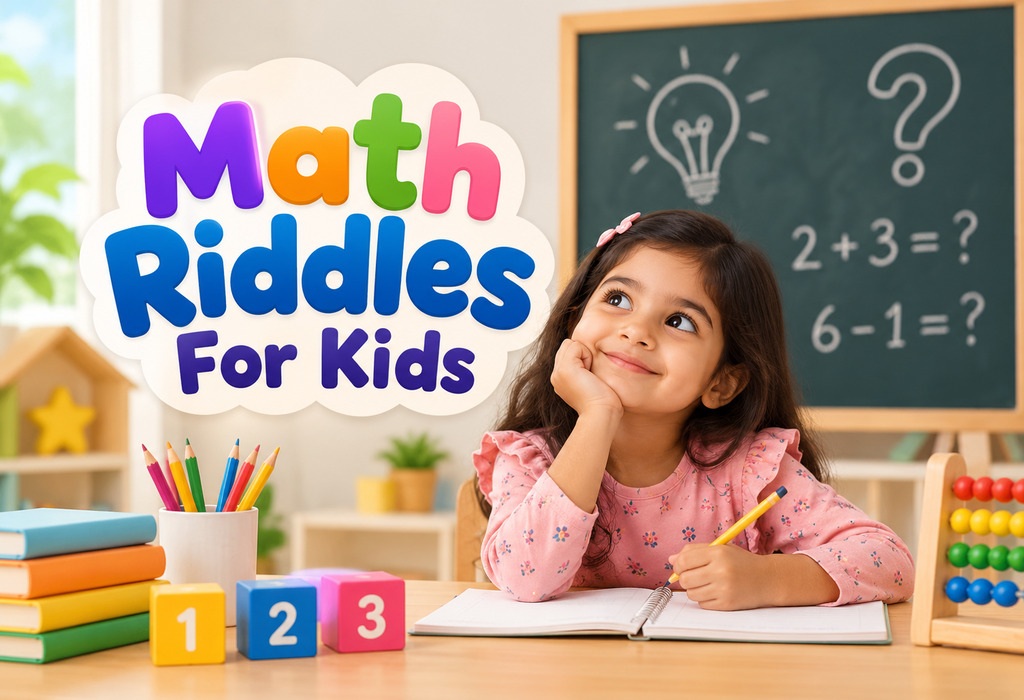
100 Maths Riddles for Kids to Test Their Skills (With Answers)
Key Takeaways
Math riddles can make learning and practicing math more enjoyable.
Brain teasers encourage kids to think, reason, and solve problems.
Start with simple riddles and gradually introduce more challenging ones.
Give kids time to work out the answer before helping them.
Making mistakes is part of learning, so encourage kids to keep trying.
Looking for a fun way to make numbers more exciting? These math riddles for kids with answers turn calculations, number patterns, and logic into playful brain teasers that kids can enjoy solving. They’re a great way to encourage kids to think carefully, spot patterns, and find creative ways to reach an answer. With 100 riddles to explore, kids can tackle different types of math challenges, practice their problem-solving skills, and have fun seeing how many they can solve correctly.
What Age Can Kids Start Solving Math Riddles?
Kids can start solving simple math riddles as early as 4-5 years old, depending on their number skills and ability to follow basic instructions. At this age, riddles can focus on counting, shapes, comparisons, and simple addition or subtraction. As kids get older, you can introduce riddles involving multiplication, division, patterns, and logic.
Benefits of Math Riddles for Kids
Beyond being fun to solve, number riddles for kids can help them develop several useful skills while they practice. Here are some of the key benefits they can offer:
Improves Problem-Solving Skills : Math riddles encourage kids to break a question into smaller parts, explore possible solutions, and find the right answer.
Strengthens Logical Thinking : Solving riddles helps children recognise patterns, make connections, and use reasoning to work through a problem.
Makes Math More Enjoyable : A playful approach can make math practice feel more interesting and encourage kids to spend more time working with numbers.
Builds Confidence : Successfully solving a riddle gives kids a sense of achievement and motivates them to take on new challenges.
Encourages Critical Thinking : Math riddles encourage kids to pay attention to details, think beyond the obvious, and carefully consider each part of a question.
Math Riddles for Preschoolers & Kindergartners (Ages 3–5)
Ready for some playful number fun? These easy math riddles for kids help little learners explore counting, shapes, addition, subtraction, and simple number concepts. Let’s see how many of these 20 fun riddles your little problem-solvers can figure out!
1. I have 3 apples and you give me 2 more. How many apples do I have?
Answer: 5 apples
2. I have 3 sides and 3 corners. What shape am I?
Answer: A triangle
3. You have 5 cookies and eat 2. How many cookies are left?
Answer: 3 cookies
4. What number comes after 6?
Answer: 7
5. I am round and have no corners. What shape am I?
Answer: A circle
6. There are 2 cats, 3 dogs, and 1 cow. How many animals are there altogether?
Answer: 6 animals
7. What is 2 + 2?
Answer: 4
8. You have 4 balloons and get 4 more. How many balloons do you have?
Answer: 8 balloons
9. I have 4 equal sides and 4 corners. What shape am I?
Answer: A square
10. There are 6 frogs. Two hop away. How many frogs are left?
Answer: 4 frogs
11. What number comes between 4 and 6?
Answer: 5
12. You have 1 toy and get 3 more. How many toys do you have?
Answer: 4 toys
13. How many fingers are on one hand?
Answer: 5 fingers
14. If you multiply this number by any other number, the answer will always be the same. What number is this?
Answer: 0
15. I have 4 sides, but two sides are longer than the other two. What shape am I?
Answer: A rectangle
16. There are 5 birds on a tree. One flies away. How many birds are left?
Answer: 4 birds
17. What number comes before 3?
Answer: 2
18. You have 8 candies and get 3 more. How many candies do you have?
Answer: 11 candies
19. A tricycle has 3 wheels. How many wheels do 2 tricycles have?
Answer: 6 wheels
20. There are 7 red balls and 2 blue balls. How many balls are there altogether?
Answer: 9 balls
Math Riddles for Early Graders (Ages 6-8)
These math brain teasers for kids ages 6–8 are simple, fun, and a great way to practice their skills while solving each challenge. Let’s jump into these funny math riddles with answers for kids and see how many they can solve!
Math Riddles for 1st Graders
How well can your 1st grader handle these quick math challenges? Let’s find out!
1. I have 8 crayons and give 3 to my friend. How many crayons do I have left?
Answer: 5 crayons
2. I am 2 more than 7. What number am I?
Answer: 9
3. There are 5 ducks in a pond and 4 more join them. How many ducks are there?
Answer: 9 ducks
4. I have 4 sides and 4 corners, and all my sides are the same length. What shape am I?
Answer: A square
5. What number comes between 16 and 18?
Answer: 17
6. You have ₹20 and spend ₹6 on a snack. How much money do you have left?
Answer: ₹14
7. There are 10 flowers. Four are picked. How many flowers remain?
Answer: 6 flowers
8. A clock shows 7:00. What time is it?
Answer: 7 o’clock
9. I have 3 tens and 5 ones. What number am I?
Answer: 35
10. You have 2 red balls and 6 blue balls. How many balls do you have altogether?
Answer: 8 balls
11. Which number is smaller: 12 or 21?
Answer: 12
12. What is 5 + 4?
Answer: 9
13. A triangle has 3 sides. How many sides do 2 triangles have altogether?
Answer: 6 sides
14. You have 9 stickers and give 2 away. How many stickers remain?
Answer: 7 stickers
15. What number comes just before 30?
Answer: 29
Math Riddles for Second Graders
Looking for something a little more challenging? These math riddles for class 2 are a fun way for your little one to put their skills to the test.
1. I have 5 tens and 7 ones. What number am I?
Answer: 57
2. A farmer has 24 eggs and sells 9. How many eggs are left?
Answer: 15 eggs
3. What is 8 × 4?
Answer: 32
4. A game starts at 3:30 and lasts for 1 hour. What time does it end?
Answer: 4:30
5. You have ₹100 and buy a book for ₹35. How much change do you get?
Answer: ₹65
6. What is 42 + 28?
Answer: 70
7. I am an odd number between 20 and 30. My ones digit is 5. What number am I?
Answer: 25
8. There are 5 plates with 3 cookies on each plate. How many cookies are there?
Answer: 15 cookies
9. What is half of 16?
Answer: 8
10. A rectangle has 4 sides. How many sides do 3 rectangles have altogether?
Answer: 12 sides
11. You have 63 marbles and lose 27. How many marbles are left?
Answer: 36 marbles
12. What number has 2 hundreds, 4 tens, and 6 ones?
Answer: 246
13. A pencil costs ₹5. How much do 4 pencils cost?
Answer: ₹20
14. What is 36 ÷ 6?
Answer: 6
15. What time is 15 minutes after 4:00?
Answer: 4:15
Math Riddles for Third Graders
Think you’re ready for a challenge? These maths riddles for class 3 will put your skills to the test.
1. What is 146 + 237?
Answer: 383
2. A library has 500 books and lends out 126. How many books remain?
Answer: 374 books
3. I have 6 hundreds, 4 tens, and 2 ones. What number am I?
Answer: 642
4. What is 9 × 6?
Answer: 54
5. What is 81 ÷ 9?
Answer: 9
6. A cake is cut into 10 equal pieces. Mia eats 3 pieces. What fraction of the cake did she eat?
Answer: 3/10
7. A movie begins at 1:45 and ends at 3:15. How long is the movie?
Answer: 1 hour 30 minutes
8. You have ₹500 and spend ₹175. How much money remains?
Answer: ₹325
9. I am a number between 400 and 500. My hundreds digit is 4, my tens digit is 7, and my ones digit is 2. What number am I?
Answer: 472
10. There are 7 rows with 8 chairs in each row. How many chairs are there?
Answer: 56 chairs
11. What is 3 × 25?
Answer: 75
12. A ribbon is 90 cm long. You cut off 35 cm. How much ribbon is left?
Answer: 55 cm
13. What is 1000 − 450?
Answer: 550
14. A pizza has 12 equal slices. Four friends share it equally. How many slices does each friend get?
Answer: 3 slices
15. What is ¼ of 20?
Answer: 5
16. A toy costs ₹125. You pay with ₹200. How much change should you receive?
Answer: ₹75
17. What number is 25 more than 375?
Answer: 400
18. A school bus carries 36 children. Three buses carry the same number of children. How many children are there altogether?
Answer: 108 children
19. I am an even number greater than 60 and less than 70. My digits add up to 10. What number am I?
Answer: 64
20. A shop has 96 oranges and packs them equally into 8 boxes. How many oranges go in each box?
Answer: 12 oranges
Math Riddles for Older Kids
Ready to take your math skills up a notch? These riddles are a little trickier and will give older kids plenty to think about.
1. What is 12 × 4?
Answer: 48
2. I have 72 candies and share them equally among 8 friends. How many candies does each friend get?
Answer: 9 candies
3. What is half of 36?
Answer: 18
4. A pizza has 8 equal slices. You eat 3. What fraction of the pizza is left?
Answer: 5/8
5. What is 15 × 6?
Answer: 90
6. If 96 pencils are packed equally into 12 boxes, how many pencils go in each box?
Answer: 8 pencils
7. Which is greater: 2/3 or 1/3?
Answer: 2/3
8. I am thinking of a number. Multiply me by 5 and you get 45. What number am I?
Answer: 9
9. What is ¾ of 20?
Answer: 15
10. A farmer has 7 rows of 9 trees. How many trees are there altogether?
Answer: 63 trees
11. What is 144 ÷ 12?
Answer: 12
12. If you have 4 quarters, what fraction of a whole do they make?
Answer: 1 whole
13. I am an even number between 20 and 30. My digits add up to 8. What number am I?
Answer: 26
14. What is 25 × 4?
Answer: 100
15. A cake is cut into 12 equal pieces. What fraction is one piece?
Answer: 1/12
16. You have 5 bags with 14 marbles in each. How many marbles do you have?
Answer: 70 marbles
17. What is 120 ÷ 10?
Answer: 12
18. I am greater than 30 but less than 40. I am divisible by 3 and 4. What number am I?
Answer: 36
19. Sam has twice as many stickers as Mia. Mia has 9 stickers. How many stickers does Sam have?
Answer: 18 stickers
20. What is 2/5 of 25?
Answer: 10
21. A number plus 17 equals 42. What is the number?
Answer: 25
22. There are 6 boxes with the same number of books. Altogether, there are 54 books. How many books are in each box?
Answer: 9 books
23. Which fraction is smaller: 3/8 or 5/8?
Answer: 3/8
24. I have 3 times as many pencils as you. You have 7 pencils. How many pencils do I have?
Answer: 21 pencils
25. What is 200 ÷ 25?
Answer: 8
26. A ribbon is divided into 5 equal parts. You use 2 parts. What fraction of the ribbon did you use?
Answer: 2/5
27. I am a number less than 50. I am divisible by 5 and 7. What number am I?
Answer: 35
28. There are 48 students. One-fourth of them are wearing hats. How many students are wearing hats?
Answer: 12 students
29. A number is multiplied by 4 and then 6 is added. The result is 30. What is the number?
Answer: 6
30. You have 10 coins. You give half to your friend and then receive 3 more. How many coins do you have now?
Answer: 8 coins
Tips for Parents to Help Kids Solve Math Riddles
Want to make math riddles easier and more fun for your child? Try these simple tips:
Let them try first: Give your child time to read the riddle and work through it before offering help.
Ask guiding questions: Instead of giving the answer, ask questions that help them understand what the riddle is asking.
Use everyday examples: Connect the riddle to familiar things like toys, snacks, money, or time to make it easier to understand.
Break it into steps: Encourage kids to solve longer or trickier riddles one part at a time.
Use drawings or objects: Let them use counters, pencils, coins, or simple drawings when they need help visualizing the problem.
Celebrate their effort: Praise their thinking and effort, even when they get an answer wrong, to keep them motivated.
Solving math riddles is a great activity to make maths interesting for kids. Maths riddles develop their mathematical and logical abilities and boost their mental activeness. So get your child to do these math riddles, and improve their mathematical and logical reasoning ability.
Also Read:
Maths Tricks for Children
Maths Puzzles for Children
Tips to Help your Kids Survive Maths
Read more




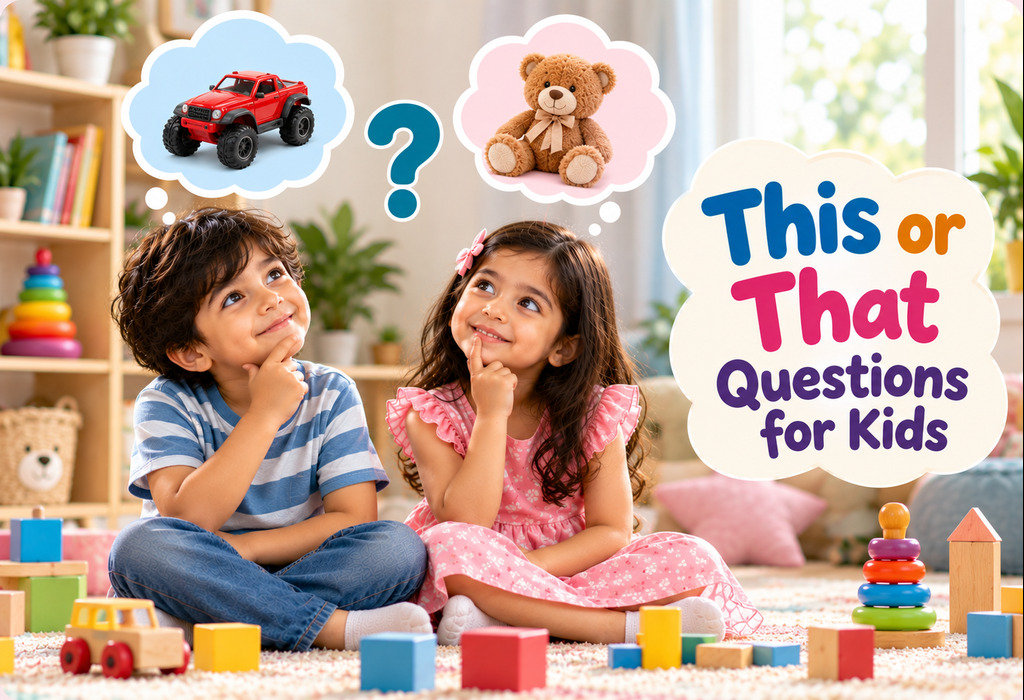
100+ This or That Questions for Kids to Spark Fun Conversations
Key Takeaways
This or that questions give kids two choices and one quick decision, making conversation easy and fun.
The game needs no props or preparation and suits children from about age three to ten.
Themes range from animals and food to space and seasonal topics.
Playing builds vocabulary, confidence, and decision-making skills.
Asking “why?” afterwards turns quick answers into deeper family conversations.
Looking for a screen-free way to get your child talking? These this or that questions for kids are quick, playful, and perfect for car rides, dinner tables, and classrooms. Each question offers two choices, and your child simply picks a favourite. There is no right or wrong answer, which keeps the game relaxed and fun. Below you will find more than 100 questions sorted into themes like animals, food, movies, space, and seasons, plus simple tips to help you get started right away.
What Are This or That Questions?
This or that questions are a simple game where a child chooses between two options, such as “pizza or pasta?” They are a light way to learn what your child likes while sparking lively chatter. Many families play this or that for kids as a quick icebreaker or a bedtime chat.
What Are the Benefits of This or That Questions for Kids?
Beyond the giggles, this game supports growth in surprising ways. Here are some of the biggest benefits.
Builds Vocabulary: Kids learn to describe their likes and dislikes with new words.
Boosts Confidence: With no wrong answers, shy children feel safe speaking up.
Strengthens Decision-Making: Choosing between two options is a low-pressure way to practice.
Encourages Bonding: Shared laughter and surprising answers bring families closer.
Sparks Creativity: Explaining a choice invites imaginative thinking.
How to Play?
Read one question aloud and let your child pick an option. Then ask “why?” to keep the chat going. Take turns so everyone answers, and use pictures for younger children. Simple this or that questions for preschoolers work well with two picture cards, while this or that questions for kindergarten can include a short reason. Keep it light and never pressure anyone to pick a “right” answer.
Animal This or That Questions for Kids
Kids love talking about their favourite creatures, so let them choose.
Cats or dogs?
Lions or tigers?
Dolphins or sharks?
Butterflies or ladybugs?
Pandas or koalas?
Elephants or giraffes?
Penguins or owls?
Frogs or turtles?
Fish or birds?
Rabbits or hamsters?
Funny This or That Questions Kids Will Love
Silly choices bring the giggles, so read these in your best dramatic voice.
Sneeze glitter or burp bubbles?
Wear socks on your hands or gloves on your feet?
Talk like a robot or walk like a crab?
Have spaghetti for hair or jelly for shoes?
Ride a unicorn or a dragon?
Laugh like a donkey or snort like a pig?
Be a giant or an ant for a day?
Have a pet dinosaur or a pet robot?
Hop everywhere or dance everywhere?
Have a tail or wings?
This or That Food and Drink Questions for Kids
Mealtime gets more fun with tasty choices.
Pizza or pasta?
Ice cream or cake?
Apples or bananas?
Pancakes or waffles?
Chocolate milk or orange juice?
French fries or popcorn?
Cookies or cupcakes?
Sweet snacks or salty snacks?
Sandwiches or wraps?
Smoothies or milkshakes?
Books and Stories This or That Questions for Kids
Story fans can share their reading tastes with these picks.
Picture books or chapter books?
Fairy tales or adventure stories?
Reading in bed or on the couch?
Comic books or storybooks?
Be a knight or a wizard?
Dragons or mermaids?
Funny stories or spooky stories?
Read aloud or read silently?
Mysteries or magic tales?
Write a story or draw a story?
Game This or That Questions for Kids
Whether it is playtime or family game night, these choices fit right in.
Board games or video games?
Hide-and-seek or tag?
Puzzles or building blocks?
Hopscotch or jump rope?
Play alone or with friends?
Card games or dice games?
Chess or checkers?
Soccer or basketball?
Lego bricks or play dough?
Simon Says or Red Light, Green Light?
Movie This or That Questions for Kids
Lights, camera, choices! Kids can pick their favourite film fun.
Animated movies or live-action movies?
Superheroes or princesses?
Movie theater or home movie night?
Popcorn or candy at the movies?
Sequels or brand-new movies?
Talking animals or friendly robots?
Funny movies or adventure movies?
Be the hero or the sidekick?
Musicals or action movies?
Watch a movie or make one?
Music This or That Questions for Kids
Music gets little ones moving, humming, and choosing.
Singing or dancing?
Piano or guitar?
Drums or trumpet?
Loud songs or quiet songs?
Slow songs or fast songs?
Sing in the shower or in the car?
Listen to music or make music?
Sing alone or in a group?
Nursery rhymes or pop songs?
Play an instrument or write a song?
Outdoor This or That Questions for Kids
Fresh air and big adventures await with these picks.
Beach or mountains?
Camping or hiking?
Swings or slides?
Bikes or scooters?
Sunny days or snowy days?
Playground or park?
Build a sandcastle or a snowman?
Climb trees or jump in puddles?
Catch fireflies or collect seashells?
Picnic or barbecue?
Space This or That Questions for Kids
Little astronauts can blast off with these cosmic choices.
Sun or moon?
Fly a rocket or drive a moon buggy?
Visit Mars or the moon?
Stars or planets?
Meet a friendly alien or a space robot?
Astronaut or space scientist?
Live on a space station or a new planet?
Saturn or Jupiter?
Float in zero gravity or bounce on the moon?
Watch a meteor shower or an eclipse?
Christmas This or That Questions for Kids
Get into the holiday spirit with these festive choices.
Reindeer or snowman?
Hot chocolate or candy canes?
Tall tree or small tree?
Wrap gifts or open gifts?
Santa or elves?
Sing carols or watch holiday movies?
Stockings or presents under the tree?
Sugar cookies or gingerbread?
Snowy holiday or warm holiday?
Twinkle lights or colourful ornaments?
Fall-Themed This or That Questions
Crisp air and cosy days inspire these seasonal picks.
Pumpkins or apples?
Jump in leaf piles or collect pretty leaves?
Hayride or corn maze?
Sweaters or jackets?
Apple cider or pumpkin pie?
Scarecrows or sunflowers?
Campfire s’mores or caramel apples?
Warm blankets or fuzzy socks?
Acorns or pinecones?
Cool mornings or early sunsets?
Halloween-Themed This or That Questions
Spooky season is more fun when kids choose their favourite frights and treats.
Trick-or-treating or a costume party?
Ghosts or witches?
Carve a pumpkin or paint a pumpkin?
Chocolate or gummy candy?
Black cats or bats?
Haunted house or spooky story?
Wizard costume or superhero costume?
Spider webs or skeleton decorations?
Candy corn or lollipops?
Glow sticks or flashlights?
Spring-themed This or That Questions
Warmer days and blooming flowers bring plenty to choose from.
Tulips or daisies?
Rain showers or sunny skies?
Kites or bubbles?
Baby chicks or baby bunnies?
Plant flowers or plant veggies?
Rain boots or sandals?
Egg hunt or picnic?
Robins or bluebirds?
Green grass or colourful flowers?
Spring break or summer break?
FAQs
1. What age is best for playing this or that?
Children as young as three can play with simple, picture-based choices. Older kids, including this or that questions for 1st, 2nd and 3rd graders, can handle trickier options and explain their reasons.
2. How do I get a shy child to join in?
Start with easy, low-stakes choices such as foods or animals, and answer a few yourself first. Never push for a reason, and let your child pass on any question.
3. Is this or that better than would you rather?
They suit different moods. This or that offers quick, simple picks, while would you rather often poses sillier or tougher dilemmas. Younger kids usually find the shorter format easier.
4. Are there topics I should avoid?
Skip choices that involve scary situations, family comparisons, or anything that could make a child feel judged. Stick to light, playful topics.
This or that questions are an easy way to turn ordinary moments into happy conversations. With more than 100 options across animals, food, music, space, and seasons, there is something for every child. Try a few during dinner, on the drive to school, or before bedtime. Remember to ask why, and celebrate every answer, since there are no wrong choices. Before long, your family may be inventing new questions of its own.
Read more
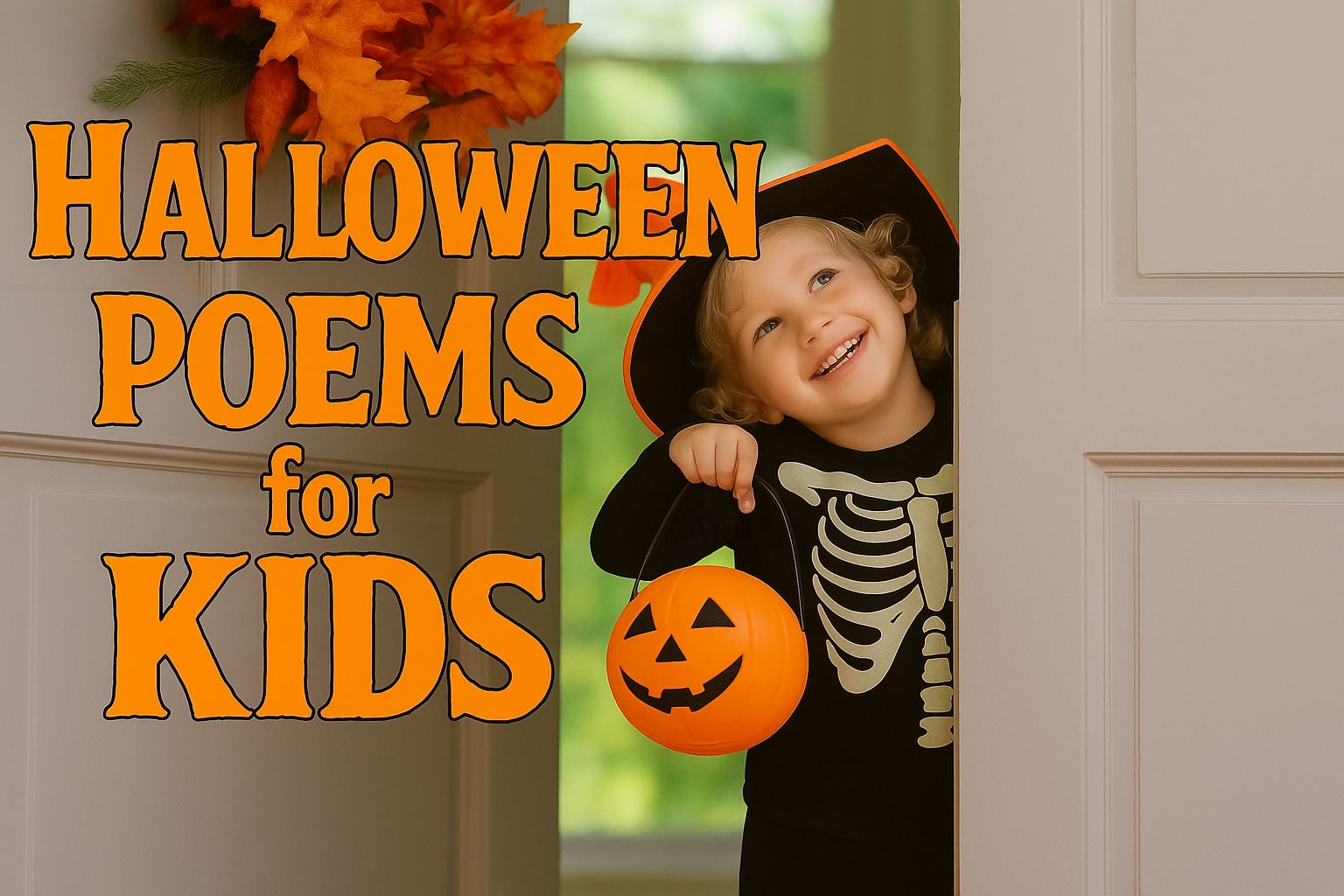
30 Halloween Poems for Kids to Enjoy
Halloween is one of the most fun and exciting times of the year for kids! With plenty of playful blend of tricks, treats, and costumes, this holiday sparks is a kids’ favourite, and even adults, too. What better way to celebrate the spooky season than with Halloween poems for kids? These poems bring a delightful mix of chills and giggles, perfect for setting the mood at Halloween parties, bedtime stories, or even school activities. From friendly ghosts and mischievous witches to glowing pumpkins, there’s a poem here to enchant every little monster.
In this article, we’ll dive into a collection of unique and funny Halloween-themed poems designed especially for children. These are easy to read, fun to recite, and sure to bring smiles (and a few playful shivers). Let’s jump right into the fun!
Short Poems About Halloween for Kids
Short Halloween poems are perfect for little ones who enjoy quick, easy-to-remember verses. They capture the spooky charm of Halloween in a fun and simple way. These poems can be shared during storytime, at Halloween events, or even as part of school activities. Let’s explore a few enchanting options that kids will adore!
1. “Five Little Pumpkins” by Anonymous
Five little pumpkins sitting on a gate,
The first one said, “Oh my, it’s getting late!”
The second one said, “There are witches in the air!”
The third one said, “But we don’t care.”
The fourth one said, “Let’s run and run and run.”
The fifth one said, “It’s Halloween fun!”
This playful rhyme is a favourite among young children and makes a delightful chant for Halloween gatherings.
2. “In the Dark, Dark Woods” by Traditional
In the dark, dark woods,
There’s a dark, dark house.
In the dark, dark house,
There’s a dark, dark room.
And in that dark, dark room…
A ghost goes BOO!
Short and spooky, this classic poem is sure to bring giggles and surprise to kids as they recite the final line.
3. “A Witch’s Cat” by Anonymous
A witch’s cat sat on her hat,
And scratched at a pumpkin bright.
With glowing eyes, he prowled the skies,
On a broomstick through the night.
This short Halloween poem paints a vivid picture of a mischievous witch and her loyal feline friend.
4. “Spooky Night” by Unknown
The wind howls loud, the moon shines bright,
The shadows grow on Halloween night.
With ghosts and goblins everywhere,
It’s time for scares—if you dare!
Kids love the rhythm and excitement in this spooky yet cheerful poem, perfect for Halloween-themed activities.
5. “Little Jack O’Lantern” by Anonymous
Little Jack O’Lantern, shining with glee,
Lights up the night for all to see.
With a toothy grin and a candle bright,
He’s the star of Halloween night!
6. Happy Halloween By Anonymous
Now, you can dress up as your favorite ghoul or pumpkin. There are plenty of tricks and treats out there. So, Happy Trick or Treating!
It’s late, and we are sleepy,
The air is cold and still.
Our jack-o-lantern grins at us
Upon the window sill.
We’re stuffed with cake and cand
And we’ve had a lot of fun,
But now it’s time to go to bed
And dream of all we’ve done.
We’ll dream of ghosts and goblins
And of witches that we’ve seen,
And we’ll dream of trick-or-treating
On this happy Halloween.
7. Halloween is Here By Debbie
Before you get too enthusiastic, keep in mind that a poem written just for Halloween is not for the faint-hearted.
It’s time for Halloween,
A day for trick or treat,
When the kids dress up in costume,
And walk proudly down the street.
They ring alot of doorbells,
And collect alot of candy, a lot
And if they happen to see aa lotst,
They will be greeted with a boo.
Pumpkins light up the windows,
And decorations adorn the front yard,
So be careful when you come in,
Because the skeleton will be on guard.
So have alot of fun,
And don’t have any fear,
Because it will soon be over,
And you’ll have to wait till next year.
This simple poem celebrates the joy of carved pumpkins, making them a favourite for young children. We hope you enjoyed these short Halloween poems, and they created lasting memories.
Classic Halloween Poems for Children
Classic Halloween poems have a timeless charm that brings the spirit of Halloween to life. These poems often feature witches, ghosts, and spooky settings, making them a perfect way to spark a child’s imagination. Let’s explore a few well-loved children’s Halloween poems that continue to delight readers of all ages.
1. “Halloween” by Harry Behn
Tonight is the night
When dead leaves fly
Like witches on switches
Across the sky.
When elves and sprites
Creep into sight,
And the moon laughs out
With a chilly light.
This classic captures the mysterious and magical feel of Halloween night, perfect for sparking the excitement of the season.
2. “The Night Wind” by Eugene Field
Have you ever heard the wind go “Yoooooo”?
’Tis a pitiful sound to hear!
It seems to chill you through and through
With a strange and speechless fear.
This poem blends spooky imagery with a touch of suspense, making it an engaging choice for older children.
3. “The Spider and the Fly” by Mary Howitt
“Will you walk into my parlor?” said the Spider to the Fly,
“’Tis the prettiest little parlor that ever you did spy.”
The way into my parlor is up a winding stair,
And I have many pretty things to show you when you’re there.
This classic poem teaches a moral lesson with a spooky twist, offering a mix of fun and wisdom for children.
4. “Haunted House” by Anonymous
There’s a house upon the hill,
Where shadows shift and creep.
It’s said that if you listen close,
You’ll hear the spirits weep.
Short and spooky, this poem captures the mystery of haunted houses in a way that’s intriguing but not too scary for kids.
5. “Witches’ Chant” from Shakespeare’s Macbeth
Double, double, toil and trouble,
Fire burn and cauldron bubble.
Fillet of a fenny snake,
In the cauldron boil and bake.
6. All Hallowe’en By Pauline Clark
The tradition of trick-or-treating dates back to medieval times, when people gathered in neighborhoods to exchange soul-cakes for prayers.
Witch and warlock all abroad
Revels keep by field and yard.
In the firelight of the farm
Boy and maiden one by one
Place their chestnuts in the grate
And for omens quietly wait;
To a string their apples tie,
Twirl them till they fallen lie;
Those whose fruits fall in a hurry,
They shall be the first to marry.
Witch and warlock all abroad
Revels keep by field and yard.
Apples from the beam hang down
To be caught by mouth alone,
Mugs of ale on Nut-Crack Night
And many a tale of ghost and sprite,
Come to cheer and chill the heart,
While the candles faint and start,
While the flickering firelight paints
Pictures of the hallowed saints.
Witch and warlock all abroad
Revels keep by field and yard.
7. Spirits of the Dead By Edgar Allan Poe
Based on Italian mythology, this is one of Poe’s most renowned compositions.
Thy soul shall find itself alone
‘Mid dark thoughts of the grey tomb-stone;
Not one, of all the crowd, to pry
Into thine hour of secrecy.
Be silent in that solitude,
Which is not loneliness — for then
The spirits of the dead, who stood
In life before thee, are again
In death around thee, and their will
Shall overshadow thee; be still.
The night, though clear, shall frown
And the stars shall not look down
From their high thrones in the Heaven
With light like hope to mortals given,
But their red orbs, without beam,
To thy weariness shall seem
As a burning and a fever
Which would cling to thee for ever.
Now are thoughts thou shalt not banish,
Now are visions ne’er to vanish;
From thy spirit shall they pass
No more, like dew-drop from the grass.
The breeze, the breath of God, is still,
And the mist upon the hill
Shadowy, shadowy, yet unbroken,
Is a symbol and a token.
How it hangs upon the trees,
A mystery of mysteries!
Though written centuries ago, these iconic lines remain a Halloween favourite, with their rhythmic chant and magical imagery captivating children everywhere.
Classic children’s Halloween poems like these are a wonderful way to connect kids with the holiday’s rich traditions and eternal tales.
Funny Halloween Poems for Kids
Halloween doesn’t always have to be spooky; it can be full of laughs, too. Funny Halloween poems add a touch of humour to the holiday while still capturing the creepy fun of ghosts and witches. Kids will love these lighthearted verses that bring out the playful side of Halloween.
1. “The Skeleton Parade” by Jack Prelutsky
The skeletons are on parade,
Their bones go click and clack.
They rattle, clatter down the street,
And then they march right back!
This playful poem brings the skeletons to life in a way that’s funny instead of scary, perfect for younger children.
2. “The Candy Gobbler” by Anonymous
Beware the Candy Gobbler, they say,
Who steals your treats on Halloween day.
With chocolate on his chin and a grin so wide,
He’ll munch through your stash and won’t even hide!
Kids will laugh at the idea of a silly gobbler sneaking their Halloween candy, making this poem a crowd-pleaser.
3. “A Witch in My Kitchen” by Anonymous
There’s a witch in my kitchen, brewing a stew,
With bat wings and worms—oh, what will I do?
She’s added some spiders and stirred with a broom,
And now my whole house smells of doom!
This humorous take on witches cooking up trouble is sure to get giggles from children.
4. “The Friendly Ghost” by Shel Silverstein
There once was a ghost, as kind as could be,
But scaring folks was his family’s decree.
He said, “I won’t boo, I won’t make them flee,
I’ll just wave and say hi, that’s good enough for me!”
This lighthearted poem about a ghost who prefers friendliness to fright is a great way to keep Halloween fun and positive.
5. “Pumpkin in My Bed” by Anonymous
I woke up last night with a pumpkin in my bed,
It had googly eyes and a hat on its head!
It whispered, “I’m here to give you a scare,”
But I just laughed and said, “Nice try, Mr. Square!”
This silly poem turns a creepy moment into a laugh-out-loud story, keeping the Halloween spirit fun for kids.
6. “Monster Dance Party” by Anonymous
At midnight sharp in a haunted hall,
The monsters gather, big and small.
They boogie and spin to a spooky beat,
With stomping claws and ghostly feet!
7. A Trick of a Treat By Nancy Hughes
Culturally, the Trick or Treat ritual has taken root and thrived.
Dressed up little creatures
on a dark October night
run from door to door
giving everyone a fright.
They come and ring your doorbell
and before they will retreat,
they beg you for some candy
by yelling “trick or treat”.
When their bags are full,
they run home to eat their fill.
They taste a bit of everything
and by morning they are ill!
So to keep the youngsters healthy,
I’ve figured out a deal.
This year instead of candy,
I’ll give them all oatmeal!
8. Halloween Memories at Grandma’s By Julian
Enjoy a spooky Halloween at Grandma’s. You may be a ghost or a witch or witches! The options are infinite!
11 foot tall Frankensteins,
Ghosts hanging from the trees,
Every time I see it I drop to my knees.
Mist comes out
and lights flash about,
Kids line up waiting to get in.
Enter at your own risk,
But you will never win
One at a time they dare to enter,
Quickly running out to the center.
I start laughing at all the dares,
And now I wonder who is really in there.
9. The Witch By Jack Prelutsky
An eerie poem that will keep you flipping the pages, The Witch will keep you on the edge of your seat.
She comes by night, in fearsome flight,
In garments black as pitch,
the queen of doom upon her broom,
the wild and wicked witch,
a crackling crone with brittle bones
and dessicated limbs,
two evil eyes with warts and sties
and bags about the rims,
a dangling nose, ten twisted toes
and fold of shriveled skin,
cracked and chipped and crackled lips
that frame a toothless grin.
She hurtles by, she sweeps the sky
and hurls a piercing screech.
As she swoops past, a spell is cast
on all her curses reach.
Take care to hide when the wild witch rides
to shriek her evil spell.
What she may do with a word or two
is much too grim to tell.
This fun and energetic poem about monsters dancing together is a perfect mix of creepy and comical.
Funny Halloween poems like these remind kids that Halloween isn’t just about scares—it’s about having fun and celebrating with a big smile!
Interactive Halloween Poems for Kids
Interactive Halloween poems are a great way to engage kids and make the holiday even more exciting. These poems encourage movement, gestures, or even sound effects, making storytime or group activities lively and memorable. Here are a few famous Halloween poems that kids can actively participate in.
1. “Stomp Like a Monster” by Anonymous
Stomp, stomp, stomp like a monster,
Growl, growl, growl like a beast!
Wave your claws high, let out a roar,
Then gobble your Halloween feast!
This fun poem gets kids moving with actions like stomping and growling, making it perfect for classroom or party games.
2. “The Witch’s Brew” by Anonymous
Stir the pot and wave your wand,
Add a frog and wave your hand.
Clap your hands, say “Bubble, bubble,”
Now watch the brew begin to trouble!
Kids love pretending to make a spooky potion as they recite this interactive poem. It’s great for combining creativity with play.
3. “The Ghost in the Mirror” by Anonymous
Wave your arms and make a ghostly face,
Boo in the mirror, then hide in a space.
Creep back out with a spooky cheer,
And watch the ghost slowly disappear!
This playful poem encourages kids to act out ghostly movements, creating a blend of fun and pretend play.
4. “Pumpkin Toss” by Anonymous
Pretend to toss a pumpkin high,
Catch it quick before it flies!
Spin around, then jump with glee,
Pumpkins are silly as can be!
This rhyme gets kids moving and laughing as they act out tossing and catching pumpkins. It’s a hit for group activities.
5. “March of the Bats” by Anonymous
Flap your arms and fly like a bat,
Circle around, then land on your mat.
Screech and squeal as bats do at night,
Then take off again for a spooky flight!
6. It’s Halloween By Jack Prelutsky
If you’re looking for a wonderful Halloween read-aloud for kids, this is it.
It’s Halloween! It’s Halloween!
The moon is full and bright
And we shall see what can’t be seen
On any other night.
Skeletons and ghosts and ghouls,
Grinning goblins fighting duels,
Werewolves rising from their tombs,
Witches on their magic brooms.
In masks and gowns
we haunt the street
And knock on doors
for trick or treat.
Tonight we are the king and queen,
For oh tonight it’s Halloween!
7. Witches Stew By Gareth Lancaster
One of the most haunting and scariest Halloween poems we’ve ever read!
Bubble, blubber, squirm and gloop,
Boiling broth of bat’s tail soup.
Wobble, slobber, liquid goo,
Add the sole of one old shoe.
Spooky shadows dance around,
Of frogs and rats and snarling hounds.
Steam swirls rising to the roof,
Add one small ear and one old tooth.
Gnarly, scratchy, tickle and itch,
Stir round and round to make it rich.
Mushy, sticky, sizzle and stew,
They’re making mischief just for you
This interactive poem combines movement with a touch of Halloween fun, making it an engaging choice for younger children.
Interactive poems bring famous Halloween poems to life, helping kids experience the holiday in a hands-on way while enjoying the magic of rhymes and imagination.
FAQs
1. What are Halloween poems for kids?
Halloween poems for kids are short, fun, and often spooky rhymes that capture the magic of Halloween. They feature themes like pumpkins, ghosts, witches, and candy, making them perfect for the holiday.
2. How can I use Halloween poems with kids?
You can read them aloud during storytime, use them for classroom activities, or recite them at Halloween parties. Interactive poems are also great for adding movement and fun to celebrations.
3. Why are Halloween poems popular with children?
They combine rhymes, imagination, and a little spookiness, which kids find exciting. These poems are easy to remember and help create lasting Halloween memories.
Halloween poems are a wonderful way to bring the spooky season to life for kids. Whether they are funny, interactive, or filled with classic charm, these poems add magic and excitement to the holiday. They are perfect for sharing at bedtime, in classrooms, or during Halloween celebrations. By encouraging kids to recite, act out, or even create their own verses, these poems spark creativity and laughter. From playful pumpkins to friendly ghosts, the themes capture the fun of Halloween in a way children adore. So, gather your little ones, pick a favourite poem, and enjoy the spooky joy of Halloween together!
Also Read:
Funny Poems for Children
Short English Poems for Kids
Beautiful Nature Poems for Kids
Famous Poems about Animals for Children
Read more
Navratri and Dussehra Facts for Kids
Normally, the second half of the year in India is full of celebration and festivals, with so many being celebrated within weeks of one another. It is a great time for families because, in many parts, they come together from all over the country in unison to celebrate the festive season.
Almost all the following festivals – Navratri, Dussehra and Diwali – celebrate the triumph of good over evil, and it is a great time to teach kids about India’s history. If you have a kid in the family, now is a great time to teach them about these festivals, and impart some Navratri information for kids to appreciate the importance of the festival better.
What is Navratri?
Navratri is a festival celebrated by Hindus. It is also known by other names in different parts of the country, including Chandra Darshan, Sindoor Tritiya, Chandi Path, Kumari Puja, Sandhi Puja, Mahagauri Puja, and Ayudha Puja, among other names. There are certain rituals which are observed in different parts of the country during this time. Each region or state has their own ways of celebration and the duration also differs from place to place.
Why and When is Navratri Celebrated?
A festival that is celebrated by those who follow Hinduism, Navratri is celebrated for different reasons in different parts of the country. It is also known as Durga Puja, whereby devotees pay respects to Goddess Durga and her nine avatars. ‘Nav’ means nine and ‘ratri’ means night; hence, the name. There is also the aspect of the nine colours of Navratri, each colour assigned to a specific day, depicting each incarnation of the Goddess.
In the North, the celebration is in honour of Lord Ram and his triumph over Lankan King Raavan, who kidnapped Ram’s wife; in the North East, they pray to Goddess Durga and her triumph over evil in the form of the demon Mahishasura.
This year, Navratri began on 11th October and will end on 20th October. In theory, Navratri actually falls from 2 to 4 times in a year, although the most celebrated one is Sharada Navratri which is celebrated after the monsoon season. The exact dates for the festival change slightly every year and depend upon the Hindu luni-solar calendar.
Why It’s Important for Children to Learn About Navratri?
“Navratri is a special festival that lasts for nine nights and ten days. It’s celebrated by many people in India with dances, songs, and prayers. It’s important for kids to learn about Navratri because it helps them know more about our culture and traditions. By understanding the stories and reasons behind the festival, children can feel more connected to it and appreciate its beauty and meaning.”
10 Amazing Facts About Navratri that Kids Should Know
Unveiling Navratri facts for kids! Discover the wonders and stories behind one of India’s most vibrant festivals.
“Navratri” comes from two Sanskrit words. “Nav” means 9, and “Ratri” means night. So, Navratri is a festival that lasts for 9 nights.
During Navratri, people worship Goddess Durga and her 9 forms. Each form has a unique power, and together they make up Goddess Durga. These forms are Shailaputri, Brahmacharini, Chandraghanta, Kushmanda, Skanda Mata, Katyayani, Kalaratri, Mahagauri, and Siddhidatri.
Navratri is celebrated five times a year, but the one in September/October, known as Sharad Navratri, is the most famous.
A big reason people celebrate Navratri is to remember Goddess Durga’s win over the demon Mahishasura. They fought for 9 days and nights, and on the 10th day, Goddess Durga won.
To remember Goddess Durga’s win over the buffalo-headed Mahishasura, some places in India have an animal sacrifice.
On the ninth day, called Ayudha Puja, many people worship things they use in their work, like computers, books, vehicles, and machinery.
Navratri dates change every year. They’re based on the Hindu lunar calendar, starting on the first day of the Ashwin month, usually in September or October. Right after Navratri ends, the Dussehra festival begins.
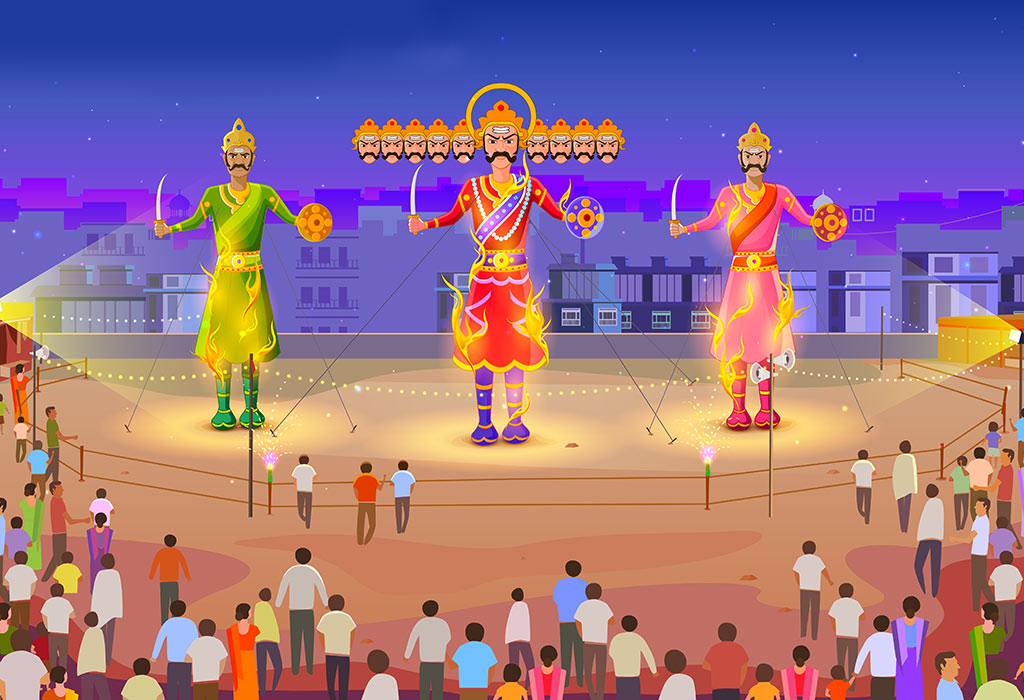
In parts of North and West India, during Navratri, people enjoy Ram Lila, which tells the story of Lord Rama. It ends with the Dussehra festival where big statues of Ravana are burnt, showing Lord Ram’s win over Ravana.
A lovely story says the Gods let Goddess Durga visit her mother for nine days every year. Navratri is believed to celebrate their happy reunion.
During Navratri, many people fast, eating special foods. This fasting is not just for religious reasons but is also considered good for health, as it detoxifies the body.
How Do People Celebrate Navratri Across India?
Here’s how people celebrate the festival in different parts of the country:
1. In East India
In Eastern India, Navratri is known as Durga Puja. Here, for days together, states like West Bengal, Odisha, Bihar etc. overflow with people. They venerate Durga Ma and celebrate her triumphant slaying of the evil demon Mahishasura. There are massive pandals, or stages, that are constructed across the state. For eight days, idols are decorated before they are immersed in the sea, to signify Her return to Kailasa.
2. In North India
In the North, Navratri is observed in the month of April in some places where people fast for nine days. It shouldn’t be implied that they do not eat at all during these nine days; they just abstain from wheat and rice. This practice is said to improve the digestive system.
The festival is again live in October, and celebrates Lord Ram and his triumph over the Lankan King Raavan, who kidnapped his wife, Sita.
The Navratri story for kids is best explained to them through the Ram Leela. For nine nights, people stay up and chant prayers praising Lord Ram and enjoy plays that celebrate his story. On the tenth day, a massive effigy of Raavan is burnt with much pomp and show, with crackers.
3. In West India
In Western India and parts of Gujarat, the festival is celebrated with dandiya or garba. It is a traditional dance between women and men, and it is called the “sword dance” because it represents a mock battle between Goddess Durga and the demon.
4. In South India
In Southern India, the festival is known as Ayudha Puja where people celebrate and pay respect to their instruments. Here, vehicles, books, and musical instruments are kept in front of the deity and smeared with holy ash or sandalwood paste. In several parts of different states in the South, people also have a unique exhibition of decorated dolls within their homes that last for all nine days.
What is Dussehra?
Dussehra is a festival celebrated largely across the North, in honour of Lord Ram’s triumphant victory against Raavan. It’s the final day of the Navratri festival and ends with many effigies of the ten-headed Raavan being burnt down to the ground.
Why and When is Dussehra Celebrated?
Dussehra is generally celebrated around mid-October and marks the tenth day of Navaratri. It is celebrated to commemorate Lord Ram’s victory over Raavan after he kidnapped his wife, Sita. The two armies fought fiercely for days before Lord Ram victoriously slew Raavan and saved his wife from the clutches of evil. It’s a great piece of Dussehra information for kids to learn and remember.
In some parts of Himachal Pradesh, the festival culminates on the tenth day of the rising moon, i.e. Vijayadashami. The history of this festival dates back to the 17th Century when the local King, Jagat Singh installed an idol of Raghunath in his kingdom, Kullu. This deity was declared as the ruling Lord of the entire valley.
10 Surprising Dussehra Facts for Kids
Introducing Dussehra facts for kids! Dive into these simple and engaging stories to understand the many shades of this grand festival.
Ravana is also loved in some places. In parts of India like Mandsaur and among the Gond Tribals, he is respected and worshipped. In Sri Lanka, he’s seen as a great king who contributed a lot to science and medicine.
Dussehra isn’t just about Lord Rama defeating Ravana. In Kolkata, it’s about Goddess Durga defeating a demon called Mahishasura. In Mysuru, it’s about Goddess Chamundeshwari’s victory. Telangana praises Goddess Gauri and in Tamil Nadu, they honor Goddess Kali.
The Pandavas, from a story called the Mahabharata, hid their weapons in a tree when they were in hiding. Later, they worshipped this tree and their weapons. This tradition is still followed today as Ayudha puja.
A story tells of a student named Kautsa who gave gold coins to the people of a city called Ayodhya on Vijayadashami. He got these coins from a generous king, and this was after he wanted to give something to his teacher.
Buddhists also have a special connection to Dussehra. They believe a king named Ashoka, who was sad because of a war, decided to follow Buddhism on this day.
In Kerala, young children start their learning journey on Dussehra. They are taught to write on rice grains. This special event is called Ezhuthiniruthu.
Dussehra comes when one season changes to another. Some traditions during this festival are believed to clean the environment, helping everyone stay healthy.
Different parts of India celebrate Dussehra for different stories and reasons. Whether it’s about a goddess, a kind king, or starting to learn, Dussehra is special for many people.
Dussehra is a time for families. They come together, share stories, and celebrate.
For many, Dussehra is about new beginnings. Some start learning, some change their ways, and some begin new tasks. It’s seen as a good day to start something new.
How Do People Celebrate Dussehra Across India?
Here are a few Dussehra facts for kids that you could teach them by showing them how the festival is celebrated in different parts of the country:
1. In East India
As mentioned before, Dussehra is celebrated as Durga Puja in the East. The number of days and certain traditions differ from state to state. Women apply sindoor on their foreheads and on the forehead of the Goddess they pray to. The festival or the puja is conducted on the days of Sashti, Saptami, Ashtami and Navami with the puja culminating on the final day of Dusshera.
2. In North India
Apart from burning of effigies, in the northern states, especially in the Kullu Valley of Himachal Pradesh, there is an internationally renowned Dusshera celebration called Kullu Dusshera. Here, the festivities start on the tenth day and continue for another seven days. This commemorates the day on which the idol of Lord Raghunath was installed on the throne by the local king Jagat Singh.
3. In West India
In Gujarat, Garba is a folk dance that is played during all the nine days of the festival. People dance to folk tunes after offering their prayers to the deity of Durga.
4. In South India
In Mysore, the festival sees a lot of prominence in the wonderfully lit Mysore Palace. The city also burns down effigies of Kumbhkaran, Raavan and Meghnath. Here too, idols of Goddess Durga are carried atop elephants from the palace to the Mantapa, or pavilion, as devotees pay their respects during the journey.
Thus, Navratri and Dussehra are celebrated wholeheartedly across the country. While they have different forms, the ultimate celebration is that of good over evil and the triumph of balance in the world.
Also Read:
Navratri Wishes,Quotes and Messages
Dussehra Quotes,Wishes and Messages
Dress Up your Children for Navratri Festival
Read more
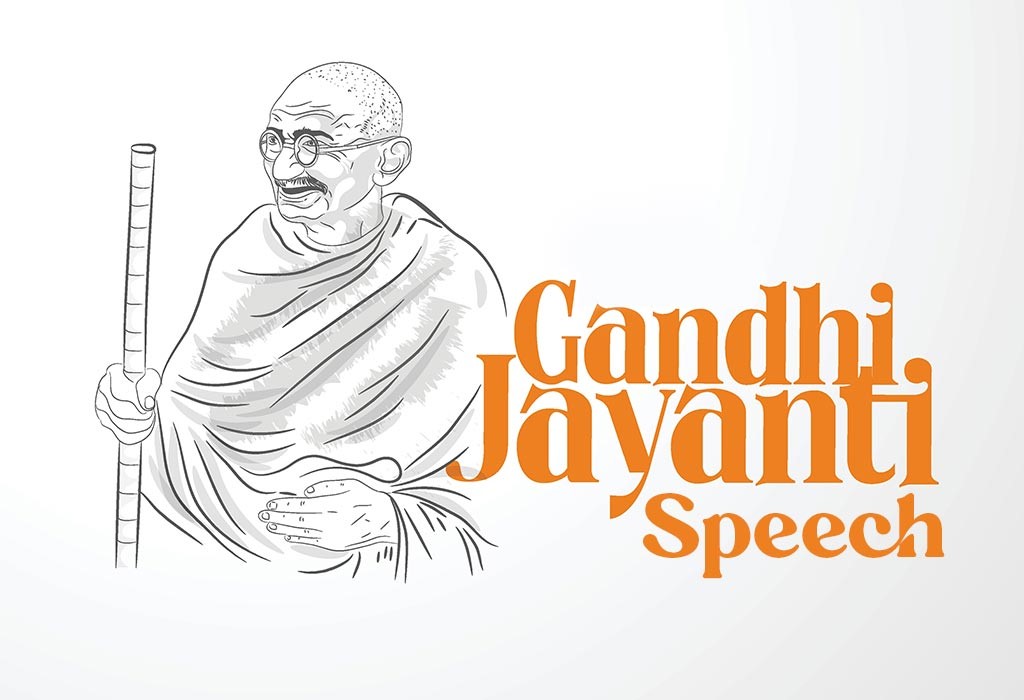
Gandhi Jayanti Speech for Students and Children in English
“Be the change you wish to see in the world.” These powerful words by Mahatma Gandhi resonate with us today as we celebrate Gandhi Jayanti on the 2nd of October. Mahatma Gandhi, the pioneer of India’s freedom journey, is known worldwide for his peaceful approach and dedication to non-violence during India’s fight for independence. Every 2nd of October marks the birth anniversary of Mohandas Karamchand Gandhi, aka Mahatma Gandhi, whose efforts and values continue to inspire people across the globe.
As we gather today, whether at school or in any gathering, let’s encourage students to deliver a Gandhi Jayanti speech that brings to life his timeless message of peace and unity. If you’re preparing a Mahatma Gandhi Jayanti speech in English, this is a great time to reflect on the values he stood for. On this 2 October, let’s deliver a Gandhi Jayanti speech that inspires children to follow his teachings of harmony and non-violence.
10 Lines Speech on Mahatma Gandhi
If you’re looking for 10 lines on Gandhi Jayanti, this section will help capture the essence of his teachings. For those preparing a Mahatma Gandhi speech in English, this format will allow you to express his values simply and clearly.
1. Mahatma Gandhi’s birth on 2nd October 1869 marked history.
2. A beacon of peace, truth, and non-violence, he led from the front.
3. Through ‘Satyagraha’, he showed the might of truth and patience.
4. His Dandi March was a peaceful protest against British salt laws.
5. Because of his guidance, India today enjoys the fruits of freedom.
6. He championed simplicity, evident in his choice of hand-spun attire.
7. For Gandhi, the spinning wheel was more than a tool, it was a philosophy.
8. His principles continue to inspire countless souls globally.
9. Celebrated worldwide, his messages of peace remain unmatched.
10. Every 2 October, Gandhi Jayanti, we’re reminded of his unwavering spirit.
Short Speech on Gandhi Jayanti for Kids
These Mahatma Gandhi short speeches in English for students are concise, ranging between 200-300 words, ensuring they’re both engaging and easy to remember. Let’s explore them!
Short Speech on Mahatma Gandhi – Sample 1
Dear friends,
Whenever I think about peace and truth, one name instantly resonates: Mahatma Gandhi. Born on 2nd October, we celebrate his ideals and life every year through Gandhi Jayanti. More than a remembrance, this day calls us to embrace his values of non-violence and honesty. A beacon of compassion and courage, Mahatma Gandhi continues to inspire generations of all age groups at different timelines.
Mahatma Gandhi showcased that genuine transformation arises not from aggression but through compassion and mutual respect. His vision steered India to independence, powered not by weapons but by sheer will and peaceful defiance. He led powerful movements throughout India that inspired not only Indian citizens at that time but also people of other nations later on. Some of the popular movements he exercised include the Champaran Movement (1917), the Non-cooperation Movement (1920), the Civil-Disobedience Movement (1930), the Quit India Movement (1942), and more.
In today’s rapidly advancing world, it becomes even more vital to recollect his teachings. As we navigate our lives, let’s endeavour to radiate kindness, uphold truth, and champion what’s just. Today, let’s salute this luminous spirit and vow to uphold the principles he so ardently championed with different acts of kindness and compassion.
Short Speech on Mahatma Gandhi – Sample 2
Hello everyone,
This morning, I wish to share about a beacon of hope and resilience: Mahatma Gandhi. Gandhi Jayanti, celebrated on 2nd October, isn’t just a date but a testament to this great man’s enduring legacy.
He wasn’t merely a freedom fighter; he embodied hope. He engrained in us that victories are sweeter when achieved with patience and peace. Through non-violence, he illustrated that true power lies in gentleness and conviction. History has witnessed his powerful movements throughout India that inspired not only Indian freedom enthusiasts at that time but also people across continents. Some of the popular movements he exercised include the Champaran Movement (1917), the Non-cooperation Movement (1920), the Civil-Disobedience Movement (1930), the Quit India Movement (1942), and more.
As we confront daily adversities, let’s draw inspiration from Gandhi’s teachings. By fostering peace, love, and unity, we don’t merely remember him; we strive for a harmonious world.
Each small action we take has the power to reshape our world. Just as Mahatma Gandhi once profoundly expressed, “Be the change that you wish to see in the world.” Delivering a short speech on Gandhi Jayanti is meaningful, but truly imbibing the values and essence found in every small speech on Mahatma Gandhi is how we genuinely honour his teachings in our everyday lives.
Short Speech on Mahatma Gandhi – Sample 3
Good morning everyone,
Today, we gather to celebrate the life and teachings of Mahatma Gandhi, a man who showed the world that peace is more powerful than any weapon. Born on 2nd October, we celebrate Gandhi Jayanti to honour his journey and his dedication to non-violence and truth.
Mahatma Gandhi led India’s freedom struggle through peaceful protests, proving that change can be achieved without harm. His famous movements, like the Salt March and Quit India Movement, inspired millions to stand up for what is right, using only truth and patience. Gandhi believed in simple living and high thinking, and his messages continue to guide us even today.
As we remember him on this special day, let’s pledge to follow his teachings of kindness, honesty, and courage in our daily lives. Just as Gandhi taught us, “The best way to find yourself is to lose yourself in the service of others.” So, let’s all be kind, help one another, and keep spreading peace in everything we do.
Thank you.
Long Speech on Gandhi Jayanti in 400-600 Words
Dear students and children, immerse yourselves in the profound wisdom of Bapu through this Gandhi Ji speech. Embrace the teachings and legacy in this English speech on Mahatma Gandhi, tailored just for our budding leaders.
Long Speech on Mahatma Gandhi – Sample 1
Respected Principal sir/maam, teachers, and my dear friends, today we are assembled here to remember and commemorate a beacon of peace, the Father of our Nation – Mahatma Gandhi. As India marks Gandhi Ji’s 155th birth anniversary, it’s an honour to walk you through his journey.
Born in Porbandar, Gujarat, in 1869, Mohandas Karamchand Gandhi is widely recognised as Mahatma Gandhi. His legacy is so profound that 2nd October isn’t just celebrated in India but is also recognised by the UN as the ‘International Day of Non-Violence’. The moniker’ Mahatma’, signifying ‘the one with a grand soul’, was aptly bestowed upon him by the legendary Rabindranath Tagore.
From his early days as a barrister in South Africa, where he fought against racial discrimination, to his return to India, Gandhi Ji was determined to combat injustice. He became a pivotal figure in the Indian National Congress, initiating groundbreaking movements like the Champaran Satyagraha in 1917 and, later, the Dandi March and Quit India Movement. Other significant movements led by this popular figure include the Non-cooperation Movement in 1920, the Civil-Disobedience Movement in 1930, the Kheda Movement in 1914, the Khilafat Movement in 1920, and more. His principle of Ahimsa, or non-violence, wasn’t just a political strategy but a philosophy he lived by. People from different ethnicities and castes supported Gandhi Ji in their movements. One prime example of people supporting them is Sardar Vallabhbhai Patel, who, under Mahatma Gandhi’s guidance, directed several farmers to protest against the tax collection by Britishers during the times of the famine. Similarly, several other philanthropists of that time, including Sarojini Naidu, Jamanalal Bajaj, Vallabhbhai Patel, Vinoba Bhave, and more supported Gandhi.
His simple living, adorned in self-spun Khadi, was a testament to his belief in self-reliance and indigenous products. Apart from the fight for freedom, Gandhi Ji was a staunch advocate against social evils, pushing for women empowerment, supporting farmers, and championing Hindu-Muslim unity. His life’s motto, ‘My life is my message’, resonates with us even today.
On this day, our leaders, including our honourable Prime Minister and President, pay homage to Raj Ghat in Delhi. Schools and institutions nationwide commemorate his legacy with various programs and activities, such as slogan competitions, plantation drives, sketching competitions, skits, fancy dress competitions, seminars, and more. As we remember Gandhi Ji, let us pledge to imbibe his teachings of non-violence, truth, and harmony in our lives.
Jai Hind!
Thank You
Long Speech on Mahatma Gandhi – Sample 2
Honourable Principal, esteemed guests, revered teachers, and my dear fellow students,
Today, as we congregate in this hall, we pay homage to a visionary who not only led India to its much-desired freedom but also gifted the world a philosophy imbued with truth and non-violence. Mohandas Karamchand Gandhi, affectionately known as Bapu, is not just a historical figure; he is a beacon of hope, a symbol of perseverance, and a testament to the indomitable human spirit.
In the coastal town of Porbandar, 1869, Gujarat, the young Mohandas was as ordinary as any of us. But it was his experiences, both in India and abroad, especially in South Africa, that shaped his convictions, molding him into the Mahatma – the great soul. It’s these convictions that taught us the power of peaceful dissent, of Satyagraha, and of the belief that in the heart of all human beings, there resides an inherent sense of good.
But why, after so many years of his passing, do we still find the teachings of Gandhiji relevant? The world today is starkly different from the one he lived in. Yet, the core principles he advocated for are timeless.
In a world grappling with intolerance and discrimination, his unyielding stand against all forms of prejudice resonates strongly. At a time when he could’ve chosen to be bitter against those who were oppressed based on colour or caste, he chose love, understanding, and reconciliation. He dreamt of an India where all its citizens, irrespective of caste, creed, or religion, lived in harmony. This dream, in today’s diverse and often divided world, stands as a goal we should all strive towards.
Furthermore, as our planet faces unprecedented challenges, Gandhiji’s emphasis on sustainable living is more pertinent than ever. His life was a testament to minimalism. He believed in consuming only what was necessary. Today, as we deal with climate change and environmental degradation, adopting a Gandhian approach to consumption could very well be the solution we seek.
Another of his invaluable teachings was that of self-reliance. At a time when India was under colonial rule, he championed the cause of the indigenous industry, urging people to wear Khadi to spin their own yarn. This wasn’t just a protest against foreign goods but a call to every individual to be self-sustaining and to believe in their own potential.
Furthermore, in today’s era of rapid digital communication, where misunderstandings proliferate at the click of a button, Gandhiji’s commitment to truthful communication is a lesson for all. His regular writings, be it in ‘Harijan’ or ‘Young India’, always aimed at spreading truth and fostering understanding among communities.
To sum up, the life of Mahatma Gandhi stands as a testament to the power of will, the strength of conviction, and the potential of the individual to bring about meaningful change. His journey, from being the young, unsure Mohandas to becoming the Mahatma, is a journey each of us can undertake in our own capacities. As we remember him today, let’s pledge to imbibe and inculcate his teachings, to be the change we wish to see, and to create a world that he would be proud of.
Thank you.
Long Speech on Mahatma Gandhi – Sample 3
Respected Principal, esteemed teachers, and dear friends,
Today, we gather to honour the man who gave India its freedom and taught the world that peace is more powerful than violence. Mahatma Gandhi, born on 2nd October 1869, in Porbandar, Gujarat, devoted his entire life to the principles of truth, non-violence, and justice. Gandhi Jayanti is not just a day to remember his birth, but to reflect on the lessons he left behind for humanity.
Gandhiji’s belief in Ahimsa, or non-violence, was the foundation of his fight for independence. He showed us that even the most powerful empires can be challenged without lifting a single weapon. His peaceful movements, such as the Salt March and the Quit India Movement, encouraged millions of Indians to join the struggle for freedom. His philosophy wasn’t limited to political freedom alone; he fought for social justice, equality, and the removal of untouchability in India.
One of the remarkable aspects of Mahatma Gandhi’s life was his simplicity. He wore clothes made from hand-spun Khadi as a symbol of self-reliance and empowerment. He believed in living with minimal needs, showing us that happiness doesn’t come from material wealth but from inner peace and contentment.
In today’s world, as we face challenges of inequality, violence, and environmental issues, Gandhiji’s teachings remain incredibly relevant. His message of non-violence and tolerance can guide us in dealing with modern-day conflicts. Furthermore, his emphasis on sustainable living is crucial as we tackle issues like climate change.
As we celebrate Gandhi Jayanti, let us all pledge to follow his path of truth, non-violence, and simplicity in our own lives. Let’s work together to create a society that Gandhiji dreamed of—one that is just, peaceful, and united.
Thank you.
FAQs
1. What is a good way to initiate a speech?
One can begin by introducing the core idea or by sharing a relevant quote. This not only sets the tone but also engages the audience right from the start.
2. How can you enhance the impact of your speech?
To amplify the effectiveness of your speech, keep it concise, use relatable anecdotes, maintain a clear structure, and employ vocal variations to emphasize key points. Additionally, interactive elements like questions can engage the audience.
3. How many years of Gandhi Jayanti celebrations does 2026 represent?
The year 2026 marks 157 years of Gandhi Jayanti celebrations since Mahatma Gandhi’s birth in 1869.
4. Can you list some prominent freedom movements led by Mahatma Gandhi?
Some of the major movements initiated by Mahatma Gandhi include the Non-Cooperation Movement, the Salt March or Dandi March, and the Quit India Movement.
5. What are some key themes to touch upon in a Gandhi Jayanti speech?
In a Gandhi Jayanti speech, one can discuss Gandhi’s philosophy of non-violence, his contribution to India’s freedom struggle, and his enduring impact on global peace and justice movements.
6. How to incorporate Gandhi’s teachings in a modern-day speech?
One can draw parallels between current global challenges and Gandhi’s principles, emphasizing the relevance of his teachings on non-violence, truth, and harmony in today’s context.
7. What are some of the most famous slogans associated with Mahatma Gandhi?
Mahatma Gandhi slogans that are closely associated with him include:
“Satyameva Jayate” (Truth Alone Triumphs)
“Be the change that you wish to see in the world.”
In delivering a speech about Gandhiji in English, we don’t just remember a historical figure, but we embrace timeless values of truth, non-violence, and perseverance. His teachings, transcending generations, serve as a guiding light, urging us to be agents of positive change in our world today.
Also Read:
Gandhi Jayanti Quotes, Wishes and Messages
Mahatma Gandhi Quiz for Kids and Adults
Kid-Friendly Movies on Mahatma Gandhi’s Life
Mahatma Gandhi Information and Facts for Kids
Gandhi Jayanti History, Significance and Celebration
Read more
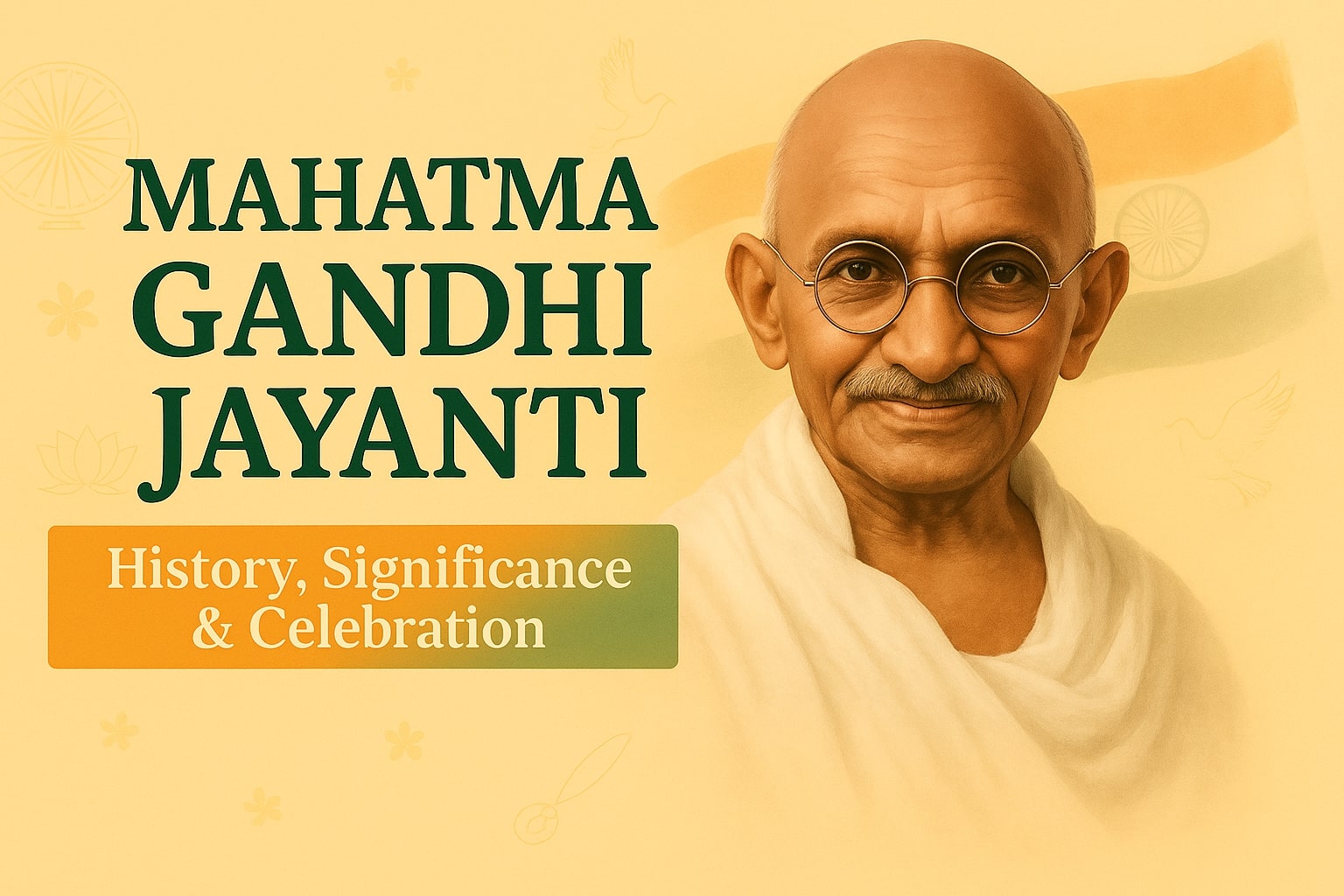
Mahatma Gandhi Jayanti 2026 – History, Significance & Celebration
The warmth of October breezes in India ushers not just the onset of autumn but also one of its most revered national holidays, Mahatma Gandhi Jayanti. Celebrated on the 2nd of October, the date marks the birth anniversary of Mohandas Karamchand Gandhi, fondly known as Mahatma Gandhi. For the year 2026, we are all set to commemorate the 157th birth anniversary of Mahatma Gandhi. In this post, we will delve deep into the history, significance, why we celebrate this day, and the ways this day resonates with celebrations, not just in India but across the globe about this Indian icon.
When Is Gandhi Jayanti Celebrated?
Gandhi Jayanti is a significant national holiday in India, dedicated to commemorating the birth anniversary of Mahatma Gandhi, one of the most prominent figures in the country’s struggle for independence. This day is marked with reverence and respect throughout the nation and beyond. Recognised globally for his teachings of non-violence and truth, the Mahatma Gandhi birth anniversary falls on 2nd October and is celebrated as Gandhi Jayanti. This day not only honours his immense contribution to India’s freedom movement but also reiterates his philosophy and ideals to a new generation.
Mahatma Gandhi – Life History
Incorporating Gandhi Jayanti’s information into our understanding of Mahatma Gandhi allows us to appreciate his contributions to India and the world. Here are ten salient points about his life history:
1. Early Life and Education
Mahatma Gandhi, originally named Mohandas Karamchand Gandhi, was born on 2nd October 1869 in Porbandar, Gujarat. He later went to England to study law and became a barrister.
2. Time in South Africa
Gandhi moved to South Africa in 1893, where he faced racial discrimination and began his initial protests against oppressive government policies, laying the foundation for his methods of non-violent resistance.
3. Concept of Satyagraha
In South Africa, Gandhi developed and honed his concept of Satyagraha or “truth-force.” It is a form of nonviolent resistance against unjust practices or laws.
4. Return to India
In 1915, Gandhi returned to India and soon became a pivotal figure in the Indian struggle for independence against British rule.
5. Non-Cooperation Movement
In 1920, Gandhi initiated the Non-Cooperation Movement, urging Indians to boycott British-made goods, educational institutions, and law courts, promoting Swadeshi or locally-made products instead.
6. Salt March
In 1930, Gandhi led the famous Dandi March or Salt March, a 240-mile protest against the British monopoly on salt production and sales in India.
7. Role in Partition
Though Gandhi was deeply saddened by the partition of India in 1947, he played a key role in ensuring a relatively peaceful transition and addressing communal riots.
8. Assassination
Tragically, on 30th January 1948, Mahatma Gandhi was assassinated in New Delhi by Nathuram Godse, a radical nationalist.
9. Legacy
Gandhi’s teachings and principles of non-violence, truth, and civil disobedience have left an indelible mark on the world, influencing several civil rights movements globally. His life and work are celebrated every year on Gandhi Jayanti, a testament to his enduring legacy.
Gandhi Jayanti Significance
Gandhi Jayanti, celebrated annually on October 2nd, is more than just a remembrance of Mahatma Gandhi’s birth. It is an occasion that honours his unparalleled contributions to India’s fight for freedom and his timeless teachings of non-violence, peace, and unity. The day holds profound significance not just for India but for the world, underlining the values of resilience, sacrifice, and the power of peaceful resistance.
1. Emphasis on Non-Violence
Gandhi Jayanti serves as a global reminder of the importance of non-violence and the need to resolve disputes amicably.
2. Promotion of Peace
The day is also observed as the International Day of Non-Violence by the United Nations, emphasising global peace and harmony.
3. Unity and Brotherhood
Gandhi Jayanti encourages the spirit of unity and brotherhood, reminding people of all backgrounds, religions, and ethnicities to coexist harmoniously.
4. Eco-consciousness
Through the recollection of Gandhi’s teachings, there’s a renewed focus on sustainable living and respecting nature, as he always emphasised the importance of environmental conservation.
5. Community Service
Various community service activities and cleanliness drives are organised, reflecting Gandhi’s belief in “Sewa” or selfless service.
6. Cultural Celebrations
Schools, colleges, and institutions across the country organise cultural programs, essay competitions, and other events, emphasising Gandhian values and principles.
7. Spreading Awareness
Gandhi Jayanti provides an opportunity for educators to teach the younger generation about Gandhi’s role in India’s freedom struggle and the relevance of his philosophies in today’s world.
8. Global Influence
The day also serves as a testament to Gandhi’s influence on global leaders like Martin Luther King Jr. and Nelson Mandela, who adapted his principles of non-violence to their respective struggles for justice.
9. Celebrating Simplicity
Gandhi’s simple lifestyle and beliefs in minimalism are celebrated, encouraging individuals to adopt simplicity in their lives.
10. Commitment to Truth
Above all, Gandhi Jayanti is a day to reiterate our commitment to truth, integrity, and righteousness in all spheres of life, echoing Gandhi’s principle of “Satyagraha” or “truth force”.
Role of Mahatma Gandhi in India’s Struggle for Freedom
Mahatma Gandhi, often referred to as the ‘Father of the Nation’, was a beacon of hope and resilience during India’s prolonged battle for independence from British rule. His unique approach, combining non-violence with civil disobedience, not only reshaped the Indian freedom movement but also left an indelible mark on global peace initiatives. Through his leadership, Gandhi infused the independence struggle with a sense of morality, ethics, and unwavering determination.
1. Championing Civil Disobedience
Gandhi introduced the concept of civil disobedience to the Indian freedom struggle. This involved the peaceful refusal to obey certain laws, demands, and commands of the ruling British government, emphasising morality over physical power.
2. Non-Cooperation Movement
In 1920, Gandhi led the Non-Cooperation Movement, urging Indians to boycott British goods, institutions, and ceremonies. The movement witnessed massive participation and was a significant blow to the British economic and administrative control in India.
3. Dandi March and Salt Satyagraha
In defiance of the British monopoly on salt, Gandhi embarked on the Dandi March in 1930, walking 240 miles to the Arabian Sea coast to produce salt without paying the tax. This act highlighted the repressive policies of the British and garnered international attention.
4. Quit India Movement
In 1942, Gandhi’s clarion call of “Do or Die” during the Quit India Movement galvanised the nation. This movement marked a direct call for the British to leave India, intensifying the demand for immediate independence.
5. Negotiations and Dialogues
Apart from leading mass movements, Gandhi also played a crucial role in negotiating with British officials. He attended the Round Table Conferences in London, representing the Indian National Congress and the broader aspirations of the Indian people.
6. Advocate for Communal Harmony
Gandhi was not just a leader of political movements but also a beacon of communal harmony. During times of sectarian strife, he went on hunger strikes and worked tirelessly to ensure peace between different religious communities, emphasising India’s underlying unity amidst diversity.
Why Mahatma Gandhiji Is Remembered in the World?
Mahatma Gandhi, commonly known as Gandhiji, transcended the boundaries of India to become a global icon of peace, non-violence, and righteousness. His teachings and philosophies have left an indelible mark on humanity, continuing to inspire millions around the world. The reasons for his lasting impact are manifold:
1. Apostle of Non-Violence
Gandhi’s staunch belief in non-violence, or “ahimsa,” has inspired numerous global movements. His methods were adopted by leaders like Martin Luther King Jr. and Nelson Mandela in their respective fights against racial segregation and apartheid.
2. Global Peace Advocate
Beyond the confines of the Indian subcontinent, Gandhi is revered as a symbol of global peace. His birthday, 2nd October, is commemorated as the International Day of Non-Violence by the United Nations.
3. Universal Principles
Gandhi’s philosophies are not just historical; they are timeless. Concepts like “Satyagraha” (insistence on truth) have universal appeal, emphasising the power of truth and righteousness.
4. Champion of Civil Rights
Gandhi’s methodologies in challenging oppressive laws, first in South Africa and then in India, made him an icon in the global civil rights movement.
5. Simplicity and Sustainable Living
In a world grappling with the challenges of consumerism and environmental degradation, Gandhi’s principles of simplicity, self-sufficiency, and sustainability resonate more than ever. His emphasis on living in harmony with nature is a sustainable living guideline.
6. Emphasis on Moral Values
Gandhi believed that the means were as important as the ends. His life, characterised by honesty, integrity, and self-discipline, stands as a testament to the importance of moral values in public life.
7. Interfaith Dialogue
At a time when religious tensions flare up periodically across the globe, Gandhi’s teachings about respect for all religions and his efforts to promote interfaith dialogue hold immense significance.
8. Empowerment of the Marginalised
Gandhi’s efforts to uplift the “Harijans” or the downtrodden, and his emphasis on equal rights for all, regardless of caste or creed, make him a beacon for social justice worldwide.
In essence, Mahatma Gandhi’s legacy is a tapestry of ideals, principles, and actions that have universal relevance. His life story serves as a reminder that one individual, armed with conviction and moral clarity, can indeed change the world.
Gandhi Jayanti Celebration – A Tribute to Bapu
Gandhi Jayanti, celebrated on October 2nd, stands as one of the three national holidays in India, alongside Independence Day and Republic Day. The day not only commemorates the birth of Mahatma Gandhi but also serves as a reflection of his ideals, teachings, and their relevance in contemporary times. Across the length and breadth of the country, Gandhi Jayanti is observed with a mix of solemnity, reverence, and celebratory spirit.
1. National Observance
At the national level, leaders, dignitaries, and the general public gather at Raj Ghat in New Delhi, the final resting place of Mahatma Gandhi, to pay their respects. Floral tributes are offered, and hymns are sung in his memory.
2. Prayers and Bhajans
Across India, meetings are organised where prayers, devotional songs, and Gandhi’s favourite bhajans, especially “Raghupati Raghav Raja Ram,” are sung.
3. Cleanliness Drives
In line with Gandhi’s emphasis on cleanliness and his vision of a Swachh Bharat or Clean India, various cleanliness campaigns and drives are organised on this day, reinforcing the importance of hygiene and sanitation.
4. Cultural Programs
Schools, colleges, and institutions often hold cultural programs, debates, and essay writing competitions, focusing on Gandhian values, teachings, and his role in the Indian freedom struggle.
5. Public Gatherings and Seminars
Seminars and public gatherings are organised to discuss and reflect on Gandhi’s contributions, his philosophies, and their relevance in today’s world.
6. Art and Exhibitions
Art exhibitions showcasing paintings, sculptures, and other art forms inspired by Gandhian themes are prevalent. Moreover, photo exhibitions displaying key moments from his life often attract large audiences.
7. Media and Broadcasts
Television and radio channels broadcast programs, documentaries, and films related to Mahatma Gandhi’s life, emphasising his impact and legacy.
8. Spreading Gandhian Values
Organizations and groups engage in community outreach, distributing literature and organising talks about Gandhian values, promoting peace, non-violence, and communal harmony.
The celebrations across India on Gandhi Jayanti serve as a powerful reminder of Mahatma Gandhi’s enduring legacy and his timeless teachings. The day inspires generations to adopt and uphold the values of truth, non-violence, and righteousness in their lives.
Iconic Places in India to Celebrate Gandhi Jayanti
Gandhi Jayanti, which marks the birth of Mahatma Gandhi, resonates deeply with Indians and people worldwide. India, the land where Gandhi lived and shaped his legacy, is dotted with various significant locations associated with his life. On Gandhi Jayanti, these places become epicentres of homage, reflection, and celebration. If you’re looking to experience the essence of this day, here are some iconic places to consider:
1. Raj Ghat, New Delhi
Raj Ghat is the final resting place (samadhi) of Mahatma Gandhi. Located in the capital city, New Delhi, this memorial sees numerous visitors, including dignitaries and common people, who gather to offer floral tributes and participate in prayer sessions on Gandhi Jayanti.
2. Sabarmati Ashram, Ahmedabad
Located on the banks of the Sabarmati River in Ahmedabad, Gujarat, this ashram was Gandhi’s residence and the epicentre of India’s non-violent freedom struggle. On Gandhi Jayanti, the ashram witnesses various activities, including prayer meetings, exhibitions, and educational programs.
3. Mani Bhavan, Mumbai
Situated in Mumbai, Mani Bhavan served as Gandhi’s residence during his visits to the city. Today, it operates as a museum and research centre. On Gandhi Jayanti, visitors flock to the location to experience exhibitions, films, and other events that reflect on Gandhi’s life and philosophies.
4. Gandhi Smriti, New Delhi
Previously known as Birla House, Gandhi Smriti is the site where Mahatma Gandhi was assassinated. The place has been converted into a museum that chronicles Gandhi’s life through photographs, sculptures, and multimedia exhibits. On Gandhi Jayanti, special commemorative events are organised here.
5. Agakhan Palace, Pune
This historical palace in Pune was where Gandhi, along with his wife Kasturba Gandhi and secretary Mahadev Desai, were imprisoned during the Quit India Movement. The palace grounds house their memorials, and on Gandhi Jayanti, special events and prayer sessions are held.
6. Sevagram Ashram, Wardha
Established by Gandhi in the 1930s, Sevagram Ashram in Wardha, Maharashtra, became a hub for the freedom struggle. Today, it stands as a testament to Gandhi’s simplistic lifestyle and ideals. Visitors can partake in prayer meetings and view exhibits related to Gandhian principles on this special day.
Mahatma Gandhi’s legacy is intricately woven into the fabric of India’s history and consciousness. Visiting these iconic places on Gandhi Jayanti provides a unique opportunity to connect with his enduring spirit, rekindling a collective commitment to peace, non-violence, and the timeless values he championed.
Mahatma Gandhi’s enduring influence, symbolised through the celebration of Gandhi Jayanti, is a testament to the timeless power of his ideals and principles. As people worldwide remember and pay homage to him on this day, they are reminded of the path of non-violence, truth, and moral fortitude that he championed, ensuring that his legacy continues to inspire generations.
Also Read:
Quiz on Mahatma Gandhi
Facts About Mahatma Gandhi for Kids
Gandhi Jayanti Speech for Children and Students
Famous Mahatma Gandhi Slogans in English to Remember
Read more
Quiz on Mahatma Gandhi – Question and Answers About Gandhiji
Mahatma Gandhi, revered as the Father of the Nation, played an indispensable role in India’s struggle for independence, inspiring millions with his principles of non-violence and civil disobedience. As responsible citizens of a free India, it is imperative that we acquaint our children with his extraordinary life and the sacrifices he made to secure our freedom from British colonial rule. This October 2nd, consider organizing a Mahatma Gandhi quiz at home for your kids. Utilize this insightful quiz on Mahatma Gandhi for kids on his life and legacy, providing an engaging opportunity for learning and reflection. Let’s celebrate his enduring spirit and ideals through fun and educational Gandhi quiz questions and answers!
Quiz Questions On Mahatma Gandhi With Answers
Here are some engaging quiz questions on Mahatma Gandhi, designed to test your knowledge of the life and legacy of the Father of the Nation.
1. Who called Gandhiji ‘Mahatma’?
a) Jawaharlal Nehru
b) Rabindranath Tagore
c) Subhash Chandra Bose
d) Sardar Vallabhbhai Patel
Answer: b
Explanation:
Rabindranath Tagore called Gandhiji ‘Mahatma’. The term “Mahatma” means “great soul” in Sanskrit, reflecting Tagore’s admiration and respect for Gandhi’s spiritual and moral stature.
2. Who is considered as the spiritual guru of Gandhiji?
a) Leo Tolstoy
b) Swami Vivekananda
c) Ramakrishna Paramahamsa
d) Paramahansa Yogananda
Answer: a
Explanation:
Leo Tolstoy is considered the spiritual guru of Gandhiji. Gandhi corresponded with Tolstoy and was deeply influenced by his ideas on non-violence and simple living.
3. Where was Mahatma Gandhi born?
a) Delhi, India
b) Mumbai, India
c) Porbandar, India
d) Kolkata, India
Answer: c
Explanation:
Mahatma Gandhi was born in Porbandar, India. It is a coastal city in Gujarat, known for its association with Gandhi and also as the birthplace of Sudama, a friend of Lord Krishna.
4. What is Mahatma Gandhi’s first name?
a) Raghuram
b) Karamchand
c) Mohandas
d) Harilal
Answer: c
Explanation:
Mahatma Gandhi’s first name is Mohandas. He is commonly referred to as Mahatma Gandhi, with “Mahatma” being an honorific title meaning “great soul.”
5. What is the name of Mahatma Gandhi’s parents?
a) Ramdas and Anandibai Gandhi
b) Karamchand and Putlibai Gandhi
c) Devdas and Saraswati Gandhi
d) Vishnu and Lakshmi Gandhi
Answer: b
Explanation:
Mahatma Gandhi’s parents were Karamchand Gandhi and Putlibai Gandhi. They had a significant influence on his upbringing and values.
6. What did Gandhiji call freedom fighter Subhash Chandra Bose?
a) Patriot
b) Comrade
c) Netaji
d) Leader
Answer: c
Explanation:
Gandhiji called Subhash Chandra Bose “Netaji.” This title was given to Bose as a sign of respect and leadership within the Indian National Congress.
7. What is the significance of the Gandhi Memorial in Kanyakumari?
a) It is where Gandhiji was born.
b) Gandhiji’s ashes were kept here before immersion in the sea on February 12, 1948.
c) It is where Gandhiji was assassinated.
d) It is where Gandhiji practiced law.
Answer: b
Explanation:
The significance of the Gandhi Memorial in Kanyakumari is that Gandhiji’s ashes were kept there before immersion in the sea on February 12, 1948. This memorial serves as a tribute to his life and teachings.
8. When was the Mahatma Gandhi Series of banknotes issued by the Reserve Bank of India?
a) 1947
b) 1956
c) 1978
d) 1996
Answer: d
Explanation:
The Mahatma Gandhi Series of banknotes was issued by the Reserve Bank of India in 1996 to honor the legacy of Mahatma Gandhi and reflect India’s cultural heritage.
9. Who is the author of Gandhiji’s favourite Bhajan ‘Vaishnava jana to tene kahiye’?
a) Rabindranath Tagore
b) Mirabai
c) Narsi Mehta
d) Tulsidas
Answer: c
Explanation:
Narsi Mehta is the author of Gandhiji’s favorite Bhajan ‘Vaishnava jana to tene kahiye’. The bhajan speaks about the ideals of a Vaishnava Jana or a follower of Lord Vishnu.
10. What was the civil disobedience movement where the British were asked to leave India called?
a) Quit India Movement
b) Non-Cooperation Movement
c) Khilafat Movement
d) Bardoli Satyagraha
Answer: a
Explanation:
The movement where the British were asked to leave India was called the Quit India Movement. It was launched by Mahatma Gandhi in 1942, demanding an end to British rule in India.
11. Who led the Salt Satyagraha Movement with Gandhi?
a) Sarojini Naidu
b) Jawaharlal Nehru
c) Subhash Chandra Bose
d) Vallabhbhai Patel
Answer: a
Explanation:
Sarojini Naidu was a prominent leader who actively participated in the Salt Satyagraha Movement alongside Mahatma Gandhi, mobilizing people and advocating for the cause of Indian independence.
12. How is the date of Mahatma Gandhi’s return to India in 1915 observed now?
a) Pravasi Bharatiya Divas
b) Independence Day
c) Republic Day
d) Gandhi Jayanti
Answer: a
Explanation:
The date of Mahatma Gandhi’s return to India in 1915 is observed as Pravasi Bharatiya Divas, commemorating the contributions of overseas Indians towards the development of India.
13. When is the International Day of Non-Violence celebrated?
a) January 30
b) August 15
c) October 2
d) November 14
Answer: c
Explanation:
The International Day of Non-Violence is celebrated on October 2nd, coinciding with Mahatma Gandhi’s birthday, to promote the principles of non-violence and commemorate his legacy.
14. Where is Sabarmati Ashram?
a) Delhi
b) Mumbai
c) Ahmedabad
d) Kolkata
Answer: c
Explanation:
Sabarmati Ashram is located in Ahmedabad, Gujarat. It was established by Mahatma Gandhi in 1917 and served as a focal point for the Indian independence movement, promoting principles of truth, non-violence, and self-reliance.
15. By which name is Gandhi lovingly called by his countrymen?
a) Mahapurush
b) Mahatma
c) Bapu
d) Babu
Answer: c
Explanation:
Gandhi is lovingly called “Bapu” by his countrymen. It is a term of endearment in Gujarati, meaning “father” or “papa,” reflecting the deep respect and affection people had for him.
16. What was Gandhiji’s age when he went to London to become a barrister?
a) 17 years old
b) 19 years old
c) 21 years old
d) 23 years old
Answer: b
Explanation:
Gandhiji was 19 years old when he went to London to study law and become a barrister. His experiences in London played a significant role in shaping his later philosophy and activism.
17. What title did Mahatma Gandhi give to his autobiography?
a) The Autobiography of a Yogi
b) My Experiments with Truth
c) The Story of My Life
d) Freedom Fighter
Answer: b
Explanation:
Mahatma Gandhi gave the title “My Experiments with Truth” to his autobiography, reflecting his lifelong pursuit of truth and his spiritual and philosophical journey.
18. In which prison was Gandhi mostly imprisoned during his struggles against the British?
a) Alipore Jail
b) Tihar Jail
c) Yerwada Jail
d) Cellular Jail
Answer: c
Explanation:
Gandhi was mostly imprisoned in Yerwada Jail in Pune during his struggles against the British. He spent several years in prison for his civil disobedience and non-cooperation movements.
19. Which major non-violent protest was launched by Gandhiji in 1930?
a) Quit India Movement
b) Civil Disobedience Movement
c) Non-Cooperation Movement
d) Dandi March or Salt March
Answer: d
Explanation:
The major non-violent protest launched by Gandhiji in 1930 was the Dandi March, also known as the Salt March, which protested against the British salt tax and sparked widespread civil disobedience across India.
20. Which political leader often disagreed with Gandhi but described him as the “Saint of Sabarmati”?
a) Jawaharlal Nehru
b) Subhash Chandra Bose
c) Vallabhbhai Patel
d) Dr. B.R. Ambedkar
Answer: a
Explanation:
Jawaharlal Nehru often disagreed with Gandhi on various political matters but still described him as the “Saint of Sabarmati,” acknowledging his moral and spiritual leadership.
21. How many times was Mahatma Gandhi nominated for the Nobel Peace Prize?
a) Two times
b) Three times
c) Four times
d) Five times
Answer: d
Explanation:
Mahatma Gandhi was nominated for the Nobel Peace Prize five times in 1937, 1938, 1939, 1947, and 1948, but he never won the prize despite his significant contributions to peace and non-violence.
22. Which British officer was assassinated by Gandhiji’s supporter, leading to Gandhi fasting as an act of atonement?
a) Sir Michael O’Dwyer
b) Reginald Dyer
c) Lord Mountbatten
d) James A. Dyer
Answer: d
Explanation:
Mahatma Gandhi’s supporter assassinated James A. Dyer, the British officer responsible for the Jallianwala Bagh massacre, leading Gandhi to fast as an act of atonement for the violence.
23. Who played the role of Mahatma Gandhi in the 1982 movie ‘Gandhi’?
a) Ben Kingsley
b) Anthony Hopkins
c) Richard Attenborough
d) Morgan Freeman
Answer: a
Explanation:
Ben Kingsley portrayed the role of Mahatma Gandhi in the 1982 movie ‘Gandhi,’ directed by Richard Attenborough. Kingsley’s performance was critically acclaimed and won him an Academy Award for Best Actor.
24. What was the first Satyagraha movement initiated by Gandhi?
a) Dandi March or Salt March
b) Champaran Satyagraha
c) Kheda Satyagraha
d) Ahmedabad Mill Workers Strike
Answer: b
Explanation:
The first Satyagraha movement initiated by Gandhi was the Champaran Satyagraha in Bihar in 1917, where he protested against the exploitation of indigo farmers by British landlords.
25. In which year did Gandhiji initiate the Non-Cooperation Movement?
a) 1919
b) 1920
c) 1921
d) 1922
Answer: b
Explanation:
Gandhiji initiated the Non-Cooperation Movement in 1920, calling for Indians to boycott British goods, institutions, and services as a non-violent protest against British colonial rule.
26. Which principle, meaning “non-violence,” was a cornerstone of Gandhiji’s philosophy?
a) Satyagraha
b) Swadeshi
c) Ahimsa
d) Sarvodaya
Answer: c
Explanation:
Ahimsa, meaning “non-violence” or “non-harming,” was a cornerstone of Gandhiji’s philosophy and approach to social and political change, advocating for the resolution of conflicts through peaceful means and respect for all life.
27. What was the name of the organization founded by Gandhi in South Africa to advocate for Indian rights?
a) Indian National Congress
b) Natal Indian Congress
c) Indian Independence League
d) Indian Home Rule Movement
Answer: b
Explanation:
The Natal Indian Congress was founded by Gandhi in South Africa in 1894 to fight discrimination against Indian immigrants.
28. Which event marked the beginning of Mahatma Gandhi’s activism in India?
a) Champaran Satyagraha
b) Non-Cooperation Movement
c) Salt Satyagraha
d) Khilafat Movement
Answer: c
Explanation:
Mahatma Gandhi’s first major activism in India was marked by the Salt Satyagraha or the Dandi March in 1930, which protested the salt tax imposed by the British.
29. What was the name of the agreement signed between Mahatma Gandhi and Lord Irwin in 1931, securing the release of political prisoners?
a) Gandhi-Irwin Pact
b) Poona Pact
c) Lucknow Pact
d) Delhi Pact
Answer: a
Explanation:
The Gandhi-Irwin Pact, also known as the Delhi Pact, was signed between Mahatma Gandhi and Lord Irwin in 1931, securing the release of political prisoners and allowing for participation in the Round Table Conferences.
30. Which British viceroy was in power when Mahatma Gandhi launched the Quit India Movement?
a) Lord Curzon
b) Lord Mountbatten
c) Lord Wavell
d) Lord Linlithgow
Answer: d
Explanation:
Lord Linlithgow was the Viceroy of India when Mahatma Gandhi launched the Quit India Movement in 1942, demanding an end to British rule.
31. Which incident led to the formation of the Non-Cooperation Movement in 1920?
a) Jallianwala Bagh Massacre
b) Champaran Satyagraha
c) Chauri Chaura incident
d) Khilafat Movement
Answer: c
Explanation:
The Chauri Chaura incident, where protesters clashed with police resulting in violence, led Mahatma Gandhi to call off the Non-Cooperation Movement in 1922.
32. What was the name of the newspaper edited by Mahatma Gandhi during his South African struggle?
a) Indian Opinion
b) Young India
c) Harijan
d) Navajivan
Answer: a
Explanation:
Indian Opinion was the newspaper founded and edited by Mahatma Gandhi during his time in South Africa, which served as a platform for his views on civil rights.
33. What was the name of the ashram founded by Mahatma Gandhi in South Africa?
a) Phoenix Settlement
b) Tolstoy Farm
c) Sevagram Ashram
d) Sabarmati Ashram
Answer: a
Explanation:
Phoenix Settlement was the ashram established by Mahatma Gandhi near Durban in South Africa, where he practiced his principles of simple living and self-sufficiency.
34. In which year did Mahatma Gandhi famously lead the Salt March?
a) 1928
b) 1930
c) 1932
d) 1934
Answer: b
Explanation:
Mahatma Gandhi led the Salt March in 1930 as a protest against the salt tax imposed by the British, which became a significant event in the Indian independence movement.
35. Which of the following movements was not led by Mahatma Gandhi?
a) Quit India Movement
b) Khilafat Movement
c) Civil Disobedience Movement
d) Swadeshi Movement
Answer: b
Explanation:
The Khilafat Movement was led by Muslim leaders, primarily Ali brothers, seeking to preserve the Ottoman Caliphate. While Gandhi supported it, he did not lead it.
36. What was the original name of the Salt Satyagraha?
a) Dandi March
b) Bardoli Satyagraha
c) Champaran Satyagraha
d) Non-Cooperation Movement
Answer: a
Explanation:
The Salt Satyagraha is also known as the Dandi March because it started at Sabarmati Ashram and ended at Dandi Beach, where Gandhi and his followers made salt from seawater.
FAQs
1. What is the significance of Mahatma Gandhi’s concept of ‘Satyagraha’?
Mahatma Gandhi’s concept of ‘Satyagraha’ holds immense significance as a method of nonviolent resistance and civil disobedience. It emphasizes the power of truth and moral force to confront injustice and oppression. ‘Satyagraha’ promotes peaceful protest and seeks to transform adversaries through empathy and understanding rather than confrontation or violence.
2. What role did Mahatma Gandhi play in the Indian National Congress?
Mahatma Gandhi played a pivotal role in shaping the Indian National Congress (INC) into a mass movement for independence from British rule. He provided dynamic leadership, advocating for nonviolent resistance, civil disobedience, and Swaraj (self-governance). Gandhi’s principles of nonviolence and Satyagraha mobilized millions of Indians to participate in the freedom struggle, making the INC a formidable force against colonialism.
3. How can I prepare for a Mahatma Gandhi quiz?
To prepare for a Mahatma Gandhi quiz, start by studying key aspects of his life, such as his early years, education, experiences in South Africa, leadership in the Indian independence movement, and principles of nonviolence. Familiarize yourself with significant events, speeches, writings, and contributions of Gandhi. Utilize books, documentaries, online resources, and quiz questions to reinforce your understanding. Practice recalling information and discussing Gandhi’s legacy with others to deepen your knowledge.
I hope this set of Gandhiji quiz questions complements your list well!
Take a trip down India’s history with these general knowledge questions on Mahatma Gandhi. What’s more, this Gandhi Jayanti quiz can be fun not just for kids but also the adults. Just add some fun buzzers and cool gifts at the end!
Also Read:
Mahatma Gandhi Information and Facts for Kids
Gandhi Jayanti Speech for Children and Students
Kid-Friendly Movies on Mahatma Gandhi’s Life
History and Celebration of Mahatma Gandhi Jayanti
Famous Mahatma Gandhi Slogans In English to Remember
Read more
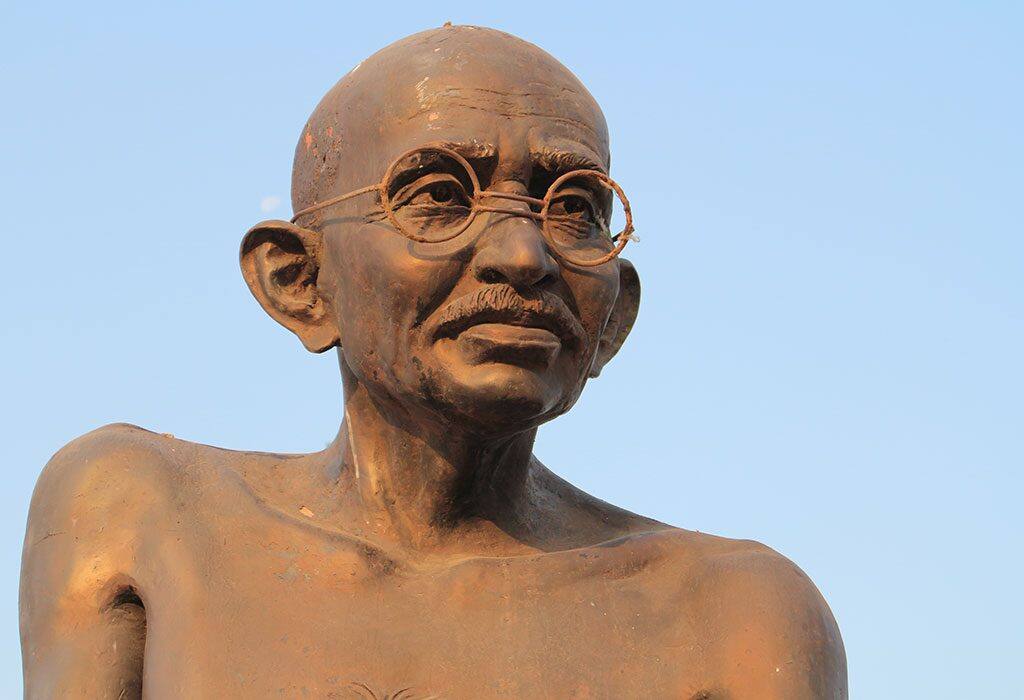
Facts & Information about Mahatma Gandhi for Kids
Figuring out an easy-to-read Mahatma Gandhi biography for kids might not be an easy task for most parents. There are numerous books that describe different aspects of his life, but there might be very few that would be understood by kids clearly. Giving them a head start into understanding the context of the times and the motivations of Gandhi can be achieved by pairing the children’s history lessons with some important facts around his life. Some preliminary information about the greatest leader of our country can prove to be a potential springboard into knowing more about the man himself, as well as the independence struggle. Mahatma Gandhi facts for kids can further enhance their understanding.
While putting together some pertinent information and “Facts About Mahatma Gandhi For Kids,” we’ve worked out an entire path that takes you right from his birth and childhood, to the time spent in Africa, the struggle for India’s independence, and his assassination.
Childhood and Family Facts
The real name of Mahatma Gandhi is Mohandas Karamchand Gandhi.
He was born in Porbandar on the 2nd of October, in 1869.
His parents were Karamchand Gandhi and Putlibai. The former was the Chief Minister of Porbandar at the time.
Since child marriage was quite prevalent in that era, Mohandas Gandhi’s marriage was also planned around the time he was 13 years old.
He was married to Kastur Kapadia, who later changed her name to Kasturba Gandhi after the marriage. They were married in the year 1883. Kasturba was 14 years old then.
Even after marriage, Kasturba continued to stay with her parents at her own home. Kasturba Gandhi, too, was politically active through her life and focused on attaining civil rights for everyone.
Mohandas Gandhi and Kasturba Gandhi had 4 children. All of them were boys. Their names were Harilal, Manilal, Ramdas, and Devdas.
In 1885, Gandhi-ji and Kasturba had their first baby, which did not survive and passed away just a few days after birth. In the same year, Karamchand Gandhi passed away as well, leaving Mohandas fatherless.
As wonderful as he might seem today, Mohandas Gandhi was a weak student in school. He found the subject of Geography too difficult to understand. However, he loved reading Hindu scriptures and began to idolize Raja Harishchandra, the king who would always tell the truth.
At the age of 18, in 1888, Mohandas Gandhi left for London to study law, leaving behind Kasturba and his infant son. This decision was met with mixed feelings within his family and community, given the prevailing sentiment against crossing the seas.
During his time in England, Gandhi faced challenges in adapting to Western culture and practices. He initially struggled with dietary restrictions due to his vow of vegetarianism but later discovered and joined the London Vegetarian Society, deepening his convictions.
Information about Worked in South Africa
After completing his initial education, Gandhi made his way to London in order to study law. His aim was to become a barrister, which was also what his family wanted for him.
He studied law in the University College of London in the year 1888. After that, he returned back to India, making attempts to start his own law practice.
When those attempts did not bear any fruit, he decided to take up a job with a law firm. That job is what brought him to South Africa.
In that period, South Africa was facing a lot of discrimination along the lines of race and colour. Gandhi, hailing from India, also had a dark coloured skin.
While riding a bus that was filled completely, a white man asked Gandhi to vacate the seat he was sitting in, just because he had a dark coloured skin. Gandhi refused to do so and, as a result, he was thrown out of the bus.
Along with that incident, there were various instances where Gandhi was refused a room in the hotels of South Africa as well as ordered to remove his turban by a court magistrate as well.
All of these moments inspired him to fight for equality and develop political ideas that could help people.
Gandhi began using a peaceful protest method in South Africa called “Satyagraha,” meaning the “force of truth.” It was about not fighting back but standing up for the truth.
In 1894, he set up the Natal Indian Congress in South Africa. It was created to give Indians a unified voice against unfair laws.
Facts about Mahatma Gandhi and Indian Freedom Struggle
On returning to India, he realized how the Indian populace was suffering under the British Empire. He decided to lead a movement with the aim to have an independent nation.
The key strategy of his political ideas was the use of non-violence. Gandhi always believed that violence was never a solution to any problem.
He began undertaking numerous campaigns, revolving around the idea of civil disobedience. The strategy was simple: to refuse any orders given by the British Empire, without resorting to any violence. The streets soon filled with people boycotting their work and refusing to cooperate with the British.
Similarly, Gandhi also conducted the Dandi march when the British imposed a heavy tax on salt.
While Gandhi was elected to be a member of the Congress party in the year 1920, he later walked out of the party in 1934 and continued to work towards India’s independence struggle by himself.
With repeated boycotts, disobedience movements, and nationwide rallying of the people with the “Quit India” movement to overthrow the empire, the British finally conceded and agreed to leave India, making it independent.
Facts and Information about Mahatma Gandhi’s Death
After India’s partition came into effect, the nation split into India and Pakistan.
Many people began to detest the policies of Gandhi. Nathuram Godse was a Hindu nationalist, who had a strong hatred for Gandhi.
As a result, he fired three bullets at Gandhi on 30th January 1948 at around 5.17pm and assassinated him.
The title of “Mahatma” was bestowed on Gandhiji and a large funeral was arranged for him. More than 20 lakh people attended the funeral to bid goodbye to the father of our nation.
Other Facts and Information about Mahatma Gandhi for Children
These facts highlight Gandhi’s unique philosophy, lifestyle, and influence beyond his basic biography and major documented work.
Gandhi developed the concept of satyagraha, meaning “holding onto truth,” which is a committed but nonviolent resistance to evil. He first used this technique in South Africa in 1906 to combat racial discrimination.
He led the famous Salt March in 1930, a 240-mile protest against the British salt monopoly, which became a powerful act of civil disobedience in India’s independence struggle.
Gandhi lived very modestly from the 1920s onward, residing in a self-sufficient community, eating simple vegetarian food, and frequently fasting as both political protest and spiritual practice.
His mother tongue was Gujarati, and he attended Alfred High School in Rajkot.
Gandhi corresponded with well-known author Leo Tolstoy through letters.
He established Tolstoy Farm in South Africa, a communal settlement for his followers engaged in the struggle for civil rights.
Gandhi insisted on using homespun cloth and encouraged Indians to spin their own yarn to boycott imported British textiles.
He never traveled by plane, choosing simple modes of travel throughout his life.
Gandhi was assassinated by Nathuram Godse, a Hindu nationalist, in 1948.
His birthday, October 2nd, is celebrated as the International Day of Nonviolence worldwide.
When describing Mahatma Gandhi’s history for kids, understanding the timeline of events that made him the person that he is and motivated him to fight against the British rule is extremely important. The principle of Satyagraha is at the core of his life and helping your kids understand the necessity of truth, honesty and non-violence is quite essential as well.
Also Read:
Mahatma Gandhi Quiz for Kids and Adults
Kid-Friendly Movies on Mahatma Gandhi’s Life
Gandhi Jayanti Speech for Children and Students
Famous Mahatma Gandhi Slogans In English to Remember
Read more
14 Fascinating Lord Ganesha Stories for Kids with Morals
Amongst a multitude of gods that are present in the pantheon of Hindu mythology, Lord Ganesha is perhaps one of the most popular ones. His idols are omnipresent in nearly every corner of the country, and there is a huge interest in celebrating Ganesha Chaturthi. That might also be due to the very source of the name Ganesha, which has been formed from two words. “Gana” means the masses of people, and “isha” is used to refer to a god. This, quite literally, makes Ganesha the Lord of the masses. He has been worshipped for many years, and Lord Ganesha’s stories for kids have gained quite a lot of popularity among people.
Why Should Children Listen or Read Lord Ganesha Stories?
Listening to or reading the moral stories of Lord Ganesha helps children understand valuing and respecting their parents and elders. Lord Ganesha is also known as the Deva of intellect, prosperity, wisdom, and the remover of obstacles. Reading these stories will help children instil His teachings and morals in them.
Interesting Stories of Lord Ganesha for Kids
Kids may not be interested in the long pujas and worship procedures of Lord Ganesha. However, you can introduce them to various Ganesha stories that surround this mythological deity and let them be awestruck by how wonderful some of them are.
1. The Story of His Birth
Let’s begin from the start with the lord Ganesha’s birth story.
Lord Shiva and Goddess Parvati lived on Mount Kailash. While Shiva was away, Parvati created a boy named Ganesha from turmeric to guard her home while she bathed. When Shiva returned, Ganesha blocked his entry, not knowing who he was. Enraged and unaware that the boy was Parvati’s creation, Shiva beheaded him.
Parvati, devastated and furious, threatened to destroy the universe. To calm her, Brahma and Shiva promised to bring Ganesha back to life. Shiva sent his troops to fetch the head of the first living creature they found—an elephant. The elephant’s head was placed on Ganesha’s body, and he was revived and declared Shiva’s son. From then on, Ganesha came to be worshipped as the remover of obstacles and the god of beginnings.
Moral
As much as this story talks about the birth, it teaches us an important lesson on how anger can cause harm to our near and dear ones and how necessary it is to rectify our mistakes as soon as we can.
2. The Story of the Missing Conch
This is a wonderful story that showed how even Lord Vishnu had to relent to Lord Ganesha’s antics.
Lord Vishnu was deeply attached to his conch, which he kept with him at all times. One day, he realized it had gone missing and grew very annoyed. Determined to find it, he used all his powers to search for it. Eventually, he heard the familiar sound of the conch coming from a distance and followed it to Mount Kailash. There, he discovered that Lord Ganesha had taken the conch and was happily blowing it.
Vishnu requested Ganesha to return the conch, but Ganesha refused. So, Vishnu turned to Lord Shiva for help. Shiva explained that even he could not influence Ganesha’s will and advised Vishnu to perform a puja in Ganesha’s honor. Vishnu humbly followed the suggestion and conducted the puja with full devotion. Pleased with Vishnu’s sincere worship, Ganesha finally returned the conch to him.
Moral
The story quite interestingly reveals the fun side to Lord Ganesha and his antics. Furthermore, it teaches us about humility by showing how God as great as Vishnu, did not hesitate to worship Ganesha.
3. The Story of Shiva’s Failed Battle
Lord Shiva and Lord Ganesha have many stories together. However, this story goes beyond the relationship between father and son and teaches a very important lesson.
When the elephant head was procured and Ganesha was brought back to life, Shiva heeded Parvati’s wishes and made it a rule that before beginning any new endeavor, it was necessary to worship Lord Ganesha and get his blessings. However, Shiva forgot that the rule applied to him as well.
On one such occasion, Shiva was heading out to war with the demons and proceeded to take his entire army along with him for it. But, in the rush of leaving for the battle, he forgot to worship Ganesha first. This led to them facing many problems even before reaching the battlefield. On the way to the location of the battle, the war-carriage wheel was damaged and the progress came to a halt. This seemed like divine intervention to Shiva and he suddenly remembered that he had totally forgotten to worship Ganesha before heading for battle.
Stopping all his troops, Shiva proceeded to set up the puja then and there and completed the rituals worshipping Ganesha. With Ganesha’s blessings, Shiva proceeded ahead and he and his army were successful in defeating the demons completely.
Moral
This just goes to show that no matter who you are, once you have created a rule, it applies to everyone equally.
4. The Story of Ganesha’s Wisdom
Ganesha and his younger brother Karthikeya once found a magical fruit in the forest, said to grant immense knowledge and immortality. Both wanted it and refused to share, so they took the matter to their parents, Lord Shiva and Goddess Parvati. To decide who should have it, Shiva challenged them to circle their world three times. Karthikeya flew off quickly on his peacock, determined to win.
Ganesha, knowing his mouse couldn’t match the speed, chose a different path. He respectfully walked around his parents three times, explaining that to him, they were his entire world. Touched by his deep wisdom and devotion, Shiva declared Ganesha the winner and gave him the fruit, showing why Ganesha is revered as the god of knowledge.
Moral
Not only does this story give a great example of how using your wisdom can help resolve a situation smartly, but it also teaches that your parents should be given the respect and love they deserve.
5. The Story of Parvati’s Wounds
This wonderful story is a great example of how the entire world is a single unit.
Ganesha was known to be a mischievous child and he would indulge in a number of naughty activities. One time, he came across a cat while he was playing, and proceeded to mess around with it. He picked up the cat and threw it on the ground, pulling its tail and having fun with it, while the cat meowed in pain. Ganesha failed to notice it and played around until he was tired and then came back home.
On reaching Mount Kailash, Ganesha was shocked to see Parvati lying down outside the home, with wounds all over her body, and crying in pain. Ganesha rushed to her and asked her who did this. To which Parvati replied that Ganesha himself had done this to her. The cat was actually a form of Parvati, and she wanted to play around with her son, but Ganesha treated her unfairly and ruthlessly and his actions on the cat have reflected on his own mother.
Ganesha was utterly sorry for his behaviour and took an oath to treat all animals in a gentle manner with care and affection.
Moral
This story gives a very important lesson that does unto others as you would want others to do unto you, and this also includes animals.
6. The Story of Kubera’s Downfall
Kubera was a renowned God who was very popular for being the wealthiest of them all in the entire universe. He had a treasure trove of wealth and would hoard everything to himself with pride.
One day, he invited many guests over for dinner, including Shiva and Parvati. But they both could not attend the dinner, so they sent over Ganesha as their representative. Ganesha noticed how Kubera’s behaviour was and he decided to let his antics loose. He began devouring the dinner speedily and ended up finishing all the food leaving barely anything for the other guests. Yet his hunger was not satiated. So he ended up entering Kubera’s wealth collection and start eating all the gold and wealthy items. Still unsatisfied, Ganesha then proceeded to eat Kubera himself, who ran to Mount Kailash for protection.
Shiva, seeing the reason behind Ganesha’s doing, offered a simple bowl of cereals to Ganesha. He ate them and immediately was satisfied. Kubera learned not to amass wealth greedily and agreed to distribute it amongst everyone.
Moral
The story shows how greed and pride can be harmful to a person and it is necessary to be considerate towards everyone.
7. The Story of Kaveri’s Creation
It begins with the wish of a sage called Agastya who wished to create a river that would benefit the people staying in the southern lands. The Gods heeded his wish and presented him with a small bowl containing water. Wherever he would pour the bowl, the river would originate from there.
Agastya decided to create the origin beyond the mountains of Coorg and proceeded to travel there. On the journey, he got tired and began looking for a place to take some rest. Just then, he came across a small boy who was standing alone. He requested him to hold the pot of water while he went and relieved himself. The boy was Ganesha himself. He knew what the pot of water was for and realized that the location he was at was perfect for the river, so he set the pot down.
When Agastya came back, he saw the pot on the ground and a crow attempting to drink water from it. He shooed away the crow, who flew away but not before tipping the pot on the ground. This resulted in the river originating from that place itself, which is now called the Kaveri river.
Moral
Sometimes, things may not always work out in the way we wish them to. Nevertheless, what happens does happen for a good reason.
8. The Story of Ganesha’s Single Tusk
There are many versions that explain this but this Bal Ganesh story does it best.
As legend has it, Mahabharata is Ved Vyas’ creation, but it is said to be written by Lord Ganesha himself. Ved Vyas approached Ganesha so that he could transcribe the epic story as he narrated it to him. The condition was that Vyas had to narrate it without break and Ganesha would write it in a single go.
As they progressed in writing the story, there came a point where the quill that Ganesha was using to write it down broke and he had no other quills with him at that moment. Ved Vyas could not stop narrating the story since the condition was already set in stone for him. Without wasting any time, Ganesha quickly broke off one of his own tusks and fashioned it into a pen, using it to continue writing the epic without interruption. This allowed the epic to become a holy one and Ganesha and Vyas ended up completing it together.
Moral
This story of Ganesha shows very clearly how necessary it is to be disciplined and determined to complete a task once you have accepted to complete it, no matter what happens. A personal sacrifice might also be necessary to complete something epic.
9. The Story of the Lunar Curse
After enjoying a lavish feast hosted by Kubera, Ganesha’s stomach grew so large that he struggled to walk and eventually fell down. The moon witnessed this and laughed at Ganesha, mocking his appearance and fall. Feeling insulted, Ganesha cursed the moon to disappear completely. However, when the moon sincerely apologized, Ganesha softened and modified the curse—allowing the moon to wax and wane in a 15-day cycle.
In another version, after overeating modaks prepared by Parvati, Ganesha rode out on his mouse. Startled by a snake, the mouse stumbled and Ganesha was thrown to the ground, causing his belly to burst open and spill the modaks. He quickly stuffed them back and tied a snake around his waist to hold his stomach in. The moon, watching again, burst into laughter. Furious, Ganesha cursed him once more—declaring that anyone who looked at the moon on Ganesh Chaturthi would face false accusations.
Moral
One should never laugh at somebody else’s problems or deformities. This is impolite and is not a sign of good behaviour.
10. The Story of The Sweet Kheer
Ganesha once entered a village in the form of a boy, holding some rice in one hand and milk in the other. He began asking for help to make some kheer but everybody was busy.
He reached a poor woman’s hut who agreed to make the kheer for him. As she mixed it together and set the pot to cook, she fell asleep and the boy went out to play. On waking up, she realized the kheer had cooked and was extremely delicious.
She was too hungry and couldn’t resist it. But before eating the kheer, she took out some of it in a bowl and offered it to Ganesha’s idol and then began eating the kheer. No matter how much she ate, the pot never emptied. When the boy returned, the woman gave him the entire pot and confessed that she ate before him because she was hungry. The boy replied saying he ate it too when she offered the bowl to the Ganesha idol. The woman began crying at his feet and Ganesha blessed her with wealth and health.
Moral
Before taking care of your own needs, make sure to worship God and keep something aside for others as well.
11. The Story of Ganesha at Kubera’s Wedding
This Ganesha story for kids will help kids learn a valuable lesson about being greedy.
Kubera was a proud and greedy God well known for the huge wealth he had accumulated. Once, Kubera invited several guests to a wedding feast. Lord Shiva and Goddess Parvati sent their son Ganesha who decided to teach arrogant Kubera a lesson. Ganesha quickly ate up all the food at the feast, leaving no food for the other guests. He then went on to eat up the furniture, vessels, and even Kubera’s wealth! Kubera ran to Mount Kailash for Lord Shiva’s help. Lord Shiva advised him to humbly offer Lord Ganesha a bowl of cereal. Ganesha’s hunger was finally satisfied by eating a bowl of cereal. Kubera learned that he was wrong to be too greedy and proud.
Moral
It is not good to be too proud and greedy. Just be happy and satisfied with what you have.
12. The Story of How Mouse Became Ganesh’s Vehicle
Here is another Lord Ganesha story for kids to listen to Ganesh Chaturthi’s story in English.
One day, in the court of God Indra, Krauncha, a divine musician-God, accidentally stepped on the foot of Sage Vamadeva. Sage Vamadeva got angry and cursed Krauncha to become a mouse and remain so for his entire life.
Krauncha immediately became a mouse and ended up damaging everything in its path. One day, he ended up stepping on the ashram of Maharshi Parashar, with whom Lord Ganesha was staying at that time. Krauncha ended up destroying the ashram too.
Lord Ganesha decided to teach Krauncha a lesson and unleashed his noose on Krauncha. It ended up looping Krauncha, the mouse and bringing him to Lord Ganesha’s feet. Krauncha begged for forgiveness, and so Lord Ganesha made the mouse his vehicle from that day.
Moral
Intelligence and wisdom can solve small and big issues.
13. The Story Why Lord Ganesh Loves Modak
Goddess Parvathi, Lord Shiva, and Bal Ganesh once visited Anusuya, wife of Sage Atri. Anusuya prepared a lot of delicious dishes for them. Lord Shiva was hungry, but Anusuya insisted on serving Bal Ganesh first. Only after his hunger was satiated would she serve Lord Shiv and Goddess Parvati. Bal Ganesh started to eat and almost finished the entire food. But he was still hungry.
Anusuya realised that there would not be anything left for Lord Shiva and Goddess Parvati. So, she prepared a special sweet made with rice flour, coconut, jaggery, and ghee. She then offered it to Ganesh. Surprisingly after eating the sweet Bal, Ganesh immediately felt full and satisfied. Looking at this, Goddess Parvati said that all his devotees must offer this special sweet to Ganesh during every puja. The sweet none other than Modak. This is how Lord Ganesh’s love for Modak became well known.
Moral
Parents always think of their children’s happiness first.
14. The Story of How Lord Ganesha Became the “God of Beginnings”
Once, Lord Ganesha was guarding the Swarg Lok as everybody went to attend Lord Vishnu’s wedding. When Narad Muni saw Lord Ganesha alone, he told him that he was not invited to the wedding because he ate too much and was very fat. This made Lord Ganesha very angry, and he sent an army of mice to dig the soil and make it hollow on the way from where the marriage procession was going to pass. The army of mice dug the soil, and the wheels of the chariot got stuck into it.
None of the Gods were able to pull out the chariot, so a passerby was asked for help. He took Lord Ganesha’s name and pulled out the wheels! When the Gods asked him why he took his name, he said that he was the God of beginnings who removes all the hurdles from life.
On hearing this, the Gods went back to him, apologised and took him with them to the wedding.
Moral
You should not judge someone based on their looks.
FAQs
1. Who is Lord Ganesha?
Lord Ganesha is one of the most worshipped deities in Hinduism, known as the remover of obstacles and the god of wisdom, beginnings, and prosperity.
2. Why Do Kids Love Lord Ganesha?
Kids love Lord Ganesha as they admire him for his great wit, and that is why they love to listen to his stories.
3. Which Is the Most Famous Story of Lord Ganesha?
Although all the stories of Lord Ganesha are famous, the story of his birth tops the list.
Telling your kids the Lord Ganesha’s stories from the trove of mythology is a great way to introduce them to Lord Ganesha. Various pujas and rituals may always be a part of the home, but what’s necessary is to hold God in your heart and adhere to the principles put forward by him.
Also Read:
Ramayana Stories for Kids
Mythological Stories for Kids
Lord Krishna Stories for Children
Read more
Essay on Janmashtami in English for Students & Children
Janmashtami is a joyful and widely celebrated Hindu festival that marks the birth of Lord Krishna, the eighth avatar of Lord Vishnu. It is observed with great devotion across India and many parts of the world. Children and students are especially excited about the day because it involves colourful decorations, sweet treats, and engaging cultural performances.
The festival usually falls in August or September, depending on the lunar calendar. On this day, temples are beautifully decorated, devotees observe fasts, and people sing devotional songs called bhajans all night.
This essay on Krishna Janmashtami will help young learners understand the importance and traditions associated with the festival in a simple way. Whether you’re preparing for a school assignment or just wish to know more, this Janmashtami essay in English will give you all the essential details.
Five Lines on Krishna Janmashtami
For younger students, especially in early grades, short and simple essays are the easiest way to learn about festivals. These five-line essays help children remember key facts and understand the meaning of celebrations in a fun and easy format. Below is a 5-line essay for Class 1 that explains Janmashtami in a simple way.
Krishna Janmashtami is celebrated as the birthday of Lord Krishna.
People decorate temples and homes with flowers and lights.
Devotees fast and sing bhajans throughout the day.
Kids dress up as little Krishna and Radha in schools.
It is a joyful festival filled with devotion and celebration.
10 Lines on Janmashtami
Short essays are a great way for children to learn about festivals in a simple way. This section includes ten lines on Janmashtami that are easy to understand and perfect as an essay for classes 1 and 2. These lines cover the main highlights of the festival.
Janmashtami is the birthday of Lord Krishna, celebrated all over India.
It usually falls in August or September based on the Hindu calendar.
Stories of Krishna’s childhood are told to teach values like honesty and courage.
Lord Krishna was born at midnight in Mathura to Devaki and Vasudeva.
Many stay awake till midnight to celebrate the time of Krishna’s birth.
Temples hold special prayers and offer sweets to the deity.
Children enjoy dressing up as Krishna and Radha in schools.
In Maharashtra, people celebrate Dahi Handi by forming human pyramids.
The story of Krishna teaches us about kindness, love, and bravery.
It is a special festival that brings happiness to children and families.
Paragraph on Janmashtami
For young learners, reading short paragraphs helps in understanding festivals better. This section includes a simple essay on Janmashtami in 100 words for Class 3. It explains the meaning and joy of the celebration in one small paragraph.
Janmashtami is a festival that celebrates the birth of Lord Krishna. People clean and decorate their homes and temples with lights and flowers. Devotees fast during the day and sing songs to welcome Krishna at midnight. Children dress up as Krishna and Radha and take part in fun programs at school. In many places, young people make human pyramids to break the Dahi Handi, just like Krishna did with his friends. Families pray together and enjoy sweets. The festival is full of happiness and devotion. It teaches us to be kind, honest, and loving, and brings peace and joy to all.
Short Essay on Krishna Janmashtami
This section covers a short essay on Krishna Janmashtami in around 200 words. It includes important points about the festival in a way that is easy for students to understand and remember.
Krishna Janmashtami is a Hindu festival celebrated to mark the birth of Lord Krishna. He was born in Mathura at midnight to Queen Devaki and King Vasudeva. Lord Krishna is known for his wisdom, kindness, and playful nature. His teachings are found in the holy book Bhagavad Gita.
On Janmashtami, people decorate their homes and temples with flowers, lights, and colourful designs. Devotees observe fasts and sing devotional songs throughout the day. At midnight, the idol of baby Krishna is placed in a cradle, and prayers are offered with joy and love. Special dishes and sweets made of milk and butter are prepared and shared with family and friends.
Children enjoy this festival by dressing up as Krishna and Radha. Schools also hold cultural programs and fancy dress competitions. In some parts of India, like Maharashtra, the Dahi Handi event is held where young boys form human pyramids to break a pot filled with curd.
Janmashtami teaches us to follow the path of truth and goodness. It brings people together and fills hearts with devotion. The festival is not only about fun but also about learning the values taught by Lord Krishna.
Long Essay on Janmashtami
When students learn through long essays, they get a better understanding of our festivals and traditions. Below is a long essay on Janmashtami, divided into helpful sections so children can follow along without confusion.
Celebrated on the eighth day (Ashtami) of the Krishna Paksha (dark fortnight) in the month of Bhadrapada (August–September), Janmashtami is more than just a religious event. It marks the birth of Lord Krishna, the eighth avatar of Vishnu.
Historical Significance of Krishna Janmashtami
Janmashtami holds a deep spiritual meaning for people who follow his teachings. Lord Krishna is believed to be the eighth avatar of Lord Vishnu. He was born to protect the good, punish the wicked and guide people towards truth and peace.
The festival reminds us of the values Lord Krishna stood for. His messages from the Bhagavad Gita are followed even today. He taught people to do their duty without expecting rewards. Janmashtami is not just a festival of devotion but also of learning. It connects people to their roots and helps children learn about India’s rich culture and beliefs. Many temples and places related to Krishna’s life become centres of grand celebration during this time.
Story of Krishna’s Birth
The story of Krishna’s birth is full of magic and lessons. He was born in Mathura to Queen Devaki and King Vasudeva. His uncle Kansa was a cruel king who had been warned by a voice from the sky that Devaki’s eighth son would end his rule. Out of fear, Kansa put Devaki and Vasudeva in prison and killed their first six children.
The seventh child, Balarama, was safely moved to another womb. When the eighth child, Krishna, was born, the prison guards fell asleep, and the locks opened by themselves. Vasudeva carried baby Krishna in a basket across the Yamuna River during a heavy storm. He took him to Gokul and handed him to Yashoda and Nanda to keep him safe.
Krishna grew up in Gokul, where he showed many divine powers even as a child. He loved playing with his friends, stealing butter, and protecting people from danger. His childhood stories are full of fun and lessons that children enjoy learning.
How to Celebrate Janmashtami
Janmashtami is celebrated with great happiness and faith in many parts of India. People clean and decorate their homes and temples with flowers and lights. They prepare sweets and special dishes to offer to Lord Krishna. Devotees observe fasts throughout the day and spend time singing bhajans and reading stories about Krishna.
At midnight, when Krishna is believed to be born, his idol is bathed and dressed in new clothes. The idol is placed in a small cradle and rocked gently by the devotees. This moment is full of joy and emotion for all who take part.
Children look forward to the festival because they get to dress up as Krishna and Radha. Schools and community groups organise events like singing, dancing, and fancy dress competitions. In some states like Maharashtra, Dahi Handi is a big event. A pot filled with curd is tied high up, and young boys form human pyramids to break it, just like Krishna did with his friends.
Many people also visit temples or join online celebrations if they cannot go out. Homes are filled with the sounds of devotional songs and stories about Krishna. Everyone joins together in prayer and celebration, making it a festival that brings families and communities closer.
Key Points to Remember When Writing a Janmashtami Essay
Writing an essay becomes easier when you know what to include and how to keep it simple. These key points will help students write clearly and stay focused on the topic. The list below can guide you while writing any Janmashtami essay in school or for homework.
Mention that Janmashtami is the birthday of Lord Krishna.
Include where and when Krishna was born.
Write about why the festival is celebrated with devotion.
Talk about how people celebrate Janmashtami at home and in temples.
Mention school celebrations like fancy dress and cultural programs.
Add a few lines about Krishna’s childhood and his teachings.
Use simple words and short sentences to keep it easy to read.
Avoid repeating the same ideas again and again.
Keep the tone positive and joyful to match the spirit of the festival.
End the essay with a short message or learning from Lord Krishna’s life.
What Will a Child Learn From the Janmashtami Essay?
An essay about Janmashtami helps children know why we celebrate the birth of Lord Krishna. It teaches values like honesty, love, and kindness through simple stories. Kids also learn how families and temples celebrate this festival with devotion and joy. They understand the importance of good actions and helping others.
FAQs
1. What lessons can we learn from Lord Krishna’s childhood stories?
Krishna’s stories teach us kindness, bravery, friendship, and standing up for truth, even when facing difficulties.
2. What is the meaning of Krishna’s flute?
Krishna’s flute is a symbol of peace, love, and attraction. It is believed to bring joy to those who hear it.
Janmashtami teaches children about the birth and values of Lord Krishna in a simple way. From stories to songs, every part of the celebration holds love and learning. Children enjoy dressing up and taking part in fun school events. Families prepare sweets, decorate homes, and pray with full faith. The festival also reminds us to be kind, honest, and brave just like Krishna. Celebrating Janmashtami helps children connect with culture and grow with good values.
Also Read:
Childhood Krishna Stories for Kids
Tips to Ensure Child Safety in Dahi Handi
Janmashtami Celebration Ideas for Children
10+ Best Krishna Janmashtami Activities and Celebration Ideas For Kids
Read more

Solar Eclipse – Occurence and Other Interesting Facts
Solar eclipses have been associated with fear and fascination for the longest time now. There are some reasons why it is believed to be connected with good and bad things, but most of those are not relevant to the present time. So, what is an eclipse? It is a natural phenomenon or natural occurrence when three celestial bodies are aligned in a straight line, such that the celestial body in the middle casts a shadow on either of the bodies. But, that’s not all, there is a little more to this fascinating occurrence because of the varied sizes, and the orbits of the celestial bodies. Continue reading to know more about solar eclipses, including interesting facts for kids.
What Is a Solar Eclipse?
All of know that the earth orbits the sun and the moon orbits the earth. Therefore, there are chances of the three astronomical bodies getting aligned in a straight line. A solar eclipse occurs when the sun, the moon, and the earth align in a straight line (or an almost straight line) in that respective order. During the process, the moon casts an eclipse shadow on the part of the earth facing the sun.
For the observers on the ground, the moon and the sun should be in more or less the same place in the sky during the day. As the eclipse progresses, the moon passes between the sun and the earth casting a shadow on the ground. Depending on how much of the sun is covered by the moon, we could experience a partial, total, or annular solar eclipse.
Since the positioning of the astronomical bodies matters, solar eclipses do not occur as frequently. Because the orbital planes of earth and moon are tilted, we can only see up to 5 eclipses per year on different parts of the globe.
Eclipses also occur in seasons and cycles. A typical ‘season’ is a 35 day period when we can expect two or even three eclipses to occur and repeat after 6 months. This is why there is always a solar eclipse two weeks before or two weeks after a lunar eclipse. Eclipse cycles are a bunch of repeated eclipses separated by intervals of time.
A common question most parents get asked if all solar eclipses are the same. If your little one happens to ask you the question, you will would the information below quite helpful.
What Are the Types of Solar Eclipse?
Depending on the position of the sun, moon, and the earth, there are four types of solar eclipses that occur.
1. Total Solar Eclipse
A total solar eclipse occurs when the moon completely covers the disc of the sun.
As the moon inches closer to covering up the sun’s disc, the part of the earth that experiences daytime turns almost completely dark, and the temperature goes down.
The sun’s outermost layer, the corona is visible during a total eclipse as a ghostly halo.
The diamond ring effect or Baily’s beads are caused by the rugged mountainous terrain of the moon. Soon after the moon covers the sun’s complete disk, the diamond ring effect is seen and subsequently bead-like structures on the lunar surface as the light passes through the mountains.
Annular Eclipse
An annular solar eclipse is similar to a total solar eclipse, however, since the moon is slightly further away in its orbit it is unable to cover the entire disc of the sun.
At its peak, an annular eclipse makes the sun look like a bright glowing ring of fire.
Although most of the sun is covered, it does not become completely dark like in the case of a total solar eclipse.
Annular eclipses can last from 5 to 12 minutes.
Hybrid Solar Eclipse
A hybrid solar eclipse is a rare occurrence when some parts of the earth see a total eclipse, whereas some see an annular eclipse.
Since the earth is almost spherical, during a hybrid eclipse, there are parts on earth that are close enough to the moon diametrically to see a total eclipse. The parts which are slightly further away see an annular eclipse.
Partial Solar Eclipse
A partial solar eclipse occurs when the sun, the moon, and the earth are not perfectly lined up. This means only one part of the sun is eclipsed by the moon’s disc.
Partial solar eclipses also occur in regions outside the path of totality.
Occurrence Of Solar Eclipse
As mentioned earlier, the sun the moon and the earth need to be alignment, with the moon in the middle. The alignment also depends on the size of the sun and moon, and the distances between them when they align in their orbits. Interestingly, the sun and the moon seem almost the same size because although the sun is 400 times bigger than the moon, it is also 400 times further away. Therefore, when you superimpose one on top of another, the moon covers the sun perfectly.
Also, solar eclipses can only occur on a new moon when the moon enters its phase where it is completely dark. In other words, a solar eclipse occurs when the moon is in the same part of the sky as the sun is, which is opposed to a full moon when the moon is exactly on the opposite side of the sun.
The reason why there isn’t a total solar eclipse every time is that the apparent size of the sun and the moon vary in the sky. As the earth goes around the sun in an elliptical orbit, the sun is 3 per cent bigger at its closest (perihelion) than it is at the furthest point (aphelion). The same effect is seen with the moon. When it is closer to earth (perigee) it looks 14% bigger than when it is at the furthest (apogee). Therefore, when the moon is at perigee, it can easily cover the entire disc of the sun resulting in a total solar eclipse. When the eclipse occurs with the moon is in apogee, it won’t be able to cover the sun’s entire disc resulting in an annular eclipse.
To understand what happens during a partial solar eclipse, it’s essential to understand the moon’s shadow. The shadow can be divided into three parts; The umbral region, the penumbral region and the antumbra. The umbra is the darkest part of the shadow, and an observer viewing from this region sees a total solar eclipse. Any observer who stands in the penumbral region of the shadow will see a partial eclipse where the sun isn’t fully covered. The antumbra is the shadow under which observers see an annular eclipse.
If all the information has got you excited to witness a solar eclipse, here’s some information about the solar eclipse schedule.
Solar Eclipse 2020 Schedule
There are two solar eclipses in 2020:
21 June 2020 Annular Solar Eclipse
The next solar eclipse is primarily visible in large parts of Africa and Asia. The path of annularity is narrow and goes over central Africa, south-east Europe, Pacific Ocean, Indian Ocean, most parts of Asia, and northern parts of Australia.
The annular eclipse is visible in cities such as Impfondo (Congo), Ethiopia, Yemen, Oman, Saudi Arabia, Sind (Pakistan), Gharsana (Rajasthan, India), and Xiamen and Fujian (China), etc. The rest of Africa and Asia will see a partial eclipse.
The total eclipse duration is about 6 hours and 15 minutes. It starts at 03:45:58 UTC and ends at 09:34:01 UTC.
14 December 2020 Total Solar Eclipse
The last solar eclipse for 2020 passes the Pacific Ocean, South America, and the Atlantic ocean.
This is a total solar eclipse, and the path of totality passes over Temuco and Villarrica in Chile, and in Piedra del Águila, Ministro Ramos Mexía, Sierra Colorada, and Junín de Los Andes in Argentina. The partial eclipse is visible over most parts of South America.
This solar eclipse begins around 13:33:55 UTC and ends by 18:53:03 UTC and lasts for about 5 hours and 20 minutes.
This natural phenomenon is tempting, no doubt, but it cannot be witnessed as one would witness a lunar eclipse. Read on to know how you and your little one can witness a solar eclipse.
How to Watch a Solar Eclipse?
Watching a solar eclipse can be a highly rewarding experience depending on the methods used and the safety precautions taken. Before getting into the dos, the don’ts must first be laid out:
Do not look at the sun with unshielded eyes.
Do not look at the eclipse wearing sunglasses alone.
Do not look at the eclipse through translucent plastic sheets, smoked glass, X-ray sheets, photo films, Polaroid filters or any material that is not designed to filter out solar radiation.
Do not look at the sun/eclipse through any optical instruments such as cameras, binoculars or telescopes that are ‘unfiltered’.
Safe Ways to View a Solar Eclipse
1. Eclipse Glasses
These are the best option you have if you wish to look at the sun directly and comfortably. Eclipse glasses use special filter material that is safe for viewing the sun without straining the eyes. They are available inexpensively at hobby stores, museums, or online.
2. Welders Glass #14 or Darker
Welder’s glass comes close to what is ‘acceptable’ for short periods of viewing the sun. Make sure you purchase #14 or darker to ensure most of the sun’s rays are blocked out. Hold the glass in front of your eyes and look through for a few seconds and look away to give your eyes a break. Do not use welder’s glass with optical instruments.
3. Commercial Solar Filters
The most popular solar filters with enthusiasts are the Baader filter, aluminised polyester, and metal-coated glass. The first two are available online as sheets and are perfect for making custom filters for optical instruments. They can also be used to make custom eclipse glasses.
4. Pinhole Projection
A pinhole camera is a clever contraption most children would have built as a school project. They are also excellent for projecting solar eclipses. A pinhole punched into an index card can neatly project an image of the sun three or four feet behind the card. A long carton box can be turned into a pinhole camera to make a brighter projection for a small crowd to see.
5. Viewing From Local Astronomy Club or Planetarium
If you are unsure about the best way to go about viewing the eclipse, you can always head to a local astronomy club or planetarium. Watching with other amateur astronomers and sky gazers will not only give you an opportunity to get the best views of the eclipse but also learn a great deal about it.
6. Optical Instruments
If you have a pair of binoculars or a small telescope, make a solar filter for the front end of the instrument (the objective) using commercial solar filter paper. Make a circular cardboard disk that fully and securely covers the objective of the instrument. Cut out a small breach in the centre of the disk and cover it securely with the solar filter paper. This mask for the instrument would reduce most of the sun’s rays from entering the instrument while keeping it bright enough for comfortable viewing.
7. Online Viewing
If your location is cloudy or you are unable to view the eclipse directly, you can always tune into popular channels that broadcast the eclipse live.
Fun Facts About Solar Eclipse
Here are some solar eclipse fun facts for kids:
During a partial or total solar eclipse, the shadows under trees show thousands of tiny little crescents instead of the usually bright and dark regions. This is because the light coming through tree leaves are subject to the pinhole effect, and the shadow below is an actual image of the eclipse.
The eclipse shadow can travel at high speeds. Close to the equator they can go at 1,100 mph while at the poles they can race at 5,000 mph!
A Saros Cycle is when identical eclipses occur every 18 years.
There are perceivable weather changes during a total or annular solar eclipse. The temperature drops and the wind begins to get chilly like it is the night before getting back to normal in about an hour.
Total solar eclipses confuse both plants and animals. Birds are often seen flying back to their nests, and tree leaves droop to prepare for the night.
The path of totality can be as wide as 269 miles and sweep a total distance of over 10,000 miles in one total eclipse.
The Babylonians recorded the earliest solar eclipses using the saros cycle. Their clay tablets contain the first mentions of a solar eclipse which was observed on May 3, 1375, BC.
The ancient Chinese believed that the sun was eaten up by a dragon during a total solar eclipse. It was their tradition to bang drums and pots to scare off the dragon.
At some point in China, solar eclipses were associated with success and health. According to a legend, two Chinese astronomers, Ho and Hsi, were executed by the emperor of China in 2134 BCE after they failed to predict the solar eclipse. If they had predicted it, it would have been the oldest solar eclipse ever recorded.
The moon is moving away at a rate of 2 cm every year from the earth. At this rate, in about 600 million years it will be so further away from that there will be no more total solar eclipses
A solar eclipse is a celestial phenomenon which occurs as a consequence of the moon passing in between the sun and the earth, casting a shadow on the earth. They can be predicted years in advance and viewed by all with proper equipment and safety guidelines.
Also Read:
Sun Facts for Children
Earth Facts for Children
Moon Facts for Kids
Read more
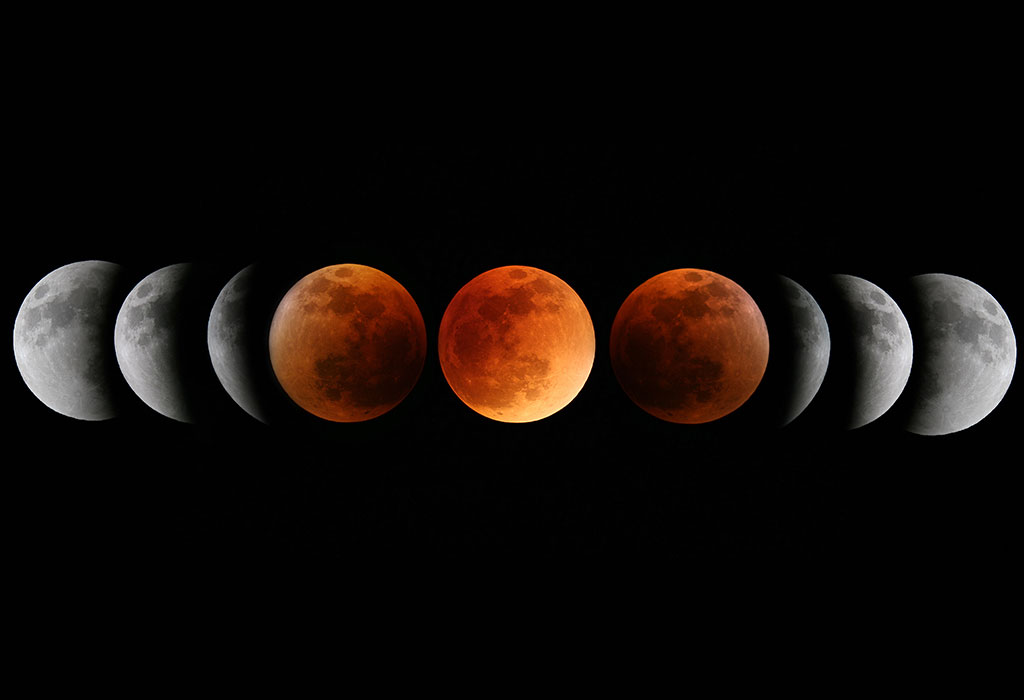
Lunar Eclipse – Interesting Facts for Kids!
The moon has a face like the clock in the hall; She shines on thieves on the garden wall,
On streets and fields and harbour quays, And birdies asleep in the forks of the trees.
– Robert Louis Stevenson
These lines from a poem written by Robert Louis Stevenson beautifully describe an image of the surroundings illuminated by the moon. But, it doesn’t come anywhere closer to mentioning another natural phenomenon related to the moon, a lunar eclipse. They have been the roots of several worries and fears in ancient times, too, when we did not know much about them. With the progress made in astronomical studies, our understanding of lunar eclipses has increased. If you’d love to pass on some great information about this natural phenomenon to your kids, read on.
What Is a Lunar Eclipse?
A lunar eclipse occurs when the sun, the earth, and the moon are aligned, with the earth in the centre. The three astronomical bodies could be in a straight line or closely aligned in a way that the earth’s placement casts a shadow on the moon, making the moon appear reddish-brown in colour.
Types of Lunar Eclipse
As the alignment of the three astronomical bodies cannot always be in a straight line; we get to see three types of lunar eclipses.
1. Total Lunar Eclipse
A total lunar eclipse occurs when the earth is right in the middle between the sun and the moon and casts a complete shadow on the moon. However, because the sun is 109 times bigger than our planet, it’s light still reaches the moon, making it appear reddish-brown when seen from our planet. Why does it appear so? We’ll answer that soon below.
2. Partial Lunar Eclipse
When the alignment is such that the earth casts a shadow on a portion of the moon, we get a partial lunar eclipse. Many identify a partial lunar eclipse easily as it looks like someone has taken a bite out of the moon.
3. Penumbral Lunar Eclipse
During a penumbral lunar eclipse, the outer shadow of the earth (penumbra) falls on the moon giving it a faintly darker appearance, which can only be seen when you observe the moon closely through the eclipse.
How Many Times Can a Lunar Eclipse Occur?
A lunar eclipse can occur two to five times a year. The most commonly occurring eclipses are either partial or penumbral; a total lunar eclipse is less common compared to these two types.
What Is a Blood Moon Lunar Eclipse?
A blood moon is a non-scientific name used to refer to a total lunar eclipse when the moon appears reddish or reddish-brown. It happens because the earth’s atmosphere filters the light emitted by the sun causing the green to violet wavelengths (on the visible spectrum) to scatter more compared to the red wavelength, which reaches the moon and makes it appear red.
So, is there a chance we could see a blood moon in 2020? Let’s find out!
Lunar Eclipse 2020 Schedule
In 2020, four penumbral lunar eclipses have been predicted. Unfortunately, there won’t be a blood moon this year.
This is what the schedule looks like though –
10th of January 2020: Penumbral Lunar Eclipse
5th of June 2020: Penumbral Lunar Eclipse
5th of July 2020: Penumbral Lunar Eclipse
30th of November 2020: Penumbral Lunar Eclipse
If you missed the lunar eclipse of January 2020, you can witness the next lunar eclipse that is predicted to occur on the 5th of June.
How to Watch a Lunar Eclipse?
During a lunar eclipse, the moon does not emit harmful rays as is the case with a solar eclipse. Therefore, you can witness this natural phenomenon with your naked eye from a safe location. In case you wish to take a closer look at the moon, you could use a pair of binoculars or a telescope if you have one.
Other Interesting Facts About Lunar Eclipse
Humans have witnessed, loved, feared, and studied natural occurrences on the planet for ages, which resulted in the numerous facts and myth irresistible to many. Here are some interesting lunar eclipse facts kids are sure to enjoy reading –
The alignment of the sun, the earth, and the moon during a lunar eclipse is called syzygy (pronounced si-zuh-jee) which is defined as a straight-line alignment (or a rough straight-line alignment) of three or more astronomical bodies in a gravitational system.
Christopher Columbus correctly predicted a total lunar eclipse in the early 16th century (1st of March 1504) and cleverly used it to intimidate the natives of Jamaica into providing for him and his crew while they were stranded on the island. He said God would make the moon appear inflamed with wrath to display his displeasure towards the people of the island if they wouldn’t help those stranded. When the Jamaicans witnessed the event, they ran to the ships with provisions and asked Columbus to convince God to save them from the “wrath”. People also call this incident as the Columbus lunar eclipse or the Columbus eclipse.
The English word “eclipse” comes from the Greek word “ékleipsis” which means abandonment or downfall. Sounds scary, we know, but the term came into existence ages ago, and mainly signified the darkening of the moon’s face and its association with a certain belief system. The term continued being in use, but the meaning and its logical explanation have changed completely over the years.
The level of darkness on the moon’s face during a total lunar eclipse can be measured using a 5-point scale called the Danjon Scale.
Other than being safe to watch, lunar eclipses are longer compared to solar eclipses. Some lunar eclipses can last over three hours. So, you can plan a campout the next time a lunar eclipse is scheduled to happen.
A lunar eclipse is sure to get kids and adults equally inquisitive as the moon has been the centre of several thoughts and beliefs for ages. A professor of philosophy and former dean at Rutgers University, Emmanuel George Mesthene, once quoted, “A decade ago, the moon was an inspiration to poets. A decade later, it will be just another airport.”
Also Read:
Sun Facts for Kids
Earth Facts for Kids
Moon Facts for Kids
Read more
Teachers Day Poems – Heartfelt Verses to Honor Educators
Teachers’ Day is a special occasion celebrated in India every year on September 5th to honor and appreciate the hard work and dedication of teachers. This day commemorates the birth anniversary of Dr. Sarvepalli Radhakrishnan, a great teacher, scholar, and the second President of India.
Students and kids often express their gratitude through beautiful teachers day poems, sharing their feelings and respect. A popular way to celebrate is by reciting a poem related to teachers day, which highlights the importance of teachers in our lives.
Here are some teachers day poems for preschoolers, class 1, 2 and 3. These poems also help to generate beautiful teachers’ day greeting cards to express thanks and appreciation. These poems remind us how teachers inspire, guide, and support us every day.
Heartfelt Poems Related to Teachers Day
A heartfelt poem is a beautiful way to express gratitude and admiration for teachers. Here are some of the best poem on teachers day in english that capture the warmth and respect students feel for their mentors.
1. I Want To Be Like You by Joanna Fuchs
Thank you, teacher,
for being my life’s role model.
When I consider all you’ve taught me
and reflect on the kind of person you are,
I want to be like you –
smart, interesting and engaging,
positive, confident, yet unpretentious.
I want to be like you –
well-informed and easy to understand,
thinking with your heart as well as your head,
gently nudging us to do our best,
with sensitivity and insight.
I want to be like you –
giving your time, energy and talent
to ensure the brightest possible future for each of us.
Thank you, teacher
For giving me a goal to shoot for:
I want to be like you!
2. Thanks for Showing Me the Light by Felicity Luckey
Thank you teacher
You’re so kind
You gave me joy
And peace of mind
You helped me dream
You gave me hope
You taught me so
I would not mope
You gave me strength
So I can see
A future that
Belongs to me
A future that
Looks really bright
Thanks for showing
Me the Light
3. My Teacher by Edgar Guest
A builder builds with brick and stone,
A teacher builds with love alone.
And never does that work decay,
It lives forever, day by day.
A teacher gives the best of heart,
And in the world, they play their part.
Their lessons linger, strong and true,
In all the things we learn and do.
Image Source : AI Generated Image
Short and Sweet Teachers Day Poems
These simple and heartfelt verses beautifully capture the special bond between students and teachers in just a few words.
1. Rainbow Teacher by Joanna Fuchs
A good teacher
is a brilliant light,
illuminating the prism of life,
revealing to students
a rainbow of possibilities.
2. Thank You, Teacher by Julie Hebert
Thank you, Teacher, for your smile,
For making each day worthwhile.
You plant the seeds that always grow,
Much more than you will ever know.
3. Lessons of Life by Joyce Hemsley
Lessons of life from teacher to child,
With patience and kindness, gentle and mild.
Not just from books, but from heart to heart,
Teachers give knowledge that sets us apart.
Image Source : AI Generated Image
4. My Teacher, My Guide
A teacher’s like a guiding star,
That brightens up our night,
With kindness, care, and wisdom deep,
You lead us toward the light.
Inspirational Poems for Teachers Day
Inspirational poems for Teachers Day celebrate the dedication, passion, and influence of teachers who shape the future. These poems motivate students to appreciate their teacher and honor the invaluable role play in their lives.
1. A Teacher for All Seasons by Joanna Fuchs
A teacher is like Spring,
Who nurtures new green sprouts,
Encourages and leads them,
Whenever they have doubts.
A teacher is like Summer,
Whose sunny temperament
Makes studying a pleasure,
Preventing discontent.
A teacher is like Fall,
With methods crisp and clear,
Lessons of bright colors
And a happy atmosphere.
A teacher is like Winter,
While it’s snowing hard outside,
Keeping students comfortable,
As a warm and helpful guide.
Teacher, you do all these things,
With a pleasant attitude;
You’re a teacher for all seasons,
And you have my gratitude!
2. The Heart of a Teacher by Paula J. Fox
The child arrives like a mystery box,
With puzzle pieces inside.
Some of the pieces are broken or missing,
And others just seem to hide.
But the heart of a teacher can sort them out,
And help the child to see
The potential for greatness he has within,
A picture of what he can be.
Her goal isn’t just to teach knowledge
By filling the box with more parts.
It’s putting the pieces together
And creating a work of art.
Image Source : AI Generated Image
3. Teachers by Kevin William Huff
Teachers Paint their minds
And guide their thoughts
Share their achievements
And advise their faults
Inspire a love
Of knowledge and truth
As you light the path
Which leads our youth
For our future brightens
With each lesson you teach
Each smile you lengthen
Each goal you help reach
For the dawn of each poet
Each philosopher and king
Begins with a Teacher
And the wisdom they bring.
4. Why God Made Teachers by Kevin William Huff
When God created teachers,
He gave us special friends
To help us understand His world
And truly comprehend
The beauty and the wonder
Of everything we see,
And become a better person
With each discovery.
When God created teachers,
He gave us special guides
To show us ways in which to grow
So we can all decide
How to live and how to do
What’s right instead of wrong,
To lead us so that we can lead
And learn how to be strong.
Why God created teachers,
In His wisdom and His grace,
Was to help us learn to make our world
A better, wiser place.
5. The Village Schoolmaster By Oliver Goldsmith
Beside yon straggling fence that skirts the way
With blossomed furze, unprofitably gay,
There, in his noisy mansion, skilled to rule,
The village master taught his little school.
A man severe he was, and stern to view;
I knew him well, and every truant knew;
Well had the boding tremblers learned to trace
The day’s disasters in his morning face;
Full well they laughed with counterfeited glee
At all his jokes, for many a joke had he;
Full well the busy whisper, circling round,
Conveyed the dismal tidings when he frowned.
Yet he was kind, or if severe in aught,
The love he bore to learning was in fault.
The village all declared how much he knew;
‘Twas certain he could write, and cipher too;
Lands he could measure, terms and tides presage,
And e’en the story ran that he could gauge.
In arguing, too, the parson owned his skill,
For e’en though vanquished, he could argue still;
While words of learned length, and thund’ring sound,
Amazed the gazing rustics ranged around;
And still they gazed, and still the wonder grew
That one small head could carry all he knew.
6. When the Teacher Isn’t Looking by Kenn Nesbitt
When the teacher isn’t looking,
The kids are really cool,
They swing on the monkey bars,
And they jump rope at school.
When the teacher isn’t looking,
The kids all play tricks,
They make mud pies,
And do all sorts of tricks.
When the teacher isn’t looking,
The kids are wild and free,
But when the teacher is looking,
They’re as good as can be.
7. A Teacher’s Gift by Unknown
A teacher’s heart is full of grace,
Lighting lives in every place.
With patient words and guiding hand,
They help us learn to understand.
They nurture dreams and help us grow,
More than words could ever show.
For all the lessons, love, and care,
A teacher’s gift is truly rare.
Thank you, teacher, for all you do,
For seeing potential in me and you.
On this day, we celebrate you,
For making the world bright and new.
Importance of Teachers Day Poems for Students
Teachers Day poems play a significant role for students by providing a meaningful way to express their love, respect, and gratitude toward their teachers.
These poems help students creatively convey their feelings and appreciation for the hard work and dedication of teachers, making the celebration more heartfelt and memorable.
Reciting or writing Teachers Day poems encourages students to reflect on the positive impact that teachers have on their lives, inspiring them to value education and the guidance they receive.
Teachers Day poems strengthen the special bond between students and teachers by celebrating the role teachers play in shaping their future.
FAQs
1. Can kids use Teachers Day poems to create greeting cards?
Yes, many Teachers Day poems are short and rhyming, making them perfect for writing on cards to show appreciation for teachers.
2. What makes a good Teachers Day poem for kids?
A good poem for kids is usually short, easy to understand, with simple rhymes and a positive tone that expresses respect and love for teachers.
Teachers Day poems offer a wonderful way for students and kids to express their feelings of gratitude and admiration. A poem for teachers day not only makes the message more memorable but also adds a fun and rhythmic touch that kids enjoy. Through these poems, young learners can celebrate the inspiring role of teachers and strengthen the bond of respect and love that lasts a lifetime.
Also Read:
Teachers Day Crafts for Kids
Teachers Day Games and Activities
Teachers Day Quotes, Wishes and Messages
Read more

100+ Best Teachers' Day Appreciation Quotes, Sayings and Messages
Teacher appreciation quotes, messages, and sayings are powerful ways to express gratitude and admiration for the dedication and hard work that teachers put into shaping young minds. Whether you’re looking for the perfect teacher appreciation words to include in a card, speech, or social media post, heartfelt quotes can beautifully capture the impact teachers have on our lives. These inspiring teacher appreciation quotes remind us of the invaluable role educators play in guiding, motivating, and encouraging students to reach their full potential.
A sincere thank you message for teacher is a simple yet meaningful gesture that shows how much you value their commitment and care. Whether it’s for Teachers Day, the end of the school year, or any special occasion, thoughtful words can brighten a teacher’s day and strengthen the bond between students and educators. Use these quotes and messages to celebrate and honor teachers who make a lasting difference.
Beautiful Teacher Appreciation Quotes and Sayings
Express your gratitude and admiration for teachers with this collection of beautiful thank you teacher quotes and sayings.
“When educating the minds of our youth, we must not forget to educate their hearts.” – Dalai Lama
“Treat people as if they were what they ought to be, and you help them to become what they are capable of becoming.” – Goethe
“Education is simply the soul of a society as it passes from one generation to another.” – GK Chesterton
“Let us be grateful to the people who make us happy; they are the charming gardeners who make our souls blossom.” – Marcel Proust
“To aid life, leaving it free, however, to unfold itself, that is the basic task of the educator.” – Maria Montessori
“I’ve learned that people will forget what you said, people will forget what you did, but people will never forget how you made them feel.” – Maya Angelou
“A good criterion for measuring success in life is the number of people you have made happy.” – Robert Lumsden
“I think the teaching profession contributes more to the future of our society than any other single profession.” – John Wooden
“The more I live, the more I learn. The more I learn, the more I realize, the less I know.” – Michel Legrand
“Most of us end up with no more than five or six people who remember us. Teachers have thousands of people who remember them for the rest of their lives.” – Andy Rooney
“Teachers appreciate being appreciated, for teacher appreciation is their highest award.” – William Prince
“The best teachers are those who show you where to look but don’t tell you what to see.” – Alexandra K. Trenfor
“Be a wonderful role model because you will be the window through which many children will see their future.” – Thomas Mckinnon
“I like a teacher who gives you something to take home to think about besides homework.” – Lily Tomlin
“I was lucky that I met the right mentors and teachers at the right moment.” – James Levine
A teacher’s job is to take a bunch of live wires and see that they are well-grounded.” – D. Martin
“Education without values, as useful as it is, seems rather to make man a more clever devil.” – C.S. Lewis
“Students don’t know how much you know until they know how much you care.” – John C. Maxwell
“Teachers teach because they care. Teaching young people is what they do best. It requires long hours, patience, and care.” – Horace Mann
“Education is the key to success in life, and teachers make a lasting impact in the lives of their students.” – Solomon Ortiz
“When we strive to become better teachers than we are, everyone in our classroom becomes better too.” – Robert John Meehan
“The teacher who is indeed wise does not bid you to enter the house of his wisdom but rather leads you to the threshold of your mind.” – Khalil Gibran
“The great teacher is not the man who supplies the most facts, but the one in whose presence we become different people.” – Ralph Waldo Emerson
“Your heart is slightly bigger than the average human heart, but that’s because you’re a teacher.” – Aaron Bacall
“What greater or better gift can we offer the republic than to teach and instruct our youth?” – Marcus T. Cicero
“Teaching is not just a job. It is a human service, and it must be thought of as a mission.” – Dr. Ralph Tyler
“Teaching is a very noble profession that shapes the character, calibre, and future of the individual. If the people remember me as a good teacher, that will be the biggest honour for me.” – APJ Abdul Kalam
“Teaching kids to count is fine, but teaching them what counts is best.” – Bob Talbert
“A good teacher is like a candle — it consumes itself to light the way for others.” – Mustafa Kemal Ataturk
“Everyone who remembers his own education remembers teachers, not methods and techniques. The teacher is the heart of the educational system.” – Sidney Hook
“The mediocre teacher tells. The good teacher explains. The superior teacher demonstrates. The great teacher inspires.” – William Arthur Ward
“One looks back with appreciation to the brilliant teachers, but with gratitude to those who touched our human feelings.” – Carl Jung
“A teacher is a compass that activates the magnets of curiosity, knowledge, and wisdom in the pupils.” – Ever Garrison
“A hundred years from now, it will not matter what kind of car I drove, what kind of house I lived in, how much money I had in the bank. But the world may be a better place because I made a difference in the life of a child.” – Forest Witcraft
“Great teachers empathize with kids, respect them, and believe that each one has something special that can be built upon.” – Ann Liberman
“I have come to believe that a great teacher is a great artist and that there are as few as there are any other great artists. It might even be the greatest of the arts since the medium is the human mind and spirit.” – John Steinbeck
“The greatest sign of success for a teacher… is to be able to say, ‘The children are now working as if I did not exist.” – Maria Montessori
“Ideal teachers are those who use themselves as bridges over which they invite their students to cross, then having facilitated their crossing, joyfully collapse, encouraging them to create bridges of their own.” – Nikos Kazantzakis
“The task of the excellent teacher is to stimulate ‘apparently ordinary’ people to unusual effort. The tough problem is not in identifying winners: it is in making winners out of ordinary people.” – K. Patricia Cross
“The dream begins with a teacher who believes in you, who tugs and pushes and leads you to the next plateau, sometimes poking you with a sharp stick called ‘truth.’” – Dan Rather
“One test of the correctness of educational procedure is the happiness of the child.” – Maria Montessori
“A good teacher can inspire hope, ignite the imagination, and instil a love of learning.” – Brad Henry Love
“A master can tell you what he expects of you. A teacher, though, awakens your own expectations.” – Patricia Neal
“I put the relation of a fine teacher to a student just below the relation of a mother to a son.” – Thomas Wolfe
“The hardest arithmetic to master is that which enables us to count our blessings.” – Eric Hoffer
“A teacher affects eternity; he can never tell where his influence stops.” – Henry Brooks Adams
“The art of teaching is the art of assisting discovery.” – Mark Van Doren
“Teachers are expected to reach unattainable goals with inadequate tools. The miracle is that at times they accomplish this impossible task.” – Haim Ginott
“The true teacher defends his pupils against his own personal influences.” – Amos Alcott
“Good teachers know how to bring out the best in students.” – Charles Kuralt
“Good teachers are those who know how little they know. Bad teachers are those who think they know more than they don’t know.” – R. Verdi
“Education breeds confidence. Confidence breeds hope. Hope breeds peace.” – Confucius
“What sculpture is to a block of marble, education is to a human soul.” – Joseph Addison
“Good teaching is more a giving of right questions than a giving of right answers.” – Josef Albers
“One good teacher in a lifetime may sometimes change a delinquent into a solid citizen.” – Philip Wylie
“If we teach today’s students as we taught yesterday’s, we rob them of tomorrow.” – John Dewy
“If you have to put someone on a pedestal, put teachers. They are society’s heroes.” – Guy Kawasaki
“Live as if you were to die tomorrow. Learn as if you were to live forever.” – Mahatma Gandhi
“Appreciation is a wonderful thing. It makes what is excellent in others belong to us as well.” – Voltaire
“The object of education is to prepare the young to educate themselves throughout their lives.” – Robert M. Hutchins
“It is the supreme art of a teacher to awaken joy in creative expression and knowledge.” – Albert Einstein
“Education is the passport to the future, for tomorrow belongs to those who prepare for it today.” – Malcolm X
“I am indebted to my father for living, but to my teacher for living well.” – Alexander the Great
“Children are likely to live up to what you believe of them.” – Lady Bird Johnson
“Good teaching is one-fourth preparation and three-fourths pure theatre.” – Gail Godwin
“If we could say, ‘We are respectful and courteous in our dealing with children, we treat them as we should like to be treated ourselves’, we should have mastered a great educational principle and be setting an example of good education.” – Maria Montessori
“Teaching is not a lost art, but the regard for it is a lost tradition.” – Jacques Barzun
“To stimulate life, leaving it then free to develop, to unfold, herein lies the first task of the teacher.” – Maria Montessori
“The whole purpose of education is to turn mirrors into windows.” – Sydney J. Harris
“None of us got where we are solely by pulling ourselves up by our bootstraps. We got here because somebody – a parent, a teacher, an Ivy League crony or a few nuns – bent down and helped us pick up our boots.” – Thurgood Marshall
“Education is not the filling of a pail, but the lighting of a fire.” – William Butler Yeats
“The best way to predict the future is to create it.” – Abraham Lincoln
“Teaching is the greatest act of optimism.” – Colleen Wilcox
“To teach is to learn twice.” – Joseph Joubert
“Education is not preparation for life; education is life itself.” – John Dewey
Thank You Message for Teachers from Students
Expressing gratitude through a short thank you message for teacher from students is a heartfelt way for students to show appreciation for their guidance, support, and inspiration.
Thank you for always believing in me and encouraging me to do my best. Your support has made a huge difference in my life.
I am grateful for your patience and dedication. You have taught me more than just lessons—you have taught me important life values.
Your passion for teaching and your kindness inspire me every day. Thank you for being a wonderful guide and mentor.
Thank you for creating a classroom where I felt safe to learn and grow. Your encouragement helped me reach heights I never thought possible.
I appreciate all the extra time and effort you put into making lessons interesting and meaningful. You have ignited a love for learning in me.
Your teaching goes beyond textbooks; you’ve taught me how to be confident and believe in myself. Thank you for your unwavering support.
Thank you for always listening, understanding, and guiding me with patience and care. You have truly shaped my future in the best way.
Your dedication to helping each student succeed is truly inspiring. I am thankful for all the knowledge and wisdom you have shared with me.
Thank you for being more than a teacher—you are a mentor and a friend. Your encouragement has motivated me to chase my dreams.
I am forever grateful for your encouragement during tough times. Your belief in me kept me going, and I’m a better person because of you.
Thank You Message For Teachers from Parents
Expressing thanks words for teacher from parents is a heartfelt way to acknowledge the vital role teachers play in their child’s growth and success. These thank you messages from parents show deep appreciation for the care, patience, and dedication teachers provide every day.
We are truly grateful for the positive impact you have on our child’s life. Your dedication and kindness inspire confidence and a love for learning.
Thank you for your patience, guidance, and unwavering support. You have helped our child grow academically and personally, and we appreciate everything you do.
Your passion for teaching shines through in every lesson. We are thankful for the encouragement and motivation you provide our child each day.
We appreciate the personalized attention and care you offer. It means so much to us knowing our child is in such capable and caring hands.
Thank you for creating a warm and welcoming classroom environment where our child feels safe and inspired to learn.
Your hard work does not go unnoticed. We sincerely thank you for the countless hours you invest in helping our child succeed.
We are grateful for the values and lessons you instill beyond academics. Your influence shapes a bright future for our child.
Thank you for seeing the potential in our child and nurturing it with dedication and compassion.
Your encouragement has boosted our child’s confidence and eagerness to learn. We truly appreciate your ongoing support.
We feel blessed to have such a wonderful teacher guiding our child. Thank you for your unwavering commitment and care.
Short Thank You Messages for Teachers
Short thank you messages for teachers are a simple yet meaningful way to express appreciation for their dedication and support.
Thank you for your endless patience and unwavering support in helping me grow and learn every day. Your guidance has made a lasting impact on my life.
I am truly grateful for the passion and dedication you bring to teaching. You inspire me to be the best version of myself, and for that, I thank you.
Your encouragement and belief in my abilities have given me confidence and motivation to pursue my dreams. Thank you for being such an incredible teacher.
Thank you for creating a positive and welcoming classroom where I always feel valued and inspired to learn. Your hard work does not go unnoticed.
I appreciate the care and time you invest in each student. Your lessons have taught me more than just academics—they’ve taught me life skills.
Thank you for challenging me to think critically and to never give up, even when things were difficult. Your support has helped me grow tremendously.
You have a unique way of making every lesson interesting and engaging. Thank you for making learning a joyful experience.
Your kindness, patience, and dedication have made a difference in my life that I will always remember. Thank you for being an amazing teacher.
Thank you for believing in me, even when I doubted myself. Your faith in my potential has encouraged me to work harder and achieve more.
I am grateful for the valuable lessons you have taught me both inside and outside the classroom. You are truly an inspiring role model.
The teaching profession requires a lot of understanding, patience, and a lifetime of dedication. With these beautiful teacher appreciation day quotes and ‘thank you, teacher’ quotes, you are definitely going to let them know how much you admire them!
Also Read:
Essay on Teachers Day
History and Importance of Teachers Day
Crafts Ideas of Teachers Day for Children
Teachers’ Day Quotes, Wishes & Messages
Games, Activities and Celebration Ideas for Teachers
Read more
50 Drawing Prompts for Kids to Boost Creativity
Key Takeaways:
A good drawing prompt turns “I don’t know what to draw” into instant inspiration, making creative play easier to start and easier to stick with.
This collection includes 50 ideas grouped into five themes: animals and nature, imaginary worlds, everyday life, silly and funny, and feelings and self-expression.
The prompts work for kids roughly ages 4 to 10 and need nothing beyond paper and something to draw with.
Rotating between themes keeps drawing time fresh instead of repetitive.
Kids stare at a blank page for the same reason adults stare at a blank document: too many options feel like no options at all. My own daughter used to ask “what do I draw?” more often than she actually drew anything, until I started handing her one word instead of a blank sheet: dinosaur, treehouse, silly monster. Something clicked almost immediately. A solid set of drawing prompts for kids works the same way. It removes the pressure of deciding and replaces it with a spark they can run with. For parents watching a child’s imagination stall out from screen fatigue or plain boredom, prompts offer a quiet, low-pressure way back into creative play. Below are 50 ideas sorted by theme, so you can grab exactly the kind of inspiration your child needs today, calm and familiar or big and imaginative.
Why Drawing Prompts Help Kids Grow?
Drawing does more for a child than fill an afternoon. It builds fine motor control through the repeated, controlled movements of holding and guiding a crayon or pencil. It strengthens visual thinking, since a child has to picture something in their head before they can put it on paper. It also gives kids a safe outlet for feelings they don’t yet have words for, which is part of why art therapists lean so heavily on drawing with younger children.
Creative drawing prompts for kids add a second layer of benefit on top of these basics: they stretch imagination in a specific, guided direction. A prompt like “draw a house made of candy” asks a child to combine two familiar ideas into something new, which is a small but real exercise in creative problem solving. Over time, that kind of practice builds confidence. Kids who draw regularly tend to worry less about getting it “right,” because prompts shift the focus from perfect execution to playful exploration.
There’s also a social side to this that’s easy to overlook. A child who draws a monster who is “actually very shy” or a superhero version of themselves is often working through ideas about identity, fear, or belonging in a low-stakes way. Teachers and child development specialists frequently point to open-ended art as one of the more reliable windows into how a young child is thinking and feeling, precisely because it doesn’t require the same verbal skill that talking about emotions does. A single prompt won’t reveal much on its own, but a habit of drawing over weeks and months tends to say a lot about what’s on a child’s mind.
How to Use This List
There’s no wrong way to work through this drawing prompts list, but a few simple habits can make it even more enjoyable:
Let your child choose the theme that matches their mood instead of assigning one.
Keep drawing sessions short—10 to 15 minutes is plenty for younger kids.
Stick to simple supplies like crayons, markers, coloured pencils, and plain paper.
If a prompt doesn’t spark their interest, skip it. The goal is creativity and momentum, not completing every idea.
You can also turn the list into a simple routine:
Pick a weekly theme: For example, animals on Monday, imaginary worlds on Wednesday, and vehicles on Friday. This creates a fun rhythm while keeping each drawing a surprise.
Keep the list handy: Tape it inside a sketchbook or store it somewhere easy to reach, then pull it out whenever your child says they’re bored or can’t think of what to draw.
However you use it, the key is to treat the prompts as invitations rather than assignments. Kids are usually more engaged when they feel they’ve chosen the idea themselves.
Fun Drawing Prompts for Kids
We’ve rounded up 50 drawing prompts and organised them into easy-to-browse themes, so finding the next creative idea is simple. Start with any category below and see where their imagination takes them.
Animals and Nature
Create a cat wearing a tiny hat.
Draw a dinosaur enjoying a giant ice cream.
Show your favourite zoo animal doing a funny trick.
Design a bird’s nest using unusual materials.
Fill the page with an underwater scene and three sea creatures.
Make a garden where the flowers are bigger than the trees.
Give a dog the power to talk and show what it would say.
Decorate a butterfly’s wings with your own patterns.
Combine all four seasons in one picture of a tree.
Invent an animal you have never seen before.
Imaginary Worlds and Fantasy
Build a castle floating high above the clouds.
Create a friendly dragon and the place where it lives.
Design a robot that helps your family at home.
Draw a treehouse with a secret room inside.
Draw a spaceship exploring a brand-new planet.
Open a magical door and show what is waiting behind it.
Turn yourself into a superhero with your own powers.
Create a world where candy falls from the sky.
Draw a monster who is too shy to scare anyone.
Make a map of an island that exists only in your imagination.
Everyday Life and Family
Show your family having fun together.
Recreate your bedroom just as it looks today.
Design a meal you would happily eat every day.
Draw your best friend doing something that makes them special.
Bring a favourite vacation memory to life.
Show your morning routine from waking up to leaving home.
Imagine the perfect pet for you and bring it to life.
Capture your favourite outdoor place to play.
Plan the birthday party you would love to have.
Show something you are proud to have learned.
Silly and Funny
Give a shoe legs and let it walk on its own.
Put an elephant on a skateboard and see where it goes.
Draw a sandwich with the strangest ingredients you can think of.
Imagine a snowman trying to stay cool on a hot summer day.
Turn your teacher into a superhero.
Dress a dog in your favourite outfit.
Create a monster who would rather clean than scare people.
Give a car wheels shaped like something completely unexpected.
Flip the world upside down and show what happens.
Draw a silly machine that solves a small everyday problem.
Feelings and Self-Expression
Use only colours to show how you feel today.
Capture something that always makes you laugh.
Create a picture of a place where you feel calm and safe.
Bring your happiest memory to life.
Show what courage looks like to you.
Turn something you are a little scared of into a friendly character.
Create a special gift you would love to give someone.
Show what kindness looks like through a picture.
Picture the goal you are working toward.
Create a self-portrait that shows how you see yourself.
Tips for Making the Most of Drawing Time
A few simple habits can help your child get even more out of simple drawing prompts:
Let creativity lead, avoid correcting proportions, colours, or accuracy while they’re drawing.
Ask open-ended questions like, “Tell me about this part,” to encourage storytelling and confidence.
Display finished drawings on the fridge, a wall, or a bulletin board to show that their work is valued.
Change up the format now and then by drawing on a whiteboard, using a dedicated sketchbook, or setting a fun timed challenge.
Focus on the process rather than the outcome. The goal is to enjoy creating, not to produce a perfect picture.
Common Mistakes to Avoid
To keep drawing fun and pressure-free, try to avoid these common pitfalls:
Comparing your child’s drawings to a sibling’s or another child’s work.
Expecting every drawing to match the prompt exactly. Creative interpretation is part of the fun.
Rushing through prompts just to finish the list instead of letting kids enjoy the creative process.
Treating every drawing like a finished masterpiece that has to be neat or perfect. Messy, unfinished, and experimental drawings are all valuable learning experiences.
Saving drawing prompts only for moments when your child is bored or frustrated. Instead, make them a regular part of your weekly routine so they become something your child looks forward to.
Drawing prompts work because they lower the barrier to starting, and starting is usually the hardest part for a young artist. This list gives you fifty ways in, spread across themes that match different moods and energy levels, so there’s almost always one that fits the day you’re having. Keep it nearby, let your child choose freely, and treat the process as more important than any single result. Over time, that approach builds not just better drawings, but a kid who’s genuinely comfortable picking up a pencil and seeing what happens next.
Also Read:
Fun and Innovative Writing Prompts
Kindergarten Writing Prompts
Creative Activities For Kids
Read more
Essay On Teachers Day – 10 Lines, Short and Long Essay
Teachers help kids build a foundation for their future. They dedicate their entire lives to educating children and making schools a second home and a space for intellectual and emotional development. Even though some teachers can be stern, they allow kids to make mistakes and learn from them. They also teach about the facts and sometimes complexities of life, and are responsible members of society that make a lasting impression on kids. Teachers should be praised, appreciated, and celebrated, because if it weren’t for them, every child would have struggled to have a balance in life. And, what better way can there be than an essay to share how thankful you are to your teachers? This year, express your gratitude on Teacher’s Day with these best long and short Teachers’ Day essays.
Five Lines on Teachers Day
Need a quick and meaningful way to celebrate Teachers Day? Explore these “5 lines on teachers day” to express appreciation and gratitude for your teachers’ hard work and dedication.
1. Teachers are like shining stars who guide us every day.
2. They teach us new things and help us grow.
3. Teachers care for us and always do their best.
4. On Teachers Day, we say thank you with a smile.
5. We celebrate our teachers for their love and kindness.
10 Lines On Teachers Day
Teachers’ Day is a time for kids to celebrate and thank the special teachers who make learning exciting and help them grow every day. Here get an idea to write 10 lines on teachers day in english.
1. Teachers’ Day is a special day when we celebrate our teachers and all they do for us.
2. On this day, we say “Thank you” to our teachers for helping us learn and grow.
3. Teachers make learning fun and exciting, so we can discover new things every day.
4. They help us when we’re stuck and cheer us on when we do our best.
5. Teachers show us how to be kind, work together, and believe in ourselves.
6. We give our teachers cards, flowers, and big smiles to show how much we care.
7. It’s a day to remember how important our teachers are in making school a happy place.
8. Our teachers teach us not just from books, but also how to be good friends and helpers.
9. On Teachers’ Day, we celebrate the love and care our teachers give us every day.
10. Saying “Happy Teachers’ Day” is our way of saying thank you for everything they do!
Paragraph about Teachers Day
Looking for a concise and meaningful essay on Teachers Day 100 words? This short paragraph highlights the importance of teachers and their role in shaping our future.
Teacher’s Day is celebrated on the 5th of September every year as a day to thank teachers who play a key role in the upbringing and development of kids. The day is actually the birthday of the first Vice President and the second President of India, Dr Sarvepalli Radhakrishnan. Dr Radhakrishnan was a professor, philosopher, and politician. He served as the Professor of Philosophy in some of the most renowned colleges in India before becoming the Professor of Eastern Religion and Ethics at the University of Oxford, and then a lecturer at the University of Chicago. He was the first Indian to hold the professorial chair at Oxford.
With his contributions in the fields of Philosophy and Comparative Religion, Dr Radhakrishnan has been quite influential in shaping the understanding of Hinduism, especially in Western countries. He defended Hinduism against Western criticism, and contributed to the formation of the contemporary Hindu identity. He has been awarded the Bharat Ratna, a knighthood, and honorary membership of the British Royal Order of Merit.
He was one of the many major contributors who put our country on the map, and influenced many people with his work. By now, you must know why we celebrate Teacher’s Day on his birthday. Some say that his students requested him to allow them to celebrate his birthday, but he asked them to celebrate the day as Teacher’s Day instead, so every teacher in the country is appreciated for their contribution. How cool is that!
Short Essay On Teachers Day
Teachers are some of the few people with whom kids communicate every day. They are their sources of knowledge and inspiration. With this short essay on Teacher’s Day, you can now thank your teachers for everything they have taught you. This Teacher’s Day essay is apt for kids in Class 1, but older kids can also use it as a template, and elaborate on their thoughts.
I Am the Way I Am Because of My Teachers
Teachers are like friends who help us learn many things. Imagine a world without them – we will not know how to read or write to express our thoughts and feelings, or be creative and imaginative. The world would seem limited, boring, and uninspiring, wouldn’t it? Our lives are this way because we have our teachers who motivate us to try new things, learn about new concepts, and be ready to explore the world when we grow up.
We must be grateful to the teachers who always strive to teach us the best things. They share their knowledge and experience through activities, games, talks, and even through books. If it weren’t for them, we would have given up on the tedious lessons we had trouble learning. I am eternally grateful to my teachers for making education interesting and easy. It is because of you, my teachers, that I feel confident and ready to take on the world every day!
Long Teachers Day Essay
For older kids, a 500-word essay could help them express their thoughts about this special day. This essay covers most aspects of the day that you can easily use for an essay-writing assignment on Teacher’s Day. Having said that, be creative, imaginative, and genuine, as that counts when it comes to making an essay a unique piece of writing.
Why the Best Teachers Are Blessings for Us?
Teacher’s Day, as we all know, was a valuable recommendation made by Dr Sarvepalli Radhakrishnan, a renowned professor, philosopher, and politician, who also served as the second President of India. Dr Radhakrishnan never stopped teaching. He continued serving as Professor in many Indian and international colleges, and made our country proud! One day, some students asked him if they could celebrate his birthday, which is on the 5th of September. He, instead, asked them to celebrate the day as Teacher’s Day, and thus 5th September was established as Teacher’s Day in India.
Teachers teach, coach, and mentor during the most important days of our lives. They ensure we have a safe environment to learn, and always inspire us to achieve our goals. Some believe that education is mostly encouragement, and if you have a teacher who encourages you, you are blessed!
The best teachers know how to inspire us to keep learning, and even push, at times, to help us know our true potential. They motivate us to be imaginative and use our skills creatively when facing issues, be it at school or at home. Their teaching methods don’t just help us sharpen our aptitude; they also boost our confidence and make us and our parents hopeful about the future.
If it weren’t for these wonderful teachers, many of us would have had a difficult time understanding the difference between right and wrong, and good and evil. They help us improve our characters and build unique personalities. Their lessons and contributions are significant, which reflect on our report cards and in our decisions.
Some teachers have a gentle approach, which all of us love, while some are stringent and leave no room for error when it comes to crucial topics. We would be lying if we said the stringent approach doesn’t bother it. It bothers most of us, doesn’t it? But if a teacher has to be tough to make us do our homework or get better scores, it is all worth it.
That’s precisely why Teacher’s Day holds a very important place in our lives. Some might say that we don’t need a dedicated day for teachers, and that’s true, too, as we can celebrate Teacher’s Day every day by being respectful and cooperative towards our teachers. But, a special day gives us an opportunity to express how grateful we are to them. So, we decorate our classrooms, prepare handmade gifts, felicitate our teachers, and enjoy a snack or two on this special day with them. None of this would probably match the generosity of the teachers, but it could help us bond with them. After all, they are also the friends we make at school.
These essays on Teacher’s Day might provide you with a template to write your own essay for your teachers. You can tweak them and add your personal experiences to make them special. The trick to a great Teacher’s Day essay is to ensure your teacher knows how grateful you are to them and that you look forward to all the useful things they plan to teach you, whether it is mathematics or a life skill. So go ahead and pen down your thoughts about Teacher’s Day and keep polishing it until you have a great essay in place!
Also Read:
DIY Teacher’s Day Greeting Card Ideas for Children
Best Teacher’s Day Craft Ideas for Preschoolers and Kids
Teacher’s Day Quotes, Wishes & Messages to Share With Your Child’s Teacher
Read more
10 Best Teachers' Day Speech & Preparation Tips
A teacher is a friend, philosopher, and guide who instills confidence, provides direction, and encourages dreams. There is no better time to express our gratitude than on Teachers’ Day, a day dedicated to honoring the remarkable contributions of teachers. If your child is preparing a Happy Teacher’s Day speech, this occasion offers the perfect opportunity to recognize and appreciate the pivotal role teachers play in shaping young minds. 👩🏫👨🏫 Teaching has always been considered a noble and rewarding profession. In India, Teachers’ Day is celebrated on the 5th of September, the birth anniversary of Dr. Sarvepalli Radhakrishnan, the second President of India, who was an esteemed scholar and teacher📚. His birthday is the ideal day to acknowledge the invaluable contributions of educators.
Students across the country take this day to express their heartfelt thanks. If your child is looking to give a short speech on Teachers’ Day, we have some tips and ideas that can help them convey their appreciation effectively. Words are a powerful medium, and crafting a Teachers’ Day speech in English can be a wonderful way to show respect and admiration for those who dedicate their lives to education. Whether it’s a few words or a more detailed speech, the focus should be on highlighting the importance of teachers and the lasting impact they have on their students. 🎓
Teachers’ Day Speech Ideas in English
A teacher is definitely the most important influence in one’s life. If we talk about the little ones aged six, seven, or eight years of elementary school, they perceive their teacher as a magician. On a very important occasion such as Teachers’ Day, students would love to express their gratitude to their teachers. Whether it’s a small speech on Teachers’ Day or a more elaborate presentation, kids can impress their teachers with heartfelt thoughts and feelings. To help with this, take a look at some samples of Teachers’ Day speech in English for kids that can guide your child in expressing themselves more effectively. For a concise yet impactful tribute, a 10 Lines Speech on Teachers’ Day can also be a great choice.
Sample Speech #1
Respected teachers and dear friends!
Very good morning to all of you. Today, on the special occasion of Teachers’ Day, we are here to celebrate and pay a hearty tribute to our very dear teachers, who tirelessly work to ensure that they provide the best education to their students, as we are the nation’s future.
Teachers’ Day is celebrated on September 5 every year with lots of joy, happiness, and enthusiasm. Today is the birth anniversary of Doctor Sarvepalli Radhakrishnan, who was a great scholar and teacher. He was also the second President of our country. Students across the country observe this day as Teachers’ Day to pay respect to their teachers, who play a big role in building the character of students and are the undeniable backbone of society.
It would not be wrong to say that teachers are equal to our parents. They teach us selflessly and treat us as their own children. Parents give birth to a child, while teachers shape the personality of that child, and they constantly try to help a child evolve into a good human being. So, as students, we should always respect and love them. Teachers are the source of inspiration. They motivate us, nourish our young minds with knowledge, give us strength and prepare us to face the obstacles in life.
Teachers are, therefore, a blessing for us in many ways. Let’s pledge today to always respect our teachers, obey them and follow their advice to be worthy citizens. On this day, I want to thank all my teachers for guiding me whenever I needed you.
A big thanks to all of you!
Sample Speech #2
Respected Principal, teachers, and my dear friends!
Good morning to one and all! We are here today to celebrate the honourable occasion of Teachers’ Day. This day gives us the opportunity to celebrate and express our gratitude to our teachers. September 5 commemorates the birth anniversary of our former President, Doctor Radhakrishnan, who was not only a political figure but also a teacher in the true sense.
Hence, his birthday is the perfect day to express our love and appreciation to our teachers for their valuable contribution in shaping the future of tomorrow. Teachers not only impart knowledge, but they also shape the personalities of children. Teachers give children hope to dream, they guide and support students in achieving their goal. They enrich the quality of education and tirelessly work towards making it even better. Hence they are a perennial source of inspiration and motivation. Teachers do deserve this tribute and gratitude for the million ways in which they touch the lives of the students.
As a student, I cannot thank you enough. Whatever I will say will be less because no amount of words can suffice how much you all mean to me and other students. To all the teachers, who have taught me, thank you for guiding me whenever I needed you. To all the teachers present here, thank you all for your genuine efforts, patience, and positive encouragement. Today, I express my heartfelt gratitude to you. Lastly, I want to end this speech with a quote by Ever Garrison, dedicated to all the teachers, “A teacher is a compass that activates the magnets of curiosity, knowledge, and wisdom in pupils.”
Thank you for always supporting us.
Sample Speech #3
Very good morning to all of you!
We are gathered here to celebrate Teachers’ Day! I am given this opportunity to give a speech on Teachers’ Day, express my thoughts and thank all the teachers who have influenced me to learn and lead a better life.
I will begin with a quote. In the words of Brad Henry, “A good teacher can inspire hope, ignite the imagination and instil a love of learning.”
This wonderful thought suffices the importance of teachers in our lives. It is my honour to deliver a speech on the occasion of Teachers’ Day. Since 1962, Teachers’ Day is celebrated on the 5th of September every year in India. This day is the birth anniversary of Doctor Radhakrishnan, who was an outstanding scholar, a teacher who changed several lives, and the second President of India.
Teachers have a special place in our hearts. Although parents contribute a lot to bring us up in the right manner, it is the teachers who awaken our hearts with the light of knowledge and remove the darkness of ignorance. Teachers inspire us to think about a better future and teach us to withstand the obstacles we may face in our lives. They bring out hidden talents and creativity and also impart immense knowledge.
Since teachers lay the foundation of knowledge and education in every child’s life, they deserve gratitude and regard for all the things they keep doing selflessly. On behalf of all the students present here, I want to tell you all that you have been the epitome of strength and a pillar of support. Your immense contribution has made us what we are today. Teachers readily accept all students wholeheartedly without any bias. No matter how much I say will be less. So, I would like to conclude by thanking all the teachers and Principal on behalf of all my fellow students. Thank you for being an indispensable part of our lives.
Thank you so much!
Sample Speech #4
“With a special gift for learning
And with a heart that deeply cares,
You add a lot of love
To everything you share.
And even though
You mean a lot,
You’ll never know how much,
For you helped
To change the world
Through every life, you touched.”
I would like to wish all the teachers and the Principal a very happy Teachers’ Day!
These lovely lines of the poem I recited are by Joanna Fuchs. This poem brings the image of my favourite teacher to my mind. All my friends must have also recalled their own favourite teachers. This is a special day when students across the country celebrate, pay respect and express gratitude to their teachers, who are the backbone of our country. It is a well-known fact that every year Teachers’ Day is celebrated on the 5th of September in memory of Doctor Sarvepalli Radhakrishnan, who was the second President of India and a teacher par excellence. This day is special and important as teachers are felicitated in recognition of their contribution to the field of education.
Many relations exist, but the relation and understanding between a teacher and a student, or shall I say a disciple, is beyond every other relation. Teachers and students are not bound by blood, yet it is teachers who feel extremely proud of the achievements of their students. They genuinely feel happy to hear about every milestone their students achieved. It is the tireless efforts of teachers that make success possible. The world knows the greatness of a teacher through his students. It is only a teacher who can transform a mediocre student into a successful one.
On this special occasion, I appeal to all my friends to join me in appreciating the efforts of the teachers and assuring them that they will always occupy a special place in our hearts. On behalf of all the students, I would like to thank all the teachers who gave us hope to become something in life. We cannot repay what you have done for us, we can only thank you for your efforts. Thank you so much for teaching us and for bearing with us when we shout. We promise to be good students, and one day all of us will make you proud.
Thank you all!
Sample Speech #5
Very good morning to the respected Principal, teachers, and my friends!
On this special occasion of Teachers’ Day, and on behalf of all the students present here, I want to present a short speech to acknowledge, thank, appreciate and honour the amazing work done by our teachers. As you all know, Teachers’ Day in India is observed on September 5th, the birth anniversary of the second president of India, Doctor Sarvepalli Radhakrishnan. He was an excellent teacher who believed that teachers should be the best minds in the country. In India, we have been celebrating Teachers’ Day since 1962 to celebrate and honour this great leader who has inspired millions.
Teachers are an important part of the lives of students. No student becomes a great student without the help of his teachers. They endow us with knowledge, believe in us and make us pursue our dreams. We never thank our teachers enough the way we should. We never realise the importance of our teachers in our lives. Teachers make us what we are! Just imagine for a moment what our lives would have been had we not had the teachers we have today—all these teachers who have guided us with patience right from the start! Right from the beginning, teachers play an important role in our lives. And we simply cannot imagine our lives without you. A big thank you to all the teachers present here for teaching us with patience, for showing faith in us when we did not believe in ourselves, and for encouraging us to participate in debate competitions when we said we had stage fright. It is because of you that today, I am standing in front of you and expressing my heartfelt gratitude.
All the students present here are grateful to all of you. We promise to make you proud someday!
Thank you!
Sample Speech #6
Good morning to respected principal ma’am, teachers and students. On this beautiful occasion of Teacher’s Day, we have gathered to celebrate the hard work of our teachers, who are considered to be the second parents of a child’s life.
Our teachers teach us well and try their best to share their knowledge with us. We can never thank our teacher’s enough for their gift to us.
In India, teacher’s day in India is celebrated on September 5th every year. It is celebrated to remind the birth anniversary of Dr Sarvapalli Radhakrishnan. The celebration of teacher’s day started first in 1962, on the auspicious occasion of Sarvepalli Radhakrishnan’s birthday. He was a great teacher and the second president of India. The celebration began when some of his students and friend requested him to allow them to celebrate his birthday on September 5th. He said, “instead of celebrating my birthday, it would be a proud privilege if September 5th is observed as teacher’s day”.
We are all thankful to all our teachers for being in our lives and teaching us with love and guidance. Your guidance and blessings will always be with us.
Happy Teacher’s Day!
Thank You!
Sample Speech #7
Wishing you all a very good morning. I want to speak a few words on this auspicious occasion of Teachers’ Day. Let’s start by wishing all our beloved and respected teachers a very Happy Teachers’ Day! Because of your faith, dedication, and hard work, we, as students, learn and evolve to be the best versions of ourselves. I want to thank all the teachers with all my heart for always supporting us and correcting our numerous mistakes. Teachers’ Day is the perfect opportunity to commemorate their hard work towards teaching and to show them our appreciation; and is celebrated all over India on 5th September.
The celebration of Teachers’ Day was begun by Dr. Sarvepalli Radhakrishnan, the first Vice President of India. He was born on 5th September 1988. He was also the second-ever President of India and a well-known scholar. Dr. Radhakrishnan, with a passion for teaching, was also awarded the Bharat Ratna. It is said that once when some of his students approached him and asked to celebrate his birthday, Dr. Radhakrishnan simply told them that he would be much honoured if instead of celebrating 5th September as his birthday, they commemorated it as Teachers’ Day. This incident truly shows us how much he was dedicated to the noble teaching profession and passionate about respecting all the teachers everywhere. Thus, every year, Dr. Sarvepalli Radhakrishnan’s birth anniversary marks the Teachers’ Day celebration.
Teachers’ Day in school holds an extraordinary place in our hearts. As students, we get the opportunity to plan special performances to honour our respected teachers. This day is full of excitement, fun, and many activities for all the students. I shall now end by wishing all our wonderful teachers a Happy Teacher’s Day, and we hope you enjoy what we have planned for you today!
Sample Speech #8
Greetings to our esteemed Principal, revered teachers, and dear fellow students!
Today, we stand here to celebrate the essence of education and the guiding lights of our lives – our teachers. As we commemorate Teachers’ Day, it’s a moment of reflection and gratitude for the tireless efforts they put into shaping our futures.
This day holds significance on the birth anniversary of Dr. Sarvepalli Radhakrishnan, a great philosopher and statesman, who believed that teachers play a pivotal role in nurturing generations. They are architects of our minds, cultivating curiosity, and igniting the flames of knowledge.
Our teachers are more than just instructors; they are mentors, friends, and role models. They cultivate values, inspire dreams, and provide unwavering support through our academic journey. It’s their dedication that molds us into better individuals and prepares us for the challenges that lie ahead.
So, on this special day, let us take a moment to express our heartfelt gratitude to our teachers. Your sacrifices, patience, and unending encouragement are truly appreciated. You’re the reason we stand on the threshold of possibility, ready to conquer the world. Happy Teachers’ Day!
Sample Speech #9
Good morning to all respected teachers and my dear friends!
On this special occasion of Teachers’ Day, I am honored to have the opportunity to express my gratitude to all the wonderful teachers who have played such a vital role in our lives. Teachers are not only instructors but also our mentors and guides, helping us navigate the complexities of life with wisdom and patience.
Teachers’ Day is celebrated every year on the 5th of September to honor the birth anniversary of Dr. Sarvepalli Radhakrishnan, a great scholar and the second President of India. His contributions to education and his belief in the importance of teachers continue to inspire us today. Teachers are the backbone of our society, and their influence goes beyond the classroom. They shape our thoughts, our character, and ultimately, our future.
As students, we are blessed to have such dedicated and caring teachers who work tirelessly to help us achieve our dreams. Today, I want to end by saying that while a single day may not be enough to express our gratitude, let us carry forward the lessons our teachers have taught us in everything we do. Their wisdom will forever guide us on our journey.
Thank you, and Happy Teachers’ Day!
Sample Speech #10
Respected Principal, teachers, and my fellow students,
A very good morning to everyone! Today, we have gathered to celebrate a day dedicated to honoring our teachers, who have been our guiding light and source of inspiration. Teachers’ Day, celebrated on the 5th of September, reminds us of the contributions of Dr. Sarvepalli Radhakrishnan, whose life and work symbolize the importance of education and the role of teachers in shaping the future.
Teachers are not just educators; they are the ones who inspire us to dream big and work hard to achieve those dreams. They help us overcome our fears and doubts, pushing us to be the best version of ourselves. As we celebrate this special day, let us take a moment to reflect on the positive impact our teachers have had on our lives.
To all the teachers present here, I want to extend my heartfelt gratitude. Your dedication, patience, and love for teaching have shaped us into who we are today. As I conclude, I wish to remind everyone that the true measure of a teacher’s success is not found in the words we speak today, but in the lives we go on to lead. Let’s make our teachers proud by living up to the values they’ve instilled in us.
Thank You All
Tips to Write the Best Teachers Day Speech
Teachers hold a very special place in the lives of students. Their role in shaping the future of the nation and guiding them to become ideal citizens cannot be overlooked. In order to pay respect to your guide, guru, mentor or educator, follow the tips given below to draft an awesome speech:
1. Organise the Speech
A good speech should have an organised structure. The content should be well arranged even if the speech is informal or personal. Your child should have enough inputs about his teachers to organise the speech systematically. The format of a speech includes an introduction, a middle, and an end. Think about what he would like to talk about in each section. This preparation will also help your child organise the speech.
2. Duration of the Speech
When drafting a speech, there is no harm in expressing one’s thoughts and reciting innuendos, but the speech should be kept short. A well-drafted speech should be short and sweet, the impact of which should be thought-provoking and long-lasting. Dull and imposing speeches can never give the audience a memorable time.
3. Appreciate, Do Not Exaggerate
A touching and impressive speech can be adorned with relevant quotes or some lines from a poem. Articulate your thoughts and feelings in the simplest form. Praise your teachers, talk about the instances when they helped you, but don’t overdo it, lest they will understand that it is not coming from your heart.
4. Do Not Undermine the Purpose of the Speech
A speech should be informative and inspirational. While delivering a speech on Teachers’ Day, do not forget to pay tribute to your favourite teacher. You can give examples and innuendos, but do not forget the heart of the speech. It is your teachers, who should be the focus of the speech. Bear that in mind.
5. Dedicate Your Thoughts
The speaker should have the flair and be expressive to flaunt one’s emotions in a speech. The speaker should dedicate the speech to communicate gratitude to the teachers, acknowledge their diligence and applaud them for the role they play in a student’s life.
After helping your child write the speech, is now time to make him practice it before the event. Here are a few points that will help your child prepare and deliver an impressive yet touching speech on Teachers’ Day.
6. Intonation and Voice Modulation
The speech should sound just as heartwarming as it is written. Voice modulation helps express emotions the way they are supposed to. Practice intonation and modulate your voice to highlight the mark your teachers have made in your life.
7. Moderate Rate of Speech
The rate of speech or the speed of talking is another important factor that will add value to the speech. So make sure you make your child practise speech at a moderate rate. The rate of speech will also help your child remember the speech well and modulate his voice.
8. Pleasing Pitch
This is another important factor that affects speech. A pleasing pitch will hold the teachers’ attention and make it easier for you to share your message. Do make sure your child practices the speech in a pitch that sounds pleasing as well as vibrant.
9. Presentation
Ensure your child dresses his best on the day he is supposed to deliver the speech. Since all eyes will be on him, his uniform should be clean and ironed, his hair should be in place, and his shoes well-polished.
10. Engage the Audience with Eye Contact
Maintaining eye contact is crucial for connecting with the audience and delivering an impactful speech. Encourage your child to look at the teachers and fellow students during the speech. This not only boosts confidence but also shows respect and sincerity.
How to Prepare Your Child for the Speech?
It is not an easy task to prepare a child to deliver a 2 minute speech on Teachers’ Day in English. However, with proper planning and preparation, you can help your child deliver the best speech on Teachers’ Day.
1. Demonstrate
Teach your child how to deliver the speech by making him watch you deliver it with proper voice modulation. Ensure you have appropriate body language also, as the child will pick it up when he is delivering the speech.
2. Listen When Your Child Practises the Speech
Let your child memorise the content and practise many times so that he feels confident. Avoid stopping the speech in between, as it will break your child’s flow and stress him out. Listen patiently and share your inputs in the end. Also, if your child is ready to go over it again, ensure you encourage him instead of stopping him.
3. Practice in Front of a Mirror
Your child will learn to adjust his body language and facial expressions by practising in front of a mirror. So, ensure that he practices enough in front of a mirror and you will see an improvement. This trick will also help your child get rid of the initial hesitation or fear of delivering the speech.
4. Gather an Audience
Once your child has mastered the speech, let him speak in front of his friends or at a gathering. This will give him the confidence to speak in front of many people.
5. Appreciate Your Child
Once your child masters the speech, ask him to deliver it. If he speaks confidently without making any mistakes, applaud him. Your praise will make him feel confident, and he will know that he is ready!
FAQs
1. What are some creative ways to celebrate Teachers’ Day virtually?
In the digital age, celebrating Teachers’ Day virtually has become increasingly popular. Creative ideas include organizing a virtual talent show where students can showcase their skills in honor of their teachers, creating a collaborative digital thank-you card where each student adds a personalized message, or even setting up a surprise video call with students expressing their gratitude individually. Another idea is to curate a playlist of songs dedicated to teachers and share it during an online celebration.
2. How can students involve their parents in celebrating Teachers’ Day?
Students can involve their parents by organizing a joint celebration at home. This could include parents helping their children to prepare a special meal or dessert to share with teachers during a class celebration, creating handmade gifts or crafts together, or even recording a family video message of thanks. Parents can also participate in virtual events or help plan surprise activities for teachers.
3. Can Teachers’ Day be celebrated beyond the classroom?
Absolutely! Teachers’ Day can extend beyond the classroom through community activities. For example, students can organize a tree-planting event in honor of their teachers, dedicate a community service project to them, or host a public art display featuring drawings and messages of gratitude. Local businesses can also get involved by offering discounts or special offers to teachers in recognition of their hard work.
Teachers play a major role in shaping the minds of children. They inspire, motivate, influence, and encourage students to think differently. Hence, children should not hesitate to pay tribute to their teachers. And, a speech is the best way to convey your thoughts! With these tips and speech samples, you can help your child draft and deliver a remarkable speech on teachers’ day.
Also Read:
Teachers Day Appreciation Poems
Unique Teacher’s Day Craft Ideas
DIY Teachers Day Card Ideas for Kids
Best Teacher’s Day Quotes and Messages
Teachers Day – History, Importance and Celebration Ideas of Shikshak Din
Read more
Happy Teachers' Day (2026) – 30+ Thank You Teacher Poems
Teachers’ Day is a time to honour those who have dedicated their lives to shaping young minds. Teachers have the power to ignite our minds with the light of knowledge and change the lives of their students. Not only do they teach children in schools, but they also instil in them moral values and social etiquette. If you are looking for a better way to express your gratitude to your teachers, one of the best ways is by sharing thank you poems for teachers to remind them how much you admire and respect them. Choose from these fantastic teacher appreciation poems for your teacher and make their day memorable!
Appreciate Your Teacher With One of These Poems
Looking for heartfelt ways to honor your teacher on Teachers Day? Discover inspiring teachers day poems to express gratitude and thanks to those who shape our lives.
1. Number One Teacher by Joanna Fuchs
(Write the name of your teacher here),
I’m happy that you’re my teacher;
I enjoy each lesson you teach.
As my role model you inspire me
To dream and to work and to reach.
With your kindness you get my attention;
Every day you are planting a seed
Of curiosity and motivation
To know and to grow and succeed.
You help me fulfil my potential;
I’m thankful for all that you’ve done.
I admire you each day, and I just want to say,
As a teacher, you’re number one!
2. Favorite Teacher
Thank you, favorite teacher
For acting like a friend,
And taking time to show me,
Lessons hard to comprehend.
Thank you for your caring
And lots of other stuff;
For all the things you gave me,
I can’t thank you enough.
3. The Teacher Gets A+ by Joanna Fuchs
I look forward to your class
When I come to school.
You’re an awesome teacher;
I think you’re very cool.
You’re smart, fair and friendly;
You’re helping all of us.
And if I got to grade you,
From me, you’d get A+!
4. Thank You for Bringing Out the Best in Me
You bring out the best in others
You brought out the best in me
The results of all your efforts
I hope are plain to see
Your care and your dedication
Always shines right through
So teacher with my heart and soul
I want to say thank you.
5. Teachers by Kevin William Huff
Teachers
Paint their minds
and guide their thoughts
Share their achievements
and advise their faults
Inspire a love
of knowledge and truth
As you light the path
Which leads our youth
For our future brightens
with each lesson you teach
Each smile you lengthen
Each goal you help reach
For the dawn of each poet
each philosopher and king
Begins with a teacher
And the wisdom they bring.
6. From Reading and Writing to Math and Language Skills
To letters and numbers, with shapes and fun
None of this would be possible, if it wasn’t for a certain one
They give their time, so selfless and free
Thank you for all you’ve done
And for sharing your knowledge and time with me
7. You Taught Me How to Read
Thank you for teaching me
how to read and write,
For guiding me to distinguish
between what is wrong and what is right.
For allowing me to dream
and soar as a kite,
Thank you for being my friend,
mentor and light.
8. Why God Made Teachers by Kevin William Huff
When God created teachers,
He gave us special friends
To help us understand His world
And truly comprehend
The beauty and the wonder
Of everything we see,
And become a better person
With each discovery.
When God created teachers,
He gave us special guides
To show us ways in which to grow
So we can all decide
How to live and how to do
What’s right instead of wrong,
To lead us so that we can lead
And learn how to be strong.
Why God created teachers,
In His wisdom and His grace,
Was to help us learn to make our world
A better and wiser place.
9. Our Children All Need Great Teachers Like You
You once had a choice
And you chose to teach
And every day
It’s our children you reach
You make the difference
In the life of each child
Those that are quiet
And those that are wild
It’s the way that you teach
You do it so well
They look up to you
And think you are swell
You teach from your heart
That’s plain to see
They think you’re divine
And we all agree
Please never forget
And remember it’s true
Our children all need
Great teachers like you
We appreciate you
And we value your time
And if you should forget
Please re-read this rhyme
10. Thank You for Teaching Me How to Believe by Felicity Luckey
Forever I’ll keep your memory
Stored within my heart
Forever I’ll remember
Just how you played a part
You played a part by teaching me
To think bigger and think higher
I never will forget you
As for greatness, I’ll aspire
You played a part by telling me
My dreams will all come true
For teaching me how to believe
Teacher I’m thanking you
11. Thank You for Saying No to Bullying by Felicity Luckey
He once was a bully
He loved to fight
You taught him that
It was not right
You shamed him in
The nicest way
And showed him how
He’d have to pay
You said that karma
Won’t be nice
If he continued
With this vice
You gave him a
Piece of your mind
You taught him ways
He could be kind
You even cut
Him down to size
You helped him to
Apologize
You taught him words
That he could use
And to avoid
Words of abuse
You showed him ways
He could express
So he’d avoid
An awful mess
You showed him that
When life got tough
He could avoid
Such nasty stuff
You said he was
A kinder soul
And should respect
The greater whole
You helped him see
A better way
Thanks and thanks
Is what I say
12. Thanks for Showing Me the Light by Felicity Luckey
Thank you teacher
You’re so kind
You gave me joy
And peace of mind
You helped me dream
You gave me hope
You taught me so
I would not mope
You gave me strength
So I can see
A future that
Belongs to me
A future that
Looks really bright
Thanks for showing
Me the Light
13. Two More Days Till School by Leslie Kimmelman
I’m finally going to school this year,
and now the big day’s almost here.
I’ll learn to write and count and read–
Only two more days till school.
I got new pants and shirts and socks,
a brand-new red and blue lunch box;
I’ll paint and sing and dance and play–
Only one more day fill school.
My hair is washed, my sneakers squeak,
I’m so excited, I can hardly speak!
New things to do, new friends to meet–
Hooray! It’s the first day of school!
14. Teachers Day Thank You Poem
I want to thank you
Not just for being a good teacher
But for being
A caring second mother
I want to thank you
Not just for being my teacher
But for being
A guide and a mentor
I want to thank you
Not just for helping me out
But for motivating me
And melting away my doubts
Thank you!
Short Teacher Appreciation Poems
If you want a thank you teacher poem that is short and crisp yet holds thousands of meanings and emotions, then this column will certainly suit your interests! Let’s take a look at some short teacher appreciation poems:
1. Fine Teacher by Joanna Fuchs
Teacher, teacher, you’re so fine
I’m really blessed that you are mine.
I’m happy when I come to school,
Because you’re fun, and you’re so cool.
I need to learn, but very few
Can make me want to, like you do!
2. Rainbow Teacher
A good teacher is a brilliant light
illuminating the prism of life,
revealing to students,
a rainbow of possibilities.
3. Dear Teacher by Joanna Fuchs
Dear teacher,
You listen to me,
getting to know the real me.
You believe in me.
You teach me to try,
to always do my best;
You encourage me, support me;
You point me toward success.
I want to become
strong, smart, and independent.
I want to be like you,
dear teacher.
4. My Teacher by Joanna Fuchs
My Teacher,
You taught me, inspired me
guided me, encouraged me
pushed me to do my best.
Thank you for caring about me.
5. I Feel Good by Joanna Fuchs
Kind Teacher,
You conquered my fears
that I was dumb.
You focused on my smart strengths
and ignored the rest.
Because of you,
I feel good about me.
Funny Teacher Appreciation Poems
A funny teacher appreciation poems from students? We’ve got you!
1. The Supply Teacher by Allan Ahlberg
Here’s the rule for what to do
If ever your teacher has the flu
Or for some other reason takes to her bed
And a different teacher comes instead
When the visiting teacher hangs up her hat
Writes the date on the board, does this or that
Always remember, you have to say this,
OUR teacher never does that, Miss!
When you want to change places or wander about
Or feel like getting the guinea pig out
Never forget, the message is this,
OUR teacher always lets us, Miss!
Then, when your teacher returns next day
And complains about the paint or clay
Remember these words, you just say this:
That other teacher told us to, Miss!
2. The Village Schoolmaster by Oliver Goldsmith
The village all declared how much he knew;
’Twas certain he could write, and cipher too:
Lands he could measure, terms and tides presage,
And e’en the story ran that he could gauge.
In arguing too, the parson own’d his skill,
For e’en though vanquished he could argue still;
While words of learned length and thund’ring sound
Amazed the gazing rustics rang’d around;
And still they gazed and still the wonder grew,
That one small head could carry all he knew …
3. Where Do All the Teachers Go? by Peter Dixon
Where do all the teachers go
When its four o’clock?
Do they live in houses
And do they wash their socks?
Do they wear pajamas?
And do they watch TV?
And do they pick their noses
The same as you and me?
Do they live with other people
Have they mums and dads?
And were they ever children
And were they ever bad?
Did they ever, never spell right
Did they ever make mistakes?
Were they punished in the corner
If they pinched the chocolate flakes?
Did they ever lose their hymn books
Did they ever leave their greens?
Did they ever scribble on the desktop
Did they wear old dirty jeans?
I’ll follow one back home today
I’ll find out what they do
Then I’ll put it in a poem
That they can read to you.
4. Teacher’s Pet by Daniel Turner
As I look back, it all seems funny now
Recalling all those awkward teen age years
I pushed the limits farther than allowed
Supposedly when young, we had no fears
Infatuation caught me with the blues
My heart was swollen by love’s gentle sting
It was a crush that only left a bruise
Left by the diamond in her wedding ring
The first day I laid eyes on her, I fell
The lightning bolt she was, that shook my world
And to this day I swear I’d know her smell
Could she have read my mind, she’d likely hurled
I hated school but never missed her class
She said she loved me ’cause I made her laugh
5. Some Teachers
Some teachers are sweet
Some teachers are a delight
Some teachers are funny
Some teachers are always right
Some teachers are cute
Some teachers are annoying
Some teachers are boring
Some teachers are irritating
But you, are hard to label
Because in every possible way
You motivate and inspire us
Day after day
Thank you
Inspirational Teacher Appreciation Poems
Whether you are looking for a headmaster or preschool teacher thank you poem, we have dug out a medley of inspirational poetry, each penned by talented poets who understand the true essence of teaching. Let’s get started, shall we?
1. A Special Thank You by Catherine Pulsifer
A special thank you just for you
We thank you for all you do.
The children always love you so
You teach them lots and let them grow.
You open learning doors for them
To us you are such a gem.
You help them when struggles appear
To us, you are such a dear.
You show you are a teacher who cares
No one else can compare.
We thank you from the bottom of our heart
For the knowledge, you do share and impart.
2. I’m Grateful I Was Taught By You
There once was a teacher
That teacher was you
Who always knew
Just what to do
Just what to do
And what to say
And how to make
A student’s day
For all your help
For all you teach
For every student
That you reach
For all you are
And all you do
With gratitude
I say thank you
There once was a teacher
That teacher was you
I’m grateful I
Was taught by you
3. There Are People by Catherine Pulsifer
There are people who impact our life
People who help us deal with strife.
People who are an example to follow
People who help us deal with sorrow.
People who teach us things
People who coach on what life brings.
People who always seem to care
People who will encourage a dare.
People who make us bring out the best
People who encourage us to pass the test.
People who make us smile
People who show us how to turn the dial.
You, my teacher, have been all these things
So much learning you did bring
My life has changed because of you
Thank you for all you have done and still do!
4. Ode to Educators by Jovial Jane
Oh, teachers, you’re the stars so bright,
Guiding us through both day and night.
With endless facts and stories to share,
You lead with compassion, showing you care.
Quirky tales and riddles galore,
In your classrooms, learning’s never a bore.
You make us laugh, you make us think,
Raising us up with each joyful wink.
5. You Showed The Way by Catherine Pulsifer
I stand here tall and confident today,
Dear teacher you showed the way,
Your patience, kindness and care,
You helped me learn and be aware.
Your support and words of encouragement so true,
Gave me hope even when I lost my view.
Your guidance inspired confidence and pride,
For this, I am truly grateful for all the time you’ve tried.
You lightened difficult roads through your exemplary grace,
And continued to believe in me no matter what pace.
Thank you for never giving up on me no matter what I did,
Appreciation is sent to you from this kid!
Famous Teacher Appreciation Poems
Here are some worth-reading poems on teacher appreciation from famous poets of the time. Relive the memories you spent with your teachers as you read these impressive verses.
1. We Appreciate You, Teacher by Mary S. Scotsburn
You spend so much time with our children each day
We appreciate you in every way.
You teach them and encourage each one
And we thank you for all you have done.
We don’t tell you often enough
How much you are thought of.
The work you do does get noticed
Our children are living proof.
We appreciate you for all that you do
This thank you is long overdue!
2. Teachers Light the Flame by Catherine Pulsifer
Teachers are the ones who light the flame
Of knowledge within our hearts aflame.
Their wisdom guides us along life’s road,
Their patience helps us bear the heaviest load.
They dedicate their lives to making us grow,
Their efforts and hard work we’ll forever know.
We offer our thanks, this much is true,
To every teacher out there, for all that they do.
3. God Made Teachers
God understood our thirst for
Knowledge, And Our Need to Be Led
By someone wiser;
He needed a heart of compassion,
Of encouragement, and patience;
Someone who would accept
The Challenge Regardless of The
Opposition;
Someone who could see potential
And believe in the best in others . . .
So, he made teachers.
4. A Tribute to Teachers by Hattie Vose Hall
A builder builded a temple,
He wrought it with grace and skill;
Pillars and groins and arches
All fashioned to work his will.
And men said as they saw its beauty,
“It never shall know decay.
Great is thy skill, O Builder!
Thy fame shall endure for aye.”
A teacher builded a temple
With loving and infinite care,
Planning each arch with patience,
Laying each stone with prayer.
None praised the unceasing efforts.
None knew of the wondrous plan
But the temple the teacher builded
Was unseen by the eye of man.
Gone is the builder’s temple,
Crumpled into the dust;
Low lies each stately pillar,
Food for consuming rust.
But the temple the teacher builded
Will last while the ages roll;
For the beautiful, unseen temple,
Was a child’s immortal soul.
5. Good Guide by Joanna Fuchs
A smart and really good teacher
Should be a good guide, not a preacher.
She’d open each mind
Therein treasures to find;
Encouragement would be her best feature.
You have this good quality and more;
You inspire each brain to explore.
Our respect you are earning;
You’ve made us love learning,
As no teacher has before.
FAQs
1. How can I express gratitude to my teachers?
Expressing gratitude to your teachers is a wonderful gesture that they’ll surely cherish. Here are some ways to do that:
Consider writing a heartfelt thank-you note, expressing your thoughts and memories that highlight their impact on your learning journey.
Create a personalised gift, such as a handmade card or a small craft, to add a personal touch and show your effort in expressing your gratitude.
Share sincere compliments and specific examples of how their teaching has influenced you.
Collaborate with your classmates to create a group thank-you card or a surprise celebration.
Thoughtful gifts like a book related to their interests or a plant can convey your appreciation in a tangible way.
2. What is the greatest joy of teaching?
The greatest joy of teaching is the journey of witnessing the lifelong groundwork of learning take root and flourish within eager minds. It’s that cherishable moment when a complex concept finally clicks for a student, and their eyes light up with understanding and enthusiasm for learning.
Did you know that there are around 98,000 public schools in the United Schools and over 3 million teachers in the US in K-12 schools? In ancient Greece, teachers were some of the most highly paid-skilled workers. They are passionate about their job and enjoy making a difference. After spending long hours at work, they stay late, take papers home to grade, and dedicate the summer holidays to preparing for the next academic year and other professional development opportunities.
Also Read:
Teachers Day Speech for Kids
Teachers Appreciation Quotes
Teachers Day Craft Ideas for Children
Teacher’s Day Quotes, Wishes & Sayings
Teachers Day History, Importance and Celebration
Read more

Comedy Movies for Kids: 20 Best Picks
A humorous movie intends to provide a moment of respite from the realities of life, offering laughter and joy to viewers of all ages. Regardless of when they were made, good comedy movies for kids lighten up the mood and entertain everyone, no matter their age. Funny kids movies have a unique way of blending silly humor, clever storytelling, and heartwarming moments that appeal to both children and adults. These films often feature memorable characters, hilarious situations, and witty dialogue that keep audiences engaged from start to finish. From classic favorites to modern hits, these films prove that humor is timeless and universal.
20 Funny Kids Movies to Watch
The most hilarious movies focus on funny characters or funny situations that make us laugh. Comic movies have evolved from being squirted with a garden hose into several sub-genres of comedic styles. These family comedy movies are hugely entertaining and packed with positive messages. Bringing on gales of laughter, these are the funniest kids’ movies you’ll find to entertain your child. Furthermore, they are artistically impressive and timeless enough to be considered for a family movie night on your comfy sofa with a huge bowl of popcorn. These must-see funny movies for kids will appeal to the entire family.
1. Wonder Park
Release Date – 2019
Get ready for an extraordinary adventure with June, an incredibly creative and imaginative little girl, as she accidentally uncovers an abandoned amusement park. Full of amazing rides and operated by friendly animals, June and her furry friends will do whatever it takes to save the park from certain danger.
2. Boss Baby
Release Date – 2017
Filled with laughs, this movie is about familial love. Upon the arrival of his new brother, Tim’s parents turn all their attention to the baby. However, the sibling rivalry must come to an end as Tim finds out about the baby’s mission to thwart the puppies’ diabolical plan – and the baby can do this only with Tim’s help.
Image Credit: Pinterest
3. Minions
Release Date – 2015
The minions are yellow creatures that have been serving unsuccessful masters from the beginning of time. Eventually, they end up master-less until three minions with a plan set out on a trip to find the perfect overlord for their kind. Their humanlike behaviour and overwhelming cuteness make the minions popular movie characters.
Image Credit: Pinterest
4. Baby’s Day Out
Release Date – 1994
This is a family movie about baby Bink being kidnapped by three klutzy criminals after his millionaire father’s money. But soon, Bink escapes, and now the criminals have to search the city for him as he wanders around, thinking he has to reconstruct scenes from his favourite storybook in order to get home.
Image Credit: Pinterest
5. Kung Fu Panda 3
Release Date – 2016
Master Po, the great Dragon Warrior, now transformed from student to teacher, reunites with his long-lost father and enters a panda village to tutor clumsy, fun-loving pandas to become martial-art combatants. Now fully trained in Kung Fu, the panda kin fight the evil supernatural warrior Kai together.
Image Credit: Pinterest
6. Madagascar
Release Date-2005
Alex, the lion, is the main attraction at the Central Park Zoo in New York City. He and his friends lead a comfortable life with regular meals and an adorable audience. However, Marty, the zebra, wants to explore the wild and breaks out of the zoo along with some funny penguins. The others follow Marty, and they end up getting washed ashore on Madagascar.
Image Credit: Pinterest
7. Zootopia/ Zootroplis
Release Date-2016
Zootopia is a buddy-cop movie about a rabbit named Judy Hopps, who defied all odds to become a police officer. When she takes up a case to find missing animals, Judy has to work with Nick Wilde, a wily fox, to uncover a criminal conspiracy. The fox’s witty remarks and the rabbit’s hilarious adventures as a police officer will make you laugh out loud.
Image Credit: Pinterest
8. Cloudy With a Chance of Meatballs
Release Date – 2009
Swallow Falls has fallen into trouble, and the townspeople can afford only sardines to eat. Failed inventor Flint Lockwood tries to solve the crisis by making a machine that makes treats fall from the sky, leading to some hilarious situations. But soon, the machine spins out of control, leaving the town in deep, deep trouble. Flint’s sidekick, the monkey, trying to talk like a human is an extra fun touch that will be sure to evoke laughter among the audience.
Image Credit: Pinterest
9. Wreck-It Ralph
Release Date – 2012
This hilarious movie tells the story of a video game villain who wants to be good. When Wreck-It-Ralph, the bad guy in his arcade game, wants to be seen as a hero, he sets out to win a medal to prove it. Soon, a deadly virus accidentally released by Ralph endangers the entire arcade.
Image Credit: Pinterest
10. The Grinch
Release Date – 2018
The Grinch, who has a heart two sizes too small, lives with his loyal dog Max on Mount Crumpet near Whoville. When his neighbours, the Whos, plan on celebrating Christmas in a bigger and brighter way, an annoyed Grinch plots to ruin it by posing as Santa Claus and stealing their Christmas away. Max tries to make Grinch see reason and save Christmas, with some rib-tickling situations that will have you bursting with laughter.
Image Credit: Pinterest
11. The Bad Guys
Release Date – 2022
A group of notorious animal criminals—Mr. Wolf, Snake, Shark, Piranha, and Tarantula—pretend to reform to avoid prison, but their leader starts questioning if they should actually become good guys. Packed with heists, humor, and unexpected heart, this animated comedy is a blast for kids and adults alike.
Image Credit: Pinterest
12. The Mitchells vs. The Machines
Release Date – 2021
When a tech uprising turns robots against humanity, the dysfunctional Mitchell family must work together to save the world. With quirky animation, hilarious gags, and a heartfelt family dynamic, this film is a laugh riot.
Image Credit: Pinterest
13. Ron’s Gone Wrong
Release Date – 2021
In a world where every kid has a high-tech robot best friend, Barney ends up with Ron—a malfunctioning, hilariously glitchy bot. Their chaotic friendship leads to slapstick comedy and touching moments about real connection.
Image Credit: Pinterest
14. The Secret Life of Pets
Release Date – 2016
Ever wondered what pets do when their owners are away? This movie follows Max the dog and his new roommate Duke as they get lost in New York City, encountering a rebellious bunny, a psychotic poodle, and other hilarious animals.
Image Credit: Pinterest
15. Trolls
Release Date – 2016
Poppy, the happiest Troll ever, teams up with grumpy Branch to rescue their friends from the Bergens, who believe eating Trolls brings happiness. With catchy songs, vibrant colors, and non-stop humor, this movie is pure joy.
Image Credit: Pinterest
16. The Lego Movie
Release Date – 2014
Ordinary construction worker Emmet is mistaken for the “Special” MasterBuilder who can save the Lego universe from Lord Business. Packed with rapid-fire jokes, clever meta-humor, and an all-star voice cast, this film is endlessly entertaining.
Image Credit: Pinterest
17. Hotel Transylvania
Release Date – 2012
Dracula runs a luxury hotel for monsters, but his overprotective parenting is tested when a human stumbles in and falls for his daughter. Adam Sandler’s Dracula and the wacky monster crew deliver big laughs.
Image Credit: Pinterest
18. Despicable Me
Release Date – 2010
Supervillain Gru adopts three orphan girls to help pull off a heist, but their adorable antics melt his icy heart. The Minions’ gibberish and slapstick comedy make this a timeless favorite.
Image Credit: Pinterest
19. Penguins of Madagascar
Release Date – 2014
The breakout stars of Madagascar get their own spy-themed adventure, packed with fast-paced humor, ridiculous missions, and a villainous octopus voiced by John Malamuth.
Image Credit: Pinterest
20. Smallfoot
Release Date – 2018
A Yeti named Migo discovers a human (“Smallfoot”), challenging his village’s beliefs. The film’s clever humor, catchy songs, and reverse-perspective storytelling make it a fun watch.
Image Credit: Pinterest
FAQs
1. How do kids’ comedy movies stay funny for all ages?
Kids’ comedy movies need to be fun for children but not too silly for adults. They use simple jokes, funny faces, and crazy situations that kids love. At the same time, they add clever little jokes that parents enjoy. The best ones make everyone laugh without being rude or too babyish.
2. Can funny kids’ movies teach them anything?
Yes! Comedy good movies for kids often show lessons about friendship, never giving up, and learning from mistakes. Laughing also helps kids feel happy and less stressed. When they see characters in funny but tough situations, it can help them understand how to handle problems in real life.
3. Why do some old kids’ comedy movies still feel funny today?
The best comedy movies of all time for kids don’t use jokes about things that go out of style (like old trends or slang). Instead, they focus on silly actions, funny sounds, and everyday kid problems—stuff that’s always funny, no matter when you watch it. Movies that rely too much on what’s “cool” at the time often feel dated later.
4. How do movies make both kids and parents laugh?
Good kids’ comedies work on two levels—big, obvious jokes for kids (like someone slipping on a banana peel) and smarter, quieter jokes for adults (like a funny line only parents get). This way, the whole family can enjoy the movie together instead of just the kids.
Considering the world and its uncertainties in the present times, laughter can be the best medicine. Even if it may be regarded as a pastime, English comedy movies relieve stress, anxiousness, renew our energy, and develop a sense of humour. Fun movies to watch with kids appeal to all ages and create happy memories for your kids. Besides, watching movies is an easy and inexpensive recreational activity that you can do with your family. It helps to build trust and family tradition besides a host of benefits for children. Movie time boosts self-confidence, promotes academic performance, stimulates creative thinking, lessens behavioural problems, sibling rivalry, and fosters social and communication skills. They learn to cooperate and collaborate within the family and with others. Watching films with friends helps to strengthen our relationship. So whether it is a holiday season or a weekend around the corner, choose the most delightful movie to reap all the goodness that a good comedy movie time has to offer.
Also Read:
Space Movies for Kids
Animated Movies for Children
Educational Movies for Children
Best Back-to-School Movies for Kids
Read more
Introducing Kids to Poetry
Teaching poetry to kids is an interesting habit that needs to be inculcated in your child’s formative years. This practice will in turn help your child enjoy reading and make him appreciate words too. Learn ways to introduce poetry to your children with interesting tricks that will inspire them.
As kids, the first stories we were all told were probably verses and poems. Most of us tend to approach storytelling through poems. For children especially toddlers and pre-schoolers,the benefits of reading and learning through poetry is vast. Poetry can make you smile and keep your child entertained. One of the countless benefits of poetry is that it conveys feelings and thoughts through minimum and carefully chosen words.
Teaching poetry to children will make them appreciate words and cultivate them to pick up reading too. Believe it or not, introducing poetry to kids at an early age helps them enrich and develop rich vocabulary; phonological awareness through repetition, rhythm and rhyme; and their imagination knows no boundaries.It’s fun and children love it! What’s more? With so many benefits, one wonders how to get them started early, so they can revel in the beautiful woven words of a poem. There are some tips that you can follow to introduce your kids to poetry and cease your quandary.
Poetry and Children – How to Develop This Relationship?
1. The ‘I Am’ Poem
One of the best ways to introduce your child to poetry is to start with the simple ‘I Am’ series of poems. These poems contain three stanzas of six lines each and usually describe an object or a person. It enlists all the good qualities of that person or thing. This would be one of the best ways of introducing your kid to the world of poems. You could also help your children come up with an ‘I Am’ poem, describing themselves. This will improve his imaginative skills and vocabulary.
2. Poem Illustrations
One of the most effective ways to inculcate imagination in the child is to allow them to illustrate the poem with colours. Ask them to draw a picture, which best represents what the poem means to them. You will be surprised to see how creative kids can get. Involve the child in a discussion later to understand his interpretation of the poem. In this manner you are inculcating poem reading habit in children and also allowing them to think beyond their limits!
3. The Musical Way
Another effective way of making your child love poetry is to get your hands on musical versions of the poems. Play them at home through your smartphone or your laptop. Your kid will soon grow to adore poems because of the whole musical effect of the activity. This is a great way to get your little one to like poetry in the long run. You could always make a rhyme of your own, and you will be amazed to see how excited your little one is.
4. Bedtime Poetry
One of the best ways to introduce your child to poetry would be to read the poem to them like you’d read a bedtime story. Sound imaginative and create interest, while you read the poem aloud. Most children’s poetry has a soothing and relaxing element to it. Before you know it, she would be reminding you to read them to her even when you’re a deadbeat. Poems like ‘Princess Sleepyhead’ is a perfect bedtime poem for little girls.
5. The Rhyming Game
Poetry for kids can be fun and informative, if you make it into one. Choose fruits or any objects in the house and ask your kid to come up with words that rhyme with that object. However, you might not want to point out to fruits like apples and oranges; in short, words that are difficult to rhyme. In time, your kid will get the hang of it and enjoy this wordplay.
Introducing your kids to poetry should start when they are young. This is because poems expand the mental and creative horizons of a child and will also make your child develop a liking for words. Furthermore, inculcating this habit will also help increase your child’s vocabulary. This would not just increase their knowledge, but will also make your child stand out.
Read more
Sort By
 Latest
 Most Popular
 Trending
Please select atleast one Filter