
15 Tree Facts for Kids That Will Surprise You
From giant redwoods to trees that "talk," these fun tree facts for kids will spark curiosity and make learning about nature exciting.




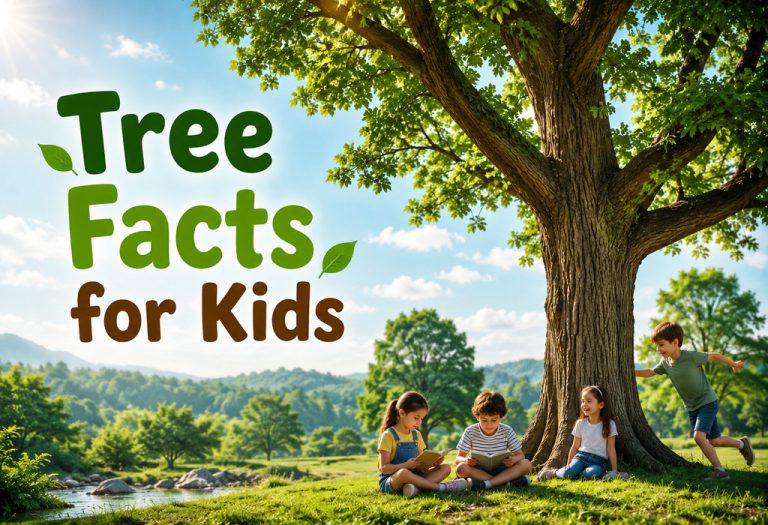
Image Source: AI-Generated Image
Have you ever wondered if trees can talk to each other or if some trees are older than castles and even entire countries? Trees may seem quiet and ordinary, but they are full of incredible secrets that make nature even more amazing. From giant trees that touch the sky to tiny trees that can survive in the harshest places, there’s so much to discover.
Whether you love climbing trees, playing in the park, or simply enjoy learning fun and interesting facts about nature, these surprising tree facts will leave you amazed. Read on to discover 15 amazing tree facts for kids that will change the way you look at trees forever!
Fun and Surprising Facts About Trees
Think you know everything about trees? Think again! From trees that can live for thousands of years to ones that “talk” to each other underground, these fun facts about trees for kids will show you just how amazing nature can be. Let’s dive in and discover some incredible tree secrets!
1. Trees Are the Oldest Living Things on Earth
Some trees have been alive for an incredibly long time. The oldest known living tree is a bristlecone pine called Methuselah, located in California, and it is thought to be around 4,765 years old (1). That means this tree was already a sapling when ancient Egypt’s pyramids were being built! Unlike most living things, trees do not really “die” from old age the way animals do. They just keep on growing.
2. You Can Find Out a Tree’s Age by Counting Its Rings
Slice through a tree trunk and look at the circles inside. Each ring represents one year of growth. The lighter, wider rings show fast growth during spring and summer. The darker, thinner rings show slower growth in autumn (2). Scientists who study tree rings are called dendrochronologists, and they can use those rings to learn what the weather was like hundreds of years ago, even before people kept weather records!
3. Trees Talk to Each Other Underground
This might sound like something from a fairy tale, but it is true. Trees communicate through a huge underground network made up of tiny fungi called mycorrhizae (say it like: my-co-RY-zee). These fungi wrap around tree roots and connect different trees together, almost like the internet. Through this network, trees can share water, nutrients, and even warning signals. If one tree is being attacked by insects, it can send a chemical message to its neighbours so they can prepare their own defenses. Scientists call this the “wood wide web” (3).
4. Trees Make Their Own Food From Sunlight
Trees are amazing chefs. They use their leaves like solar panels to capture sunlight, then mix it with water from the soil and carbon dioxide from the air. This process is called photosynthesis. The result? The tree makes its own sugar for energy and releases fresh oxygen into the air as a bonus. That oxygen is exactly what you breathe every time you take a deep breath outdoors.
5. One Tree Can Make Enough Oxygen for Four People
A single, healthy, mature tree produces enough oxygen every day for around four people to breathe (4). Now imagine a whole forest! Trees are basically nature’s air purifiers. They also absorb carbon dioxide, a gas that contributes to climate change, which is why planting more trees is one of the best things we can do for our planet.
6. There Are Over 60,000 Species of Trees
If you think all trees look the same, think again. Scientists have identified more than 60,000 different species of trees worldwide (5). They range from tiny dwarf willows in the Arctic, which grow only a few centimeters tall, to towering coast redwoods in California that can reach over 350 feet high. Some trees have spiky bark, some have smooth peeling bark, and others are covered in magnificent flowers.
7. The Tallest Tree in the World Is as Tall as a 35-Story Building
A coast redwood tree named Hyperion, found in Redwood National Park in California, holds the record for the world’s tallest living tree. It stands at about 380 feet tall. To put that in perspective, that is roughly as tall as a 35-story skyscraper! These giant trees can live for over 2,000 years and grow so wide that people have carved roads through the base of some of them in the past (6).
8. Trees Have Roots That Can Stretch Incredibly Far
Most of a tree is hidden underground. Tree roots can spread two to three times wider than the tree’s canopy (the leafy part you see above ground). Roots have two important jobs: they anchor the tree firmly in the soil so it does not tip over, and they absorb water and nutrients to feed the entire tree. Some trees, like the banyan tree found in India, even grow roots from their branches that drop down into the ground, creating a tree that looks like an entire forest all on its own.
9. Trees Can Protect Themselves From Bugs
Trees are not completely helpless when creepy-crawlies come calling. Many trees can produce special chemicals called phenolics when they detect insect attacks. These chemicals make the leaves taste bitter or even toxic to the bugs, which helps the tree protect itself (7). Some trees even release these chemicals into the air as a signal to nearby trees. It is like a natural alarm system built right into the forest.
10. A Tree’s Bark Is Like Its Skin
Bark is the tough outer layer of a tree, and it works like skin does for your body. It protects the tree from extreme temperatures, insects, diseases, and physical damage. Underneath the rough outer bark is a softer layer called the inner bark or phloem. This inner layer acts like a highway, carrying food (sugars made by the leaves) down to the roots. Without healthy bark, a tree can get very sick.
11. Some Trees Travel to Space
In 1971, astronaut Stuart Roosa carried hundreds of tree seeds on the Apollo 14 moon mission. These seeds orbited the Moon and were then planted back on Earth when the astronauts returned. The resulting trees, called Moon Trees, were planted across the United States to celebrate (8). Remarkably, they grew just like normal trees, proving that a trip to space does not change how a seed grows.
12. Trees Keep Us Cool Like Natural Air Conditioners
On a hot summer day, do you notice how much cooler it feels under a shady tree? That is no accident. Trees provide cooling shade, but they do something even more impressive called transpiration. They pull water up from their roots and release it as water vapour through their leaves. This process can cool the surrounding air by several degrees. In fact, a healthy shade tree has the cooling power of multiple air conditioning units!
13. Trees Give Us Food, Medicine, and Materials
Think about how much of your daily life comes from trees. The wood in your furniture, the paper in your books, the fruit on your breakfast table, and even some of the medicines in your cabinet may come from trees. Willow tree bark contains a natural compound similar to aspirin and has been used for centuries to treat pain. Maple trees provide sweet syrup, rubber trees give us natural rubber, and around 2,000 types of trees produce edible fruits worldwide.
14. Trees Are Homes for Thousands of Animals
A single oak tree can support more than 500 different species of insects, birds, and other animals throughout its lifetime. Squirrels build nests in branches. Woodpeckers drill holes for shelter. Owls roost in hollows. Bats hang from the bark. Even after a tree falls down, it continues to provide habitat for beetles, salamanders, mosses, and fungi. A fallen tree in a forest is anything but dead; it is a buzzing little city of life.
15. Trees Help Prevent Floods and Clean Our Water
Tree roots act like natural sponges. When it rains heavily, tree roots absorb huge amounts of water and slow down runoff that could cause flooding. As water moves through the soil around tree roots, it also gets filtered and cleaned before it reaches rivers and streams. Forests act as nature’s water treatment plants, helping keep our drinking water safe and our rivers healthy.
FAQs
1. Why do leaves change colour in autumn?
As days get shorter and cooler, trees stop making chlorophyll (the green pigment that captures sunlight). Without it, the other colours hiding in the leaf, yellows, oranges, and reds, finally become visible.
2. Do trees sleep at night?
Not exactly the way we do, but research suggests trees do have a slight “drooping” of their branches at night as water movement through the tree slows. Some scientists think of this as a kind of resting state.
3. Can trees feel pain?
Trees do not have a nervous system or brain, so they cannot feel pain the way people and animals do. However, they do respond to damage by releasing chemicals, sealing wounds, and sending signals through fungal networks.
Trees are far more than just pretty scenery. They are ancient living systems that breathe, communicate, shelter wildlife, clean our air and water, and provide us with food and materials we use every day. The next time you stand under a shady tree at the park or look out at a forest, remember that you are looking at one of nature’s most extraordinary inventions.
Also Read:
Fun Facts About Animals for Kids
Interesting Sun Facts for Kids
Interesting Moon Facts for Kids
Was This Article Helpful?
1. National Park Service – Bristlecone Pine
2. National Institute of Standards and Technology – How Do You Measure the Age of a Tree?
3. National Forest Foundation – Underground Networking: The Amazing Connections Beneath Your Feet
4. U.S. Department of Agriculture – The Power of One Tree – The Very Air We Breathe
5. Harvard Advanced Leadership Initiative – One in Five Tree Species is on the Brink of Extinction
- Author


Related Articles
-

Letter J Tracing Worksheets - Free Printables To Learn
-
Essay On Gratitude - 10 Lines, Short and Long Essay
-
Coding for Kids - Why, When and How to Get Started
-
The Boy Who Cried Wolf Story in English With Moral for Kids
-
Short and Sweet Weather Poems for Kids
-
Essay on CV Raman – 10 Lines, Short and Long Essay





.svg)