
Homeschool vs Online School: Which Learning Method Is Right for Your Child?
Compare homeschooling and online schooling to choose the learning approach that best suits your child's needs, goals, and learning style.




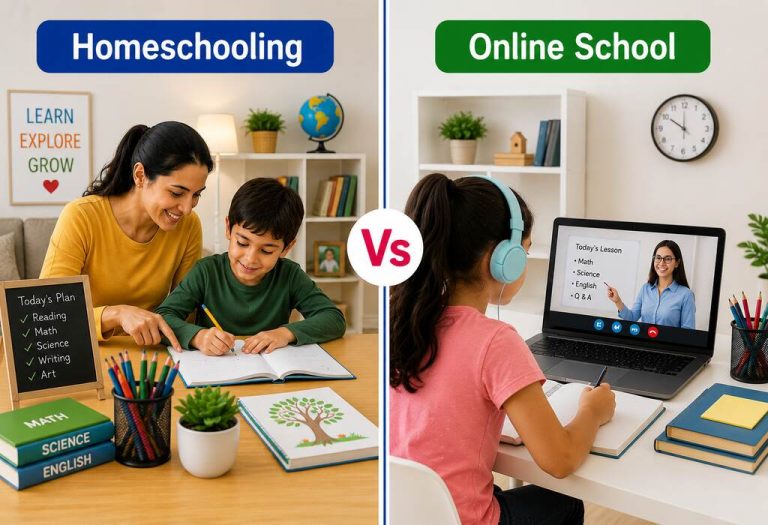
Choosing between homeschool vs online school is one of the biggest decisions a family can make about a child’s education, and it’s rarely an easy one. Both paths take children out of a traditional classroom, but the way lessons are delivered, who does the teaching and how much structure is involved can look completely different. Some parents want to design every lesson themselves, while others prefer a ready-made curriculum with teachers and deadlines already built in. Every family is different, and the best choice is the one that aligns with your child’s learning needs, your family’s lifestyle and the level of involvement you’re prepared to take on.
To help you make that decision, this article breaks down exactly how homeschooling and online school work, where they overlap, and how to figure out which one actually fits your child and your household.
What Is Homeschooling?
Homeschooling means a child’s education takes place primarily at home, with a parent or guardian acting as the main instructor. Families choose their own curriculum, set their own daily schedule, and decide how each subject gets taught, whether through textbooks, hands-on projects, field trips or online resources they select themselves.
For example, a homeschooling parent might spend mornings on maths and reading, then dedicate afternoons to nature walks or a science experiment tied to that week’s topic. This flexibility is the biggest draw for many families, especially those with children who thrive outside a rigid timetable.
What Is Online School?
It’s a formal education programme delivered through a virtual platform, typically run by an accredited school, school district or online education provider. Certified teachers lead live or recorded classes, assign work, grade assignments and track attendance, much like a traditional school, just without the physical building.
A typical day might include scheduled video classes, assigned reading, quizzes submitted through a learning portal, and progress reports sent to parents. Students usually follow the same academic year, grading system and graduation requirements as their local public or private school district.
Key Differences Between Homeschooling and Online School
The difference between homeschool and online school comes down to who controls the teaching, the curriculum and the daily structure. In homeschooling, the parent is the primary decision-maker. In online school, a certified institution sets the curriculum and manages instruction, and the parent plays more of a supporting role. These differences ripple into almost every part of daily life, from how mornings are structured to how progress gets measured at the end of the school year.
|
Factor |
Homeschool |
Online School |
|
Who teaches |
Parent or hired tutor |
Certified teachers |
|
Curriculum control |
Fully customisable |
Set by the school or provider |
|
Daily schedule |
Flexible, family-led |
Fixed class times and deadlines |
|
Accreditation |
Varies by state and programme |
Usually accredited |
|
Cost |
Ranges from free to several thousand dollars a year |
Often free for public online schools; private options cost more |
|
Socialisation |
Requires parents to organise activities |
Often includes virtual clubs and events |
|
Parental time commitment |
High, hands-on teaching |
Moderate, supervisory role |
|
Best suited for |
Families wanting full academic control |
Families wanting structure with less daily teaching |
The Pros and Cons of Homeschooling and Online School
Every learning approach has its strengths and trade-offs, and neither homeschooling nor online school is the right fit for every family. Here’s a closer look at the main pros and cons of each option.
Homeschooling pros:
- Complete flexibility over pace, subjects and teaching methods.
- Strong one-on-one attention for the child.
- Curriculum can be tailored to specific learning needs or interests.
Homeschooling cons:
- Requires significant time and effort from a parent.
- Socialisation must be actively arranged.
- Consistency across subjects depends on the parent’s organisation.
Online school pros:
- Structured curriculum with certified teacher support.
- Often free through public online school programmes.
- Clear grading, attendance and graduation pathway.
Online school cons:
- Less flexibility around daily schedule.
- Screen time can be higher than in other learning models.
- Still requires parental oversight for younger children.
Myth vs Fact
There are plenty of myths about homeschooling and online school, but not all of them are true. Here are some of the most common misconceptions and the facts behind them.
|
Myth |
Fact |
|
Homeschooled children don’t get socialised. |
Many homeschool families join co-ops, sports teams and community groups specifically for social interaction. |
|
Online school is the same as homeschooling. |
Online school follows a set curriculum led by certified teachers, while homeschooling is parent-directed. |
|
Homeschooling isn’t recognised for college admission. |
Colleges regularly accept homeschool transcripts and portfolios alongside standardised test scores. |
|
Online school means no live interaction with teachers. |
Most accredited online schools include live classes, office hours and direct teacher communication. |
Signs Your Child Might Do Better With Each Model
Some children give clear signals about which learning environment will help them succeed. A child who asks endless questions, enjoys setting their own pace, and gets frustrated by rigid timetables often flourishes with homeschooling’s open structure.
A child who enjoys routine, responds well to a set class schedule, and likes having a designated teacher to check in with tends to settle more easily into online school. Watching how your child already learns at home, whether through independent projects or structured practice, can offer useful clues before you commit to either path.
Common Mistakes Parents Make
Even with plenty of research, it’s easy to overlook a few important details. Here are some of the most common mistakes parents make when choosing between homeschooling and online school.
- Choosing based on convenience alone: A method that fits a parent’s schedule but ignores the child’s learning style often leads to frustration for both.
- Underestimating the time commitment: Homeschooling especially requires daily planning, grading and lesson preparation that some families don’t fully anticipate.
- Assuming online school requires no parental involvement: Younger children in particular need supervision to stay on task and meet deadlines.
- Overlooking accreditation: Families planning to transfer back to a traditional school or apply to college should confirm that credits and transcripts will be recognised.
- Ignoring the child’s input: Older children often have strong preferences about how they want to learn, and involving them improves outcomes.
How to Decide Between the Two Options?
Deciding between homeschool or online school starts with an honest look at your family’s routine, your child’s personality and how much teaching responsibility you’re prepared to take on. If your child does well with structure, enjoys interacting with a set class of peers, and you’d rather not design lessons yourself, online school is likely the better fit. If your child benefits from a flexible pace, learns well through hands-on exploration, and you have the time to guide daily lessons, homeschooling may suit your family better.
Many families also start with one option and switch to the other as their child’s needs change, which is worth keeping in mind rather than treating the decision as permanent.
FAQs
1. Is online school easier than homeschooling for parents?
Online school generally requires less day-to-day lesson planning since certified teachers deliver instruction, though parents still need to supervise schedules and assignments, especially for younger children.
2. Can a child switch from online school to homeschooling later?
Yes, many families move between the two models as their child’s needs, age or circumstances change, and transcripts or coursework can often be adapted for the new approach.
3. Does online school cost money?
Public online schools are typically free for residents of that state or district, while private online school programmes usually charge tuition similar to private school fees.
4. Do homeschooled or online-schooled children need textbooks and physical materials?
Both models often use a mix of digital platforms and physical materials, though homeschooling families generally have more freedom to choose their own resources, while online schools typically supply an approved curriculum package.
There’s no universally “better” option between homeschooling and online school, only the option that fits your child’s learning style and your family’s capacity to support it. Homeschooling rewards families who want full control and flexibility, while online school offers structure and certified instruction with less daily teaching responsibility. Taking time to honestly assess your child’s needs, your own schedule, and your long-term education goals will make the decision far clearer than comparing the two models in the abstract.
Was This Article Helpful?
Parenting is a huge responsibility, for you as a caregiver, but also for us as a parenting content platform. We understand that and take our responsibility of creating credible content seriously. FirstCry Parenting articles are written and published only after extensive research using factually sound references to deliver quality content that is accurate, validated by experts, and completely reliable. To understand how we go about creating content that is credible, read our editorial policy here.
- Author






.svg)