

Baby Sticking Tongue Out – Is It Normal?
Is your baby constantly sticking their tongue out? Learn the reasons, milestones, and helpful parenting tips.





As parents, we often overanalyze everything our newborns do. One behavior that raises questions is babies sticking their tongue in and out repeatedly. While it may seem unusual, this habit—often searched as baby sticking tongue out—is actually very common and usually harmless.
Babies use tongue movements to explore their surroundings and build important oral motor skills needed for sucking, swallowing, and eventually speaking. When a baby sticks their tongue out, it’s typically a normal part of development and even a reflex in early months.
However, if the tongue movement seems constant, is paired with feeding difficulties, or your baby appears uncomfortable, consult your pediatrician. In most cases, though, it’s simply your little one learning how their body works and discovering the world around them.
Is Sticking Tongue Out a Normal Part of Child Development?
Sticking the tongue out is a natural gesture for babies and is known as the thrust reflex (1). Tongue protrusion happens when the tongue goes beyond the border of the lips. It is a kind of muscle reaction that takes place in reply to a simulation. This can also be a signal for babies to show they are hungry.
It helps kids to latch properly while feeding. As they grow up, they realize that they can communicate through other means. The sucking reflex disappears within 4–6 months of a baby’s birth (2). Babies don’t have control over their body movements; thus, they can convey their requirements through tongue movement.









Why Do Babies Stick Their Tongue Out?
There are numerous reasons for babies to stick their tongue out. Let us understand the reasons behind their tongue movement:
1. Copying the Elders
Babies tend to imitate their elders. Whether you are trying to give a pose while clicking a selfie or just playfully removing your tongue out of the mouth, the babies will memorize the pose and do the same number of times (3). They do so out of fun and let us know about their understanding.
2. Communicating Their Needs
Babies, while sticking their tongues out, convey their hunger to their mothers (4). They also do so to convey to their mothers to discontinue feeding them further. Infants sticking tongue out during 3 months want us to know that they are hungry.
3. Normal Gesture
It can occur due to normal sucking reflexes in babies. Sucking and gag reflex is an infant reflex that causes the baby to remove their tongue from their mouth. This kind of reflex helps soothe the area near their mouth. Babies move their tongues and lips in expectation of suckling. They tend to show a gag reflex whenever the back of the throat or mouth comes into contact with a solid object near their mouth. Babies don’t clog any object in their mouths due to the gag reflex. The tongue removes the object out of their mouth.
4. Only Liquid Food
While feeding babies with semi-solid food, they stick their tongue out of the mouth. It could be that the baby isn’t ready for solid and semi-solid foods yet. Once they can swallow the food and push their tongue above the palate, they will stop doing the same. Feeding babies with solid food is a new milestone in parents’ and babies’ lives. Therefore, while there is some restraint from babies initially, they gradually become habituated to the food and eat it comfortably.
5. Congestion in the Nose
Babies often breathe through their mouths when their noses are congested, causing their tongues to stick out. They find normal breathing difficult during colds, coughs, allergies, adenoids, or inflamed tonsils.
Babies also stick their tongues out naturally when they tend to choke on something, where thrusting the tongue out is a reflex. The same thing happens with babies as well. If anything is stuck in your baby’s mouth that is not big enough to swallow, they tend to stick their tongue out.
6. Gas Problems
Babies usually suffer from gastrointestinal problems since they have only milk as food. This causes pain in their stomach, which makes them uneasy. Due to this, some babies may stick their tongues out.
7. Macroglossia
When the number of tissues in a baby’s tongue increases, it is called Macroglossia. This condition makes the tongue stick out since the enlarged tongue can’t fit in the mouth (5). An enlarged tongue can occur from birth, or it can develop gradually over time. This abnormality can be caused by many reasons, such as acromegaly (growth hormone increment), Beckwith-Wiedemann syndrome, mucopolysaccharides, and congenital hypothyroidism (inadequate thyroid hormone).
The build-up of elements such as glycogen and amyloid in the body in the tongue is observed in glycogen and amyloidosis storage diseases. The large tongue may occur due to tumors or any injury. It may be inherited genetically. The large tongue makes it difficult for the baby to keep it inside the mouth, and hence it comes out of the mouth.
8. Micrognathia
In Micrognathia, babies have small chins and jaws, resulting in difficulty containing the tongue inside their small mouths (6). This condition disappears with time as the size of the mouth increases and the facial muscles develop. Cleft palate and Down syndrome, like trisomy 13, trisomy 18, Pierre Robin syndrome, etc., are the reasons for micrognathia. Muscles around the lower jaw aren’t well developed, resulting in the sucked-in chin. DiGeorge syndrome is another condition where the small-mouth condition is observed.
9. Hypotonia
It is a low muscle tone disorder that affects the development of each muscle in the body, including the tongue (7). We hold our tongue back in the mouth, which reduces the space occupancy of the tongue in the mouth. Without the tone, the tongue will rest in a completely relaxed state and stick out of the mouth. Rett syndrome, Prader-Willi, and many other Down syndromes show hypotonia.
10. Cyst Growth
Extra mass growth around the tongue forces the tongue to stick out. Thyroglossal duct cysts are formed near the salivary glands. These cysts appear and vanish on their own without any treatment.
11. Orofacial Myofunctional Disorder
Thrusting of the tongue is one of the general types of orofacial myofunctional disorder. If the tongue sticks out due to an OMD, it is an abnormal tongue position while in a relaxing state. Hereditary reasons, congenital problems, and thumb-sucking habits for a long duration can lead to the development of this disorder (8).
12. Baby Sticking Tongue Out After Feeding
You will commonly find a baby sticking tongue out after feeding to convey they are full and don’t want to eat anymore. You should observe your baby’s body language to understand whether they are full or want to feed more.
When Do Babies Stop Sticking Their Tongue Out?
You know that classic move when newborns stick their tongue out like they’re trying to catch a fly? Well, it’s cute and all, but when can we expect them to quit it? As much as we love those little tongues, it can start to feel a bit odd when your baby keeps sticking it out well into toddlerhood.
Fear not, fellow parent! While it can vary from baby to baby, most infants stop sticking their tongue out constantly around 4 to 6 months old. So if you’re still getting repeated tongue sticking out antics from your little one after that, just remember that they’re all unique and will reach milestones at their own pace. Until then, enjoy the silly faces and try not to get too tongue-tied!
When Should You Not Get Worried About Baby’s Sticking Tongue Out?
Let’s face it, as new parents, we worry about everything. From the color of our baby’s poop to the number of burps they produce per feeding, it can be overwhelming. So, when it comes to your newborn’s tongue sticks out, it’s natural to wonder if something is wrong. But don’t fret, my friend! There are many reasons why babies stick their tongue out, or even when a baby keeps sticking tongue out, and most of them are completely normal.
First off, it’s important to remember that newborns are still learning how to control their movements. This means that sticking their tongue out is just another way for them to explore their environment. Additionally, some babies may stick their tongue out to soothe themselves or because they’re hungry. So, unless your baby’s sticking their tongue out is accompanied by other concerning symptoms, like trouble feeding or breathing, there’s likely no need to worry. Just enjoy the show and capture those adorable moments on camera!
When to See a Doctor

Teething can also cause your baby to stick their tongue out at 6 months. Teething causes redness and swelling, thus causing discomfort to babies. While teething is a considerably normal reason, there are instances when you need to consult a doctor. Some of these instances include:
- Newborn sticking tongue out is a completely normal thing until it continues beyond the normal time. It is a natural reflex that makes your newborn comfortable in this new world. But if it continues beyond normal or if you start observing other symptoms along with tongue extrusion, you should visit the pediatrician for further consultation.
- The proper consultation will enable you to resolve the problems early without making them an acute burden for your baby. Early treatment will enable you to avoid developing future issues in your baby’s life.
- If you observe mouth breathing most of the time, it can indicate Down syndrome. It can occur due to hypotonia or poor musculoskeletal control, resulting in an open mouth and tongue sticking out.
- Most of the time, infants continue the habit of sticking their tongues out and don’t stop even after the normal reflex is resolved. Although they don’t suffer from the above problems, sticking tongues out becomes a habit for many kids. This can be resolved with the help of a speech therapist. You can take up speech or physical therapy once your baby is 6 months old and the doctor has observed no serious health conditions.
Baby sticking tongue out at 6 months can be an adorable gesture for everyone to enjoy. As a parent, it is always challenging and pleasing to understand your baby’s behavior. But once you understand, it will be the world’s best experience anyone can get. Try to enjoy your baby’s little movements, expressions, and gestures without worrying much. Babies try to imitate the facial expressions of people they see around them. If you see a baby’s tongue out all the time, it can turn out to be an issue of stress that you can resolve by visiting a pediatrician at an early stage.
FAQs
1. Do Down Syndrome infants stick their tongue out?
Yes, babies with Down syndrome have small mouths and enlarged tongues, resulting in difficulty holding their tongues back in the mouth. However, only sticking the tongue out should not be considered a factor in diagnosing Down syndrome in babies. Other symptoms will also be accompanied by protrusion of the tongue to confirm Down syndrome in babies.
2. Can sticking tongue out indicate teething in babies?
Sometimes, yes. Your 6-month old baby might stick the tongue out because of the discomfort caused by the redness and swelling of teething. They try to lower the pain of teething by sticking their tongue on their gums. You will also find excessive drooling, taking things in the mouth, red and swollen gums, and irritating behavior by babies while they experience the stage of teething.
3. Is sticking tongue out related to Autism?
Autism is a kind of developmental issue that can be identified with a lack of interaction and communication with people. You will also find repetitive and restrictive behavior. Tongue protrusion cannot be considered the only symptom of Autism. You should also look out for other symptoms to confirm the occurrence of Autism in your baby. Visit your doctor to identify the disorder.
4. Is it normal if an infant sticks tongue out while concentrating?
Yes, it can be completely normal. Sometimes an infant sticks tongue out while focusing on a new skill, such as grabbing a toy or learning to sit. This happens because babies are still developing muscle coordination, and their tongue movements may accompany concentration. If your baby keeps sticking tongue out occasionally during play but shows normal growth and feeding patterns, it is usually not a concern.
5. Could reflux cause a baby to stick their tongue out?
Yes, acid reflux can sometimes lead to repeated tongue movements. If your baby keeps sticking tongue out, it may be due to throat irritation or discomfort caused by reflux. Babies experiencing reflux often push their tongue forward in response to the burning sensation. If tongue protrusion is combined with frequent spit-up, arching of the back, coughing, or feeding challenges, consult your pediatrician for proper evaluation and care.
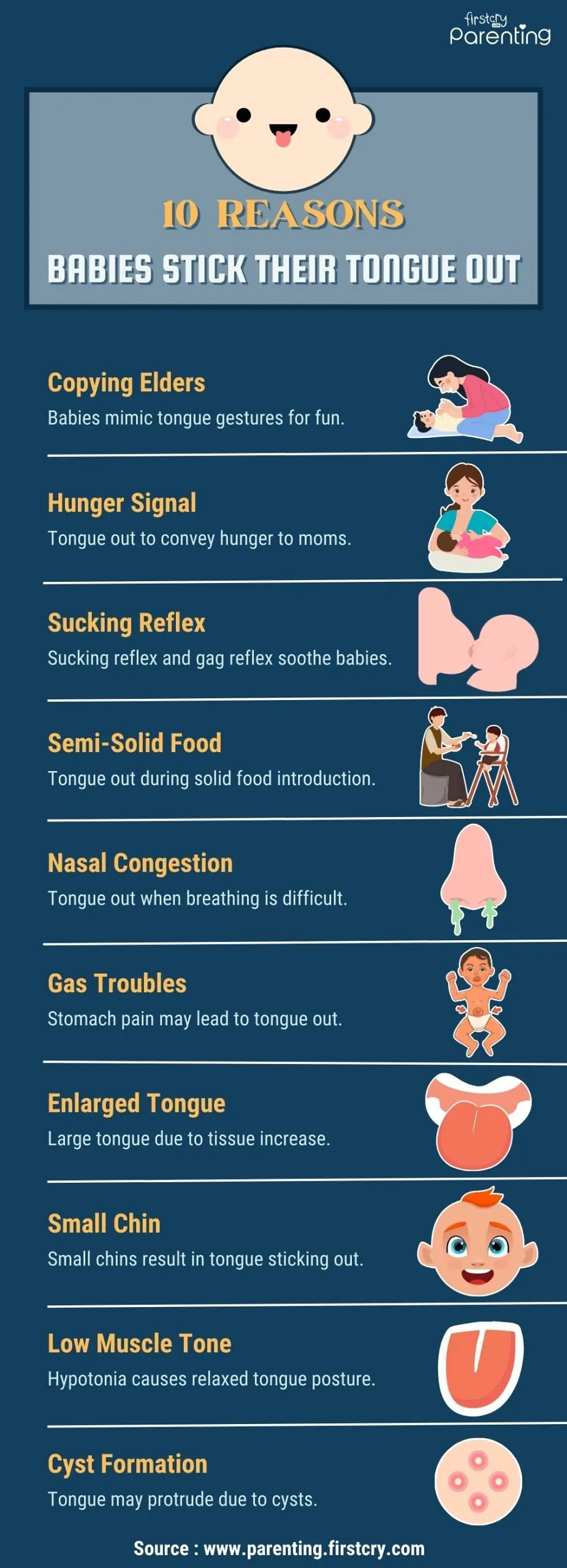
Infographic: 10 Reasons for Baby Sticking Tongue Out
Also Read:
Tongue-Tie in Newborns
Babies Chewing their Tongue
How to Clean a Baby’s Tongue
Was This Article Helpful?
Parenting is a huge responsibility, for you as a caregiver, but also for us as a parenting content platform. We understand that and take our responsibility of creating credible content seriously. FirstCry Parenting articles are written and published only after extensive research using factually sound references to deliver quality content that is accurate, validated by experts, and completely reliable. To understand how we go about creating content that is credible, read our editorial policy here.
1. Cleveland Clinic – Tongue Thrust
2. HealthyChildren.org – Newborn Reflexes
4. CDC – Signs Your Child Is Hungry or Full
5. Cleveland Clinic – Macroglossia
6. Cleveland Clinic – Micrognathia
7. National Library of Medicine – Hypotonia
8. American Speech-Language-Hearing Association – Orofacial Myofunctional Disorders
- Author
 About the Author








.svg)