

Enrichment Activities for Kids: Benefits, Ideas, and Tips
Make learning exciting with enrichment activities for kids that inspire curiosity, build skills, and support overall development.




In this Article
- What Are Enrichment Activities?
- Why Enrichment Matters for Development
- Best Enrichment Activities for Toddlers (Ages 1 to 3)
- Best Enrichment Activities for Preschoolers (Ages 3 to 5)
- Best Enrichment Ideas for School-Age Kids (Ages 6 to 10)
- How to Choose the Right Activities for Your Child
- Common Mistakes Parents Make
- FAQs
View More
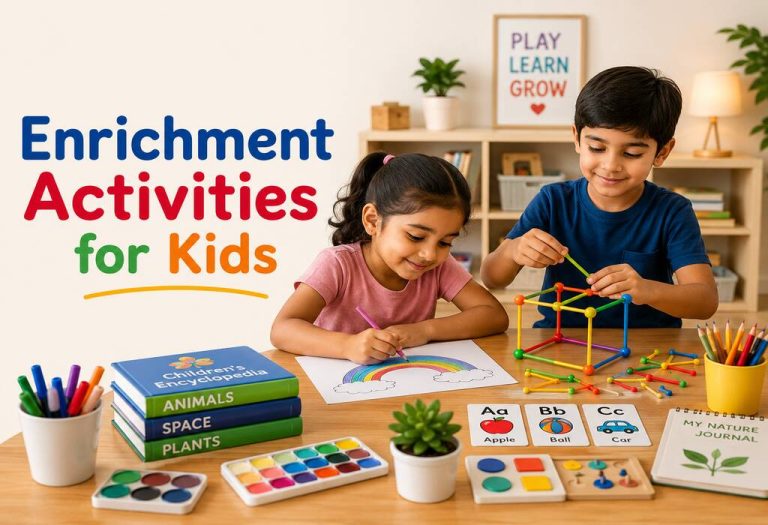
Every child has unique talents waiting to be discovered, and sometimes all it takes is the right activity to bring them to life. If you’ve ever wondered how to keep your child engaged while helping them learn something new, enrichment activities are a great place to start. They go beyond academics, giving kids the chance to explore their interests, build confidence, and develop important life skills, all while having fun. Whether it’s painting, playing a sport, coding, gardening, or solving puzzles, these activities encourage creativity, curiosity, and personal growth.
In this article, we’ll explore the benefits of fun enrichment activities for kids, share fun ideas for different age groups, and offer tips to help you choose the ones that best suit your child.
What Are Enrichment Activities?
Enrichment activities are experiences outside the standard school day that stretch a child’s abilities in academic, creative, physical, or social areas. They are not remedial work and they are not simply extra homework. Instead, they give children room to explore a subject or skill more deeply than a classroom schedule allows.
A child who struggles to sit through a maths worksheet might light up while doubling a cookie recipe. A quiet child who rarely raises their hand at school might become talkative during a puppet show at home. That gap between “school learning” and “real-world practice” is exactly where enrichment does its work. It is less about adding content and more about giving children a low-pressure space to test out new skills.
Why Enrichment Matters for Development
Enrichment supports several areas of growth at once, which is part of why paediatricians and educators recommend it so consistently. Below are some of the biggest benefits these activities provide.
1. Cognitive Growth
Activities like puzzles, building sets, and simple science experiments strengthen problem-solving, memory, and early reasoning skills. Children who regularly encounter open-ended challenges tend to approach new problems with more patience.
2. Social-emotional Skills
Group activities such as team sports or cooperative games teach turn-taking, negotiation, and empathy. Children learn to read social cues and manage frustration when a game does not go their way.
3. Physical Development
Movement-based activities build coordination, balance, and gross motor strength, which in turn supports concentration and classroom behaviour.
4. Confidence and Identity
When learning feels like fun rather than a chore, children stick with a skill long enough to notice their own improvement, and that sense of progress is often what builds lasting self-esteem.
5. Language and Communication
Storytelling, dramatic play, and conversation-based games give children repeated, low-stakes practice expressing ideas out loud.
Best Enrichment Activities for Toddlers (Ages 1 to 3)
The toddler years are all about exploration, curiosity, and learning through play. Here are some fun and age-appropriate enrichment ideas for toddlers aged 1 to 3.
- Sensory Bins: Rice, dried pasta, or water beads in a shallow tub let toddlers scoop, pour, and explore texture safely.
- Stacking and Nesting Toys: Blocks and cups build early hand-eye coordination and an understanding of size and order.
- Simple Music and Movement: Clapping games, shaker instruments, and dancing to familiar songs support rhythm and gross motor skills.
- Picture Book Time: Reading the same board books repeatedly helps toddlers build vocabulary and predict what comes next.
- Outdoor Exploration: Short walks where toddlers touch leaves, splash in puddles, or watch birds build early observation skills.
Best Enrichment Activities for Preschoolers (Ages 3 to 5)
This is the perfect stage to introduce activities that nurture their curiosity while building important developmental skills. Here are some engaging enrichment ideas for children aged 3 to 5.
- Pretend Play Stations: A pretend kitchen, doctor’s kit, or grocery store checkout encourages storytelling, vocabulary growth, and social role-play.
- Beginner Art Projects: Cutting with safety scissors, finger painting, and collage work strengthen fine motor control needed for writing.
- Simple Counting and Sorting Games: Sorting buttons by colour or counting steps while climbing stairs introduces early maths thinking.
- Gardening Basics: Planting seeds in a cup and tracking growth teaches responsibility and basic science concepts.
- Short Obstacle Courses: Pillow forts, hula hoops, and balance beams made from tape build gross motor skills and following directions.
Best Enrichment Ideas for School-Age Kids (Ages 6 to 10)
As children enter their school years, they’re ready to take on new challenges and explore their interests more deeply. Enrichment activities at this stage can help them develop valuable skills, boost their confidence, and encourage a lifelong love of learning. Here are some of the best enrichment ideas for kids aged 6 to 10.
- Coding and Robotics Basics: Beginner platforms and simple robotics kits build logical thinking and patience with trial and error.
- Chess or Strategy Games: These sharpen planning skills and teach kids to think several steps ahead.
- Journaling or Creative Writing: A simple notebook with weekly prompts builds writing fluency and emotional processing.
- Team Sports or Dance Classes: Structured practice builds discipline, teamwork, and physical stamina.
- Cooking and Baking Projects: Measuring ingredients naturally reinforces fractions and sequencing while building independence.
- Nature and Citizen Science Projects: Bird counts, backyard bug journals, or simple weather tracking connect kids to real scientific observation.
How to Choose the Right Activities for Your Child
With so many enrichment activities to choose from, finding the right one for your child can feel overwhelming. Rather than picking from a generic list, work through these questions first.
- What does your child already gravitate toward? Watch what they choose during free play. A child drawn to building things may enjoy blocks or beginner engineering kits more than a scheduled art class.
- How much unstructured time is left after school commitments? If the week is already full, one well-chosen activity beats three rushed ones.
- Does the activity require your presence, or can your child engage independently? Toddlers need hands-on supervision, while school-age kids often thrive with some independent practice time.
- Is there room to fail without pressure? Activities that feel evaluative from day one can discourage kids who are still building confidence.
- Can you sustain it for at least a month? Short trial periods help you judge genuine interest instead of a first-week novelty.
Common Mistakes Parents Make
While parents have the best intentions, certain choices can unintentionally take the fun out of learning or create unnecessary pressure. Here are some common mistakes to avoid when supporting your child’s growth.
- Overscheduling the week. Back-to-back activities leave no time for unstructured play, which is where children process and consolidate what they have learned.
- Choosing activities based on trends rather than fit. A popular class is not automatically the right one for your child’s temperament or interests.
- Expecting instant enthusiasm. Some children need several sessions to warm up to something new before deciding whether they enjoy it.
- Ignoring budget realistically. Committing to an expensive program before confirming genuine interest can lead to costly dropouts.
- Treating enrichment as a resume item. Activities chosen purely to look good on a future application rarely hold a child’s interest for long.
FAQs
1. What age should enrichment activities start?
Enrichment can start in infancy through simple sensory and movement play. Formal classes or structured programs typically work best from around age three onward.
2. How many enrichment activities should a child do at once?
Most child development specialists suggest one to two activities at a time for young children, gradually increasing as they get older and can manage a fuller schedule.
3. Are enrichment activities necessary, or is regular school enough?
School provides an academic foundation, but enrichment fills gaps in social, physical, and creative development that a classroom schedule cannot fully cover on its own.
The best enrichment activity is the one your child genuinely enjoys. When learning feels like play, children are naturally more curious, confident, and excited to explore new things. So, don’t worry about filling every hour of their schedule, instead, focus on creating opportunities that spark their interests and let them grow at their own pace.
Also Read:
After-School Programs & Activities for Kids
Interactive Music Games for Kids
Animal Games and Activities for Kids
Was This Article Helpful?
Parenting is a huge responsibility, for you as a caregiver, but also for us as a parenting content platform. We understand that and take our responsibility of creating credible content seriously. FirstCry Parenting articles are written and published only after extensive research using factually sound references to deliver quality content that is accurate, validated by experts, and completely reliable. To understand how we go about creating content that is credible, read our editorial policy here.
- Author


Related Articles
-
12 Best Gardening Activities for Your Children
-

Teachers Day Poems - Heartfelt Verses to Honor Educators
-

15 Creative and Unique Decorating Ideas for Kids Room
-

9 Ways to Entertain the Kids Indoors
-
20 Amazing St. Patrick's Day Crafts For Toddlers, Preschoolers & Kids
-

10+ Best Krishna Janmashtami Activities and Celebration Ideas For Kids


.svg)