
25 Kindness Activities for Kids to Teach Empathy
Teach empathy with engaging kindness activities for kids that inspire compassion, gratitude, and meaningful connections every day.




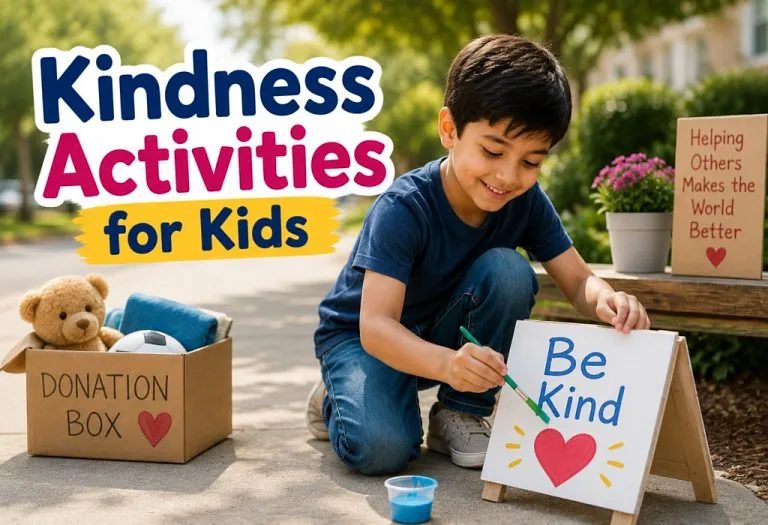
Kindness is one of the greatest gifts we can teach kids, and it starts with small, everyday actions. Whether it’s sharing a toy, helping a friend, or simply listening to someone, these little moments help children build empathy and understand the importance of caring for others. The everyday moments are often the ones that leave the biggest impact.
Through fun, hands-on activities, kids can practice empathy in ways that feel natural and enjoyable while building habits they’ll carry for years to come. In this article, you’ll find 25 kindness activities for kids that encourage compassion, strengthen empathy, and make kindness a meaningful part of everyday life.
How to Choose the Right Activity for Your Child’s Age
Not every activity suits every age. Use the age guide below to find activities that best suit your child’s stage and interests.
| Age Group | Best Activity Type | Attention Span | Adult Involvement |
| 2 to 4 years | Sensory, imitation-based | 2 to 5 minutes | High, hand-over-hand guidance |
| 5 to 7 years | Structured games, simple crafts | 10 to 15 minutes | Moderate, guided instructions |
| 8 to 10 years | Planning-based, small projects | 20 to 30 minutes | Low, occasional check-ins |
25 Kindness Activities for Your Children
Ready to inspire more kindness in your child’s everyday life? These activities are designed to help kids express compassion, build stronger connections, and understand the impact of even the smallest acts of kindness. To make choosing easier, we’ve organised them by age, so you can jump straight to the activities that are most suitable for your child.
For Toddlers and Preschoolers (Ages 2 to 4)
Toddlers and preschoolers learn best through simple, hands-on experiences they can see and practice every day. Here are a few kindness activity for kids that are easy to follow, fun to do, and perfect for little learners.
1. The Gentle Hands Game
Show your toddler how a gentle pat feels versus a rough one, using a stuffed animal. Practise together until “gentle hands” becomes second nature during play.
2. Sharing Basket
Fill a small basket with duplicate toys. Practise handing one to a sibling or friend while saying, “Here you go.” Repetition builds the physical habit of offering before being asked.
3. Helper of the Day
Give your toddler one small task, such as carrying napkins to the table. Frame it as helping the family, not as a chore.
4. Kindness Puppet Show
Use two puppets to act out a scenario, like one puppet dropping a toy and the other helping pick it up. Toddlers absorb social scripts through pretend play far more easily than through direct instruction.
5. Hug and High-Five Choice
Teach your toddler to ask a friend, “Hug or high-five?” before greeting them. This introduces consent and reading another person’s preference in a playful way.
For Preschool and Early Primary (Ages 5 to 7)
As children grow, they become more aware of other people’s feelings and begin forming stronger friendships. This is the perfect age to encourage thoughtful actions that help them practice kindness, teamwork, and empathy in everyday situations. The activities below are engaging, age-appropriate, and easy to weave into their daily routine.
1. Kindness Jar
Fill a jar with folded slips describing small acts, such as “compliment a classmate” or “help set the table.” Each morning, your child draws one slip to complete that day.
2. Compliment Chain
Cut coloured paper strips. Each time your child gives or receives a genuine compliment, add a link to a growing paper chain hung somewhere visible.
3. Buddy Bench Role Play
Set up a pretend “buddy bench” at home and practise approaching someone sitting alone, asking their name, and inviting them to play.
4. Kindness Rocks
Paint smooth stones with encouraging words or pictures and leave them in a park or on a neighbour’s doorstep for strangers to find.
5. Thank-You Note Drawing
Have your child draw a picture for a teacher, grandparent, or postal worker, then dictate a short message for you to write underneath.
6. Story Time Discussion
After reading a picture book, pause and ask, “How do you think that character felt?” and “What would you have done?” This builds the habit of perspective-taking.
7. Feed the Birds Together
Make a simple bird feeder from a pinecone and seeds. Explain that kindness extends to animals too, not only people.
8. The Listening Game
Take turns being the speaker and the listener. The listener must repeat back what they heard before responding, teaching patience and attentive listening.
For School-Age Children (Ages 8 to 10)
Kids between 8 and 10 are ready to take kindness beyond simple gestures and understand why it matters. Here are some engaging ideas they’ll enjoy while learning to care for others.
1. Family Kindness Meeting
Once a week, sit together and each share one kind act you gave and one you received. Keep it brief, under ten minutes, so it stays a habit rather than a chore.
2. Care Package for a Neighbour
Help your child assemble a small package, such as homemade cookies or a handwritten card, for an elderly neighbour or someone going through a hard time.
3. Classroom Kindness Ambassador
Encourage your child to notice one classmate each week who seems left out and to invite them into a game or conversation.
4. Charity Bake Sale Planning
Let your child choose a cause, help price items, and manage a small table at a school or community event. This connects kindness to tangible outcomes.
5. Gratitude and Giving Jar
Set aside spare change in a jar labelled with a specific cause. Once it reaches a goal, let your child choose how to donate it.
6. Peer Mentoring
Pair your child with a younger sibling or neighbour to help with reading or a simple skill. Teaching others reinforces patience and empathy simultaneously.
7. Community Clean-Up Walk
Spend twenty minutes picking up litter in a local park together. Discuss why keeping shared spaces clean is itself a form of consideration for others.
8. Kindness Interview
Have your child interview a grandparent or older relative about a time someone was kind to them. This builds intergenerational empathy and storytelling skills.
9. Random Act of Kindness Challenge
Set a week-long challenge with a checklist of small acts, such as holding a door, sharing lunch, or writing a note to a teacher. Review the list together at the end.
10. Donation Sorting Day
Go through outgrown clothes or toys together and let your child choose items to donate, explaining who might benefit from them.
11. Kindness Roleplay for Conflict
Practise scripted responses for common friction points, such as being excluded from a game, so your child has ready language for handling hurt feelings kindly.
12. Volunteer Shadow Day
If age-appropriate, bring your child along to a low-intensity volunteer shift, such as sorting food bank donations, so they witness the impact of collective kindness firsthand.
Common Mistakes Parents Make When Teaching Kindness
Sometimes, even with the best intentions, certain approaches can make kindness feel like a rule instead of a genuine habit. Let’s look at some common mistakes parents make and how to avoid them.
- Treating kindness as a punishment fix: Asking a child to “say sorry and be nice” after a conflict teaches compliance, not genuine empathy.
- Overpraising every small gesture: Constant applause can shift a child’s motivation from caring about others to seeking approval.
- Skipping the explanation: Children repeat behaviour they understand. Always pair an activity with a short “why” conversation.
- Expecting instant results: Empathy develops over months and years of small repetitions, not a single themed week.
- Forgetting to model it yourself: Children copy what they see far more reliably than what they are told.
Signs Your Child Is Building Real Empathy
Empathy doesn’t develop overnight; it’s something children build through everyday experiences and consistent encouragement. As they grow, you’ll start to notice small but meaningful changes in the way they think, respond, and care for others. Here are some signs your child is developing genuine empathy.
- Unprompted comfort: Your child notices a friend crying and offers a hug or a toy without being asked.
- Perspective language: Phrases like “I think she felt sad” or “he probably didn’t mean it” start appearing in everyday conversation.
- Delayed reaction to conflict: Instead of an immediate outburst, your child pauses, even briefly, before reacting to being upset.
- Generosity without a reward request: Sharing happens without immediately asking “what do I get?”
- Curiosity about other’s experiences: Your child asks questions about how someone different from them, whether in age, ability, or background, experiences the world.
How Teachers Can Reinforce These Habits
Kindness practised only at home tends to stay fragile. Children generalise behaviour far more reliably when it is reinforced across settings. Teachers, grandparents, and childminders can support the same habits with minimal effort:
- Keep a classroom version of the kindness jar with age-appropriate prompts.
- Praise the specific action rather than the child’s character, saying “that was a kind thing to share your crayons” rather than simply “good girl.”
- Use circle time or car rides to ask reflective questions, such as “who did you help today?”
- Coordinate with parents so the same vocabulary and expectations carry across school and home.
FAQs
1. At what age should I start teaching kindness?
Most children begin showing the capacity for empathy around age two or three, though structured acts of kindness activities for kids work best from around age four, once they can follow simple instructions and hold a short conversation about feelings.
2. How long should a kindness activity take?
For toddlers, aim for two to five minutes. For school-age children, fifteen to thirty minutes works well, especially for project-based activities like a bake sale or donation sorting.
3. What if my child resists these activities?
Keep the tone playful rather than instructional. Forcing participation often backfires, while modelling the behaviour yourself and inviting rather than requiring participation tends to draw children in naturally over time.
4. Do these activities work for children with different personalities?
Yes. Shy children often prefer quieter acts, such as writing notes or drawing pictures, while more outgoing children may gravitate toward group activities like a buddy bench or classroom ambassador role.
Teaching kindness is less about finding one perfect activity and more about building small, repeatable habits into everyday life. Start small, stay consistent, and let your child see kindness modelled at home first. Over time, these simple exercises add up to a child who treats empathy not as a lesson to memorise, but as a natural part of how they move through the world.
Also Read:
Group Games and Activities for Kids
Top 25 Sensory Activities for Kids
Fun Learning Activities for Kids
Was This Article Helpful?
Parenting is a huge responsibility, for you as a caregiver, but also for us as a parenting content platform. We understand that and take our responsibility of creating credible content seriously. FirstCry Parenting articles are written and published only after extensive research using factually sound references to deliver quality content that is accurate, validated by experts, and completely reliable. To understand how we go about creating content that is credible, read our editorial policy here.
- Author







.svg)