

25 Interesting Sun Facts for Kids
Learn interesting sun facts for kids, from its layers to amazing heat.




Key Takeaways
- The Sun is a star at the centre of our solar system, made mostly of hydrogen and helium.
- Sunlight takes about 8 minutes and 20 seconds to travel the 150 million kilometers to Earth.
- The Sun’s core reaches around 15 million°C, producing energy through nuclear fusion.
- The Sun provides light and warmth, supports plant growth, and supplies renewable solar energy.
- These fun facts about the Sun for kids explain its layers, solar activity, and fascinating future.
Sun facts for kids reveal just how amazing our closest star really is! The Sun sits at the centre of our solar system, providing the light and heat that make life on Earth possible. Did you know that it is about 150 million kilometers (93 million miles) away from Earth, yet its light takes only about 8 minutes and 20 seconds to reach us?
From its incredible size to its scorching temperatures, the Sun holds many fascinating secrets. Keep reading to learn fun facts about the Sun and discover why this giant star is so important to our planet.
What Is Sun?
The Sun is a giant ball of hot gases, mainly hydrogen and helium, at the centre of our solar system. It is a star that produces its own light and heat through a process called nuclear fusion. The Sun provides the energy Earth needs to support life, helps plants grow, and keeps our planet warm. Although it looks small in the sky, the Sun is about 1.4 million kilometers (865,000 miles) wide (1), so large that more than one million Earths could fit inside it!
Structure of the Sun
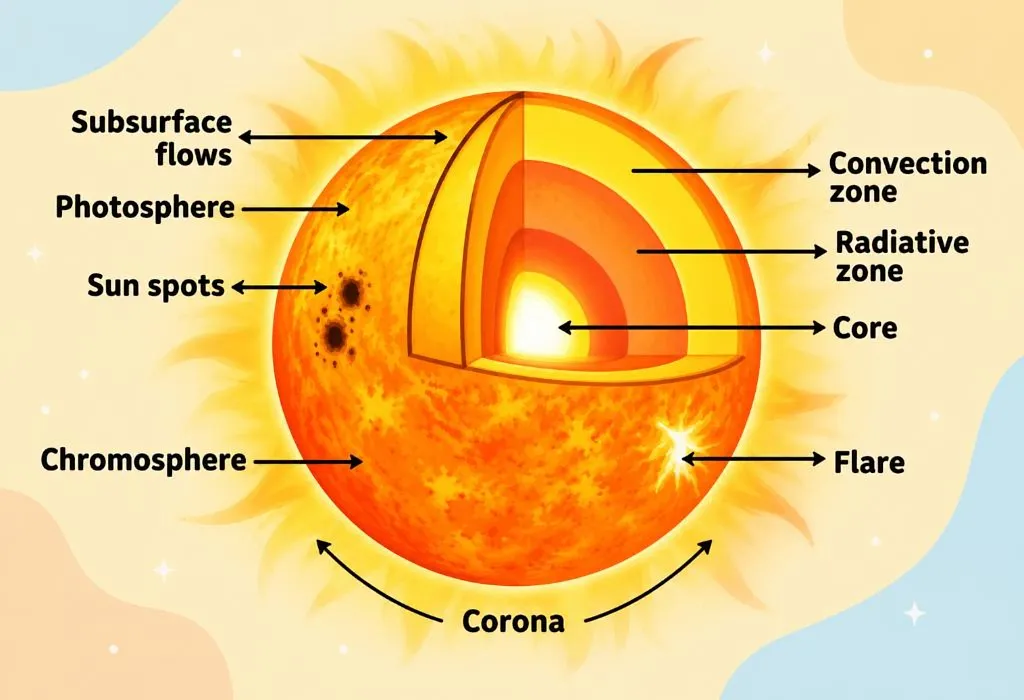
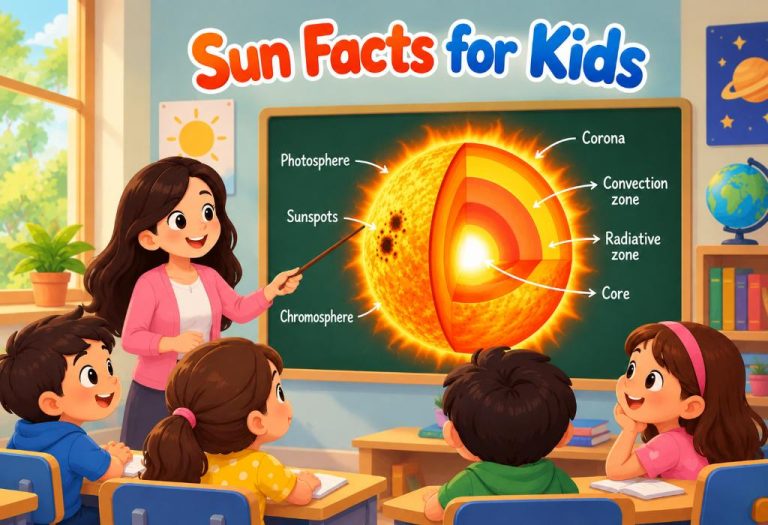
The Sun has several layers, and each one plays an important role in producing or carrying its energy. These layers are divided into two main groups: the outer layers, which we can observe from space, and the inner layers, where the Sun produces and transports its energy (2).
Outer Layers of the Sun
The Sun’s outer layers form its visible surface and its surrounding atmosphere. There are four main layers to learn about:
- Photosphere: This is the Sun’s visible surface, where most of the sunlight we see comes from. Its temperature is about 5,500°C (9,900°F).
- Chromosphere: This thin layer lies above the photosphere and often appears reddish during a total solar eclipse.
- Transition Region: This is a very thin layer where the temperature rises rapidly between the chromosphere and the corona.
- Corona: This is the Sun’s outermost atmospheric layer. It extends millions of kilometers into space and can be seen as a glowing halo during a total solar eclipse.
Inner Layers of the Sun
The Sun’s inner layers are hidden beneath its visible surface. These three layers work together to produce energy and move it toward the outside.
- Core: The core is the Sun’s centre, where nuclear fusion turns hydrogen into helium and releases enormous amounts of energy. Its temperature is around 15 million°C (27 million°F).
- Radiative Zone: Energy travels outward through this layer mainly as radiation. It can take a very long time for energy to pass through this dense region.
- Convective Zone: In this outer part of the Sun’s interior, hot plasma rises toward the surface, cools, and sinks again, creating a continuous movement that carries energy outward.
Fun Facts About the Sun for Kids
From receiving Vitamin D from this gigantic star to solar energy and many benefits that enrich our lives, here are 25 amazing facts about the sun for kids that will leave you feeling simply hooked! Keep reading…
- The Sun is composed of hydrogen and helium gases. It’s over 4.5 billion years old and formed from a cloud of dust, slowly gaining heat and forming a huge centre.
- Sunspots are areas of the sun that are cooler than the rest. They are often darker in tone than warmer areas (3).
- Gases shoot out from the sun’s surface into space. Although these are beautiful to look at, they sometimes cause troubles with satellite signals and interfere with television and cell phone transmissions.
- It takes eight minutes for sunlight to reach the Earth. This is what we call the “speed of light.”
- The Earth revolves around the Sun.
- Aristarchus was the first scientist in the world to theorise that the Earth and the other planets orbited around the Sun over 2000 years ago (4).
- Isaac Newton brought the theory of the planets orbiting around the sun to reality with the introduction of the law of gravity through his books (5).
- Avoid looking at the sun with naked eyes as it may damage vision and cause impairment due to prolonged exposure. Scientists look at the ‘Sun’ using customised filtered telescopes.
- In ancient culture, it was believed that ‘Sun’ is a God. The ancient Egyptians revered the Sun as ‘Ra’ while the Aztecs named the Sun God as ‘Tonatiuh.’
- The Sun is one million times bigger than the Earth.
- When the moon comes between the Earth and sun, that’s when a ‘Solar Eclipse’ occurs.
- Approximately 74% of the sun is composed of hydrogen while helium contributes to 24% of its composition. Heavier elements such as oxygen, carbon, iron, and neon make up for the remaining 2% (6).
- Solar winds composed of electrons and neutrons escape the Sun’s gravitational field due to their high kinetic energies, and the high temperature of the corona of the sun and planets such as Earth with strong magnetic fields deflect these charged particles from reaching the atmosphere.
- Nicholas Copernicus was a polish scientist who wrote a book named ‘Revolutionibus Orbium Coelestium’ which translated to ‘Concerning the revolution of the heavenly spheres.’ In this book, he tried to prove that planets revolved around the Sun. People who believed him were imprisoned and sentenced to death (7).
- The Sun is a huge star and contributes to 99.86% of the Solar System’s mass!
- The Sun’s diameter is 110 times wider than that of the Earth. What’s shocking? The Sun is actually 865,000 miles (1,392,000 km) wide!
- According to scientists, it is hypothesised that the Sun will one day consume the Earth along with Venus and Mercury, once it burns up its Hydrogen composition. In the next 130 million years, as the sun burns up helium, it will be dubbed as the ‘White Dwarf’ and transform into a huge red giant once it absorbs those planets in the solar system.
- The weight of the sun is a mind-boggling 4,385,214,857,119,399,823,317,774,893,056 pounds! It’s such a long number that you’d have a hard time reading it out loud!
- The temperature of the sun is approximately 9,941 degrees Fahrenheit. That’s 5,500 degrees Celsius and 74 times hotter than the highest recorded temperature on Earth (which is 134 degrees Fahrenheit or 56 degrees Celsius!)
- The Earth receives 94 billion megawatts of energy from the Sun which is equal to powering up 4 trillion light bulbs of 100 watts each! The amount of energy emitted by the sun comes to 386 billion megawatts!
- The Sun’s gravity keeps the solar system together. Its powerful gravitational pull keeps Earth and the other planets moving in their orbits around it.
- The Sun is about 4.6 billion years old. It formed from a giant cloud of gas and dust and is roughly halfway through its expected lifetime.
- The Sun’s energy takes a long time to escape its core. Energy can spend thousands to hundreds of thousands of years moving through the Sun’s interior before reaching its surface.
- The Sun rotates at different speeds. Unlike Earth, the Sun does not rotate as one solid object. Its equator takes about 25 days to rotate, while its polar regions take roughly 35 days (1).
- The Sun will change as it gets older. In about five billion years, it is expected to expand into a red giant before eventually shedding its outer layers and leaving behind a white dwarf.
FAQs
1. Why should students learn about the Sun?
Sun facts for students help explain important scientific ideas, including gravity, nuclear fusion, Earth’s seasons, and renewable energy. Learning about the Sun also helps students understand how our solar system works.
2. Can we travel to the Sun?
Humans cannot safely travel to the Sun because of its extreme heat and harsh conditions. However, robotic spacecraft such as NASA’s Parker Solar Probe can travel much closer to it to study its atmosphere.
3. Why does the Sun look bigger at sunrise and sunset?
The Sun can appear larger near the horizon because of a visual illusion. Its apparent size is nearly the same throughout the day, even though it may look enormous when rising or setting.
4. What would happen if there were no Sun?
Without the Sun, Earth would lose its main source of light and heat. Temperatures would fall dramatically, photosynthesis would stop, and most life as we know it could not survive.
5. What are some fun facts about the Sun for kindergarteners?
Fun Sun facts for preschoolers include that it is a star, it looks bright in our sky, and it helps flowers grow. The Sun is also so big that more than a million Earths could fit inside it by volume!
The Sun is a huge star in the Solar System and one of the many wonders of the universe. Thankfully, we’ve shed some light on the subject that hopefully piqued your interest. Tell your kids about this amazing information of Sun they will surely be mesmerised by it. Isn’t it amazing how one big star is so vast in potential and magnitude in contrast to the Earth? Well, we sure think it certainly is amazing, and we hope you think so too!
Also Read:
Earth Facts for Kids
Space Facts for Kids
Facts about Solar System
Milky Way Facts for Children
Was This Article Helpful?
Parenting is a huge responsibility, for you as a caregiver, but also for us as a parenting content platform. We understand that and take our responsibility of creating credible content seriously. FirstCry Parenting articles are written and published only after extensive research using factually sound references to deliver quality content that is accurate, validated by experts, and completely reliable. To understand how we go about creating content that is credible, read our editorial policy here.
1. National Aeronautics and Space Administration – Our Sun: Facts
2. National Aeronautics and Space Administration – Layers of the Sun
3. National Aeronautics and Space Administration – Sunspots
4. Encyclopedia Britannica – Aristarchus of Samos
5. Encyclopedia Britannica – Isaac Newton
- Author

Related Articles
-

40+ Interesting White Tiger Facts for Kids
-

40 Questions to Ask at Parent-Teacher Conference
-

How to Talk Your Kids About Sex (ages 6 to 8)
-

Teachers Day Poems - Heartfelt Verses to Honor Educators
-

20+ Republic Day Poems in English for Kids (26th January, 2026)
-

Self-contained Classroom for Children - Usage and Setbacks