

75+ Interesting Debate Topics for Students and Kids
Fun and thoughtful debate topics for students and kids to encourage discussion and smart thinking.




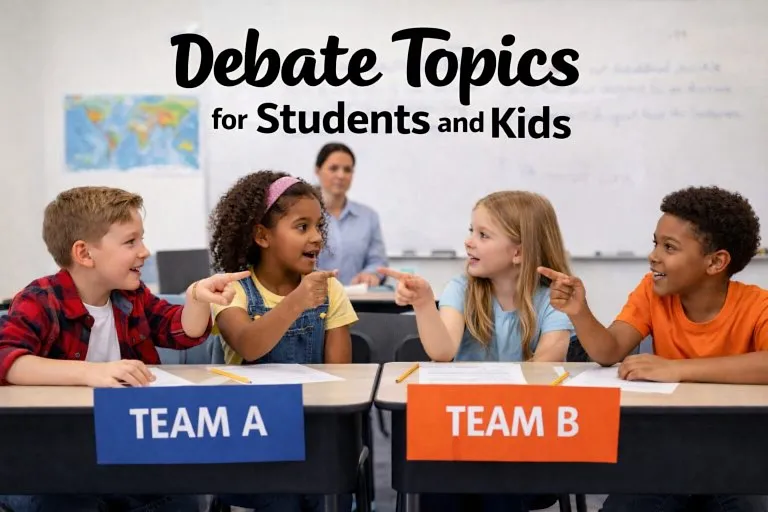
Image Credit : AI Generated Image
In this Article
- What Is a Debate?
- How Do Debates Benefit Children?
- How to Choose Debate Topics for Your Kids?
- Interesting and Creative Debate Topics for Children
- FAQs
View More
Introducing your kids to some fun debate topics is necessary and recommended while they are in school. A debate is nothing but a discussion deliberated around a particular theme, supported by facts and informed opinions. This involves communication between two people who hold different schools of thought. A debate helps merely in understanding which person was able to put forward their points lucidly and convincingly, and who is then declared the winner of the competition. Engaging children in the best debate topics for students not only improves their speaking skills but also enhances critical thinking, logical reasoning, and confidence. Choosing age-appropriate debate topics for kids helps them enjoy the process and learn to articulate their opinions clearly to an audience.
Also Read: Educational Games for Kids
What Is a Debate?
A debate is a formal discussion in which two or more people sit together and share their views, opinions, facts, and ideas on certain topics. It is a balanced conversation where every person gets the chance to share their opinions and philosophies. The children’s debate topics can range from easy and medium to hard and complex ones. Debates can be done on political matters, the environment, fashion, day-to-day life, people’s behaviours, etc. Participating in a debate is a great way to boost mental development and learn new facts and theories.
How Do Debates Benefit Children?
Debates help children in a variety of ways and promote the all-around development of personality. Here are some benefits of debates.
1. Improves Critical Thinking
The child can analyse situations and form their own argument. This also gives the opportunity for self-reflection, where he can find holes or inconsistencies in his own theory and make a balanced argument.
2. Enhances Self-confidence and Public Speaking Skills
There is no other way to overcome stage fright than to actually go up on stage and face your fear. Debating in front of an audience enhances children’s public speaking skills and makes them more confident to speak on a social platform. This, in turn, enriches their personality.
3. Improves Listening Skills
Listening is a skill that very few people possess. Debating allows children to listen to the other person’s point of view and accept contradictory opinions with grace.
4. Helps Organise Thoughts
Debating gives children the opportunity to structure their thoughts and opinions logically, so they can be expressed in the proper flow rather than being haphazardly spread out.
Also Read: Activities to Improve Communication Skills in Kids
How to Choose Debate Topics for Your Kids?
Choosing debate topics for kids should neither be very hard nor very easy. The debate topics for children should be age-appropriate and also coincide with their current level of knowledge, or maybe a bit higher. The topics should be such that they expand your child’s knowledge base and are easy to formulate opinions on.
Interesting and Creative Debate Topics for Children
Choosing what topics might be appropriate for children and helping them form viewpoints from different perspectives can be a tough task for anyone. With that in mind, we have put together some exciting and creative debate topics for elementary kids that will keep them hooked and give them enough food for thought. So, what are we waiting for? Let’s dive into these amazing debate questions for kids:
Debate Topics for Preschoolers
- Should you save your allowance or spend it all away?
- Should children be allowed to play video games?
- Should it be made mandatory for kids to exercise daily for one hour?
- Should it be made mandatory for every home to adopt a pet?
- Is sharing toys important?
- Should kids have a fixed bedtime?
- Is playing outside better than playing indoors?
- Are cartoons better than storybooks?
- Should kids choose their own clothes?
- Is ice cream better than vegetables?
Debate Topics for Elementary Children
- Is it necessary to give children homework?
- Is there a need to have junk food in the school cafeteria?
- Should the school hours shift to be later in the day?
- Is it necessary to enforce uniforms for school children?
- Does it make sense to allow mobile phones in school?
- Is group study better than studying alone?
- Should schools have more sports periods?
- Is online learning better than classroom learning?
- Should grades matter more than skills?
- Should schools start later for students?
Funny Debate Topics for Kids
- Is it better to be invisible or able to fly?
- Would life be better without homework?
- Are dogs better than cats?
- Is pizza better than burgers?
- Should kids be allowed to eat desserts before dinner?
- Would the world be better without Mondays?
- Would you rather live in a cartoon world?
- Are superheroes better than real-life heroes?
- Is chocolate better than ice cream?
- Should kids be in charge of the world for one day?
- Are aliens afraid of humans?
- Is being the class clown better than being the class topper?
- Is it funnier to slip or trip?
- Would life be fun if everyone could talk to animals?
- Should kids rename school subjects?
Science and Technology Debate Topics for Children
- Can we replace teachers with computers?
- Is exploring space really important?
- Is there a possibility of aliens existing out there?
- Can using Facebook turn into an addiction?
- Do people exist even after they die?
- Does god really exist?
- Is artificial intelligence dangerous for humans?
- Is too much screen time harmful for children?
- Can technology replace books completely?
- Should children learn coding at school?
- Are smartphones making people less social?
- Is virtual reality the future of education?
- Can science solve all human problems?
- Should robots be allowed in classrooms?
- Is internet privacy still possible?
Environmental Debate Topics for Kids
- Are zoos beneficial to animals in any way?
- Is saving water more important than saving electricity?
- Should plastic be completely banned?
- Is climate change a bigger threat than wars?
- Should everyone be forced to save water?
- Is recycling enough to save the environment?
- Should cutting trees be completely stopped?
- Are electric vehicles better than fuel vehicles?
- Is it our responsibility to protect endangered animals?
- Should littering be punished strictly?
- Is solar energy the best energy source?
- Should factories be closed to reduce pollution?
- Is paperless living possible?
- Should schools teach environmental responsibility?
- Is pollution the biggest problem in the world today?
Educational Debate Topics for Kids
- What is the need to have the Olympics?
- Does there need to be a change in the voting age?
- If a child makes a mistake, should parents be punished for it?
- Do children need privacy in their lives?
- Can playing games teach important skills?
- Should rich countries share their wealth with poor and developing countries?
- Can we allow kids to go on long trips all by themselves?
- Should schools teach life skills along with academics?
- Is competition good for children?
- Is memorization a bad way of learning?
- Is discipline more important than creativity?
- Should kids get pocket money every week?
- Is celebrating birthdays important?
- Is it better to ask questions or try to figure things out yourself?
- Is reading books more helpful than watching videos?
Also Read: Parents’ Role in Child’s Education
FAQs
1. How to help your child become a better debater?
To help your child become a good debater, you should:
- Start when your child is young.
- Pique their interest in debate-worthy topics by showing them different debate competitions.
- Broaden their knowledge of things and eventually help them form opinions, positive or negative.
- Teach your child to express their emotions and thoughts freely in front of people in a polite manner.
- Build their self-confidence and fix their posture.
2. How long should a debate speech be?
The duration of a debate speech depends on the level of the debate (the level of the students). A middle school debate can stretch for around 5-8 minutes, whereas a high school debate can go on for about 10 minutes or more.
3. What are the rules of a debate for kids?
Some important rules of a debate for kids are:
- The debate should begin with an introduction, the name of the topic, and the side that you’ll be favouring or arguing against.
- To support your claim, give 2-3 relevant and strong points.
- Meanwhile, listen to what the other person has to say. Do not be rude to your opponent or belittle them with their argument.
- State a reason to counter the opposition’s claim.
- If you agree or disagree with any point of your fellow debater, call them out politely and professionally.
- Stick to your points and restate them for your conclusion.
4. How do I teach my child to conclude a debate?
To conclude a debate, restate your points affirmatively with earlier mentioned facts. Also, thank the audience and fellow debaters with confident eye contact.
Debate ideas for kids can range from extremely simple to some which can lead to a great depth of thought never seen before. Kids should be encouraged to take part in debates and allow a healthy standard of communication to exist, leading them to be individuals who will create a better nation in the future. The above-mentioned good debate topics for students have been picked from the lot of primary school debate topics and elementary school debate topics. Hope you find the suitable one for yourself!
Also Read:
Best Learning Apps for Kids
Educational Games for Kids
True or False Questions for Kids
Trivia Questions and Answers for Kids
Was This Article Helpful?
Parenting is a huge responsibility, for you as a caregiver, but also for us as a parenting content platform. We understand that and take our responsibility of creating credible content seriously. FirstCry Parenting articles are written and published only after extensive research using factually sound references to deliver quality content that is accurate, validated by experts, and completely reliable. To understand how we go about creating content that is credible, read our editorial policy here.
- Author
 About the Author







.svg)