
25 Panchatantra Stories for Kids
Read short and meaningful Panchatantra stories for kids that build imagination and teach morals.




Image Credit : AI Generated Image
The Panchatantra moral stories are one of the most popular collections of animal-based fables. Originally written in Sanskrit, each of these fables has an associated moral. These Panchatantra stories for kids are light, colourful and appropriate, even for tiny tots, and provide valuable lessons that stay in their minds forever.
The legend about the origin of Panchatantra dates back to the times of King Amarashakti, who appointed a scholar named Vishnu Sharma to educate his three sons.Vishnu Sharma realised that conventional teaching tools and techniques did not work well with these princes, so he taught them through small Panchatantra stories instead. He, therefore, wrote a collection of stories under the following five volumes, and so it was named as Panchatantra (‘pancha’ – five and ‘tantra’ – systems):
- Mitra labha (gaining friends) – Collection of stories related to winning friends.
- Mitra bheda (losing friends) – Collection of stories related to losing friends.
- Aparïksitakárakam (acting without thinking) – Collection of stories about how imprudence leads to losing what is important.
- Labdhapranásam (Loss of gains) – Collection of stories that mention how to come out of difficult situations without losing things.
- Kákolùkïyam (Crows and owls) – Collection of stories about rules and strategies of war and peace.
The Panchatantra was translated into many languages, including English, various Indian vernacular languages, Persian, and Arabic.
Also Read: 10 Fun and Interesting Tenali Raman Stories for Kids
Panchatantra Stories for Kids in English With Moral
To make story time fun and informative, here are some small Panchatantra stories in English with a moral that will enhance your child’s imagination and teach them something!
1. The Monkey and the Crocodile
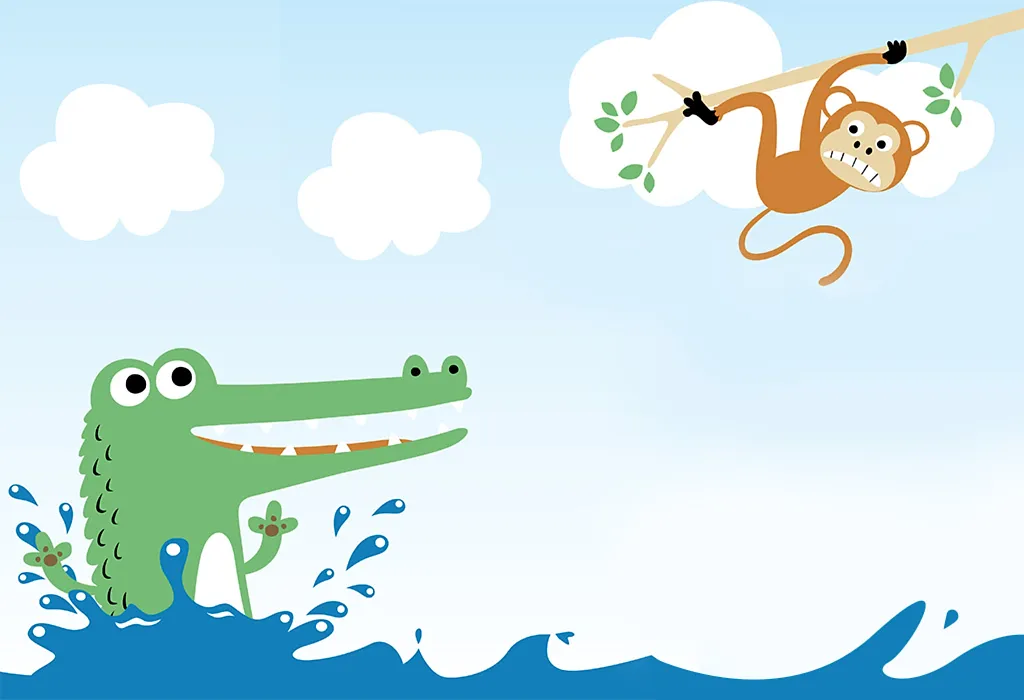
Once upon a time, in a forest, there lived a monkey who resided on a jamoon (berry) tree, which was on the banks of a river. In the same forest, there lived a crocodile and his wife. One day, the crocodile came to the banks of the river and rested under the tree. The kindhearted monkey offered him some fruits. The crocodile came back the next day for more fruit, as he loved them. As days passed by, the crocodile and the monkey became good friends.
One day, the monkey sent some fruits for the crocodile’s wife. She ate the fruits and liked them, but was jealous, as she didn’t like her husband spending time with the monkey. She told her husband, “If the fruits are so juicy, I wonder how sweet the monkey’s heart would be. Get me the heart of the monkey.” The crocodile was not willing to kill his friend, but had no choice.
He invited the monkey to his house for dinner, and he hoped his wife would like to meet him. The monkey was happy, but couldn’t swim, so the crocodile took him on his back. The crocodile was happy that he had tricked the monkey; however, while talking, he blurted out the real reason for taking the monkey home. The clever monkey said, “You should have told me earlier, I left my heart on the tree. We must go back and get it.” The crocodile believed him and took him back to the tree. Thus, the clever monkey saved his life.
Moral of the Story: Choose your company wisely and always have presence of mind.
2. The Stork and the Crab
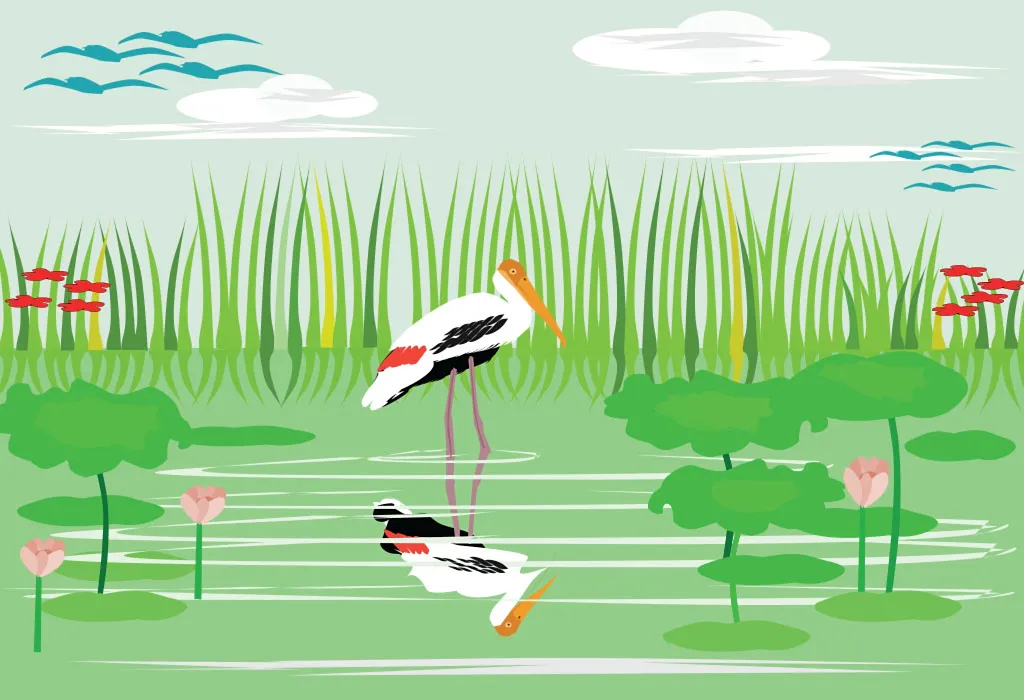
Once upon a time, there lived a stork who used to pick fish from the pond beside him and eat them. However, as he grew older, he found it difficult to catch a single fish. In order to feed himself, he thought of a plan. He told the fish, frogs, and crabs that some men are planning to fill the pond and grow crops, and that’s why there won’t be any fish in the pond. He also told them how sad he felt about this and that he would miss them all. The fish were sad and asked the stork to help them. The stork promised to take all of them to a bigger pond. However, he told them, “As I am old, I can take only a few of you at one go.” The stork would take the fish to a rock, kill them, and eat them up. Every time he was hungry, he would take a few of them to the rock and eat them.
There lived a crab in the pond, who wanted to go to the bigger pond too. The stork thought of eating the crab for a change and agreed to help him. On the way, the crab asked the stork, “Where is the big pond?” The stork laughed and pointed to the rock, which was filled with fish bones. The crab realised that the stork would kill him, and so quickly thought of a plan to save himself. He caught the stork’s neck and did not let it go until the stork died.
Moral of the Story: Always have a presence of mind and act quickly when in danger.
3. The Elephants and the Mice
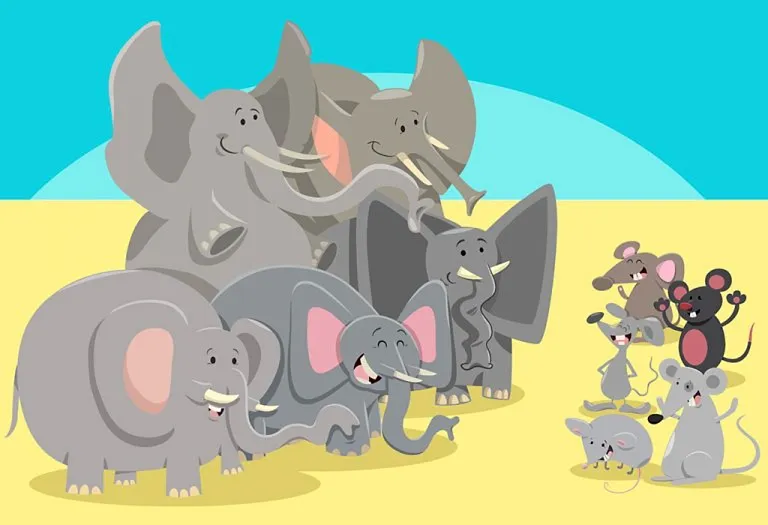
There was a village that was abandoned by its people after it was shattered, following an earthquake. However, the mice living in the village decided to stay and make it their home. On the outskirts of this village, there was a lake, where a herd of elephants visited regularly to bathe and drink water. Since the village was on the way to this lake, the elephants trampled the mice while walking there. So, the king of mice decided to meet the elephants. He told them, ” O elephants, as you travel through the village, many mice are trampled. We will be very grateful if you could please consider changing your route. We will remember and return the favour when you are in need.”
The elephant king laughed, “We are giant elephants. What favour can you mice return? Nevertheless, we honour your request and change our route.”
After a few days, the elephants got trapped and entangled in nets that were set up by hunters. They struggled hard to escape, but in vain. The elephant king remembered the promise made by the king of mice. So, he sent a fellow elephant who got lucky and was not trapped, to ask the mice king to come and help them.
Soon, all the mice came and started nibbling the nets, freeing the elephants. The king of the elephants couldn’t thank the mice enough!
Moral of the Story: A friend in need is a friend indeed. Always be kind to people and grateful for their help.
4. The Loyal Mongoose
A farmer couple had a pet mongoose. One day, the farmer and his wife had to urgently go out of the house for work, and so they left the mongoose with their infant, assured that he would guard their baby well. While they were gone, a snake stealthily entered the house and moved towards the cradle to attack the infant. The smart mongoose fought and killed the snake in order to protect the baby.
When the farmer’s wife returned home, she was shocked to be greeted by blood stains on the mongoose’s mouth and teeth. She lost her temper and shouted, “You killed my baby!” In her anger, she lost all control and killed the loyal mongoose. When she entered her house, she saw the baby alive and the dead snake beside him. She realised what happened and regretted her actions.
Moral of the Story: Think before you act.
5. The Tortoise and the Geese
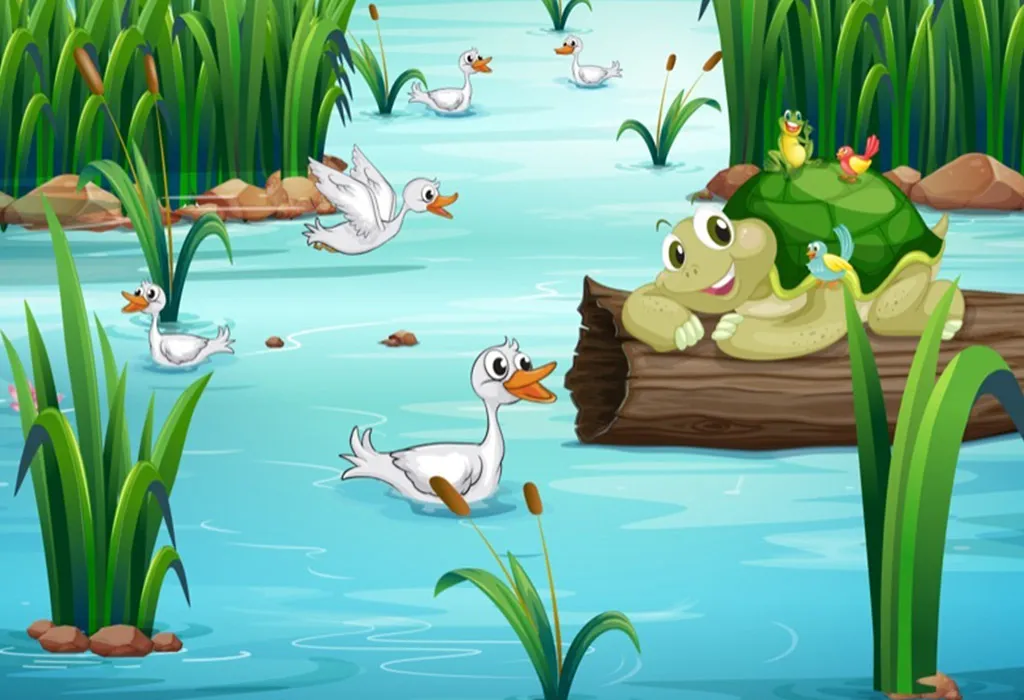
Once upon a time, beside a lake, there lived a tortoise and two geese who were great friends. As the lake was drying, the geese decided to migrate to a new place. The tortoise also wanted to move with them, but he couldn’t fly, and so he pleaded with the geese to take him with them. After trying really hard to convince them, finally, the geese agreed. They held a stick with their beaks and asked the tortoise to hold the stick with his mouth, warning him not to open his mouth and let go of the stick.
As they flew high, some onlookers thought that the tortoise was kidnapped and commented, “Oh, the poor tortoise!” This angered the tortoise, and he immediately opened his mouth to say something back. As soon as he did, he fell to the ground and died.
Moral of the Story: Think before you speak. Listen to instructions and follow them.
6. A Tale of Three Fish
In a lake, there were three fish who were great friends. The first fish was very smart, the second one knew how to find his way out of trouble, and the third was adamant and hated changes. The first fish overheard a fisherman’s conversation about coming back the next day and fishing in the lake. Sensing danger, he cautioned his friends to move out of the lake. The second fish said, “I will stay here and find a way out if I’m caught.” The third fish said, “I do not want to move out. I will remain here, and if I have to get caught, I will.” The first fish moved out. The next day, the fisherman arrived and caught the other two fish. The second one cleverly escaped by pretending to be dead. The third fish did nothing and got caught and died.
Moral of the Story: One should always be open to change and adapt accordingly. Take immediate action when you sense danger.
7. The Foolish Lion and the Clever Rabbit
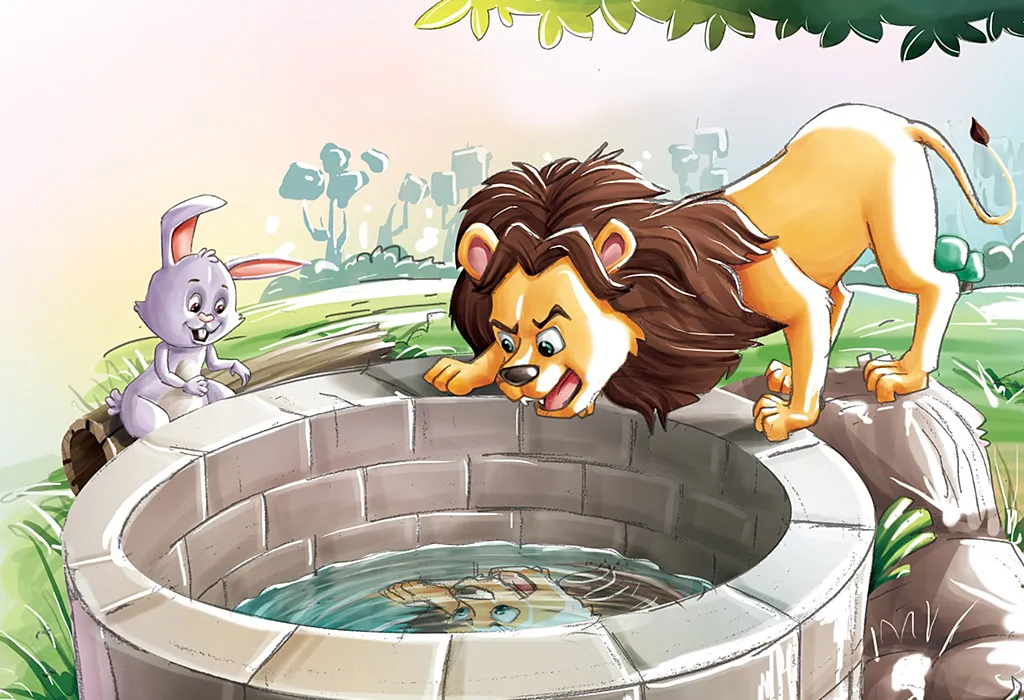
Once upon a time, there lived a greedy lion who attacked and killed animals, because of which every animal in the jungle was very afraid of him. One day, they decided that each animal would go to the lion, once a day, as his prey. The lion agreed. When it was the rabbit’s turn, they decided to send the wise old one. He travelled slowly and reached the lion’s den before sunset. The lion furiously asked him, “Why are you so late?” The rabbit answered, ”A group of rabbits were coming to you, but on their way, the others were attacked by another ferocious lion. I managed to escape and came here.” The rabbit also mentioned that the other lion was challenging this one.
The lion was extremely angry and asked the rabbit to take him to meet the new lion. The wise rabbit took the lion to a deep well and showed him his own reflection. As the lion growled, his reflection did the same. He considered this reflection to be his enemy. The enraged lion jumped into the well to attack the other lion, and ended up dying. Thus, the wise old rabbit saved himself and all the animals in the forest.
Moral of the Story: One must always focus on solutions, rather than problems.
8. The Jackal and the Drum
Once upon a time, a jackal wandered away from his jungle and reached a deserted battlefield. He was very hungry, and so he started looking for food, when he heard a strange sound. The jackal got scared and decided to run away, but then he thought, “Let me carefully see who is making that sound.” As he looked around, he found an abandoned drum lying next to a tree, and as the wind blew, the branches of the tree rubbed against it, making the sound. He was relieved and continued to search for food.
Moral of the Story: Face difficulties, instead of running away from them.
9. The Elephant and the Sparrows
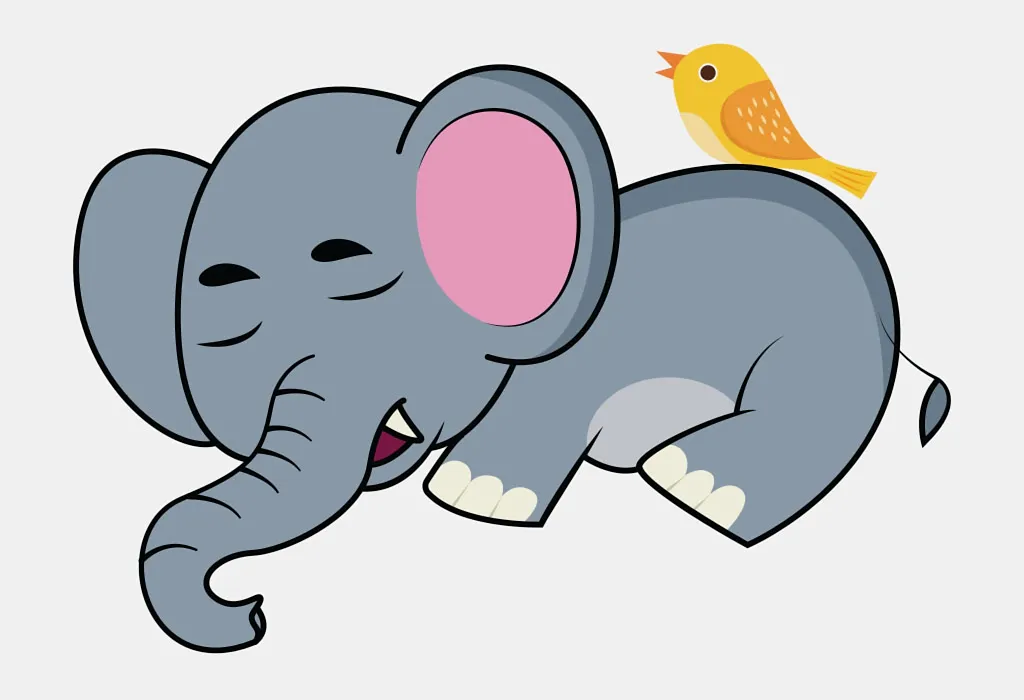
A sparrow couple had a beautiful nest with eggs, on a tall, strong tree, and were expecting their little ones soon. However, an arrogant elephant soon visited the area and shook the tree so hard that he managed to destroy the nest and the eggs. Angered and saddened by this, the sparrows decided to seek revenge.
They asked their woodpecker friend to help them. The woodpecker, along with his friends, the fly and the frog, devised a plan. The frog asked the fly to buzz near the elephant’s ear. He said, “When the elephant closes his eyes, woodpecker, you must pierce his eyes. The elephant will stand up and try to find water. I will croak far away, and the elephant will think there’s water around and reach the place. We will create a big pit, and the elephant will fall into it.”
At sunset, they worked as per the plan, and the elephant fell into the pit and died.
Moral of the Story: It’s not physical strength and haughtiness that win, but intelligence and teamwork that matter.
10. The Wise Minister’s Advice
A gang of owls attacked some crows in a forest one night and killed them all. Because the crows couldn’t see clearly at night, they couldn’t fight back.
The King of the crows was so distressed to hear the news that he went to his wise old minister for guidance. The minister gave him some advice and sent him back.
The next day, the crows went to the owl’s cave and put on a dramatic show! One crow pretended to praise the owls and the other ones struck him down! Seeing this, the Owl King thought that this crow was in favour of the owls. The crow continued to live with the owls till one morning, the crow flew away and, with the help of his crow friends, set fire to the entrance of the owl cave! Since owls are nocturnal creatures, they were fast asleep, and all of them were killed!
Moral of the Story: Keep your friends close, but your enemies closer.
11. The Musical Donkey
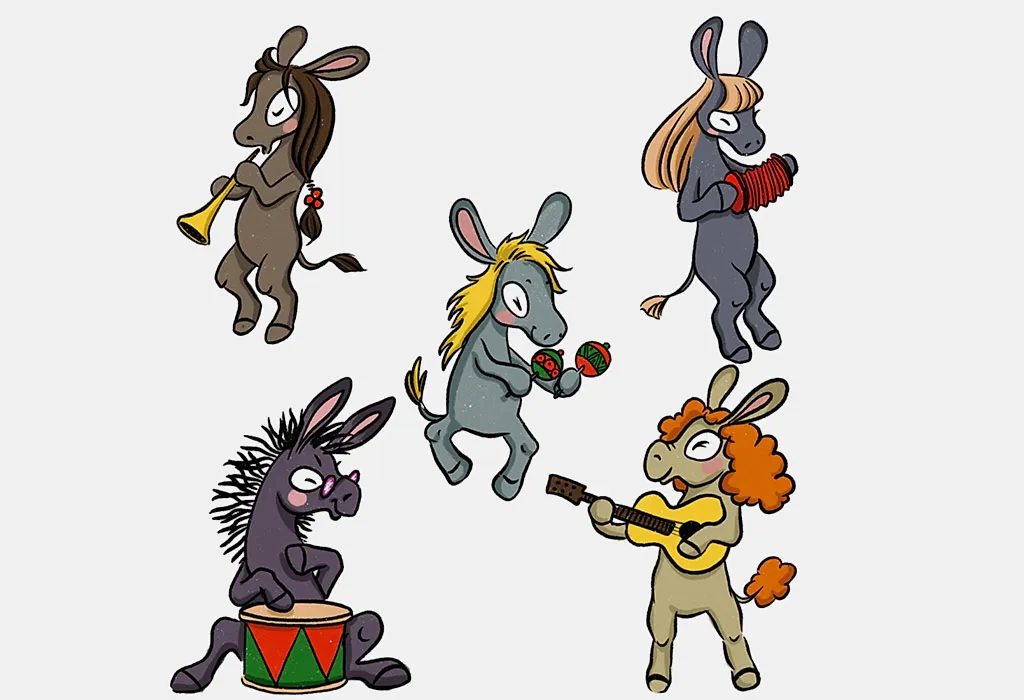
After a hard day’s work, a washerman’s donkey would be free to graze on the green field. Instead of staying on the field, he would sneak into the villagers’ farms and eat the growing vegetables before sneaking home. The donkey met a jackal, and they became good friends. They decided to hunt together, and the fat donkey would break the fence to eat vegetables, while the jackal hunted the farm animals. One night, the donkey told the jackal that he felt like singing. The jackal pleaded with him not to sing, as they would get caught. However, the donkey got annoyed and insisted on singing. He opened his mouth and began to bray loudly, and the jackal immediately ran away. On hearing the donkey bray, the farmers came rushing out and thrashed him for eating their vegetables. The farmer tied a mortar on the donkey, and as he walked home, the jackal joked about the farmer gifting the donkey a necklace for his singing.
Moral of the Story: There is a time and place for everything.
12. The Blue Jackal
Once upon a time, a jackal was chased by a pack of fierce dogs in a village. While running for his life, he jumped into a large tub filled with blue dye used by washermen. The dogs ran away, but when the jackal came out, his fur had turned completely blue.
When he returned to the forest, all the animals were shocked to see a strange blue creature. They believed he was a divine being sent from heaven. The clever jackal took advantage of their fear and declared himself the king of the forest. The animals obeyed him and brought him food every day.
For some time, the jackal lived comfortably. But one night, he heard other jackals howling nearby. Forgetting his disguise, he also began to howl. The animals immediately recognised his voice and realised he was an ordinary jackal. Angry at being fooled, they chased him out of the forest.
Moral of the Story: False appearances do not last forever
13. Four Friends and a Hunter
A rat, a crow, a deer, and a turtle were all pals. They were content to live in a jungle. The friends devised a strategy to save the deer when he accidentally fell into a hunter’s trap one day. After struggling and appearing in pain, the deer lay motionless with its eyes open, appearing dead. Then, as they do to a dead animal, the crow and the other birds sat on the deer and began prodding it.
The turtle immediately moved into the hunter’s path to draw his attention away. After leaving the deer, which he presumed to be dead, the hunter pursued the turtle. The crow immediately picked up the turtle while the rat chewed open the net to release the deer.
Moral of the Story: Teamwork can achieve great results
14. The Hermit and the Mouse
A temple in a small community was taken care of by a hermit. He collected alms and gave some of them to those who assisted him in cleaning the temple. Unfortunately, a mouse kept stealing the hermit’s food and giving him grief in the temple. No matter what he tried, the hermit could not get rid of the mouse. Even when the food was put in an earthen jar suspended from the roof, the mouse kept stealing it.
Disgusted, the wise man sought counsel from a friend, who advised him to locate and eliminate the mouse’s food sources. After thoroughly searching the area, the sage discovered and destroyed the mouse stash. The mouse couldn’t hop to the roof to find food since its food supply had run out. The hermit seized and flung it far from the temple when it grew weak. The injured mouse abandoned the temple and never came back.
Moral of the Story: To overcome an enemy, strike at his power source.
15. The Sparrow and Monkey
A monkey suddenly appears in this story, which is about a pair of sparrows residing in a banyan tree. The monkey was shivering from the cold, as it was raining cats and dogs. One of the birds saw the monkey in distress and encouraged him to construct his own home to protect himself. In retaliation, the monkey misunderstood this advice for conceit and destroyed the sparrow’s nest. We learn that those who need assistance resent it the least, and that advice is rarely valued.
Moral of the Story: You should only offer counsel to people who genuinely deserve it to avoid experiencing regret.
16. The Crows and the Cobra
A cobra and two crows were living on a banyan tree in a forest close to a small kingdom. As the crows left the nest searching for food, the cobra, who was evil, ate the crows’ eggs. The crows were disheartened and hurt; they thought of taking guidance from a knowledgeable jackal. One of the crows followed the jackal’s suggestion and proceeded to the royal palace to steal the queen’s precious jewellery while the guards looked on. The crow flew carefully to its nest, allowing the guards to follow it. The snake dwelt in the banyan tree’s hollow cove, where the crow dropped the necklace after arriving there. When the guards discovered a snake in the hole, they killed it and snatched up the necklace. The crows thanked the jackal and continued to live contentedly.
Moral of the Story: With enough intellect, even the most formidable adversaries can be defeated.
17. The Lion and the Camel
A lion lived in a deep jungle with his three assistants: a jackal, a crow, and a leopard. The assistants never had to look for food because they lived near the forest king. One day, they were shocked to find a camel walking through the woods, a creature that generally dwelt in the desert. They discovered that the camel got lost. It received protection and shelter from the lion.
The powerful lion was once hurt during a conflict with some elephants. The lion and the assistants went hungry since they were unable to hunt. The lion declined to kill the camel despite the three assistants suggesting that they consume it. The assistants hatched a plan to make the camel offer itself as food to its protector. The crow, the leopard and the jackal each offered themselves as food to the lion, which he refused. As soon as the camel saw this, it followed suit and was immediately slain by the lion.
Moral of the Story: It isn’t smart to put your faith in crafty people who surround wealthy or powerful people for personal gain.
18. Right-Mind and Wrong-Mind
In a village lived two companions named Dharmabuddhi (sound, virtuous mind) and Papabuddhi (false, wicked sense). Papabuddhi, who was evil, decided to capitalise on the virtues of Dharmabuddhi. So, he persuaded his pal to join him on a lucrative global tour. After they had enough money, Papabuddhi persuaded his friend to bury it in a jungle for protection. So, one night, he grabbed all the money and returned to the community.
Papabuddhi pretended ignorance when the friends returned to the forest to retrieve the money. He accused Dharmabuddhi of stealing it, and brought up the situation with the village elders, who decided that they should inquire with the forest’s tree spirit about Dharmabuddhi’s culpability.
To prove the innocent man’s guilt, Papabuddhi ordered his father to slink away in the tree bark and speak in the voice of the tree spirit. Sensing something wrong, Dharmabuddhi set dry leaves and twigs on fire inside the hollow cove of the tree, forcing his friend’s father out. Later, Papabuddhi’s father confessed to his son’s wrongdoing, and the village elders chastised him.
Moral of the Story: Refrain from associating with the bad since you could also have to pay for their transgressions.
19. The Talkative Tortoise
Once upon a time, Kambugriva, the tortoise, resided beside a lake. It was very close friends with two other residents of the lake, swans. The lake started to dry up one summer, leaving the animals with little access to water. The swans told the tortoise that there was another lake in another forest, where they should go to survive. They devised a method to transport the tortoise. They forced the tortoise to bite the stick from the middle and instructed it not to open its mouth.
The tortoise was sandwiched between the swans as they flew while holding the pole at each end. The villagers in the vicinity were astounded to see a tortoise flying. Two birds using a stick to catch a tortoise caused a stir on the ground. The tortoise opened its jaws and asked, “What’s that noise all about?” despite the swans’ cautions. And it died as it fell to the ground.
Moral of the Story: Speak only when it is appropriate.
20. Goats and the Jackal
A jackal once witnessed two powerful goats fighting while travelling through a village. There were people all around the goats, cheering them on. The goats were bleeding a little and had bruises on their bodies a few minutes into the fight. Due to its attraction to the smell of blood, this jackal desired to consume some of the goats’ meat. So it immediately and thoughtlessly jumped at the goats.
The jackal was cruelly trampled on and killed by the two goats since they were stronger than the jackal.
Moral of the Story: Consider your options before jumping.
21. The Brahmin and the Goat
A Brahmin was once travelling to a nearby village carrying a goat on his shoulders. Three cunning cheats saw him and decided to steal the goat using trickery instead of force.
The first cheat approached the Brahmin and said, “Why are you carrying a dog on your shoulders?” The Brahmin ignored him and continued walking. After some distance, the second cheat said the same thing. The Brahmin looked at the goat and felt slightly confused, but still walked on.
Finally, the third cheat repeated the same words. Now the Brahmin began to doubt himself. He thought, “Everyone cannot be wrong. Maybe I am mistaken.” Believing he was carrying something unholy, he threw the goat away and ran.
The cheats laughed and took the goat with them.
Moral of the Story: Do not lose confidence by blindly believing others.
22. The Monkey and the Wedge
Once, a curious monkey wandered into a carpenter’s workshop. The carpenters were cutting a big wooden log using a wedge. After placing the wedge inside the log, they went away for lunch.
The monkey, who loved imitating humans, climbed onto the log. He noticed the wedge and wondered what it was for. Without understanding its purpose, he pulled it out playfully. As soon as the wedge came out, the log snapped shut.
Unfortunately, the monkey’s tail was caught between the log, causing him terrible pain. Crying loudly, he struggled to free himself. When the carpenters returned, they rescued the monkey, but he was badly injured.
The monkey learned his lesson and never interfered in human work again.
Moral of the Story: Never interfere in matters you do not understand.
23. The King and the Foolish Monkey
A king once had a monkey as his pet. The monkey was very loyal and followed the king everywhere. One afternoon, the king fell asleep in his garden. A fly kept sitting on the king’s face and disturbing his sleep.
The monkey tried to shoo the fly away many times, but it kept returning. The monkey became angry and decided to end the trouble once and for all. Seeing a sword lying nearby, the monkey picked it up.
When the fly sat on the king’s face again, the monkey struck at it with full force. Sadly, instead of killing the fly, the monkey killed the king.
Thus, the monkey’s foolishness caused great harm despite his good intentions.
Moral of the Story: Good intentions without wisdom can lead to disaster.
24. The Rats Who Ate the Iron Balance
Once upon a time, there lived a merchant who had a close friend. Before leaving on a long journey, the merchant handed over his heavy iron weighing balance to his friend for safekeeping. The friend promised to keep it safe until the merchant returned.
When the merchant came back after many months, he asked for his iron balance. The dishonest friend replied, “I am very sorry. Rats in my house have eaten the iron balance.” The merchant understood that his friend was lying but pretended to believe him.
A few days later, the merchant invited his friend’s young son to his house and kept him there. When the friend became worried and demanded his son back, the merchant calmly said, “Rats in my house have eaten your son.”
The frightened friend realised his mistake and begged for forgiveness. He immediately returned the iron balance. Only then did the merchant return the child safely.
Moral of the Story: Cleverness can defeat dishonesty, and lies are often punished.
25. The Bedbug and the Louse
Once upon a time, a king slept on a soft and comfortable bed. A quiet bedbug lived inside the bed. It bit the king gently at night, so the king was never disturbed and slept peacefully.
One day, a restless louse came and settled on the king’s bed. The louse began biting the king again and again, causing itching and discomfort. The king woke up in anger and called his servants. He ordered them to search the bed and kill whatever was troubling him.
Sensing danger, the clever bedbug quickly hid under the bed and remained still. The louse, however, stayed on the bedsheet and continued jumping around. The servants easily found the louse and killed it instantly.
The bedbug survived because of its patience and presence of mind.
Moral of the Story: Calm thinking and intelligence help one survive in difficult situations.
FAQs
1. How beneficial are Panchatantra stories for kids?
Panchatantra tales may help a child’s brain grow and teach them how to handle real-life challenges. The Panchatantra stories with pictures are full of wisdom, valour, and occasionally amorality. These illuminating stories encourage children to study and grow intellectually by stimulating their thinking.
2. Which is the best story in Panchatantra?
The famous stories listed above are a few of the best stories in Panchatantra. They all have a unique moral and are extremely interesting. However, you may try ‘The Crows and the Cobra’ story, ‘Right-Mind and Wrong-Mind’ story, ‘Tortoise and the Geese’ story for wisdom.
3. Why do most Panchatantra stories have animals as characters?
Animals in Panchatantra stories are used to teach lessons because each animal represents human qualities—like courage, cleverness, or greed. Using animals makes the stories fun and easier for children to understand complex ideas without feeling scared or judged.
You can narrate these Panchatantra stories to explain moral values to children. For example, Panchatantra’s stories on discipline, friendship, strength, intelligence and other virtues can make children understand what these morals stand for and their impact on their daily lives. These bedtime stories can also help in your child’s linguistic and cognitive development. To further develop your child’s qualities, get him a kid’s activity subscription kit that contains fun and interesting activities. By trying out these activities, your child can enhance his/her other skills as well.
Also Read:
Bedtime Stories for Kids
Short Moral Stories for Kids
Motivational Stories For Kids
Thrilling Adventure Stories for Kids
Was This Article Helpful?
Parenting is a huge responsibility, for you as a caregiver, but also for us as a parenting content platform. We understand that and take our responsibility of creating credible content seriously. FirstCry Parenting articles are written and published only after extensive research using factually sound references to deliver quality content that is accurate, validated by experts, and completely reliable. To understand how we go about creating content that is credible, read our editorial policy here.
- Author
 About the Author