
Nursery vs Preschool: Know the Difference
Learn the key differences between nursery and preschool, from age and learning to daily routines, and choose the right start for your child.




Key Takeaways
- Nursery usually welcomes children from around six months to three years, with a focus on comfort, care and gentle social exposure rather than formal lessons.
- Preschool typically serves children aged three to five and introduces structured, school-readiness learning.
- The real difference between nursery and preschool is the balance of care versus curriculum, not just the age on the door.
- Playgroups sit earlier still, offering informal, often parent-supported play with little to no set curriculum.
- Many settings blend both rooms under one roof, so ask about daily structure and staff training rather than trusting the sign outside.
Your toddler has just about stopped crying at drop-off, and already another parent at the school gate is asking whether you have “moved her up to preschool yet.” If that question left you blinking, you are not alone. The nursery vs preschool question trips up even experienced parents, partly because the two settings often share a building, a car park, and sometimes the very same teachers. Yet they are built around genuinely different goals: one exists to help very young children feel safe away from home, the other exists to prepare slightly older children for the structure of formal school. Knowing where one ends and the other begins can save you from paying for a programme that does not suit your child, or enrolling them somewhere they are not quite ready for. Here is how the two actually compare.
What Is Nursery?
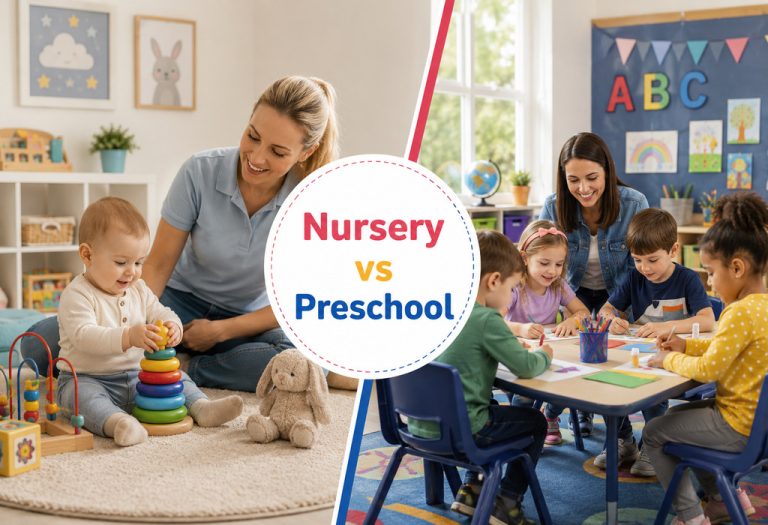
A nursery is generally the first stop in early childhood education, welcoming children from anywhere between 18 months and three years old, though the exact starting age varies by country and provider. At this stage, children are only just learning to separate from a parent or carer for a few hours at a time, so the environment is built around comfort first and learning second.
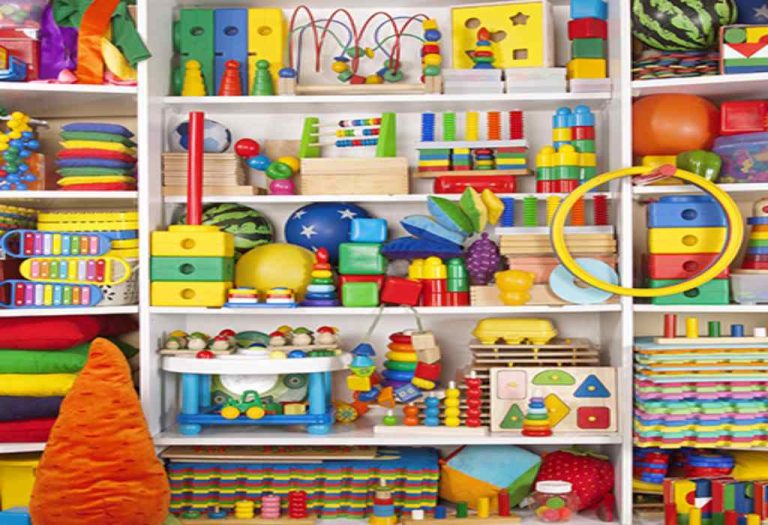
Days at nursery revolve around routine rather than lessons: feeding and nap schedules, nappy changes, sensory play, singing, and lots of unstructured free movement. Staff-to-child ratios tend to be higher than in preschool because younger children need closer supervision. Any “curriculum” at this age is really just intuitive, hands-on exposure, things like stacking blocks, splashing in water trays, or listening to a story, chosen to build trust, language, and basic motor skills rather than to hit academic milestones.
Importantly, nursery is not about pushing early literacy or numeracy. A good nursery practitioner is watching for emotional regulation, how a child copes with sharing, waiting a turn, or being comforted by someone other than a parent, far more than whether the child can recite letters.
What Is Preschool?
Preschool generally picks up where nursery leaves off, usually serving children from around three to five years old, right up until they start kindergarten or primary school. The shift is not only about age. It reflects a genuine change in what children are developmentally ready for: longer attention spans, the ability to follow multi-step instructions, and enough emotional steadiness to sit through a structured activity without a parent nearby.
Because of this, preschool days look noticeably different. Expect a defined timetable with circle time, guided group activities, and short, purposeful lessons woven into play, phonics awareness, counting games, pattern recognition, and early writing practice through drawing and tracing. Staff are usually trained early years educators rather than general carers, and progress is often tracked in some form, even if informally through observation notes shared with parents.
The goal is school readiness. By the time a child leaves preschool, they should be comfortable sitting in a group, following classroom routines, and handling the basics of listening, sharing, and simple problem-solving that primary school will demand from day one.
Difference Between Preschool and Nursery
No two providers run to an identical script, and plenty of settings deliberately blend both approaches under one roof, but this table reflects the general pattern parents can expect almost everywhere.
|
Factor |
Nursery |
Preschool |
|
Typical age range |
18 months to 3 years |
3 to 5 years |
|
Primary focus |
Care, comfort, social exposure |
School readiness, structured learning |
|
Daily structure |
Loose, routine-based |
Timetabled, activity-driven |
|
Staff-to-child ratio |
Higher (closer supervision) |
Lower than nursery, still generous |
|
Staff training |
Carers and early years assistants |
Qualified early years educators |
|
Academic content |
Minimal, incidental |
Deliberate: pre-literacy, pre-numeracy |
|
Typical hours |
Full-day or flexible sessions |
Often term-time, shorter sessions |
|
Parent involvement |
Frequent drop-in updates |
More formal progress reporting |
Where Playgroup Fits In?
Playgroup usually sits a step earlier than nursery on the early years ladder, and understanding the difference between nursery and playgroup matters just as much as understanding preschool. A playgroup is typically aimed at children under three, and it leans heavily on informal, unstructured play, often with a parent or carer staying in the room rather than dropping the child off entirely. There is rarely a fixed curriculum, no assessment, and no expectation that a child will sit through a planned activity. The point is simply exposure: to other children, to a shared space, and to gentle routines like tidy-up time or a group song.
Nursery builds on that same foundation but takes it further. Children are expected to separate from a parent for longer stretches, staff take a more active instructional role, and the setting starts introducing light structure, even if it is still mostly play-based. Think of the three stages as a gradual ramp: playgroup for first social exposure, nursery for building independence and comfort away from home, and preschool for genuine academic preparation.
Factors to Consider When Choosing Between Preschool vs Nursery
There is no universal right answer here, only the right fit for your child’s age, temperament, and your family’s circumstances. A few questions worth working through before you commit:
- Age and readiness first: A child who still needs frequent naps and close comfort will likely struggle in a preschool timetable built for four-year-olds, regardless of what the calendar says.
- Temperament matters as much as age: Some three-year-olds thrive on structure early; others need another six months of unstructured play before they can sit through group activities.
- Look past the label: Visit during an actual session, not just an open day, and watch how staff manage transitions, meltdowns, and group time.
- Check staff qualifications and ratios: These vary enormously between providers even within the same “nursery” or “preschool” category.
- Think about your own schedule: Preschool sessions are often shorter and term-time only, while nursery frequently offers full-day, year-round care that suits working parents better.
- Ask what happens after: If a setting combines nursery and preschool rooms, moving up may be seamless. If not, plan for a transition period.
Common Mistakes Parents Make
A few patterns show up again and again when parents choose between these settings:
- Assuming the name tells the whole story. Two nurseries in the same town can run completely different programmes; always ask for a sample daily timetable.
- Rushing the move to “preschool.” Pressure from other parents or a sense that a child should be “ahead” sometimes pushes families into structured settings before a child is emotionally ready.
- Ignoring ratios and turnover. A low staff-to-child ratio and a stable, long-serving team usually matter more to a young child’s experience than a polished brochure.
- Skipping the trial visit. A short settling-in session reveals far more about fit than any prospectus, especially for children who are anxious about separation.
- Overlooking practical logistics. Session length, holiday closures, and drop-off flexibility can matter just as much as curriculum when juggling work and childcare.
Nursery and preschool both play a genuine role in a child’s early years, but they are answering different questions at different stages. Nursery is largely about helping a very young child feel secure away from home while picking up early social and language skills through play. Preschool takes that foundation and starts deliberately building the habits, attention span, and early academic skills a child will need once formal schooling begins. Playgroup, meanwhile, offers the gentlest introduction of all, usually with a parent still in the room. Rather than choosing based on which label sounds more advanced, it helps to look closely at your own child’s readiness, visit settings in person, and ask direct questions about structure, staffing, and daily routine. The right choice is the one that matches where your child actually is, not where the label suggests they should be.
Also Read:
Nursery Admission Interview Questions for Preschool Child
What Is The Best Age To Start Preschool for Kids?
Nursery Rhymes for Toddler and Preschooler
Was This Article Helpful?
- Author