
Interesting Pigeon Facts for Kids
Learn amazing pigeon facts for kids, from their incredible navigation skills to unique behaviors that make these birds truly fascinating!




Have you ever watched a pigeon strut across a park, bobbing its head with every step? These birds are so common that most of us barely notice them, but there is a fascinating fun fact about pigeons hiding behind every feather. From their super-sensitive eyesight to their surprising sense of direction, pigeon facts for kids reveal a bird that is far cleverer than it looks. This article takes a closer look at how pigeons live, what makes them special, and why they have fascinated scientists and city dwellers alike for thousands of years.
What Is a Pigeon?
A pigeon is a plump, short-necked bird belonging to the Columbidae family, the same family that includes doves (1). Most of the pigeons children spot in parks, railway stations, and rooftops are known as rock pigeons or feral pigeons. These birds are descendants of wild rock doves that once nested on cliffs, which is why they feel right at home on tall city buildings today.
Pigeons are found on every continent except Antarctica. They have lived alongside humans for over 5,000 years, making them one of the oldest domesticated birds in the world. Ancient Egyptians and Mesopotamians kept pigeons long before chickens became common farm animals.
What Do Pigeons Look Like?
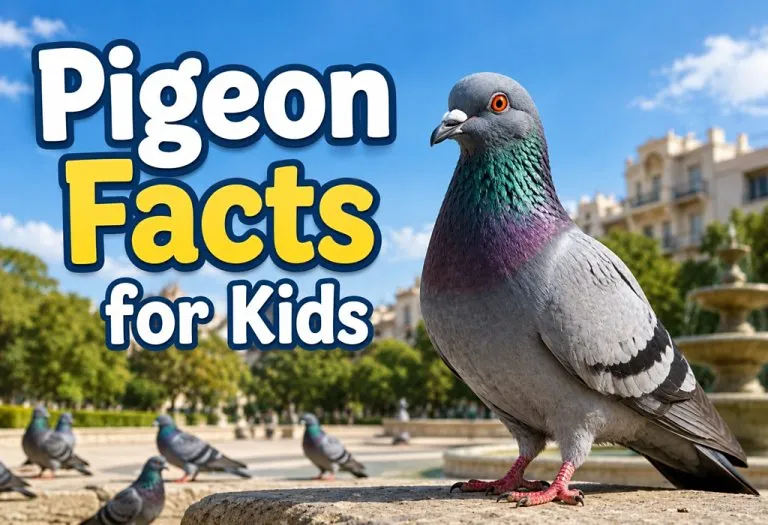
Pigeons have plump bodies, small round heads, and short legs built for walking and pecking at the ground. Look closely at a pigeon’s neck the next time you see one in the sunlight. Many pigeons have feathers that shimmer green and purple, almost like a rainbow painted across their throat.
Their wings are broad and strong, letting them fly at speeds of up to 90 miles per hour when startled (2). Pigeons also have excellent eyesight and can spot tiny crumbs of food from far away. Scientists have discovered that pigeons can see ultraviolet light, a colour range that is completely invisible to human eyes (3).
Where Do Pigeons Live?
Pigeons are incredibly adaptable and can live almost anywhere, from quiet villages to the busiest cities in India. In the wild, their ancestors nested on rocky cliffs and in caves. Today, pigeons treat window ledges, bridges, and building rooftops the same way, building simple nests out of twigs and straw.
A single pair of pigeons often returns to the same nesting spot again and again, sometimes for years. This loyalty to one location is part of why pigeons feel so much like neighbours in busy neighbourhoods.
What Do Pigeons Eat?
Pigeons are mostly seed eaters, though they happily munch on grains, fruit, and even small insects when they get the chance. In cities, pigeons often eat leftover bread, rice, or biscuit crumbs dropped by people, though these snacks are not very healthy for them.
A pigeon’s favourite natural foods include wheat, millet, and corn. Interestingly, pigeons do not need to tilt their heads back to swallow water like most birds. They can suck up water directly, almost like drinking through a straw, which is a rare skill in the bird world.
Pigeons also have a special pouch in their throat called a crop, where food is stored before it moves down to the stomach for digestion. This handy built-in pantry lets a pigeon gather a large meal quickly and then digest it safely later, away from predators or crowded feeding spots.
How Do Pigeons Find Their Way Home?
One of the most amazing pigeon bird facts is their homing ability. Pigeons can be released hundreds of kilometres from their nest and still find their way back within hours. Scientists believe pigeons use a combination of the sun’s position, the earth’s magnetic field, and even familiar smells and landmarks to navigate (4).
This built-in compass is so reliable that people have trained pigeons, known as homing pigeons, to carry small messages tied to their legs for centuries. Even today, homing pigeon racing remains a popular hobby in many parts of the world, including India.
Pigeons in History
Long before telephones and the internet existed, pigeons served as living messengers. Armies during both World Wars used homing pigeons to carry urgent notes across battlefields where telephone lines had been destroyed. One especially brave pigeon named Cher Ami saved an entire group of soldiers by delivering a message despite being badly injured, and she was later awarded a medal for her courage (5).
Kings, traders, and news reporters also relied on pigeons to send information quickly between cities. Some historians believe pigeons even helped spread news of major sporting events before radio broadcasting became common.
Baby Pigeons and Pigeon Families
Baby pigeons are called squabs, and they look very different from the pigeons we usually see outside. Squabs are born nearly featherless and stay tucked safely in the nest for about four to six weeks. This is much longer than many other birds, which is one reason people rarely spot baby pigeons in the wild.
Both pigeon parents take turns feeding their squabs a special substance called crop milk, which is produced in the parent’s throat rather than from a stomach like mammal milk (6). Pigeon pairs often mate for life and may raise several sets of squabs each year.
Unlike many baby birds, squabs grow very quickly on this nutrient-rich diet. Within just a few weeks, they are almost as large as their parents, even though they still have some growing to do before they can fly confidently and search for their own food.
Pigeon vs Dove: What Is the Difference?
Many children wonder whether pigeons and doves are actually the same bird. The truth is, they belong to the same family, but people usually use the words slightly differently (7).
| Feature | Pigeon | Dove |
|---|---|---|
| Size | Usually larger and plumper | Usually smaller and slimmer |
| Common colour | Grey, white, or shimmering | Often white or soft brown |
| Common meaning | Everyday city bird | Symbol of peace |
| Family | Columbidae | Columbidae |
In short, every dove is technically a pigeon, but not every pigeon is called a dove. The names mostly come down to size, colour, and cultural tradition rather than strict biology.
Myth vs Fact
Myth: Pigeons are dirty birds that spread disease easily.
Fact: Pigeons actually preen and clean their feathers often, and the risk of catching an illness from a healthy pigeon is very low with normal hygiene, such as washing hands after touching birds or their droppings.
Myth: Pigeons are not intelligent.
Fact: Pigeons can recognise human faces, remember locations for years, and even pass simple mirror-recognition tests that many animals fail.
Fun Facts About Pigeons
Here are some amazing facts that make pigeons even more remarkable:
- Pigeons can recognise themselves in a mirror, a skill shared with very few animals.
- A resting pigeon’s heart beats around 200 times per minute (8), but during flight it can exceed 600 beats per minute (9).
- Pigeons can be trained to recognise letters of the alphabet and simple shapes.
- There are more than 350 recognised breeds of domestic pigeons worldwide (10).
- Pigeons almost never get lost thanks to their built-in sense of direction.
- A group of pigeons is sometimes called a flock, but a group specifically of doves or pigeons together is also known as a “kit.”
FAQs
1. Are pigeons smart birds?
Yes, pigeons are considered one of the more intelligent bird species. They can remember faces, recognise patterns, and navigate long distances without getting lost.
2. What do baby pigeons look like?
Baby pigeons, called squabs, hatch with very little feather covering and stay in the nest for several weeks before they look like adult pigeons.
3. Why do pigeons bob their heads when they walk?
Pigeons bob their heads to help them see clearly while moving. This head movement keeps their surroundings steady and in focus, since their eyes cannot move much inside their skull.
Pigeons may seem like ordinary birds fluttering around parks and pavements, but they carry a surprising amount of history, intelligence, and charm within their feathers. From guiding soldiers with life-saving messages to finding their way home across unfamiliar cities, pigeons prove that even the most familiar creatures can hold remarkable secrets. The next time your child spots a pigeon pecking at crumbs nearby, they will have plenty of interesting stories to share.
Was This Article Helpful?
Parenting is a huge responsibility, for you as a caregiver, but also for us as a parenting content platform. We understand that and take our responsibility of creating credible content seriously. FirstCry Parenting articles are written and published only after extensive research using factually sound references to deliver quality content that is accurate, validated by experts, and completely reliable. To understand how we go about creating content that is credible, read our editorial policy here.
1. Encyclopedia Britannica – pigeon
2. Northumberland National Park – Pigeon Perfect
3. National Wildlife Federation – True Colors: How Birds See the World
4. Smithsonian Science Education Center – How Do Birds Navigate?
6. National Audubon Society – Pigeon Milk Is a Nutritious Treat for Chicks
7. National Parks Board – Dove vs Pigeon: What’s the Difference?
- Author


Related Articles
-

Teaching Your Toddler to Draw a Straight Line
-
50+ Interesting Plant Facts for Kids
-
Happy Friendship Day Quotes,Wishes, Messages for Kids
-
Essay On Veer Bal Diwas - 10 Lines, Short and Long Essay for Children and Students
-
Interesting Facts About Stars for Kids
-
14 Fascinating Lord Ganesha Stories for Kids with Morals








.svg)