

Boils on Baby: Causes, Symptoms, Treatment & Prevention
Learn what causes baby boil and abscess, how to treat them safely, and when parents should take action to protect their baby.





Medically Reviewed By
Dr. Sameer Awadhiya
(Paediatrician)

This health content has been medically reviewed by qualified experts and follows the FirstCry Parenting editorial policy to ensure accuracy and reliability.
Babies, very new to the world, have sensitive skin because they are still adapting to external stimuli and their immune systems are still developing. This implies that they are more vulnerable to infections. To top this, if the weather conditions are unfavourable, babies may develop outbreaks or rashes on their skin in the form of boils. Boils on infants can be very discomforting. Abscesses & boils in children are common during summer and rainy months, so it is very important to maintain good hygiene.
In such a scenario, it is crucial to maintain proper hygiene and keep the baby’s skin cool to prevent the situation from worsening. You may also like to consider changing the baby products you are using on your baby, like bathing soap, oil or lotion, and talcum powder. The boils may become painful or serious if not treated on time.
What Are Boils?
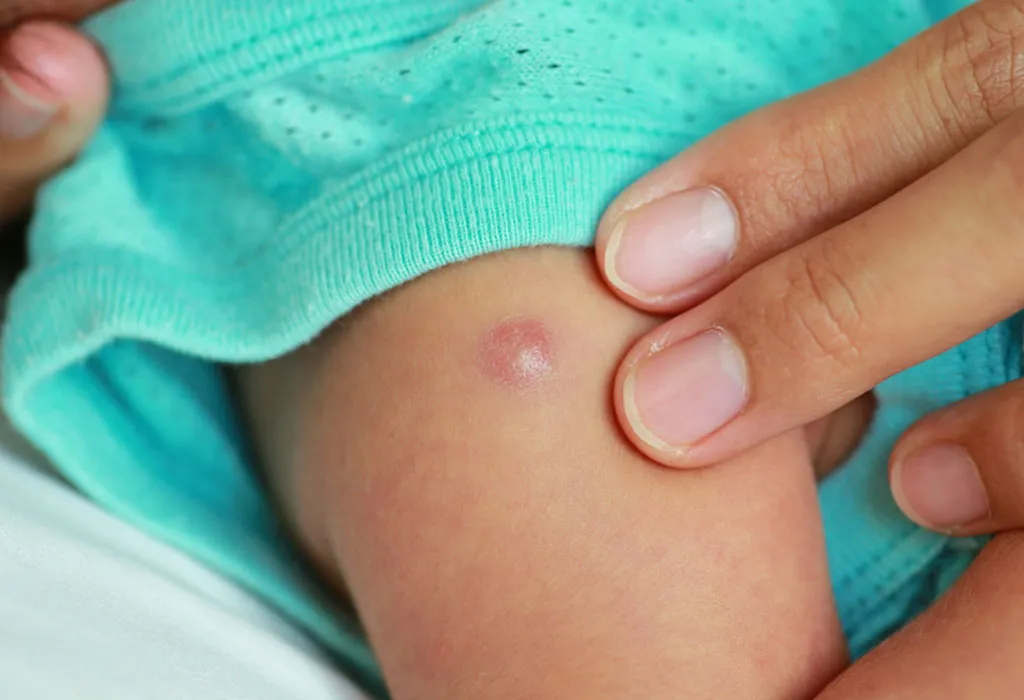
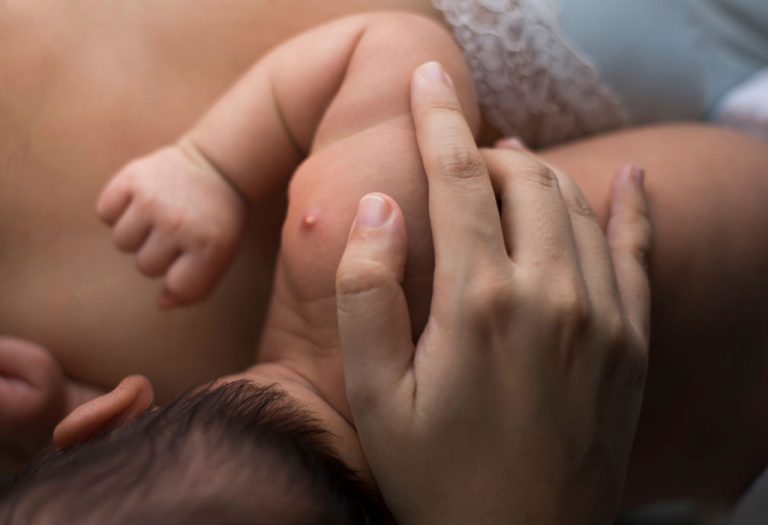
A boil is a tender, painful lump that appears on the skin due to a bacterial infection in an oil gland or hair follicle. The infection commonly occurs because of a bacterium called Staphylococcus aureus (1). This bacterium lives on our skin, and in our nose and mouth. Skin normally acts as a barrier to these bacteria, preventing them from entering the body and causing infections. The small pockets of pus caused by the bacterial infection are called abscesses (2).
When we get a scrape, cut, bite, or break in the skin, bacteria make their way in. This bacterium enters the body through small cracks in the skin or from hair follicles. This infection develops into a boil (1). When the baby’s skin is affected by this bacterium, the body responds by sending white blood cells to fight it. The build-up of white blood cells, dead bacteria, and skin forms a mixture known as pus.

At first, the affected skin turns red, and a lump forms. Over time, the lump may turn white as pus accumulates under the skin. The formation of pus makes a painful abscess (3).
Boils can appear anywhere on the body but often erupt in damp areas, such as the face, armpits, groin, back of the neck, shoulders, thighs, and buttocks. In some cases, babies may have a fever. Heat boils in babies can be treated with home remedies, but if in doubt, it is better to seek medical help.
Are Boils in Babies Contagious?
Boils that contain pus can be contagious. Pus boils occur when a hair follicle becomes infected with staph bacteria. Pus boils begin as tiny sore lumps, but they grow bigger with time and fill with pus. Not only can they spread to other areas of the baby’s body, but they can also infect any person who comes in contact with the baby. This infection is also transmissible through the sharing of towels, bedsheets, and toothbrushes (4).
Multiple pus boils are called a carbuncle. In fact, a carbuncle is deeper and bigger than a boil. Pus boils on babies can appear on any part of their body, as hair follicles are present all over the skin. However, they are more likely to appear on parts that are susceptible to sweat and friction, like the face, neck, groin, armpits, thighs, waist, and buttocks (5). This is why many moms have observed that pus boils usually occur in babies during the summer and rainy seasons.
Where Do Boils Appear on the Baby’s Body?
Boils or abscesses on babies can appear anywhere on the body, but often occur in damp areas of the body, such as the face, armpits, groin, back of the neck, shoulders, thighs, and buttocks. Parents often worry about boils on infants’ faces, but they usually subside within weeks with proper care.
How Long Do Infant Boils Last?
When a boil occurs, a tender lump forms on the baby’s skin, and it grows bigger and redder with time. It starts filling up with pus in about 1 week’s time since its appearance. If left to the body’s natural defence mechanisms, it may begin to subside within a couple of weeks. In case the boil does not disappear or show any signs of subsiding even after two weeks, it is wise to seek medical assistance.
Causes of Boils in Babies
Certain medical conditions can also expose a baby to a greater risk of developing boils. Some of them are given below:
- Lack of good personal hygiene
- Low immunity
- Lack of necessary nutrients in the body
- Anaemia or iron deficiency
- Chemical exposure from the use of harsh soaps, creams or detergents, resulting in skin irritation
- Unfavourable weather conditions like extreme heat or humidity
Signs and Symptoms of Boils in Infants
Some of the signs and symptoms of boils in infants are (6):
- The affected skin around the boil tends to become swollen and red.
- A baby can develop a fever.
- Multiple boils may form near the site of the first boil.
- The lymph glands around the boil may swell up and feel sore.
- The lump has a white or yellow centre filled with pus, which can sometimes burst (7).
Diagnosis
A timely diagnosis of any health concern can significantly prevent discomfort for the baby. Here’s how doctors may diagnose boils in babies:
- Health History: The doctor will check the current symptoms of the baby and ask for health history.
- Physical Examination: The doctor may conduct a thorough physical examination of the baby’s body to establish if the infection has spread to other areas of the body.
- Culture: The doctor may also test a portion of the boil to rule out any other underlying medical reasons for the appearance of boils. After analysing all the factors, the doctor will present their diagnosis.
- Blood Tests: If there are recurring boils on infants, the doctor may prescribe blood tests, although rare (8).
Complications
Timely care of boils on babies can help prevent various complications, such as:
- Scarring: Infant boils normally do not lead to any complications and do not require medical intervention. However, if a boil is squeezed or pierced, it may lead to scarring.
- Surgery: If the boil grows very large, it may form a cellulitic abscess and may need to be treated with antibiotics. If the boil becomes a carbuncle and shows no signs of resolving, surgery may be recommended.
- Spread of Infection to Other Areas of the Body: You may want to take extra care when dealing with pus boils, as they are contagious.
- Cavernous Sinus Thrombosis: It is an uncommon consequence of boils (9). It typically arises when an infection triggers the formation of a blood clot in the cavities located behind the eye socket, leading to elevated pressure in the brain. Symptoms consist of intense and severe headaches, eye swelling, and excruciating eye pain. If not addressed promptly with antibiotics, this condition can be fatal.
Recurrent Boils on Babies
Occasionally, babies can develop recurring boils. This may not be a cause for concern unless you notice a pattern in relation to other infections in your baby. Recurrent boils may be contagious as the bacteria living on the skin are transferred from one body to another easily. Therefore, it is essential to find out if someone in your family has boils and if they have accidentally passed the bacteria on to your baby.
Treatment
Boils often get better on their own. However, if your baby is highly sensitive or if the boil is worsening with day, following treatments can be given (10):
1. Incision and Drainage
It is important to regularly clean the affected area properly with a suitable antiseptic to prevent the infection from spreading. In case the boil bursts, wipe the area clean with some cotton and an antiseptic wash. On drying, cover it with gauze or a dressing to prevent the baby from touching it. Resist the temptation to squeeze or pierce the boil, as this may result in scarring and spreading of infection to the surrounding areas.
2. Antibiotics
If the boils seem to be growing bigger or spreading, the doctor may prescribe antibiotics. Bear in mind to complete the whole course even if the boils fade away, lest there is a relapse. The doctor may also prescribe topical antibiotics for folliculitis and boils.
3. Surgery
In some cases, the doctor may suggest surgically opening the boil if it has escalated into an abscess and draining the pus (11). This procedure may be performed under anaesthesia.
4. Disinfection
Boils on the baby’s head can be treated by rubbing alcohol on the area (not to be done if the boil is eroded). This will disinfect the area and can heal the boils that may have developed because of a simple infection. In case of multiple boils on the head, the probable cause is heat or humid weather. In such a scenario, applying coconut oil can prove very useful as it has cooling properties.
Home Remedies to Cure a Boil
In most cases, boils heal on their own in a few days’ time. Nevertheless, you can also try the following home remedies to quicken the healing process:
1. Warm compress
For instant relief from pain, a warm compress can be placed on the affected area for a few minutes. This action can be repeated a few times during the day. This may also help the pus to ooze out of the boil, after which the healing can begin.
2. Honey Therapy
Applying honey to the boil can be a good idea, as honey is a natural antiseptic.
5. Turmeric
Putting turmeric powder on the boils can also prove useful in treating them due to its antiseptic properties.
Since there is little you can do when it comes to treating boils in babies, you must practise precautions to prevent the boils. Read on to know more.
Boils in Infants – Precautions to Take
Here are some useful practices you can follow to avoid boils in your baby or handle them so as to prevent them from spreading.
- Maintain proper hygiene. Ensure you bathe your baby and keep his surroundings clean (12).
- Make sure your baby is having healthy and balanced meals.
- Wash your hands before handling your baby.
- Regularly change the baby’s towels and bedsheets, and wash the baby’s clothes with hot water.
- To prevent boils from spreading further, keep dressing them and changing the dressing from time to time. Bear in mind to dispose of the bandages carefully (13).
- In case the pus-filled boil bursts, clean it properly and ensure that the pus doesn’t come in contact with other areas of the baby’s body.
- Keep an eye out for any signs of new boils appearing on the baby’s body.
If there is no improvement, you must consult a doctor immediately. Below are some more signs that will help you make a decision and seek medical attention for your baby.
When Should You Consult a Doctor?
You may like to consult the doctor if:
- The baby develops a fever.
- The boil starts growing in size and becomes painful.
- The boil is on your baby’s face.
- The boil shows no signs of fading away even after two weeks.
- The boil is recurring and spreading to other areas of the body.
- The baby’s lymph nodes swell up.
- The boils get filled with pus.
FAQ
1. Can teething cause boils in infants?
No, teething does not cause boil in infants.
The appearance of boils on babies is usually not a worrisome situation. The body’s natural defence system usually takes care of it. But in case you feel that the boils are not subsiding and are spreading to other parts of the body, it may indicate an underlying medical condition that may need medical attention.
Also Read:
Warts in Babies
Baby Skin Allergy
Eczema in Infants
Easy Tips for Keeping Your Baby’s Skin Healthy
Was This Article Helpful?
Parenting is a huge responsibility, for you as a caregiver, but also for us as a parenting content platform. We understand that and take our responsibility of creating credible content seriously. FirstCry Parenting articles are written and published only after extensive research using factually sound references to deliver quality content that is accurate, validated by experts, and completely reliable. To understand how we go about creating content that is credible, read our editorial policy here.
1. Children’s National – Pediatric Folliculitis, Furuncles (Boils) and Carbuncles
2. SickKids – Boils (abscesses)
3. Nemours KidsHealth – Skin Abscesses
4. American Academy of Pediatrics – Boils, Abscess & Cellulitis
5. Nationwide Children’s – Folliculitis, Furuncles, and Carbuncles in Children
6. CHOP – Children and Folliculitis, Boils, and Carbuncles
7. KidsHealth Hauora Taitamariki – Boils In Children
8. National Library of Medicine – Overview: Boils and carbuncles
9. Cleveland Clinic – Boils & Carbuncles
10. National Library of Medicine – Boils and carbuncles: Learn More – How are boils treated?
11. St. Louis Children’s Hospital – Abscess
- Author
- Expert Reviewer
 About the Author
Aliya Khan

Related Articles
-

10 Signs & Symptoms of Teething in Babies
-
14 Easy Exercises for Infants
-
Common Concerns for Newborns: Challenges and Solutions
-
Newborn Baby Breathing Problem - Causes, Symptoms, and Treatment
-
Birthmarks in Newborn Baby: Reasons, Types & More
-
A Complete Chart on Average Weight Gain for Breastfed Babies





.svg)