


Visual Schedule for Toddlers: Benefits and How to Create One
Help your toddler follow daily routines with ease. Learn the benefits of a visual schedule and how to create one that works.




In this Article
- What Is a Visual Schedule?
- Why Do Visual Schedules Work for Toddlers?
- Benefits of Using a Visual Schedule
- How to Create a Visual Schedule for Your Toddler
- Mistakes to Avoid When Creating a Visual Schedule
- FAQs
View More
Ever wish your toddler came with a little instruction manual for smoother mornings and fewer meltdowns? While there’s no magic fix for every parenting challenge, one simple tool can make everyday routines a whole lot easier: a visual schedule.
Toddlers are naturally curious, but they also like knowing what’s coming next. When the day feels unpredictable, even small transitions like getting dressed, cleaning up toys, or getting ready for bed can lead to frustration. A visual schedule takes the guesswork out of the day by showing each activity with easy-to-understand pictures, helping your child feel more confident and secure. In this article, we’ll explore the benefits of using a daily visual schedule for toddlers and share simple tips to help you create one that works for your family’s daily routine.
What Is a Visual Schedule?
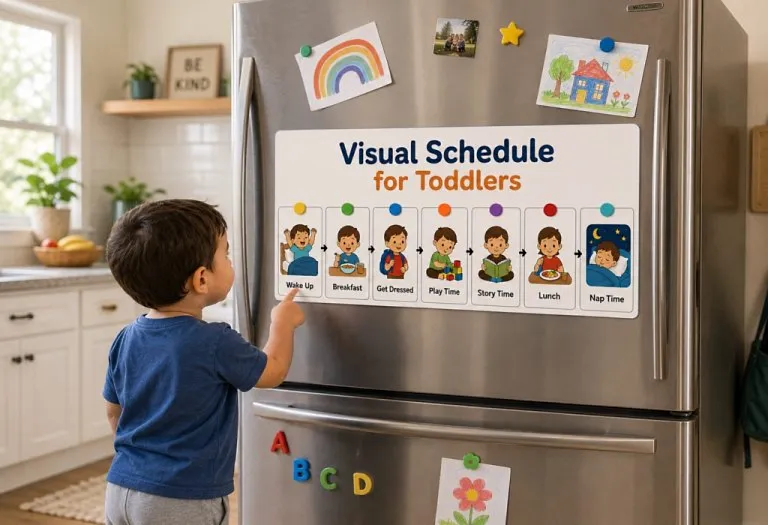
A visual schedule is a sequence of pictures, icons, or photos that represents the order of activities in a day, morning, or specific routine. Instead of telling a toddler “we’re getting dressed, then eating breakfast, then leaving,” you show them, step by step, in an order they can check back on (1).
Why Do Visual Schedules Work for Toddlers?
Toddlers are still developing their memory, language, and ability to follow multi-step directions. A two-year-old might understand each individual word in “brush your teeth after breakfast,” yet still forget the sequence thirty seconds later. Pictures don’t disappear the way spoken words do. A toddler visual schedule stays put on the wall or fridge, so a child can look back at it as many times as needed without asking an adult to repeat themselves.
It also gives toddlers a little more independence. Instead of asking, “What’s next?” they can check the schedule on their own. This helps them feel more confident, makes transitions easier, and can even reduce tantrums.
Benefits of Using a Visual Schedule
At first, a visual schedule might seem like just a few pictures on a wall. But once you start using one, you’ll notice how much easier everyday routines can become. Here are some of the biggest benefits it can bring for both you and your toddler (1).
1. Fewer Power Struggles Over Transitions
Most toddler meltdowns aren’t really about the activity itself. They’re about the surprise of being asked to stop one thing and start another. A schedule removes the surprise element because the next activity was already visible (2).
2. Faster, Calmer Mornings and Bedtimes
Once a routine is mapped out in pictures, toddlers start moving through steps with less prompting. Parents commonly report that using visual cues in a child’s daily routine can cut the number of reminders needed during the morning routine by roughly half within a couple of weeks.
3. Stronger Independence
A child who can check a schedule to see “next is shoes” doesn’t need to wait for an adult to tell them. This builds a small but genuine sense of control, which toddlers crave (3).
4. Support for Language and Sequencing Skills
Talking through each picture (“first breakfast, then teeth”) reinforces vocabulary and the concept of order, both of which feed directly into early literacy and executive function skills.
5. Smoother Handling of Changes
When something in the routine shifts, like a doctor’s appointment replacing playtime, a schedule gives you a concrete way to prepare a child in advance rather than springing the change on them (4).
6. Less Reliance on Repeated Verbal Reminders
Parents often find themselves saying the same instruction five or six times before a toddler responds. A schedule shifts some of that repetition onto the chart itself, since the child can check it independently instead of waiting to be told again.
How to Create a Visual Schedule for Your Toddler
Building one doesn’t require design skill or expensive materials. Follow these steps to get a working version up within an hour.
Step 1: Pick one routine to start with.
Don’t try to map the entire day at once. Morning routines and bedtime routines are the easiest wins because they repeat daily and involve a predictable number of steps, usually four to six.
Step 2: List the steps in order.
Write down exactly what happens, in the order it happens. For a morning routine, that might be: wake up, use the potty, brush teeth, get dressed, eat breakfast, put on shoes.
Step 3: Choose your picture format.
You have a few options:
- Photos of your child doing each activity, which tend to hold the most meaning for very young toddlers.
- Simple hand-drawn icons, which take under a minute per card and work fine even if you’re not artistic.
- Printable icon sets, widely available for free online, which save time if you’d rather not draw or photograph.
Step 4: Choose a display method.
Now decide how you’ll display the schedule. You can stick the pictures on the fridge, hang them on a wall, use a pocket chart, or even keep them in a small binder. The best option is the one your toddler can easily see and reach throughout the day.
Step 5: Walk through it together, out loud.
The first few times, narrate each card as you move through the routine. “Here’s breakfast, then we brush teeth.” Toddlers learn the connection between image and action through repetition, not by studying the chart alone.
Step 6: Let your toddler move the cards.
Handing over some control, like flipping a card to “done” or moving it to a finished pile, gives a toddler a physical sense of progress through the day. Many parents find this single change does more for cooperation than anything else on this list, since it turns the schedule from something imposed on the child into something the child actively runs.
Step 7: Keep it consistent for at least two weeks before judging results.
A toddler schedule chart only becomes useful once the child has seen it enough times to trust that it’s accurate. Expect an adjustment period, not instant compliance.
Mistakes to Avoid When Creating a Visual Schedule
A visual schedule is simple to use, but a few small mistakes can make it less effective. Here are some common mistakes to watch out for (4).
- Adding Too Many Steps at Once: A toddler schedule with fifteen icons is overwhelming. Start with one routine and five or six steps.
- Switching Formats Too Often: Constantly redesigning the schedule undermines the predictability it’s meant to provide.
- Using it Only When Things Go Wrong: A schedule works best as a daily habit, not an emergency tool pulled out mid-tantrum.
- Skipping the Narration: Pointing at pictures silently doesn’t teach the connection between image and action nearly as well as talking through it does.
- Placing it Out of Reach: If a toddler can’t physically touch or point to the cards, engagement drops fast.
FAQs
1. At what age should I start using a visual schedule?
Most families see results starting around 18 months, once a toddler can recognise simple images and associate them with actions. It remains useful well through the preschool years.
2. How many steps should be on a toddler’s schedule?
Keep it to four to six steps per routine. Overloading a schedule with too many cards makes it harder for a toddler to track and defeats the purpose of simplifying the routine.
3. Do I need to use photos, or are drawings enough?
Either works. Photos of your own child tend to connect faster for very young toddlers, while simple drawings are quicker to produce and just as effective once a child is a bit older and used to symbolic pictures.
Every toddler is different, so don’t worry if your visual schedule isn’t perfect from day one. Give your child time to get used to it, celebrate the small wins, and make changes as needed.
Also Read:
Moral Values for Kids to Build Good Character
Bad Parenting Signs and Its Impact on Children
Short Moral Stories in English for Kids
Was This Article Helpful?
Parenting is a huge responsibility, for you as a caregiver, but also for us as a parenting content platform. We understand that and take our responsibility of creating credible content seriously. FirstCry Parenting articles are written and published only after extensive research using factually sound references to deliver quality content that is accurate, validated by experts, and completely reliable. To understand how we go about creating content that is credible, read our editorial policy here.
- Author










.svg)