

















.svg)
.svg)
.png)


Behavior & Discipline
Suggested articles for you
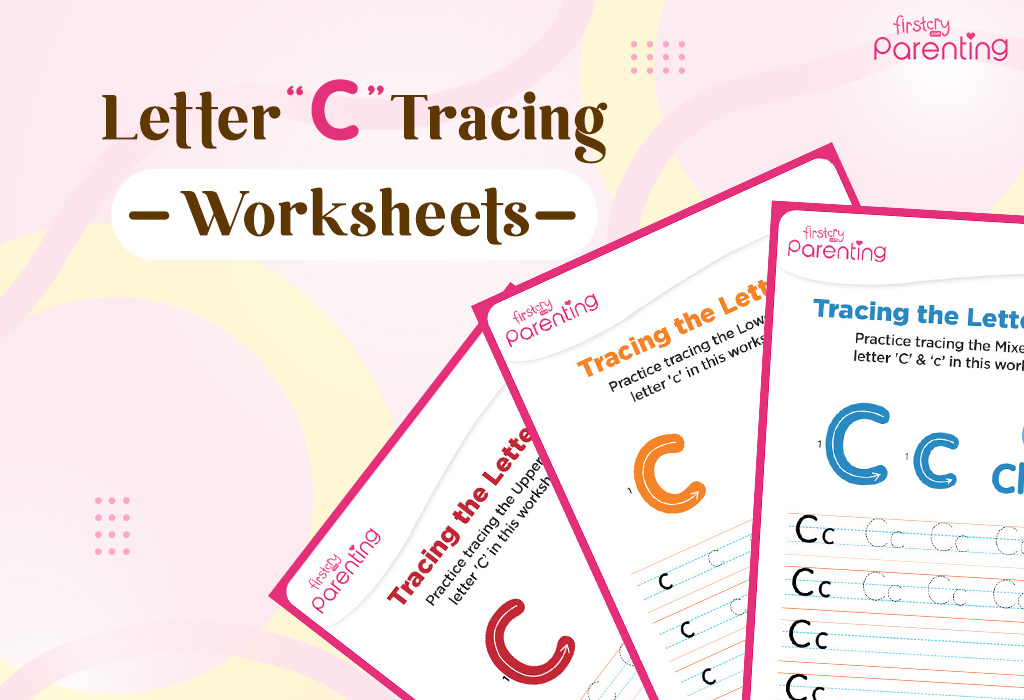
Letter C Tracing Worksheets – Free Printables To Learn
Letter C tracing worksheets are a fantastic way to introduce preschoolers to early writing through fun, hands-on activities. These printable sheets guide young learners as they practice the correct strokes and learn to write both uppercase and lowercase C, building confidence and control. A letter C for tracing worksheet helps improve fine motor skills while reinforcing alphabet recognition. Perfect for use at home or in the classroom, these worksheets make learning enjoyable and meaningful.With a wide selection of letter C worksheets for preschoolers, learning becomes both playful and purposeful. To add even more variety, you can explore our collection of educational resources, including letter C worksheets free printables, that make handwriting practice enjoyable and accessible.
Uppercase Letter C Tracing Worksheets
Printable letter C tracing worksheets are an excellent tool for helping pre-K students and young learners practice the uppercase letter. These capital letter C tracing worksheets allow students to trace the dotted lines, improving their letter formation and fine motor skills.
C for Cake Worksheet
C for Car Worksheet
C for Cow Worksheet
C for Cat Worksheet
C for Cup Worksheet
Lowercase Letter c Tracing Worksheets
Lowercase Letter C Tracing Worksheets are great for helping students and kids practice writing the small letter c tracing. These worksheets provide clear guidance, allowing young learners to develop proper handwriting skills while enjoying the process.
“c” for camel Worksheet
“c” for chicken Worksheet
“c” for camera Worksheet
“c” for candy Worksheet
“c” for carrot Worksheet
Upper and Lowercase “Cc” Tracing Worksheet
This worksheet provide a fun and engaging way for kids and students to practice both the mixed lowercase and uppercase versions of the letter C. These worksheets help improve handwriting and letter recognition while offering clear guidance for mastering both letter forms.
“Cc” for Clock Worksheet
Fun Activities To Trace and Learn Letter C
Fun activities to trace and learn the letter C can make learning enjoyable and interactive for young learners. Kids can practice tracing using letter C dotted worksheets while engaging in various creative tasks. Here are some fun activities that will enhance their learning experience:
Tracing with Crayons : Using crayons, children can trace the dotted lines on the letter C worksheets, making it colourful and fun.
C is for Crafting : Kids can cut out shapes of the letter C and decorate them with stickers or glitter to reinforce recognition.
Letter C Scavenger Hunt : Ask kids to find items around the house or classroom that start with the letter C and trace them on the worksheet.
Sand or Salt Tracing : Kids can trace the letter C using their fingers in a tray of sand or salt, making learning hands-on.
Playdough Letter Formation : Using playdough, kids can form the letter C and then trace it on their letter C dotted worksheets for added tactile learning.
Flashcard Matching : Create flashcards with uppercase and lowercase C and ask kids to match them with the traced letters on their worksheets.
Letter C Art : Encourage children to draw pictures of objects that start with C (like a cat or car) and trace the letter C around them.
C Letter Stamps : Use letter stamps to stamp the letter C on paper and have kids trace around them on the worksheets.
Blank Lines Printable Worksheet For Practicing Tracing Letter C
Kids can independently practice writing the letter C with the help of blank lines printable worksheets. These worksheets offer blank lines where children can trace and write both the uppercase C and lowercase c, allowing them to master proper letter formation. With a C traceable worksheet download, kids can enhance their writing skills, improve hand-eye coordination, and gain confidence in writing the letter C correctly.
FAQs
1. How do letter C tracing worksheets help with handwriting?
These worksheets help kids improve their handwriting by teaching them how to form letters correctly. Tracing helps build muscle memory and hand-eye coordination, which is essential for neat writing.
2. How often should my child practice with letter C tracing worksheets?
It’s ideal for children to practice with letter C tracing worksheets a few times a week to reinforce letter recognition and improve writing skills without overwhelming them. Consistent short sessions work best.
3. Can letter C tracing worksheets be used with other activities?
Absolutely! You can pair letter C tracing worksheets with activities like finding objects that start with the letter C or writing short words with the letter C, further enhancing the learning experience.
4. How do I know if my child is tracing the letter C correctly?
Ensure your child follows the correct stroke order when tracing. The letter C should start from the top and curve smoothly to the right, forming an open curve. You can guide them by showing the proper formation and using tracing examples.
Letter C tracing worksheets are valuable for helping kids improve their handwriting and letter recognition skills. By practising tracing the letter C, children can develop better fine motor skills, gain confidence in writing, and establish a strong foundation for early literacy. With various fun and engaging activities available, these worksheets make learning the letter C an enjoyable and practical experience for young learners.
Also Read:
Cat Colouring Pages
Kitten Colouring Pages
Race Car Colouring Pages
Letter A Tracing Worksheets
Read more





Good Table Manners for kids
Whether your child is eating at home, having meals in school, or dining out with your friends, good table manners will help them enjoy the mealtimes and make them thrive in social situations for the rest of their lives. Teaching table manners to kids is important, and the earlier you start the better. Good table manners are necessary for social interactions and knowing that your child has learned them, you can send him to his friend’s birthday party without worrying about how he will eat or behave.
Now whether you want to teach table manners to your toddler or preschooler, or an older child, we have tips for teaching table manners to kids of different age groups.
How to Teach Table Manners to Your Child
When it comes to teaching something new to kids, always, always, lead by example. Constantly demonstrate and explain to your child what needs to be done and how. Children learn by observing and imitating their parents. So they need to see you and other family members setting the standards for good table manners like talking nicely at the table, using ‘please’ and ‘thank you’ while interacting with each other, etc.
Keep in mind to always appreciate your child’s good behaviour at the table. It is always better to talk specifically when praising a child. Explain to the child what exactly impressed you like when he sat properly or when he asked for things nicely. Positive reinforcement by parents motivates children to perform well.
Being consistent is important when teaching kids good table manners. When you introduce a polite behaviour to your child like saying ‘thank you’, have reasonable expectations in the beginning then prompt or gently remind the child every time he forgets to say it. Gradually, he will get conditioned to say ‘thank you’ whenever required.
Another way of teaching good table manners can be to organize dinner theme nights every week. You can choose a particular cuisine for example Chinese. Kids may not only find it a fun and interesting way to pick up good table manners like the use of chopsticks but may also learn about the culture and eating habits of different countries.
Toddlers
Toddlers may require persistent reminding to behave properly. It is important that parents start conditioning toddlers as early as they can start. Toddlers have a mind of their own, and for them, everything can be a game. So, you may have to keep repeating the rules again and again. It may be better to show them what they are expected to do. It may also help to demonstrate the consequences of not following the rules.
Most toddlers indulge in bad behaviour like flinging food, spitting food to seek attention. If the bad behaviour gets a child attention, he may repeat it. It may be best to try and ignore bad behaviour.
What You Can Teach
From the time your toddler starts eating solids, ensure that he sits and eats properly. Constantly reinforce the idea of sitting at the table each and every time they eat. You can let him leave the table once he is done eating.
Try and involve your toddler during mealtimes by eating together as a family. This will give him the feeling that he is also a part of the family and mealtimes mean family time.
You can help your toddler wash his hands before the family sits down to eat. He may get habituated to do so as he grows up.
You can also try teaching your baby that throwing food, banging utensils, spitting food, screaming during mealtimes is unacceptable behaviour.
What You Can Expect
Certain things that you can expect your toddler to do while eating include:
Talking with a mouthful
Reaching over to grab food from other’s plates
Improper use of cutlery
Preschoolers
Preschoolers can be fussy and slow eaters and are prone to throwing tantrums. But a preschooler usually has more attention span than a toddler and can be better at following instructions. The best way to inculcate good table manners for kindergarteners can be by making them practise. It is important to explain to preschoolers what is expected of them at the table. Praise and encourage them when they behave well and cue them when they tend to slip. You may have to patiently remind them repeatedly.
Refrain from labelling a child when he tends to be sloppy or makes a mistake at the table. Instead, offer him a practical solution or advice. For example, if your child drops food on his clothes while eating, simply give him a napkin and explain its use to him.
What You Can Teach
You can teach preschoolers to:
Properly sit at the table without squirming, wriggling or wandering around.
To patiently wait till everyone is seated at the table and have helped themselves before start eating.
The right way to use a napkin, how to place it on the lap before starting a meal, how to use it to wipe the mouth and so on.
To take small bites and eat with his mouth closed and not to talk while he has a mouthful.
To use polite words, like ‘please’ and ‘thank you’ while interacting with people at the table.
What You Can Expect
You can expect the following from your preschooler:
He may make a mess while eating
He may forget to follow the good manners while sitting at the table
Kids
Older kids are better equipped to understand the rules that they are expected to follow. They may realise how their actions can affect others and why manners are important. You can offer reasonable explanations to your child and tell him why he should adhere to the rules at the table and follow it up with rational consequences in case he refuses to observe them. For example, you can teach him that he won’t get a second helping of his favourite dessert unless he learns to ask politely or if his behaviour is inappropriate at the table.
What You Can Teach
Older kids already know basic table manners. But there are certain things you can teach them. Such as:
Proper use of the cutlery, how to use a fork and knife, the right choice of cutlery when faced with options like a smaller spoon for dessert, a soup spoon for soup, and so on.
The art of making pleasant conversation at the table. Encourage him to compliment the food and teach him not to say something hurtful if he didn’t like the food.
Laying the table with a proper placing of cutlery and clearing the table after the meals.
How to properly serve and pass the food around the table without reaching over or being in someone’s face.
Not to carry their tabs, cell phones or other gadgets to the table.
What You Can Expect
Though kids at this stage are pretty clued in the lessons of good table manners, you can’t expect them to be perfect. Their can be times when your child may forget his manners or simply refuse to comply with the rules.
Your child may encounter situations he may not be yet ready to tackle like a formal party or a fancy wedding reception with complicated tableware.
You can’t expect the lessons in table etiquette for children to be over at this step. You may have to keep motivating your child to imbibe good table manners.
A family dinner must not be converted into some sort of a lecture or lesson on good table manners. Refrain from making mealtimes stressful for kids. Rather mealtimes should be family’s quality time together where family members can relax and share their day’s happenings and discuss other topics. Keep a balance between teaching kids good table manners and also making mealtimes fun and pleasurable for them.
Also Read: List of Good Manners for Children
Read more
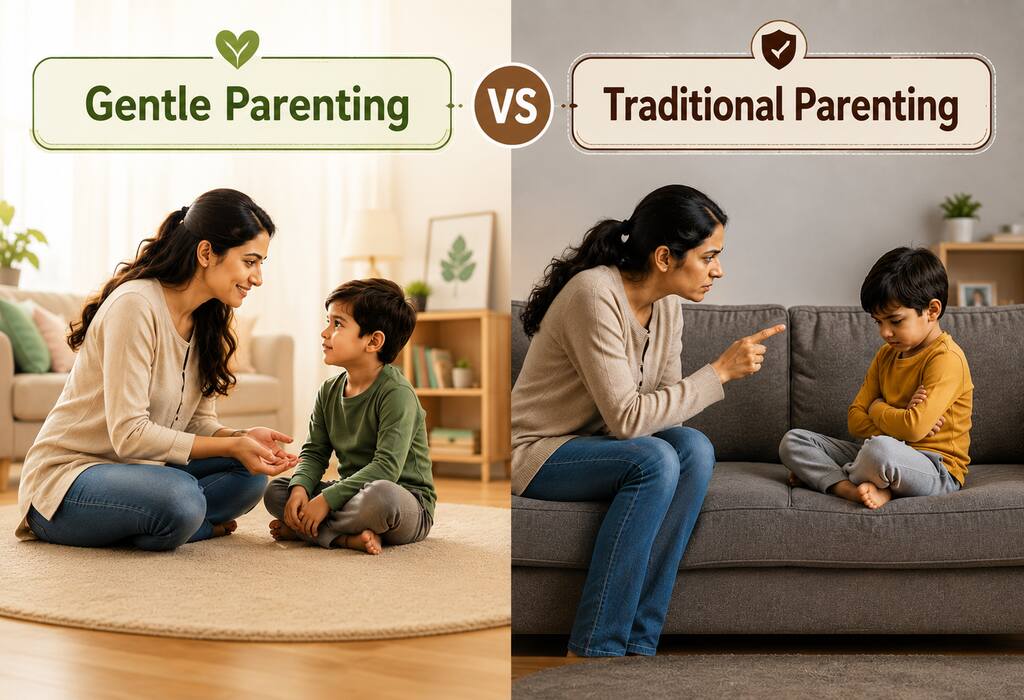
Gentle Parenting vs Traditional Parenting: Differences & Which Is Better?
Choosing between gentle parenting vs traditional parenting is one of the most debated decisions modern parents face, and it’s easy to see why. Both approaches promise well-adjusted, happy children, yet they take almost opposite routes to get there. If you’re a parent of a child anywhere between the toddler years and age ten, you’ve probably felt the pull between wanting to nurture your child’s feelings and needing them to actually listen when it matters. This article breaks down what each style really looks like day to day, where they overlap, where they clash, and how to figure out what will genuinely work for your family, rather than what looks good on social media.
What Is Gentle Parenting?
Gentle parenting is a child-rearing philosophy built around empathy, respect, and open communication. Rather than controlling a child’s behaviour through punishment, gentle parents try to understand what’s driving it. The core belief is simple: children misbehave because they lack a skill, not because they’re being deliberately difficult.
In practice, this might look like:
Getting down to your child’s eye level and naming their feelings (“You’re frustrated because we have to leave the park”)
Offering choices instead of ultimatums (“Do you want to put your shoes on yourself, or should I help?”)
Using natural consequences rather than punishments (a child who refuses a coat feels cold, rather than losing screen time)
Staying calm and connected even during meltdowns, rather than sending a child away to “calm down” alone
What Is Traditional Parenting?
Traditional parenting, sometimes called authoritarian parenting, is rooted in the idea that children need clear rules, consistent consequences, and respect for parental authority. It’s the style many of today’s parents grew up with themselves, shaped by generations of “because I said so” household rules.
Common features include:
Clearly defined rules with predictable consequences for breaking them
An expectation of obedience without lengthy negotiation
Rewards and punishments (sticker charts, time-outs, loss of privileges) used to shape behaviour
A parent-as-authority structure, where the adult’s decisions aren’t typically up for debate
Traditional parenting isn’t automatically harsh or cold. Many traditional households are warm and loving; they simply prioritise structure and obedience as the fastest route to raising well-behaved children who understand limits.
Gentle Parenting vs Traditional Parenting: Key Differences at a Glance
This is the difference between gentle parenting and traditional parenting in its clearest form: one starts from the child’s internal experience, the other starts from the household’s external rules. Most real families sit somewhere between the two extremes rather than living entirely in one camp.
Aspect
Gentle Parenting
Traditional Parenting
View of misbehaviour
A sign of an unmet need or missing skill
A choice that needs correcting
Discipline style
Empathy, natural consequences, collaboration
Rules, rewards, and punishments
Parent’s role
Guide or coach
Authority figure
Emotional expression
Actively validated and named
Often managed quickly, sometimes discouraged
Structure
Present but flexible
Firm and consistent
Common criticism
Can be time-consuming; may lack firm limits
Can feel harsh; may discourage emotional openness
Best suited for
Families prioritising emotional connection
Families prioritising predictability and order
Where the Two Styles Actually Overlap
It’s easy to frame this as a battle, but gentle parenting and traditional parenting share more ground than headlines suggest. Both aim to raise children who become capable, respectful adults. Both rely on consistency, since children of any parenting style struggle when rules change unpredictably. And both require the parent to stay involved and attentive; neither approach works well on autopilot.
Child development researchers often point to a third option that borrows the best of each: authoritative parenting. This style keeps the warmth and responsiveness of gentle parenting while holding on to the clear expectations of a more traditional structure. A child is allowed to express big feelings, but the boundary itself doesn’t move because of them.
Common Mistakes Parents Make With Each Style
Recognising these patterns matters more than picking a label. A parent who avoids these pitfalls, regardless of which camp they lean towards, tends to raise children who feel both secure and capable.
With gentle parenting:
Confusing validation with permission, so limits quietly disappear.
Over-explaining decisions to a two- or three-year-old who isn’t developmentally ready to process lengthy reasoning.
Feeling guilty for holding a boundary, which sends mixed signals to the child.
With traditional parenting:
Relying on punishment without explaining the reasoning behind a rule.
Dismissing a child’s feelings as “dramatic” or “attention-seeking”.
Using fear or shame as the main motivator, which can damage trust over time.
Which Approach Is Better for Your Child?
There’s no single answer that fits every family, but a few factors can help you decide where to land.
Consider your child’s temperament: A highly sensitive child may respond better to the emotional validation central to gentle parenting, while a child who thrives on predictability might do well with the clear structure of a more traditional approach.
Consider your own capacity: Gentle parenting asks a lot of the parent in the moment, patience, emotional regulation, and time to talk things through. On days when that reserve is running low, a simpler, rules-based response may be more realistic and still effective.
Consider the situation: Safety issues (running into a road, touching a hot stove) call for immediate, firm intervention regardless of parenting philosophy. Emotional moments (a tantrum over a broken toy) leave more room for a gentle, connection-first response.
Consider long-term goals: If raising a child who can identify and manage their own emotions is the priority, gentle parenting techniques offer useful tools. If the priority is a household that runs smoothly with minimal friction, traditional structure may feel more sustainable day to day.
How Each Style Plays Out at Different Ages
Gentle and traditional parenting can look quite different as children grow, with each approach shaping how parents respond to changing needs, behaviours, and levels of independence.
Toddlers (1-3 years): Gentle parenting techniques, such as naming feelings and offering limited choices, can reduce power struggles, but toddlers still need very short, very firm boundaries around safety. A purely traditional approach can feel overwhelming for a child who doesn’t yet have the language to explain what’s wrong.
Preschoolers (4-5 years): This is often where the two styles show the clearest contrast. Gentle parents lean on collaborative problem-solving (“What could we do differently next time?”), while traditional parents lean on consistent consequences (“If you throw a toy, the toy gets put away”). Both can work, provided they’re applied consistently rather than only when a parent has the energy for it.
School-age children (6-10 years): By this stage, children can understand cause and effect more fully, which makes room for a genuine blend of the two approaches. A parent can explain the reasoning behind a rule, gentle parenting’s strength, while still applying it firmly and predictably, traditional parenting’s strength.
A Practical Middle Ground
Many parenting professionals now describe the healthiest approach as one that blends empathy with firm limits, essentially taking the connection of gentle parenting and pairing it with the consistency of traditional parenting. In everyday terms, this could mean acknowledging a child’s frustration out loud while still holding the boundary that started the frustration in the first place: “I understand you’re upset we’re leaving, and we’re still leaving now.”
This blended approach also tends to age well. What works for a two-year-old having a meltdown over socks looks different from what a ten-year-old negotiating screen time needs, and a flexible framework adapts more easily than a rigid one.
FAQs
1. Is gentle parenting the same as permissive parenting?
No. Gentle parenting still involves boundaries and limits; the difference is in how those limits are communicated. Permissive parenting typically avoids setting firm limits altogether, while gentle parenting combines empathy with clear expectations.
2. Can I mix gentle parenting and traditional parenting?
Yes, and many experts recommend it. Combining the emotional validation of gentle parenting with the consistency of traditional structure, often called authoritative parenting, tends to produce well-balanced outcomes for children.
3. Does gentle parenting work for strong-willed children?
It can, though it may need to be paired with firmer limits than usual. Strong-willed children often respond well to having their feelings acknowledged, but they also need consistent boundaries so they understand where the limits genuinely sit.
Gentle parenting and traditional parenting aren’t rivals so much as two different toolkits for the same job: raising children who feel secure, understand limits, and grow into capable adults. Gentle parenting leans on empathy and connection to guide behaviour, while traditional parenting leans on structure and consistent consequences. Neither is inherently right or wrong, and most families find that a blend, rooted in warmth but backed by clear boundaries, works better than strict adherence to either label. The most effective parenting style is ultimately the one that fits your child’s temperament, your family’s values, and what you can realistically sustain on the hard days as well as the easy ones.
Also Read:
Gentle Parenting
Permissive Parenting Style
Gentle Parenting vs Authoritative Parenting
Read more

Nacho Parenting – Pros, Cons, And How To Use It
Parenting, in all its forms, offers a profound opportunity to shape the next generation. Among the many emerging parenting styles, ‘Nacho Parenting’ provides a unique blend of detachment and involvement, particularly in step-parenting situations. Though the name might conjure images of cheesy tortilla chips, the approach is far from frivolous. Instead, it is a metaphor for the non-biological parent’s role in the blended family. Let’s embark on this journey to understand the essence, advantages, and potential pitfalls of Nacho Parenting and how to implement it effectively.
What Is Nacho Parenting?
Nacho Parenting is a philosophy predominantly adopted by step-parents. In this approach, step-parents consciously choose not to get fully involved in disciplining or making decisions for their stepchildren. Instead, they allow the biological parents to take the primary role, fostering a more natural bond and avoiding potential conflicts (1). This approach likened to the ‘nacho’ problem (not your problem), promotes harmony in blended families and reduces unnecessary tensions.
How Does It Work?
The Nacho Parenting approach can seem abstract to those unfamiliar with the concept. It’s’ a paradigm shift in which step-parents prioritise building relationships over authoritative duties. The nacho parenting method recognises boundaries, and understanding is cultivated (2). Let’s delve into the intricate workings of this method through some core principles.
1. Building Trust First
Before anything, the relationship comes first. The initial phase involves building trust with the stepchild rather than asserting authority.
2. Deferring Discipline
When issues arise, the biological parent is the primary disciplinarian. This prevents potential resentment from the stepchild towards the step-parent.
3. Open Communication
Open dialogue between the biological parent and step-parent is vital. This ensures everyone is on the same page, and any concerns regarding the child can be addressed collaboratively.
4. Empathy Over Authority
The nacho parenting method emphasises understanding the child’s emotions and perspectives. Rather than enforcing rules, the step-parent offers empathy and support.
5. Recognising Individual Roles
Every member of a blended family has a unique role. Respecting these roles ensures that no one feels out of place or marginalised.
6. Strengthening the Parental Unit
While the step-parent may take a step back from direct parenting, they must support their partner’s decisions. This unified front is essential for family stability.
7. Flexibility and Adaptation
Blended families can be complex. The nacho parenting method emphasises adapting, recognising that each family dynamic might require varying approaches.
Incorporating these principles helps blended families navigate the delicate balance of roles and relationships, ensuring each member feels valued and understood.
Advantages And Disadvantages Of Nacho Parenting
In blended families, the Nacho Parenting approach has garnered attention and practice for its unique perspective on step-parenting. While it offers several benefits, especially in fostering better relationships, it has drawbacks. Let’s dive deep into the pros and cons of Nacho step-parenting.
Pros Of Nacho Parenting
1. Enhanced Relationship Building: Step-parents can foster a genuine bond with their stepchildren by focusing less on discipline and more on connection.
2. Reduced Resentment: Leaving disciplinary actions to the biological parents diminishes potential resentment stepchildren might feel towards their step-parent.
3. Unified Parenting Approach: The biological parents make primary parenting decisions, so there’s more consistency in rules and values (3).
4. Reduced Pressure on Step-parent: Removing direct parenting responsibilities gives the step-parent space and smoother the transition into the blended family (3).
5. Increased Understanding: ‘Nachoing’ creates an environment of empathy and patience, making it easier for step-parents to understand their stepchild’s feelings and behaviours.
Cons Of Nacho Parenting
1. Perceived Lack of Involvement: Some stepchildren might perceive the step-parent’s lack of disciplinary actions as disinterest or indifference.
2. Potential for Misunderstandings: Without open communication, the stepchild might misconstrue the reasons behind the nacho step-parenting approach.
3. Overburdening the Biological Parent: This method might burden the biological parent, making them the sole disciplinarian.
4. Inconsistency in Parenting: If not executed correctly, there can be noticeable discrepancies in parenting methods between the step-parent and biological parent.
5. Potential to Create Divides: Without proper understanding, this approach can create divides in the family, making the step-parent feel isolated.
6. Complex Adaptation: The line between ‘nachoing’ and total detachment can be thin, requiring constant evaluation and adjustment.
7. Might Not Suit All Families: Every blended family has its dynamics, and the Nacho Parenting method might not fit all.
Navigating the maze of blended family dynamics can be complex. While the Nacho Parenting approach offers a different perspective, its success requires careful execution and constant communication.
Simple Tips To Use Nacho Parenting
Embarking on the Nacho Parenting journey requires more than just understanding the philosophy; it calls for practical steps to embed it into daily life. For those considering or starting with this approach, here are some actionable tips to ensure a smooth transition and positive outcomes for your blended family.
1. Prioritise Bonding: Invest time learning your stepchild’s likes, dislikes, and interests. Organise activities together to foster a genuine bond.
2. Stay in Sync with Your Partner: To maintain a unified front, regularly discuss your roles, responsibilities, and any challenges your spouse faces.
3. Establish Clear Boundaries: Knowing when to step in and when to step back is essential. Clearly define these boundaries for both you and the child.
4. Be a Good Listener: Always be available for your stepchild to vent, share, or seek advice, even if you’re not the primary decision-maker.
5. Educate Yourself: Read up on Nacho Parenting, attend workshops, or join online forums to learn from other step-parents” experiences.
6. Seek Feedback: Occasionally, ask your partner and stepchild about how they feel about the relationship dynamics to ensure continuous improvement.
7. Practice Patience: Building trust and rapport takes time. Be patient and give the relationship the time it deserves.
8. Celebrate Small Wins: Acknowledge and celebrate small milestones in your relationship with your stepchild.
9. Avoid Negative Talk: Do not speak ill of the child’s other biological parent in their presence.
10. Stay Adaptable: Remember that every child is different. What works for one might not for another, so be prepared to tweak your approach as needed.
11. Seek Professional Guidance: Consult a family therapist or counsellor if challenges seem insurmountable.
Nacho Parenting is a continuous journey of learning and adapting. With the right mindset and these practical steps, step-parents can cultivate a harmonious and loving environment in their blended families (4).
Is Nacho Parenting the Right Choice for Your Family?
Deciding on a parenting style is deeply personal and should be tailored to each family member’s needs. With its emphasis on understanding, boundaries, and reduced step-parent intervention, Nacho parenting can be transformative for some families. However, its effectiveness largely depends on the blended family’s existing dynamics, relationships, and communication patterns.
Here are a few things to consider:
1. Assess Your Family Dynamics
The foundation of Nacho Parenting is allowing the biological parent to handle their child’s primary disciplining and decision-making. Consider if this dynamic will be accepted and respected by all family members.
2. Communication is Key
Nacho Parenting’s success is rooted in clear and open communication. Before adopting this method, gauge whether your family can consistently discuss feelings, boundaries, and concerns.
3. Gauge Stepchild’s’ Expectations
Every child is different. Some might appreciate a step-parent taking a backseat, while others view it as indifference. It’s crucial to understand your stepchild’s expectations and needs.
4. Your Comfort
As a step-parent, assess your comfort level. Are you okay with taking a more passive role in certain aspects of your stepchild’s life? Can you find fulfilment in building a relationship based on understanding rather than authority?
5. Feedback from Biological Parent
Discuss extensively with the biological parent. Their insights and feelings about you taking the Nacho Parenting approach are pivotal.
6. Trial and Adapt
If you’re leaning towards trying Nacho Parenting, remember that it doesn’t have to be all or nothing. You can adopt certain principles and see how they work, adapting as necessary.
7. Professional Insights
Consider getting insights from family therapists or counsellors familiar with blended family dynamics. Their external perspective can provide clarity.
Ultimately, the right choice fosters love, understanding, and harmony within the family. If Nacho Parenting aligns with these goals and feels like a good fit, it might be the right approach for your family. If not, that’s okay too. The key is finding what works best for your unique family unit.
When to Seek Help?
Every family faces unique challenges, and blended families, with their intricate dynamics, are no exception. While Nacho Parenting offers a structured approach to navigating these complexities, there are times when professional intervention becomes necessary. Recognising these moments and seeking assistance can make all the difference in fostering a harmonious family environment.
1. Persisting Tensions: If, despite best efforts, tensions remain high and relationships don’t seem to improve, it might be a sign that external intervention is needed.
2. Breakdown in Communication: When open dialogue becomes challenging and misunderstandings become frequent, it’s an indicator that professional guidance might be beneficial.
3. Feelings of Isolation: If any family member, whether a step-parent, biological parent or child, feels persistently isolated or left out, it should be a cause for concern.
4. Behavioral Changes in Children: Noticing drastic changes in the child’s behaviour, mood, or academic performance could indicate underlying issues that need addressing.
5. Feeling Overwhelmed and Stressed: If the pressures of blending families become overwhelming for any member, it’s essential to seek support.
6. Conflicting Parenting Styles: If there are constant clashes in parenting approaches between the biological parent and step-parent, a mediator might help.
7. Emotional and Mental Well-being: Prioritise the mental health of all family members. If anyone exhibits signs of depression, anxiety, or other emotional challenges, professional help should be sought immediately.
Seeking help isn’t a sign of failure but rather an acknowledgement that families, like individuals, need support, guidance, and sometimes therapy to thrive. Whether through counselling, family therapy, or support groups, external resources can offer invaluable perspectives and tools for navigating the challenges of blended family life.
Nacho Parenting presents a fresh perspective on navigating the intricate tapestry of blended families, emphasising understanding and boundaries. While it might be a beacon for some, it’s essential to remember that every family is unique, and what works for one may not work for another. Regardless of the approach chosen, the ultimate goal remains the same: fostering a loving, understanding, and harmonious environment for every family member.
References/Resources:
1. Making stepfamilies work; American Psychological Association; https://www.apa.org/topics/families/stepfamily https://www.apa.org/topics/families/stepfamily August 2019
2. Nacho Parenting: What It Is, Pros, Cons, & More; Choosing Therapy; https://www.choosingtherapy.com/nacho-parenting/
3. Carloni, K.; What Is Nacho Parenting? [IS IT EFFECTIVE?]; Father Resource; https://fatherresource.org/what-is-nacho-parenting/ May 2023
4. Stepfamily Relationship Quality and Children's Internalizing and Externalizing Problems – PMC; Todd M. Jensen, MSW, doctoral candidate, Melissa A. Lippold, Ph.D., assistant professor, Roger Mills-Koonce, Ph.D., associate professor, and Gregory M. Fosco, Ph.D., assistant professor; https://www.ncbi.nlm.nih.gov/pmc/articles/PMC5705583/
Also Read:
Dealing with Stepchildren Made Easier!
Ensuring Equal Treatment for all Children in Blended Families
Read more
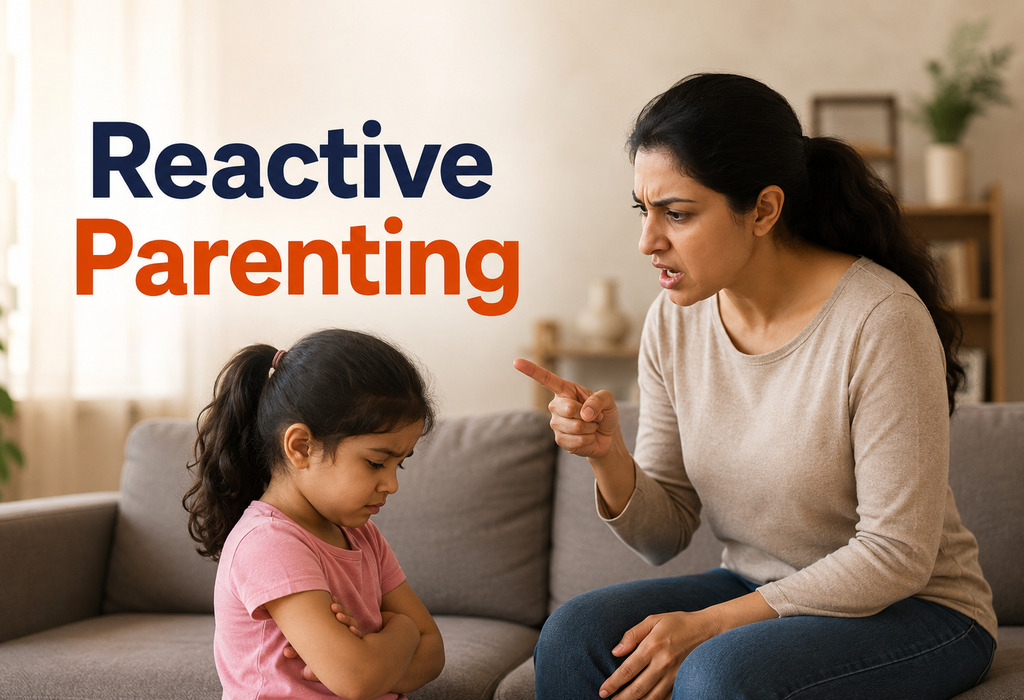
Reactive Parenting: Effects and Ways to Break the Cycle
Every parent has had a moment where a child’s whining or a public tantrum triggered a response they later regretted. That snap reaction, the raised voice that comes out before you’ve had time to think, is the hallmark of reactive parenting. It isn’t a character flaw. It’s a pattern, often rooted in stress or your own upbringing, and like any pattern, it can be recognised and changed. This article covers what reactive parenting looks like day to day, why it develops, how it affects children, and practical steps to respond instead of react.
What Is Reactive Parenting?
Reactive parenting is a style where a caregiver’s actions are driven by immediate emotional impulses rather than a thought-out approach to discipline or connection. Instead of pausing to consider the best response, a reactive parent acts on the first wave of frustration, fear, or embarrassment that arises.
This isn’t the same as occasionally losing your patience, which happens to every parent. Reactive parenting becomes a pattern when the same situations, such as whining, defiance, or public meltdowns, repeatedly trigger the same impulsive responses, like yelling, threatening consequences, or handing out punishments in the heat of the moment.
Why Reactive Parenting Happens
Reactive responses rarely come out of nowhere. They usually build from a few overlapping factors, including:
1. Chronic Stress and Exhaustion
A sleep-deprived parent juggling work and a toddler’s tantrum has a shorter fuse than a well-rested one, since stress lowers the threshold for what counts as “too much.”
2. Unprocessed Childhood Experiences
Many parents unconsciously repeat the discipline styles they grew up with, even ones they disliked, because those patterns feel familiar under pressure.
3. Lack of a Game Plan
Without a clear approach to common flashpoints like bedtime resistance or grocery store meltdowns, parents default to whatever feels urgent in the moment.
4. Feeling Judged
A tantrum in public can trigger embarrassment, which often escalates a parent’s response beyond what the situation calls for.
Recognising these root causes matters, because reactive parenting is rarely about the child at all. It’s usually about the parent’s internal state colliding with a hard moment.
Reactive Parenting Examples
Seeing reactive patterns in action can make them easier to spot in your own home. Common patterns that fit this style include:
Yelling “Stop it right now!” the instant a child starts whining, without addressing why it started.
Threatening to leave a store during a meltdown, then not following through.
Giving in to a demand just to stop a public tantrum, even when it’s normally not allowed.
Snapping at a child over a minor accident, like spilling milk, in a tone disproportionate to the event.
Comparing a child unfavourably to a sibling in the heat of frustration.
Each of these examples of reactive parenting shares a common thread: the response is driven by the parent’s discomfort rather than a considered plan for guiding behaviour.
Signs You Might Be an Emotionally Reactive Parent
It can be hard to see your own patterns clearly, especially in the middle of a hard day. A few signs tend to show up consistently in someone who reacts on emotion first and thinks second:
You often feel regret or guilt shortly after responding to your child.
Your tone or volume shifts dramatically within seconds of a trigger.
You find yourself saying things you don’t actually mean, like empty threats.
Your child seems to hesitate before telling you things.
You struggle to explain your reasoning calmly once the moment has passed.
None of these signs mean you’re a bad parent. They point to a pattern worth examining, and awareness is genuinely the hardest part of the process.
Comparing Reactive and Responsive Approaches
Trigger response
Immediate emotional reaction
Brief pause before responding
Consistency
Varies by mood or stress level
Consistent regardless of mood
Communication
Often raised voice, sharp words
Calm, clear explanations
Child’s experience
Uncertainty about what to expect
Predictability and security
Long-term goal
Stopping the behaviour fast
Teaching a skill or lesson
Parent’s emotional state
Driven by frustration or fear
Regulated, even under stress
This isn’t about labeling one parent “good” and another “bad.” Most parents move between these styles depending on the day and how many stressors are competing for their attention. The goal isn’t perfection, it’s shifting the balance toward the responsive end over time.
Effects of Reactive Parenting on Children
Growing up with consistently reactive parenting can shape how children understand themselves and their relationships. Although occasional reactive moments are a normal part of parenting, they don’t define a child’s development. It’s the consistent, repeated pattern that tends to leave a lasting mark.
1. Emotional Regulation Struggles
Children partly learn to manage big feelings by watching how the adults around them handle stress. When a parent regularly reacts with anger or panic, children may struggle to build their own calming strategies.
2. Reduced Trust and Openness
If a child anticipates an unpredictable or harsh reaction, they may become less likely to share mistakes or fears, creating distance in the relationship over time.
3. Anxiety Around Mistakes
Kids raised in reactive environments sometimes develop a heightened fear of getting things wrong, since past errors were met with strong emotion rather than calm guidance.
4. Modelling Reactive Behaviour
Children are natural imitators, and one frequently exposed to reactive responses may adopt similar patterns, reacting to frustration with outbursts rather than problem-solving.
How to Stop Being a Reactive Parent
Shifting away from reactive patterns takes practice, not perfection. These strategies can help build that shift over time.
Build in a pause: Even five seconds of silence before responding gives your brain time to move past the initial emotional surge, whether that’s counting to five or simply stepping back before speaking.
Name your triggers: Keep a mental list of situations that reliably set you off, like whining at dinner or dawdling before school, so you can prepare a calmer response in advance.
Prepare a few go-to phrases: A simple script, such as “I can see you’re upset, let’s figure this out together,” takes the pressure off improvising mid-meltdown.
Address your own stress first: Sleep, meals, and short breaks change how much emotional bandwidth you have left, and reactive responses often ease once basic needs are being met.
Repair after a reactive moment: If you do snap, circling back afterwards to acknowledge it models accountability and rebuilds connection quickly.
Get support when needed: A therapist or parenting coach can help uncover deeper patterns behind reactive responses, especially ones rooted in your own upbringing.
Common Mistakes Parents Make When Trying to Change
Changing long-standing parenting habits takes time, and setbacks are part of the process. Here are a few common mistakes that can make the shift more difficult than it needs to be.
Expecting instant results:Long-standing patterns take repeated practice to shift, and setbacks are part of the process, not a sign of failure.
Ignoring your own stress levels: Trying to parent more calmly while running on no sleep rarely works, since the underlying stress hasn’t been addressed.
Skipping the repair step: Moving on without acknowledging a reactive moment to the child misses a chance to model accountability.
Only focusing on the child’s behaviour: Real change usually requires looking at the parent’s own triggers, not just trying to control the child’s actions.
Being too hard on yourself: Harsh self-criticism after a reactive moment adds stress, which ironically makes future reactive responses more likely.
Myth vs. Fact
There’s no shortage of parenting advice, and not all of it is accurate. Here are some common myths about reactive parenting and what the evidence actually says.
Reactive parenting means you’re a bad parent.
Reactive parenting is a common pattern, often shaped by stress and past experiences, not a measure of how much you love your child.
Once you’re a reactive parent, you always will be.
With awareness and consistent small changes, most parents can shift meaningfully toward a calmer, more responsive style.
Staying calm means never showing emotion.
Responsive parenting still allows for genuine emotion; it simply involves managing the intensity and timing of the response.
Reactive parenting only affects toddlers.
The effects can extend into the school-age years and beyond, shaping how children handle stress and relationships later in life.
FAQs
1. Is reactive parenting the same as yelling at your child?
Yelling can be one expression of reactive parenting, but the pattern also includes other in-the-moment responses like giving in to demands, issuing empty threats, or overreacting to small mistakes. The common thread is an unplanned emotional response rather than the specific behaviour itself.
2. Can reactive parenting be unlearned?
Yes. While it takes consistent effort, most parents can shift toward a calmer, more responsive style by identifying their triggers, building in a brief pause before responding, and repairing after reactive moments. Progress tends to happen gradually rather than overnight.
3. When should I seek professional support for reactive parenting?
If reactive responses are frequent, feel out of your control, or are affecting your relationship with your child despite your efforts to change, a therapist or parenting coach can help identify underlying causes and build more effective strategies.
Reactive parenting is far more common than most parents realise, and recognising it in yourself is not a failure, it’s the first step toward change. By understanding your triggers, pausing before responding, and repairing the moments when you do react, you can gradually shift toward a calmer, more predictable style that helps your child feel secure. Progress is rarely linear, but every small shift adds up.
Read more

9 Effective Tips to Calm Down a Hyper Toddler
Do you often feel helpless when your tot throws a tantrum and refuses to settle down no matter how strict you are? Trust us, you’re not alone! Parenting is a roller-coaster ride, especially when you have a hyperactive toddler. Keeping up with these little bundles of energy can feel like chasing a tornado in tiny shoes. Sometimes, it is that extra bar of chocolate he is being denied. At other times, it is an additional hour up at bedtime, which you adamantly refuse to allow him. Managing a hyperactive 3-year-old can be exhausting, but with patience and understanding, it’s possible to help them channel their energy positively. Toddlers can have the best disciplinarians at their wit’s end, so we could all do with natural ways to calm a hyper child. In this article, we’ve rounded up nine easy-breezy tips to help you bring peace and calm to your household.
Why are Toddlers Hyper?
Have you ever wondered why toddlers are like little tornadoes, swirling around with endless energy? Well, there are a variety of factors at play. Here’s a peek into what might be driving that hyperactivity.
1. Exploring Everything
Toddlers are like tiny scientists, always eager to explore and discover new things. Their boundless curiosity keeps them moving as they investigate the world around them.
2. Big Emotions, Small Bodies
Toddlers experience a whirlwind of emotions, from excitement to frustration, and they haven’t mastered self-regulation yet. This can result in bursts of energy as they try to express themselves (1).
3. Hyperactivity or ADHD?
While high energy levels are typical in many children, there’s a fine line between typical exuberance and hyperactivity that could signal Attention deficit hyperactivity disorder (ADHD) (2). If hyperactive behaviours start interfering with schoolwork or social interactions, it may be time to seek guidance from a medical professional (3).
Natural Ways to Calm a Hyper Toddler
All kids are bound to be hyperactive at one point or the other in their lives. We bring you a set of helpful calming tips for dealing with a hyperactive toddler. This behavioural toolkit is essential for every parent to have in their kitty!
1. Practise Systematic Ignoring
Harsh, though it sounds, ignoring the tantrum is often the best way to deal with it (6). Your child must realise that throwing a tantrum is not the solution for every situation in life. Let the hyperactive behaviour, often accompanied by howling, take its time to die. While the ignoring is on, ensure you provide the kid with food items such as fresh vegetables and fruits, especially chicken and walnuts, and whole grains like pasta and brown bread. These calming foods for toddlers will have them settle down and be their usual grinning selves much faster than a about of shouting is ever likely to achieve!
2. Use the Power of Hugging
This always works. When your child seems most menacing, hug him tight. There is healing in mom’s hug, and it is sure to assure your tot that you are always there for him. Hugging doesn’t mean giving in to unreasonable demands (something you should never do) but ascertains an understanding. This is often enough to bring your tot down from the peaks of hyperactivity.
3. Bring Bubbles to the Rescue
Pop, pop! When those dainty soap bubbles burst, our hearts feel instantly lighter. Your toddler also enjoys this activity and is sure to feel calmer when surrounded by lovely, airy bubbles. You can also consider buying musical bubble guns set to different tunes. They are a significant stress and tantrum buster!
4. Run a Hot Water Bath
Much like adults, steaming hot water baths are helpful even for kids. They soothe their frayed nerves and bring a sense of calm. Ensure the water is not too hot. You can also infuse the water with relaxing bath salts, lavender oil, chamomile and rosemary. These are considered to be calming herbs for kids and have a positive effect on your child’s nervous system.
5. Play Calming Music
Music can be a great way to restore peace at home. The next time your children get unruly try music as therapy. Tracks such as animal sounds, waterfalls and ocean sounds are considered to be calming music for toddlers. Playing them at a moderate volume in the background can peacefully affect your tantrum-throwing child.
6. Engage Them in a Physical Activity
When hyperactivity peaks, children need an outlet for all the extra energy driving them crazy. Get your children to engage in high-energy activities such as running around the garden, skipping, playing with a ping-pong ball or swinging. This alternate channelisation of energy will help them eventually return to their pre-tantrum state (5).
7. Converse in a Calming Voice
Finally, mamma’s calm voice is all a toddler needs when vulnerable. Get your child to sit down and talk to him quietly and softly. You could also whisper in his ears and tell him that his unruly behaviour really hurts you. Children are more emotionally sound than you know, and the message will likely hit home.
8. Mindful Breathing and Relaxation
Teach your toddler simple mindfulness techniques like deep breathing or gentle stretching exercises. These practices can help them learn to regulate their emotions and calm themselves down when feeling overwhelmed or overstimulated (7).
9. Massage and Touch Therapy
Gentle massage techniques, such as light strokes or circular motions on your toddler’s back or limbs, can help release tension and promote relaxation. Incorporate calming essential oils like lavender or chamomile for added soothing benefits (8).
FAQs
1. How can I tell if my toddler is hyperactive or just energetic?
It’s important to differentiate between normal toddler energy levels and hyperactivity. While all toddlers have high energy, hyperactivity often involves excessive restlessness, impulsivity, and difficulty focusing (4).
2. What are some quick techniques to calm a hyper toddler in public settings?
When dealing with a hyperactive toddler in public, distraction can be essential. Bring along small toys or books to redirect their attention. It’s also necessary to stay patient and avoid reacting with frustration, as this can exacerbate the situation.
3. Are there any dietary or lifestyle changes to help manage hyperactivity in toddlers?
While there’s no one-size-fits-all solution, some parents find that certain dietary adjustments, such as reducing sugar and artificial additives, can help manage hyperactivity in toddlers. Establishing consistent routines, providing ample opportunities for physical activity, and ensuring sufficient sleep can also contribute to better behaviour regulation.
4. When should I seek professional help for my hyperactive toddler?
If you’re concerned about your toddler’s hyperactivity impacting their development or quality of life, it’s advisable to seek professional guidance. A paediatrician or child psychologist can evaluate your child’s behaviour, provide insights into potential underlying issues, and recommend appropriate interventions or therapies.
Managing the energy levels of a hyper toddler can be challenging, but with patience, understanding, and a few effective techniques, it’s entirely possible to help them calm down and thrive. Remember, every child is unique, so finding the best strategies for your little one may take trial and error. By staying calm, patient, and proactive, you’ll help your toddler navigate their hyper moments and foster a nurturing environment where they can learn and grow. Together, you and your hyperactive toddler can tackle any challenge that comes your way!
References/Resources:
1. 10 Tips to Prevent Aggressive Behavior in Young Children; American Academy of Pediatrics; https://www.healthychildren.org/English/ages-stages/toddler/Pages/Aggressive-Behavior.aspx
2. Smith. M, Segal. J; ADHD Parenting Tips; HelpGuide.org; https://www.helpguide.org/articles/add-adhd/when-your-child-has-attention-deficit-disorder-adhd.htm
3. Smith. M, Robinson. L, Segal. J; ADHD in Children; HelpGuide.org; https://www.helpguide.org/articles/add-adhd/attention-deficit-disorder-adhd-in-children.htm
4. Kelly. K; Why some kids get overexcited; Understood; https://www.understood.org/en/articles/why-some-kids-get-overexcited
5. Taming Tempers; Nemours Children’s Health; https://kidshealth.org/en/parents/temper.html
6. Miller. C; How to Help Children Calm Down; Child Mind Institute; https://childmind.org/article/how-to-help-children-calm-down/
7. Calming the Active/Hyperactive Child; Miracle Foundation; https://www.miraclefoundation.org/wp-content/uploads/2021/06/Calming-the-Active_Hyperactive-Child.pdf
8. Khilnani. S, Field. T, Hernandez-Reif. M, Schanberg. S; Massage therapy improves mood and behavior of students with attention-deficit/hyperactivity disorder; The Questia Online Library; https://www.researchgate.net/publication/8648691_Massage_therapy_improves_mood_and_behavior_of_students_with_attention-deficithyperactivity_disorder
Also Read:
When Toddlers Learn to Lean Over
Effective Ways for Disciplining a Toddler
Reasons Why Toddlers Throw Things So Much
Read more

Role of the Family in a Child's Development
Humans are social animals, and, thus, social structure plays a pivotal role in their development. The initial social interactions a baby experiences typically occur within their family circle, making immediate family members the primary social group. So, what role does a family play in a child’s development? The family plays multifaceted roles in a child’s development, serving as the primary source of emotional support, moral guidance, and cultural transmission. Additionally, family dynamics significantly influence cognitive and behavioral patterns, shaping the individual’s worldview and interpersonal skills from an early age. Thus, the family unit serves as the cornerstone of a child’s social and psychological development.
How Does the Family Influence a Child’s Development?
Family members are the first few people that a child interacts with and, thus, the role of the family in the socialization of a child cannot be undermined. It is because of these interactions that may help a child to have a better understanding of himself and of people around him. The way a child is loved, cared and nurtured at home provides the opportunities for a child to thrive better in his life. A family’s impact on child development is like a foundation, which may help in shaping up the future of a child. Here are some ways a family may influence a child’s development:
1. Values
A child is like a sponge and absorbs whatever he may notice or observe. This leaves a big onus on the parents because the child may eventually learn from the parents. Therefore, if you respect a certain section of society or give more preference to some people, your kid may be making his opinions in a similar manner. When you may behave in a disrespectful manner with somebody, your kid may be observing that too. The best way to teach a child is to lead by example, more than preaching it is what you may be practising that your child is more likely to follow.
Also, it will be a good idea to start inculcating good values from a younger age only. Many believe that a younger child may not be able to appreciate or understand the importance of learning good values, but that may not be true. Kids understand better when you make them understand the consequences of their actions. Help them know what may happen if they do things a certain way and vice-a-versa. Therefore, it is very important for a family to inculcate good values in their child.
2. Socialisation and Social Development
The family is your baby’s first social group. This means whatever your kid may be learning, he may be learning by observing the family members. It is observed that happy families or families that treat each other with love and respect help in giving a positive outlook of a family with their kid or share a positive example of social interaction. If your family spends quality time by having meals together, watching television together or spends time doing other such things together, it may help in fostering healthy social development.
Also, your interactions with your child help him in learning about interaction with others. It is the way a family interacts with a child that may help a child to understand relationships better. He may learn how to feel comfortable, make friends or trust people from his own family only. Relationships are very important for human survival, and your kid may learn to make and sustain relationships from his family. The foundations of good social skills are laid at home, which may help your kid to have better social skills and help him socialise better as he grows.
3. Developmental Skills
It is very important for a child to learn various developmental skills such as motor skills, cognitive skills, emotional skills and language skills for his optimal growth and development. For helping your child polish his motor skills, you should involve your kid in various kinds of physical activities that may help him tune his motor skills. What may seem ordinary or comes naturally to you as an adult may be a task for your little one. In order to help his motor skills help your kid to learn to sit, walk, crawl, run and do other such physical activities.
To help your kid with the language, it is important that you talk, read, sing or engage in other such activities that involve the use of language. It has been observed that parents or family members who spend more time talking to younger children have better hold over language. It is very important for a child to learn various emotional skills and a family plays an important part in that. It is from a family that a kid learns about various emotions such as love, compassion, sympathy etc. In lack of proper emotional skills, your child may not be able to express himself better emotionally, which may lead to making destructive choices later in life.
4. Security
A child understands security from his family because it is the family only that tends to all his basic needs such as food, clothing and shelter. Apart from taking care of these basic survival needs of a child, a family provides a child with emotional security that he may not find anywhere else. This is because when your kid is outdoors, he may be required to behave in a certain manner or be social because he may be expected to behave as per the social norms. However, at home, he may express openly and. thus. it becomes important that a safe and secure environment is created at home for a child to express freely. A child who feels secure and safe may grow and develop better than a child who may be living in an unsecured environment, where he may be scared to express himself freely. Security is of utmost importance for a child, and it may help your kid to grow better emotionally, physically and cognitively.
5. Spiritual Nurturing
Encouraging an understanding of spirituality, fostering prayerfulness, promoting moral discernment, cultivating empathy, instilling ethical values, fostering appreciation for parental guidance, and encouraging goal-setting all contribute to nurturing children’s spiritual essence. By instilling a sense of purpose and encouraging belief in benevolence, parents can empower their children’s spiritual growth. It’s essential to allow children the freedom to explore spirituality autonomously rather than imposing rigid religious beliefs upon them.
6. Mental Development
Parenting styles can help a child learn in new ways, accept setbacks and overcome them, understand discipline, receive criticism, and understand the concept of reward and punishment. It shapes their thoughts by governing their responses to stimuli.
Some Effective Parenting Tips to Make Your Child Grow Better
Parenting is a challenging yet rewarding journey that significantly impacts a child’s growth and development. Effective parenting involves providing love, guidance, and support while fostering independence and resilience in children. Here are some valuable tips to help parents navigate this journey and promote their child’s optimal growth:
1. Foster a Loving and Supportive Environment
Create a nurturing atmosphere at home filled with love, encouragement, and support to promote emotional well-being and security in your child.
2. Set Clear and Consistent Boundaries
Establishing clear rules and boundaries helps children understand expectations and develop self-discipline while promoting a sense of safety and structure.
3. Encourage Open Communication
Create an environment where your child feels comfortable expressing their thoughts, feelings, and concerns. Listen actively and validate their emotions to foster trust and strengthen your bond.
4. Lead by Example
Demonstrate positive behaviors and values you want to instill in your child through your actions. Be a role model they can look up to and emulate in their own lives.
5. Provide Opportunities for Independence
Allow your child to make age-appropriate decisions and take on responsibilities to foster independence, self-confidence, and problem-solving skills.
6. Prioritize Quality Time Together
Make time for meaningful interactions and activities as a family to strengthen bonds, create lasting memories, and support your child’s social and emotional development.
7. Support Learning and Exploration
Encourage curiosity, creativity, and a love for learning by providing opportunities for exploration, discovery, and hands-on experiences.
8. Practice Positive Discipline
Use positive reinforcement, praise, and constructive feedback to encourage desired behaviors while teaching important life lessons and values.
9. Be Flexible and Patient
Recognize that parenting is a journey filled with challenges and setbacks. Stay flexible, patient, and adaptable as you navigate the ups and downs of raising a child.
10. Take Care of Yourself
Remember to prioritize self-care and maintain your physical, emotional, and mental well-being. By taking care of yourself, you’ll be better equipped to meet the needs of your child and family.
FAQs
1. What is the role of parents in children’s education?
The role of parents in child’s life is crucial when it comes to education. They help by providing support, encouragement, and resources. They act as primary influencers, setting expectations, motivating learning, and reinforcing educational values. Additionally, parents collaborate with educators to create a conducive learning environment and monitor their child’s progress.
2. How do parents foster a child’s independence?
Parents foster a child’s independence by gradually granting age-appropriate responsibilities, encouraging decision-making, and promoting problem-solving skills. Providing opportunities for autonomy, allowing children to experience natural consequences, and offering guidance rather than dictating outcomes all contribute to nurturing independence.
3. What is the significance of a stable and nurturing home environment in child development?
A stable and nurturing home environment is essential for fostering healthy child development. The role of family in child development is a vital one. It provides emotional security, promotes positive relationships, and cultivates a sense of belonging and self-worth. Such an environment supports cognitive, emotional, and social development, laying the foundation for a child’s overall well-being and future success.
So, this was all about the role of family in character development of a child and many more avenues. Nurturing a child is not a cakewalk, and it requires great effort on the parent’s part. However, it is an extremely rewarding experience to see your child turn into a responsible and caring human being. It is not only important to inculcate good values and habits in your child, but it is also important to provide a conducive and secure environment to make sure that your child is able to abide by what you have taught him. Also, perfection may not always be feasible, and there is no harm in making mistakes, and the same goes for bringing up children. Parents are humans and may make mistakes but what is more important is to register the mistake and make amends. Do not be too harsh on yourself or your child. A family is a child’s first source of learning and thus make sure it is a good one. No one is perfect, but you can surely strive to make efforts to do the right things so that it may help in the optimal growth and development of your child.
Also Read:
Personality Development Tips for Children
Stages of Child Growth & Development
Importance of Play in Your Child’s Development
Factors Affecting Growth and Development in Child
Read more

Effective Ways to Handle Your Screaming Toddler
We’ve all seen toddlers lose their cool in public and screaming like there’s no tomorrow while one of their parents tries desperately to calm them down. We’ve all winced and pitied at the parent, while secretly being thankful it’s not us.
Well, what happens when your own toddler decides to throw a tantrum in the same way, at home or out in public? Or you end up having to deal with a toddler screaming at night? Now, you’re the one who needs to quickly calm the child down without too much drama or disturbance and at the same time, without hurting the child in any way. So how do we manage these toddler tantrums? This article will give you quick and effective ways to handle your toddler’s screaming tantrums and calm her down. Let’s get to it!
Is It Normal for Your Toddler to Scream?
Yes, it is entirely normal for toddlers to engage in screaming behavior. Toddlers are in a crucial stage of development where they are exploring and learning to express themselves. Screaming is one way they experiment with their vocal abilities and communicate their needs or emotions. It’s important for parents and caregivers to understand that this phase is a natural part of a child’s development and is not necessarily indicative of a problem.
Do All Toddlers Undergo the Phase of Screaming?
While it’s common for many toddlers to go through a phase of experimenting with screaming, not every child necessarily exhibits this behavior. Each toddler is unique, with individual temperaments and communication styles. Some toddlers may express themselves through different means, such as gestures or words, and may not engage in frequent or intense screaming. The variation in behavior among toddlers is normal, and parents should be attentive to their child’s overall development and communication style rather than expecting universal behaviors.
Why Do Toddlers Scream?
Rarely do you see a toddler screaming for no reason. Almost always, there is a reason, and it is up to the parents to quickly decipher what that reason is. Come to the root of the problem, if we can put it that way. Here are some reasons why a toddler might scream or throw a tantrum:
1. Attention Seeking
Sometimes your child may want your full attention and the only way they see that happening is by screaming, throwing things around, and crying. They will do anything they can to get attention.
2. Playing
Your toddler might be just having fun with her own voice. She might try making sounds with her mouth by yelling, screaming, or hollering to understand her voice and how to modulate it.
3. Communicating
Toddlers are still practically babies, and sometimes they find it hard to communicate what they want through speaking. They might resort to shouting and screaming along with gestures to tell their parents what they want. After all, we all know how frustrating it is when someone doesn’t understand what you’re saying, don’t we?
4. Full of Energy
Your toddler is full of energy, and she might need an outlet to vent it out. Yelling, screaming, and throwing a tantrum might be the perfect outlet for her!
5. Angry Screamers
Your child might not be happy about something that may have happened or is happening. In fact, she could be furious about it. Maybe you have asked her to come inside when she wants to play, or you are not giving her your phone. In any case, she will shout and scream to show how angry she is.
Why Do Toddlers Scream at Bedtime?
Bedtime can sometimes be a challenging period for both toddlers and parents, marked by resistance, tantrums, and, often, screaming. Understanding why toddlers scream at bedtime can help parents navigate and address these situations more effectively.
1. Fear of Separation
Toddlers may experience separation anxiety at bedtime, fearing being away from their caregivers. This fear intensifies when they realize they’ll be alone in their room, leading to screams as a way to seek comfort and attention.
2. Overstimulation and Overtiredness
Overstimulation or overtiredness can make it difficult for toddlers to settle down. Excessive stimuli or exhaustion may cause restlessness, making it challenging for them to transition smoothly into bedtime routines.
3. Testing Boundaries
Bedtime can become a testing ground for a toddler’s growing independence. They may scream as a way to assert control or challenge bedtime rules, exploring the limits set by parents.
4. Unsettled Routine
Changes in the bedtime routine or disruptions to the usual schedule can contribute to toddler screaming. A consistent and predictable routine provides a sense of security, and deviations may trigger protests.
5. Communication of Needs
Toddlers are still developing language skills, and screaming can be a primary means of expressing their needs or discomfort. It serves as a communication tool when they struggle to articulate their feelings or desires.
6. Nightmares or Night Terrors
Nightmares or night terrors can provoke bedtime screaming. Toddlers might be scared by vivid dreams or have difficulty transitioning between sleep cycles, leading to sudden and intense expressions of fear.
Toddler Screaming Tantrums
Toddler tantrums is a term for the specific behaviour that toddlers exhibit. They are usually seen in kids between the ages of 1 and 3. These tantrums have certain characteristic identifiers along with a sudden change in attitude and temperament. Your child might be happy one minute, and the next minute could be screaming her lungs out. It mostly occurs when the child is at a stage when she cannot speak well to communicate her needs and hence resorts to shouting and yelling.
How to Handle a Screaming Toddler?
How can we handle a child screaming at the top of her lungs? You never know, it might even be your toddler screaming in pain. There are different reasons for your child screaming and hence, different ways to tackle each one. Let us go through these ways on how to stop a toddler from screaming, one by one:
1. Pat Them
If your toddler is screaming just to vent out additional energy, pick them up and pat them on their backs. This offers affection and helps divert their mind and regain their original behaviour. A little display of love goes a long way.
2. Give Them Attention
If your toddler is screaming to get attention, leave whatever you are doing and sit with her. Acknowledge her feelings, ask what help she needs and the reason why she has decided to scream or shout (1). Try to help her instead of yelling at her, and gently make her understand that she can’t have your attention at all times.
3. Save From Embarrassment
If your toddler is constantly screaming in public, instead of getting embarrassed each time, try to find crowded places where screaming can go unnoticed. Simply avoiding such instances will spare you the embarrassment. But work with your child slowly on reducing the tantrum behaviour. This tactic is a temporary solution, but make sure it doesn’t encourage your child to scream all the time.
4. Divert Them
If your toddler suddenly gets angry and screams to vent out her anger, don’t panic or get angry yourself. Divert her attention to something else or some other activity, which will make her forget why she was crying in the first place (2). A simple “dance for me” or “sing a song for us” can help in such situations. Try to play an active part in these activities, at least till the child gets back to her normal behaviour.
5. Keep Them Occupied
A good and effective practice is to keep your toddler occupied at all times. Quick games, playground sessions, and activities with other kids will reduce opportunities for temper tantrums.
6. Answer Softly
This is the tactic of ‘the louder she yells, the softer you respond’ whenever your toddler is throwing a tantrum. Your kid will end up matching your volume because she wants to engage. If it is in a public place, lead her away, and quietly speak to her. When she gradually stops her tantrum and displays her usual temperament, praise her. It is the positive behaviour you want to reinforce.
7. Make a Game Out of It
Now, this is a noisy tactic and works best when you are in a private place. When your toddler is having a screaming fit, try to indulge her need to be loud by saying, “Let’s both be as loud as we can” and join her in the screaming. Then say, “Now, let’s see who can whisper the best” and stick to a whisper. Play it like a Simon Says game, where you can also add movements like jumping around or moving your hands. Your child will be willing to play along and automatically will get distracted by her screaming.
8. Give Them Some Space
Sometimes, a child just needs to let it out. Do not engage in a yelling match or a battle of wills with your child. Give her space to let her feelings out, pull herself together, and regain control on her own. Just ensure that there is nothing in the tantrum’s way that could hurt her.
9. Use a Calming Ritual
Establish a calming ritual before bedtime or during stressful situations. This could involve reading a soothing story, playing soft music, or providing a comfort object. Consistency in the ritual can signal to the toddler that it’s time to wind down, reducing the likelihood of screaming.
10. Implement Positive Reinforcement
Encourage positive behavior by implementing a reward system. Praise and reward your toddler when they exhibit calm behavior, especially in situations where they might otherwise scream (3). Positive reinforcement can reinforce desired conduct and create a positive association with good behavior.
When to Consult a Doctor?
If your toddler’s screaming behavior persists in the following situations, it is advisable to consult a doctor:
Despite your various attempts, your toddler continues to scream.
Your toddler struggles to comprehend basic instructions or rules, resulting in tantrums in various settings like parks and restaurants.
Each episode of screaming extends for an hour or more.
Your toddler consistently engages in physical harm to themselves or others during screaming episodes.
Your toddler experiences difficulty in talking or exhibits poorer social and communication skills compared to peers.
Your child is above the age of three years.
FAQs
1. Does Screaming in Toddlers Indicate Autism?
No, screaming alone in toddlers does not necessarily indicate autism. While some children with autism may engage in unusual behaviors, including screaming, it is important to consider various factors and consult with a healthcare professional for a comprehensive evaluation.
2. What Are the Possible Long-term Effects of Toddler’s Screaming Behavior?
Prolonged or intense screaming in toddlers may not have specific long-term effects, but it can impact parent-child relationships, communication, and family dynamics. Addressing the underlying causes and promoting effective communication strategies can help mitigate potential challenges.
3. Is It Different When Toddlers Scream or Have Tantrums?
Yes, screaming and tantrums are related but distinct behaviors. Screaming is a vocal expression, while tantrums involve a range of behaviors, including crying, kicking, and throwing objects. Tantrums are often emotional outbursts in response to frustration or not getting what the toddler wants, whereas screaming can serve various purposes, including communication or seeking attention.
There will be many such instances when your toddler is screaming uncontrollably. The key is to be calm and not lose it like your kid! So, stay firm, analyse the cause, and try to help your child through it. Show some love, check if everything is fine if your toddler screams all the time, and move onto the next steps to calm your child down.
References/Resources:
1. Crying Over Little Things; Children’s Hospital of Philadelphia; https://www.chop.edu/pages/crying-over-little-things
2. Tantrum in the Grocery Store; American Psychological Association; https://www.apa.org/act/resources/fact-sheets/challenging-36-months
3. 10 Tips to Prevent Aggressive Behavior in Young Children; American Academy of Pediatrics; https://www.healthychildren.org/English/ages-stages/toddler/Pages/Aggressive-Behavior.aspx
4. Sisterhen. L, Wy. P; Temper Tantrums; National Library of Medicine; https://www.ncbi.nlm.nih.gov/books/NBK544286/
5. Emotional Development: 2-Year-Olds; American Academy of Pediatrics; https://www.healthychildren.org/English/ages-stages/toddler/Pages/emotional-development-2-year-olds.aspx
6. Temper Tantrums; Stanford Medicine; https://www.stanfordchildrens.org/en/topic/default?id=temper-tantrums-90-P02295
7. Meltdowns – a guide for all audiences; National Autistic Society; https://www.autism.org.uk/advice-and-guidance/topics/behaviour/meltdowns/all-audiences#
Also Read:
Toddler Behaviour Problems & Solutions
How to Get Your Kid to Listen to You
Effective Ways for Disciplining a Toddler
Reasons Why Toddlers Throw Things So Much
Read more

10 Effective Ways for Disciplining a Toddler
Disciplining a toddler can be tricky. It can be particularly demanding as kids at this age start exploring their independence and try to find their identity. However, they have limited ability to reason and communicate at this age. Therefore, parents are required to teach toddlers about appropriate behaviour. Disciplining a child at the right age can shape your little one’s character.
Video: How to Discipline a Toddler – 10 Easy Ways
But disciplining a toddler doesn’t mean restricting him/her to a set of rules and resorting to punishments. Parents need to realise that children are adventurous by nature and hence you should not stop them from experimenting and exploring. Discipline should be a way of instructing and training a toddler to implement good behaviour. To discipline a child, parents should try positive reinforcement when the toddler resorts to inappropriate behaviour.
For most parents, disciplining their kids is not an easy job. Of course, raising and disciplining a child is never easy, but with some efforts, you surely can succeed.
How to Discipline a Toddler – Useful Tips for Parents
Most parents keep wondering about the ways to discipline their toddlers. There is no ‘one‘ fool-proof method of disciplining a toddler as all children are different. It is desirable to try diverse disciplines tools and watch your toddler’s reaction to determine which particular method may suit your kid the best. Your toddler tantrums can get annoying if you do not handle them in time. So, here are some useful strategies to discipline your naughty little one:
1. Be consistent
As a parent, you need to be unfailing in your approach while trying to discipline your child. If your responses to a circumstance keep altering, you may end up confusing your toddler with mixed signals. Toddlers may need constant reminders and checks to break their patterns of bad behaviour and adopt improved ways of behaving. Setting a routine for your toddler will provide him/her with the necessary security to behave in a calm and proper manner. This means following a consistent schedule for mealtimes, playtime, naps, and bedtimes. Do prepare him/her in advance for any changes in routine to prevent any likely scenes or tantrums later on.
2. Identify the Triggers
Recognising the common causes or behavioural patterns of your toddler may go a long way in effectively dealing with him/her. If a toddler is hungry or sleepy, he/she will be agitated. With careful planning in advance, try to avoid all such potential triggers. For example, do not plan a trip to the market if your toddler is sleepy. One good way to discipline a child is to not provoke him/her when he/she is not in a good mood.
3. Develop a Sense of Self
Try involving your toddler in activities that you can do together like putting away his/her toys, cooking his/her meal, taking a bath, or getting dressed. This may build up a sense of importance in him/her as he/she is bound to enjoy your attention. Instead of giving your toddler directions give responsibilities. For example, ask him/her to decide whether he/she wants to wear a black or a red outfit for the birthday party. Giving choices to your toddler may convey the message that you respect his/her feelings and he/she has a say in a particular situation.
4. Consider Your Toddler’s Perspective
Kids may have difficulty expressing their displeasure in an appropriate manner. They may resort to tantrums to display their disagreement in a particular situation. For example, if you take away his/her ball saying playtime is over but he/she wants to play more and you still refuse, then he/she may show his annoyance by crying loudly. Looking at things from your toddler’s point of view may help you prevent a budding meltdown. In such a situation, understand his/her point of view and find ways in which you can keep his/her point and yours as well.
5. Try Distraction
Toddlers usually have short attention spans. You can use your toddler’s short attention span to distract him/her with some interesting activity when he/she throws tantrums. Redirecting your toddler to some productive activity may help him/her forget the tantrum.
6. Positive Reinforcement
Make it a point to appreciate the good behaviour of your toddler which may encourage him/her to repeat it. For example, praise his/her good conduct at the table or the way he/she tidied up the room. When you appreciate, he/she will be happy and understand that he/she did a good deed. This will strive him/her to do even better and improve.
7. Use Proper Language
When disapproving of your toddler’s unacceptable behaviour, do keep in mind your language and tone. Losing control and shouting at your toddler may not be a good idea. This will only aggravate his/her bad behaviour. Of course, you might be angry but take some time to calm yourself before talking to your child. The best approach can be to use a firm tone to condemn the action but not the child. If you want to discipline your child, you must keep your tone in check.
8. Express Affection
A parent’s touch meets a child needs for physical affection and stimulation and makes him/her feel secure. A nurturing touch may help fulfil your toddler’s need for physical affection and security. Parents who opt for a nurturing approach while interacting with their toddler encourage healthy attachment and good behaviour. Freely express your love by cuddling, hugging, kissing or simply holding your toddler in your arms. A nurturing touch may also promote the overall healthy physical growth and intellectual development of your toddler.
9. Ignore
Sometimes simply ignoring your toddler’s improper behaviour may help diffuse a stressful situation. Try to be patient and allow his/her bad mood to pass. He/She may eventually feel tired of yelling upon realising that he/she is not getting the attention sought. Later, he/she will realise his/her mistake and apologize to you. Sometimes, staying quiet also disciplines a child.
10. Modelling of Behaviour
Toddlers commonly copy their adults. They learn their responses to situations after seeing their parents’ reactions. For example, the way you treat other people, how you manage stress, how you cope with your negative feelings, your toddler is silently observing you and will behave the same. Be mindful of your behaviour and try and set up the right examples for your kid to copy. Becoming a constructive role model for your toddler can be the best way to discipline your child and inculcate good behaviour in him/her.
It is normal to feel stressed while trying to discipline your toddler. The initial years of a child are of extreme importance, this is the time when a child’s personality and a behavioural pattern develops. So, instil good behaviour in your little one through affirmative reinforcement and observational learning.
Also Read: Toddler Behaviour Problems and Solutions
Read more

Top 5 Reasons Why Following a Routine is Important for Toddlers
Routines can help children to feel secure and organize themselves. Daily routines like brushing teeth or reading bedtime stories can go a long way in establishing healthy habits and good behaviour in toddlers.
Toddlers feel quite secure and comfortable around a predictable routine life. This is primarily because it gives them the confidence to expect a series of events at the same time, the same way and in the same order everyday. Another reason is that at such a young age, their brains haven’t matured enough to grasp the concept of time. Structured routines are important to help toddlers take control of their lives and also turn them into disciplined beings.
Routines for toddlers need not be strictly restricted to day to day activities such as getting up from the bed at a specific time, or saying a prayer before meals. As parents, you can take them for weekly fun outings or treat them to their favourite pizza once in a while, which is also considered a routine in itself.
Advantages of Having Routines
A well structured routine can benefit toddlers in a number of ways.
1. Develops healthy habits
Teaching toddlers to inculcate activities like washing hands before meals, going to bed early or tidying up after playing with toys as a routine will be instrumental in developing good personal hygiene and healthy habits.
2. Reinforces positive behaviour and discipline
Routines make it easier for children to become confident, take charge of situations and become responsible for their actions. When a routine is followed religiously, children understand what is expected out of them, and become disciplined on their own accord without needing any reminders.
3. Makes children feel safe and emotionally stable
Toddlers often get nervous around the situations unknown to them. Seeing a new member in the family, not being able to listen to the daily bedtime story or experiencing developmental milestones can evoke fear in children. With a familiar routine, parents can tackle potential tantrums, transitions or toddler anxiety in a better way, making them feel secure and safe.
4. Reduces Parent–Child Conflict
How often do you have to nag your toddlers for doing a task on its specified time? By establishing predictable routines, the power struggles between parents and children reduce to a considerable extent. In fact, routines can help parents to eliminate instances of frequent behaviour correction, without facing much resistance from children.
5. Builds social skills
As toddlers grow, their social skills pick up pace. They like to talk more to their parents or play often with friends and siblings. Daily routines such as eating dinner together or greeting everyone in the morning makes a predictable pattern for social interactions. The regular and consistent schedule can make parents stress free too, and give them more ‘me’ time.
Types of Routines
Maintaining steady routines would be challenging for both parents and toddlers, but they can make a big difference, and hence should be started as early as possible. The following daily routines may be considered for toddlers:
Waking up early in the morning
Going to the toilet
Brushing teeth twice a day
Taking a bath and getting dressed
Eating meals on time
Play time with parents/friends/siblings
Reading a bedtime story
Going to bed early
Watching an animation movie once a week
Eating their favourite ice cream on special occasions
Routines are important for toddlers, but make sure that they don’t become too rigid or boring. You can break routines into smaller steps, and let there be room for a little amount of flexibility or creativity. Let the routines be a learning opportunity for children!
Read more

Jellyfish Parenting: What It Is, Pros & Cons
If you’ve been exploring modern parenting styles, you should definitely try jellyfish parenting. It is a type of parenting in which parents are deeply loving, emotionally available, and supportive, but tend to avoid setting firm rules or consistent boundaries. This approach of jellyfish parenting usually comes from a good place. Many parents want to move away from the strict or controlling environments they may have experienced growing up. They want their children to feel safe, heard, and free to express themselves. And in many ways, this style delivers on that promise.
At the same time, parenting is not only about connection. Children also need guidance and structure to understand the world around them. When those elements are missing or inconsistent, it can create confusion. Understanding how this style works can help parents find a healthier balance.
What Is Jellyfish Parenting?
Jellyfish parenting is a gentle and flexible way of raising children where love and emotional support come first, and when people talk about jellyfish parenting meaning they are usually describing a parent who avoids strict rules and lets the child lead many decisions, these parents care deeply about their child’s happiness and often step back to prevent conflict or stress, and it comes from a place of kindness and good intention but it can sometimes leave children without clear guidance on what is expected.
Pros of Jellyfish Parenting
This parenting style often comes from a deep desire to raise kind and emotionally secure children. When we look at jellyfish parenting characteristics, we see a strong focus on empathy, freedom, and trust. Parents who follow this approach usually create a home where children feel safe to express themselves. While it is not perfect, there are some real strengths that can positively shape a child’s growth.
1. Strong Emotional Bond
Children often feel very close to their parents because their feelings are heard and respected; this builds trust and openness in the relationship.
2. Encourages Self-Expression
Kids are given the space to share their thoughts and emotions freely, which helps them become confident in expressing who they are.
3. Builds Creativity
With fewer rules and more freedom, children often explore ideas and activities in their own way, which supports creative thinking.
4. Reduces Fear Based Behaviour
Children are less likely to act out of fear since discipline is not harsh, they feel safe making mistakes and learning from them.
5. Supports Independence.
When children are allowed to make choices early, they begin to develop a sense of independence and personal responsibility.
6. Nurtures Empathy.
Because parents model understanding and compassion, children often learn to treat others with kindness and sensitivity.
Cons of Jellyfish Parenting
This style feels warm and loving but it can quietly create gaps in a child’s development, children need both freedom and clear limits to feel secure and understand expectations, when boundaries are missing or unclear kids may feel confused even if they are loved, over time this can affect behavior confidence and how they handle real world situations.
1. Lack of Boundaries.
Children may struggle to understand limits because rules are not clearly defined or consistently followed. This can make it hard for them to know what is acceptable behavior in different situations.
2. Difficulty With Discipline.
Without structure it becomes hard for children to learn right from wrong or understand consequences. Over time they may not take rules seriously because they are not used to consistent guidance.
3. Low Frustration Tolerance.
Kids who are not used to hearing no may find it difficult to handle disappointment or setbacks. Even small challenges can feel overwhelming because they have not practiced coping with limits.
4. Struggles With Routine.
Inconsistent schedules can affect sleep habits school readiness and daily responsibilities. Children may feel unsettled because they do not have a predictable rhythm to follow.
5. Dependence on Parents.
Even with freedom some children may rely heavily on parents for decisions because guidance is unclear. They may feel unsure about making choices on their own without clear direction.
6. Challenges in Social Settings.
Children may find it harder to follow rules in school or group environments where structure is expected. This can lead to conflicts with teachers or peers who are used to clear boundaries.
7. Reduced Sense of Responsibility.
When expectations are loose children may not fully learn accountability for their actions and choices. They may avoid taking ownership because consequences are not clearly enforced.
Practical Tips to Practice Jellyfish Parenting Effectively
Many parents who follow this style want to stay gentle but also bring in some balance and clarity.
A thoughtful jellyfish parent can create a loving space while still guiding a child in the right direction.
It is not about becoming strict overnight but about adding small layers of structure that support growth.
With a few mindful changes this approach can feel both warm and steady for both parent and child.
1. Set Simple and Clear Boundaries.
Children feel safer when they know what is expected even if the rules are few. Keep boundaries simple and explain them calmly so the child understands the reason behind them.
2. Be Consistent With Rules.
It helps when rules stay the same from day to day so children do not feel confused. Consistency builds trust and makes it easier for kids to follow expectations over time.
3. Say No Without Guilt.
Saying no does not make you a bad parent it teaches children limits. When you say it calmly and kindly children learn that boundaries are a normal part of life.
4. Create Gentle Routines.
Daily routines like bedtime or mealtime bring a sense of stability. They do not have to be strict but should be predictable enough to help children feel secure.
5. Guide Instead of Controlling.
Offer choices but within limits so children learn decision making in a safe way. This keeps their independence alive while still giving them direction.
6. Teach Emotional Regulation.
Help children name and understand their feelings instead of avoiding them. This builds emotional strength and helps them handle tough moments better.
7. Follow Through on Consequences.
If a rule is broken respond in a calm and consistent way. Children learn responsibility when actions are linked to clear outcomes.
8. Encourage Problem Solving.
Instead of fixing everything for your child ask simple questions that help them think. This builds confidence and helps them learn how to handle challenges on their own.
9. Balance Freedom With Guidance.
Give your child space to explore but stay involved in their choices. A balance of freedom and support helps children grow with confidence and direction.
10. Reflect on Your Own Parenting Style.
Take time to notice what is working and what feels challenging. Small adjustments over time can make a big difference in how your child responds and grows.
FAQs
1. Is jellyfish parenting good for children?
It can help children feel loved and emotionally secure which is very important. At the same time it needs some structure so children also learn limits and responsibility.
2. How is jellyfish parenting different from gentle parenting?
Gentle parenting includes warmth but also focuses on clear boundaries and guidance. Jellyfish parenting leans more toward freedom and may lack consistent rules.
3. Can this parenting style affect a child’s behavior?
Yes children may struggle with rules or handling frustration if limits are not clear. With some balance it can still support positive behavior and emotional growth.
4. Can parents shift from this style to a more balanced approach?
Yes small changes like adding routines and consistent rules can make a big difference. It does not require a complete shift but a gradual adjustment.
5. What is the biggest challenge of this parenting style?
The biggest challenge is maintaining discipline while staying gentle and supportive. Without that balance children may feel confused about expectations.
Jellyfish parenting comes from a place of love and a genuine desire to raise happy and emotionally secure children, and that intention truly matters. At the same time children need a mix of warmth and guidance to feel confident and prepared for the real world. When parents bring in small but clear boundaries along with empathy this style can become more balanced and effective. The goal is not to change who you are as a parent but to support your child with both care and direction so they grow with confidence and clarity.
Also Read:
Gentle Parenting – Techniques, Pros and Cons
Benefits of Peaceful Parenting and Tips to Practise It
Authoritarian Parenting – Characteristics and Pros & Cons
Read more
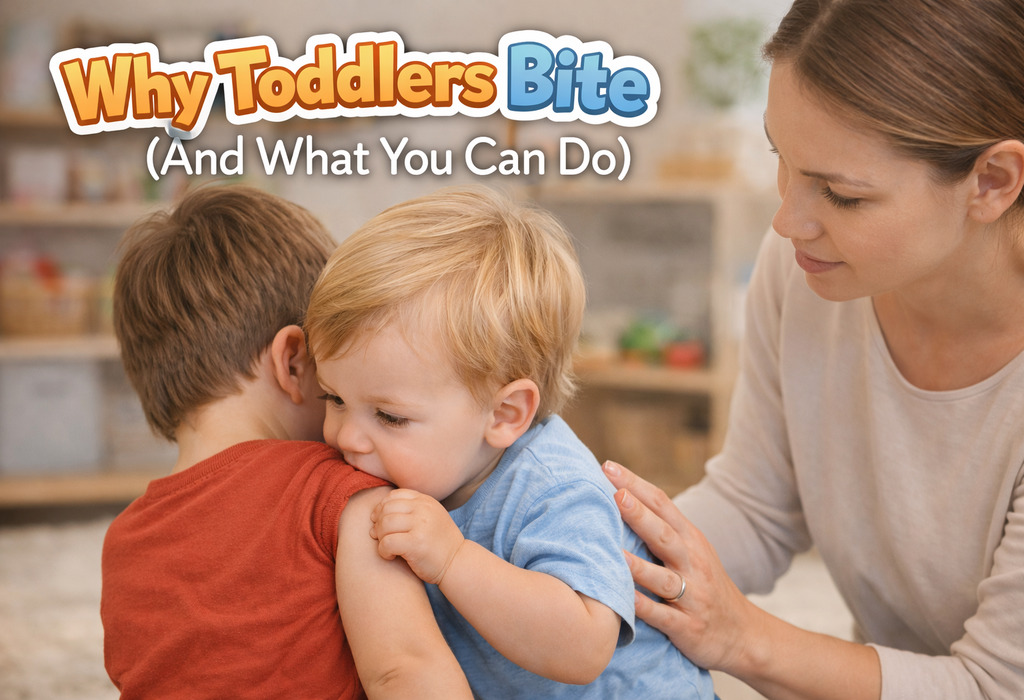
Toddler Biting: What Causes It and How to Stop
Let’s be honest, nothing prepares you for the moment your toddler bites. Not the parenting books, not the advice from relatives, not even your own patience. Parents are left asking why it happens and how to stop it without yelling, bribing, or questioning their life choices.
If this is sounding familiar, take a deep breath. Toddler biting is actually very common, especially in the early years. It does not mean your child is aggressive or doing something wrong. At this age, toddlers are still learning how to handle big emotions, express their needs, and communicate with the people around them. Sometimes, biting is simply the quickest way they know how to react. Thankfully, this phase doesn’t last forever, and there are effective ways to handle it.
In this article, we will talk about why toddlers bite and share easy-to-follow tips to help you stop toddlers from biting without yelling, shaming, or losing your calm.
What Causes Toddlers to Bite?
Most toddlers are not trying to hurt others on purpose. Biting is often their way of dealing with feelings they cannot yet explain. Below are some common reasons why do toddlers bite (1) (2) (3) (4).
Image Credit : AI Generated Image
Teething Discomfort: Sore gums can make toddlers want to bite anything that brings relief. People nearby sometimes become the easiest target.
Limited Language Skills: When toddlers cannot express anger, excitement, or frustration with words, they may use biting instead.
Strong Emotions: Overexcitement, frustration, or feeling overwhelmed can trigger biting, especially during group play or busy settings.
Seeking Attention: Some toddlers notice that biting brings a big reaction from adults. Even negative attention can feel rewarding.
Curiosity and Cause-and-Effect Learning: Toddlers are natural explorers. They may bite simply to see what happens next.
Fatigue or Hunger: A tired or hungry toddler has less patience and self-control, making impulsive behaviours more likely.
What to Do When Your Toddler Bites?
Your response in the moment matters more than you might think. Calm, clear reactions help toddlers learn boundaries without fear or shame. Here’s how you can respond in a way that teaches, not frightens (1).
1. Stay Calm and Respond Right Away
Your reaction sets the tone. Try to stay calm and firm, and let your toddler know that biting is not okay in clear, simple words like, “Biting hurts. We don’t bite.” Big reactions can sometimes make the behaviour more interesting to them, so steady and calm works best (3).
2. Figure Out the “Why” Behind the Bite
Most toddlers bite because they’re overwhelmed, frustrated, tired, or teething, not because they’re being “bad.” Pay attention to patterns: Does it happen when they’re hungry? Overstimulated? Around certain kids? Once you spot the trigger, you can step in earlier next time (2) (5).
3. Don’t Bite Back or Use Harsh Punishments
As tempting as it might be to “teach them a lesson,” biting back or using physical punishment only sends a confusing message (4). Toddlers don’t learn empathy from being hurt; they learn it from seeing it modelled. When we respond gently but firmly, we’re teaching them how to handle big feelings without using their teeth.
4. Give a Short, Calm Time-Out (When Needed)
Image Credit : AI Generated Image
Time-outs can be helpful if they’re used gently and consistently; think of them as a reset, not a punishment. Keep it short (about one minute per year of age), explain why it’s happening (“We take a break because biting hurts”), and reconnect with a hug or calm words afterwards.
5. Notice and Praise the Good Moments
It’s easy to focus on the biting, but don’t miss the moments when your toddler handles a tough situation without using teeth. Catch them being gentle and name it: “I love how you used your words!” Positive attention goes a long way in shaping behaviour (5).
How to Stop a Toddler From Biting?
Now, you might be wondering how to get toddler to stop biting. Although progress may be slow at first, consistent and calm responses help reduce biting over time. The tips below will help you get started (2).
1. Step in Immediately and Set the Boundary
When biting happens, don’t wait it out. Move in right away and clearly let your toddler know biting isn’t okay, using a firm but calm voice. Your tone and facial expression help them understand the seriousness of the moment, even before the words fully sink in (6).
2. Help Them Find Words for Frustration
Many toddlers bite because they don’t know how else to communicate. Teach short, simple phrases they can use when they’re upset, like “Stop,” “Mine,” or “Help me.” Over time, those words can replace the impulse to bite (3).
3. Acknowledge the Feelings Behind the Bite
Image Credit : AI Generated Image
Biting often comes from strong emotions, not bad intentions. Let your child know you see their feelings: “That was really upsetting when your toy was taken.” Feeling understood can calm them down faster than correction alone (5).
4. Notice Patterns and Head Off Triggers
If biting tends to happen around the same situations: certain toys, crowded playdates, or when your toddler is tired; that’s your clue. Adjusting the environment or stepping in earlier can prevent a lot of incidents before they start.
5. Don’t Let Biting ‘Work’ for Them
If your toddler bites to get a toy or space, make sure that tactic doesn’t pay off. Calmly remove them from the situation and return the toy to the other child. When biting doesn’t get results, it loses its power.
6. Focus on Comforting the Child Who Was Hurt
It’s natural to zero in on the biter, but putting your attention on the child who was bitten sends an important message. It shows your toddler that hurting others doesn’t earn extra attention (6).
7. Stay Close During High-Risk Moments
During playdates or busy group settings, keep a closer eye on your toddler. If you notice tension building, step in with a gentle distraction or change of activity. Being proactive beats dealing with tears afterwards (3).
8. Offer Something Safe to Chew
Image Credit : AI Generated Image
For some toddlers, biting is about sensory needs or teething. Having an appropriate item they’re allowed to chew on can meet that need without hurting anyone. Over time, they’ll learn what’s okay to bite and what’s not (5).
9. Give Extra Attention During Big Life Changes
Big transitions can make toddlers act out; new siblings, weaning, moving, or changes in routine can all stir up emotions. A little extra one-on-one time can go a long way in helping them feel secure and less likely to lash out.
10. Model Gentle Behaviour
Toddlers learn by imitation, including how people interact. If playful biting or rough play happens around them, they may copy it with other kids. Showing gentle behaviour in everyday moments gives them a better model to follow.
When to Visit a Doctor?
In most cases, biting in toddlers is a normal developmental phase. Consider speaking with a paediatrician if biting is frequent, severe, continues past age three, or is paired with delays in speech or social interaction (1) (6). A professional can rule out underlying issues and guide you toward extra support if needed.
FAQs
1. How long does the biting phase usually last?
It varies by child, but for most toddlers, biting fades as they learn to talk, share, and manage frustration better. Consistent responses from parents can shorten how long the phase sticks around.
2. Is it normal for toddlers to bite when angry?
Yes! The behaviour of a toddler biting when angry is very common. Most children outgrow it as they develop better communication and emotional regulation skills.
Parenting through a biting phase means showing up again and again, even when it feels uncomfortable or a little embarrassing. It takes patience, quiet strength, and the ability to remind yourself that growth rarely happens in a straight line.
Also Read:
Activities For 2 Year Olds
Helping Your Toddler Cope with Guilt
Tips to Deal with Destructive Behaviour in Toddlers
Common Toddler Behaviour Problems and Their Solutions
Read more
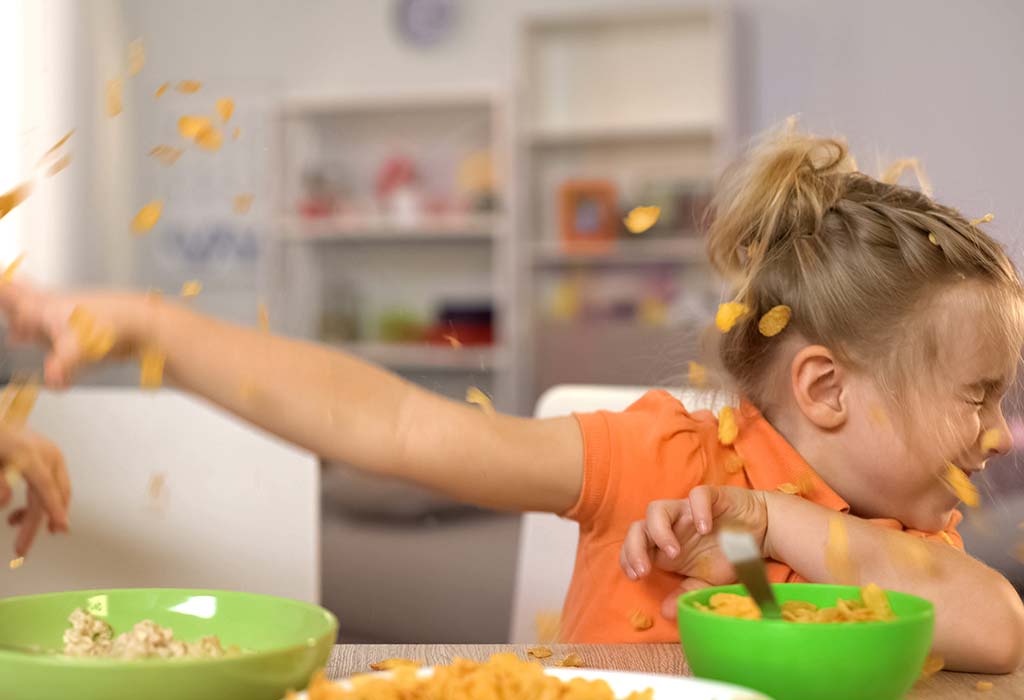
How to Stop Your Toddler From Throwing Food?
Testing limits, experimenting with food, creating artwork with fruit juice are all part and parcel of your kid’s growth phase. Every mom gets frustrated to the core, trying to stop their child from playing with food. But your patience is what is going to help you power through this phase. It gets better once you understand why and how you can stop your toddler from throwing food all around them.
Video : Tips to Stop Your Baby Or Toddler From Throwing Food
Why Do Toddlers Throw Away Their Food?
Toddlers love watching their food all over the place. Most times, they might be just discovering how their gross motor skills work, and sometimes gravity is just fun to observe. During this entire process, when your young one is pushing you over the edge, although unintentionally, you need to understand that from their perspective, it is quite fun to spray and splatter food all over the house.
It can be quite frustrating to watch this entire scene unfold before your eyes while struggling to get your child to eat as mothers and caregivers. In case if you were wondering if this happens only in your home, you don’t have to stress. In almost every home and throughout generations, toddlers ages 8-18 months go through this particular phase of dropping food on the floor.
Often, the reason can be as simple as your baby is not hungry or has major difficulty chewing the food. We often fail to recognize that their teeth and tastebuds are not as developed as ours and become snappy.
We have listed down a few more reasons why most toddlers throw food on the floor that might help you, in the long run, to understand them much better.
Way of communication: If you observe closely, you might learn that dropping food (for some) is a method of non-verbal communication. Once children understand they do not have to eat the food flung on the floor, they might start doing the same whenever they do not like a particular food or how it looks. This is also how toddlers learn to distinguish between food that appeals to them, and that does not.
Cause and effect relationship: Your young scientist is learning how there can be consequences to every action. And in a fun manner! For instance, if you have a dog in the house to lick up the food your child throws on the floor, they might begin to understand the major relationship between cause and effect and how it works.
Forced to eat: Most of us want to finish feeding our toddlers to start on our next work as soon as possible, not realizing that they do not like being fed in that particular way. What it does to most kids is create issues about their eating habits and eventually being very picky with their food. It also happens that sometimes toddlers who have been force-fed more than a couple of times begin to throw their food on the floor as a show of protest.
Attention seeking: Note that if you react when your toddler starts to fling the food across the room, your little one will love it. Kids love attention, and if you are not focused on them while feeding, it compels them to make you notice their presence. As an adult, you have to keep yourself in check and not make it into a power struggle but rather be firm and consistent with your response to them. Once they realize that it no longer triggers you, they will, most probably, stop repeating the behavior.
Now that we have an idea of why most toddlers throw food, let us know about ways to prevent them from doing so.
What to Do When Your Child Throws Food?
Coming to the crux of the matter, what can you do as a parent when your child throws food on the floor, ceiling, and all over the room? Are you going to try to reason with a toddler or get all worked up? Knowing that this might become a daily occurrence in the kitchen, how are you planning on tackling the situation?
To make your mornings a little easier, we have compiled certain easy tips to teach your toddler not to throw food:
1. Offer choices
Most toddlers like having a say in what they consume. You can provide them with two or three options (you can rotate between milk, vegetables, and fruits), making them more interested in their food choices.
2. Eat alongside your toddler
When you give concentrated attention to your child, they feel loved. Most children nowadays lack attention from their parents, making it hard for them in the later years. When you sit alongside your toddler eating and talking with them, you instill certain values and avert potential bad behavior that can probably occur.
3. Put less on their plate
We want our kids to be filled with healthy food that builds up their immune system, forgetting that they would not be able to consume so much. There’s always milk, fruits, one or two vegetables, formula, juice, and whatnot for them to eat up, leaving no time to exhaust all that energy. Here’s where we need to use our senses and realize that more food on the plate means more food for them to play with and use as ammunition.
4. Complying with the rules
When your child is around 20 months old or even before, you can begin to set a clear limit to show that certain behavior like dropping food or flinging them onto the ceiling is frowned upon. A little discipline can help the child to prevent disruptive actions in the future.
5. Divert your child’s attention elsewhere
Children, especially toddlers, have a low attention span. Diverting your child’s attention by playing a game that captures their full attention or making up a storyline that involves food or anything remotely amusing can encourage their eating habit. Parents need to get creative as they come.
6. It’s okay to dislike food
Sometimes toddlers drop food on the floor just because they do not like that particular food. Instead of forcing them to consume something they do not like, you can always offer to take it away from their plate and give them something else to eat. It’s as easy as that. When you try to force them into eating something they dislike, they might act out. What we parents can do is to tackle situations like these smoothly with another solution, creatively.
7. Necessary precautions
You have to make all the necessary arrangements when you know that your toddler throwing food on the floor might make a mess of things, even if it is unintentional. Their fine motor skills have not yet been developed fully, resulting in much scattering and splattering of food. In cases like that, you can roll up their sleeves or put a bib around their neck, place newspapers around their sitting area, and maybe even stay away from the walls and curtains so that you can do damage control.
8. Replacing the fallen food
Try replacing the food your toddler throws on their plate while verbally conveying that food belongs on the plate and not on the floor. You can also teach them to say or show that they are done eating when they are full. It helps them not to overeat but, at the same time, go easy on their hunger pangs.
9. Praising them
If your toddler consumes more food than by your floor or dog, you can call it to be a success. Change does not happen overnight, and for toddlers, it is pretty hard not to poke around and play with food. And so, praising them and applauding their efforts might get you on their good books. They might even take more effort to restrain themselves from the next time onwards.
What to Do If Nothing Works?
If all the above steps to help your baby stop throwing food do not work, have a “discard plate” for your toddler to keep the food they do not want to eat. You can substitute the food with something they like. Even if the child does not eat, at least your house will remain intact. If your toddler is in the mood to play and you have been running behind them trying to get them to eat, it is more likely that food will spray all over the room since your child is in a playful mood and wants nothing to do with eating. Lastly, in each case, remind yourself not to raise your voice harshly as it can negatively impact them the next time they have to eat.
Now that you have a strategy for the next meal with your toddler, you can be relaxed. Most children learn by experimentation and fun. If your home is stress-free and provides a good environment for your toddler to learn and grow, it will help them during their growing up years.
Also Read:
Toddlers Throw or Hit Things
Destructive Behavior in Toddlers
Tips for Handling Demanding Behavior in Toddlers
Read more

Toddler Says ‘No' a Lot
Your little one has reached an age, where he is exercising his independence and asserting himself by saying ‘no’, and often. Now that he knows he has a will, he is going to use it. When you hear your munchkin saying ‘no’ for the first time, you will find it funny, but if he repeatedly uses it, especially for the things you want him to do, you’re likely to ask yourself and fellow parents what you can do to deal with your child’s new-found defiance.
You can start by staying calm. You can also try and find out the reasons for his defiance, before dealing with it.
Why Your Toddler Says ‘No’ a Lot
As babies grow, their minds develop too. Their ability to think grows at a faster pace. When babies enter toddlerhood, they pretty much know what they want and what they don’t. Of course, they are still too young to understand the consequences of certain actions, but they realise that they need to say certain words to get or avoid something. Therefore, they use ‘no’, just like adults do.
If you’ve experienced your toddler’s opposition, remember that it’s normal until it becomes a behavioural issue. Therefore, don’t be taken aback when you get an extreme response. It is, in fact, a sign that your toddler is becoming independent and making his own decisions. Also, opposing is a way for your little one to assert himself and feel in control.
You must also know that toddlers have more than one way to say ‘no’. Yes, they will use the word wherever they want to (sometimes, even when they don’t mean it), but their actions also speak louder than their words. Here are a few more ways your toddler may oppose certain things he doesn’t like.
By avoiding a hug or a cuddle.
Running away from you.
Rejecting an offer made by you.
Refusing your request.
Ignoring or avoiding you.
Pushing you away when you hold him close.
These responses might worry you, but they are pretty useful when it comes to your munchkin’s safety. As a parent, you need to understand when it is normal for your child to say ‘no’, and when it is not.
Understanding Your Opposing Toddler
Toddlers learn to say ‘no’ for several reasons. They may say ‘no’ when they are stressed or don’t feel safe. Sometimes, they would also keep repeating ‘no’, just for fun. Therefore, parents should be able to gauge the reasons the child says ‘no’ for. Look for signs of distress, withdrawal, fear, etc. to know exactly why your little one has a negative response.
If you know that your child has been saying ‘no’ unnecessarily, you need to address the issue immediately as it could lead to the development of behavioural issues. Read on to know how you can gauge your child’s need and take appropriate actions to help him through.
Things Parents Can Do When Toddler Says ‘No’ Often
1. Check for Signs of Fear
As mentioned earlier, check for signs of withdrawal or fear. Your child’s opposition due to fear or threat will be different than when he says no to a vegetable.
2. Give Your Toddler Some Time to Adjust
Saying ‘no’ can be a normal reaction to something new, such as trying out a new dish. In that case, give your little one enough time to adjust to whatever is new in his life.
3. Manage Boredom
Toddlers have a tendency to say ‘no’ to everything they find boring. Your little one could be done playing with his toys, or doesn’t like that orange shirt anymore. You can add a bit of variety by introducing him to new games and activities to keep him interested.
4. Analyse the Negativity
Analyse what your little one does and observe all day. Get to the root of the negativity if required, and gently change his thoughts by communicating with him. Using the whisper technique usually works here. You can hold your little one close and whisper all the positive things about the stuff he says no to. Reiterating positives can help change a child’s negative thoughts. This technique can also be used to correct his behaviour.
5. Ask, Don’t Tell
Opposing inculcates a feeling of being in control. When your child opposes, ask him to do something instead of telling him. When you ask your child something or give him options, he will exercise independence intact and encourage him to be cooperative.
6. Mind What You Say
The way you talk to your child can have an impact on his behaviour. If your child has been saying ‘no’ often, try giving them choices or using positive words when talking to him. Using positive words can get your toddler to cooperate and participate, and he won’t oppose anything you ask him to do. For example, “let’s eat the veggies and then the cookie monsters” instead of “you will not get any cookie if you don’t eat the vegetables”.
When Should You Be Concerned?
You can handle your toddler’s constant defiance by using some of the useful tips given above. But if these tips don’t work and your little one has started showing behavioural issues, you can be firm. Sometimes, it is okay to tell your toddler you are the parent, and you make the decision.
If there’s no change in your child’s behaviour, you may consult a counsellor, who can help you with some more ideas to tackle the issue. The practitioner can also help diagnose any psychological or medical issues that are stressing your toddler out and giving rise to the behavioural issues.
Getting your toddler to say ‘yes’ might be overwhelming, but you’re the parent and you can do it. And we hope the information in this article helps you manage your munchkin’s behaviour. While you modify the way you approach your child, you must also practice patience and perseverance to bring about good results. Also, remember that your child doesn’t have to be a ‘yes’ kid. Hear him out, understand the emotion he is feeling and act accordingly. Respecting his ‘no’ in certain situations will show him that his feelings are valid, and it will slowly but surely build self-respect in him.
Also Read:
Social Anxiety In Your Toddler
Outrageous Things Only Toddlers Can Say!
How to Deal with Demanding Behaviour in Toddlers
Read more
Why Do Toddler Ignore You and What to Do About It?
Life with a toddler can be incredibly fun, with every day bringing something new. But some days can also be frustrating, especially when it seems like your little one just doesn’t want to listen to you. You may ask him to pick up something from the floor, and instead, he takes off in the opposite direction. Or he may have selective hearing and only respond once in a while. However, your toddler ignoring you isn’t always a sign of acting out, and may not be as complicated as it seems. Here is why you think “my toddler ignores me” and what you can do about it.
Reasons Why Your Toddler Is Ignoring You
When your child seemingly ignores you, his sole motive may not be to defy you. Try one of the following explanations and find the answer to “why does my toddler not listen to me”:
1. Personality and Independence
Your child will be more assertive at that age, and he is just discovering his personality and independence. If what you’re telling him to do curbs any of these things, he may assert his independence by ignoring you.
2. Different Agendas
At that age, a toddler’s sole purpose in life is to discover new things around, and your instruction may be the opposite of what he wants to do at that moment. So, if he’s running around the house and you tell him to sit down, he may ignore your instruction because he wants to run about and play. Toddlers also have no perception or regard for safety, so your child may not understand why you’re telling him to stop doing something or hurrying him.
3. Overstimulation
As mentioned earlier, a toddler’s day is mainly filled with playing and discovering new things. Toddlers easily get overstimulated, especially when parents sternly repeat instructions or yell at them, so they space out in an attempt to remove themselves from the situation.
4. Dealing With Emotions
If your child is upset or angry about something, ignoring you may be a way of expressing that anger. Toddlers can’t exactly walk out of the house in a fit of anger, so they do the next best thing, by tuning out of the situation. While this may seem better than him throwing things around the house, you should try and get your child to express his emotions, so he knows its a safe space to tell you how he’s feeling.
5. Caught Up in Something
Children don’t have the ability to multitask or focus on multiple things at once. Hence, when they’re solving a puzzle or are engrossed in some activity, they tend to put in all their concentration into it. If you speak to your child and he ignores, he may just not have heard you because he’s busy doing his own thing.
6. Memory
A toddler’s ability to retain information develops over time. Sometimes your child may have genuinely got distracted and forgotten the instruction you gave him, even if it was just a few minutes earlier.
7. Low Impulse Control
Toddlers are very impulsive, so if you tell your little one not to do something, chances are it must be all he can think about now. Of course, this is something that should later be controlled using certain measures so your child listens to you.
What to Do If Your Child Ignores You?
Your child ignoring you doesn’t have to be met by a yelling match. Remember, he’s only a tiny human trying to discover and adjust to the world around him. Here are some things you could do instead.
1. Be Clear and Specific
Instead of saying ‘clean up this space’, say ‘pick up your toys from the floor and put them on that table’. Being clear and specific about what you want your toddler to do will leave out any confusion.
2. Simplify Instructions
Giving your toddler a 3 step instruction will only overstimulate him and make him anxious. Instead, give instructions with only 1-2 steps at a time. You may have to wait while your child catches up, but its better than not having the task done at all, right?
3. Be Understanding
Simply observing how your child reacts to different situations, different tones of voice etc. will give you an idea of how to get through to him. Every child is different, so each of them responds in different manners. Also, expecting your child to drop what he’s doing and follow your instruction is unreasonable, as you wouldn’t want that to be done to you either, right? Understand that your child may be overwhelmed or simply too caught up to listen, so give him some space and time.
4. Follow Through With the Instruction
If you tell your child to stop doing something and he doesn’t, go up to him and do it yourself. For example, if you tell him not to climb on a chair and he just won’t listen, go and pick him up off the chair yourself. Letting it go all the time simply gives kids the idea that not listening will be tolerated.
5. Use Incentives
Reward and punishment are often used together, but even just one aspect without the other works wonders. When it doubt, always go for positive reinforcement. Give your child incentives for listening to you, even if its as small as a sticker, a cookie, or even a compliment. You’ll see how quickly he listens to you.
6. Stop Saying ‘No’
If you constantly say no to whatever your child asks, he/she anticipates a negative response and will simply start ignoring you. That doesn’t mean you have to say yes to every single thing your child wants! Instead, find an alternative to the word ‘no’. For example, if your toddler wants to have chocolate, don’t say no. Say, ‘you can have one after lunch’.
7. Get Their Attention
Gently call their name or try to make eye contact. Sometimes, children get lost in their thoughts or activities, and a simple nudge can refocus their attention.
8. Use Positive Reinforcement
Encourage positive behaviour by acknowledging when they do listen and respond. Praise them for their attention and engagement.
9. Find the Right Moment to Talk
Timing is crucial. Choose a moment when your child is relaxed and open to conversation. Avoid addressing the issue in the midst of a conflict or when they’re engrossed in something else.
FAQs
1. Does Shouting on Toddlers Make Any Effect?
Shouting at toddlers can have short-term effects, like immediate compliance due to fear, but it’s not an effective long-term parenting strategy. It can lead to anxiety and defiance and hinder healthy communication and emotional development.
2. At What Age Does Toddler Behaviour Improve?
Toddler behaviour typically starts to improve around the age of 3 to 4 years old. At this stage, many children have developed better communication and social skills, as well as increased emotional regulation. However, it’s important to note that each child is unique, and development can vary. Consistent and patient parenting plays a significant role in fostering positive behaviour.
Reading situations will help you figure out how to get toddlers to listen when they are ignoring you. Remember, your toddler is only a small human trying to discover the world around him, so whatever you do, don’t curb that.
Also Read:
Helping Your Toddler Cope with Guilt
How to Handle Aggresive Behavior in Toddlers?
Tips to Deal with Destructive Behaviour in Toddlers
Common Toddler Behaviour Problems and Their Solutions
Read more
30 Short Moral Stories in English for Kids
Short moral stories for kids have been an essential part of a child’s moral education for generations. These short moral stories in English are not only entertaining but also have a profound impact on a child’s character and personality development. They instil many vital values, such as honesty, kindness, compassion, and respect for others, which go a long way in life.
As kids listen to these stories, they learn valuable life lessons that they can practically apply to their lives. These stories help them navigate their own life more easily. With a vast array of stories to choose from, parents can select tales that are not only age-appropriate but also reinforce the values they want their child to learn. These stories will help them raise their children to be ideal citizens of society who are compassionate towards both animals and humans.
In this article, we have shortlisted engaging and meaningful moral stories for children that can teach them valuable lessons and help them become better individuals.
30 Popular Short Moral Stories for Kids
If you want to imbibe good habits in your kids from early on and watch them grow up to become good individuals, read moral stories to them. Here are 30 children’s stories with moral values that you can read to your kids!
1. The Lion and the Mouse
A lion was once sleeping in the jungle when a mouse started running up and down his body just for fun. This disturbed the lion’s sleep, and he woke up quite angry. He was about to eat the mouse when the mouse desperately requested the lion to set him free. “I promise you, I will be of great help to you someday if you save me.” The lion laughed at the mouse’s confidence and let him go.
One day, a few hunters came into the forest and took the lion with them. They tied him up against a tree. The lion was struggling to get out and started to whimper. Soon, the mouse walked past and noticed the lion in trouble. Quickly, he ran and gnawed on the ropes to set the lion free. Both of them sped off into the jungle.
Moral of the Story
A small act of kindness can go a long way.
Also Read: Childhood Stories of Lord Krishna for Kids
2. Count Wisely
One day, king Akbar asked a question in his court that left everyone in the courtroom puzzled. As they all tried to figure out the answer, Birbal walked in and asked what the matter was. They repeated the question to him.
The question was, “How many crows are there in the city?”
Birbal immediately smiled and went up to Akbar. He announced the answer; he said there were twenty-one thousand, five hundred and twenty-three crows in the city. When asked how he knew the answer, Birbal replied, “Ask your men to count the number of crows. If there are more, then the relatives of the crows must be visiting them from nearby cities. If there are fewer, then the crows from our city must be visiting their relatives who live outside the city.” Pleased with the answer, Akbar presented Birbal with a ruby and pearl chain.
Moral of the Story
Having an explanation for your answer is just as important as having an answer.
Also Read: Fascinating Ramayana Stories for Children
3. The Boy Who Cried Wolf
In a village, lived a carefree boy with his father. The boy’s father told him that he was old enough to watch over the sheep while they graze in the fields. Every day, he had to take the sheep to the grassy fields and watch them as they graze. However, the boy was unhappy and didn’t want to take the sheep to the fields. He wanted to run and play, not watch the boring sheep graze in the field. So, he decided to have some fun. He cried, “Wolf! Wolf!” until the entire village came running with stones to chase away the wolf before it could eat any of the sheep. When the villagers saw that there was no wolf, they left muttering under their breath about how the boy had wasted their time. The next day, the boy cried once more, “Wolf! Wolf!” and, again, the villagers rushed there to chase the wolf away.
The boy laughed at the fright he had caused. This time, the villagers left angrily. The third day, as the boy went up the small hill, he suddenly saw a wolf attacking his sheep. He cried as hard as he could, “Wolf! Wolf! Wolf!”, but not a single villager came to help him. The villagers thought that he was trying to fool them again and did not come to rescue him or his sheep. The little boy lost many sheep that day, all because of his foolishness.
Moral of the Story
It is difficult to trust people who lie, so it’s important to always be truthful.
Also Read: Short Stories of the Mahabharata for Kids with Moral Lessons
4. The Fox and the Stork
One day, a selfish fox invited a stork for dinner. Stork was very happy with the invitation – she reached the fox’s home on time and knocked at the door with her long beak. The fox took her to the dinner table and served some soup in shallow bowls for both of them. As the bowl was too shallow for the stork, she couldn’t have soup at all. But, the fox licked up his soup quickly.
The stork was angry and upset, but she didn’t show her anger and behaved politely. To teach a lesson to the fox, she then invited him for dinner the next day. She too served soup, but this time the soup was served in two tall narrow vases. The stork devoured the soup from her vase, but the fox couldn’t drink any of it because of his narrow neck. The fox realised his mistake and went home famished.
Moral of the Story
A selfish act backfires sooner or later!
Also Read: Indian Mythological Stories for Kids
5. The Golden Touch
Once there lived a greedy man in a small town. He was very rich, and he loved gold and all things fancy. But he loved his daughter more than anything. One day, he chanced upon a fairy. The fairy’s hair was caught in a few tree branches. He helped her out, but as his greediness took over, he realised that he had an opportunity to become richer by asking for a wish in return (by helping her out). The fairy granted him a wish. He said, “All that I touch should turn to gold.” And his wish was granted by the grateful fairy.
The greedy man rushed home to tell his wife and daughter about his wish, all the while touching stones and pebbles and watching them convert into gold. Once he got home, his daughter rushed to greet him. As soon as he bent down to scoop her up in his arms, she turned into a gold statue. He was devastated and started crying and trying to bring his daughter back to life. He realised his folly and spent the rest of his days searching for the fairy to take away his wish.
Moral of the Story
Greed will always lead to downfall.
6. The Milkmaid and Her Pail
Patty, a milkmaid, milked her cow and had two full pails of fresh, creamy milk. She put both pails of milk on a stick and set off to the market to sell the milk. As she took steps towards the market, her thoughts took steps towards wealth. On her way, she kept thinking about the money she would make from selling the milk. Then she thought about what she would do with that money.
She was talking to herself and said, “Once I get the money, I’ll buy a chicken. The chicken will lay eggs, and I will get more chickens. They’ll all lay eggs, and I will sell them for more money. Then, I’ll buy the house on the hill, and everyone will envy me.” She was very happy that soon she would be very rich. With these happy thoughts, she marched ahead. But suddenly, she tripped and fell. Both the pails of milk fell, and all her dreams were shattered. The milk spilt onto the ground, and all Patty could do was cry. “No more dream,” she cried foolishly!
Moral of the Story
Do not count your chickens before they are hatched.
Also Read: Popular Fairy Tale Stories for Kids
7. When Adversity Knocks
This is a story that explains how adversity is met differently by different people. There was a girl named Asha who lived with her mother and father in a village. One day, her father assigned her a simple task. He took three vessels filled with boiling water. He placed an egg in one vessel, a potato in the second vessel, and some tea leaves in the third vessel. He asked Asha to keep an eye on the vessels for about ten to fifteen minutes while the three ingredients in three separate vessels boiled. After the said time, he asked Asha to peel the potato and egg, and strain the tea leaves. Asha was left puzzled – she understood her father was trying to explain her something, but she didn’t know what it was.
Her father explained, “All three items were put in the same circumstances. See how they’ve responded differently.” He said that the potato turned soft, the egg turned hard, and the tea leaves changed the colour and taste of the water. He further said, “We are all like one of these items. When adversity calls, we respond exactly the way they do. Now, are you a potato, an egg, or tea leaves?”
Moral of the Story
We can choose how to respond to a difficult situation.
8. The Proud Rose
Once upon a time, there was a beautiful rose plant in a garden. One rose flower on the plant was proud of its beauty. However, it was disappointed that it was growing next to an ugly cactus. Every day, the rose would insult the cactus about its looks, but the cactus stayed quiet. All the other plants in the garden tried to stop the rose from bullying the cactus, but the rose was too swayed by its own beauty to listen to anyone.
One summer, a well in the garden dried up and there was no water for the plants. The rose slowly began to wilt. The rose saw a sparrow dip its beak into the cactus for some water. The rose then felt ashamed for having made fun of the cactus all this time. But because it was in need of water, it went to ask the cactus if it could have some water. The kind cactus agreed, and they both got through summer as friends.
Moral of the Story
Never judge someone by the way they look.
Also Read: Bible Stories for Children
9. The Tale of the Pencil
A boy named Raj was upset because he had done poorly in his English test. He was sitting in his room when his grandmother came and comforted him. His grandmother sat beside him and gave him a pencil. Raj looked at his grandma puzzled, and said he didn’t deserve a pencil after his performance in the test.
His grandma explained, “You can learn many things from this pencil because it is just like you. It experiences a painful sharpening, just the way you have experienced the pain of not doing well on your test. However, it will help you be a better student. Just as all the good that comes from the pencil is from within itself, you will also find the strength to overcome this hurdle. And finally, just as this pencil will make its mark on any surface, you too shall leave your mark on anything you choose to.” Raj was immediately consoled and promised himself that he would do better.
Moral of the Story
We all have the strength to be who we wish to be.
10. The Crystal Ball
Nasir, a small boy, found a crystal ball behind the banyan tree of his garden. The tree told him that it would grant him a wish. He was very happy and he thought hard, but unfortunately, he could not come up with anything he wanted. So, he kept the crystal ball in his bag and waited until he could decide on his wish.
Days went by without him making a wish but his best friend saw him looking at the crystal ball. He stole it from Nasir and showed it to everyone in the village. They all asked for palaces and riches and lots of gold, but could not make more than one wish. In the end, everyone was angry because no one could have everything they wanted. They became very unhappy and decided to ask Nasir for help. Nasir wished that everything would go back to how it was once, before the villagers had tried to satisfy their greed. The palaces and gold vanished and the villagers once again became happy and content.
Moral of the Story
Money and wealth do not always bring happiness.
11. A Bundle of Sticks
Once upon a time, three neighbours living in a village were having trouble with their crops. Each of the neighbours had one field, but the crops on their fields were infested with pests and were wilting. Every day, they would come up with different ideas to help their crops. The first one tried using a scarecrow in his field, the second used pesticides, and the third built a fence on his field, all to no avail.
One day, the village head came by and called the three farmers. He gave them each a stick and asked them to break it. The farmers could break them easily. He then gave them a bundle of three sticks, and again, asked them to break it. This time, the farmers struggled to break the sticks. The village head said, “Together, you are stronger and work better than you do it alone.” The farmers understood what the village head was saying. They pooled in their resources and got rid of the pests from their fields.
Moral of the Story
There is strength in unity.
12. The Ant and the Dove
On a hot scorching day of summer, an ant was walking around in search of water. After walking around for some time, she saw a river and was delighted to see it. She climbed up on a small rock to drink the water, but she slipped and fell into the river. She was drowning but a dove who was sitting on a nearby tree helped her. Seeing the ant in trouble, the dove quickly dropped a leaf into the water. The ant moved towards the leaf and climbed up on it. The dove then carefully pulled the leaf out and placed it on the land. This way, the ant’s life was saved and she was forever indebted to the dove.
The ant and the dove became the best of friends and days passed happily. However, one day, a hunter arrived at the forest. He saw the beautiful dove sitting on the tree and aimed his gun at the dove. The ant, who was saved the dove saw this and bit on the heel of the hunter. He shouted from the pain and dropped the gun. The dove was alarmed by the voice of the hunter and realised what could have happened with him. He flew away!
Moral of the Story
A good deed never goes unrewarded.
13. The Fox and the Grapes
On a hot summer day, a fox wandered across the jungle in order to get some food. He was very hungry and desperately in search of food. He searched everywhere, but couldn’t find anything that he could eat. His stomach was rumbling and his search continued. Soon he reached a vineyard which was laden with juicy grapes. The fox looked around to check if he was safe from the hunters. No one was around, so he decided to steal some grapes. He jumped high and high, but he couldn’t reach the grapes. The grapes were too high but he refused to give up. The fox jumped high in the air to catch the grapes in his mouth, but he missed. He tried once more but missed again. He tried a few more times, but couldn’t reach. It was getting dark and the fox was getting angry. His legs hurt, so he gave up in the end. Walking away, he said, “I’m sure the grapes were sour anyway.”
Moral of the Story
We pretend to hate something when we can’t have it.
14. The Ant and the Grasshopper
Once upon a time, there were two best friends – an ant and a grasshopper. The grasshopper liked to relax the whole day and play his guitar. The ant, however, would work hard all day. He would collect food from all corners of the garden, while the grasshopper relaxed, played his guitar, or slept. The grasshopper would tell the ant to take a break every day, but the ant would refuse and continue his work. Soon, winter came; days and nights became cold and very few creatures went out.
On a cold day of winter, a colony of ants was busy drying out some grains of corn. The half-dead grasshopper, cold and hungry, came up to the ant who was his friend and asked for a piece of corn. The ant replied, “We work day and night to collect and save up the corn so that we don’t die hungry on cold winter days. Why should we give it to you?” The ant further asked, “What were you doing last summer? You should have collected and stored some food. I told you as much before.”
The grasshopper said, “I was far too busying singing and sleeping.”
The ant replied, “You can sing all winter as far as I am concerned. You will not get anything from us.” The ant had enough food to last through the winter, without any worries at all, but the grasshopper didn’t and he realised his mistake.
Moral of the Story
Make hay while the sun shines.
15. The Bear and Two Friends
One day, two best friends were walking on a lonely and dangerous path through a jungle. As the sun began to set, they grew afraid but held on to each other. Suddenly, they saw a bear in their path. One of the boys ran to the nearest tree and climbed it in a jiffy. The other boy did not know how to climb the tree by himself, so he lay on the ground, pretending to be dead. The bear approached the boy on the ground and sniffed around his head. After appearing to whisper something in the boy’s ear, the bear went on its way. The boy on the tree climbed down and asked his friend what the bear had whispered in his ear. He replied, “Do not trust friends who do not care for you.”
Moral of the Story
A friend in need is a friend indeed.
16. Friends Forever
Once upon a time, there lived a mouse and a frog, who were the best of friends. Every morning, the frog would hop out of the pond to visit the mouse, who lived inside the hole of the tree. He would spend time with the mouse and go back home. One day, the frog realised that he was making too much of an effort to visit the mouse while the mouse never came to meet him at the pond. This made him angry, and he decided to make things right by forcefully taking him to his house.
When the mouse wasn’t looking, the frog tied a string to the mouse’s tail and tied the other end to his own leg, and hopped away. The mouse started getting dragged with him. Then, the frog jumped into the pond to swim. However, when he looked back, he saw that the mouse had started to drown and was struggling to breathe! The frog quickly untied the string from his tail and took him to the shore. Seeing the mouse with his eyes barely open made the frog very sad, and he immediately regretted pulling him into the pond.
Moral of the Story
Don’t take revenge because it can be harmful to you.
17. The Elephant and Her Friends
Once upon a time, a lone elephant made her way into a strange forest. It was new to her, and she was looking to make friends. She approached a monkey and said, “Hello, monkey! Would you like to be my friend?” The monkey said, “You are too big to swing like me, so I can’t be your friend.” The elephant then went to a rabbit and asked the same question. The rabbit said, “You are too big to fit in my burrow, so I can’t be your friend.” The elephant also went to the frog in the pond and asked the same question. The frog replied, “You are too heavy to jump as high as me, so I can’t be your friend.”
The elephant was really sad because she couldn’t make friends. Then, one day, she saw all the animals running deeper into the forest, and she asked a bear what the fuss was about. The bear said, “The lion is on the loose – they are running from him to save themselves.” The elephant went up to the lion and said, “Please don’t hurt these innocent people. Please leave them alone.” The lion scoffed and asked the elephant to move aside. Then, the elephant got angry and pushed the lion with all her might, injuring him. All the other animals came out slowly and started to rejoice about the lion’s defeat. They went to the elephant and said to her, “You are just the right size to be our friend!”
Moral of the Story
A person’s size does not determine their worth.
18. The Woodcutter and the Golden Axe
There was once a woodcutter working hard in the forest, getting wood to sell for some food. As he was cutting a tree, his axe accidentally fell into the river. The river was deep and was flowing really fast – he lost his axe and could not find it again. He sat at the bank of the river and wept.
While he wept, the God of the river arose and asked him what had happened. The woodcutter told him the story. The God of the river offered to help him by looking for his axe. He disappeared into the river and retrieved a golden axe, but the woodcutter said it was not his. He disappeared again and returned with a silver axe, but the woodcutter said that was not his either. The God disappeared into the water again and came back with an iron axe – the woodcutter smiled and said it was his. God was impressed with the woodcutter’s honesty and gifted him both the golden and silver axes.
Moral of the Story
Honesty is the best policy.
19. The Needle Tree
There lived two brothers near a forest. The elder one was very mean to the younger brother – he would finish all the food and wear all the new clothes of his younger brother. One day, the elder brother decided to go into the forest to get some firewood and sell it at the market. As he went around, chopping tree after tree, he stumbled upon a magical tree. The tree said, “Oh, kind sir, please do not cut my branches. If you spare me, I will give you golden apples.” He agreed but was left disappointed with the number of apples the tree gave him. As greed overcame him, he threatened the tree to cut the entire trunk if it didn’t give him more apples. The magical tree, instead, showered upon the elder brother hundreds and hundreds of tiny needles. The elder brother lay on the ground, crying in pain, as the sun set.
The younger brother was worried, and so he searched for his elder brother. He found him lying in pain near the tree, with hundreds of needles on his body. He rushed to his brother and removed each needle lovingly and gently. After he finished, the elder brother apologised for treating him badly and promised to improve. The tree saw the change in the elder brother’s heart and gave them all the golden apples they would ever need.
Moral of the Story
It is important to be kind and gracious, as it will always be rewarded.
20. The Greedy Lion
On a hot day, a lion in the forest started feeling hungry. He was starting to hunt for his food when he found a hare roaming around alone. Instead of catching the hare, the lion let it go – “A small hare such as this can’t satisfy my hunger”, he said and scoffed. Then, a beautiful deer passed by, and he decided to take his chances – he ran and ran behind the deer, but since he was weak because of hunger, he struggled to keep up with the deer’s speed. Tired and defeated, the lion went back to look for the hare to fill up his stomach for the time being, but it was gone. The lion was sad and remained hungry for a long time.
Moral of the Story
Greed is never a good thing.
21. The Goose and the Golden Eggs
Once upon a time, a farmer lived with his wife in their cottage. They had a goose that would lay one golden egg every day. The farmer and his wife were mighty pleased because of this. Every morning, the wife would set out with her basket to collect all the eggs from the hens and the goose. But over time, they started getting greedier. They wondered if the process could be sped up. They were very upset that they were getting just one golden egg daily. They wondered that if the goose was laying golden eggs, its insides must surely be made of gold too! They imagined getting rich as they would get all the gold at once. So, they caught hold of the poor bird and killed it. Alas, upon opening it, they didn’t find any gold, and the insides of the goose were like those of any other bird.
Moral of the Story
Think before you act.
22. The Greedy Dog
Once upon a time, there was a dog who was roaming around the village in search of food. He was a greedy dog and never satisfied with whatever he had. On one particular day, he managed to snatch a piece of bone from a butcher’s shop and ran away to eat it in peace. On the way, he came across a river. He was very curious, so holding the bone, he peeped into the river. He was astonished when he saw his reflection. But he thought that it was another dog with a bone. As this dog was greedy, he wanted that bone too. So he opened his mouth and started barking in the hopes that the other dog would get scared and leave his bone behind. But, as soon as he opened his mouth, his bone fell into the river and started floating away. The dog then got upset that in his greed to get the second bone, he lost his own bone.
Moral of the Story
Do not be greedy.
23. The Tortoise and the Hare
In a lush forest, a speedy hare was always bragging about how fast he could run. Tired of his boasting, a slow but steady tortoise challenged him to a race. The hare laughed at the idea but agreed. When the race began, the hare quickly raced ahead. Seeing the tortoise far behind, he decided to take a nap under a tree, confident he could still win. Meanwhile, the tortoise kept moving slowly but without stopping. When the hare woke up, he saw the tortoise near the finish line. He sprinted, but it was too late—the tortoise had already won the race.
Moral of the Story
Slow and steady wins the race.
24. The Wind and the Sun
The Wind and the Sun were arguing about who was stronger. They saw a traveller walking below wearing a cloak. They agreed that whoever could make the traveller remove his cloak would be the stronger one. The Wind went first. He blew with all his might, but the traveller only wrapped his cloak tighter. Then, the Sun took his turn. He shone gently and warmly. The traveller, feeling the pleasant heat, soon untied his cloak. The Sun shone brighter, and the traveller, now too warm, took off his cloak completely.
Moral of the Story
Kindness and gentleness are often more effective than force.
25. The Crow and the Pitcher
On a hot summer day, a very thirsty crow was searching for water. After a long time, he found a pitcher with a little water at the bottom. He tried to drink, but his beak could not reach the water. He thought of tipping the pitcher over, but it was too heavy. Then, he had an idea. He started picking up pebbles nearby and dropping them one by one into the pitcher. The water level slowly rose. He kept adding pebbles until the water was high enough for him to drink. His cleverness saved his life.
Moral of the Story
Where there is a will, there is a way.
26. The Dog in the Manger
A sleepy dog found a comfortable manger filled with soft hay in a stable. He curled up and went to sleep. Later, the tired oxen returned from the fields, hungry for the hay in the manger. But the dog woke up, snarled and barked, refusing to let the oxen near. He wouldn’t eat the hay himself, but he wouldn’t let the oxen eat it either. The oxen shook their heads and said, “How selfish you are! You don’t need this hay, yet you won’t let us have it.”
Moral of the Story
Do not prevent others from having something that you cannot enjoy yourself.
27. The City Mouse and the Country Mouse
A country mouse invited his city cousin for a simple meal of roots and grains. The city mouse turned up his nose at the plain food and said, “Come visit me, and you shall dine like a king!” In the city, the country mouse was amazed by the feast of cheese, fruit, and cake on the table. But their meal was constantly interrupted by the terrifying sound of dogs barking and people coming and going. The country mouse finally said, “Your food is fine, but I would rather eat my simple meal in peace than live in such constant fear.” He returned to his quiet home.
Moral of the Story
A simple, peaceful life is better than a lavish one filled with danger and fear.
28. The Belling of the Cat
A family of mice lived in constant fear of the house cat. One day, they held a meeting to decide on a plan. A young mouse boldly proposed, “Let us tie a bell around the cat’s neck! Then we will hear him coming and can run away in time.” All the mice cheered for this brilliant plan. Then, an old, wise mouse stood up and asked quietly, “That is a wonderful idea, but who will volunteer to bell the cat?” The mice fell silent. No one was willing to take the risk.
Moral of the Story
It is easy to propose impossible solutions, but much harder to carry them out.
29. The Monkey and the Crocodile
A clever monkey lived in a fruit tree by a river and became friends with a crocodile, often giving him fruit.
The crocodile’s wife grew jealous and demanded the monkey’s heart. The crocodile reluctantly invited the monkey for a ride on his back, planning to kill him. Midway, he confessed his plan. The quick-thinking monkey said, “Oh dear! I left my heart in the tree. Let’s go back for it.” The crocodile swam back, and the monkey jumped to safety, saying, “You can’t trick a true friend!”
Moral of the Story
Quick thinking can save you from danger.
30. The Two Pots
A brass pot and a clay pot were carried down the river together. The brass pot, strong and shiny, suggested they float side by side. The clay pot replied, “Please, dear friend, stay away from me. If you bump into me even gently, I will break into pieces. It’s safer for me to keep my distance.” They floated with space between them.
Moral of the Story
It is wise to know your own weaknesses and to avoid situations where you might get hurt.
Benefits of Moral Stories for Kids
Moral stories for kids benefit them in more ways than one can imagine. The following are the benefits:
1. Prepare kids for their role in society
Moral stories help kids understand what’s right and what’s wrong. They impart a belief system which will help the child cope very well with whatever life has to offer.
2. Help kids become resilient
Very short stories for kids with morals help the child navigate life’s ups and downs by imparting strong ethics and moral values to them. These stories act like guidelines to help the little ones make the right choices.
3. Counter bad influence
Many children start picking up vices under peer pressure. Good values from moral stories help the child stay strong and not succumb to temptations.
Tips on Making Storytime Interesting for Your Kids
No matter how good or engaging a story may be, how you recite it to your kids will make all the difference. If you want to make story sessions fun (and less preachy) for your kids, here are some tips on narrating stories.
Be creative while you read the story to your child. Usually, the personality or character of the story catches a child’s interest the most. So use different voices for each character or act out various parts from the story to bring life to those characters. Acting out parts from the story will make story sessions fun and memorable for your kids.
If you use books or pictures, lay them before your kids. You can ask them to turn the pages or trace the words as you read.
Talk about the story after you’ve finished reciting it. Ask your children questions along the way and discuss the moral of the story in the end. This way, you will also know if your children understood what happened in the story. Asking questions from time to time will keep children engaged and promote speech development in kids. You can also highlight new words in the story and tell their meanings to your kids – this will develop their vocabulary.
Read aloud together with your kids. Ask your child to read with you. This will encourage your child’s reading habits and improve his reading skills.
Take stories outdoors. You don’t have to sit on the bed with your kids while narrating a story to them – you can take the story beyond the four walls of your home. For instance, if you are reading a story on ‘fun in the park’, take your child to an amusement park, lay a blanket under a tree in that park, and read the story there. This will make the story more life-like, and your kid will enjoy it even more.
Try reading stories at different times of the day. Storytime need not always be bedtime. Try reading stories to your kids at different times of the day, like in the afternoon or evening, to understand your child’s attention span. Once you know the time when your child’s attention span is the highest, read stories to him during that time.
These were some inspiring and motivational short stories with a moral. Make storytime fun and exciting with the above tips. These tips will help you leave an impact on your kids and make storytime the favourite part of their day. Also, read the above short moral stories to your kids – we are sure they will enjoy listening to these stories. Furthermore, these easy short stories with moral values will even teach your children some important lessons which they will always remember.
Infographic: Benefits of Moral Stories for Kids
Also Read:
Inspirational Stories for Kids
Interesting Bedtime Stories for Kids
Bedtime Princess Stories for Children
Short Panchatantra Stories for Children
Read more

Nurturing Parenting – What It Is & How to Be One
Nurturing a child is incredibly important as it plays a vital role in helping the child grow into a healthy, confident, and well-rounded individual. So, how exactly should parents nurture their kids? If that’s what you wish to know, we recommend going through this post. We tell you how you can become a nurturing parent by incorporating nurturing parenting activities into your daily routine. These activities can include spending quality time together, creating a safe and supportive environment and more. By engaging in such nurturing parenting activities, you can foster a strong emotional bond with your child and help them thrive in all aspects of life.
What Is Nurturing Parenting?
Every parent loves their child and makes the best efforts to protect them. However, being a nurturing parent is more than that. If you are wondering why it is important to be a nurturing parent, this is why: apart from loving and protecting your child, the child also needs to be understood and listened to, and you need to be there for your kid. A child who feels secure in a family grows into a better individual. Nurturing is essential in bringing up a child, as it helps in the overall well-being, growth, and development of a child. Nurturing parenting skills are essential for fostering a child’s emotional well-being, building trust, and creating a strong foundation for their overall development.
How to Be a Nurturing Parent?
A child who is nurtured from the start grows into a healthy, well-balanced individual, and being a nurturing parent can help him lead a better life. Here are some qualities of a nurturing parent that you can incorporate:
1. Quality Time With Your Kid
It is vital to spend quality time with your child. Being around your child but not being involved with him fruitfully is not productive – you should do things where both you and your child can be fully involved. You can play games, read books, cook, or do any such kind of activity that requires interacting with the child on a one-on-one level.
2. Express Warmth and Love
Some parents feel that it is okay not to express love and affection towards babies because they may not understand such emotions. But this is not true as kids can develop an understanding of love and affection from a very young age. Start expressing your affection towards your child from a young age and let them know you are always there for them. Soothe your little munchkin when he cries; it will send a positive signal to his mind.
3. Make a Routine
Getting your child into a set routine is also an important part of nurturing. When a child is told what is expected of him, he knows what to do and when to do it. This offers a sense of discipline and clarity in a child’s life, and there is no scope of ambiguity or chaos. This also offers a sense of comfort to the child because he knows what is going to happen next.
4. Listen to Your Kid
Whenever your child comes to you with doubts, worries, or things that he wishes to discuss with you, listen to him. The things that affect a child may look or sound trivial to you, but they may be of great importance to your child. Lending an ear to your child is a great way of telling him that you care for whatever is going in his life.
5. Practice Positive Touch
It is very important for a parent to bond with the child, and physical touch is one of the best ways to bond. Whether it is a pat, a peck on the cheek, or a warm hug, make sure you indulge in these small physical reassurances with your child.
6. Appreciate and Reward
No matter how small the achievement or how little the effort, make sure you appreciate your kid for all his endeavours. This encourages the child to undertake bigger challenges in life.
7. Every Kid Is Different
No two parents are the same, and the same goes for the kids. Even when you have two kids, what may work for one may not work for another. Children have special emotional and physical needs, and as parents, you have to understand and fulfil those.
8. Encourage Your Kid to Interact
Human beings are social beings, and therefore, in order to help our children grow into better social beings, it is important that they learn social skills from a young age. Take your child to parks, library, hobby classes, etc. and help nurture their extrovert side.
9. Keep Your Kid Safe
Provide a safe and secure environment for your child. Also, take measures to inculcate safety habits in your child. Try and avoid potential hazards and educate your child about the same too.
10. Take Care of Yourself
Before you offer your best to your kid, it is important that you pay heed to your needs too. Therefore, before you nurture your kid, it is important to indulge in some self-nurturing, too. Go for a walk, talk to your friends, watch a movie or do anything that helps you relax, rejuvenate and recharge yourself.
FAQs
1. Are nurturing parenting styles effective for children with special needs?
Nurturing parenting can be particularly impactful for children with special needs, as it emphasises patience, adaptability, and unconditional support. Tailoring nurturing parenting activities to meet the child’s specific requirements can help them feel secure and empowered to overcome challenges.
2. How can nurturing parents help children develop emotional resilience in a digital age?
In a world dominated by screens and social media, nurturing parents may wonder how to teach their children emotional resilience. Strategies like limiting screen time, encouraging face-to-face interactions, and modelling healthy coping mechanisms can help children navigate digital challenges while building emotional strength.
3. How can nurturing parents support a child’s unique interests and talents?
Nurturing parenting activities often involve recognising and encouraging a child’s individuality. Parents can foster growth by providing opportunities for exploration, celebrating their child’s achievements, and offering constructive feedback to help them develop their passions and skills.
This was all about becoming a nurturing mother or father. We hope this article helped you understand more about how to be a nurturing parent and helped you incorporate changes in your parenting style.
Also Read:
Montessori Parenting
Authoritative Parenting
Permissive Parenting Style
Techniques of Gentle Parenting
Tips to Improve your Parenting Skills
Read more

Sibling Rivalry – Reasons & Solutions
“Having one child makes you a parent, having two makes you a referee.”
Your first child is at the centre of the universe in your life. Every decision you make is keeping in mind their best interest. The child is also aware of this privileged status and enjoys the undivided attention of parents. Their perfect life changes, however, the day you bring in another child in your life. The birth of a sibling can be a stressful event in your child’s life.
Video: Sibling Rivalry in Children – Reasons and Solutions
What Does Sibling Rivalry Mean?
Siblings can be the best of friends or worst of enemies. Based on their situation, they can either love or hate each other, but they cannot ignore their presence in each other’s life.
It is common for siblings to fight and then make up with each other. While it can be frustrating to see your kids fight over trivial matters, it should not be a reason for you to lose your sanity. But, you can reduce the frequency of fights and promote peace in your home by making some ground rules.
What Causes Sibling Rivalry?
Sibling rivalry starts soon after the second child is born and it will continue all through their growing years. Siblings compete for everything: from parents’ attention to toys, anything shared between them could be a potential area of conflict. In a way, it is healthy as they will learn to compete, share and reach compromises. These qualities can help them in dealing with relationships later in life. Some reasons for this rivalry can be:
Jealousy – Being the firstborn, your toddler is used to getting your undivided attention. Now they will have to share you with another individual who is pretty much incapable of doing anything and is entirely dependent on you. It can make your child feel neglected as this new entrant in the family now gets all the attention. As they grow, the jealousy can flare up as you ask them to share their toys, room, bed, clothes, books, etc.
Comparison – It is very common for parents, family, friends or relatives to compare siblings. It could be a comparison based on their physical appearance or temperament, nature, communication, mannerism, hobbies, eating habits, skills, etc. This continuous comparison could make them feel lesser compared to their sibling and can be a cause of long-lasting rivalry.
Individual temperament – Every child is unique and will have a different temperament. Their mood, disposition, adaptability, etc., will form a part of their personality. It will play an essential role in how they will get along with others. Some kids are introverted and may not be bothered by their sibling taking up attention. Others may require extra love, care, and attention. The same personality traits can be a reason for conflict as both kids will want a similar amount of attention.
Special needs / Unwell child – Sometimes, a child could have special needs because of ill health, slow learning, emotional needs or physical disability. This will require the parent to dedicate more time to them and maybe a reason for the other child to be jealous of their sibling.
Evolving needs – In most families, the younger child will inherit things used by the older sibling, making them feel jealous of being unable to get new things. Similarly, the older sibling may have a special attachment to their belongings and not be ready to share them. As they grow up, they will develop a sense of individuality and may resent taking care of their sibling or sharing household responsibility. They will not want to play with someone of a different age group and maybe looking forward to spending more time with their own friends.
Role Models – Your kids will learn from you. Ensure that you set the right examples; if you resolve conflicts with your partner in a respectful way, they will learn the same. If you are aggressive in their presence, be assured of similar behaviour from them.
Sibling Rivalry Between Toddler And Baby
When you are unable to handle your toddlers’ rival attitude towards the newborn, it can get frustrating. You are already going through post-partum stress, and your toddler’s hostile behaviour can add to your misery.
Think from the child’s point of view. It is a stressful time for them too. They will find it tough to accept the newborn as a part of life. They are used to getting undivided attention, and they are losing this privilege. They will show their discomfort by misbehaving, yelling, shouting, crying. Some could go to the extent of making unnecessary demands, stealing, breaking things, hurting the baby or even themselves. They can be annoyed by the newborn’s constant crying or merely the fact that you are dedicating more time to the baby. Their demands could be as silly as being carried on the lap, rocked on their crib, using a sippy cup, eating baby food or sleeping next to you.
Dealing with this aggressive relationship will be challenging for you, and the way you handle the situation at this stage will form the base of their long-term relationship.
How To Prepare Your Toddler For Your Newborn’s Arrival?
It is advisable to prepare your toddler before the baby is born to ensure a healthy bonding between them.
Inform them in a way that they can relate to the arrival of the new baby.
Involve them during pregnancy by letting them touch your baby bump or talk to the baby inside your stomach. Take them along for gynaecologist visits and see the ultrasound or hear the heartbeats.
Tell them the positives of having a sibling so that they look forward to having a partner and friend rather than seeing the baby as competition.
While one parent gets busy with a newborn, the other parent should spend quality time with the toddler, so it is not difficult for your toddler to handle the parent time conflict.
Once the baby has arrived, involve your toddler in child care. Let them choose clothes or toys for the newborn and help set up the nursery. It would be nice to let them feel responsible for the well-being of the baby. Let them hold the baby so that they can bond.
Even when you are busy with the baby, take out some time every day for the toddler.
Involve your toddler in feeding the baby. You can encourage your toddler to entertain the baby with funny faces, dancing, and singing. They will be more than happy to share the time with you and bring a smile to the sibling.
Be prepared for tantrums and aggressive behaviour once in a while.
How To Deal With Sibling Rivalry
Whether you like it or not, fighting kids will always be a part of every parent’s life. The way you deal with the situation will form the foundation of their relationship. Setting ground rules from day one will ensure household peace in the long run. They will have to learn to compromise, negotiate, control their anger, understand others’ perspective, and finally, to let go and start afresh.
Do not get involved in every small conflict. Let the kids try to resolve it before you feel the need to step in. It will only increase their dependence on you if you solve all their problems in life.
Physical harm should be a strict NO. Any situation should not escalate to violence.
Monitor the language used, and ensure that there is no name-calling or abusive usage of words. If you hear any inappropriate language, find out the source from where they might have learned this.
Do not take sides or show favouritism, be fair and hear both sides of the story. Involve kids in resolution rather than solving issues for them.
Separate the kids until they calm down. Sometimes just keeping them away from each other will give them time to reflect.
Do not focus on figuring out who is responsible for the fight. It takes two to fight – so both are responsible.
Do not compare kids based on their skill levels, eating habits, educational performance, etc. Each child is unique and will have different talents and traits. Comparisons can only lead to rivalry.
Share your time with each kid and give them undivided individual attention for some time every day.
Do not use violence to stop the argument. It will only make the kids use violence as a tool to end conflicts at some point in life.
Treat all your children equal. Either they learn to share, or no one gets it. For instance, when they want to play with the same toy, let them take turns or put it away till they agree to share.
There might be tantrums, arguments, whining, and battles, but as a parent, you will have to deal with it.
Tips To Stop Sibling Rivalry
1. Helping Kids Get Along
You can help your kids get along by merely setting a few rules. These apply to parents as well as kids to ensure solutions are found to sibling arguments.
If kids have varied interests, make time for the needs of both.
Allow them to share their time with friends as well as siblings. Make sure that they spend quality time together.
Have dedicated quality time with the whole family. Plan outings, vacations, movies, picnics, and let them bond with each other.
Allow them to solve their conflicts and get involved only when needed.
Make a schedule for things that they would have to share.
If required, seek professional help to resolve sibling rivalry.
2. When One Sibling Is Handicapped
Parenting comes with its challenges, and these increase significantly if one of the siblings has special requirements in terms of physical or emotional needs. Parents will need to spend more time with this child and balance their time with the other sibling. Parents end up becoming preoccupied with caring for the sibling with special needs and ignoring the other child’s needs. This situation can lead to lots of resentment and hatred at some point in life. This tension can be relieved by involving your kids in the tasks required to care for the special needs child and spending quality time with them.
3. When One Sibling Is Gifted
Each child is gifted in their way. They can have different abilities and talents. Do not compare them, especially in front of others. Make them feel loved and special. Recognise their talent and help them develop their strengths. It is okay to mention your weaknesses and help them overcome them.
Taking care of more than one child is no walk in the park. Sibling rivalry is an inevitable part of growing up with kids who have siblings. Your job as a parent is to manage the conflict to a level where it can become an opportunity for your children to grow as individuals.
Read more

Bad Parenting Signs and Its Impact on Children
One of the most challenging tasks is having a good and consistent parenting style. There are instances of bad parenting that can have lasting consequences on children. Most parents use their upbringing as a blueprint for parenting, which is not recommended because of the evolution of society and new social standards. It is proven that specific parenting practices are more harmful than beneficial to your child. And what could they be? Continue reading to learn about various aspects of parenting and understand the difference you can make by being a good parent while moving farther away from bad parenting styles.
What Is Bad Parenting?
Bad parenting is a series of actions that can seriously harm the child’s demeanour and psychology. Bad parenting isn’t restricted to a single act; it is a collection of these acts that are usually what contributes to a harmful effect on the child. Most poor parenting may not be intentional, but this does not reduce its negative impact on the child. Some parents are not aware of the consequences of these actions, and some might not even care. Bad parenting might stem from not knowing enough to be a better parent or from a general lack of apathy to learning the right way.
Bad parenting can have many adverse effects on your child. With our lifestyles being as fast-paced as they are today, it might seem easy to just tell your child what to do. However, you must remember that your child is an individual who requires care and nurturing from you. Make the time to join parenting groups and forums and bring up any issues you might be facing. Have an honest conversation with other parents and listen to any advice they might have. If there are any signs of the effects of poor parenting on your child, it might be best to consult a child psychologist.
Signs of Bad Parenting
There are several actions and incidences that could make you a bad parent. Here are a few examples of bad parenting that you must avoid at all costs:
1. Reprimanding the Child Excessively
If your child does something wrong and you reprimand or scold him excessively for the mistake, it can have a negative influence on your child. This practice can have a worse effect if your child has displayed honesty and has confessed to making a mistake.
2. Disciplining the Child in Front of Everyone
You might lose your patience and scold, yell, or even hit your child in front of others. This is one of the top bad parenting signs. Such an act can have a serious impact on your child’s confidence, and the feeling of shame arising from this method of discipline will be hard to shake off.
3. All Advice, No Encouragement
You dispense advice about everything, from brushing your teeth to picking the right clothes, rather than encouraging your child with support.
4. Withholding Affection
You do not give your child hugs or say ‘I love you’ to your child often. This will make your child feel emotionally disconnected from you.
5. Not Setting Rules
Children need structure and boundaries in order to grow up to be healthy individuals. If the child does not grow with discipline, then he/she will suffer in situations outside the home environment.
6. Lack of Support
Children need support, especially during stressful times like a performance at school or examinations. You could be more concerned about your work, and this might leave your child feeling anxious.
7. Comparing Your Child
You constantly tell your child that he/she should be like other children and emulate their positive traits. This is a sign of bad parenting.
8. Not Proud of His/Her Achievements
You never praise your child for his/her achievements and do not show pride in hard work.
9. Using a Criticising Tone
Using a tone that shows disapproval of all your child’s actions will leave a negative mark on him/her.
10. Not Respecting His/Her Feelings
You do not take the time to have a conversation with your child and understand his/her feelings. When opinions and feelings are disregarded and not addressed in a healthy manner, it could adversely affect kids.
11. Being a Poor Example
Your child will pick up on all your habits and behaviours. You might want to think about why and where your child has picked up a particular behaviour.
12. Not Giving Him/Her a Choice
You do not give your child a choice and instead expect him/her to do something because you have said so.
13. Too Much Pampering
You might think that your child is the most special child, but for the rest of the world they are just another child. Making him/her feel entitled could lead to bad behaviour that causes social isolation.
14. Being Overprotective
You protect your child from every imaginable danger out there. This will make your child fearful and afraid of taking any type of risk, from making new friends to trying new activities.
15. Lack of Trust
You do not allow your child to make decisions because you are sure that they will make the wrong choices or you do not believe him/her.
16. Not Giving Your Time
You are always too busy to talk or play with your child or just have no interest in doing these things. Being glued to your phone screen while your child is talking to you can make them feel neglected.
17. Emotional Invalidation
Emotional invalidation occurs when parents dismiss, ignore, or belittle their child’s emotions. It involves minimising or trivialising their feelings, often by saying things like “Stop crying, it’s not a big deal” or “You’re overreacting.” This form of parenting can lead to the child feeling unheard, invalidated, and emotionally neglected. Over time, it may result in difficulties expressing emotions, low self-esteem, and challenges with emotional regulation.
18. Enmeshment
Enmeshment refers to a lack of healthy boundaries between parents and children. It occurs when parents overly involve themselves in their child’s life, emotions, and decisions, blurring the lines between the child’s individuality and the parents’ identity. Enmeshed parents have difficulty allowing their child to develop autonomy and independence, often exhibiting controlling behaviours, over-protectiveness, or intrusive involvement in the child’s friendships, relationships, or hobbies. This dynamic can hinder the child’s ability to develop a strong sense of self, make independent choices, and establish healthy boundaries in future relationships.
These bad parent signs are neither healthy for the children nor the parents themselves.
Impact of Bad Parenting on Children
Bad parenting can have a lasting adverse impact on your child in terms of behaviour and psychology. Here are a few effects of bad parenting:
1. Antisocial Behaviours
When your child does not consider how his actions might affect others, it is known as antisocial behaviour. A severe form of this can lead to substance abuse, mental health problems, crime, and poor health. Bad parenting actions like parental drug abuse, domestic violence, and maternal depression usually contribute to this condition. This is also observed in children whose parents displayed critical, negative, and coercive behaviour.
2. Poor Resilience
Children learn how to cope with emotional, mental, and physical trauma from seeing how their parents deal with any hardships themselves. In this case, bad parenting comes in the form of not shielding the child from a crisis or not being able to handle negative emotions, which in turn, rubs off on the child.
3. Depression
Many studies have shown that parents who have a negative approach will have children with a higher susceptibility to depression. Bad parenting actions that lead to depression include low levels of emotional and physical support, physical punishment, and an unhealthy expression of negative emotions.
4. Aggression
Many studies have shown that kindergarteners who have explosive anger issues usually have a poor relationship with their mothers. Negative parenting techniques like rough handling and expressing negative emotions towards the child during infancy will cause the child to have high levels of anger.
5. Lack of Empathy
If the child is treated with indifference at home, then chances are high that he/she will behave the same with others outside.
6. Difficulty with Relationships
Parents who do not help their child express their emotions in a healthy manner will find that their children are unable to maintain friendships. Bad parenting also could cause the child to question trust and develop low self-confidence.
What Are the Reasons for Bad Parenting?
Every parent desires to avoid spoiling their children, yet certain circumstances can lead to terrible parenting. Let’s explore how seemingly insignificant aspects of your daily routines can inadvertently contribute to less effective parenting.
Egoism: Some parents put their wants before those of their kids, acting egotistically in ways that could harm their kids’ wellbeing. Such circumstances may have an impact on children’s mental health.
Psychological Disorders: Parents facing mental health issues may struggle to care for their children adequately. Taking care of oneself while dealing with such disorders is already tricky, let alone raising a child.
Poverty: Children raised in households where poverty is a significant problem are more likely to lack access to quality education and other life requirements, even though their parents may be aware of the problem.
Families in Crisis: Parents not living with their partners can significantly impact their children’s happiness and well-being. While a single parent can be an excellent caregiver, having both parents present generally benefits a child’s happiness.
Technology: Allowing children unrestricted access to electronics without proper supervision shows poor parenting. While technology has its benefits, excessive exposure can harm children, making it essential for parents to monitor their children’s usage of technology, especially on social media platforms.
How to Be a Good Parent?
One of the biggest steps you can take is admitting that you have a few bad parenting techniques. You can always learn new ways to overcome these shortcomings. Here are a few tips on being a good parent:
1. Hands-on Parenting
Get involved with your child’s life and take it upon yourself to teach your child some of life’s most important lessons. Focus your energy on building an emotional rapport with your child.
2. Do Not Shout at Your Child
Instead of shouting at or scolding children, try to reason with them calmly. Give them a time-out if they’re being difficult and then sit down and listen to why they were upset in the first place. If it has to do with school, then calmly ask your child to explain the difficulties he/she is facing. Explain to your child why his/her actions are wrong and the larger consequences of those actions.
3. Give Reasons
If you want your child to do something, then explain to him/her the reasons behind your request. If you want him/her to finish school work before going out to play, then explain the reasons behind it. A great way to explain it would be to say that the second he/she finishes, playtime begins. This also works as motivation.
4. Set Rules
The structure is important for your child’s development. However, whatever new rules you put in place, make sure to discuss them with your child. In case you want your child to take up a chore around the house, then have a discussion with him/her about which chore he/she would like to do and to what degree you want that chore to be done. Ask your child to set up a schedule for this new chore. Sticking to this new schedule will boost self-esteem.
5. Give Your Child Choices
Talk to your child about the different options he/she might have. It can be something small like deciding if he/she wants to go to the park with you the next day. Allowing your child to make choices will boost confidence in making decisions.
6. Listen
One of the most important aspects of parenting is listening to your child. Even if what your child says seems mundane to you, you must listen, as it might be something important to him/her.
7. Be a Good Example
Children are known to pick up habits and actions from the people around them. As a parent, your child will be looking up to you for advice on almost everything, particularly in the younger years. Practice healthy habits and your child is bound to pick them up himself/herself.
8. Don’t Raise Your Hand
You’ll encounter numerous times during your parenting journey when your child may misbehave or disobey to a large extent, making you lose your patience. However, take a deep breath and count before you raise your hand on him/her. Physical violence can have serious psychological effects on the child, affecting development. In turn, this causes children to emulate the same behaviour when they become parents/
9. Inculcate Reward and Punishment
Reward and punishment are by far the best ways to discipline a child. Rewarding good behaviour and punishing bad behaviour sets a touchstone for the child on which behaviour to follow and which to avoid. Make sure to set punishments that are non-physical.
10. Don’t Suffocate Your Child
Rather than being too controlling and constantly hovering around your child’s every step, give them some element of freedom. If they know the consequences of bad behaviour, they are likely to misuse the freedom they’ve been given.
FAQs
1. Which Parenting Style Is Most Successful?
The concept of a “most successful” parenting style is subjective and can vary depending on cultural norms, individual circumstances, and the child’s temperament. However, research has identified some parenting styles that tend to promote positive outcomes for children:
Authoritative Parenting: This style combines warmth and responsiveness with clear boundaries and expectations. Authoritative parents provide support and guidance while allowing their children to develop autonomy.
Positive Parenting: Positive parenting emphasises nurturing, positive reinforcement, and open communication. It involves setting age-appropriate limits, promoting independence, and using non-punitive discipline strategies.
2. What Are the Biggest Mistakes Parents Make While Parenting?
Parenting is a challenging journey, and mistakes are a natural part of the learning process. Here are a few common mistakes parents may make:
Inconsistent discipline
Overprotection and helicopter parenting
Neglecting self-care
Focusing solely on achievements
Not listening or invalidating emotions
Bad parenting is not just harmful to your child at the moment but will definitely have a lasting negative impact on your child for years to come, which could stay on, even as an adult. Remember that parenting is not just about imparting wisdom to your child but about allowing them to grow and find their own lifestyles. This includes raising them to be responsible for their actions and accepting responsibility for the decisions they make and the actions they take. How you decide to impart the knowledge and teach them about responsibility can be the key element to raising your child. This should not be forced onto them in any manner. Talk to child psychologists to learn how to communicate with your child. It is recommended that as a parent, both your partner and you attend parenting seminars, talk to counsellors and work out a manner in which to develop and navigate through your parenting philosophy.
Coming up with a parenting philosophy can be a challenge due to the numerous hurdles in both faith and conscience that you will face. Remember that the past generations of parenting are not just to be followed blindly but to be used as a platform to evolve from. In the past hitting your child was acceptable, but research shows physical intimidation does more harm than good when it comes to raising your child. Establishing mutual respect and a line of open communication is important, so is allowing your child to make mistakes and encouraging them to recover from their failures. A point every parent must remember is not to overwhelm the child with restrictions. Letting your child grow while having fun and being social has numerous benefits to their mental health.
Also Read:
Best Parenting Books
Tips to Be a Nurturing Parent
How to Raise Happy Kids
Tips to Enhance Your Parenting Skills
Successful Co-Parenting Tips One Should Know
Read more

8 Tips to Deal with Destructive Behaviour in Toddlers
Is your little one giving you a lot of trouble lately by acting all aggressive, violent and destructive? Is your toddler destructive when angry? Well, before you scold or punish your child, it is essential for you to understand why your child is behaving in this manner. Chances are you have a destructive toddler. Children do not know what is right or wrong. In other words, they are not born with good behaviour or bad behaviour. Instead, they learn their behavioural traits from their surroundings or by observing people around them. Let us find out in detail why children have destructive behaviour and what you can do as a parent to correct it, in this post.
Signs of Destructive Behaviour in Toddlers
Occasional stomping on toys, throwing their stuff around in anger or pulling their hair can be considered a normal part of growing up, and all children engage in such behavioural traits once in a while. However, if your child is exhibiting some of the following behavioural characteristics on a regular basis, it could be indicative of destructive behaviour
1. Aggression
In most cases, suppressed hostility usually turns into deadly action. Aggression can be both physical and verbal, and often, children engage in this kind of behaviour to gain their parent’s attention. Also, the severity can be established from the age of the child. For instance, a toddler snatching things from other children and exhibiting temper tantrums may be considered normal, but the same behaviour by an older child may be an indication of some serious issue.
2. Self-Harm
Children with negative behavioural traits may deliberately harm themselves by burning, cutting or hitting themselves. You may find them involved in activities that may include inflicting self-hurt and pain. This may be due to some hidden or suppressed anger, depression, fear, sadness or frustration.
3. Disruptive Nature
You may often find such children showing disturbing nature, which means they may interfere with other people’s jobs and thus make it more difficult for them. For example, the child may not listen to the teacher, he may break the rules in school, or he may not obey elders. Such children may be trying to gain attention, but it may not be in proper or acceptable ways.
4. Property Destruction
Sometimes, children may act nasty and start breaking or destructing things around them. The child may show no regard towards anyone’s feelings and no fear of the consequences of such actions. The reason for this kind of nature is usually anger, frustration or other negative emotions.
What Causes Destructive Behaviour in a Child?
It is not a pleasant sight for the parents to see their child turn into a diabolical being. However, parents need to understand that the child is doing so because he may be seeking attention or affection from the parents (1). Sometimes, such behavioural traits come into light when a child may want to evade a particular chore or situation. For example, a child may deliberately break his pencil so that he is unable to do his homework, or he may purposely spoil his party clothes so that he may get punished, which would eventually mean skipping the event that he does not wish to attend.
How to Stop Destructive Behaviour in Toddlers?
Here are some ways of stopping children’s destructive behaviour (2)
1. Try to Understand Your Child
No two children are alike, not even siblings. Therefore, as parents, you need to understand and appreciate your child’s unique personality and needs. Be a part of your child’s life and learn more about him. Find out what he did in school and what bothers him or interests him.
2. Prevention Should Be the Aim
If your child shows such personality traits, punishing and scolding will not help instead it may further worsen the situation. The best way to put a stop to such behaviour is to prevent it. Keep an eye on him or keep him under observation. If he starts any mischief, you may intrude and talk to him or spend time with him.
3. Make a Routine for the Child
It will be a great idea to keep your child engrossed and occupied in doing something constructive or keeping him fruitfully busy. Children who follow routines are less likely to become destructive in comparison to kids who do not support any routine.
4. Pamper, But Don’t Spoil
We all love and adore our children, but giving in to all their demands and agreeing to whatever they say may make them spoilt. And it is very easy for spoilt children to turn destructive. You should aim at teaching your child to be well-behaved and disciplined.
5. Nurture Your Child’s Individuality
If your child is more active than other children, you should not sulk or crib about it; instead, you should plan for activities that may help in positively channelling your child’s energies.
6. Keep Encouraging Good Behaviour
When destructive toddler tantrums become a regular phenomenon, you may feel tired of reinforcing good behaviour. However, do not forget that if you feel discouraged, your kid may feel discouraged, too. Be consistent and keep showing him your love and, at the same time, encourage good behaviour in your child (3).
7. Keep Calm and Do Not Yell or Punish Harshly
It is easy to get agitated and stressed when your little one goes into their destructive phase. However, it is important to keep calm and not yell at them as it will imitate the same behaviour they chose and encourage them to get more angry. Yelling will also sensitise the nervous system of kids, and they may get distant or lose mental comfort from you. Instead, handle the situation calmly with patience and a gentle voice.
8. Don’t Give in to All of Their Demands
Giving up and doing all the things your toddler is demanding in that destructive phase is not the right way to go. This will only fuel their behaviour and they may try more ways of destruction to get their demands fulfilled in the future.
FAQs
1. I want to discipline my child, But how different it is from punishment?
Discipline is a way or method of teaching a person the dos and don’ts with the intent to improve the behaviour. Punishment, although a part of discipline, is harsh and leaves a negative mark on a child’s psychology, whereas discipline doesn’t. Young children till the age of three are not able to distinguish between discipline and punishment. Therefore, setting limits and firm-toned advice or a ‘No’ are way better than punishment for a destructive toddler (2).
2. When should I worry about my child’s aggressive behaviour?
According to the American Academy of Pediatrics and Cleveland Clinic, these are some warning signs that should not be ignored further and should be enough to get your child diagnosed by a child psychologist (2) (4):
Attack you or others in their range
More than frequent disruptions at home
Being sent home from schools, parties, or playgrounds
Doing poorly in academics
3. Are temper tantrums normal in my child?
Tantrums are often a way to express frustration or disagreement by children. In young age, like toddlerhood, it is commonly seen, but if it happens with older kids, then it is a learned behaviour as children now understand the rewards and consequences of such behaviour (3).
4. Will ignoring my child’s misbehaviour help?
According to the CDC, ignoring your child’s misbehaviour can actually help reduce it. Kids crave attention, even negative attention, like yelling or screaming. If you pay more attention to them during tantrums, you might accidentally encourage the behaviour to continue. By ignoring certain misbehaviours, you’re less likely to see them repeated in the future (5). However, this should not done in the long run and their issues must be health with.
If any of the resorts mentioned above do not prove to be of any help, you may go in for professional advice. Sometimes, taking parenting classes may prove to be helpful, too. Whatever may be your call, however, do not give up on your child and help your child overcome this behavioural trait.
References/Resources:
1. Dealing with child behaviour problems; NHS; https://www.nhs.uk/conditions/baby/babys-development/behaviour/dealing-with-child-behaviour-problems/
2. 10 Tips to Prevent Aggressive Behavior in Young Children; American Academy of Pediatrics; https://www.healthychildren.org/English/ages-stages/toddler/Pages/Aggressive-Behavior.aspx
3. Temper tantrums in toddlers: How to keep the peace; Mayo Clinic; https://www.mayoclinic.org/healthy-lifestyle/infant-and-toddler-health/in-depth/tantrum/art-20047845
4. Ways To Deal With Your Toddler’s Aggressive Behavior; Cleveland Clinic; https://health.clevelandclinic.org/6-ways-to-deal-with-your-childs-aggressive-behavior
5. How to Use Ignoring; CDC; https://www.cdc.gov/parents/essentials/toddlersandpreschoolers/consequences/ignoring.html
Also Read:
Intense Mood Swings in Toddlers
How to Deal with Overstimulation in Toddlers?
Effective Ways to Handle Your Screaming Toddler
How to Deal with Demanding Behaviour in Toddlers?
Read more
Sort By
 Latest
 Most Popular
 Trending
Please select atleast one Filter