
50 Drawing Prompts for Kids to Boost Creativity
Spark kids’ imagination with fun drawing prompts that inspire creativity, build confidence, and make art time more exciting.




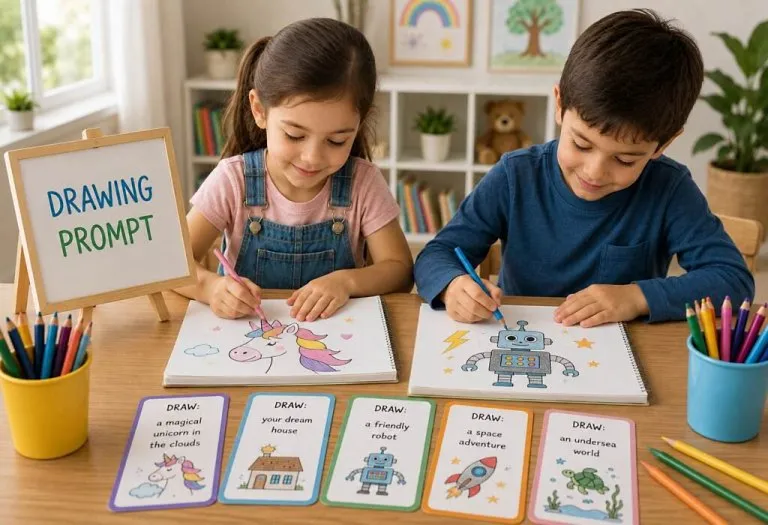
Key Takeaways:
- A good drawing prompt turns “I don’t know what to draw” into instant inspiration, making creative play easier to start and easier to stick with.
- This collection includes 50 ideas grouped into five themes: animals and nature, imaginary worlds, everyday life, silly and funny, and feelings and self-expression.
- The prompts work for kids roughly ages 4 to 10 and need nothing beyond paper and something to draw with.
- Rotating between themes keeps drawing time fresh instead of repetitive.
Kids stare at a blank page for the same reason adults stare at a blank document: too many options feel like no options at all. My own daughter used to ask “what do I draw?” more often than she actually drew anything, until I started handing her one word instead of a blank sheet: dinosaur, treehouse, silly monster. Something clicked almost immediately. A solid set of drawing prompts for kids works the same way. It removes the pressure of deciding and replaces it with a spark they can run with. For parents watching a child’s imagination stall out from screen fatigue or plain boredom, prompts offer a quiet, low-pressure way back into creative play. Below are 50 ideas sorted by theme, so you can grab exactly the kind of inspiration your child needs today, calm and familiar or big and imaginative.
Why Drawing Prompts Help Kids Grow?
Drawing does more for a child than fill an afternoon. It builds fine motor control through the repeated, controlled movements of holding and guiding a crayon or pencil. It strengthens visual thinking, since a child has to picture something in their head before they can put it on paper. It also gives kids a safe outlet for feelings they don’t yet have words for, which is part of why art therapists lean so heavily on drawing with younger children.
Creative drawing prompts for kids add a second layer of benefit on top of these basics: they stretch imagination in a specific, guided direction. A prompt like “draw a house made of candy” asks a child to combine two familiar ideas into something new, which is a small but real exercise in creative problem solving. Over time, that kind of practice builds confidence. Kids who draw regularly tend to worry less about getting it “right,” because prompts shift the focus from perfect execution to playful exploration.
There’s also a social side to this that’s easy to overlook. A child who draws a monster who is “actually very shy” or a superhero version of themselves is often working through ideas about identity, fear, or belonging in a low-stakes way. Teachers and child development specialists frequently point to open-ended art as one of the more reliable windows into how a young child is thinking and feeling, precisely because it doesn’t require the same verbal skill that talking about emotions does. A single prompt won’t reveal much on its own, but a habit of drawing over weeks and months tends to say a lot about what’s on a child’s mind.
How to Use This List
There’s no wrong way to work through this drawing prompts list, but a few simple habits can make it even more enjoyable:
- Let your child choose the theme that matches their mood instead of assigning one.
- Keep drawing sessions short—10 to 15 minutes is plenty for younger kids.
- Stick to simple supplies like crayons, markers, coloured pencils, and plain paper.
- If a prompt doesn’t spark their interest, skip it. The goal is creativity and momentum, not completing every idea.
You can also turn the list into a simple routine:
- Pick a weekly theme: For example, animals on Monday, imaginary worlds on Wednesday, and vehicles on Friday. This creates a fun rhythm while keeping each drawing a surprise.
- Keep the list handy: Tape it inside a sketchbook or store it somewhere easy to reach, then pull it out whenever your child says they’re bored or can’t think of what to draw.
However you use it, the key is to treat the prompts as invitations rather than assignments. Kids are usually more engaged when they feel they’ve chosen the idea themselves.
Fun Drawing Prompts for Kids
We’ve rounded up 50 drawing prompts and organised them into easy-to-browse themes, so finding the next creative idea is simple. Start with any category below and see where their imagination takes them.
Animals and Nature
- Create a cat wearing a tiny hat.
- Draw a dinosaur enjoying a giant ice cream.
- Show your favourite zoo animal doing a funny trick.
- Design a bird’s nest using unusual materials.
- Fill the page with an underwater scene and three sea creatures.
- Make a garden where the flowers are bigger than the trees.
- Give a dog the power to talk and show what it would say.
- Decorate a butterfly’s wings with your own patterns.
- Combine all four seasons in one picture of a tree.
- Invent an animal you have never seen before.
Imaginary Worlds and Fantasy
- Build a castle floating high above the clouds.
- Create a friendly dragon and the place where it lives.
- Design a robot that helps your family at home.
- Draw a treehouse with a secret room inside.
- Draw a spaceship exploring a brand-new planet.
- Open a magical door and show what is waiting behind it.
- Turn yourself into a superhero with your own powers.
- Create a world where candy falls from the sky.
- Draw a monster who is too shy to scare anyone.
- Make a map of an island that exists only in your imagination.
Everyday Life and Family
- Show your family having fun together.
- Recreate your bedroom just as it looks today.
- Design a meal you would happily eat every day.
- Draw your best friend doing something that makes them special.
- Bring a favourite vacation memory to life.
- Show your morning routine from waking up to leaving home.
- Imagine the perfect pet for you and bring it to life.
- Capture your favourite outdoor place to play.
- Plan the birthday party you would love to have.
- Show something you are proud to have learned.
Silly and Funny
- Give a shoe legs and let it walk on its own.
- Put an elephant on a skateboard and see where it goes.
- Draw a sandwich with the strangest ingredients you can think of.
- Imagine a snowman trying to stay cool on a hot summer day.
- Turn your teacher into a superhero.
- Dress a dog in your favourite outfit.
- Create a monster who would rather clean than scare people.
- Give a car wheels shaped like something completely unexpected.
- Flip the world upside down and show what happens.
- Draw a silly machine that solves a small everyday problem.
Feelings and Self-Expression
- Use only colours to show how you feel today.
- Capture something that always makes you laugh.
- Create a picture of a place where you feel calm and safe.
- Bring your happiest memory to life.
- Show what courage looks like to you.
- Turn something you are a little scared of into a friendly character.
- Create a special gift you would love to give someone.
- Show what kindness looks like through a picture.
- Picture the goal you are working toward.
- Create a self-portrait that shows how you see yourself.
Tips for Making the Most of Drawing Time
A few simple habits can help your child get even more out of simple drawing prompts:
- Let creativity lead, avoid correcting proportions, colours, or accuracy while they’re drawing.
- Ask open-ended questions like, “Tell me about this part,” to encourage storytelling and confidence.
- Display finished drawings on the fridge, a wall, or a bulletin board to show that their work is valued.
- Change up the format now and then by drawing on a whiteboard, using a dedicated sketchbook, or setting a fun timed challenge.
- Focus on the process rather than the outcome. The goal is to enjoy creating, not to produce a perfect picture.
Common Mistakes to Avoid
To keep drawing fun and pressure-free, try to avoid these common pitfalls:
- Comparing your child’s drawings to a sibling’s or another child’s work.
- Expecting every drawing to match the prompt exactly. Creative interpretation is part of the fun.
- Rushing through prompts just to finish the list instead of letting kids enjoy the creative process.
- Treating every drawing like a finished masterpiece that has to be neat or perfect. Messy, unfinished, and experimental drawings are all valuable learning experiences.
- Saving drawing prompts only for moments when your child is bored or frustrated. Instead, make them a regular part of your weekly routine so they become something your child looks forward to.
Drawing prompts work because they lower the barrier to starting, and starting is usually the hardest part for a young artist. This list gives you fifty ways in, spread across themes that match different moods and energy levels, so there’s almost always one that fits the day you’re having. Keep it nearby, let your child choose freely, and treat the process as more important than any single result. Over time, that approach builds not just better drawings, but a kid who’s genuinely comfortable picking up a pencil and seeing what happens next.
Also Read:
Fun and Innovative Writing Prompts
Kindergarten Writing Prompts
Creative Activities For Kids
Was This Article Helpful?
Parenting is a huge responsibility, for you as a caregiver, but also for us as a parenting content platform. We understand that and take our responsibility of creating credible content seriously. FirstCry Parenting articles are written and published only after extensive research using factually sound references to deliver quality content that is accurate, validated by experts, and completely reliable. To understand how we go about creating content that is credible, read our editorial policy here.
- Author






.svg)