

Vision Boards for Kids: Benefits and How to Create One
Help your child dream big with a vision board! Discover its benefits and learn how to create one in simple, fun steps.




In this Article
- What Is a Vision Board?
- The Science Behind Visualisation
- Why Vision Boards Matter for Child Development
- How to Make a Vision Board for Kids: Step-by-Step
- Common Vision Board Mistakes Parents Should Avoid
- Adapting Vision Boards by Age
- Myth vs. Fact
- FAQs
View More
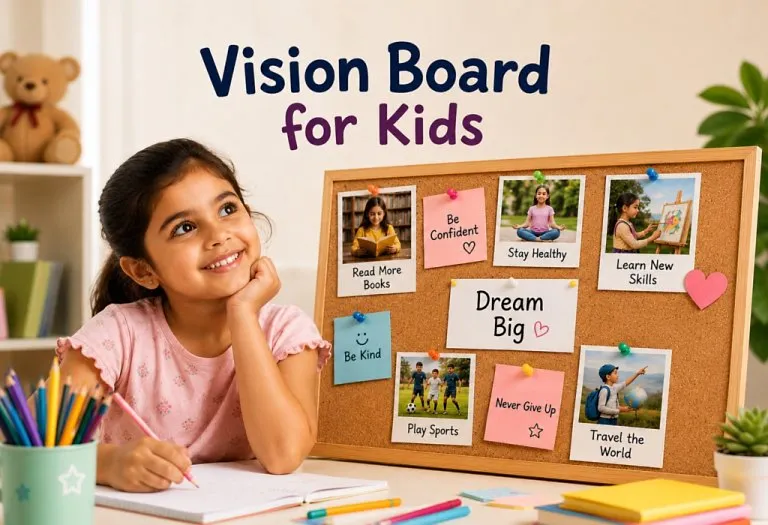
Every parent has watched a child draw a rocket ship, a soccer trophy, or a treehouse and wondered how to turn that spark of imagination into something more lasting. A vision board for kids does exactly that. It’s a simple collage of pictures, words, and drawings that represents what a child hopes, wants, or dreams about, whether that’s learning to swim, making a new friend, or becoming an astronaut someday. Unlike an abstract goal chart, a vision board speaks in the language kids already understand best: images and colour.
This article walks you through what a vision board actually is, why child psychologists and educators recommend them, and exactly how to build one with your child, no craft experience required. Along the way, we’ll cover common mistakes parents make, how to adapt the activity for different ages, and how often a board should be refreshed to stay useful rather than becoming another piece of forgotten wall decor.
What Is a Vision Board?
It’s a poster, corkboard, or digital collage filled with images, words, and drawings that represent a child’s goals, interests, or dreams for the future. Think of it as a scrapbook with a purpose. Instead of randomly pasting stickers and photos, a child selects images that connect to something they want to achieve or experience, like a new hobby, a personal habit, or a big dream like travelling to space. The board becomes a visual reminder that sits somewhere the child sees every day, whether that’s a bedroom wall or the refrigerator door.
Example: A seven-year-old who wants to get better at maths might glue a picture of a calculator, a gold star, and a photo of themselves smiling next to the words “I can do hard things.”
The Science Behind Visualisation
Vision boards work because the brain responds to repeated visual cues by reinforcing the neural pathways connected to those goals, a concept borrowed from sports psychology and cognitive behavioural research.
Athletes have used mental imagery for decades to rehearse performance before a competition even begins, and researchers have found that regularly picturing a goal can strengthen motivation and planning behaviour. Children benefit from a simplified version of the same principle. A board doesn’t create ability on its own, but repeated exposure to a goal, paired with encouragement and small wins, helps a child stay oriented toward what they’re working on instead of losing sight of it amid school, screens, and daily distractions.
This is also why the process matters as much as the finished product. Choosing images, talking through what they mean, and physically placing them on a board all reinforce the goal far more than simply telling a child what they should want to achieve.
Why Vision Boards Matter for Child Development
Vision boards aren’t just a cute craft project. Educators and child development specialists point to several real benefits when children engage in this kind of goal visualisation regularly.
1. They Build Goal-Setting Skills Early
Vision boards teach children to identify a goal, picture what success looks like, and connect daily actions to that outcome.
Young children often think in the present moment. A vision board introduces the idea that today’s choices, like practicing spelling words or being kind to a sibling, connect to something bigger down the road. This mirrors how SMART goal frameworks work for adults, just translated into pictures a five-year-old can understand.
Example: A child who places a picture of a piano on their board might start asking to practice without being reminded, because the image keeps the goal visible and personal.
2. They Strengthen Self-Esteem and Self-Efficacy
Seeing personal goals represented visually helps children believe those goals are achievable, which builds confidence over time.
Psychologists refer to this belief as self-efficacy, the sense that “I am capable of making this happen.” When kids see their own dream represented on a board they built themselves, it reinforces ownership. This is especially valuable for children who struggle with confidence in school or social settings.
Example: A child who has been shy about making friends might include a picture of kids playing together, giving them a small, private reminder that this is something they’re working toward, not something wrong with them.
3. They Support a Growth Mindset
Vision boards reinforce the idea that skills and traits can be developed through effort, a core principle of growth mindset thinking.
Rather than treating talent as fixed, a vision board frames goals as things a child is working toward, not things they either have or don’t have. Adding words like “practice,” “try,” or “learn” alongside images reinforces this mindset naturally.
Example: Add a short phrase under each image, such as “I am learning to…” instead of “I will be…”.
4. They Give Kids a Healthy Outlet for Big Emotions
Building a board gives children a nonverbal, low-pressure way to express hopes and worries they may not yet have the vocabulary to explain out loud.
Children often have big hopes and worries they can’t fully put into words. A vision board gives them a way to express what matters most, whether that’s excitement about a new pet, hope about making a team, or something quieter, like wanting a parent to spend more one-on-one time with them. For anxious or overwhelmed kids, the repetitive, hands-on process of cutting, arranging, and creating can also be genuinely calming, similar to other quiet craft activities used in classrooms and counselling settings.
Example: A child adjusting to a new sibling might include a picture of two kids holding hands, quietly signalling a hope for connection without needing to say it directly.
How to Make a Vision Board for Kids: Step-by-Step
Making a children’s vision board doesn’t require Pinterest level crafting skills. Here’s an easy process that works for most ages between four and ten.
What You’ll Need
- Poster board, corkboard, or a large piece of cardstock
- Old magazines, printed photos, or a printer
- Scissors (child-safe for younger kids)
- Glue stick or tape
- Markers or crayons
- Stickers (optional but popular with younger children)
Step 1: Talk Before You Cut
Sit down with your child and ask open-ended questions: What do you want to learn this year? What makes you excited? What’s something you’re proud of? Write down their answers, even the ones that seem unrealistic. This conversation matters more than the finished product.
Step 2: Gather Images and Words
Let your child flip through magazines, browse a pre-approved folder of printed pictures, or draw their own images. For nonreaders, focus heavily on pictures. For older kids, mix in short words and phrases alongside the visuals.
Step 3: Arrange Before Gluing
Have your child lay everything out on the board first without gluing anything down. This lets them experiment with placement and avoids the frustration of a crowded, uneven board.
Step 4: Glue, Decorate, and Personalise
Once the layout feels right, glue everything in place. Encourage your child to add their name, decorate the edges, or write one sentence about why the board matters to them.
Step 5: Display It Somewhere Visible
A vision board only works if a child sees it regularly, so display location matters as much as the content. Hang the finished board somewhere your child spends time daily, like above a desk or beside the bed. A board tucked in a closet loses its purpose almost immediately.
Common Vision Board Mistakes Parents Should Avoid
Creating a vision board should feel exciting, not like another task on your child’s to-do list. A few well-meaning habits can unintentionally take the fun and ownership out of the process. Here’s what to watch out for so the experience stays positive and motivating.
- Taking over the creative process: A board that reflects a parent’s vision instead of the child’s loses most of its developmental value.
- Adding too many goals at once: More than four or five images can dilute focus and make the board feel cluttered rather than meaningful.
- Never revisiting it: A board that goes up once and is never discussed again becomes background decoration instead of an active tool.
- Using it to pressure achievement: Vision boards should inspire, not create anxiety about performance or comparison with siblings and peers.
Adapting Vision Boards by Age
| Age Range | Approach |
| 4-6 years | Focus almost entirely on pictures and simple words; keep sessions short, around 15-20 minutes. |
| 7-9 years | Mix pictures with short phrases; introduce basic goal-setting language like “practice” and “learn” |
| 10 and up | Allow more independence in selecting images and writing personal reflections or short goal statements |
Myth vs. Fact
Vision boards work best when they’re seen as a tool, not a shortcut. Before you create one with your child, it’s worth clearing up a few common myths so you know what to expect and how to make the most of the experience.
| Myth | Fact |
| Vision boards are only for adults chasing career goals. | Vision boards work well for children as young as four, adapted to their developmental stage. |
| A vision board guarantees a goal will happen. | A vision board supports motivation and focus; it doesn’t replace effort or practice. |
| Kids need expensive materials to make one. | A vision board can be made with old magazines, markers, and a piece of cardboard. |
FAQs
1. What age is best for starting a vision board with kids?
Most children can meaningfully participate starting around age four, as long as the activity is simplified to focus mainly on pictures rather than written goals.
2. How often should a child update their vision board?
Revisiting the board every four to six weeks works well for most families, giving children enough time to make progress before reassessing their goals.
3. Can a vision board be digital instead of a physical craft project?
Yes, older children can create digital versions using a slideshow or collage app, though physical boards tend to work better for younger kids who benefit from hands-on cutting and gluing.
This kind of goal board is a small, low-cost activity with an outsized impact on how children think about goals, effort, and their own potential. By giving kids a hands-on way to picture what they’re working toward, whether that’s a new skill, a personal hope, or simply a feeling they want more of in their life, parents hand them a tool they can return to again and again. The craft itself takes an afternoon, but the habits it builds, reflection, patience, and belief in their own growth, can last far longer. Revisit the board together often, and let your child’s own words and pictures guide what comes next.
Also Read:
DIY Sensory Board Ideas for Children
Chalk Art, Games, and Activities for Kids
Was This Article Helpful?
- Author








.svg)