
Mahabharata Stories for Kids with Moral
Interesting Mahabharata stories for kids with morals, helping children learn values, courage, respect, and wisdom.




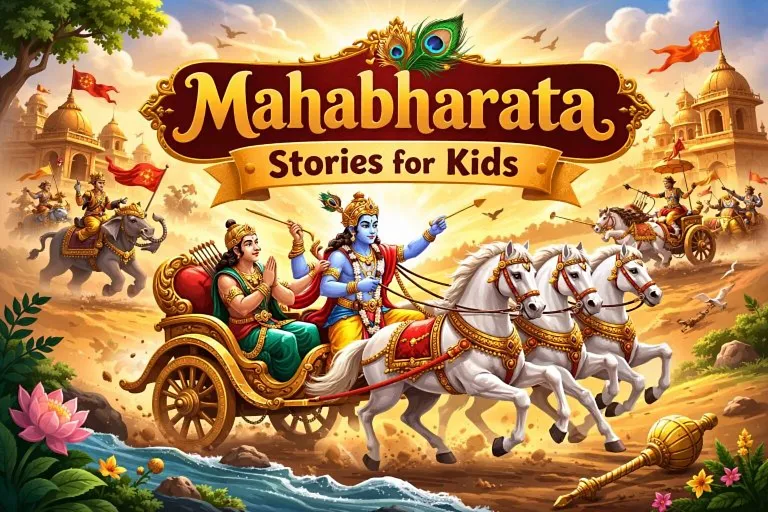
Image Credit : AI Generated Image
The Mahabharata is a literary treasure and a blend of Hindu mythology and philosophy. It is considered to be for adults only. But this great epic is more than that. Its varied stories and many characters have an appeal for the kids, too. In fact, it is a treasure trove for today’s generation raised on Harry Potter and similar tales. It has countless stories that teach valuable lessons in ethics and morality. This great epic is a part of our culture and should have a rightful place in the hearts of our children. Here are some Mahabharata stories for kids:
What Is the Mahabharata?
What is the story of the Mahabharata? It is one of the two major Hindu Mythological Sanskrit epics of India. It is the narration of the great eighteen-day Kurukshetra war between the hundred Kauravas and the five Pandavas, the children of two brothers. Interwoven with many short stories and a multitude of characters, it comprises philosophical and devotional material. It also contains the Bhagwat Gita, the much-revered Hindu religious text. The Mahabharat is not meant to be read as a pastime for amusement. You have to delve deeply into it and understand the characters and their actions and reactions. Once involved in the story, you will find yourself playing out so many roles, identifying something similar with the characters as they appear in the story.
Mahabharata Story – In Short
Here is the Mahabharat story in English in short:
The story begins with Hastinapur’s King Shantanu of the Kuru dynasty marrying the river Goddess Ganga. Bhishma, one of the prominent characters in the Mahabharata, was their son. Ganga left them to carry out her godly duties, and Shantanu married Satyavati and had two sons with her. Vichitravirya, one of the sons, became the king after him. He fathered three sons, Dhritarashtra, Pandu and Vidur. Dhritarashtra, being blind, Pandu became the king, supported by Bhishma.
Dhritarashtra married Gandhari and had a hundred sons, the Kauravas. Pandu married Kunti and Madri, and with the blessings of different gods, the five Pandavas were born. Unknown to everyone, Kunti was already an unwed mother to her oldest son, Karna.
Having brought prosperity to his kingdom, Pandu decided to retire to the forest, entrusting the kingdom to the care of Dhritarashtra. After Pandu and Madri’s deaths, Kunti came back to Hastinapur with the five boys. The cousins, Kauravas, and Pandavas never got along. There were failed attempts by the Kauravas to kill them. And after one such conspiracy, the Pandavas, with their mother, went into hiding. In this period, Arjun married Draupadi, and they all went back to Hastinapur. But they were exiled to the forest for thirteen years when, in a game of dice, Yudhishthir lost everything to the Kauravas. On their return, Duryodhana refused to give back the kingdom, and the stage was set for the greatest battle despite Lord Krishna’s attempts to bring peace. The war went on for eighteen days and ended with the defeat of the Kauravas. Yudhishthir was crowned the King.
Mahabharata Stories for Kids in English
This lengthy epic has hundreds of stories, many of which are also for children. Here are some well-known Mahabharata stories for kids.
1. Arjun and the Bird’s Eye Test
Guru Dronacharya decided to test the skills of the Kauravas and the Pandavas. He placed a wooden bird on a tree branch and asked his students to aim at its eye. One by one, they were asked what they could see. Some said they saw the tree, the sky, the branches, and the bird.
When it was Arjun’s turn, he replied calmly, “I see only the black eye of the bird.” Pleased with his focus, Dronacharya allowed him to shoot. Arjun’s arrow struck the target perfectly.
Moral: Concentration and focus lead to success.
2. Abhimanyu and the Chakravyuh
Abhimanyu, the brave son of Arjun, had learned how to enter the powerful Chakravyuh battle formation while he was still in his mother’s womb. During the Kurukshetra war, he fearlessly entered the formation to help the Pandavas.
Though surrounded by mighty warriors, the young prince fought bravely. However, he did not know how to come out of the Chakravyuh. After a fierce battle, he was unfairly defeated. His courage remains unforgettable.
Moral: Courage and bravery shine even in the face of great danger.
3. Eklavya and Dronacharya
Eklavya, a tribal boy, wished to learn archery from Guru Dronacharya but was refused. Determined to learn, he made a clay statue of the guru and practised sincerely before it. Soon, he became a skilled archer.
When Dronacharya learned of his talent, he asked for Guru Dakshina. Eklavya humbly offered his right thumb, knowing he would never shoot the same again. His devotion made him immortal.
Moral: True dedication and respect make a person great.
4. The Story of King Shibi
King Shibi was known for his kindness and truthfulness. One day, a dove sought his protection from a hawk. The hawk demanded its prey, but the king promised to save the dove.
To keep his word, Shibi offered flesh from his own body equal to the dove’s weight. As he prepared to sacrifice himself fully, the gods revealed themselves and blessed him for his righteousness.
Moral: Keeping one’s promise is the highest form of righteousness.
5. Ganesha the Scribe
Sage Veda Vyasa wished to compose the Mahabharata and needed someone wise to write it down. Lord Ganesha agreed, but on one condition—the sage must dictate without pause.
Vyasa began reciting the great epic. Whenever he needed rest, he spoke difficult verses, giving himself time while Ganesha carefully understood and wrote them. Together, they completed the magnificent Mahabharata.
Moral: Wisdom and teamwork can accomplish great tasks.
6. The Unused Weapon: Pashupatastra
During exile, Arjuna prayed to Lord Shiva for a powerful weapon. One day, a wild boar charged at him, and he shot it. A hunter claimed the kill, and they argued. Arjuna challenged the hunter but failed to defeat him.
Suddenly, Arjuna realised the hunter was Lord Shiva in disguise. Bowing in humility, he sought forgiveness. Pleased, Shiva granted him the mighty Pashupatastra and taught him to give up pride.
Moral: Humility is greater than strength.
7. Bhishma’s Terrible Vow
Devavrata, the son of King Shantanu, loved his father dearly. When his father wished to marry Satyavati, her father demanded that her son become king.
To ensure his father’s happiness, Devavrata took a terrible vow to never marry and never claim the throne. The gods named him Bhishma for his fearful promise.
Moral: Selflessness and sacrifice are marks of true greatness.
8. Draupadi and the Miracle of the Akshaya Patra
During exile, the Pandavas received a magical vessel called the Akshaya Patra that provided endless food. One day, Sage Durvasa arrived after Draupadi had finished eating, and the vessel was empty.
Worried, Draupadi prayed to Lord Krishna. He found a single grain of rice in the vessel and ate it. Miraculously, the sage and his disciples felt full and left satisfied.
Moral: Faith in God removes even the greatest troubles.
9. Bhima Meets Hanuman
While searching for a rare flower, Bhima saw an old monkey blocking his path. Proud of his strength, he asked the monkey to move. The monkey requested Bhima to lift his tail instead.
Bhima tried with all his might but failed. The monkey revealed himself as Hanuman, his elder brother. Bhima learned that true strength comes with humility.
Moral: Pride weakens, but humility strengthens.
10. Yudhishthira and the Yaksha
During exile, the Pandavas felt thirsty in a forest. Nakula found a lake, but a mysterious voice warned him to answer questions before drinking. Ignoring it, he fell unconscious. One by one, the other brothers did the same.
When Yudhishthira arrived, he listened carefully to the Yaksha’s questions about truth and duty. He answered wisely and patiently. Pleased, the Yaksha revived all his brothers.
Moral: Wisdom and patience save lives.
11. Karna’s Generosity
Karna was famous for never refusing anyone who asked for help. One day, Indra came disguised as a poor Brahmin and asked for Karna’s divine armour and earrings.
Though he knew giving them away would weaken him, Karna removed them and offered them without hesitation. His act of charity made him immortal in fame.
Moral: True generosity expects nothing in return.
12. The Game of Dice
Duryodhana, filled with jealousy, invited Yudhishthira to play dice. With Shakuni’s trickery, Yudhishthira lost his kingdom, his brothers, and Draupadi.
Draupadi prayed to Krishna when she was insulted, and he protected her honour. This unfair game led to the great war of Kurukshetra.
Moral: Greed and dishonesty lead to downfall.
13. Krishna Becomes Arjuna’s Charioteer
Before the war, Krishna offered a choice—his army to one side and himself, unarmed, to the other. Duryodhana chose the army, but Arjuna chose Krishna.
On the battlefield, when Arjuna felt confused, Krishna guided him with wise teachings. With courage restored, Arjuna was ready to fight for justice.
Moral: Right guidance leads to right action.
14. The Birth of Dhrishtadyumna and Draupadi
King Drupada wished for revenge against Dronacharya and performed a sacred yajna. From the holy fire arose a brave warrior, Dhrishtadyumna, destined to defeat Drona. Soon after, a radiant princess, Draupadi, also emerged from the flames.
Both children were born for a special purpose and later played important roles in the great war of Kurukshetra. Their lives showed that destiny often unfolds through divine will.
Moral: Destiny unfolds in mysterious ways through courage and faith.
15. The Story of Barbarika’s Promise
Barbarika, the grandson of Bhima, was a powerful warrior with three magical arrows. He promised his mother that he would always fight for the weaker side.
Before the war began, Krishna realised that this vow would upset the balance of the battle. When asked for his head as a sacrifice, Barbarika agreed without hesitation. His devotion and sacrifice became legendary.
Moral: True devotion means surrendering even what is most precious.
Moral Lessons for Children From the Mahabharata
Here are the moral lessons one can pick from the Mahabharat story for kids.
- Be focused, and you will always succeed.
- A teacher can guide you and inspire you, but practice will make you perfect.
- Keep good company. Bad friends will bring about your downfall.
- Respect women. The disrespect shown to women will bring disasters upon you.
- Don’t indulge in vices like gambling. You will end up losing everything.
- Don’t give up easily. Fight for what is rightfully yours. Truth always wins in the end.
- Don’t apply half-learned knowledge to your actions. It will only lead to failure.
- Don’t support the wrong acts of your close friends and relatives. It will bring trouble upon you as well.
- Do not seek revenge. Vengeance spells the end for the seeker and the sought both.
- War is never good. Matters can be resolved with dialogue.
- A wrong step taken during any stage of your life can have effects for a lifetime.
- Envy gives birth to rivalry, and this can cause a lot of damage to an individual.
These were some of the many moral stories from the Mahabharata for kids. Like all great epics, the Mahabharata is the story of the victory of good against evil. The word ‘Mahabharata’ has become synonymous with any great confrontation in day-to-day life, also. But its moral lessons will be synonymous with the right and truthful way of life for years and years to come.
Also Read:
Indian Mythological Stories for Kids
Childhood Stories of Lord Krishna for Kids
Fascinating Ramayana Stories for Children
Was This Article Helpful?
Parenting is a huge responsibility, for you as a caregiver, but also for us as a parenting content platform. We understand that and take our responsibility of creating credible content seriously. FirstCry Parenting articles are written and published only after extensive research using factually sound references to deliver quality content that is accurate, validated by experts, and completely reliable. To understand how we go about creating content that is credible, read our editorial policy here.
- Author
 About the Author