

Breastfeeding Twins: Positions, Tips, and How to Make It Work
From latch to routine find support for a confident relaxing and well guided breastfeeding journey with your twins





Breastfeeding twins is usually a worry for most moms-to-be since they worry whether they will have enough milk to feed both babies. However, there are very few mothers who do not have enough milk to feed their twins since milk production works on the principle of demand and supply. The extra stimulation from two or more babies sucking results in your body producing the milk they need. When the baby sucks at the breast, two hormones are released: prolactin (which stimulates more milk production) and oxytocin (which releases the milk from the breast). This release is called the ‘let down’ or milk ejection reflex. This is an important mechanism by which milk is made available to babies.
Now, let’s talk about taking care of the nutritional needs of twins. Several health experts, including the World Health Organisation, recommend that babies be exclusively breastfed until they are at least 6 months of age, after which they can be gradually introduced to solid foods. But when it comes to breastfeeding twins, there is a ton of contradictory information out there that can confuse and discourage new moms. Thus, to begin, let’s dispel some myths.
Can a Woman Produce Enough Breast Milk for Twins?
Yes, a woman’s body can produce enough breast milk to feed two or more babies (1). The breasts can produce enough milk each time a mother breastfeeds her twins, as the body operates on a demand-and-supply basis. This continuous demand for milk, in turn, increases the milk supply in the mother. Thus, the more you nurse, the more adequate the milk supply will be (2). Knowing how breastfeeding works will help you understand how this is possible.
Things You Need for Breastfeeding Your Twins
There are a few everyday things that all moms of newborn twins will need to make breastfeeding a breeze, such as:
- A nursing pillow for twins
- A comfortable and safe space for feeding
- A comfortable or ergonomic bed, sofa, or chair
- Baby towels to clean up spills or spit-ups
As a new mom, make sure to have pillows, towels, and a glass of water within arm’s reach when settling down for a feeding session.
What to Do to Produce Enough Milk?
There may be instances where you feel as though you do not have enough milk to give to your baby. You might feel this way if your baby isn’t gaining weight or if your nipples feel sore by the time you’ve finished feeding. Here are a few techniques that you could use to increase your milk supply:
- Since the production of milk relies heavily on the demand, the more you feed your babies, the more the supply of milk will be. To produce more milk, one must feed the babies more frequently.
- WHO and other health organisations recommend that healthy mothers and their babies should have continuous skin-to-skin contact right after birth for a minimum of one hour and continuing until after the initial feeding for those who breastfeed. Skin-to-skin contact involves laying dried, unclothed newborns on their mother’s bare chest, while covering the newborn’s back with warmed light blankets or towels (3). Skin-to-skin contact encourages babies to breastfeed well and soon (4).
- It is at times seen that new mothers in the initial phase panic while breastfeeding, but there is no reason to do so. In fact, one must relax while breastfeeding. The more you relax, the better the milk supply.
- Lactating mothers should consume a minimum of 1,800 calories per day and drink at least six glasses of water daily to increase their milk supply.
- Pumping also helps simulate the production of more breast milk.
- Undressing the child while breastfeeding helps the baby to feed for a longer time, and the longer the feeding session, the more milk is produced.
- Do not fixate on one breast for each baby. Babies will nurture and thrive more effectively when they receive milk from both breasts. Alternate which baby feeds from each breast during each feeding session. This practice will aid in balancing your milk production, particularly if one baby has a noticeably stronger suck (5).
Benefits of Nursing Twins
Below are some of the advantages of breastfeeding:
- A mother’s milk is considered the most nutritious food for babies. This is because the mother’s milk has antibodies which boost the baby’s immune system. It thus helps the baby fight diseases and infections.
- Breast milk also offers special benefits for premature babies, which is often the case with twins. This is especially relevant for premature babies who have smaller and less mature intestines and stomachs. Premature babies’ gut is immature, which makes breast milk the most tolerable and digestible compared to supplemented feeds (6).
- Breast milk is considered the gold standard for infant nutrition as it is easier to digest and contains all the necessary nutrients a baby needs to develop.
- Beyond the health benefits that breast milk offers, it is also the most convenient and cost-effective way to feed your baby.

Do You Need to Stick to a Breastfeeding Routine With Your Twins?
The breastfeeding twins’ schedule should be adjusted according to the babies’ demands. You should feed the babies when they are hungry (7). During growth spurts in babies, early nap waking and increased night waking due to hunger are commonly observed at approximately 7-10 days, 2-3 weeks, 4-6 weeks, 3 months, 4 months, 6 months, and 9 months. During these times, the mother should allow the babies to feed more. This helps the babies to sustain themselves.
Apart from these periods, whenever the baby wakes up early, the mother can offer her breasts to feed, as they usually wake up hungry. Ensure your babies are fed at least 8 to 10 times within 24 hours. If one of your babies is too sleepy to rouse themselves or a bit weaker and can’t demand milk every few hours, you may need to wake them to feed to ensure they get enough milk and do not stay hungry (8).
Please remember that midnight waking should not be treated as the only signal of hunger. If you suspect a low milk supply, feed the child every two hours during the day.
Feeding Twins Together or One at a Time
Initially, for new mothers, it is easy to breastfeed one baby at a time. Some mothers prefer to save time by feeding their infants simultaneously, while others opt to feed each infant separately to ensure individual bonding moments with each baby, or because a specific baby requires additional assistance. Feeding them together might benefit the weaker baby. This is because the more proficient baby can encourage the milk flow, allowing the weaker baby to receive more milk more rapidly (9).
Once you get the hang of it, you can feed both babies together. Allowing both your kids to drink milk simultaneously is quicker and allows the mother to get time to sleep, focus on chores, or do other work.
Positions for Feeding Twins Together
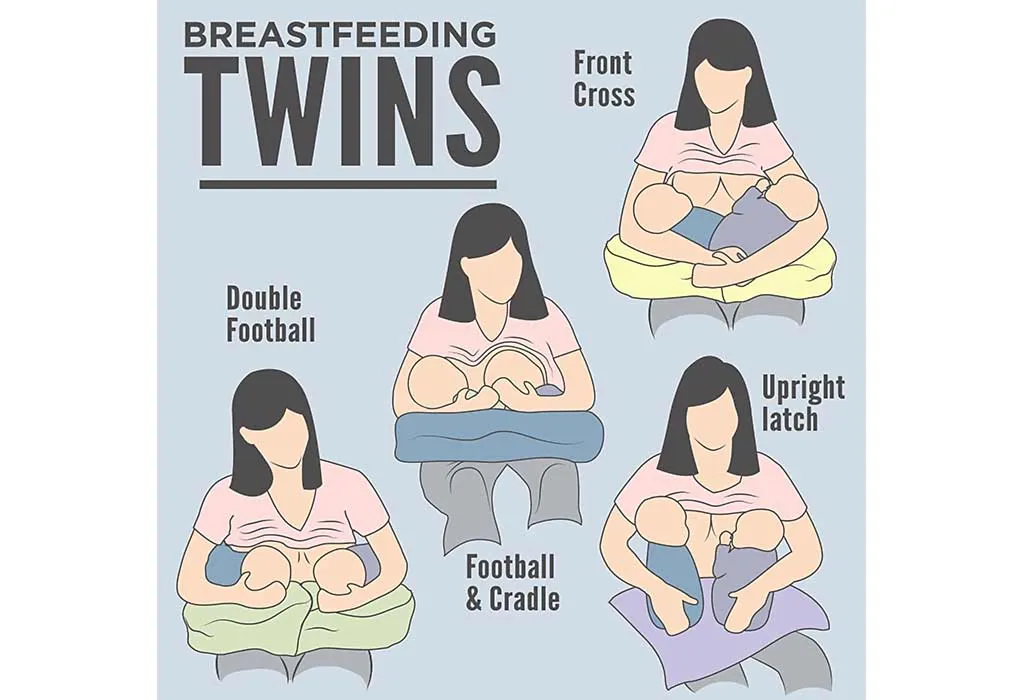
Several positions allow for breastfeeding twins at the same time. However, one must choose the correct position—one that is comfortable and enables the correct latch for the baby. Here are a few positions to choose from:
1. Double Clutch or the Twins Football Hold
In this position, one must hold each baby in a clutch or football hold. Each baby must be placed on a pillow beside the mother, almost under her arm, so that the baby’s legs point towards the back of the chair. The baby’s back should be supported by the inside of the mother’s forearm. After doing so, the babies’ heads should be at nipple level, and the mother’s palms should be used to hold the back of the babies.
2. Cross-cradle Position
Each of the baby’s heads should be in each of the mother’s arms. The heads may rest in the bend of the mother’s arm near the elbow, and the bodies will be in the lap with the legs towards the mother’s abdomen.
2. The Cradle-Clutch Hold
This position holds one baby in the classic cradle position and the other baby in the clutch or football position. Holding your baby in a cradle means keeping its head on your forearm, and facing its body into yours (and not up). This position is helpful if one of your twins can latch easier or faster than the other, thus placing one in the cradle and the other in the clutch .
4. The Lying Down Position
In this position, the mom reclines or lies on her back, and the babies are positioned either along her sides or on her belly. This is the natural, biological breastfeeding position of most mammals, including humans. It is comfortable for both mom and baby – it allows the mom to get the hang of latching and breastfeeding, and it allows the babies to use all their senses to navigate towards the nipple and suckle. This position also offers plenty of skin-to-skin contact, making the babies feel warm, comforted, and protected.
Tips for Nursing Twins
How to breastfeed twins is a frequently asked question. Nursing twins, especially for first-time mothers, can be hard and cumbersome at the same time. Getting mentally prepared to nurse twins and to relax is the foremost thing to do before starting. Here are a few tips to help you along
- During the pregnancy period, gaining information on breastfeeding helps. Books, DVDs, leaflets and antenatal classes could help.
- Try to breastfeed your twins as soon as possible after they are born. Colostrum, which is full of antibodies, nutrients and fat, is found in the mother’s milk soon after a child is born.
- If you are unable to breastfeed after giving birth, make sure that there is physical contact between you and both your offspring.
- It’s okay if you don’t know right away how to help the babies latch on, or the right way to breastfeed, or how to manage chores with two little ones in tow. Ask for help when you need it, and do your own research beforehand, if possible.
- It is advisable to keep interchanging your twins between breasts frequently so that it helps to equalise the mother’s milk production in each breast.
- Stay calm and relaxed, since a relaxed mind increases the supply of milk.
- A mother of twin babies should be organised, as haphazard planning can lead to issues such as one twin getting more feed than the other.
- Getting adequate rest, especially when twins are resting, should be at the top of the priority list of nursing mothers of twins. It will help in relaxing the mind, thereby increasing the milk supply of nursing mothers.
- It is important to make sure that the nipple is latched on correctly by the baby, or it could lead to soreness. Initially, one can ask the midwife or the wife to ensure correct latching.
- In case a mother wants to express milk, she should investigate various options and invest in a breast pump, as it can make the task of expressing milk less labour-intensive.
- Try to avoid bottle feeding formula milk until and unless necessary because the more the baby breastfeeds, the more is the supply of milk. Moreover, breastfeeding facilitates emotional bonding between the child and mother, as it allows for skin-to-skin contact.
- After babies become proficient at breastfeeding, usually by the third week, bottles containing expressed milk can be given for convenience, without posing the same risk of disrupting breastfeeding (10).
- Having “nursing stations” – several places in your house where you can sit or lie down and nurse your babies – is a good way to soothe and relax yourself while feeding the babies. When the mother is calm and relaxed, the supply of milk automatically increases.
- Do not forget to include a balanced diet rich in protein, calcium, and essential vitamins to support the health of the mother and promote milk production.
- You can breastfeed both twins at the same time or decide to breastfeed one twin at a time. Both are feasible options as per your choice.
- Learn to tandem feed. It takes practice, but when you and the babies catch on, it saves time, energy, and effort, and can be thoroughly liberating.
- Let your babies decide when they are hungry.
- Build a positive and healthy support system, be it family or friends. It takes a village to raise a child, and for two of them, you’ll need all the support you can get!
- Don’t go overboard on the hygiene of your breasts. Areolas have natural oils in them, and over-washing them can disturb the balance of the skin, causing nipple dryness and cracking. Follow basic cleanliness, and wash them gently once or twice a day.
- An oversupply of milk can cause your ducts to get blocked. Thus, let the babies establish the feeding routine, so you can avoid overstimulating your milk supply.
- On that note, keep in mind that your body can actually produce enough milk for both your babies. If you feel that your milk supply is low, try pumping or hand-expressing, and continue nursing regularly to stimulate milk flow.
- Twins are double the effort, so believe in yourself and your body, and don’t give up!
Tandem Nursing Your Twins
Tandem nursing or feeding means that you are feeding two babies, either of the same age (twins) or different ages, at the same time.
To answer your most straightforward (and most obvious) question – How? – think of it this way: two babies, two breasts! Women can feed two little mouths at the same time, so why not take advantage of that? Tandem nursing is one of the most efficient ways of feeding your twins, especially if both babies get hungry at the same time, and you want to breastfeed them as much as possible (11).
However, that being said, tandem nursing is not the only way to go about feeding your babies. It takes practice to get into the rhythm, and if you find that you or the babies are uncomfortable, there are other approaches to adopt, such as solo feeding one baby at a time (while giving the other a bottle), or tandem nursing only once or twice a day. Remember, mother knows best, and you need to do what’s best for you and your little ones!
Breastfeeding Your Twins: Myth vs. Truth
Some of the most common misconceptions that people have about breastfeeding twins are:
- A mother cannot breastfeed both her babies, as she will get tired and fatigued very easily.
- A mother cannot produce enough milk to feed two babies at the same time.
- Formula milk is a necessary supplement.
- The babies should be given pumped or expressed milk and formula.
Unsolicited advice like this can actually work to discourage a new mother, rather than the opposite. Breastfeeding is a natural, innate instinct that allows a mother to nurture, care for, and protect her children. On the other side, babies seek the breast as primarily a food supply, and then as a source of comfort and familiarity.
So, let’s find out the truths that will replace these myths!
- A mother is very capable of breastfeeding both her babies. While it can get tiring at first, it takes practice (as two moms tell us in their stories further on), and soon you’ll be quite used to it.
- If you can produce two children from your body, you can feed them from your body, too. When you have twins, your milk production is not divided among the two babies, but instead, it is multiplied, so that both babies can have enough.
- Formula milk, while helpful, is not necessary. It comes in handy if, for some reason, you are unable to produce enough breast milk for your babies. But remember, this is not a matter of embarrassment – you are doing the best you can!
- Pumping or expressing milk for the bottle is also helpful, but if you can, try to breastfeed as much as you can. You can keep bottles on hand as an extra supply, for emergencies, or if you’re simply tired.
FAQ’s
Usually, first-time mothers, especially mothers of twins, are anxious when it comes to breastfeeding. They have a lot of questions regarding nursing their babies, as twins can seem like double trouble. Below, we have curated some of the most commonly asked questions by parents around the world who have to deal with twins.
1. What Takes Longer – Breastfeeding or Bottle Feeding?
They both roughly take the same time, provided that both breasts are utilised for breastfeeding. The only difference is that after breastfeeding, once the babies are done, you are done too, but in the case of bottle feeding, you must take into consideration the amount of time it takes to clean and sterilise the bottle and to prepare the formula.
2. Is it Fine to Combine Breastfeeding and Bottle Feeding?
It is perfectly fine to combine breastfeeding with bottle feeding using formula milk or expressed milk. It especially works well for mothers when they go back to work and have trouble pumping milk every day. However, it is advisable to nurse your baby as much as possible, even if it is once or twice a day. Although formula milk provides all the nutrients, it lacks the unique antibodies that only mother’s milk contains
3. Can I Breastfeed Babies if They Are in Special Care or NICU?
You can absolutely breastfeed your babies even if they are in special care or NICU. You can feed your baby from a bottle, a feeding tube or an IV since mother’s milk has antibodies which help the babies to grow and develop.
4. Will my Nipple be Sore if I Feed More Than One Baby?
Breastfeeding twins or more than one baby does not make you more likely to have sore nipples. Soreness in the nipple is caused chiefly by incorrect latching on or positioning of the babies. Therefore, you should take a nurse or a midwife’s help initially to learn the correct method of positioning your baby correctly before breastfeeding. Soreness may be due to some other reason and should be identified and treated.
5. When Will I Get a Break from Breastfeeding?
Breastfeeding, especially twins, can be very draining and tedious. However, you can take a short coffee break at a nearby cafe, go for an evening stroll at a nearby park, take a nap or read a book in between feeds and when your babies are asleep. Once the babies start weaning, you can take longer breaks and start going out for a movie at a theatre or for some retail therapy too. If you are waiting to wean your babies, you may be happy to know that this is a personal decision and the answers depend on the readiness of the babies as well as the mother.
During the past decade, the benefits of breastfeeding have been emphasised by many authorities and organizations all over the world. It is probably the most ancient form of feeding a baby and has existed since the beginning of time. It is advised to exclusively breast-feed babies for the first six months of their lives, and this is true of twins too. As mentioned earlier, breastfeeding is especially beneficial for twins as they are often premature. So go ahead and overcome your inhibitions about breastfeeding twins, and the task is sure to become easier as you get the hang of how to do it.
Also Read:
Gift Ideas for Twin Babies
Surprising Facts About Twins
What Is Twin Telepathy and Does It Exist?
Mirror Twins: What Are They & Their Characteristics
Was This Article Helpful?
Parenting is a huge responsibility, for you as a caregiver, but also for us as a parenting content platform. We understand that and take our responsibility of creating credible content seriously. FirstCry Parenting articles are written and published only after extensive research using factually sound references to deliver quality content that is accurate, validated by experts, and completely reliable. To understand how we go about creating content that is credible, read our editorial policy here.
1. Australian Breastfeeding Association – Breastfeeding twins, triplets or more!
2. PubMed Central – Breast feeding twins and high multiples
4. Twins Trust – Breastfeeding
5. Pregnancy Birth and Baby – Raising and feeding twins
6. NHS – Feeding twins and multiples
7. PubMed – Volume and frequency of breastfeedings and fat content of breast milk throughout the day
8. La Leche League GB – Twins and More
9. HSE – Breastfeeding twins or triplets
10. Standford Medicine – Mothers with Multiples
11. NHS – TWINS – TIPS FOR BREASTFEEDING MOTHERS
- Author
 About the Author






.svg)