

Alpha Fetoprotein (AFP) Test in Pregnancy: Purpose, Procedure and Results
Learn about the AFP test in pregnancy, why it is recommended, and what high or low results could mean, explained by a gynaecologist.





Medically Reviewed By
Dr. Deepinder Kaur
(Gynaecologist)

This content has been reviewed by a qualified expert and follows the FirstCry Parenting editorial policy to ensure accuracy and reliability.
Alpha Fetoprotein (AFP) test in pregnancy is one of many prenatal screening tests that is usually suggested in the second trimester. The Alpha-Fetoprotein Test is useful for identifying the presence or absence of a number of fetal abnormalities. Your doctor may recommend it around 15–20 weeks as a screening tool rather than a diagnosis, depending on your pregnancy’s health status. AFP is a protein produced mainly by your developing baby, and some of it enters your bloodstream during pregnancy. Measuring its level can help assess whether your baby may have a higher-than-usual risk of certain birth defects or genetic conditions. If the result is outside the expected range, your doctor may recommend an ultrasound or other follow-up tests to understand what it means.
What Is the Alpha-Fetoprotein Test?
This is a blood test that tests for Alpha-Fetoprotein (AFP) levels in the mother. As per the MedlinePlus, AFP is made by the liver and yolk sac of your unborn baby (1), and the amount of this substance present in your blood indicates whether or not your baby is at risk of health issues such as spina bifida (a birth defect in which a developing baby’s spinal cord fails to develop) and anencephaly (a defect in the formation of a baby’s neural tube during development). It is usually conducted in the second trimester of pregnancy as part of the triple screen or quad screen (2).
Why Do You Need an AFP Test?
An AFP test helps your doctor decide if further tests or screenings are required during your pregnancy. This test is highly accurate when done between 15 and 20 weeks of your pregnancy and looks primarily for birth defects in your unborn child (3). Some reasons why you might be asked to get an AFP test are:
- To check for brain and spinal problems in the unborn child
- To determine if the unborn child has Down’s Syndrome (a genetic chromosome 21 disorder causing developmental and intellectual delays)
- If you are aged 35 or more
- You have a family history of birth defects
- If you used any harmful medication when pregnant
- If you are diabetic
How to Prepare for the Test?
No preparation is required before you get the AFP test. Your weight will be noted before the blood is drawn, since this is integral to the outcome. You might also be asked to provide details about your race, age, and the number of weeks you have been pregnant.
How Is the Test Performed?

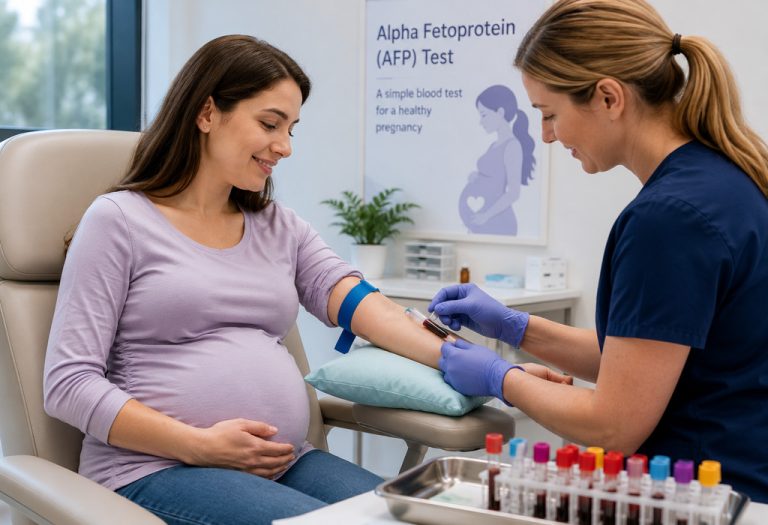
This is a simple blood test done on an outpatient basis, usually at a diagnostic lab. The results are available in one or two weeks. The lab technician drawing your blood will:
- Wrap an elastic band around the intended spot, usually on the upper arm, so that the vein is easy to find.
- Dab the spot with alcohol.
- Stick the needle into the vein and draw blood till the tube attached to the needle is full.
- Remove the elastic band from your arm after blood has been drawn.
- Press a cotton ball over the needle site and apply a bandage over it.
What Does the Test Feel Like?
It is a painless process. You might feel a pinch or a sting at most when the needle pierces your arm. The process usually takes only a few minutes. Since the results will be available only after a few days, you might be anxious to know about your baby during the waiting period.
Risks Associated With AFP Test
There are almost no risks associated with an AFP test. Minor discomforts such as those associated with a regular blood test might occur. You may experience:
- Soreness or pain at the spot where the needle was inserted.
- A small bruise may appear at this spot.
- In rare cases, the vein may swell up resulting in a condition called phlebitis, which can be treated with a warm compress applied at regular intervals.
AFP Results in Pregnancy

The amount of alpha-fetoprotein in your blood tells your doctor if there are any problems with your unborn baby and, if yes, what they might be. AFP levels can be categorised as normal, high, and low.
Alpha-Fetoprotein Normal Level
The normal range of alpha fetoprotein levels in pregnancy can vary somewhat, depending on the lab you go to. Normal values will also depend on the age of the baby. The following are commonly thought to be in the alpha-fetoprotein normal range (4).
| Category | AFP range in nanograms/millilitre |
| Normal adults | 0-40 ng/ml |
| Pregnant women from 15-18 weeks | 10-150 ng/ml |
Alpha-Fetoprotein High Level
Your individual circumstances and health will have to be taken into consideration before considering AFP values that are abnormally high. High levels of AFP can mean one of the following:
- You are carrying more than one baby.
- Your pregnancy is more advanced than thought, and the due date will have to be calculated again.
- The baby has a neural defect.
- Fetal death may have occurred.
- The baby might have an abdominal wall defect, a condition wherein the intestines or other organs are located outside the body. Surgery after birth can help rectify this.
Alpha-Fetoprotein Low Level
Unusually low levels of AFP mean one of the following:
- The gestational age of your baby is wrong. This can happen when the due date has been miscalculated and you are earlier in your pregnancy than the initial estimate.
- The baby has Down Syndrome or Edwards Syndrome (a condition that causes developmental delays due to an extra chromosome 18).
What Can Affect the Test?
There are certain factors that can influence the outcome of the test, leading to results that can be misleading. This can happen because:
- It is a multiple pregnancy – i.e., the presence of more than one baby.
- You have gestational diabetes.
- You are a smoker, which can cause higher levels of AFP in the blood.
- You had to undergo a medical test that used radioactive tracers within two weeks of the AFP test.
Points to Keep in Mind
Also known as the Maternal Serum Alpha-Fetoprotein (MSAFP) test, this is just a screening test, and not a diagnostic one. It is important to note that the test only indicates that you are at a greater or lower risk of giving birth to a child with birth defects. It does not give definitive results either way. Here are some other things to remember when you undergo this test:
- Any abnormal AFP results will be followed up by repeat AFP testing, and if the results are the same, an ultrasound may be done to determine the cause.
- If an ultrasound does not reveal the reason behind unusual AFP levels, an invasive test such as amniocentesis may be recommended.
- Levels of AFP are usually normal in the amniotic fluid of a majority of women who have abnormal AFP blood levels. Such mothers are at very low risk of giving birth to a child with neural defects.
- A normal AFP result cannot be taken as a guarantee that your pregnancy will be a normal one, or that the baby will be born healthy (5).
- If your AFP results show abnormal levels, discuss this with your doctor, or you may be referred to a genetic counsellor.
- There are chances that AFP results are abnormal for no valid reason. It is estimated that in every 1,000 pregnancies, 25 to 50 abnormal AFP results are obtained. Of these, babies with actual birth defects are somewhere between 1 in 16 and 1 in 33.
- If invasive procedures are recommended after the AFP test, discuss the pros and cons in detail with your doctor before making a decision.
FAQs
1. Is the AFP test safe during pregnancy?
Yes. The Alpha Fetoprotein pregnancy test is a blood test that requires a sample from the pregnant person’s vein and does not involve a procedure inside the uterus.
2. When is the AFP test performed during pregnancy?
The AFP test is generally performed during the second trimester, commonly around 15–20 weeks of pregnancy. When AFP in pregnancy is included in a quad screen, the testing window may extend to approximately 22 weeks depending on the laboratory and clinical protocol.
3. What does an abnormal AFP result mean?
Abnormal AFP results in pregnancy do not automatically mean that your baby has a birth defect. It indicates that further evaluation may be needed because factors like pregnancy dating, multiple pregnancy and other conditions can affect AFP levels.
4. Does a normal AFP result rule out birth defects?
No. AFP is a screening test, not a diagnostic test, so a normal result cannot rule out every birth defect or genetic condition. Whether AFP elevated in pregnancy or not, a doctor may or may not recommend further testing. Similarly, an abnormal result does not confirm that a problem is present.
Abnormal levels of AFP by themselves, whether high or low, do not mean that your baby has a birth defect. It only means that your doctor is likely to order further tests, such as an ultrasound, to arrive at a diagnosis. This is not a mandatory test, and you have the right to take or refuse it. However, almost 75% to 90% of babies with neural tube defects can be identified through this test; taking it might help you chart your future course of action. Additional testing can give you a confirmed diagnosis, following which you can find out if any medical interventions are possible, or start making lifestyle changes that might be necessary when bringing up a child with special needs.
Disclaimer: This information is just a guide and is not a substitute for medical advice from a qualified professional.
Also Read:
Nonstress Test
Genetic Testing in Pregnancy
Triple Marker Test during Pregnancy
Was This Article Helpful?
Parenting is a huge responsibility, for you as a caregiver, but also for us as a parenting content platform. We understand that and take our responsibility of creating credible content seriously. FirstCry Parenting articles are written and published only after extensive research using factually sound references to deliver quality content that is accurate, validated by experts, and completely reliable. To understand how we go about creating content that is credible, read our editorial policy here.
- Author
- Expert Reviewer


Related Articles
-

White Vaginal Discharge During Third Trimester of Pregnancy
-
Fever During Pregnancy - Risks & Remedies
-
Eating Ginger During Pregnancy - Is It Safe?
-
Follicle Stimulating Hormone (FSH) Level in Pregnancy - What's Normal?
-
DVT (Deep Vein Thrombosis) in Pregnancy - Causes , Risks, & Treatment
-
Spa in Pregnancy: Safe Treatments and Precautions