
Taped Diapers vs. Diaper Pants: Which Is Right for Your Baby?
Taped diapers or diaper pants? Learn about their pros, cons, fit, and convenience to choose the right diaper for your baby's growing needs.




Key Takeaways
- Taped diapers suit newborns and babies who lie still, while diaper pants suit babies who roll, crawl or stand.
- Fit decides leaks and skin marks more than style, so match the weight range and check the waist and thighs.
- Price per diaper depends on pack size as much as style, so compare it on the listing.
- Both styles can share a routine, such as taped diapers for sleep and pants for outings.
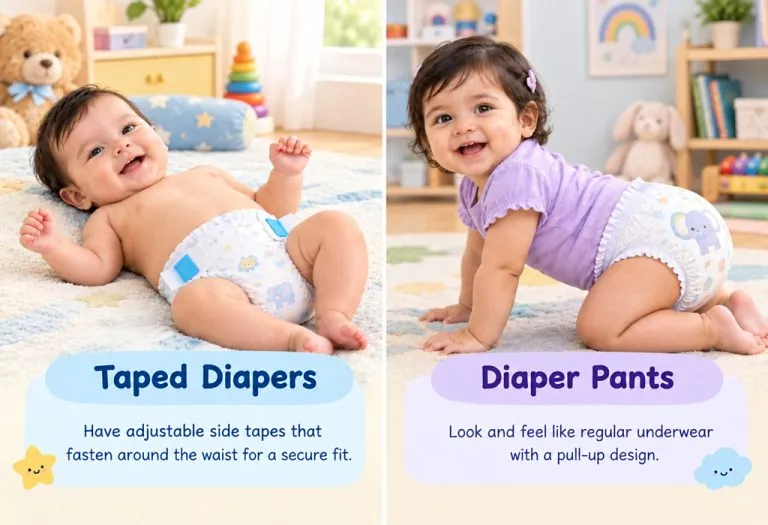
The tape diaper vs pant diaper choice comes down to movement: taped diapers suit newborns and babies who lie still, while diaper pants suit babies who roll, crawl or stand. Taped diapers give an adjustable fit and are easy to change on a lying baby. Diaper pants pull on like underwear and save time with a wriggly baby. This article compares fit, ease of change, cost and rash risk for parents of babies from birth to toddler age. Every point applies to disposable diapers sold in India.
|
Key Facts Two finger fit test. A diaper is not too tight when 2 fingers slide between the diaper and the baby’s tummy. Indian standard. Disposable baby diapers fall under mandatory BIS certification in India through IS 17509:2021, so check the product details for it. Change quickly. Changing wet or dirty diapers as soon as possible is a core step in preventing nappy rash. |
What Are Taped Diapers?
Taped diapers are disposable diapers that fasten at the waist with adhesive tabs, so a parent can adjust the fit on each side. Taped diapers suit newborns, whose small waists need an adjustable fit. FirstCry is a go to shopping destination for baby and kids essentials, where the type filter on the taped diapers listing narrows the choice by size and weight.
Benefits of Taped Diapers
So, what makes taped diapers a popular choice among parents? Let’s look at some of the benefits they offer.
- Adjustable fit: The tabs tighten or loosen each side as the waist changes.
- Easy lying down changes: A baby who lies still needs no high leg lifts.
- Easy to check: Opening the tabs shows a soiled diaper without removing it.
- Overnight fit: Some parents prefer the tuned fit for a sleeping baby.
Limitations of Taped Diapers
While taped diapers offer plenty of convenience, they may not be the perfect fit for every baby or situation. Here are a few limitations worth keeping in mind.
- Hard on wriggling babies: Tabs are hard to fasten evenly when a baby rolls away.
- Tabs can weaken: Tabs may lose grip after repeated refastening.
- Fit errors: A loose tab leaves leg gaps, and a tight tab can irritate skin.
- Not potty friendly: Toddlers cannot pull taped diapers down alone.
What Are Diaper Pants?
Diaper pants are disposable diapers with a stretchy waistband that pull on and off like underwear. The parent slides the pants over the feet and up to the waist, and many designs have tearable side seams for removal. Diaper pants suit babies who roll, crawl or stand, since changing does not need the baby to lie still. The type filter on FirstCry lists diaper pants next to taped diapers.
Benefits of Diaper Pants
Diaper pants bring their own set of advantages that can make a difference in your baby’s daily routine. Here’s a closer look at what they offer.
- Quick to put on: The pull on design takes seconds, even with a wriggling baby.
- Standing changes: A toddler can stand for the change, with no wrestling on the mat.
- Easier outings: Changes on the go need less space and time.
- Close fit all round: The stretch waistband can reduce gaps as the baby moves.
Limitations of Diaper Pants
Like any diapering option, diaper pants have certain drawbacks too. Let’s take a look at where they may fall short.
- Less fit control: A pant size is fixed and cannot be tuned.
- Messier removal: Soiled pants must be pulled down past the legs or torn.
- Price per diaper: Pants may cost more per diaper, so compare listings.
- Tight waist marks: Pants that run small leave red marks, and the NHS advises against tight diapers.[3]
Difference Between Taped Diapers and Diaper Pants
Diaper pants vs tape comes down to fastening, fit control and how each style handles a moving baby. The table below compares ten practical points that parents notice in daily use.
|
Feature |
Taped Diapers |
Diaper Pants |
|
Fastening |
Adhesive tabs |
Stretch waistband |
|
Best stage |
Newborns and lying babies |
Rolling, crawling and standing babies |
|
Fit adjustment |
Adjustable on each side |
Fixed by size |
|
Moving baby |
Harder, must lie flat |
Easier, can stand |
|
Sleeping baby |
Easier, stays on the back |
Harder, legs lifted through |
|
Soiled removal |
Open tabs, fold away |
Pull down or tear seams |
|
Cost per diaper |
Often lower, check listing |
Often higher, check listing |
|
Risk of gaps |
Loose tabs |
Wrong size |
|
Potty training |
Tabs opened each time |
Toddler can pull down |
|
Outings |
Needs a flat surface |
Quick change anywhere |
Fit and Sizing: How to Get the Right Fit in Either Style
A well fitted diaper sits snug at the waist and legs without leaving marks. Start with the weight range on the pack, because size labels differ between brands.
- Taped diapers: Fasten both tabs at the same height.
- Diaper pants: Pull the waistband up and smooth the leg gathers outwards.
- Too small: Red marks, back leaks and tabs that barely reach.
- Too big: Leg gaps or a waistband that slips down.
How to Choose Between Taped Diapers and Diaper Pants by Age and Mobility
Here’s how to choose between taped diapers and diaper pants at different stages of your baby’s development.
- Newborn and lying baby: Taped diapers are a practical choice for newborns and babies who spend most of their time lying down.
- Rolling baby: Diaper pants can make changes easier when babies start rolling or moving around during diaper changes.
- Crawling and standing baby: Pants are convenient for active babies who crawl, stand, or resist lying still.
- Walking toddler: Diaper pants are easy to pull up and down, making them useful during potty training.
On FirstCry, the type filter separates taped diapers from pants, and the weight filter runs from 0 to 7 kg up to 18 to 25 kg. Babyhug pant style diapers are listed in Medium for 7 to 12 kg. The pant style filter holds far more products than the taped filter, so newborn parents should compare brands carefully.
Signs It Is Time to Switch From Taped Diapers to Diaper Pants
Not sure when to make the switch? Your baby’s changing movements and diapering habits can offer a few clues. Here are some signs to look out for.
- Rolling away: The baby rolls over before the tabs are fastened.
- Crawling or standing: Lying flat becomes a struggle.
- Tab trouble: The baby opens the tabs mid change.
- New leaks: Leaks appear as the baby moves and tabs shift.
- Longer changes: Each change takes minutes and gets messy.
Taped Diapers vs. Diaper Pants: Which Is Better for Your Baby?
Which is better diaper pants or tape? Neither style wins for every baby, and the answer changes as the baby grows. Taped diapers work best for newborns and babies who lie still, because the tabs adjust the fit. Diaper pants work best for babies who roll, crawl or stand, because pants pull on in seconds. Nappy rash depends mostly on how long wee or poo stays on the skin, so quick changes, a snug fit and good absorbency matter more than style. Many families use both styles. Start with the style that matches the baby’s movement today, check the fit at every change, and switch when changes become a struggle.
FAQs
1. Can I use taped diapers and diaper pants together?
Yes, taped diapers and diaper pants can be used together. Many families use taped diapers for sleep at home and pants for crawling or outings. Check the size and fit for each style.
2. How many diapers does a newborn use in a day?
A newborn may need about 10 to 12 diaper changes a day in the early days, falling to about 6 to 8 when the baby is a bit older, according to the NHS.
3. How often should I change a diaper, and can one stay on overnight?
Change a diaper as soon as it is wet or dirty, and put on a fresh one at bedtime. The bedtime diaper can stay on overnight if it fits well, but change it if the baby wakes soiled.
4. What does the wetness indicator on a diaper mean?
A wetness indicator is a line on the front of the diaper that changes colour when the diaper is wet. The colour change shows when a change is due without opening the diaper.
5. Do diaper pants or taped diapers cause more nappy rash?
Neither style causes more nappy rash on its own. Nappy rash follows long contact with wee or poo, so quick changes, a snug fit and extra absorbent diapers matter more than style.
6. Which leaks less: taped diapers or diaper pants?
Fit decides leaks more than style. A taped diaper leaks when the tabs sit loose or uneven, and a pant leaks when the size is wrong. Check the weight range and smooth the leg gathers.
7. Which diapers suit babies prone to nappy rash?
Diapers with a super absorbent core suit rash prone babies, and an Indian Journal of Pediatrics abstract reports they reduce nappy rash incidence. Change them promptly, and see a doctor if the rash persists.
8. Which diaper pants suit crawling and walking babies?
Diaper pants in the size matching the baby’s current weight suit crawling and walking babies. Look for a stretchy waistband that stays up during movement and leg openings that leave no gaps.
9. Where can I buy taped diapers and diaper pants?
Taped diapers and diaper pants can be bought wherever baby essentials are sold, and the same checks apply: the type, the weight range, BIS certification and price per diaper. On FirstCry, the type, size and weight filters separate taped diapers from pants.
10. Which are the top brands of taped diapers and diaper pants?
No single brand suits every baby, so compare weight range, fit, absorbency, wetness indicator and price per diaper. Check the product details for BIS certification under IS 17509. On FirstCry, the brand filter allows side by side comparison, and Babyhug pant style diapers are one example.
Taped diapers suit newborns and babies who lie still, and diaper pants suit babies who roll, crawl or stand. Fit and quick changes protect skin more than style does. Before buying, check the weight range, the fit at the waist and thighs, the price per diaper and IS 17509. Using both styles is fine when routines differ between home, sleep and outings. Ask your paediatrician if a rash persists or if size or style is unclear.
Was This Article Helpful?
- Author