







.svg)
.svg)
.png)

Shopping
Suggested articles for you

The Ultimate Prams Buying Guide
What is a Pram?
The word ‘Pram’ is derived from the word perambulator, more suited to carry babies from birth till they grow into independent sitters. Newborn babies do not have control over their neck, which needs to be gently held in place when the babies are lifted from their lying positions. Therefore, they require a carriage where they can comfortably lie and look at the world above them. The pram bassinets are ideal for babies to lie down on their backs, when the parents step outside. The canopy of a pram covers more than half of the bassinet, thereby shielding babies from dust and heat and giving them a cozy atmosphere. Since prams allow babies a fully reclining position, straps and harness belts are usually absent. However, you can customize your pram to add these features if you feel that they are necessary.
How is a Pram Useful?
While it is true that the bonding between the caregiver and baby increases by holding the baby close to your body, in reality, how long can you really keep your hand propped up holding up the little one? You obviously need your hands free for other tasks, and need to move around, going about your daily routine. There is the option of wearing your child, but that still constricts your movements to some extent since you cannot bend down to make swift movements. The answer to this dilemma then is, Prams!
A full sized four-wheel pram has a full range of options for bassinet, travel systems, accessories, and large wheels and generally come with rubber tires. They also have a wide canopy and usually cover up to half the carriage protecting the infant from dust and harsh light. A pram has wheels which allows you to easily push it around while strolling.
Why You Need a Pram?
Most moms prefer to use prams for their babies because –
Babies like to explore the world and all its sights and sounds, and shouldn’t have to wait till they find their feet.
Taking babies in a pram and going for long walks helps them shed that pregnancy weight while giving their back a much-needed respite from strain.
With a pram, newborns get to enjoy warmth and comfort, even when outdoors.
Most prams allow rear-facing option, giving them the chance to maintain eye contact or sing to their baby wherever they go.
Features List
There are a few features to consider while buying a pram. The ‘Must Haves’ point to the essential features, while the ‘Good to Haves’ are add-on features you may or may not choose to go for.
Must Haves
An adjustable canopy.
Reclining Seat – Fully reclining position is best for babies who have not developed head and neck support.
3-Wheel System or 4-Wheel System – A 3-wheel pram is lighter and easier to maneuver than a 4 wheel one. This is useful for parents who wish to jog with their newborns in tow. However, the 3-wheel structure makes the pram less sturdy and stable.
Reversible Seat It lets babies enjoy the world or look at you when they are cranky.
Good to Haves
Toy Attachments – To keep your baby entertained.
I-Pad Hookup.
Height-adjustable handle.
A Storage Basket-To hold the diaper bag/ purse/ grocery bags.
Reversible Handle – Strollers come with reversible handles that can be positioned to make your child face you on the rear, or forward, according to the child’s age and mood.
Reference:- 4-http://www.essentialbaby.com.au/forums/index.php?/topic/796558-reversible-pram/
Pros and Cons of a Pram
Just as there are 2 sides to a coin, prams have their advantages and disadvantages.
Pros
Cons
A sturdy frame with 3 or 4 wheel options.
Can be heavy and bulky.
You can make the baby lie facing you or away from you.
Can be difficult to fold.
Storage spaces allow you ease of shopping with your baby.
Traveling through small spaces can be hard.
Prams can be customized with extra accessories, and converted into stroller to extended period of use.
Might not be ideal to use when traveling short distances (say, to a mall or a park).
What to Look for when Buying a Pram?
Here are some points to keep in mind while buying a pram for your bundle of joy-
Look for quality materials and sturdy wheels.
Ensure that it fits into the boot of your car.
Look for a balanced design and suspension.
Look for durability, extra padding for babies, reversible seats and a large storage capacity.
Read more




10 Best Diaper Rash Creams for Babies 2025
Diaper rash is an issue faced by most babies and its something that can happen in spite of taking the utmost care. In addition to this, when there’s moisture or wetness in the areas around the buttocks or when there are urine leaks, the pH levels rise and cause skin irritation. This leaves the baby feeling very uncomfortable. To protect your little one’s delicate skin, choosing the best diaper rash cream in India can help soothe, heal, and prevent rashes effectively.
But the good news is that it doesn’t always have to be that way. Just keep reading and you’ll find a list of diaper rash creams that give you fast and effective results. Each option has been carefully chosen to help you pick the best baby diaper rash cream for soothing and protecting your little one’s sensitive skin.
Our Recommended Top-Rated Baby Diaper Rash Creams
Babyhug Advanced Everyday Protection Diaper Rash Cream
Sebamed Baby Rash Cream
Himalaya Herbal Diaper Rash Cream
Curatio B4 Nappi Cream
Cetaphil Baby Diaper Cream
The Moms Co Natural Diaper Rash Cream
Mustela Vitamin Barrier Cream 1 2 3
Chicco Baby Moments Diaper Rash Cream
Mother Sparsh Simply Unscented Baby Diaper Rash Cream
Mee Mee Gentle Diaper Rash Cream
List of Top 10 Diaper Rash Creams in India
If you’re searching for the best diaper rash creams in the market or online, then look no further. These are guaranteed to restore the pH balance of your baby’s skin and heal inflammation. These are very useful for babies with sensitive skin. Try them on your baby to experience the results.
1. Babyhug Advanced Everyday Protection Diaper Rash Cream
Rating: 4.1/5 ★
Product Description
Babyhug Advanced Diaper Rash Cream provides daily protection against diaper rashes while keeping your baby’s skin soft and smooth. Its gentle formulation helps soothe redness, heal irritation, and protect delicate skin from wetness and friction.
Quantity: 100 g
Recommended Age: Suitable for newborns and above
Key Ingredients: Jojoba oil and shea butter
Usage: Apply on clean, dry skin during every diaper change
Dermatologically Tested: Yes
Purpose: Prevents and heals diaper rashes
Key Features
Jojoba oil for nourishing and moisturizing delicate baby skin.
Shea butter for soothing irritation and redness naturally.
Protective barrier for reducing wetness and friction.
Mild, hypoallergenic formula for everyday diaper protection.
Smooth texture for easy, even application on sensitive skin.
Why Parents Love It
Parents value its gentle formula that quickly calms rashes and keeps their baby’s skin soft, healthy, and comfortable throughout the day.
Perfect For
Newborns and infants • Sensitive skin • Daily diaper changes • Rash prevention and healing • Night-time use
Price
Approx. ₹179 – ₹219 (Prices may vary based on ongoing offers and deals.
Customer Feedback Highlights
Parents mention it’s “very effective,” “safe for baby skin,” and “works well even in small amounts.” Many highlight that it “heals rashes quickly,” and “is a must-buy for everyday diaper use.”
2. Sebamed Baby Rash Cream
Rating: 4.6/5 ★
Product Description
Sebamed Baby Rash Cream gently protects your baby’s delicate skin from irritation and redness caused by wet diapers. It forms a soothing layer that heals rashes quickly while keeping the skin soft and calm.
Quantity: 100 ml
Recommended Age: Suitable for newborns and above
pH Value: 5.5, ideal for maintaining the skin’s natural barrier
Ingredients: Titanium dioxide, panthenol
Usage: Apply on clean, dry skin during every diaper change
Dermatologically Tested: Yes
Free From: Parabens, mineral oil, and harmful preservatives
Key Features
Panthenol content for promoting faster healing of rashes.
Chamomile extract for soothing redness and irritation.
Protective titanium dioxide layer for reducing friction and wetness.
Balanced pH 5.5 for maintaining baby’s natural skin barrier.
Clinically tested formula for safe and gentle daily use.
Why Parents Love It
Parents love its gentle, rash-free protection that keeps baby skin smooth, comfortable, and irritation-free after every use.
Perfect For
Newborns and infants • Sensitive and rash-prone skin • Daily diaper changes • Night-time skin protection
Price
Approx. ₹610 – ₹650 (Prices may vary based on ongoing offers and deals.)
Customer Feedback Highlights
Parents describe it as “very effective,” “worth buying,” and “best rash-free cream.” Many mention it “works fast.”
3. Himalaya Herbal Diaper Rash Cream
Rating: 4.5/5 ★
Product Description
Himalaya Herbal Diaper Rash Cream is a gentle, herbal formulation that helps soothe, heal, and prevent diaper rashes. It forms a protective barrier on your baby’s skin while keeping it soft, dry, and free from irritation.
Quantity: 50 g
Recommended Age: Suitable for newborns and above
Key Ingredients: Almond oil; Aloe vera; Five-Leaved Chaste Tree; Yashada Bhasma (Zinc Oxide)
Usage: Apply on clean, dry skin with each diaper change
Dermatologically Tested: Yes
Purpose: Prevents and relieves diaper rashes
Free From: Parabens, mineral oil, synthetic colors
Key Features
Yashada Bhasma (Zinc Oxide) for creating a protective barrier and aiding rash healing.
Almond oil for moisturizing and softening delicate baby skin.
Aloe vera for calming irritation and promoting soothing relief.
Five-Leaved Chaste Tree extract for anti-inflammatory support.
Herbal blend for gentle, daily-safe rash protection.
Why Parents Love It
Parents appreciate its herbal, gentle approach and visible improvement in rash healing without harsh chemicals.
Perfect For
Newborns and infants • Babies with sensitive skin • Daily diaper use • Rash-prone skin • Nighttime protection
Price
Approx ₹120 – ₹150 (Prices may vary based on ongoing offers and deals.)
Customer Feedback Highlights
Parents call it “best rash cream,” “good value for money.” Feedback often mentions it as “nice product,” “very effective,” and “budget-friendly.”
4. Curatio B4 Nappi Cream
Rating: 4.6/5 ★
Product Description
Tedibar B4 Nappi Cream is a dermatologist-tested baby cream specially formulated to prevent and treat diaper rashes. It forms a smooth protective layer that locks out moisture, soothes redness, and keeps your baby’s skin soft and rash-free.
Quantity: 75 g
Recommended Age: Suitable for newborns and above
Key Ingredients: Zinc Oxide, Calendula Oil, Altantoin.
Usage: Apply a thin layer on clean, dry skin before each diaper change
Dermatologically Tested: Yes
Purpose: Prevents and soothes diaper rash while moisturizing the skin
Free From: Parabens and harmful chemicals
Key Features
Zinc oxide for creating a barrier that protects against wetness and irritation.
Calendula oil for naturally soothing inflammation and redness.
Allantoin for promoting gentle skin healing and softness.
Mild, hypoallergenic formula for everyday protection.
Light, non-sticky texture for quick comfort and easy absorption.
Why Parents Love It
Parents appreciate its quick relief and long-lasting rash protection, making diaper time stress-free and skin-friendly.
Perfect For
Newborns and infants • Sensitive or rash-prone skin • Daily diaper routine • Overnight protection • Healing mild irritation
Price
Approx. ₹299 – ₹350 (Prices may vary based on ongoing offers and deals.)
Customer Feedback Highlights
Parents say it’s “amazing,” “Good product I am using this with confident,” and “very effective for baby skin.” Many love that it “Nice product, very helpful,” “Good For Baby.”
5. Cetaphil Baby Diaper Cream
Rating: 4.5/5 ★
Product Description
Cetaphil Baby Diaper Cream with Organic Calendula provides advanced care for your baby’s delicate skin. It forms a soothing, protective layer that calms irritation, locks in moisture, and helps heal diaper rashes gently and effectively.
Quantity: 70 g
Recommended Age: Suitable for newborns and above
Key Ingredients: Organic calendula extract, vitamin B5 (panthenol), and vitamin E
Usage: Apply a thin layer on clean, dry skin during each diaper change
Dermatologically Tested: Yes
Purpose: Helps prevent and relieve diaper rashes
Free From: Parabens, colorants, and alcohol
Key Features
Organic calendula for soothing and calming redness naturally.
Vitamin B5 (panthenol) for keeping skin moisturized and soft.
Vitamin E for nourishing and strengthening baby’s skin barrier.
Hypoallergenic formula for gentle protection even on sensitive skin.
Clinically proven care for everyday rash prevention and comfort.
Why Parents Love It
Parents appreciate its gentle texture and soothing formula that reduces redness quickly and keeps the baby’s skin smooth and comfortable.
Perfect For
Newborns and infants • Rash-prone skin • Daily diaper use • Sensitive baby skin • Long diaper hours
Price
Approx. ₹419 – ₹449 (Prices may vary based on ongoing offers and deals.)
Customer Feedback Highlights
Parents call it “best diaper cream,” “worth buying,” and “very effective in the first use.” Many mention it “Best diaper cream in the market,” “Excellent,” and “product is amazing.”
6. The Moms Co Natural Diaper Rash Cream
Rating: 4.2/5 ★
Product Description
The Moms Co. Natural Diaper Rash Cream is a toxin-free, gentle formula made to protect and heal baby skin from rashes and redness. Enriched with natural butters and oils, it soothes irritation and keeps the diaper area dry and comfortable.
Quantity: 25 g
Recommended Age: Suitable for newborns and above
Key Ingredients: Zinc oxide, organic shea butter, organic chamomile oil, and organic jojoba oil
Usage: Apply a thin layer on clean, dry skin before every diaper change
Dermatologically Tested: Yes
Purpose: Prevents, soothes, and heals diaper rashes
Free From: Parabens, mineral oil, synthetic fragrances, and toxins
Key Features
Zinc oxide for protecting skin from wetness and irritation.
Shea butter for moisturizing and healing delicate baby skin.
Chamomile oil for calming redness and discomfort.
Jojoba oil for keeping skin nourished and smooth.
Natural toxin-free formula for safe, everyday use.
Why Parents Love It
Parents appreciate its toxin-free formula that provides quick relief from rashes and keeps baby skin smooth, dry, and irritation-free.
Perfect For
Newborns and infants • Rash-prone or sensitive skin • Daily diaper care • Night-time protection • Soothing redness and irritation
Price
Approx. ₹149 – ₹199 (Prices may vary based on ongoing offers and deals.)
Customer Feedback Highlights
Parents describe it as “Great Rash Cream – so good and highly effective,” and “No Rashes – been using since 3 months old.” Others say “Very Effective – helped avoid rashes,” and “Excellent Product – my kid never had rashes.”
7. Mustela Vitamin Barrier Cream 1 2 3
Rating: 4.6/5 ★
Product Description
Mustela Vitamin Barrier Cream 1-2-3 provides triple protection—prevents, soothes, and repairs diaper rashes from the first use. Its rich, non-sticky texture creates a breathable layer that comforts your baby’s skin and keeps it soft and protected.
Quantity: 100 ml
Recommended Age: Suitable for newborns and above
Key Ingredients: Avocado perseose, zinc oxide, and sunflower oil distillate
Usage: Apply a thin layer on clean, dry diaper area after each change
Dermatologically Tested: Yes
Purpose: Prevents, relieves, and repairs diaper rash irritation
Free From: Parabens, alcohol, and artificial fragrances
Key Features
Avocado perseose for strengthening and protecting the skin barrier.
Zinc oxide for providing an effective protective shield against wetness.
Vitamin F and shea butter for soothing and nourishing delicate skin.
Clinically proven 1-2-3 action for prevention, relief, and repair.
Hypoallergenic formula for safe use from birth.
Why Parents Love It
Parents choose it for its visible results after the first use and long-lasting protection that keeps baby skin calm and healthy.
Perfect For
Newborns and infants • Sensitive and rash-prone skin • Daily diaper changes • Night-time protection • Healing redness and irritation
Price
Approx. ₹649 – ₹849 (Prices may vary based on ongoing offers and deals.)
Customer Feedback Highlights
Parents say it’s “the best cream for rashes,” noting that redness disappears within two days. Many describe it as “a life saver,” “great for sensitive skin,” and “effective from the first use.”
8. Chicco Baby Moments Diaper Rash Cream
Rating: 4.4/5 ★
Product Description
Chicco Baby Moments Diaper Rash Cream is a gentle, dermatologist-tested cream that helps prevent and soothe diaper rashes. It provides instant comfort, reduces redness, and leaves baby skin soft and protected.
Quantity: 100 ml
Recommended Age: Suitable for newborns and above
Key Ingredients: Zinc oxide and panthenol
Usage: Apply on clean, dry skin before each diaper change
Dermatologically Tested: Yes
Purpose: Prevents and heals diaper rashes
Free From: Parabens, alcohol, dyes, and artificial colors
Key Features
Zinc oxide barrier for protecting against moisture and irritation.
Shea butter for keeping baby’s skin hydrated and smooth.
Panthenol for soothing and repairing rash-prone skin.
Hypoallergenic formula for safe use on sensitive skin.
Light, non-sticky texture for quick absorption and comfort.
Why Parents Love It
Parents love its fast, visible results and gentle protection that keeps their baby’s skin soft, dry, and rash-free all day.
Perfect For
Newborns and infants • Sensitive skin • Daily diaper use • Night-time protection • Healing redness and irritation
Price
Approx ₹289 – ₹349 (Prices may vary based on ongoing offers and deals.)
Customer Feedback Highlights
Parents call it “very effective, worth the money,” and “good for diaper rash use, lasts long.” Many reviews say “must buy, gives instant results in rashes,” while others describe it as “nice for babies, very effective,” and “works like magic.”
9. Mother Sparsh Simply Unscented Baby Diaper Rash Cream
Rating: 4.8/5 ★
Product Description
Mother Sparsh Simply Unscented Baby Diaper Rash Cream is a gentle, fragrance-free formula designed to protect and soothe your baby’s sensitive skin. It helps prevent diaper rashes, calms irritation, and forms a protective layer to keep the diaper area dry and comfortable.
Quantity: 50 g
Recommended Age: Suitable for newborns and above
Key Ingredient: Natural oatmeal
Usage: Apply a thin, even layer on clean, dry skin before every diaper change
Dermatologically Tested: Yes
Purpose: Prevents and relieves diaper rash and irritation
Free From: Added fragrance and irritants
Key Features
Natural oatmeal for soothing and calming baby’s delicate skin.
Unscented formula for sensitive and newborn skin.
Protective barrier for reducing wetness and friction.
Dermatologist-approved care for safe daily use.
Gentle texture for smooth, easy application.
Why Parents Love It
Parents love its mild, fragrance-free protection that heals rashes naturally and keeps baby skin soft, dry, and irritation-free.
Perfect For
Newborns and infants • Sensitive or rash-prone skin • Daily diaper changes • Night-time use • Long diaper hours
Price
Approx. ₹269 – ₹349 (Prices may vary based on ongoing offers and deals.)
10. Mee Mee Gentle Diaper Rash Cream
Rating: 4.8/5 ★
Product Description
Mee Mee Gentle Diaper Rash Cream is dermatologically tested and microbiologically proven to protect your baby’s delicate skin from rashes and redness. Enriched with aloe vera and natural oils, it provides cooling, soothing relief while keeping the baby’s skin soft, nourished, and healthy.
Quantity: 100 g
Recommended Age: Suitable for newborns and above
Key Ingredients: Yashada Bhasma (Zinc Oxide), Aloe Vera, Jojoba Oil, Sunflower Oil, and Mineral Oil.
Usage: Apply gently on clean, dry skin during every diaper change, especially before long hours or overnight use
Dermatologically Tested: Yes
Purpose: Heals and prevents diaper rashes while moisturizing and soothing the skin
Free From: Paraben Free
Key Features
Calms diaper rashes for fast relief from redness and irritation.
Prevents dryness for smooth, well-moisturized baby skin.
Provides a cooling effect for soothing comfort during rash flare-ups.
Non-sticky and deeply nourishing for all-day softness.
Excellent barrier protection for keeping wetness away.
Why Parents Love It
Parents love its smooth, cooling texture that keeps the baby’s skin rash-free and soft all day long without stickiness or residue.
Perfect For
Newborns and infants • Rash-prone or sensitive skin • Night-time protection • Daily diaper changes • Quick rash relief
Price
Approx. ₹130 – ₹160 (Prices may vary based on ongoing offers and deals.)
Customer Feedback Highlights
Parents describe it as “worth every penny, good quality product,” “best diaper cream ever,” and “good product for newborns.” Many say it “heals rashes quickly,” “keeps skin soft and smooth,” and “a must-have in every diaper bag.”
How to Choose the Right Diaper Rash Cream for Your Baby’s Skin?
Pick creams with safe, natural ingredients like zinc oxide or aloe vera.
Choose paraben-free and fragrance-free formulas for sensitive skin.
Go for dermatologically tested and non-sticky creams.
Ensure it heals and protects against rashes effectively.
FAQs on Diaper Rash Creams for Babies
Have questions about diaper rash creams and curious about how to make the best use of them? Don’t worry; we’re here to answer. Keep reading to find out.
1. How to Apply Diaper Rash Cream?
Remove your baby’s dirty diaper first and clean her bottom using wet wipes. Before putting on a clean diaper, apply a dime-sized amount of a diaper rash cream to your baby’s bottoms. Wrap up the fresh diaper, wash off the excess cream from your hands, and you’re done!
2. Should I Use Diaper Rash Cream Every Time I Change My Baby’s Diaper?
The answer to this will depend on how often your baby gets diaper rashes and how sensitive her skin is. Most mothers apply diaper rash creams regularly as a preventive measure to protect against irritation and rashes. The best time to apply diaper rash creams is overnight since when babies sleep for long stretches; their bottoms are most susceptible to moisture and harmful irritants. If your baby is going through her teething phase, has a cold, or diarrhoea, you should use diaper rash cream at every change just to be safe.
3. Can I Use Diaper Rash Cream on My Newborn?
Yes, you can, as long as the diaper rash cream is made from natural ingredients and doesn’t contain any harmful chemicals. For more information on this, you can talk to a dermatologist.
4. What to Look for in a Diaper Rash Cream?
The best diaper rash creams will contain these four ingredients – zinc oxide, calendula oil, lanolin, and aloe vera. These ingredients are known to hydrate and heal the skin from inflammation, and also protect it from harmful irritants. Thick diaper rash creams, pastes, and over-the-counter options are suitable for severe cases of rashes and irritation, but it is always advisable to check with a dermatologist before using it, especially if you have a newborn on your hands.
5. What are the best places to buy diaper rash creams in India?
You can find high-quality diaper rash creams on trusted online platforms like FirstCry, Amazon, and Flipkart. These sites offer a wide range of genuine products, detailed reviews, and frequent discounts for parents.
6. What are the top diaper rash cream brands trusted by parents in India?
Popular and parent-trusted brands in India include Babyhug, Himalaya, Cetaphil, and Chicco. These brands are known for their gentle, dermatologically tested formulas that protect and soothe your baby’s skin.
Using diaper rash creams is a good practice which you’ll be thankful for. There’s nothing more emotionally aggravating for a mother than to see her newborn suffer the pain and discomfort caused by rashes. The good news is that these creams and OTC products have you covered, so your baby will be able to rest or move around in peace. Always choose the best diaper rash cream for newborns in India to keep your baby’s skin healthy, soft, and rash-free.
You May Also Like:
10 Best Baby Diapers
10 Best Baby Wipes
Diaper Rash Creams Offers & Deals:
Baby Diapering Products
Baby Diapering Brands
Baby Diapering Offers & Deals
Diapering Products on Sale
Also Read:
Diaper Rash – Types, Symptoms and Treatment
Natural Remedies for Diaper Rash in Infants
Disadvantages of Using Diapers for Babies
Read more

10 Best Baby Laundry Detergents
As a new parent, you’re definitely accustomed to handling baby rompers, bodysuits, mittens, bonnets, etc. on a daily basis. Baby clothes are surely cute with their tiny sizes and adorable prints, and dressing your little one is, hands down, one of the best parts of parenting. But, we’re pretty sure the same can’t be said about the endless piles of baby laundry!
Video: 10 Best Baby Laundry Detergents that are Gentle on the skin
Between spit up and foods stains, keeping your baby’s clothes clean is no mean feat. You’ll need a laundry detergent that gets the work done, but that’s also safe on your baby’s soft and sensitive skin. If you’re not sure where to begin, we’ve rounded up some of the best detergents for baby clothes to help you find the perfect one.
List of Top 10 Laundry Detergents for Baby Clothes in India
Here are some of the bestselling baby laundry detergents that you can consider.
1. Babyhug Plant Based Disinfectant Liquid Laundry Detergent
Babyhug laundry detergent is the go-to choice for baby detergents due to its natural plant formula, which is mild on your baby’s clothes, but tough on stains.
Product Description
This liquid laundry detergent is antibacterial, hypoallergenic and natural. It efficiently and quickly cleans out dirt and grime without affecting the fabric, thus ensuring the fabrics don’t cause irritation and other problems on your baby’s sensitive skin.
One to two tablespoons of this liquid detergent is enough for one bucket, making it an economical choice!
2. Himalaya Gentle Baby Laundry Wash
The Himalaya laundry detergent is enriched with soap nut extract that is known for its stain removal properties, thus getting rid of stains and odours effectively.
Product Description
The laundry detergent is specially formulated with antibacterial herbal actives and natural clenching agents that are effective but gentle on your baby’s clothes. The antibacterial properties of Lemon, Geranium and, Neem effectively sanitize the baby’s clothes. This detergent maintains the fabric’s softness without leaving any residue.
3. Mee Mee Baby Laundry Detergent
The Mee Mee Baby Laundry Detergent is biodegradable, and hence, is the best option if you’re looking for an eco-friendly detergent.
Product Description
This detergent has been specially formulated for washing baby laundry and doesn’t contain artificial colours and harsh chemicals. The detergent’s antibacterial property keeps your baby protected from harmful bacteria. The detergent produces a whitening effect that keeps the baby’s clothes as bright as ever!
4. Mamaearth Plant Based Baby Laundry Liquid Detergent
Mamaearth’s plant-based detergent is the perfect solution for your baby’s clothes. It is made up of bio-enzymes and a plant-based formula which makes it completely safe for your baby’s health.
Product Description
It is an antibacterial detergent which ensures that the washing of clothes removes all the disease-causing germs and bacteria. The bio-degradable elements in the detergent do not cause any harm to the environment. It is dermatologically tested and is free from any harmful components such as paraben, sulfates, bleach, and phosphates. The best part about the detergent is that it doesn’t leave behind any residue after washing.
5. Pigeon Liquid Laundry Detergent
The Pigeon laundry detergent is formulated from the purest of products that will help wash your baby’s clothes with ease.
Product Description
The detergent helps remove stubborn stains without any bleaching, thus keeping the colour of your baby’s clothes intact. The antibacterial formula kills 99.9% of bacteria on the baby’s clothes. It removes all dirt and stains on the clothes effortlessly, leaving them spotlessly clean. The concentrated formula makes the detergent economically-feasible as only a small amount is needed for each wash.
6. Farlin Baby Clothing Detergent
The Farlin Baby Clothing Detergent is specially created keeping your baby’s health and hygiene in mind.
Product Description
The fluorescent and phosphorus-free baby laundry detergent contains a natural plant-based formula that is completely safe for your baby and cleans out tough stains and dirt effectively. The unique anti-stink formula ensures that your baby’s clothes smell fresh all day long. The best part about using the detergent is that the clothes don’t look worn out even after multiple washes.
7. Mother Sparsh Plant Powered Laundry Liquid Detergent
Mother Sparsh laundry detergent is an organic blend of plant extracts, organic herbs and essential oils which keep the laundry fresh for longer periods of time.
Product Description
With ingredients like Eucalyptus oil, Neem and Aloe Vera extracts, and bio enzymes, this laundry detergent has antibacterial properties that eliminate germs, bacteria and microbes which result out of food spills, dirt or sweat. The detergent is dermatologically tested and has been proven safe for washing your baby’s delicate clothes.
8. Rustic Art Little Laundry Powder
The Rustic Art Little Laundry powder is one of the best options in soaps to wash baby clothes if you’re looking for a product that is handmade and vegan.
Product Description
The laundry powder contains Lavender essential oil which is known for its anti-fungal property. It has double the quantity of Neem and Coconut extracts which keep the rash-causing bacteria in check. The absence of bleach, artificial brighteners, fillers, fabric softeners, enzymes, fragrance, and foam boosters, is what sets this detergent apart from most laundry detergents available in the market.
9. LuvLap Liquid Laundry Detergent
This is a mild and gentle laundry detergent that eliminates tough stains and prevents the dirt from re-depositing.
Product Description
The Luvlap baby liquid detergent will leave your little one’s clothes bright, soft and fragrant. It is specially formulated with natural ingredients and hence doesn’t cause irritations on your baby’s skin. The Advance Cationic Softening Factor of the detergent helps the wet clothes give off vapour instantly and thus dry with ease due to the anti-mildew factor.
10. Chicco Laundry Detergent Fresh Spring
This detergent has your back if you’re looking for a product that is completely safe to use on your baby’s clothing and delicate enough not to cause any skin irritation.
Product Description
The Chicco laundry detergent is dermatologically-tested and is biodegradable in nature. It is free from Fluorescence, Phosphorous, brighteners and colourants. This hypoallergenic detergent doesn’t leave any residue after washing. Post wash, you’ll be left with baby clothes that are clean and have a delicate fragrance!
FAQs on Baby Detergent
1. Is baby detergent safe for newborn’s clothes?
Babies often have strong reactions to dyes and perfumes that are present in traditional laundry detergents. Baby-specific laundry detergents, on the other hand, are free of such harmful phosphates, dyes, phosphates, and chemicals. Thus, baby detergents are safe to use on newborn’s clothes and are in fact, critical when washing baby clothes and other items, in order to avoid adverse skin reactions caused by harsh generic detergents.
2. When should you stop using a baby detergent?
It is recommended to use baby laundry detergents for at least a year if your baby has sensitive skin. After that, you can transit to using regular detergents. Even then, ensure that you do not use detergents that are harsh and can damage the fabric of your baby’s clothes.
So, these are some of the best detergents to wash your baby’s clothes. Select the best option that you feel will suit all your requirements. No matter what detergent you choose, don’t forget to follow the instructions on the packaging and also check the label on your baby’s clothing for any special washing instructions.
You May Also Like:
10 Best Disinfectant Cleansers for Baby Bottles, Accessories & Vegetables
Also Read:
Washing Your Baby’s Clothes – How to do it Rightly
No More Tough Stains on Your Baby’s Clothes – Here’s How!
Read more

Rear-Facing Car Seat Buying Guide
What is a Rear-Facing Car Seat?
A Rear-Facing car seat, also known as infant car seat, is a portable safety seat consisting of a base and a shell like infant carrier into which your baby can be secured. When compared to leaving your infant unrestrained, these car seats reduce the risk of death/ injury to your baby by almost 90%.
Why Should I Choose a Rear-Facing Car Seat?
A newborn’s joints and spinal cord are very delicate and are at risk while travelling. A Rear-Facing car seat not only secures these joints, but also provides enhanced protection for your baby’s head, neck and spine, which are not firm as yet. The Rear-Facing car seat shields the baby from any direct impact. In the event of a collision, the shell shaped interior absorbs the energy of the impact and the integral harness keeps the baby snuggled, as compared to a forward-facing car seat. For this reason, experts recommend Rear-Facing car seats for as long as possible, that is, until the child is able to sit on own or has exceeded the prescribed weight limit for the specific category.
Reference: 5-Childcarseats.org.uk
Which One Will Fit My Infant?
On the basis of characteristics, infant car seats have been broadly categorized into three categories:
1. Group 0
Infant Carriers or Carry Cots which can be secured by seat belts in the rear seat of the car are used for this group. These car seats are designed for vulnerable infants like premature babies, babies who suffer from apnea, or weak babies with low birth weight. Experts however recommend that these car seats be used for your baby’s early months, even if your baby is healthy and not suffering from any of the above problems.
Specifications :
Position
Lying (in carrycot), rear facing, lie-back orientation, no airbags (with the exception of curtain airbags in selected models).
Recommended Weight
Up to 09 kg(20 lbs)
Approximate Age
Birth to 09 months
Recommended heights
per seat construction
Best Buy Period
Keep it ready before your child arrives. You would need to use this when you take your baby home for the first time, from the hospital.
Lasts About
09 to 15 months depending on the child’s growth.
2. Group 0+
As a surrogate of Group 0 car seats, these car seats have been designed to last longer and are meant for healthy children. These car seats administer front & side impact protection and cater to greater protection for the baby’s head, neck and spine. These carriers also secure the baby in Rear-Facing position using a standard adult seat belt and/or with an ISOFIX fitting and are equipped with handles for moving the car seat in and out of the car with ease. Turning up the given handles makes it a carrycot and clicking onto the stroller frame converts it into a pushchair. And all this can be done without so much as waking the baby up.
Specifications :
Position
Sitting, rear facing, no airbags (with the exception of curtain airbags in selected models).
Recommended Weight
Up to 09 kg(29 lbs)
Approximate age
Birth to 15 months
Recommended Height
As per seat construction
Best Buy Period
Keep it ready before your baby arrives.
Lasts About
09 to 24 months depending upon the growth rate of your baby and size of the seat.
3. Group 0+ & 1
Conventionally equipped with chassis, these car seats are integrated with handles and are strapped using an adult seat belt. They are bulky, and are recommended only for big vehicles, since they occupy a relatively large space in your car. Like other infant carriers, these car seats also offer Rear-Facing positions and provide robust features and enhanced security for your child. Although these larger car seats secure your child’s head effectively during a moment of sudden deceleration. and also require space for additional straps. These car seats are meant for specific vehicles, which makes them less sought after, though they are available.
Specifications
Position
Sitting, rear facing, no airbags (with the exception of curtain airbags in selected models).
Recommended Weight
From birth 2-3 kg (4-6 lbs.) Up till 13 kg (29 lbs.)
Approximate Age
Birth to 15 months
Height
As per seat construction
Best Buy Period
Keep it ready before your baby arrives, and use it for his/her first ride homewards.
Lasts About
09 to 24 months depending upon the growth rate of your baby and size of the seat.
Benefits & Limitations
Here is a comparative analysis of all the categories under the Rear-Facing child car seats. This will give you a bird’s-eye view of all the pros and cons and help you with your buying decision.
Benefits
Group 0
Group 0+
Group 0+ & 1
Portability
Yes
Yes
X
Handling Convenience
Yes
Yes
X
Convertible to infant carrier
Yes
Yes
X
Convenient for multiple cars
Yes
Yes
X
Individual harness tensioner
X
X
Yes
Multi-recline – 4 recline positions
X
X
Yes
Enhanced Security
X
X
Yes
Offers both Rear-Facing and forward-facing positions
X
X
Yes
Limitations
Group 0
Group 0+
Group 0+ & 1
Most kids outgrow the seat within few months
Yes
X
X
Should only be used for travel via car and not for any other activity outside the car
Yes
Yes
X
Non-portable and Bulky
X
X
Yes
Cumbersome
X
X
Yes
Expensive
X
X
Yes
X – Positive X – Negative Yes No
How to Buy
Now that you know what to look for in a Rear-Facing car seat across the groups 0, 0+, 0+and 1, find out how to go about determining whether these features are tailor made for your child to take an informed buying decision.
Make sure to push back the seat padding as though pushed back by child’s weight and measure the seat using a measuring tape.
Look out for a low shoulder, small and adjustable harness. It is always better to choose according to your child’s measurements.
Check for adjustable buckles. Check how convenient it is open and put back.
Look out for the distance of the adjustable crotch buckle from the seat’s back surface. Check how convenient it is to open and put back.
Look out for an adjustable handle as most car seat models require that the handle be lowered during travel.
Make sure to recline in all defined positions and check for comfort in each.
Look for robust security features and a strong comfortable base.
Check if the seat fits well in your car and can be customized according to your baby’s needs.
Look out for portability or use in multiple vehicles. Check by converting it into a carrier and pram etc.
Check recommended feature labels, safety instructions and user manuals.
Buying car seats online from a trusted website will save you the trouble of testing all these details yourselves, as the website will provide the images of all the necessary features and certify the product before putting it up for sale. You can also access reviews, opinions of other users, ratings etc. from the comfort of your home. Just ensure that you choose a product with a reasonable return policy, so that in the event you require a replacement, the process is easy.
The Truth About Those Common Myths of a Rear-Facing Car Seat
1. Myth
I grew up fine without a car seat, so will my child. I think my child is safe even without one.
Fact: You were fortunate enough to endure without a car seat, but it was not the safest of moves. Also, this does not imply that you can expose your baby to dangers. Safety is mandatory for everyone.
2. Myth
My child would not be travelling much in the car, so buying a car seat seems such a waste.
Fact: It does not matter how frequently your child travels with you. Even if your child will travel with you just once, when you go home from the hospital, it is your responsibility to ensure his/her safety. Accidents never come with a forewarning. You must be ready with a car seat before your child arrives for his/her first journey homeward.
3. Myth
A child car seat is not comfortable for my child.
Fact: This will not be a concern if you are using the correct child car seat for your child’s age and weight. Also, make sure you are following all the guidelines correctly. Safety and comfort, are the key factors kept in mind while designing and manufacturing any child car seat. Car seats are designed to keep your baby comfortable even during long journeys.
4. Myth
A child car seat never works. Securing it is a hazard too!
Fact: This will not be a concern if you are using the correct child car seat for your child’s age and weight. Also, make sure you are following all the guidelines correctly. Safety and comfort, are the key factors kept in mind while designing and manufacturing any child car seat. Car seats are designed to keep your baby comfortable even during long journeys.
5. Myth
My baby’s legs are too big for a Rear-Facing car seat.
Fact: Rear-Facing car seats are designed keeping baby’s body structure in mind. Your baby is absolutely safe, even if his/her legs are bent at the knees or he/she can touch/kick the vehicle seat.
6. Myth
I can carry my infant in forward-facing position too.
Fact: It is strictly recommended to avoid forward-facing position for infants. Your child must travel in a Rear-Facing position for as long as possible.
7. Myth
We shall not cover long distances. Safety seat is not required for small distances.
Fact: Whether you’re travelling cross country or just around the corner, your baby needs to be safe, and there’s no telling when disaster might strike. Routine trips are often the ones that are deceptively dangerous.
Reference: 6-Durbin, D. R. (2011). Technical report—Child passenger safety. Pediatrics, 127(4). Advance online publication. doi:10.1542/peds.2011-0215
FAQs
1.Why is Rear-facing Position Important for a Baby?
In a frontal crash (the most common and most severe type of crash), the head is thrown forward, but the body is held back. While older children and adults are protected with seat belts, a baby’s delicate neck, head and spinal cord are protected by spreading force through the back, which is not possible in a forward-facing position.
2. Do I Need a Base with My Infant Car Seat?
A base is an accessory to the infant car seat and need not necessarily be installed along with it. In certain situations like air travel, you may even be required to remove it to get a secure fit.
3. What is The Proper Recline Angle for My Child’s Infant Seat?
For an accurate angle, you should match the level lines on the side of the plastic shell with the ground level. The angle arrived at with this method, works best, even for older children. If your car seat model has a ball as an angle indicator, then the ball should be between the two marks on the indicator that matches the weight of your child. In most cases, it is found to be a maximum of 45 degrees.
4. I have an Airbag in The Front Seat of My Car. Should I Place My Child’s Car Seat in Front of The Airbag? Would it be The Safest Place for The Child Car Seat?
No, a child car seat is always the safest in the back seat, as opposed to the front seat, despite the car being equipped with an airbag in the front. The back seat reduces the chances of injury and death by more than 30%.
Read more
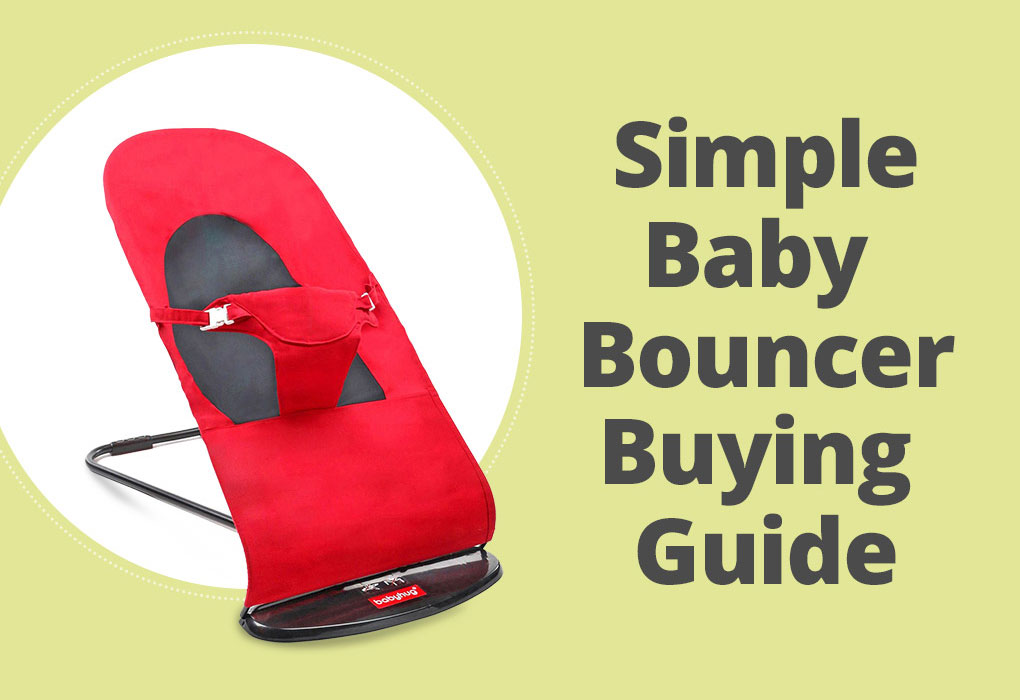
Simple Baby Bouncer Buying Guide
What is a Simple Baby Bouncer?
It is a bouncer with a simple back and forth movement and is suitable for babies who can enjoy it on their own. It needs some manual effort to get the right bouncing movement. It helps babies actively move their limbs about and expend energy, without you having to keep rocking them.
Covered with a soft, removable, washable pad that conforms to a baby’s shape, bouncer seats are springy and bounce or rock when your baby moves. Most models have a detachable, bent-wire play bar (sometimes covered with padding) or an overhead mobile of toys.
Features of a Simple Baby Bouncer?
Simple Baby Bouncer
Must Haves
Frame: A sturdy frame to support both the baby’s weight and the gentle up-and-down motion.
Safety Harness: Safety straps to secure your baby in the bouncer seat and keep the baby from rolling or slipping out of the seat.
Reclining Seat: To put the bouncer in a semi-upright position when the child is awake and in a reclining position when the baby has fallen asleep.
Removable and Washable Seat Cover: A removable and machine-washable cover, that is also dryer-friendly, is easy to clean and maintain.
Canopy: To protect your child from the harsh sun when taking the child out to the park or garden.
Fabric: Children have a tendency to lick or chew anything, so it is best to ensure that the bouncer fabric is not toxic and non-hazardous.
Good to Haves
Handle: A strong handle to safely carry your baby and the bouncer around the house or even outside.
MP3 player/iPhone/iPod hook up: To listen to soothing music, sounds of your baby’s choice while you take a relaxing shower.
Removable Head Support: A head rest attached to the bouncer seat to support the baby’s delicate head and neck. It also helps to avoid any head injuries by cushioning the hard frame of the bouncer.
Toy Bar: To hang up your child’s favourite toys or mobiles for the child to play with.
Pros and Cons of a Simple Baby Bouncer
Pros
Cons
Provides babies with physical exercise since they have to kick to rock the bouncer.
Has a limited range of motion. Does not offer the same rocking motion of a swing, that is more calming for babies.
Can replace a baby seat and baby swing, thus reducing the clutter of baby gear in your home.
Can’t be used for longer periods.
Lighter and easier to move than swings.
It is designed according to an average baby size. Thus, babies who are born big in size may not fit in the bouncer after 2 months of age.
Perfect for storage and transport and require little space to set up.
Need to use a head rest for babies under 6 months of age.
Helps develop the child’s motor skills and balance.
Easy to assemble or dismantle.
Easy to clean.
Read more

10 Best Baby Sleeping Bags for Newborn Babies
Unless you have a baby boy or girl who is blessed in the sleep department, you can make great use of sleeping gear for your little one. While there’s no product yet manufactured that can guarantee a good night’s sleep to both mother and baby, a sleeping sack that can tuck in your baby just right, and create a comfortable sleeping environment for him, is worth investing in.
Now, if you’re convinced that your baby needs a sleeping bag, check out our list of top ten baby sleeping bags for newborns, and find the best sleeping sack for your munchkin. And, if you have never before considered buying a sleeping bag for your baby, well, we suggest, you still check out our list, to understand why sleeping bags can be the answer to your baby’s sleep problems!
List of Top 10 Baby Sleeping Bags and Sleep Sacks for Infants
A sleeping bag is an ideal starting point to ensure that your baby sleeps comfortably. Let’s ‘sink into’ these sleep sacks, shall we?
1. Babyhug Sleeping Bag Dino Print
This sleeping bag by Babyhug is designed to keep your baby safe and comfortable at home and while travelling. You can even use it as a mattress for your baby!
Why You’ll Like This
Lightweight and handy, this sleeping bag is made from high-quality fibre, and is as comforting as a mother’s arms. It’s ideal for use for babies between 0 and 6 months of age. It can be used as a carrying bag or a sleeping bag. Make your little one sleep in it, and zip it up, so they won’t kick it off as babies do with blankets. This sleeping bag will create a warm and comfortable atmosphere for your baby to sleep in.
2. Babyhug Unicorn Print Sleeping Bag
This pink sleeping bag with a unicorn print is simply perfect for your little girl or boy. It’s one of the best infant sleeping bags on our list.
Why You’ll Like This
This sleep sack is lightweight and travel-friendly. You can even use it as a sleeping bag or a carrying bag. It is made of high-quality poly cotton fabric and can be used for babies 0-9 months of age.
3. ZOE Cotton Blend Baby Sleeping Bag Dog Print
This sleeping bag from Zoe is a very attractive sleeping bag and is ideal for both indoors and outdoors use!
Why You’ll Like This
If you’re looking for a sleeping bag that will keep your baby safe and comfortable while at home or travelling, then look no further! This adorable carry nest is best suited for your infant’s initial months. The bag’s cute prints will make it a fun and playful experience for your little one!
4. Babyhug Velour Sleeping Bag With Car Print
Now, this is a sleeping bag that opens up into a full bed. How amazing is that!
Why You’ll Like This
This 3-in-1 baby sleeping bag is specially crafted for your munchkin’s comfort. Made from velour, this bedding cum carry bag ensures your baby is protected from mosquitoes and insects as it covers them completely. Beautifully designed, it will give your little baby a soft and comfortable environment to sleep in. Take your pick as you place this bedding set on either the bed or floor to ensure your baby sleeps comfortably.
5. Babyhug Velour Sleeping Bag With Teddy Print
A colourful sleeping bag for your cheerful baby, this one can be used as a carry nest, sleeping bag, or baby mattress.
Why You’ll Like This
This sleeping bag by Babyhug is as comforting as a mother’s arms. It’s made of high-quality fabric that’s feathery soft and soothing for little ones. It’s also lightweight and handy, which makes it perfect for travelling purposes. This sleeping bag can be used for babies aged 0-6 months.
6. Babyhug 100% Cotton Sleeping Bag Teddy Print
Our list contains quite some teddy bear-print sleeping bags, and all for good reasons. Teddy bear prints are attractive and cute, and the little ones love them!
Why You’ll Like This
This soft and comfy sleeping bag in lovely shades of serene white and blue will create a comfortable and cosy sleeping environment for your baby. It is lightweight, which makes it perfect to carry around. Use it on a bed or floor, your baby will adore falling asleep (and waking) in it!
7. Babyhug Cotton Sleeping Bag Cars Print
This sleeping bag from Babyhug ensures the child gets a sound sleep and keeps them comfortable. It is also a great gifting option for a loved one who has just welcomed home a baby!
Why You’ll Like This
For warm nights, this is the best sleeping bag for your child. It’s made from high-quality fabric so that it offers your little one the comfort of a blanket, while still being breathable to prevent overheating. It makes for the perfect travelling companion too, due to its lightweight.
8. Mi Arcus Premium Organic Cotton Sleeping Bag
This sleeping bag is made of high-quality cotton material, which keeps the little one warm and cosy as they sleep outside the comfort of their crib.
Why You’ll Like This
The sleeping bag’s 100% cotton material ensures it is soft and fluid for a baby’s movement, with enough wiggle room at the hip, yet cocooning and warm for security. Suitable for newborns to six-month-old babies, this all-season sleeping bag also has snap buttons at the top for hassle-free use.
9. Babyhug Hooded Wrapper Lion Print
This hooded wrapper from Babyhug features a cute lion print. But that’s not the sole reason for you to like it. Read below to see what more is in store!
Why You’ll Like This
This wrapper has a soft and smooth fabric that will help your baby sleep soundly. It comes with a little flap at a corner that protects little ones from harsh weather, which means it is ideal for travel purposes as well. It can be used indoors or outdoors, and as a baby swaddle or crib wrap. This sleeping bag is perfect for babies aged 0-12 months.
10. Babymoon Organic Knitted New Born Baby Sleeping Bag
Made of high quality soft knitted and eco-friendly crochet, this baby sleeping bag from Babymoon is warm, soft, and perfect for any season!
Why You’ll Like This
What makes this sleeping bag stand out from the rest is that it is crafted from premium quality knitting wool. It doubles up as a sleeping bag and a baby blanket too!
FAQs
1. What kind of a baby sleeping bag should I buy?
A sleeping bag that fits your baby properly will be the right choice. That said, make sure your baby doesn’t feel uncomfortable in the sleeping bag, and is able to move his hands and legs, and kick freely in the bag.
2. Do you use baby blankets with baby sleeping bags?
Baby blankets and baby sleeping bags shouldn’t be used together, as using them at once can make a baby feel suffocated and uncomfortable, and increase the risk of sleep infant death syndrome (SIDS).
With these beautiful and affordable options of sleeping bags, we’re sure you will find the right sleeping sack for your baby. Pick one (or more!), and ensure your baby enjoys a deep slumber—that way, even you will be able to catch up on some much-needed sleep!
You May Also Like:
Best Mosquito Repellent Sprays For Kids
Best Mosquito Repellent Creams and Gels
Also Read:
Safe Baby Sleeping Positions
Newborn Baby Sleep
How Much Sleep Does a Baby Need?
Read more

Baby Car Seat Safety – Things Every Parent Needs to Know
Car seats are an amazing piece of baby gear. When used correctly, a car seat can keep your child safe in a car, and your hands free. But, installing a car seat is no easy feat; as a first-time parent, you may find it challenging, unless you’re a pro at DIY projects! There’s a world of necessary information about car seats and car seat safety that you need to know to ensure your little one’s safety. No, we’re not trying to scare you – we want to keep you informed!
Parents, This Is What You Need to Know About Baby Car Seat Safety
Read on to find out more about car seat installation. You’ll want to remember these pointers when you buckle up your baby in his brand new car seat!
1. Check if the car seat is suitable for your baby.
When it comes to a baby car seat, note that it’s not “one size fits all”. The best car seat for your baby is the one that is purchased keeping in mind your child’s age, weight, and size. These are the basics for buying a car seat and ensuring that your child stays safe in it. Also remember, the car seat you’re planning to buy should fit in your car!
2. Install it properly.
If you’ve got a wriggly car seat, you need to figure out the problem and install it again. Give it a good shake from where the seat belt is securely attached at the base – if it wriggles more than an inch on either side, or from front to back, chances are, you may not have tightened the belt securely. It could also be due to a twisted belt, or a basic installation issue. Figure out the source of the problem, and then put in the seat correctly.
3. Seek help if you’re struggling with the installation.
An improperly installed car seat can put your little one’s life in danger. So, if you’re struggling with the installation process, go ahead and call up a technician, and watch closely when they work. You might learn some tricks! If using baby car seats is not common where you live, do your research on how to install it. You could also check with a friend or a fellow parent who has done it before.
4. Use the LATCH system, if you’d like.
A car seat can be installed either with the vehicle’s seat belt or its LATCH system (lower anchors and tethers for children system). The latter is an attachment system designed for car safety seats. It enables a parent to install the car seat with the help of anchors, and without the use of a seat belt. You can choose either, or decide after checking the weight limit of your car. If your child’s weight combined with the weight of the car exceeds the weight limit of the LATCH system, secure your child’s car seat with the seat belt. Avoid using the anchors in this case.
5. Keep your baby rear-faced – it’s safe.
For infants and toddlers, a rear-facing car seat should be used, as their chances of getting injured in case of an unfortunate accident are less in a rear-facing position. As per the new recommendations by the American Academy of Pediatrics (AAP) with regards to rear-facing car seat safety, infants and toddlers should ride in a rear-facing car seat for as long as possible, or until they reach the highest weight and height limits given by the car seat safety manufacturer.
6. Don’t rush to move your child to a booster seat.
Want to keep your child safe in the car? Then don’t rush to transition your child from a rear-facing car seat to a forward-facing car seat, and eventually to a booster seat. Early transitions (and each transition) decrease the safety factor for a child. Therefore, the AAP recommends that parents delay the transitions for as long as possible, or until their child has outgrown the harnessed car seat.
7. Use that top tether – it’s there for a reason.
When transitioning your child from a rear-facing car seat to a forward-facing seat with a harness, use the top tether strap of the seat (that attaches the car seat to the tether anchors built in the car) to secure it in place. It helps prevent the seat from tipping over in case of a crash or accident.
8. Remove those bulky layers before buckling in your baby.
Don’t strap your child in the car seat when he is wearing a bulky winter coat. As per the AAP, bulky clothes like winter jackets or coats can compress in a crash and loosen the straps, which may increase the risk of injury for a child. So, dress your baby in thin layers, and drape a blanket or a coat on top of your child to keep him warm.
9. Ensure that the harness is snug.
When using a rear-facing car seat, place the harnesses in slots that are at or below your child’s shoulders. To check if the harness is a snug-fit, try pinching it with your thumb and forefinger. If there’s any slack in the shoulder harness when pinched, you need to tighten it. When using a forward-facing car seat, the harness should be positioned at or just above your child’s shoulders.
10. Follow the instructions.
This point is as important as all the others! When you follow the safety and installation instructions as specified by the manufacturer, you’re likely to install the car seat just right, and keep your baby safe. Go through the handbook or manual that comes with the car seat and it will make your life easier with its installation and usage. Car seats can save your child’s life, so the earlier you learn about car seat safety and installation, the better. We understand that the information above may seem a bit overwhelming for you, but once you go about installing a car seat, you will find it useful!
Also Read:
Rear-Facing Car Seat for Your Child
Right Age for Your Child to Face Forward in a Car Seat
Used Car Seats- Are They Safe for Babies & Buying and Selling Tips
Read more

10 Best Disinfectant Cleansers for Baby Bottles, Accessories & Vegetables
Babies bring a lot of joy, hugs and cuddles, sleepless nights, and cleaning duties to their parents. If you have a tiny tot, you are probably already struggling through stain removal and disinfecting everything she has access to. The pandemic also has amplified the worries, making parents, caretakers, and guardians purchase, and even hoard, different types of cleansers for baby products. The market is filled with options, no doubt. There’s something to clean every baby product. But, wouldn’t it be amazing to have just one cleanser to clean and disinfect most of the baby essentials?
Video: 10 Best Disinfectant Cleansers for Baby Bottles, Accessories & Vegetables
List of Top 10 Cleansers for Baby Bottles, Accessories & Vegetables
In this post, we have put together a list of 10 best baby safe cleaning products that will help you clean your baby essentials and safely use them.
1. Babyhug Feeding Bottles, Accessories & Vegetables Disinfectant Liquid Cleanser
Number one on our list is the Babyhug Feeding Bottles, Accessories & Vegetables Disinfectant Liquid Cleanser that is mild and has anti-stink qualities. No more extra scrubbing to take that stale milk odour off.
Product Description
This is an anti-bacterial cleanser for clothes, toys, accessories, vegetables, etc. This baby-safe disinfectant is formulated with edible ingredients (natural plants) and meets the highest safety standards. It is mild and also has anti-stink qualities that keep the products smelling fresh after the wash.
2. Pigeon Bottle Nipple and Vegetable Liquid Cleanser
Keep your baby essentials clean and disinfected with this biodegradable cleanser. This way you’ll be sure to get all those pesky germs off for good!
Product Description
This baby-safe disinfectant is good for baby bottles, accessories, toys, vegetables, and fruits. It has a biodegradable, 100% food-grade formula made with powerful sugar and coconut-based cleansing agents that safely eliminate stubborn milk stains. The formula is also easy-rinse and helps kill 99.9% bacteria. If milk stains are always a concern for you, this baby-safe cleaning product can be quite a saviour.
3. Mee Mee Baby Accessories and Vegetable Liquid Cleanser
Keep diseases at bay and your baby products clean with the Mee Mee Baby Accessories and Vegetable Liquid Cleanser. If you’re looking for an environment-friendly option, consider your search over!
Product Description
Among the baby cleaning products, using the Mee Mee Baby Accessories and Vegetable Liquid Cleanser is another safe way to clean baby toys, feeding bottles, vegetables, fruits, etc. It is formulated with edible ingredients and is made from natural, biodegradable materials. This baby-safe disinfectant is non-toxic and helps get rid of harmful, disease-causing germs and bacteria.
4. Farlin Baby Feeding Bottle Wash
Now, effectively clean all the milk stains or milk particles in the feeding bottles without worrying about impacting the environment, or your little one’s health. Read on to see what we mean!
Product Description
Keep the baby feeding bottles clean with the Farlin baby bottle cleaner liquid, which has a natural, anti-bacterial formula. Although mild, it can effectively clean milk stains. Its natural components allow it to be used for cleaning vegetables, fruits, tableware, toys, etc. This baby-safe cleaning product is FDA approved, is non-phosphorous, non-toxic, and has no artificial pigment or perfume that could harm the environment. Now, cleaning is safe for the environment, too.
5. LuvLap Liquid Cleanser for Feeding Bottles
Remove pesticides from surfaces, grocery items and all the things your baby comes in contact with! Because your little one is bound to explore; might as well make her environment as safe as possible.
Product Description
This baby bottle cleaner liquid is made with 100% food-grade ingredients and non-toxic formula. It helps remove pesticides, and therefore, is a good option for cleaning vegetables and fruits, too. It is biodegradable, has no artificial colours and is gentle on the skin. Thus it can be used to clean and disinfect most items the baby comes in contact with on a regular basis.
6. Morisons Baby Dreams Bottle & Accessories Cleaner
Fight the toughest of stains and kill disease-causing bacteria and fungi with this odourless, baby-safe cleanser.
Product Description
Morisons baby-safe disinfectant is perfect for cleaning baby toys, pacifiers, and feeding bottles as it is 100% food-grade. Its effective formula helps clean the toughest of stains and is gentle on the skin too. The cleaner can also be used to rinse and disinfect fruits and vegetables. It has no dyes, is odourless, and kills 99.9% fungi and bacteria.
7. Mother Sparsh Natural Baby Liquid Cleanser
Now, you can have spic and span feeding bottles, toys and accessories every single time with this mild, non-toxic, anti-bacterial baby liquid cleanser.
Product Description
Those looking for a safe way to clean baby toys, feeding bottles and other accessories can also go for this natural baby liquid cleanser from Mother Sparsh. It has an anti-bacterial, mild, plant-based formula, which is free from harsh chemicals, such as parabens, sulphates and synthetic dyes. The cleanser is also IFRA (International Fragrance Association) Certified. Its gentle foaming agent is tough on germs and milk residues.
8. Chicco Disinfectant Multipurpose Liquid
Disinfect everything that comes in contact with the baby with this multipurpose cleanser and keep her healthy and happy.
Product Description
This baby-safe disinfectant is ideal against bacteria and fungi, and thus can be used to clean regular baby products. Its formula can effectively disinfect metal and plastic utensils, toys, feeding bottles, nipples, pacifiers, tableware, gum massagers, and even fruits and vegetables.
9. Buddsbuddy Disinfectant Multi Purpose Liquid Cleanser
This non-toxic and anti-bacterial multipurpose liquid cleanser is your go-to to keep the baby products disinfected and clean.
Product Description
Buddsbuddy Disinfectant multipurpose Liquid is a safe cleanser to clean and disinfect almost everything your baby uses. It is made with plant extracts and natural-origin, biodegradable surfactants that are non-toxic and anti-bacterial. Therefore, you can wash fruits and vegetables also with this baby-safe disinfectant.
10. Beebaby Natural Liquid Cleanser
Want to go au naturel with your cleaning products? Keep your baby’s products hygienic with this plant-based, natural liquid cleanser.
Product Description
This is another baby-safe cleaning product useful for cleaning and disinfecting bottles, nipples, toothbrushes, nibblers, fruits, and vegetables. It has an effective naturally-derived, plant-based formula with aloe vera and lemongrass extracts, which is dermatologically tested. It can remove 99.9% germs, bacteria and pesticides from your baby’s essential products and accessories.
These top 10 multipurpose baby-safe cleaning products will help you ensure your baby’s essentials and her surroundings are free from germs and bacteria. Now, you have one less thing to worry about your baby’s health and one more reason to smile!
You May Also Like:
8 Best Mosquito Repellent Creams and Gels
10 Best Mosquito Repellent Sprays For Kids
Also Read:
Sterilising Baby Bottle – Methods & Important Safety Tips
Read more

5 Best Baby Bouncer Chairs
As much as you love holding your baby and playing with him all day, it is impossible to constantly have your little one attached to your side while going about the day. Baby bouncers can be lifesaving while you cook, use the bathroom or attend important meetings at home, especially when your little one is alert and wants to be entertained. Many parents love the way a baby bouncer calms their munchkin, whether he wants to play, is fussy or simply overstimulated. Of course, like with all other baby accessories, bouncer chairs come with their fair share on cons, especially when not constructed safely or used in an incorrect way. If you’re wondering what the best baby bouncers available in the market are, this article is just the thing for you. Read on for a list of the top bouncers available today!
List of Top 5 Infant Bouncers for Newborn Babies
Are you on the hunt for the best baby bouncer seat? The list below takes into consideration safety, availability, extra features and price point, giving you the best options to choose from.
1. Babyhug Comfy Bouncer With Music & Calming Vibrations
First on the list is the bright and colourful, Babyhug Comfy Bouncer. With music and vibrations, this one is equipped to calm your baby while keeping him safe.
Product Description:
The Babyhug Comfy Bouncer is designed for optimal safety and comfort, with a 3-point safety harness to keep your baby in position without the chance of him falling, as well as a padded and soft seat, so your munchkin sits in it comfortably, without much of a fuss. That’s not all- this bouncer has ten music settings with three adjustable volumes and 3-speed vibration, complete with a toy bar, all of which keep your baby entertained and soothed. This is truly one of the best baby bouncer chairs, as it is big on safety and an absolute delight for kids!
2. R for Rabbit Hip Hop Multipurpose Jolly Bouncer
Next up, is this vibrant, multipurpose bouncer that does a great job at calming your baby or entertaining him, based on what you want!
Product Description:
The R for Rabbit Multipurpose Bouncer is a comfortable bouncer, perfect for playing time or napping time. With an adjustable 3-point safety harness, this one keeps your little one safe and happy while you go about your work. Moreover, its comfy fabric and vibrant design make it lovable for babies, along with the gentle vibrations soothing and calming your baby just before sleeping time. If you’re on the hunt for the best baby bouncer chairs, this one isn’t to be missed!
3. Fisher-Price Carnival Bouncer
One of the favourites in the market, this bouncer from Fisher-Price includes a bit of safety, development and fun, all in one.
Product Description:
When it comes to security and happiness, the Fisher-Price Carnival Bouncer steals the show with its 3-point safety harness and calming vibrations that soothe your baby and keep him safe and secure. The overhead toy bar encourages babies to reach out and bat at the toys, so they’re thoroughly entertained. What more? The deep seat and comfortable fabric keep your little one cosy, and the seat bounces along with his natural movement, making this one of the best infant bouncers available.
4. Fisher-Price Bouncer Animal Print
Just as kids like animals and soft toys, your little one is bound to love this animal print bouncer from Fisher-Price.
Product Description:
The Fisher-Price Bouncer is ergonomically-designed and envelops your little one, making him feel snug and safe. Its gentle bouncing action and vibrations are great to soothe and calm babies, with a soft, comfortable seat, so your baby can stay seated in it without much difficulty. The overhead toy bar, complete with clacker toys and spinners keep him entertained while aiding development, so you can free up some time without much worry. All of this, and more, make this one of the top-rated baby bouncers, not to mention, your child’s favourite seat!
5. R for Rabbit Kangaroo Baby Bouncer Cum Activity Center
Last but not the least, this baby bouncer does wonders in keeping your baby entertained, especially when you need to attend to the house or work.
Product Description:
The R for Rabbit Kangaroo Baby Bouncer is proven to make fun time safe. It isn’t just a regular bouncer, but an activity centre, with toys hanging from a sturdy metal frame all around your baby. The variety of toys aids development stimulates your child’s senses and keeps him happy during playtime. It is has a 3-level height adjustment and a sturdy steel frame, so you can rest assured that your munchkin is safe! For one of the best baby bouncer jumpers, look no further!
FAQs on Baby Bouncers
1. What is the Ideal Age for Using Baby Bouncers?
The age from which a baby can use a bouncer is usually mentioned on the packaging of the bouncer you choose. On average, bouncers are usually safe from birth until the age of 6-7 months. However, the age can vary based on the bouncer specifications as well as any conditions your baby might have.
2. Which is Better- A Baby Bouncer or an Infant Rocker?
Baby bouncers and infant rockers have two different functions. A baby bouncer is usually meant for playtime, as your little one can exercise his leg muscles and have fun bouncing and playing by himself. On the other hand, an infant rocker is meant for nap time, as it sways and lulls your little one, so he can sleep. However, you can easily find a product that does the job of a bouncer and rocker, all in one.
3. How Long Can I Keep My Baby in a Bouncer Chair?
It is advised to leave a baby in a bouncer for not more than 20 minutes at a time. Babies should be able to sit up and down on their own, as well as exercise their leg muscles for better movement. Though there isn’t an exact limit, 15-20 minutes is the most you should keep your baby in a rocker or bouncer.
A baby bouncer is perfect to keep your little one engaged while you do your chores and other work. Whether it is to calm a fussy baby or keep him entertained, you should definitely look into buying a baby bouncer for the initial months of your baby’s life. And while you’re at it, why not look for a top-rated baby bouncer within your budget?
You May Also Like:
Best Baby Swings
Best Baby Walkers
Best Baby Rockers
Best Prams & Strollers
Offers & Deals
Baby Gear Products
Baby Gear Product Brands
Baby Gear Products Offers & Deals
Baby Gear Products on Sale
Also Read:
Are Baby Jumpers Safe?
Gross Motor Developmental Milestone – Jumping
Read more
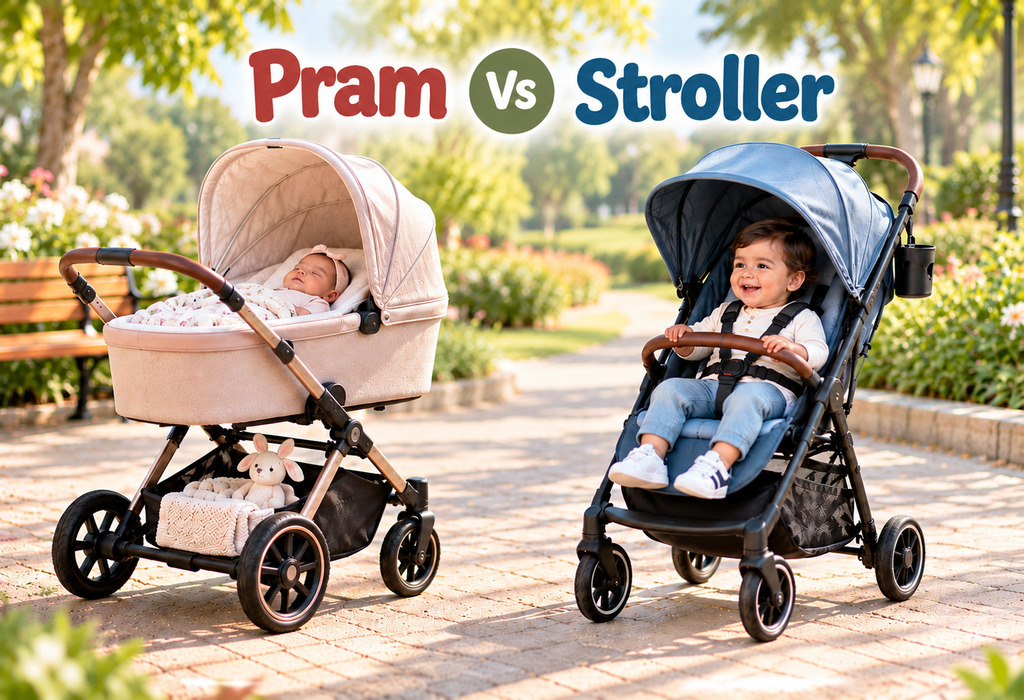
Pram vs Stroller: Know the Difference Before You Choose
Key Takeaways
A pram suits newborns because its carrycot keeps a baby fully flat, while a stroller suits babies who sit with support, usually from about 6 months.
A stroller is lighter and folds smaller, so it suits daily errands and travel.
A five point harness, working brakes and a named safety standard matter more than any extra feature.
Compare folded size, wheel type and weight limit against your daily routine.
The difference between pram and stroller comes down to how your baby lies: a pram has a flat carrycot for newborns, while a stroller has an upright or reclining seat for babies who can sit with support. Pram design supports a young baby lying flat. Stroller design favours light weight, quick folding and easy travel. Parents of babies from birth to about 12 months usually need to weigh both. This article covers everything you need to know about pram vs. stroller, including their features, pros and cons, safety checks, FAQs, and a simple way to decide.
Key Facts
Flat for the first 6 months. Raising Children Network advises that a baby should lie flat on a level surface in a pram for at least the first 6 months.
Five point harness. The American Academy of Pediatrics says a stroller should have a five point harness, used on every ride.
EN 1888 standard. EN 1888 Part 1 is the European safety standard for pushchairs and prams carrying a child up to 15 kg each, so a listing that names it tells you which test the maker followed.
What Is a Baby Pram?
A baby pram is a wheeled carrier with a deep, flat carrycot or bassinet, made for newborns who cannot sit up yet. The firm, level base keeps the baby lying down, and the hood and high sides shelter against sun and wind. Parents often use one for the first 6 months.
Key Features
A pram is designed to keep newborns comfortable and supported during walks. Its main features include:
Flat carrycot: A deep bassinet holds the baby level on a firm base.
Large hood: A deep hood shades the baby, and a mosquito net suits warm weather.
Sturdy frame: Bigger wheels and suspension soften bumps on uneven paths.
Reversible handle: Parents can push with the baby facing them.
Pros
A pram can be a practical choice for newborns, particularly during the first few months. Here’s what makes it a popular option:
Lying flat: The carrycot keeps a newborn level, which matches the advice for the first 6 months.
More shelter: Deep hoods and high sides protect a baby from sun, dust and wind.
Comfortable naps: A baby can doze in a flat bed while you stay close.
Cons
Before making a decision, it’s also worth considering the following limitations of a pram:
Bulky size: The long frame needs room in the car boot, hallway and lift.
Heavy to lift: Carrying a pram up stairs is hard work.
Short use period: Most babies outgrow the carrycot once they sit up, usually after 6 months.
What Is a Stroller?
A stroller is a wheeled seat with an upright or multi recline position, made for babies who can sit with support, usually from about 6 months. The frame is lighter than a pram and folds smaller.
Key Features
Most strollers come with features designed to make everyday outings easier, such as:
Reclining seat: Several positions let a baby move from upright to a lower recline.
Five point harness: Straps over shoulders, hips and between the legs hold the child securely.
Compact fold: Many frames fold small enough for a car boot.
Canopy and basket: A canopy shades the child and a basket holds essentials.
Footrest and swivel wheels: A footrest rests little legs and swivel wheels turn tight corners.
Pros
When it comes to everyday use, a stroller has a few clear advantages:
Easy to carry: The lighter frame suits stairs, lifts and car boots.
Tight turns: A narrower frame moves through shops and doorways.
Longer use: One stroller can serve from about 6 months into the toddler years.
Cons
Before choosing a stroller, there are a few limitations to consider, especially when it comes to your baby’s age and the type of terrain you use it on:
Not for newborns: An upright seat without a full recline does not suit a baby under 6 months.
Smaller wheels: Small wheels can struggle on broken pavements.
Less shelter: A smaller canopy covers less than a pram hood.
Less storage: A small basket tempts parents to hang bags on the handles, which can make the stroller tip backward.
Difference Between a Pram and Stroller?
Pram vs stroller comes down to eight practical points, from how the baby lies to how the frame folds:
Baby position
Fully flat in a carrycot
Upright or reclined in a seat
Suitable age
Newborn to about 6 months
About 6 months onwards
Main structure
Deep carrycot or bassinet
Open seat with a footrest
Frame size
Long, wide and heavy
Short, narrow and light
Folding
Bulky fold
Compact fold
Manoeuvring
Wide turning circle
Tight turns
Storage
Large basket below
Small basket below
Years of use
Around the first 6 months
Several years
Which Is Safer for a Newborn: Lie Flat Position and Spine or Hip Support?
A pram is the safer choice for a newborn because its carrycot keeps the baby lying flat. Raising Children Network links sitting up in a pram to good head and neck control, which usually comes after 6 months. Some strollers recline to a near flat position, so read the recline angle and age guidance. If your baby has a spine or hip concern, ask your paediatrician before choosing any seat.
Safety Certifications and Harness Systems to Check Before You Buy
Check three things on every listing: a named standard, a five point harness and working brakes. EN 1888 covers pushchairs and prams in Europe, and ASTM F833 is the carriage and stroller standard that US regulation makes mandatory. Look for either name in the product description. Brakes should be easy to operate, and the frame should lock fully open before you place the baby inside.
What to Consider When Using a Pram or Stroller
These seven habits keep every ride safer and more comfortable, whichever type of pram or stroller you choose:
Use the harness every time. Fasten all five points.
Apply the brakes at every stop.
Lock the frame open. Listen for the click.
Keep bags off the handles. Use the basket instead.
Mind small fingers. Keep hands clear of hinges.
Supervise sleep. Keep a sleeping baby in sight.
Check the label. Stay under the weight limit.
What Is the Right Choice for Your Baby?
A newborn needs a flat bed, so a pram or a stroller with a full flat recline fits the first months. Many parents settle the stroller or pram question by asking whether the baby sits with support. Parents asking when to switch from pram to stroller can use the same test: once your baby holds the head steady and sits with support, usually after 6 months, a stroller can take over.
FirstCry is a go to shopping destination for baby and kids essentials, where you can browse strollers and prams and narrow the list by age band, weight capacity, folding mechanism and hood. For a newborn, start with the 0 to 3 months age band and the Pram product type on the pram listing. Babyhug has a range of strollers, such as the Babyhug Comfy Ride Stroller With Reversible Handle, so read the description for recline details before using one for a young baby.
FAQs
1. Can a newborn baby use a stroller without a carrycot?
A newborn should use a stroller without a carrycot only if the seat lowers fully flat and the maker states it suits newborns.
2. When should you switch from a pram to a stroller?
Switch once your baby sits with support and holds the head steady, usually after 6 months. Check the carrycot label for its age and weight limit.
3. Can a pram be used as an overnight sleeping space for a baby?
A pram is built for outings, so keep overnight sleep in a cot or Moses basket in your room. The Lullaby Trust advises against babies sleeping in anything that keeps them seated or inclined.
4. Which is easier to fold and carry: a pram or a stroller?
A stroller is easier to fold and carry because the frame is lighter and more compact. Prams have longer frames and heavier carrycots.
5. Are lightweight strollers suitable for everyday use?
Lightweight strollers suit everyday use for babies who sit with support, since they weigh little and fold small. Check for a five point harness and wheels that cope with your roads.
6. Can you use a pram or stroller on Indian roads and uneven pavements?
A pram or stroller can handle uneven pavements if it has larger wheels, suspension and swivel wheels that lock.
7. What is the difference between a travel stroller and a regular stroller?
A travel stroller is lighter and folds smaller than a regular stroller, so it fits airports and car boots. Regular strollers add bigger wheels, deeper recline and more storage for daily use.
8. Are reversible seat strollers worth buying?
Reversible seat strollers are worth buying if you want your baby facing you in the early months. Check that the seat still reclines and the harness works in both directions.
9. How do you choose a pram or stroller for twins?
Measure doorways and lifts first. Side by side frames are wider and tandem frames are longer, and both need a weight limit that suits two children. FirstCry has a Twin Strollers & Prams product type to narrow the choice.
10. Can you take a baby pram or stroller on an aeroplane?
Airline rules on prams and strollers differ, so confirm the allowance with your airline. Compact frames are easier at airports, and FirstCry lists an Air Cabin Stroller product type.
11. How much weight can a pram or stroller support?
Each pram or stroller states its own weight limit on the label, so read it before buying. EN 1888 Part 1 covers pushchairs and prams carrying a child up to 15 kg each.
12. How do you clean and maintain a baby pram or stroller?
Wipe the frame with a damp cloth and mild soap, wash removable covers as the care label says, and dry everything fully. Check wheels, brakes and harness straps regularly.
13. What accessories are useful when buying a pram or stroller?
Useful accessories include a rain cover, mosquito net, sun shade and cup holder. FirstCry has a Stroller Frames & Accessories product type for these add ons.
A pram gives a newborn a flat, sheltered bed, while a stroller offers a lighter seat once your baby sits with support. The key safety rule is to keep young babies lying flat in the first months and never leave a sleeping baby alone. Before buying, check the recline, a five point harness, working brakes and a named standard such as EN 1888. Compare folded size, wheel type and weight limit against your daily routine. If you are unsure, ask your paediatrician for advice.
Read more

9 Best Baby Soaps for Newborn Babies and Toddlers
When it comes to baby products that you use on your little one’s skin daily, like baby soap, it’s no surprise that you might be spending a lot of time browsing through ingredient lists. Baby skin is sensitive and loses moisture quicker than adult skin. As a parent, you would definitely want to settle on a soap that keeps your baby’s skin nourished and hydrated!
Video: 10 Best Soaps for Babies and Toddlers
Think soap, and one thinks of a product that does its job of cleaning, but strips away the skin’s moisture and makes it dry. But, baby soaps aren’t like that! They’re natural, mild, gentle, and safe to use for your baby’s delicate skin. But, with the huge variety of soaps available today, how do you know which one is the right product for your baby? It’s simple- this list of the top-rated baby soaps will help you navigate through products with different ingredients, scents, and more!
List of Top 9 Best Baby Soaps in India
When it comes to shopping for baby soaps, take a look at these ten best soaps for infants.
1. Himalaya Extra Moisturising Baby Soap
This herbal soap from Himalaya has been specially formulated for a baby’s sensitive skin.
Why You’ll Like This
Your baby’s tender skin requires soothing, natural ingredients so that her skin’s suppleness isn’t affected. Himalaya’s baby soap is perfect in this aspect, as it contains almond and olive oil, which will nourish and protect her skin. The soap’s soothing properties will also keep itching and inflammation at bay!
2. Johnson’s Baby Soap
You’re sure to feel a little nostalgic when you use the Johnson’s baby soap, as there’s a good chance your mom used it with you!
Why You’ll Like This
A coating of moisturising oils naturally protects your baby’s skin. If these oils get washed away, her skin will be left vulnerable to irritation, dryness, and rashes. 1/4th of Johnson’s baby soap is made of baby lotion and vitamin E, which help preserve the skin’s moisture. The soap’s rich and creamy lather softly cleanses and helps keep your baby’s delicate skin supple.
3. Sebamed Baby Cleansing Bar
This is the best soap for infants with sensitive skin, as it is clinically tested!
Why You’ll Like This
The Sebamed baby cleansing bar has a good set of ingredients like wheat germ oil, chamomile, vitamins, and amino acids, which fight dryness and skin irritation. The soap isn’t heavily scented, but instead has a mild fragrance that won’t irritate your baby’s nose. And that’s not all – the soap is also suitable for adults with very sensitive or dry skin!
4. Lotus Herbals Baby Plus Little Bubbles Gentle Bathing Soap
Crafted with handpicked ingredients sourced from herbs, plants, and flowers, this baby soap from Lotus Herbals is as pure as nature itself!
Why You’ll Like This
Are you worried that using baby soap will strip the essential moisture from your baby’s skin? You must check out the Lotus Herbals baby soap, which is infused with the goodness of olive oil, aloe vera extract, and shea butter. These ingredients are known to provide optimum nourishment to delicate and soft skin. Trust us, your baby’s skin will thank you for this!
5. Chicco Baby Moments Soap
The glycerine in this soap deeply moisturises your baby’s skin, while the aloe vera protects it from environmental damage. Win-win!
Why You’ll Like This
This soap’s allergen-free fragrance will keep your baby feeling oh-so-fresh after her bath! Another reason you can feel good about using it on your baby? The soap is dermatologically tested and free of parabens, alcohols, SLS, SLES, dyes, and colour.
6. Curatio Tedibar Bathing Bar
The Tedibar bathing soap is specially formulated with the mildest surfactants and gently cleanses without harming the skin, making it soft & supple.
Why You’ll Like This
When you’re on the hunt for a bar of soap for your little one, you would want something that’s gentle on her skin and doesn’t cause any skin-related problems. The Curatio Tedibar soap is one such bathing bar that meets these criteria! It does not harm the baby skin’s delicate and natural protective layer and is suitable for all skin types. That’s not all! A plastic tray is provided in the pack, which acts as a drain tray for the soap to keep it dry after use.
7. MeeMee Nourishing Baby Soap
This nourishing baby soap from the house of MeeMee is perfect for keeping those adorable fingers, toes, and hair squeaky clean!
Why You’ll Like This
Your baby needs the utmost care right from her birth to ensure supple, radiant, and well-nourished skin. The MeeMee nourishing baby soap takes care of this, and it has been scientifically tested to bring your baby premium skincare. The soap is a perfect blend of the goodness of almond and milk extracts and gentle fragrance, and will keep your baby’s delicate skin cleansed and healthy always!
8. Baby Dove Baby Soap Bar Rich Moisture
Dove’s products are well-known for being more cream-like than soapy due to their super moisturising formulas, and their baby soap bar is no exception!
Why You’ll Like This
This soap goes beyond gentle cleansing, and adds back vital nutrients and leaves the baby’s skin beautifully smooth, soft, and healthy. And, with a gentle fragrance, you can simply revel in those special bath-time moments with your baby, knowing that you’re giving her skin the care it deserves.
9. Azafran Baby Nourishing Soap
How about a vegan soap that gently cleanses your baby’s skin from head-to-toe? Yes, please!
Why You’ll Like This
The Azafran baby soap contains coconut oil, which is known to be a natural cleanser that removes impurities while keeping the little one’s skin soft, healthy, and glowing. The olive oil, soy wax, and soya butter refine the skin’s texture while retaining moisture. With such heavenly sounding ingredients, we wouldn’t be surprised if you would get an extra soap for yourself, too!
FAQs
1. Which ingredients should I avoid while choosing a baby soap?
When choosing a baby soap, make sure that it does not contain any artificial or intense fragrances. Sulphates are another no-no, especially sodium lauryl sulfate. Other ingredients to avoid in your baby soap are parabens, glycerin, salicylic acid, ceramides, and alcohol.
2. Can I use baby soap on my infant’s face?
No. We do not recommend using baby soap on your little one’s face. With the help of a moistened, clean cotton ball or washcloth, wipe your baby’s eyes, beginning at the bridge of the nose, and then wipe out to the corner of the eye. Wash the rest of your infant’s baby’s face with a moist washcloth without soap.
3. Can I use baby soap on my newborn?
Plain water is best for your newborn baby’s skin during the first month. If needed, you can use a gentle non-soap cleanser or a fragrance-free oil at the end of the bath. You can start using unperfumed baby soaps from around four to six weeks of age. But, be careful to only use a little, so that you don’t damage your baby’s delicate skin.
We hope this comprehensive list helps you navigate the (virtual) baby soap aisle, and pick the right one for your munchkin!
Also Read: Homemade Soap, Shampoo and Body Wash for Baby
Read more

10 Best Baby Car Seats
Travelling with your baby by car can be stressful, especially, if it’s a long journey, but if you have the right gear, you can be assured that your little one will be comfortable. Your baby’s safety is your topmost priority when travelling by car (and otherwise too), and if it’s your first road trip with him, you must be considering buying a baby car seat. Strapping your little one into his car seat will ensure that he has a safe and comfy ride. But when it’s about your precious munchkin, you want the best of best. So we bring you a list of ten best baby car seats to help you pick the best one for your baby!
List of Top 10 Car Seats in India
Baby car seats are safety seats specifically designed to shield kids from injury in case of an accident. Some cars may have preinstalled child seats. But in most cases, these seats need to be purchased and then installed by customers. There are enough and more options available to parents today. You must consider your baby’s age, height, and weight before buying a car seat for him. Take a look at some of the best options in baby car seats!
1. Babyhug Cruise Convertible Reclining Car Seat With Side Impact Protection
This convertible car seat for children between the ages of 0 and 4 years is highly comfortable. It comes with a soft padded seat, which will make long road journeys comfortable for your baby.
Product Description
This easy-to-install car seat has soft body cushions which offer extra comfort to a baby. This car seat by Babyhug has a five-point safety harness and a front-adjust harness, which will enable you to get your baby in and out of the car seat easily. A five-point safety harness also helps protect the baby from jerks. It has a 3-level harness for adjusting the height. This car seat can be reclined to 3 levels as per the age and comfort of the baby. It is crash tested and meets European safety standards. This car seat is easy to carry and the soft padded seat and side-impact protection with softly padded wings help your baby relax and have a comfortable ride.
2. R for Rabbit Jack N Jill Grand Convertible Baby Car Seat
This car seat by R for Rabbit can be used for babies and toddlers. It is easy to install and very comfortable for a baby. This convertible car seat grows with your baby.
Product Description
This car seat has an innovative design and meets European safety standards. It comes with soft padded wings for side impact protection. Your baby’s head, hips, and legs will be properly secured and he will have a comfortable ride. This car seat by R for Rabbit comes with a five-point harness and front-adjust harness which will keep your baby safe and enable you to get your baby in and out of the seat easily. This convertible car seat comes with a 3-position recline which can be adjusted as per your baby’s age and comfort. The best part? You can use this car seat for your little one as he grows. Yes, this car seat can be used for children between 0-7 years of age.
3. Babyhug Amber Car Seat Cum Carry Cot With Rocking Base
This car seat by Babyhug looks cute and attractive and meets the safety standards. It’s a 3-in-1 car seat: you can use it as a car seat (of course!), a carrycot, and a rocker.
Product Description
This easy-to-carry car seat is crash tested and meets the safety standards. It includes side-impact protection which provides added comfort and support to newborns. It also comes with a canopy which can be attached or detached. The canopy will protect your baby from the heat, especially in summers. This car seat cum carrycot comes with a five-point harness and front-adjust harness which will help you get your baby in and out of the car seat easily. This Babyhug car seat also has a 3-level height adjustment—you can adjust the height of the seat as per your baby’s height and comfort. The handle of the seat can be adjusted for carrying, rocking and keeping it stable. It also has a rocking base which will help your little one relax which you rock him.
4. Chicco Keyfit 2011 Rear Facing Car Seat
Chicco Keyfit car seat has an attractive design and innovative elements and is very soft and comfortable for babies.
Product Description
This car seat with a rocking function is made of high-quality and durable material. This car seat has a five-point safety harness and one-pull feature and must be installed in a rear-facing position. This car seat can be used for babies between 0 and 18 months of age. It’s a very comfy car seat, with a soft and non-slip handle. Your baby won’t mind being strapped in this car seat while you go on a road trip with him!
5. R for Rabbit Picaboo Infant Car Seat Cum Carry Cot
This car seat, which can also be used as a carrycot, has met the most stringent safety standards.
Product Description
Lightweight and adorably designed, this seat has side impact protection owing to deep and delicately padded side wings that ensure a safe ride for your baby. This all-in-one baby car seat offers amazing adaptability due to its adjustable handle, which enables you to turn it into a feeding chair, rocker, and carrycot. It has an inbuilt canopy which can help defend your baby from harsh sunlight.
6. Babyhug Safe Journey Forward Facing Car Seat
This forward-facing car seat can be converted into a booster seat and is very comfortable.
Product Description
This car seat is available in three groups. The group 1 car seat is suitable for toddlers weighing between 9 and 13 kgs. Group 1 baby car seat is forward-facing and has belts attached in the forward position to keep the baby secure. This car seat has a five-point safety harness which will keep your child secured on the seat. It has soft padding and multilayer adjustable headrest which will provide comfort to your child during the ride. This car can seat can be used over the years. The Group 2 baby car seat is for kids between 4 and 6 years of age (weighing between 15-25 kgs), as the safety harness is removed then. For children between 6-12 years of age, this car seat can be converted and used as a booster seat.
7. Graco SnugRide SnugLock 30 Click Connect Technology Car Seat
This car seat is very comfortable and easy-to-carry. It has a comfy headrest and your baby won’t mind long journeys sitting on this car seat.
Product Description
This lightweight and easy-to-carry car seat is everything that new parents can ask for in a car seat. This car seat has a lock feature and can be installed in just 3 steps. It has an adjustable base with 4-recline positions and offers a customized fit to any vehicle. It comes with an adjustable (rotatable) canopy to keep the baby protected from the harsh sun rays. The car seat has removable and washable cushions which offer head support and body support to newborns.
8. R for Rabbit Jumping Jack The Growing Baby Forward Facing Car Seat
This top-rated toddler car seat has been crash-tested and engineered to meet European safety standards.
Product Description
This car seat is perfect for children between 15 months of age and 12 years of age. With belts attached in a forward position, this car seat can be used for children between 15 months and 5 years of age. You can even remove the harness for making it comfortable for 4 to 6 years old kids. For older kids of 6 years and above, it can be used as a booster seat with a seat belt. It has a modifiable headrest which allows you to adjust it as per the height of your baby. This car seat has padded wings which will provide ultimate protection to your baby and the five-point safety harness will keep him secured on the seat, making the ride comfortable for you and your baby.
9. Babyhug High Raise Car Booster Seat
This car booster seat by Babyhug has a simple design. Plus it is easy-to-install and is affordable. If you are looking for economical options, then you may like this car booster seat!
Product Description
The compact design of this lightweight Design car seat makes it easy-to-move around and install in any vehicle. This compact car booster seat has been crash tested and meets the safety standards. This backless car seat fits securely in a car and elevates the height so that you can strap your child on the seat with the car’s seat belt. The extra padding makes the seat comfortable and due to its simple design, the cover and seat pad can be removed easily and machine washed!
10. R for Rabbit Picaboo Grand Infant Car Seat with Base
This lightweight car seat with side impact protection will offer maximum comfort to your baby and will keep him safe and secure on the journey.
Product Description
This car seat is easy-to-carry and very comfortable for the baby. It has a three-point safety belt which can be adjusted as per a child’s height and comfort. This car seat has multiple handle positions: it can be used as a car seat or a carrycot. The inbuilt canopy feature offers maximum protection to a baby from the sunlight. It also comes with a removable cover which can be washed and cleaned often.
Baby Car Seat FAQs
Some frequently asked questions about car seats are:
1. How do I choose an infant car seat?
The numerous options available can be confusing. You can opt for an infant car seat if your baby is less than a year old. After your baby grows older, you can consider buying a convertible car seat. Once he outgrows that, you can go in for a booster seat which may last up until he’s 7 years of age or so. Alternatively, you can also purchase a travel system that comprises of an infant car seat which can also connect with a stroller, allowing you greater mobility with your infant.
2. Is it alright if I let my baby sleep in his car seat?
It may be okay to let your baby sleep in car seats while you are travelling as long as he is comfortable in it. Car seats are designed to keep toddlers safe when you are on the go. Make sure you select a good quality car seat which offers your baby optimum safety and comfort.
3. How long can my baby use an infant car seat?
Your baby can comfortably use an infant car seat up until he turns a year old. Subsequently, depending on his weight and height, you may have to look for other possibilities.
4. Do I need a base for my child’s car seat?
You may need a base for your child’s car seat. The magical element that makes kids’ car seats so appropriate is the base. It gets installed in the car for the long term while the seat may keep changing according to the requirements of your growing baby.
5. Do all car seats fit in all cars?
No, all car seats may not fit in all cars. There can be problems relating to long seat belts (which can lead to a buckle crunch) or floor storage boxes which make the support leg insecure.
6. Does a car seat have an expiration date?
Most infant car seats may last for about 5 to 10 years. However, the expiration dates of various car seats usually differ depending upon the manufacturer.
Baby car seats are adapted to be safe and comfortable for an infant. Nonetheless, you must make sure that it ticks all the necessary boxes of safety parameters before picking one for your baby.
You May Also Like:
10 Best Prams & Strollers
10 Best Baby Walkers
10 Best Baby Carriers
10 Best Baby Swings
Offers & Deals
Baby Gear Products
Baby Gear Products Brands
Baby Gear Products Offers & Deals
Baby Gear Products on Sale
Also Read:
Different Types of Car Seats for Babies and Toddlers
When Can A Child Face Forward in A Car Seat?
Baby Car Safety – Dos and Dont’s
Read more

Different Types of Ride-on Toys for Your Baby and Their Benefits
They say walking won’t take much time when babies begin to crawl, and running will follow when they begin to walk. But, through their growing years, children need ample boosts of energy and confidence to keep going. Development toys play a vital role here! Therefore toys, such as the ride-on toys, are often recommended to parents because not only do they encourage physical activity, they also fuel the imagination. In this post, we have shared information about the different types of ride-on toys you can consider for your munchkin. Be sure to read till the end to know their benefits, too!
Different Types of Ride-on Toys for Your Baby
Gone are the days of wheelbarrows; now, kids have a wide variety of ride-on toys other than the tricycle or the bicycle. Here’s what you can choose from for your ball of energy:
1. Push or Pull Ride-On Toys
As the name suggests, these ride-on toys can be pushed or pulled by a parent or an older sibling. Once the baby’s feet touch the ground, she can also push herself around and exercise her leg and core muscles.
You’ll find ample designs in this category of ride-on toys to choose from, right from wagons, buses, vans, trucks, high-end luxury cars and bikes, to animals, and cartoon characters. These toys have wheels and push handles that enable the parents to push/pull and even direct the toy until the baby gets a sense of balance and understands how to manoeuvre around.
2. Pedal Ride-On Toys
Pedal ride-on toys are nothing but the classic tricycles and bicycles, but at times, even pedal cars and pedal carts/quad bikes are included in here. Now, we know babies under a year old can barely use them, but you can consider these toys for toddlers and older kids.
Begin with a pedal car to build your child’s lower body strength. A pedal car, if you look at it carefully, is nothing but a push ride-on toy. Your child will be seated comfortably in the toy and push herself with her feet to move forward.
As your little one develops the skill of using the pedal car, you can upgrade to a sturdy, colourful tricycle for her to wheel and steer through the safe spaces around your home. Fun fact – The world’s first-ever tricycle was a three-wheeled wheelchair invented by a watchmaker in the 17th century. Now, kids’ tricycles are often referred to as ‘trikes’ and are highly recommended for their physical growth.
Let’s talk about quad bikes now. A quad bike or a pedal cart can be another option for your kid once she is tall enough to reach the pedals, and is capable of steering her way through. It is a great toy for kids who are still unsure about riding a bicycle and need a confidence-boost in that area.
3. Electric Ride-On Toys
One fine day, technology and innovation joined hands in the baby toys department and created a stunning range of electric ride-on toys for kids. These are little, motorised vehicles that can be controlled with remote controls. Some can also be steered/pedalled manually by the child. These toys have gained quite some popularity and are perfect for giving kids the ultimate thrill of driving.
4. Rocker Ride-On Toys
Rocker ride-on toys are the most basic ride-on toys for kids. They are stationary, do not require much space and are quite amusing come to think of it. These toys have developed leaps and bounds and are available in fancy, colourful designs other than the classic wooden rocking horse. Place your baby carefully on it and let her make animal sounds, sing rhymes, ride through an imaginary storm, or even fight bears in make-believe woodlands. It could just be one of the best ways to teach several other things to your munchkin.
Benefits of Ride-On Toys for Babies
Toys keep babies engaged and entertained to some extent, but that’s not all you’re looking for in a toy, are you? Every time you pick something for your little one, you are bound to research more on the product to know what benefits it has for your child. To save you the time and energy, we have enlisted some benefits of ride-on toys for kids.
Develop Fine and Gross Motor Skills – Ride-on toys encourage physical activity and help exercise the small and big muscle groups. They thus help strengthen the lower body, mainly the legs and the core and ultimately bring about the development of a sense of balance.
Enhance Spatial-Development Skills – These toys encourage movement, and with movement, your child will bump into a lot of things, but that will eventually enhance her spatial skills and give her a better understanding of space, direction and measurement.
Inculcate Independence and Boost Confidence – Once your tiny tot enjoys the thrill of the movement, she’ll probably forget you, even if it is for a few minutes. This inculcates a sense of independence and builds confidence. A rocker ride-on toy also helps in this regard as it is another tool to create an illusion of movement and speed and to promote self-soothing in toddlers and young children.
Encourage Imagination, Exploration and Critical Thinking – Ride-on toys can help foster your child’s sense of exploration and adventure, and also stimulate critical thinking. Every time she sets out on a new adventure, watch her stumble upon new discoveries and wait a moment before you pull her away from whatever she has her hands on. This encourages her observation skills, too.
To sum it up, ride-on toys are not just fun; they can be extremely beneficial, too. Look at them as intellectual machines, and it will become easier to know how important they are for children. By getting one of these toys for your munchkin, you’ll be giving her an opportunity to explore a new aspect of a healthy and happy childhood.
Also Read:
7 Best Ways To Teach Kids To Ride a Tricycle
7 Amazing Health Benefits of Cycling for Kids
Read more

15 Things You Need if You're Travelling With a Baby
Travelling alone doesn’t need much preparation, especially if you’re used to last-minute plans and short getaways. But no trip, long or short, can go smoothly without proper preparation and packing when you have a baby in tow. Travelling with babies can be a tricky affair, but making a checklist of everything you need to pack beforehand- and sticking to it- will ensure that it doesn’t need to be a struggle. Here’s a checklist of everything your little one may need on his trip so that you don’t under-pack (or over-pack)!
Things to Pack for Your Baby While Travelling
Here are some necessities for your baby, that you should definitely include in your packing checklist!
1. Diapers
It goes without saying that diapers are the most important item to carry, as you don’t want any last-minute messes and unnecessary washing of clothes. If you are travelling to a city, carry exactly how many diapers you will need (counting them by the hour) and any extras can be bought last minute. However, if you’re travelling to an isolated area, be sure to carry a few extras as well. Also, carry diaper rash cream, just in case.
2. Extra Clothes and Ziplock Bags
Pack two sets of clothes for each day, as well as some extras in case of spills or messes. Carry ziplock bags to store worn clothes. This reduces the hassle of washing and drying clothes while on vacation, so you can actually enjoy your holiday! P.s- Don’t forget to check the weather in your destination before you begin packing.
3. Baby Wipes
If you’re on the go and planning to do some sightseeing during the trip, baby wipes are a lifesaver for cleanups. Keep a pack in your carry-on bag at all times, and you can travel stress-free!
4. Sanitisers and Disinfectants
These come in handy while you’re on the road, in the hotel room and when out and about. Disinfect any surfaces your baby (or you) will touch, and sanitise your hands to kill germs. However, make sure to pick baby-safe products.
5. Baby Food
It’s best to keep baby food at hand to avoid any tummy upsets.. These are often easy to prepare and make for a great snack as well, in case your little one gets fussy or hungry on the way. Baby food usually varies with city and country, so if you’re opting for store-bought baby food, pack the brand your baby loves, in case you don’t find it elsewhere!
6. Toys
These will keep your baby occupied when he’s bored or fussy, or you just want to lay back with a book and enjoy your vacation. Carry a toy for each day, so your little one gets something new to play with every day!
7. Blankets
A thick blanket or quilts has many uses. You can use it to lay your baby down or as a comforter. Too much sunlight? Cover the windows of your vehicle with the blanket, and your little one can travel without the sun hitting his eyes!
8. First Aid Kit and Medication
Carry bandaids, pain relievers, ointments, cold medicine, and any other emergency medication your baby will need in case he hurts himself or falls sick. Also, make sure you carry enough supply of any medication he may need to take everyday.
9. Sling or Foldable Stroller
If you’re going to be on your feet a lot during your travel, carry a sling or foldable pram. A sling is great to keep your hands free, but a pram is perfect if you’re carrying heavy bags and have to walk long distances. Another option- carry both!
10. Baby Monitor
If you’re looking to spend some quality time with your partner or family, carry a baby monitor so you can put your little one to sleep in another room while still keeping an eye on him. This way, you can watch a movie, talk for hours, or do as you please, while your baby sleeps safely and comfortably.
11. Breast Pump, Bottles or Formula
On days where you may be sightseeing or travelling for a long time, you can pump milk and store it to be used when your baby feels hungry or fussy. If you feed your little one formula, prepare some to store for a few hours. Make sure you carry enough bottles. You can also buy a portable steriliser; it will make life super-convenient! You might need a cooling bag if you’re travelling in warm weather conditions.
12. Proper Identification
You may often forget this if your baby is still only a few months old, but he needs identification too! Keep photo IDs and relevant documentation handy, especially if you’re travelling out of the state of the country.
13. Grooming Tools
Any grooming tools, like a comb, nail clippers, etc. are a necessity while travelling. Also, carry a portable bathtub for your baby if the place you’re staying at doesn’t have a small area to give him a bath. Remember, babies shouldn’t be bathed in regular-sized bathtubs!
14. Moisturiser, Powder and Sunscreen
Skincare doesn’t stop on vacation, so carry baby moisturiser and sunscreen, especially if you’re going to travel in hot, sunny areas or will be exposed to dust and dirt. Make sure you give your baby a bath at the end of the day as well, so he goes to sleep squeaky clean. A warm bath will also help him go to sleep quicker, so win-win!
15. Books
Reading to your child every day is essential and shouldn’t stop even on vacation, so don’t break the habit. Carry a couple of books, depending on how long your vacation is and read to your child every night before he sleeps. The plus point, it will help him sleep if reading is a daily ritual, leaving you plenty of time to chill out!
Travelling with your baby is a fun experience since you can watch your munchkin explore the world around him and have a gala time! But if you’re one of those parents that constantly worries about your baby, being prepared with everything you might need will help you relax on your holiday too. After all, your little one will only be a baby for a short time, so enjoy these precious moments!
Also Read:
Travelling With an Infant: Things You Must Not Ignore
8 Tips For Travelling With Baby In a Bus
8 Must-Know Tips Before Travelling By Train With Baby
10 Tips for Travelling With Your Baby on a Flight
Read more
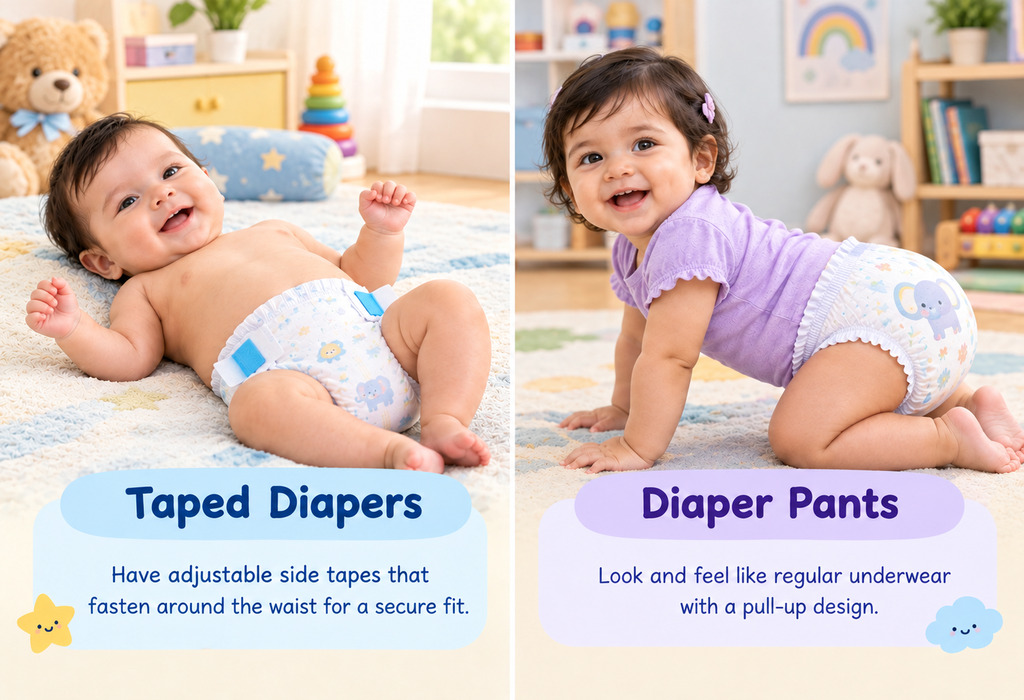
Taped Diapers vs. Diaper Pants: Which Is Right for Your Baby?
Key Takeaways
Taped diapers suit newborns and babies who lie still, while diaper pants suit babies who roll, crawl or stand.
Fit decides leaks and skin marks more than style, so match the weight range and check the waist and thighs.
Price per diaper depends on pack size as much as style, so compare it on the listing.
Both styles can share a routine, such as taped diapers for sleep and pants for outings.
The tape diaper vs pant diaper choice comes down to movement: taped diapers suit newborns and babies who lie still, while diaper pants suit babies who roll, crawl or stand. Taped diapers give an adjustable fit and are easy to change on a lying baby. Diaper pants pull on like underwear and save time with a wriggly baby. This article compares fit, ease of change, cost and rash risk for parents of babies from birth to toddler age. Every point applies to disposable diapers sold in India.
Key Facts
Two finger fit test. A diaper is not too tight when 2 fingers slide between the diaper and the baby’s tummy.
Indian standard. Disposable baby diapers fall under mandatory BIS certification in India through IS 17509:2021, so check the product details for it.
Change quickly. Changing wet or dirty diapers as soon as possible is a core step in preventing nappy rash.
What Are Taped Diapers?
Taped diapers are disposable diapers that fasten at the waist with adhesive tabs, so a parent can adjust the fit on each side. Taped diapers suit newborns, whose small waists need an adjustable fit. FirstCry is a go to shopping destination for baby and kids essentials, where the type filter on the taped diapers listing narrows the choice by size and weight.
Benefits of Taped Diapers
So, what makes taped diapers a popular choice among parents? Let’s look at some of the benefits they offer.
Adjustable fit: The tabs tighten or loosen each side as the waist changes.
Easy lying down changes: A baby who lies still needs no high leg lifts.
Easy to check: Opening the tabs shows a soiled diaper without removing it.
Overnight fit: Some parents prefer the tuned fit for a sleeping baby.
Limitations of Taped Diapers
While taped diapers offer plenty of convenience, they may not be the perfect fit for every baby or situation. Here are a few limitations worth keeping in mind.
Hard on wriggling babies: Tabs are hard to fasten evenly when a baby rolls away.
Tabs can weaken: Tabs may lose grip after repeated refastening.
Fit errors: A loose tab leaves leg gaps, and a tight tab can irritate skin.
Not potty friendly: Toddlers cannot pull taped diapers down alone.
What Are Diaper Pants?
Diaper pants are disposable diapers with a stretchy waistband that pull on and off like underwear. The parent slides the pants over the feet and up to the waist, and many designs have tearable side seams for removal. Diaper pants suit babies who roll, crawl or stand, since changing does not need the baby to lie still. The type filter on FirstCry lists diaper pants next to taped diapers.
Benefits of Diaper Pants
Diaper pants bring their own set of advantages that can make a difference in your baby’s daily routine. Here’s a closer look at what they offer.
Quick to put on: The pull on design takes seconds, even with a wriggling baby.
Standing changes: A toddler can stand for the change, with no wrestling on the mat.
Easier outings: Changes on the go need less space and time.
Close fit all round: The stretch waistband can reduce gaps as the baby moves.
Limitations of Diaper Pants
Like any diapering option, diaper pants have certain drawbacks too. Let’s take a look at where they may fall short.
Less fit control: A pant size is fixed and cannot be tuned.
Messier removal: Soiled pants must be pulled down past the legs or torn.
Price per diaper: Pants may cost more per diaper, so compare listings.
Tight waist marks: Pants that run small leave red marks, and the NHS advises against tight diapers.
Difference Between Taped Diapers and Diaper Pants
Diaper pants vs tape comes down to fastening, fit control and how each style handles a moving baby. The table below compares ten practical points that parents notice in daily use.
Feature
Taped Diapers
Diaper Pants
Fastening
Adhesive tabs
Stretch waistband
Best stage
Newborns and lying babies
Rolling, crawling and standing babies
Fit adjustment
Adjustable on each side
Fixed by size
Moving baby
Harder, must lie flat
Easier, can stand
Sleeping baby
Easier, stays on the back
Harder, legs lifted through
Soiled removal
Open tabs, fold away
Pull down or tear seams
Cost per diaper
Often lower, check listing
Often higher, check listing
Risk of gaps
Loose tabs
Wrong size
Potty training
Tabs opened each time
Toddler can pull down
Outings
Needs a flat surface
Quick change anywhere
Fit and Sizing: How to Get the Right Fit in Either Style
A well fitted diaper sits snug at the waist and legs without leaving marks. Start with the weight range on the pack, because size labels differ between brands.
Taped diapers: Fasten both tabs at the same height.
Diaper pants: Pull the waistband up and smooth the leg gathers outwards.
Too small: Red marks, back leaks and tabs that barely reach.
Too big: Leg gaps or a waistband that slips down.
How to Choose Between Taped Diapers and Diaper Pants by Age and Mobility
Here’s how to choose between taped diapers and diaper pants at different stages of your baby’s development.
Newborn and lying baby: Taped diapers are a practical choice for newborns and babies who spend most of their time lying down.
Rolling baby: Diaper pants can make changes easier when babies start rolling or moving around during diaper changes.
Crawling and standing baby: Pants are convenient for active babies who crawl, stand, or resist lying still.
Walking toddler: Diaper pants are easy to pull up and down, making them useful during potty training.
On FirstCry, the type filter separates taped diapers from pants, and the weight filter runs from 0 to 7 kg up to 18 to 25 kg. Babyhug pant style diapers are listed in Medium for 7 to 12 kg. The pant style filter holds far more products than the taped filter, so newborn parents should compare brands carefully.
Signs It Is Time to Switch From Taped Diapers to Diaper Pants
Not sure when to make the switch? Your baby’s changing movements and diapering habits can offer a few clues. Here are some signs to look out for.
Rolling away: The baby rolls over before the tabs are fastened.
Crawling or standing: Lying flat becomes a struggle.
Tab trouble: The baby opens the tabs mid change.
New leaks: Leaks appear as the baby moves and tabs shift.
Longer changes: Each change takes minutes and gets messy.
Taped Diapers vs. Diaper Pants: Which Is Better for Your Baby?
Which is better diaper pants or tape? Neither style wins for every baby, and the answer changes as the baby grows. Taped diapers work best for newborns and babies who lie still, because the tabs adjust the fit. Diaper pants work best for babies who roll, crawl or stand, because pants pull on in seconds. Nappy rash depends mostly on how long wee or poo stays on the skin, so quick changes, a snug fit and good absorbency matter more than style. Many families use both styles. Start with the style that matches the baby’s movement today, check the fit at every change, and switch when changes become a struggle.
FAQs
1. Can I use taped diapers and diaper pants together?
Yes, taped diapers and diaper pants can be used together. Many families use taped diapers for sleep at home and pants for crawling or outings. Check the size and fit for each style.
2. How many diapers does a newborn use in a day?
A newborn may need about 10 to 12 diaper changes a day in the early days, falling to about 6 to 8 when the baby is a bit older, according to the NHS.
3. How often should I change a diaper, and can one stay on overnight?
Change a diaper as soon as it is wet or dirty, and put on a fresh one at bedtime. The bedtime diaper can stay on overnight if it fits well, but change it if the baby wakes soiled.
4. What does the wetness indicator on a diaper mean?
A wetness indicator is a line on the front of the diaper that changes colour when the diaper is wet. The colour change shows when a change is due without opening the diaper.
5. Do diaper pants or taped diapers cause more nappy rash?
Neither style causes more nappy rash on its own. Nappy rash follows long contact with wee or poo, so quick changes, a snug fit and extra absorbent diapers matter more than style.
6. Which leaks less: taped diapers or diaper pants?
Fit decides leaks more than style. A taped diaper leaks when the tabs sit loose or uneven, and a pant leaks when the size is wrong. Check the weight range and smooth the leg gathers.
7. Which diapers suit babies prone to nappy rash?
Diapers with a super absorbent core suit rash prone babies, and an Indian Journal of Pediatrics abstract reports they reduce nappy rash incidence. Change them promptly, and see a doctor if the rash persists.
8. Which diaper pants suit crawling and walking babies?
Diaper pants in the size matching the baby’s current weight suit crawling and walking babies. Look for a stretchy waistband that stays up during movement and leg openings that leave no gaps.
9. Where can I buy taped diapers and diaper pants?
Taped diapers and diaper pants can be bought wherever baby essentials are sold, and the same checks apply: the type, the weight range, BIS certification and price per diaper. On FirstCry, the type, size and weight filters separate taped diapers from pants.
10. Which are the top brands of taped diapers and diaper pants?
No single brand suits every baby, so compare weight range, fit, absorbency, wetness indicator and price per diaper. Check the product details for BIS certification under IS 17509. On FirstCry, the brand filter allows side by side comparison, and Babyhug pant style diapers are one example.
Taped diapers suit newborns and babies who lie still, and diaper pants suit babies who roll, crawl or stand. Fit and quick changes protect skin more than style does. Before buying, check the weight range, the fit at the waist and thighs, the price per diaper and IS 17509. Using both styles is fine when routines differ between home, sleep and outings. Ask your paediatrician if a rash persists or if size or style is unclear.
Read more

10 Best Spout Sippers for Babies & Toddlers
A baby’s food journey is a crucial part of his childhood, as well as your parenthood. However, it is not only about the food itself; helping the child become independent enough to eat by himself takes some effort. When the time is right, you may start with feeding bottles, and eventually move on to sippy cups or sippers. They are great to help your baby get into the habit of drinking fluids all by himself.
When can your child start using a sipper cup, you ask? Well, it depends on your baby’s growth. Some babies start using it after they turn six months old, while some others may take more time. You can try it when your child starts reaching out for your coffee mug or is able to grip something with his hands and fingers. Usually, babies who can sit upright are ready to use a sippy cup.
If you are wondering what kind of sipper cup you can start with, refer our list of best sippers for babies and toddlers to aid your baby’s transition to cups.
Top 10 Spout Sippers for Babies
1. Babyhug Sipper Cup With Twin Handles
Worry no more about spillage, with the Babyhug Sipper Cup with Twin Handles.
How It Will Help Your Baby:
Made with high-quality, BPA-free, food-grade material, the Babyhug Sipper Cup with Twin Handles is perfect for babies over six months of age. The design allows the baby to hold the sipper with both hands and sip from the spout, preventing any fluid spillage. It has a sports style sipper, with a cap that allows larger feeds over longer intervals in a hygienic way.
2. Avent Classic Spout Cup With Handles
Help your baby transition to cups with this spill-proof Avent Classic Spout Cup.
How It Will Help Your Baby:
This is one of the best sippers for babies as young as six months. Its design, with easy-grip handles, allows babies to hold it firmly and drink from the soft and flexible spout. The product is BPA-free and safe for babies to use. It comes with a cap, and therefore, you can even store fluids hygienically. Also, it has interchangeable handles that can be used with other Avent bottles/sippers. So, when your baby is ready for cups, just remove the handle and help him transition!
3. Babyhug Hard Spout Non Spill Sipper Cup With Handle
Now, ensure a safe transition to cups with the Babyhug Hard Spout Non Spill Sipper Cup.
How It Will Help Your Baby:
Safety is paramount when it comes to babies. The Babyhug Hard Spout Non Spill Sipper Cup helps prevent any fluid spillage while your baby learns to drink from it. The product is BPA-free, and it comes with a cover that makes it convenient to carry fluids along hygienically and securely.
4. Chicco Transition Cup With Soft Silicone Spout
Think your tiny tot is ready for a sipper cup? The Chicco Transition Cup with Soft Silicone Spout might just be what you’re looking for.
How It Will Help Your Baby:
The Chicco Transition Cup with Soft Silicone Spout is designed for kids between 4 and 18 months old. It has a double anti-colic valve and an anti-drop system that helps babies switch from suckling to drinking with some practice. This BPA-free sipper is the best sipper to help babies and toddlers become confident at drinking from a cup.
5. Babyhug Hushie Soft Spout Sipper With Handle
Assure a comfortable and safe way of drinking fluids for your baby, whether at home or on the move, with the Babyhug Hushie Soft Spout Sipper.
How It Will Help Your Baby:
Use the Babyhug Hushie Soft Spout Sipper to feed juices, milk and water to your little one without a worry. The sipper cup is made with BPA-free material and has a spill-proof and soft spout to ensure your child can safely drink fluids from it.
6. Chicco Insulated Active Cup
Now your kid can get to drink cool or warm drinks wherever he is with the Chicco Insulated Active Cup.
How It Will Help Your Baby:
The Chicco Insulated Active Cup is the best sipper cup for toddlers aged 14 months and above. It has a removable valve that allows your child to sip easily without dropping any fluids and a hard beak that eventually assists in transitioning to a cup. Also, the cup is insulated and helps maintain the temperature of the fluids for a few hours.
7. Babyhug Ergo Grip Soft Spout Sipper
Ensure a firm grip with the Ergo Grip Soft Spout Sipper!
How It Will Help Your Baby:
Perfect for babies aged six months and above, this is one of the best sippers without a handle. Its design, with a textured surface, makes it easy for your child to hold it and drink from it. The BPA-free material and the soft spout make it a safe sippy cup for infants!
8. Mee Mee 2 in 1 Spout & Straw Sipper Cup
Ergonomically designed for your baby’s mouth cavity, the Mee Mee 2 in 1 Spout & Straw Sipper Cup is the best sipper for babies aged three months and above.
How It Will Help Your Baby:
The product is designed for comfortable grip and safe drinking. It is BPA-free, lightweight, and has twin handles, a spout, and a straw that allow your baby to drink fluids independently. The sipper conforms to the international standards of hygiene and safety, and is, therefore, one of the best sippers for babies.
9. Mee Mee Easy Grip Twin Handle Non-Spill Sipper Cup
Transitioning to a sipper cup will be a piece of cake for your little one with the Mee Mee Easy Grip Twin Handle Non-Spill Sipper Cup.
How It Will Help Your Baby:
With a smart design that allows easy flow of fluids through a hard spout, this product is one of the best sippers for babies who are three months old and above. It has a tiny cup attached to keep the spout covered, and a spill-free function that allows you to carry your munchkin’s drinks outdoors. The sipper cup has handles on either side, for the baby to hold it firmly and comfortably drink from it.
10. Mee Mee Easy Grip Twin Handle Sipper Cup
With the Mee Mee Easy Grip Twin Handle Sipper, your little one will now sip liquids without a fuss.
How It Will Help Your Baby:
This is another sipper with twin handles attached to the body of the cup. Your baby will find it easy to hold and drink from it without any fuss, once he is ready for sippers! This spill-proof sipper is made of BPA-free material that is safe for storing milk and other fluids.
FAQs on Spout Sippers for Babies and Toddlers
1. How do I transition my baby from using a bottle to a sipper?
One of the best ways to transition your baby from a bottle to a sipper is by introducing the sipper cup as early as possible. As a thumb rule, parents introduce sipper cups to their babies along with solid foods when they turn six months old. You may start with a soft silicone spout sipper, and then move to a hard spout. Later on, you can get a cup with a valve and a straw, to get your little one to practise drinking fluids through it.
2. What is the appropriate age to give sippers to babies?
As mentioned above, parents usually introduce sipper cups once their babies turn six months old. However, some parents may choose to use one when their child is 4 or 5 months old. If your baby has developed a decent grip, can sit upright and is being introduced to solids, you may get a sippy cup for him, and use it on a daily basis.
3. How to clean baby sippy cup?
It is advisable to rinse the sipper cups, valves, caps, and straws after every feed, to prevent fluids from drying up and getting accumulated inside them. Thorough cleaning with soapy water and sterilisation of the sippy cups are also necessary. First, you need to disassemble all the parts of the sippy cup and soak them in some hot soapy water for at least 15 minutes. Ensure they are completely submerged in the water. Then, rinse all the parts properly before finally sterilising them in a steriliser.
We hope your search for that perfect sippy cup for your little one ends here, with our list of best sippers for babies! You can choose more than one, and place them at various locations accessible to your baby to encourage him to drink more fluids and stay hydrated.
You May Also Like:
Best Baby Powders
Best Baby Wipes
Best Straw Sippers for Babies & Toddlers
Best Disinfectant Cleansers for Baby Bottles
Also Read:
Introducing a Sippy Cup to Your Toddler
Bottle Feeding – Advantages and Disadvantages
How to Bottle Feed a Baby
Bottle-Feeding Problems and Their Solutions
Read more
10+ Best Baby Diapers Brands in India (2026)
Choosing the right diaper can make everyday baby care easier. A good diaper should offer a comfortable fit, reliable absorbency, leak protection and materials that feel gentle against your baby’s skin. With so many options available, parents often wonder which are the best baby diapers in India and which brands are worth considering.
To make the choice simpler, we have shortlisted 10+ popular baby diaper brands, including Pampers, Huggies, MamyPoko, Babyhug, Little’s, LuvLap and others. The list considers factors such as comfort, absorbency, fit, diaper styles, sizing and features that matter during everyday use.
Quick Picks: Best Baby Diaper Brands in India
Brand
Best For
Popular Diaper Types
Pampers
Everyday and premium options
Pants, taped diapers
Huggies
Comfortable everyday use
Pants, taped diapers
MamyPoko
Pant-style diapers
Pants
Babyhug
Variety and value
Pants, taped diapers
Little’s
Everyday essentials
Pants, taped diapers
Teddyy
Absorbency-focused options
Pants, taped diapers
LuvLap
Soft, skin-conscious options
Pants
Himalaya Babycare
Skin-focused baby care
Pants
Babyoye
Softness and comfort
Pants
Mylo
Modern diaper features
Pants
R for Rabbit
Lightweight diaper options
Pants
Bonfino
Absorbency-focused options
Pants, taped diapers
Chicco
Premium baby care
Pants, taped diapers
What Makes a Good Baby Diaper?
Before choosing a brand, it helps to understand the features that can make a difference in everyday use.
Good Absorbency
A diaper should absorb urine efficiently and help keep moisture away from the baby’s skin. For overnight use, parents may prefer diapers designed for longer wear, while daytime diapers can be changed more frequently.
Soft and Comfortable Materials
Since diapers remain in close contact with a baby’s skin, a soft inner surface and comfortable leg and waist areas are important. Babies with sensitive skin may benefit from simpler, skin-conscious options.
Secure Leak Protection
Leak guards around the legs, a flexible waistband and a good overall fit can help reduce leakage. However, even a highly absorbent diaper can leak when the size or fit is not right.
Comfortable Fit
A diaper should sit securely without digging into the baby’s waist or thighs. Frequent leaks, gaps around the legs or noticeable red marks can indicate that it is time to reassess the size or style.
Wetness Indicator
Some diapers include a wetness indicator that changes colour when the diaper becomes wet. This can be particularly convenient for newborn parents who are still getting familiar with diaper changes.
Top 10+ Best Baby Diaper Brands in India
The following brands offer different combinations of absorbency, softness, fit, styles and price points. Consider the features that matter most for your baby rather than choosing a brand based only on popularity.
1. Pampers
Pampers is one of the most recognised diaper brands in India and offers options for different stages, from newborns to active toddlers. Its range includes both taped and pant-style diapers, with options focused on everyday comfort, softness and absorbency.
Best for: Parents looking for a wide selection across different baby stages.
Popular options include: Premium Care, Active Baby and All Round Protection.
Why consider it: Pampers offers multiple ranges, making it easier to switch between different features as your baby’s needs change.
2. Huggies
Huggies is another widely recognised baby diaper brand with a strong presence in the Indian market. Its diaper range includes pant-style options as well as products designed for younger babies.
Best for: Everyday use and parents looking for a familiar, widely available brand.
Popular options include: Wonder Pants and premium diaper ranges.
Why consider it: Huggies focuses on comfortable fit, absorbency and movement-friendly designs for growing babies.
3. MamyPoko
MamyPoko is particularly well known for its pant-style diapers. Its range includes options designed for everyday use as well as variants focused on longer-lasting absorbency.
Best for: Parents who prefer pant-style diapers for active babies and toddlers.
Popular options include: Pants Extra Absorb, Skin Breathe Care and premium pant ranges.
Why consider it: The pant-style format makes changing easier once babies become more active and start crawling or walking.
4. Babyhug
Babyhug offers a variety of baby diapers in both pant and taped styles to suit different needs. Parents can choose from everyday and premium options based on their baby’s size, comfort, fit, and level of absorbency needed.
Best for: Parents looking for variety across different diaper styles and stages.
Popular options include: Babyhug Advanced and Pro Bubble Care ranges.
Why consider it: The brand offers several options across sizes and styles, making it convenient to compare different features within one brand.
5. Little’s
Little’s is an Indian baby-care brand offering diapers designed around everyday comfort, absorbency and leak protection. Its range includes different sizes and styles for babies at various stages.
Best for: Parents looking for practical everyday diapering options.
Popular options include: Premium FluffySoft, Comfy Night and pant-style diapers.
Why consider it: Little’s combines everyday diapering features with soft materials and convenient designs.
6. Teddyy
Teddyy from Nobel Hygiene is an Indian diaper brand offering both taped and pant-style options. Its products focus on absorption, dryness and a secure fit for babies at different stages.
Best for: Parents looking for an Indian brand with multiple diaper formats.
Popular options include: Easy Diaper Pants, Easy Tape Diapers and premium taped diapers.
Why consider it: The availability of both tape and pant styles makes the range useful as your baby moves through different developmental stages.
7. LuvLap
LuvLap offers a range of baby-care products, including diapers designed with softness, absorbency and comfortable movement in mind. Its diaper options are available in several sizes and are suitable for everyday use.
Best for: Parents looking for a comfortable diaper from an established Indian baby-care brand.
Popular options include: LuvLap diaper pants and premium diaper ranges.
Why consider it: Features such as soft materials and lightweight construction can make the diapers comfortable for everyday wear.
8. Himalaya Babycare
Himalaya Babycare brings its established baby-care focus to its diaper range. Its diapers are designed with features aimed at keeping babies comfortable while helping parents manage everyday wetness and leakage.
Best for: Parents who prefer a baby-care brand with a skin-focused approach.
Popular option: Total Care Super Absorb Baby Pants.
Why consider it: The brand’s baby-care positioning and focus on gentle care make it an option parents may consider when skin comfort is a priority.
9. Babyoye
Babyoye offers baby diapers with an emphasis on softness, comfort and everyday protection. Its Air Soft range is designed for babies who need a comfortable pant-style diaper during the day and night.
Best for: Parents who prioritise softness and a comfortable feel.
Popular option: Air Soft Premium Pant Style Diapers.
Why consider it: The soft, lightweight feel can be useful for babies who spend long periods wearing diapers.
10. Mylo
Mylo offers modern baby-care products developed around the everyday needs of parents. Its diapers feature an Acquisition Distribution Layer (ADL), which is designed to help distribute liquid through the absorbent core.
Best for: Parents interested in diapers with absorption-focused design features.
Popular option: Baby Diaper Pants with ADL Technology.
Why consider it: The ADL is designed to support more even liquid distribution, helping the diaper manage wetness efficiently.
11. R for Rabbit
R for Rabbit is an Indian baby-care brand known for its range of thoughtfully designed baby products. Its Feather Diapers focus on a lightweight construction while providing the absorbency needed for everyday diapering.
Best for: Parents looking for lightweight diaper options.
Popular option: Premium Feather Diapers.
Why consider it: A thinner diaper profile can provide babies with greater freedom of movement, particularly when they become more active.
12. Bonfino
Bonfino offers baby diapers in both taped and pant-style formats. Its products focus on absorbency, dryness and comfortable fit across different baby stages.
Best for: Parents looking for absorbency-focused diaper options.
Popular options include: Premium Tape Style and Premium Pants.
Why consider it: The brand offers multiple formats, allowing parents to choose between taped and pant-style designs depending on their baby’s stage.
13. Chicco
Chicco is an established Italian baby-care brand with a broad range of products for babies and young children. Its diaper range focuses on softness, comfort, absorbency and ergonomic fit.
Best for: Parents looking for premium baby-care options.
Popular options include: Comfypro and Ultra Soft & Light diaper ranges.
Why consider it: Chicco’s focus on soft materials and comfortable construction makes it an option for parents who prioritise a premium feel.
Types of Baby Diapers
Understanding the different diaper types can make choosing the right product much easier.
Taped Diapers
Taped diapers have adjustable fastening tabs that allow parents to customise the fit around the baby’s waist. They are particularly convenient for newborns and younger babies who spend much of their time lying down.
Pant-Style Diapers
Baby diaper pants can be pulled on like underwear and are convenient for active babies. They are especially useful when babies start crawling, standing and walking because they make changes quicker and easier.
Disposable Diapers
Disposable diapers are designed for single use and are widely preferred for their convenience, absorbency and ease of disposal.
Cloth Diapers
Cloth diapers are reusable and can be washed and used repeatedly. They are an alternative to disposable diapers for parents who prefer reusable baby-care products.
How to Choose the Best Baby Diapers for Your Baby
1. Choose the Right Size
Always check the weight range printed on the diaper pack rather than choosing based only on age. Babies of the same age can have very different body shapes and weights.
A diaper that is too small may leave marks or cause leaks, while an oversized diaper may create gaps around the legs.
2. Consider Your Baby’s Activity Level
Taped diapers can be convenient for newborns and younger babies. Once your baby becomes more active, diaper pants can make changing easier.
3. Look at Absorbency
If your baby tends to stay dry for longer periods, consider a diaper designed for extended wear. For newborns, frequent changes are still important regardless of the diaper’s advertised absorbency.
4. Check the Fit Around the Legs
The diaper should sit comfortably around the thighs without leaving excessive gaps. If leaks repeatedly occur around the legs, check the size and fit before changing brands.
5. Consider Skin Sensitivity
If your baby has sensitive skin, pay attention to how their skin responds to a particular diaper. Look for comfortable, breathable materials and avoid continuing with a product that appears to cause irritation.
6. Decide Between Pants and Tapes
There is no universal winner between pant-style and taped diapers. Taped diapers provide adjustable fastening, while pants are convenient for active babies.
7. Think About Day and Night Use
Some parents use the same diaper throughout the day and night, while others prefer a diaper designed for longer wear at bedtime. The choice should depend on your baby’s wetting pattern, comfort and how frequently you change diapers.
8. Try a Smaller Pack First
Before buying a large pack, trying a smaller pack can help you check whether the diaper fits your baby comfortably and works well with their skin and movement.
Baby Diaper Size Guide
Diaper sizing varies between brands, so always follow the weight range provided on the specific pack.
Newborn (NB)
Up to 5 kg
Small (S)
4–8 kg
Medium (M)
6–11 kg
Large (L)
9–14 kg
Extra Large (XL)
12–17 kg
XXL and above
15 kg+
Tip: If your baby’s weight falls between two sizes, consider the fit, thigh area, waistband and frequency of leaks rather than choosing purely by the size label.
Pant Diapers vs Taped Diapers: Which Is Better?
Neither option is automatically better. The right choice depends on your baby’s developmental stage and your preferred changing routine.
Taped diapers may work well for:
Newborns
Babies who are mostly lying down
Parents who want adjustable fastening
Babies who need frequent diaper changes
Pant-style diapers may work well for:
Crawling babies
Standing babies
Toddlers
Quick changes
Parents who find fastening tabs difficult with an active baby
How Often Should You Change a Baby’s Diaper?
Diapers should be changed regularly and whenever they are wet or soiled. Newborns may need more frequent changes because they feed and urinate frequently.
For older babies, the exact number of changes can vary depending on feeding, fluid intake, activity and individual wetting patterns.
A diaper’s advertised long-hour protection should not be taken to mean that a baby should remain in a wet or soiled diaper for that entire period.
Can Diapers Cause Diaper Rash?
Diaper rash can have several causes, including prolonged contact with urine or stool, friction, moisture, sensitive skin and reactions to certain products.
Changing diapers regularly, cleaning the diaper area gently and allowing the skin to stay dry can help support healthy skin. If a rash is persistent, severe or worsening, parents should speak with a healthcare professional.
Best Baby Diapers in India: Which Brand Should You Choose?
There is no single best baby diaper brand in India for every baby. A diaper that fits one baby perfectly may not work as well for another because babies differ in body shape, skin sensitivity, activity and wetting patterns.
For example, parents who want a broad range of options may consider Pampers or Huggies. Those looking for pant-style options can consider MamyPoko, Babyhug or Babyoye. Parents interested in Indian baby-care brands can also compare Little’s, Teddyy, LuvLap and R for Rabbit.
The most useful approach is to start with the correct size, try a suitable variant and observe your baby’s comfort, skin and leakage pattern.
FAQs About Baby Diapers
1. Which is the best baby diaper brand in India?
There is no single best brand for every baby. Pampers, Huggies, MamyPoko, Babyhug, Little’s and other brands offer different combinations of fit, absorbency, softness and diaper styles. The best choice is the one that fits your baby well and keeps them comfortable and dry.
2. Which diaper is best for newborn babies?
Newborns generally need a properly sized diaper with a comfortable fit around the waist and legs. Taped diapers can be convenient at this stage because they allow parents to adjust the fit while the baby is lying down.
3. Are pant diapers better than taped diapers?
Not necessarily. Taped diapers offer adjustable fastening and can be convenient for newborns, while pant diapers are easier to pull on and can be useful for active babies. The better option depends on your baby’s age, movement and fit.
4. How do I know if my baby’s diaper is the right size?
A well-fitting diaper should sit securely without being excessively tight. Frequent leaks, gaps around the legs or persistent red marks can indicate that the size or fit needs to be reassessed.
5. Which diaper is best for overnight use?
Parents may prefer diapers designed for longer wear at night. However, the right choice depends on your baby’s wetting pattern and the fit of the diaper. A good fit is just as important as absorbency when reducing overnight leaks.
6. How many diapers does a newborn need in a day?
Newborns generally need frequent diaper changes, so parents may go through several diapers each day. The exact number varies depending on feeding, bowel movements and individual wetting patterns.
7. Can I use pant diapers for a newborn?
Some brands offer pant-style diapers in smaller sizes, but taped diapers are often convenient for newborns because they can be adjusted while the baby is lying down. Always follow the manufacturer’s size and weight recommendations.
8. Should I size up if my baby’s diaper is leaking?
Not always. Leakage can result from an incorrect fit, gaps around the legs, an overfull diaper or incorrect positioning. If the diaper feels tight or leaves marks, moving up a size may help. If it fits loosely, another size or style may be more suitable.
9. Are expensive baby diapers better?
Not necessarily. Higher-priced diapers may offer additional features, but an affordable diaper can work very well if it fits your baby properly and provides adequate absorbency and comfort.
10. How often should I change a baby’s diaper?
Change the diaper regularly and whenever it is wet or soiled. Newborns usually require more frequent changes than older babies.
11. Can I use the same diaper during the day and night?
Yes, provided the diaper is suitable for your baby’s needs and is changed regularly. Some parents prefer a higher-absorbency option at night for convenience.
12. Do diapers prevent diaper rash?
No diaper can guarantee that a baby will not develop diaper rash. Regular changes, gentle cleaning, keeping the area dry and choosing a comfortable-fitting diaper can help reduce factors associated with irritation.
13. What should I look for in diapers for sensitive skin?
Look for a soft inner surface, comfortable fit and materials that your baby’s skin tolerates well. If a particular diaper repeatedly causes irritation, consider trying another variant or brand.
14. Are wetness indicators useful?
Yes. A wetness indicator can give parents a quick visual cue that a diaper is wet, which can be particularly helpful with newborns and during nighttime checks.
15. How do I choose diapers for an active baby?
Pant-style diapers can be convenient for crawling, standing and walking babies because they are easy to pull on and take off. A flexible waistband and secure leg fit are also important for active babies.
16. Should I buy a large pack of diapers?
It can be convenient to buy larger packs once you know which size and variant suit your baby. For a new brand or size, trying a smaller pack first can help you check the fit and comfort.
17. Why does my baby’s diaper keep leaking?
Common reasons include an incorrect size, poor positioning, gaps around the legs, an overfull diaper or a diaper that does not suit the baby’s body shape. Check the fit before assuming that the brand itself is the problem.
18. Can I use different diaper brands for my baby?
Yes. Parents can try different brands and variants to find the combination of fit, comfort and absorbency that works best for their baby.
19. What is the most important factor when buying baby diapers?
Fit is one of the most important factors. A well-fitting diaper should be comfortable around the waist and thighs, provide adequate absorbency and allow the baby to move freely.
Final Word
Choosing among the best baby diapers does not have to be complicated. Start with your baby’s weight and size, then consider fit, absorbency, softness, diaper style and skin comfort.
Pampers, Huggies, MamyPoko, Babyhug, Little’s, Teddyy, LuvLap, Himalaya Babycare, Babyoye, Mylo, R for Rabbit, Bonfino and Chicco all offer different options worth comparing.
Rather than choosing a diaper simply because it is popular, pay attention to how it works for your baby. The right diaper should fit comfortably, help manage wetness and allow your little one to move, play and sleep comfortably.
Ready to choose? Browse the baby diapers collection on and compare sizes, styles and brands to find the right option for your little one.
Read more

5 Best Baby Swings
Most parents come to realise soon enough that a swing can make their life much easier when they have to put their baby down to attend to other things such as work, chores or even a shower. Cradling babies and swinging them back and forth is one of the best ways to soothe them down when they’re grumpy or annoyed or throwing a tantrum. Here’s a list of the best selling baby swings and how to choose them.
List of Top 5 Best Baby Swings, Bouncers, and Rockers in India
There are tons of options in baby swings and it can be difficult for you to choose one if you are not much familiar with baby products. Worry not, browse through these options and take a pick!
1. Babyhug Gaiety Electronic Swing With Timer & 5 Point Safety Harness
The Babyhug gaiety electronic swing is one of the best swing options you will find today owing to its affordability, design, and safety mechanism. The swing features non-slippery and anti-tipping frame base and comes with a five-point safety harness, which makes it very safe for little ones. It comes with a timer, three reclining options, and has both automatic and full swing mechanism. This Babyhug swing has everything you need to keep your baby entertained. The three plush toys on the toy bar are detachable and the swing features 12 melodies and 5 nature songs. The feeding tray is large and can be detached. This swing can be folded easily. It’s one of the safest swings you will find for your little one!
2. Chicco Polly Swing Up
This advanced portable swing for babies by Chicco has all the best features you could expect from a baby swing. It has 4 rocking speeds with a 5-point safety harness and a 2-position reclining seat for the best comfort and safety. Vibrating seats, nature sounds and soothing melodies help make it the best swing for a fussy baby. It can be carried around easily and it keeps your baby entertained and happy the whole time she is awake in the rocker.
3. Babyhug Comfy Bouncer With Music & Calming Vibrations Animal Print
This multicoloured bouncer with animal prints on it is super comfortable for little ones. This bouncer by Babyhug has a strong frame and soft padding which provides extra comfort to babies. Its three-point safety harness will keep your little one securely strapped and prevent him from falling. Packed with comfort and designed to keep your child engaged and at ease. The toy bar has two plush toys which will keep your baby entertained when they are awake and the calming vibrations will help them drift off to sleep when your child is sleepy. The large comfortable seat of this bouncer can carry a baby weighing up to 12 kgs. This comfy bouncer is perfect for babies between 0 and 2 years of age.
4. Fisher Price Infant to Toddler Rocker
Fisher Price is a durable rocker and can carry babies weighing up to 18 kgs. Designed to calm fussy babies, this rocker is perfect for putting newborns to sleep. This rocker grows with the baby and can be used for multiple purposes. You can feed or play with your baby while making them sit in the rocker. The comfortable vibrations also help soothe newborns and help them sleep peacefully. This baby rocker sleeper can be used from infant to toddler years and it features a three-point safety harness with three reclining positions. The overhead toy bar can be removed when the baby grows old to convert it into an infant seat.
5. Babyhug Opal 3 in 1 Cosy Rocker Cum Sleeper With Mosquito Net
The image of the rocker makes you want to buy it immediately, no? Wait until you read its features! This 3 in 1 rocker cum sleeper is just what you need to soothe your baby. It can be used as a rocker, sleeper, or a bassinet. The soothing melodies and soft vibrations in this rocker will make your little fall asleep and the mosquito net will keep them safe from mosquito and insect bites. The rocker cum sleeper has a three-point safety harness which will keep your baby safe and secure while he is resting in it. It also features three reclining positions; you can recline the backrest to the position of your choice. The toy bar in this rocker cum sleeper is sturdy and attractive and comes with two plush toys. The seat of the cushion is removable and washable. It’s everything you need to ensure that your baby sleeps well!
FAQs on Baby Swings
1. What Are the Different Types of Baby Swings?
There are four main types that you need to be aware of:
Bouncer Swings: Bouncers move up and down and are something babies will absolutely love. They’re perfect for keeping your baby busy while you’re occupied with other things. Bouncers are only good until your baby is in the infant stage.
Jumper Swings: Jumpers have your baby suspended from cords, allowing them to stand, walk or jump around. They are best for very active babies.
Rocker Swings: As the name suggests, they move back and forth similar to a rocking chair. Their main purpose is to soothe babies who are cranky and crying or send them to sleep if they’re used to being rocked to sleep in your arms.
Battery Operated Swings: Swings move in all four directions and are suspended from the overhanging structure. They can either be long swings or portable swings that come with overhead toys.
2. Full-size Swing or a Portable- Which One to Choose?
Whether you want to choose full-sized swings or portable ones depends on how much space you have for them and your budget. If you already have a spacious room specifically for your baby, you could opt for a full-sized swing. They tend to be bigger, sturdier and have a wider range of swing. Portable swings are great if you don’t have much room for it or you’re off vacationing. They run on batteries and can be easily set up.
3. What Should I Look for When Buying a Baby Swing?
Here are some of the things you need to consider before making your purchase of a baby swing:
The height of the swings can be different. Although they’re all well-balanced and stable, you may feel safer with a shorter one.
Pick models that have more speed settings. This will let you slow down or speed up based on how your baby likes it.
Seat belts give extra safety, so you should preferably go for a three or five-point harness.
Portability is a good factor to consider if you often travel and need to take your baby with you.
Swings work on both batteries and AC power. While you can run on AC whenever you’re home, having one that can switch to a battery will help you on the move.
Your baby will inevitably make the swing dirty, therefore pick one which comes with a removable cover that can be washed. It’s easy to clean and maintain.
Ensure the swings are well padded and comfortable so the baby won’t cry or object every time you put her in the swing.
The seats need to be adjustable; a swing with a permanently recumbent seating position isn’t fun for too long. As your baby grows older, she will prefer to sit upright.
Swings with timers are excellent; they stop when the time runs out.
Preferably go for swings with a metal frame. Plastics degrade or get weaker because of fatigue. A sturdy metal frame can last for years.
Look for all the extra features they offer, such as toys, play music, vibrating seats or a wider range of motion.
4. When to Start and Stop Using Baby Swing?
Your baby can be introduced to swings right from birth to till she is a toddler (12 to 36 months).
5. How Long Can I Leave My Baby in a Swing?
Though there are no hard and fast rules on how long you can let your baby stay in the swing, most experts recommend keeping it as short as possible. It’s best to limit the time on it to less than an hour a day. As soon as your baby falls asleep, transfer her to her crib.
The type of swing you need to buy should ideally be decided by how much space you have. Portable swings are great for small spaces, while long swings are wonderful for outdoors.
You May Also Like:
Best Baby Rockers
Best Baby Bouncer Chairs
10 Best Prams & Strollers
10 Best Baby Carriers and Carry Cots
Offers & Deals
Baby Gear Products
Baby Gear Products Brands
Baby Gear Products Offers & Deals
Baby Gear Products on Sale
Also Read:
Should You Allow Your Infant to Sleep in the Swing?
Tips to Buy a Good Infant Cradle
Common Sleep Problems in Babies
Read more

These Products Are EVERYTHING You Need to Tackle Winters With Your Baby Like a Pro
Did you know the lowest temperature ever recorded was -98 degree Celsius? Luckily in India, we do not have this kind of a temperature drop. However, come winter, and every parent is stressed out thinking about ways to make the season comfortable for their babies. Your little one is fragile and may be susceptible to illness because his/her body hasn’t developed fully yet. Babies, therefore, need extra protection and care, especially during the winter season.
Nowadays, a variety of winter essentials are available in the market. Products like humidifiers can help control the temperature indoors to make it a nice, warm and cosy space for your baby. But, with the festival and wedding season still on, you could have to take your munchkin out, say on holiday, for celebrations, family functions etc., which could expose him/her to chills and potentially, viruses. Your little one could then run a risk of catching a cold or could even suffer from influenza.
This does sound worrisome, but we assure you that there are ways to deal with winters with the help of some products that are readily available around you. And, we shall talk about them in this article for you to tackle winters with your baby like a pro!
Six Winter Essentials for Babies
Here are six essential products that can help you take care of your bundle of joy when the mercury levels drop.
1. Winter Wear
One of the most basic products to buy for your baby is some good quality winter wear. You can go for onesies, or sets with or without hoodies to make your baby feel protected and keep him/her warm. Winter wear is available in different colours and fabrics and a choice of patterns and styles for your baby boy or your baby girl. Single jersey woven fabrics are recommended if you are looking for something to keep your little one comfortable and cosy during the season. Put them on over a pair of your baby’s regular clothes, and you are good to go.
2. Thermals
Does your baby get irritable with too much clothing on?? If your answer is yes, this product is for you! Thermal wear can keep your little one warm, and he/she wouldn’t need many layers of clothing. You can dress your baby in his/her usual light, comfortable clothing along with a thermal vest. However, if it gets too cold, add a layer of clothes with a jacket. Don’t forget to add a nice pair of socks and mittens to keep the baby’s extremities warm and to avoid frostbites.
3. Winter Caps
Winter caps are essential for babies since they cannot regulate their body temperature and often, their tiny little heads go cold, making them susceptible to colds or the flu. To reduce their chances of falling sick, you must cover their heads too. Team a nice winter cap with a pair of thermals or winter wear to keep the cold at bay. One of the best parts of dressing your baby in winter caps is that they stay warm but also look so cute!
4. Nasal Aspirators
One of the most recommended winter products is a Nasal Aspirator, especially for the babies suffering from congestion. Blocked airways can lead to sleepless nights and cranky behaviour. This product can help relieve the blockage and allow your baby to breathe easily. At times, you might need a few drops of nasal saline to loosen up the mucus and suck it out with the help of this tool. In case you are unsure about using this product, you must check with your baby’s paediatrician and use it only if he/she recommends it.
5. Vicks
Vicks BabyRub For Babies could be useful in soothing your baby when he/she has a cold. It has extracts of aloe vera and coconut oil, and fragrances of rosemary and lavender in a paraffin base, that could make it a gentle product to use on babies over the age of 3 months. However, do keep your baby’s allergies under consideration before using this product. In some cases, especially if your baby has been diagnosed with asthma, inhaling the vapours could aggravate the condition. Consulting a paediatrician is highly recommended before using this product.
6. Winter Cream
The dropping temperatures can cause your little one’s skin to go dry and flaky, which could lead to skin rashes and add to his/her discomfort. To tackle this issue, you can use a good Winter Cream to keep your baby’s skin moisturised and healthy.
These products can come in handy to take care of your baby when it’s cold outside, and also help to manage winter-related health issues. After you’ve done all that it takes to make the season comfortable for your baby, just put on that CD of “Frozen”, cuddle up, and enjoy watching Elsa and Anna embark on a mysterious journey along with Kristoff and Olaf.
Read more

10 Best Baby Powders
Baby powders work like magic to provide relief from diaper rashes, excess moisture, and irritation on the skin. Baby powder can keep your baby rash-free and dry, as it absorbs sweat and bad odour. But if you’re a new parent, you will obviously want to consider different baby powder brands before settling for one. And we’re here to help! We’ve compiled a list of our top baby powders available today. Go through their descriptions and decide the one you’d like for your baby.
List of Top 10 Best Baby Powders in India
Browse through this list of best baby powder brands in India. If you are looking for something season-specific, this list also has the best baby powders for summers too. Read on!
1. Himalaya Herbal Baby Powder
Himalaya is a trusted brand and is among the top natural skin care product manufacturers in India.
Product Description
Himalaya Herbal Baby Powder is infused with the power of various herbs. The gentle formulation of zinc oxide keeps the baby cool, fresh, and happy. It is enriched with cooling extracts of khus-khus which refreshes the skin, and yashada bhasma keeps the skin dry and smooth. It helps prevent body odour and keeps the skin smooth and comfortable.
2. Himalaya Herbal Prickly Heat Baby Powder
This prickly heat baby powder by Himalaya Herbals provides relief from prickly heat and keeps a baby’s skin from infections and inflammation.
Product Description
This prickly heat powder is enriched with neem and khus grass. Neem has anti-inflammatory properties which protect a baby’s skin from rashes, inflammation. Whereas, khus grass has astringent and antiperspirant properties, which help keep baby’s skin fresh. Another ingredient that this baby powder consists of is natural zinc, which owing to its antiseptic properties, heals wound quickly.
3. Sebamed Baby Powder
Sebamed is a German brand established by Sebapharma GmbH & Co. KG. One of the best selling products of this brand is the Baby Sebamed Baby Powder, which is a must-have for your little one.
Product Description
This powder has been specifically formulated to strengthen the resistance of the baby’s skin. The extra soft formulation of the powder helps in soothing the layers of the skin that are prone to friction, thus, protecting the baby from the effects of chafing and rubbing.
4. Chicco Talcum Powder
Chicco baby moments talcum powder is a soothing and refreshing powder that is dermatologically tested.
Product Description
This baby powder by Chicco contains natural active ingredients like rice starch that refreshes and protects baby’s sensitive and delicate skin. It is free of allergens, parabens, mineral oil, dyes, alcohol, and other such ingredients which are harmful to baby skin. Its enriched formula creates a breathable layer on the skin and does not clog pores.
5. Mamaearth Dusting Powder
This dermatologically tested dusting powder is free of talc and prevents diaper rashes.
Product Description
This dusting powder contains natural ingredients which help in retaining moisture in the skin and oatmeal prevents diaper rashes and prevents diaper dry, itchy, and irritated skin. The cornstarch present in it absorbs extra moisture and contain no harmful chemicals like parabens, phthalates, SLS, or artificial fragrances.
6. Mee Mee Baby Powder
Your baby might feel uncomfortable due to the changes in weather and temperature, but worry not – Mee Mee’s velvety soft baby powder is light and will help keep your baby’s skin fresh and dry.
Product Description
Mee Mee’s baby powder is safe to use on newborns and is microbiologically tested. The powder can be used after a bath, diaper change, or to just freshen up anytime during the day. It is clinically safe, hypoallergenic, and is gentle on the baby’s tender skin. It has been tested by dermatologists.
7. Mothercare – All We Know Baby Powder
Keep your baby’s skin dry, fresh, and comfortable with this baby powder by Mothercare.
Product Description
This Mothercare baby powder is hypoallergenic and is dermatologically tested. It is tested by midwives and is gentle enough even on newborn skin.
8. The Moms Co. Talc Free Baby Powder
The Moms Co. Talc Free Baby Powder contains cornstarch which helps absorb excess moisture from the skin. This is one of the baby powders for sensitive skin.
Product Description
This powder is good at keeping the skin dry without the use of talc. It contains organic chamomile, jojoba, and calendula oils. The chamomile oil helps soothe and ease irritation and moisturises the skin while protecting it. This powder does not contain mineral oil, talc, synthetic fibres, and other harmful chemicals. This powder is dermatologically tested.
9. Pigeon Baby Powder
Pigeon baby powder is one of the best organic baby powders for newborns. This powder is ideal to use after a bath and diaper change.
Product Description
Pigeon Baby Powder is mild and gentle on the skin. It is enriched with organic extracts of rosehip, chamomile, and organic olive oil. It comes with a refreshing fragrance of lilac and milky fragrance of the powder keeps the baby smelling fresh, and the formulation keeps the baby’s skin smooth and soft, giving it a dry and comfortable feeling. The key features of this powder are that it is an anti-irritant, hypoallergenic, and dermatologically tested. It is perfectly suited for newborns.
10. Mother Sparsh Talc-Free Natural Dusting Powder for Babies
Mother Sparsh talc-free powder contains all-natural ingredients that are totally safe for baby skin.
Product Description
This hypoallergenic powder has anti-microbial properties which help prevent fungal and yeast infections by absorbing excess moisture. It contains arrowroot powder and cornstarch that help nourish and soothe the skin by absorbing excess moisture. It is also free of parabens, dyes, phthalates, and sulfates, which makes it safe to use for babies.
FAQs on Baby Powders
1. Which Powder Is Good for Newborn Babies?
All powders listed above are good for newborns. These powders are available in the market or online, and you can purchase them easily.
2. How Do I Safely Apply Baby Powder on My Infant?
Sprinkle some powder on to your palms and gently apply it on the baby’s skin. While applying, keep the powder away from the baby’s mouth and nose to ensure that your baby does not inhale it. Tightly close the bottle after use.
3. Can I Use Baby Powder on My Infant’s Face?
It is best if you do not apply powder on the baby’s face. Applying the powder to the face might cause breathing problems.
4. Can a Diaper Rash Be Treated With Baby Powder?
Yes, powders can help soothe the baby’s sore skin by creating a protective layer that prevents and eliminates rash. Use powder before putting on a clean diaper, but make sure to keep it away from the baby’s face.
5. What Is Talc-Free Baby Powder?
Talc-free baby powders are powders that are not made of talc—a mineral made up mainly of silicon, magnesium, and oxygen.
6. Is Baby Powder With Cornstarch Safe?
Yes, you can use baby powders with cornstarch instead of talc-based ones.
Powders have always been a routine part of a baby’s skincare regimen. Gentle baby powder can keep her skin smelling fresh and prevent rashes. The baby powders mentioned above can be very useful in keeping your baby fragrant while keeping her comfortable, dry, and happy.
You May Also Like:
10 Best Baby Hair Oils
10 Best Baby Massage Oils
10 Best Baby Sunscreen
15 Best Baby Lotions & Creams
Baby Powder Offers & Deals:
Baby Skin Care Products
Baby Skin Care Brands
Skin Care Products on Sale
Also Read:
Baby Powder for Infants – How Safe is It?
Baby Skin Care – All You Need to Know
Newborn Bath and Skin Care Checklist
Read more
Sort By
 Latest
 Most Popular
 Trending
Please select atleast one Filter