




Key Takeaways
- Discipline teaches a child what to do next time, while punishment focuses on making the child suffer for what they did.
- Discipline builds self control and trust, while punishment often creates fear, anger, and secrecy.
- Clear rules, calm consequences, and warm guidance are the core of effective discipline.
- Punishment may stop behaviour for a moment, but it rarely teaches the skills a child needs for the long term.
- Choosing discipline over punishment protects a child’s self esteem and strengthens the parent child bond.
Every parent wants a child who behaves well, but not every parent is sure how to get there. Should you give a consequence, set a boundary, or take a different approach? The answer often comes down to understanding punishment vs discipline. While both address misbehaviour, they teach children very different lessons. In this article, we’ll break down the key differences, share everyday examples, and learn how you can guide your child’s behaviour while building trust, responsibility, and healthy habits.
What Is Discipline?
Discipline is a way of guiding children to understand rules, manage their emotions, and make better choices. It focuses on teaching and skill building rather than blame. A disciplined approach uses clear expectations, calm explanations, and logical consequences, so the child learns why a behaviour was a problem and how to handle the situation differently next time (1).
What Is Punishment?
Punishment is a penalty given to a child after misbehaviour, with the aim of making them feel bad enough to stop. It is usually about the past mistake rather than the future lesson. Punishment often involves shouting, shaming, taking things away without a link to the behaviour, or inflicting physical pain, and it relies on fear instead of understanding (2).
Types of Punishment
Punishment can take different forms, and both of the main types can leave a lasting mark on a child’s emotional health.
1. Physical Punishment
Physical punishment includes spanking, slapping, hitting, or any act meant to cause bodily pain. It can teach children that violence is an acceptable way to solve problems and may lead to fear of the parent, aggression, and anxiety over time.
2. Emotional or Verbal Punishment
Emotional or verbal punishment includes yelling, name-calling, threats, shaming, or giving the silent treatment. It can damage a child’s self-esteem and make them feel unloved. Over time, children may become more likely to hide their mistakes rather than feel safe talking about them.
Difference Between Discipline and Punishment
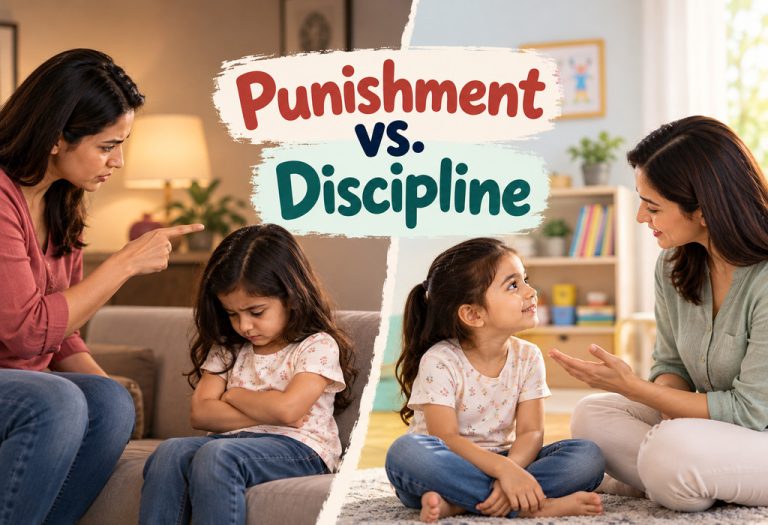
Discipline and punishment may both aim to correct behaviour, but they approach it differently. Here’s how they compare across a few key areas (3) (4).
- Purpose: Discipline aims to teach, while punishment aims to make the child pay for the mistake.
- Focus: Discipline looks forward to better future behaviour, while punishment looks backward at what went wrong.
- Emotion involved: Discipline is delivered calmly, while punishment is often driven by anger or frustration.
- Child’s feeling: Discipline makes a child feel guided and safe, while punishment makes a child feel afraid or ashamed.
- Connection to behaviour: Discipline uses consequences that relate to the action, while punishment is often random or unrelated.
- Communication: Discipline involves explaining and listening, while punishment usually involves commands and lectures.
- Control: Discipline helps a child develop self control from within, while punishment depends on outside pressure.
- Relationship: Discipline strengthens trust between parent and child, while punishment can weaken it.
- Long term result: Discipline builds responsibility and problem solving, while punishment may cause rebellion or lying.
- Child’s role: Discipline invites the child to take part in finding solutions, while punishment leaves the child as a passive receiver.
Comparison Chart
Use this discipline versus punishment chart to quickly compare how each approach handles behaviour, sets boundaries, and helps children learn from their mistakes.
| Basis of Comparison | Discipline | Punishment |
|---|---|---|
| Meaning | Training a child to follow rules and make good choices | A penalty imposed for breaking a rule |
| Approach | Positive and instructive | Negative and corrective |
| Aim | To teach and guide | To hurt or make the child suffer |
| Time Focus | Future behaviour | Past mistake |
| Method | Talking, modelling, logical consequences | Yelling, hitting, harsh restrictions |
| Parent’s Attitude | Calm and supportive | Angry and controlling |
| Effect on Child | Builds confidence and self control | Creates fear, resentment, and guilt |
| Result | Lasting behaviour change | Short term compliance |
Discipline vs. Punishment Through Real Life Examples
Seeing examples of discipline vs punishment in everyday situations makes the difference easier to understand. Here are a few common scenarios and how each approach plays out.
1. A Toddler Throws Food at Dinner
- Punishment: The parent yells, snatches the plate away, and sends the child to bed hungry.
- Discipline: The parent calmly says, “Food stays on the plate. If you throw it again, mealtime is over.” The meal ends gently if the behaviour repeats, and the child learns the rule.
2. A Child Hits a Sibling
- Punishment: The parent spanks the child and says, “Now you know how it feels.”
- Discipline: The parent separates the children, comforts the hurt sibling, and then talks with the child about using words when angry. The child is also asked to help make things right.
3. A Preschooler Refuses to Clean Up Toys
- Punishment: The parent threatens to throw the toys away and shouts until the child cries.
- Discipline: The parent sets a short timer, helps get started, and explains that toys not put away will rest on a shelf until tomorrow.
4. A School Age Child Lies About Homework
- Punishment: The parent takes away all screens for a month and calls the child a liar.
- Discipline: The parent talks about why honesty matters, creates a homework routine together, and limits screen time until the work is finished.
FAQs
1. Is time out discipline or punishment?
It depends on how it is used. A brief, calm time out that helps a child settle down and think is a form of discipline. A time out used as a threat, for long periods, or with shaming becomes punishment.
2. Can punishment ever be effective?
Punishment can stop a behaviour quickly, but the effect rarely lasts. Children learn to avoid getting caught instead of learning why the behaviour was wrong, which is why experts favour discipline (5).
3. How can I shift from punishment to discipline?
Start by pausing before you react and staying calm. Set clear rules ahead of time, explain consequences in advance, follow through consistently, and always talk with your child about what to do differently.
The debate around punishment versus discipline comes down to one question: are you trying to hurt a child or help them grow? Discipline teaches children the reasons behind rules and gives them tools to manage their feelings and actions. Punishment may bring quick obedience, but it often leaves behind fear, shame, and a weaker bond with parents. By choosing calm guidance, clear limits, and consistent follow through, you raise a child who behaves well because they understand, not because they are afraid. Small daily choices in how you respond to mistakes shape the adult your child will become.
Also Read:
Positive Discipline Techniques
Creative Punishment Ideas For Kids
Negative Discipline Techniques