
Montessori vs Reggio Emilia: Understanding the Key Differences
Compare Montessori vs Reggio Emilia to understand their teaching styles, learning environments, and approaches to early childhood education.




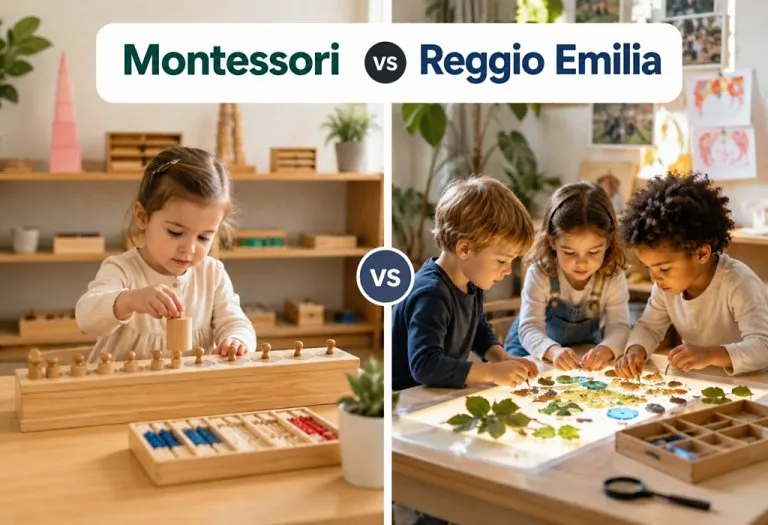
Choosing an early years philosophy can feel overwhelming when two of the most respected names in education, Montessori and Reggio Emilia, seem to overlap in so many ways. Both champion child-led learning and hands-on discovery, yet they diverge sharply in structure, materials and the role adults play. This Montessori vs Reggio Emilia comparison breaks down what actually separates the two, helping parents choose the environment that best matches their child’s temperament and learning style.
What Is the Montessori Approach?
Developed by Dr Maria Montessori in the early 1900s, this approach is built around structured independence, using specially designed, self-correcting materials. Classrooms are calm and organised into mixed-age groups spanning three years, letting older children mentor younger ones. The teacher acts as a “guide,” observing closely and stepping in mainly to introduce new materials or redirect. Long, uninterrupted work periods nurture concentration, self-discipline and a genuine, lasting love of learning (1).
What Is the Reggio Emilia Approach?
Originating in post-war Italy through the work of Loris Malaguzzi, the Reggio Emilia philosophy treats the child as a capable, curious co-constructor of their own knowledge (2). Learning grows from long-term, child-led projects shaped by their own questions, rather than fixed materials. The classroom, called the “third teacher,” is open-ended and rich in natural light, mirrors and loose parts. Documentation and close collaboration with families guide where each project goes next.
Key Principles of Montessori and Reggio Emilia Education
Both approaches share a deep respect for the child, though they express it through very different classroom principles.
Montessori
This approach is grounded in the belief that children learn best through hands-on, self-directed activity within a carefully prepared setting. Every element of the classroom, from furniture sized for small hands to materials arranged by subject, is designed to support independence and focused work. The six principles below outline how this philosophy translates into daily classroom life (3).
1. Prepared Environment
Every shelf and material has a specific place and purpose, allowing children to work independently without constant adult direction. Materials are arranged from simplest to most complex, so a child can move naturally toward greater challenge as their skills develop.
2. Sensorial Learning
Purpose-built materials isolate one concept at a time, helping children grasp abstract ideas such as size, texture or quantity through touch. Working with items like the pink tower or sound cylinders sharpens the senses and lays a concrete foundation for later abstract and mathematical thinking.
3. Freedom Within Limits
Children choose their own activities and pace within a structured set of boundaries set by the classroom and its materials. This balance of choice and structure teaches children to make decisions responsibly while still respecting the needs of the wider group.
4. Mixed-Age Classrooms
Three-year age spans encourage peer mentoring, with older children reinforcing their own learning by helping younger ones. Younger children, in turn, benefit from watching more advanced work being modelled daily, which naturally builds curiosity about what comes next.
5. Practical Life Skills
Everyday tasks like pouring, sweeping and dressing build fine motor control, focus and genuine independence. These exercises also instil a quiet sense of responsibility, as children learn to care for themselves, their belongings and their shared environment.
6. Intrinsic Motivation
Materials are designed to be self-correcting, so children learn to recognise and fix their own mistakes without needing praise or grades. This reduces reliance on external rewards and helps children develop an internal sense of satisfaction tied to effort and mastery itself.
Reggio Emilia
The Reggio Emilia approach is built on the idea that children are naturally capable, curious and full of potential, deserving a learning environment that reflects this respect. Rather than following a set curriculum, teachers follow the child, shaping projects and spaces around genuine interests and questions. The six principles below show how this philosophy comes to life in the classroom (4).
1. The Hundred Languages of Children
Children are encouraged to express ideas through many mediums, including drawing, sculpture, movement, drama and music. This philosophy holds that no single form of expression captures a child’s full understanding, so multiple mediums are used to reveal deeper layers of thinking (2).
2. Emergent Curriculum
Projects are not planned in advance but evolve from questions and interests children raise themselves. Teachers act as careful listeners and researchers, weaving in provocations and resources that extend a project as children’s curiosity naturally leads it forward.
3. The Environment as the Third Teacher
Classrooms are thoughtfully arranged with natural materials, light and open spaces that spark curiosity and exploration. Dedicated studio spaces, known as ateliers, give children room to experiment with paint, clay and found objects as extensions of their thinking.
4. Documentation and Reflection
Teachers capture children’s words, drawings and processes to track thinking and plan the next stage of a project. This documentation, often displayed on classroom walls, turns learning into a visible, shared story that children can revisit and build upon.
5. Collaborative Learning
Group work and dialogue are prioritised over solitary tasks, with children learning from one another as much as from adults. Disagreements and differing viewpoints are treated as valuable opportunities for negotiation, empathy and richer collective understanding.
6. Strong Family and Community Ties
Parents and the wider community are treated as active partners in the educational process, not outside observers. Families are often invited to contribute skills, materials or time to ongoing projects, reinforcing learning that continues well beyond the classroom.
Montessori vs Reggio Emilia: Key Differences
While both are child-centred philosophies, the difference between Montessori and Reggio Emilia becomes clear once you compare how each structures materials, activities and the teacher’s role, as this Reggio Emilia vs Montessori chart shows.
| Features | Montessori | Reggio Emilia |
| Curriculum structure | Sequenced, with defined materials and skills | Emergent, shaped by children’s interests |
| Learning materials | Specialised, self-correcting equipment | Open-ended, natural and loose materials |
| Teacher’s role | Guide who observes and demonstrates | Co-learner and facilitator alongside children |
| Classroom setup | Orderly, subject-based work areas | Flexible, studio-like spaces with an “atelier” |
| Age grouping | Mixed ages across three-year spans | Often grouped by similar age, project-based |
| Assessment style | Mastery tracked through material progression | Documented through photos, notes and portfolios |
| Focus area | Independence and practical life skills | Creativity, expression and collaboration |
| Family involvement | Generally limited to updates and conferences | Ongoing, considered a core part of the process |
Benefits of Montessori and Reggio Emilia Education
Each approach offers distinct advantages depending on a child’s needs and a family’s priorities (4) (5).
Montessori
- Builds strong independence and self-discipline from an early age.
- Encourages deep concentration through uninterrupted work periods.
- Supports steady mastery of academic skills like reading and maths.
Reggio Emilia
- Nurtures creativity and confident self-expression across many mediums.
- Strengthens communication and collaboration through group projects.
- Builds a genuine sense of community between children, teachers and families.
Drawbacks of Montessori and Reggio Emilia Education
No single method suits every child, and both come with trade-offs worth weighing (6) (7).
Montessori
- Highly structured materials may feel restrictive for very expressive children.
- Individual work can limit opportunities for group collaboration.
- Authentic Montessori classrooms and training can be costly to access.
Reggio Emilia
- Lack of a fixed curriculum can make progress harder to measure.
- Requires highly skilled, well-trained teachers to guide emergent projects.
- Fewer formally accredited schools exist compared to Montessori settings.
Montessori vs Reggio Emilia: Which Approach Is Right for Your Child?
Deciding between a Montessori approach vs Reggio Emilia setting depends on your child’s personality and needs. Order-loving, independent children often flourish with the Montessori method, while creative, social children may prefer Reggio Emilia’s open-ended projects. Visiting classrooms and observing daily life offers the clearest guide for families weighing both approaches.
Montessori and Reggio Emilia both start from deep respect for children, yet they express that respect through very different structures. Montessori offers ordered independence through purpose-built materials and mixed-age classrooms, while Reggio Emilia favours open-ended, project-based exploration guided by children’s own curiosity. Neither philosophy is inherently superior, and the right fit depends entirely on a child’s temperament, a family’s values and what is realistically available nearby. Observing real classrooms, talking to teachers and trusting how a child responds usually reveals more than any comparison chart. Whichever path a family chooses, both approaches share the same goal of raising confident, capable learners.
Also Read :
Montessori vs Traditional Preschool
Reggio Emilia Approach to Early Childhood Education
Early Childhood Education Benefits & Importance
Was This Article Helpful?
Parenting is a huge responsibility, for you as a caregiver, but also for us as a parenting content platform. We understand that and take our responsibility of creating credible content seriously. FirstCry Parenting articles are written and published only after extensive research using factually sound references to deliver quality content that is accurate, validated by experts, and completely reliable. To understand how we go about creating content that is credible, read our editorial policy here.
1. Montessori Northwest – Montessori Education
2. Reggio Children – Reggio Emilia Approach
3. The Education Hub – The Montessori approach
5. American Montessori Society – Benefits of Montessori Education
6. American Public University System – Exploring the Pros and Cons of Montessori Education
7. Goodwin University – The Pros and Cons of Reggio Emilia: Is it Right for Your Child?
- Author


Related Articles
-

How to Set Up a Perfect Homework Station for Kids
-
Air Pollution Facts to Teach Your Kids
-
Fun Raccoon Facts and Information for Kids
-
Speech on Father's Day in English for Children & Students
-
Essay on Srinivasa Ramanujan – 10 Lines, Short and Long Essay
-
100+ Words That Rhyme With Day to Boost Vocabulary