
Gentle Parenting vs Traditional Parenting: Differences & Which Is Better?
Gentle vs traditional parenting explained - compare their approaches, benefits, and find what works best for your family.




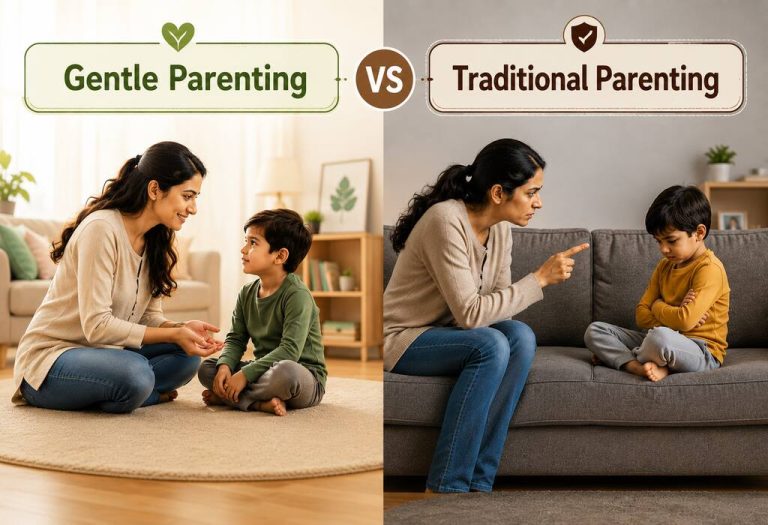
Choosing between gentle parenting vs traditional parenting is one of the most debated decisions modern parents face, and it’s easy to see why. Both approaches promise well-adjusted, happy children, yet they take almost opposite routes to get there. If you’re a parent of a child anywhere between the toddler years and age ten, you’ve probably felt the pull between wanting to nurture your child’s feelings and needing them to actually listen when it matters. This article breaks down what each style really looks like day to day, where they overlap, where they clash, and how to figure out what will genuinely work for your family, rather than what looks good on social media.
What Is Gentle Parenting?
Gentle parenting is a child-rearing philosophy built around empathy, respect, and open communication. Rather than controlling a child’s behaviour through punishment, gentle parents try to understand what’s driving it. The core belief is simple: children misbehave because they lack a skill, not because they’re being deliberately difficult.
In practice, this might look like:
- Getting down to your child’s eye level and naming their feelings (“You’re frustrated because we have to leave the park”)
- Offering choices instead of ultimatums (“Do you want to put your shoes on yourself, or should I help?”)
- Using natural consequences rather than punishments (a child who refuses a coat feels cold, rather than losing screen time)
- Staying calm and connected even during meltdowns, rather than sending a child away to “calm down” alone
What Is Traditional Parenting?
Traditional parenting, sometimes called authoritarian parenting, is rooted in the idea that children need clear rules, consistent consequences, and respect for parental authority. It’s the style many of today’s parents grew up with themselves, shaped by generations of “because I said so” household rules.
Common features include:
- Clearly defined rules with predictable consequences for breaking them
- An expectation of obedience without lengthy negotiation
- Rewards and punishments (sticker charts, time-outs, loss of privileges) used to shape behaviour
- A parent-as-authority structure, where the adult’s decisions aren’t typically up for debate
Traditional parenting isn’t automatically harsh or cold. Many traditional households are warm and loving; they simply prioritise structure and obedience as the fastest route to raising well-behaved children who understand limits.
Gentle Parenting vs Traditional Parenting: Key Differences at a Glance
This is the difference between gentle parenting and traditional parenting in its clearest form: one starts from the child’s internal experience, the other starts from the household’s external rules. Most real families sit somewhere between the two extremes rather than living entirely in one camp.
| Aspect | Gentle Parenting | Traditional Parenting |
| View of misbehaviour | A sign of an unmet need or missing skill | A choice that needs correcting |
| Discipline style | Empathy, natural consequences, collaboration | Rules, rewards, and punishments |
| Parent’s role | Guide or coach | Authority figure |
| Emotional expression | Actively validated and named | Often managed quickly, sometimes discouraged |
| Structure | Present but flexible | Firm and consistent |
| Common criticism | Can be time-consuming; may lack firm limits | Can feel harsh; may discourage emotional openness |
| Best suited for | Families prioritising emotional connection | Families prioritising predictability and order |
Where the Two Styles Actually Overlap
It’s easy to frame this as a battle, but gentle parenting and traditional parenting share more ground than headlines suggest. Both aim to raise children who become capable, respectful adults. Both rely on consistency, since children of any parenting style struggle when rules change unpredictably. And both require the parent to stay involved and attentive; neither approach works well on autopilot.
Child development researchers often point to a third option that borrows the best of each: authoritative parenting. This style keeps the warmth and responsiveness of gentle parenting while holding on to the clear expectations of a more traditional structure. A child is allowed to express big feelings, but the boundary itself doesn’t move because of them.
Common Mistakes Parents Make With Each Style
Recognising these patterns matters more than picking a label. A parent who avoids these pitfalls, regardless of which camp they lean towards, tends to raise children who feel both secure and capable.
With gentle parenting:
- Confusing validation with permission, so limits quietly disappear.
- Over-explaining decisions to a two- or three-year-old who isn’t developmentally ready to process lengthy reasoning.
- Feeling guilty for holding a boundary, which sends mixed signals to the child.
With traditional parenting:
- Relying on punishment without explaining the reasoning behind a rule.
- Dismissing a child’s feelings as “dramatic” or “attention-seeking”.
- Using fear or shame as the main motivator, which can damage trust over time.
Which Approach Is Better for Your Child?
There’s no single answer that fits every family, but a few factors can help you decide where to land.
- Consider your child’s temperament: A highly sensitive child may respond better to the emotional validation central to gentle parenting, while a child who thrives on predictability might do well with the clear structure of a more traditional approach.
- Consider your own capacity: Gentle parenting asks a lot of the parent in the moment, patience, emotional regulation, and time to talk things through. On days when that reserve is running low, a simpler, rules-based response may be more realistic and still effective.
- Consider the situation: Safety issues (running into a road, touching a hot stove) call for immediate, firm intervention regardless of parenting philosophy. Emotional moments (a tantrum over a broken toy) leave more room for a gentle, connection-first response.
- Consider long-term goals: If raising a child who can identify and manage their own emotions is the priority, gentle parenting techniques offer useful tools. If the priority is a household that runs smoothly with minimal friction, traditional structure may feel more sustainable day to day.
How Each Style Plays Out at Different Ages
Gentle and traditional parenting can look quite different as children grow, with each approach shaping how parents respond to changing needs, behaviours, and levels of independence.
- Toddlers (1-3 years): Gentle parenting techniques, such as naming feelings and offering limited choices, can reduce power struggles, but toddlers still need very short, very firm boundaries around safety. A purely traditional approach can feel overwhelming for a child who doesn’t yet have the language to explain what’s wrong.
- Preschoolers (4-5 years): This is often where the two styles show the clearest contrast. Gentle parents lean on collaborative problem-solving (“What could we do differently next time?”), while traditional parents lean on consistent consequences (“If you throw a toy, the toy gets put away”). Both can work, provided they’re applied consistently rather than only when a parent has the energy for it.
- School-age children (6-10 years): By this stage, children can understand cause and effect more fully, which makes room for a genuine blend of the two approaches. A parent can explain the reasoning behind a rule, gentle parenting’s strength, while still applying it firmly and predictably, traditional parenting’s strength.
A Practical Middle Ground
Many parenting professionals now describe the healthiest approach as one that blends empathy with firm limits, essentially taking the connection of gentle parenting and pairing it with the consistency of traditional parenting. In everyday terms, this could mean acknowledging a child’s frustration out loud while still holding the boundary that started the frustration in the first place: “I understand you’re upset we’re leaving, and we’re still leaving now.”
This blended approach also tends to age well. What works for a two-year-old having a meltdown over socks looks different from what a ten-year-old negotiating screen time needs, and a flexible framework adapts more easily than a rigid one.
FAQs
1. Is gentle parenting the same as permissive parenting?
No. Gentle parenting still involves boundaries and limits; the difference is in how those limits are communicated. Permissive parenting typically avoids setting firm limits altogether, while gentle parenting combines empathy with clear expectations.
2. Can I mix gentle parenting and traditional parenting?
Yes, and many experts recommend it. Combining the emotional validation of gentle parenting with the consistency of traditional structure, often called authoritative parenting, tends to produce well-balanced outcomes for children.
3. Does gentle parenting work for strong-willed children?
It can, though it may need to be paired with firmer limits than usual. Strong-willed children often respond well to having their feelings acknowledged, but they also need consistent boundaries so they understand where the limits genuinely sit.
Gentle parenting and traditional parenting aren’t rivals so much as two different toolkits for the same job: raising children who feel secure, understand limits, and grow into capable adults. Gentle parenting leans on empathy and connection to guide behaviour, while traditional parenting leans on structure and consistent consequences. Neither is inherently right or wrong, and most families find that a blend, rooted in warmth but backed by clear boundaries, works better than strict adherence to either label. The most effective parenting style is ultimately the one that fits your child’s temperament, your family’s values, and what you can realistically sustain on the hard days as well as the easy ones.
Also Read:
Gentle Parenting
Permissive Parenting Style
Gentle Parenting vs Authoritative Parenting
Was This Article Helpful?
Parenting is a huge responsibility, for you as a caregiver, but also for us as a parenting content platform. We understand that and take our responsibility of creating credible content seriously. FirstCry Parenting articles are written and published only after extensive research using factually sound references to deliver quality content that is accurate, validated by experts, and completely reliable. To understand how we go about creating content that is credible, read our editorial policy here.
- Author










.svg)