
Can You Do Planks While Pregnant?
Thinking about planks while pregnant? Find out when they’re safe, how to modify them, and when to choose other exercises.




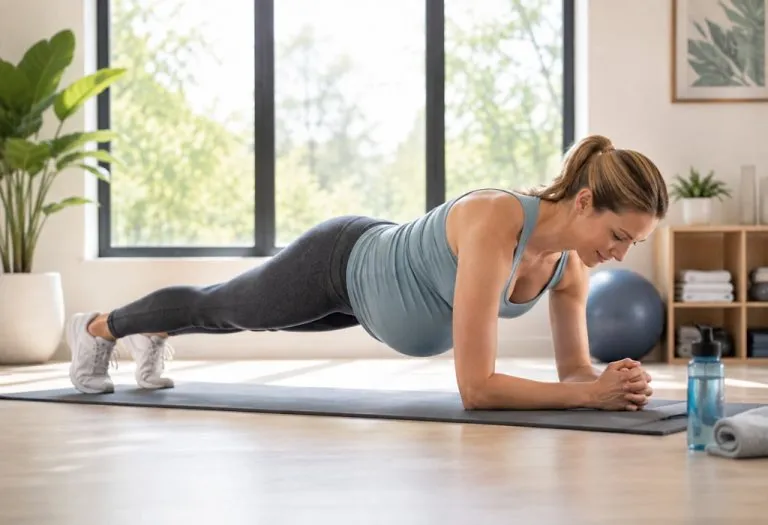
Planks while pregnant can be safe for many women, provided the pregnancy is healthy, the exercise is performed with proper form, and your doctor has cleared you for physical activity. According to the World Health Organization (WHO), pregnant women without medical complications should aim for at least 150 minutes of moderate-intensity physical activity each week to support overall health and well-being (1). While plank exercise during pregnancy can help strengthen the core, improve posture, and support stability, it may need to be modified as your pregnancy progresses.
In this article, we’ll explain whether planks and pregnancy are a safe combination, along with trimester-wise recommendations, potential benefits and risks, warning signs to watch for, and safer core exercises to try.
Can You Do Planks While Pregnant?
The simple answer is yes; you can do plank exercise in pregnancy. However, it should be done only when your doctor gives you the go-ahead. You can do planks but with certain modifications (2). If you are used to doing plank exercises, these modifications will be easy to make. However, if you’ve never done plank exercises before and want to start doing them during pregnancy, you must consult with your doctor and you must be physically active.
Benefits of Planks in Pregnancy
Plank exercises target muscles of the lower back and obliques. It also strengthens the abdominal muscles, the arm and the leg muscles too. This exercise engages the core muscles while keeping your spine in a neutral position and improves posture and strengthens the core (3). Since planks do not put any pressure on the belly, pregnant women might find it more comfortable than other mat exercises like abdominal crunches. It can also affect your mood positively and can help alleviate stress.
But pregnant women need to be extra careful while moving and exercising. When done correctly, planks can be extremely beneficial to them; however, it can also pose risks to the mother-to-be and the baby inside her. Read on to know more about the risks associated with doing planks during pregnancy.
What Are the Risks of Doing Planks During Pregnancy?
As with other exercises, there are certain risks of doing plank exercises during pregnancy. When you do it wrong or overdo it, the following risks may arise:
- Injury to the back
- Stressed muscles
- Nausea
- Dizziness
While doing planks in pregnancy, it is important that your spine is in a neutral position. You should also check to see if you have a common condition known as diastasis recti where the abdominal walls separate to accommodate the expanding uterus (4). In such a case, you should refrain from doing planks.
With the risks, you need to be very careful while doing planks during pregnancy. It is, therefore, advisable to always bear in mind a few things that will make exercising fun and absolutely safe for your baby.
Things to Remember While Doing Planks During Pregnancy
Here are some important things you must bear in mind before you hit the mat:
- Always do planks under the guidance of an instructor who has worked with pregnant women and is aware of their physical restrictions.
- Planks may not be a suitable exercise to do the entire term of your pregnancy. It is advisable to do planks in the second trimester of pregnancy.
- Ensure you have enough arm strength to avoid falls and injuries.
- Avoid doing planks when feeling dizzy.
- You may look for alternative exercises if your doctor prescribes against doing planks.
If you’ve got a go-ahead from your doctor, follow these tips while doing the plank exercise.
Steps to Do Traditional Planks During Pregnancy
As mentioned earlier, you should try doing plank exercises only under the guidance of your doctor or a certified trainer who has worked with pregnant women earlier. However, you can use the steps given below to do traditional planks.
- Get on all fours on a yoga mat.
- Make sure that your wrists are placed directly underneath your shoulders.
- Your knees have to be directly below your hips with your shins extending backwards.
- Once you are in this position, lift your right knee and extend your right leg such that only its toes touch the ground.
- Then, lift the left knee and extend the left leg in a way that your toes of the left leg touch the ground.
- Your elbows should be now positioned under your shoulders.
- Keep your neck in the neutral position, that is, look forward and not at the ground.
- Be sure to breathe normally.
- Count till ten and take a break. Repeat up to three cycles.
Once you are comfortable holding the plank position for up to ten seconds, you can start increasing the time by 5 seconds. Monitor your body and stop if you feel pain in any part of your body.
If you are looking for variations in the exercise, here are a couple of variations you can try, after checking with your doctor.
Variations in Planks to Do While Pregnant
Plank is an amazing exercise to perform, but when you are pregnant, you have to be a little careful. Make sure you use support while doing planks during pregnancy. Also, never do it alone. Perform this exercise under supervision. Here are some variations in planks that you can try (5):
1. Side Plank
A side plank can be done in several ways during pregnancy. However, the goal is to start with the simplest form. This gives you the opportunity to build strength while not over stressing your body. You can follow the steps below:
- Start on your left side.
- Place your left elbow below your left shoulder.
- Stack your feet on top of one another.
- Support your body with your left arm, and using your core strength, lift your body up.
- Then, extend your right arm such that it points towards the ceiling.
- Maintain this pose for ten seconds, take a break and repeat on the other hand.
- Remember to do this exercise under someone’s guidance and not alone.
2. Vertical Plank
As you progress through your pregnancy, you can try this form of plank exercise as it will be less stressful for your body.
- Stand straight facing a wall.
- Place your palms in front of you, on the wall.
- Your forearms and elbows should touch the wall.
- Push back gently against the wall.
- Make sure your shoulders are pushed away from your neck and close to the spine.
- Stay in this position for 10 seconds, release, and then repeat.
Warning Signs to Stop Planks Immediately
While plank exercise in pregnancy can be safe for some women, it’s important to listen to your body and stop immediately if you experience any unusual symptoms. Watch out for warning signs such as:
- Dizziness, faintness, or feeling lightheaded
- Vaginal bleeding or leaking of amniotic fluid
- Severe abdominal, pelvic, or lower back pain
- Shortness of breath, chest pain, or regular uterine contractions
Safe Alternatives to Planks During Pregnancy
If traditional planks become uncomfortable or are no longer recommended during pregnancy, here are some safer exercises that can help strengthen your core without placing excessive pressure on your abdomen.
1. Pelvic Tilts
How to Do It
- Stand against a wall or position yourself on your hands and knees.
- Tighten your abdominal muscles and gently tilt your pelvis.
- Hold for a few seconds before relaxing.
- Repeat 10-15 times.
Why It’s Great : Pelvic Tilts strengthen the deep core muscles, improve posture, reduce lower back discomfort, and help support the growing belly throughout pregnancy (6).
2. Side-Lying Leg Lifts
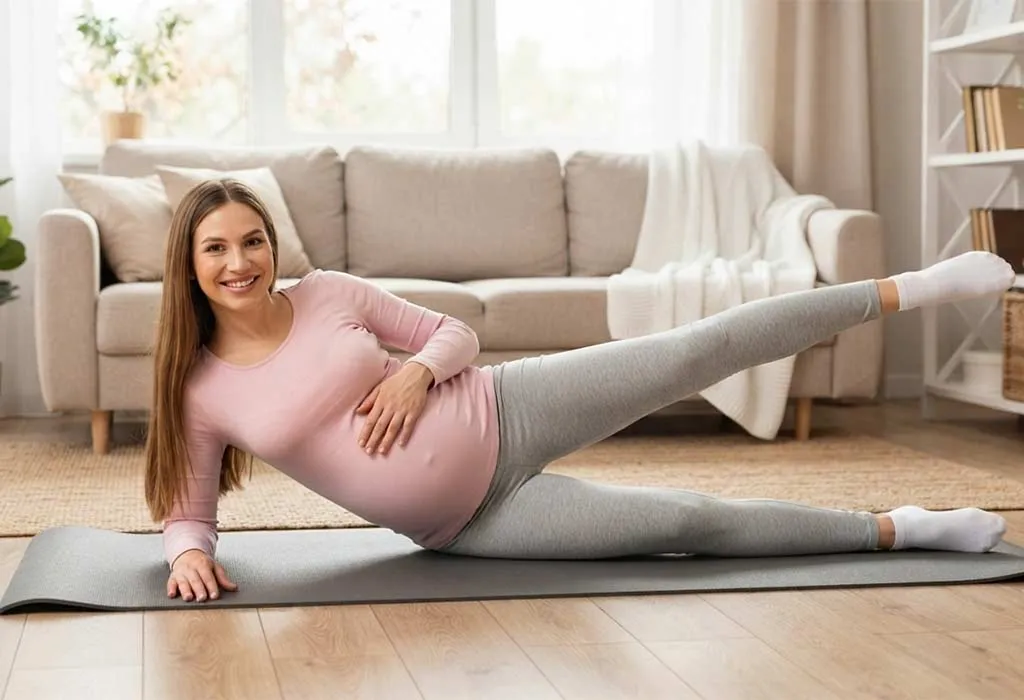
How to Do It
- Lie on one side with your legs straight and stacked.
- Support your head with your lower arm.
- Slowly lift your top leg, then lower it with control.
- Complete 10-15 repetitions before switching sides.
Why It’s Great : This exercise strengthens the hips, glutes, and outer thighs, helping improve pelvic stability and reduce pressure on the lower back.
3. Standing Crunches
How to Do It
- Stand with your feet hip-width apart and place your hands lightly behind your head or on your hips.
- Engage your core and lift your right knee toward your chest while bringing your right elbow down toward it.
- Return to the starting position and repeat on the opposite side.
- Perform 10-15 repetitions per side, moving slowly and maintaining good posture.
Why It’s Great – Standing crunches gently activate the core muscles without requiring you to lie on your back or put pressure on your abdomen. They also improve balance, coordination, and hip mobility, making them a pregnancy-friendly alternative when performed with proper form and your doctor’s approval.
4. Cat-Cow Stretch
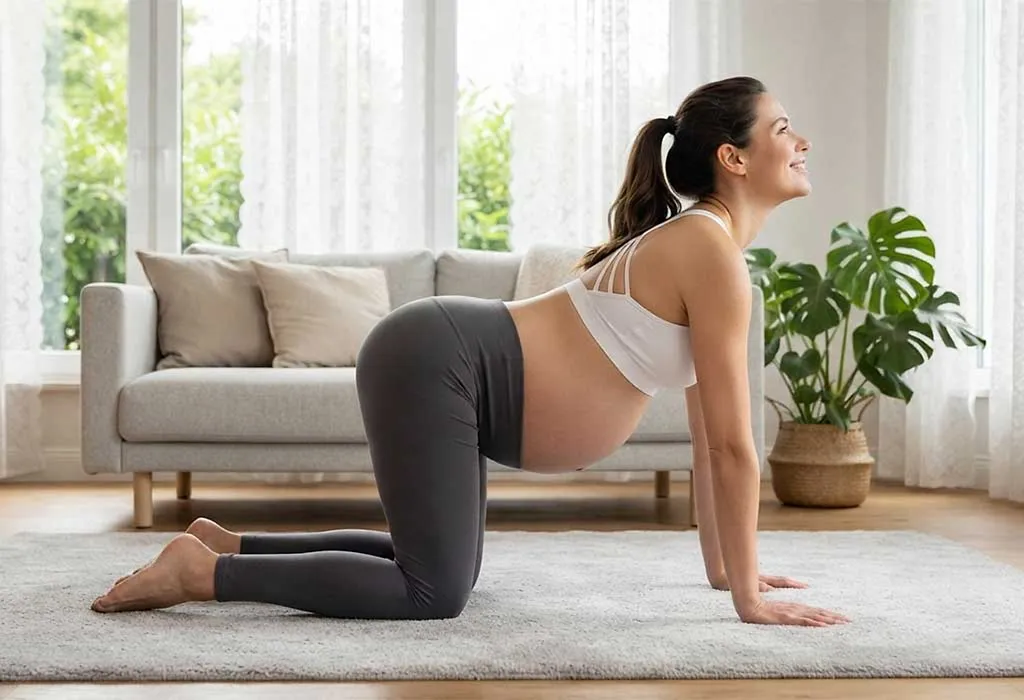
How to Do It
- Begin on your hands and knees.
- Inhale while arching your back and lifting your head (Cow).
- Exhale while gently rounding your back and tucking your chin (Cat).
- Repeat slowly for 8-10 breaths.
Why It’s Great – Cat-Cow improves spinal mobility, relieves back tension, and gently activates the core while promoting flexibility (7).
5. Bird Dog
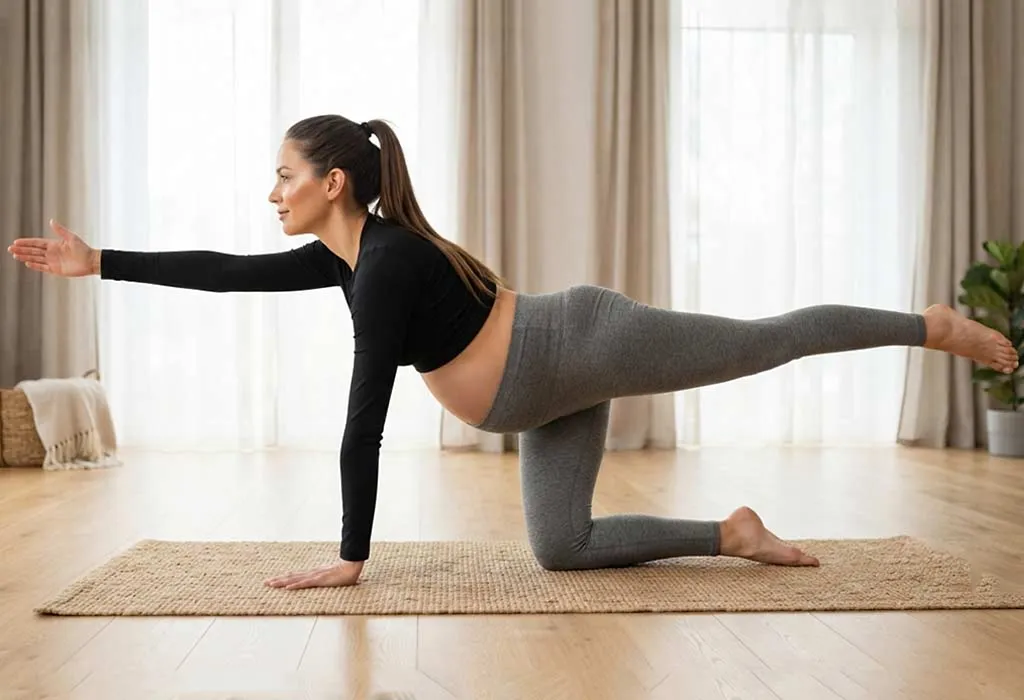
How to Do It
- Start on your hands and knees with your wrists under your shoulders and knees under your hips.
- Extend your right arm forward and your left leg backward while keeping your spine neutral.
- Hold for a few seconds, then return to the starting position and switch sides.
- Repeat 8-10 times on each side.
Why It’s Great – Bird Dog strengthens the core, back, glutes, and shoulders while improving balance and stability. It also places minimal pressure on the abdominal muscles, making it a safer choice during pregnancy.
6. Wall Push-Ups
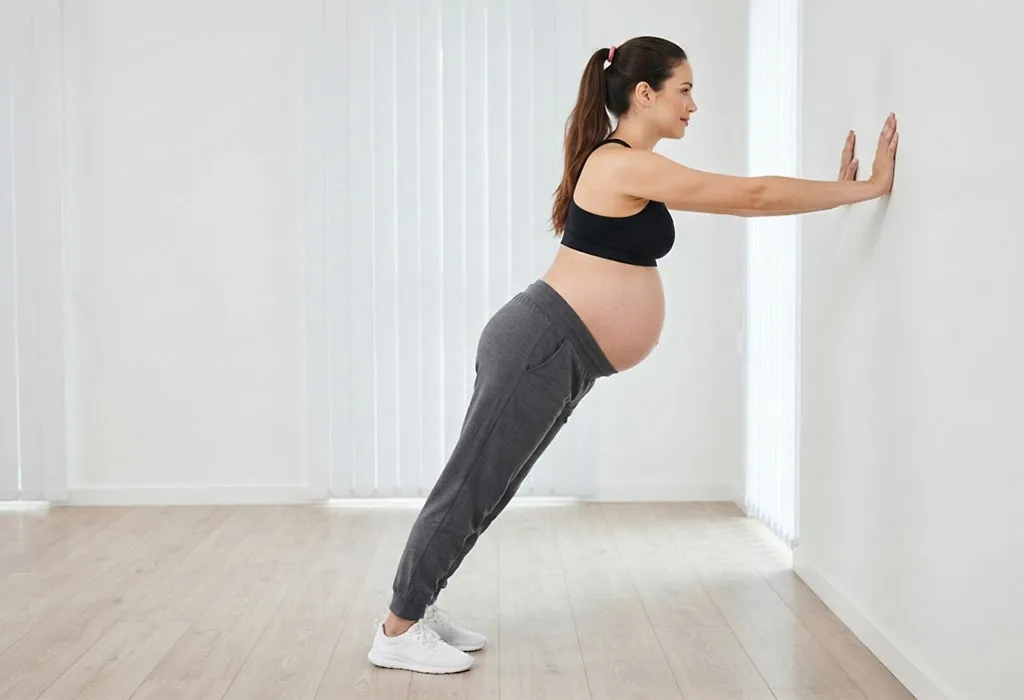
How to Do It
- Stand facing a wall with your hands placed slightly wider than shoulder-width apart.
- Bend your elbows to bring your chest toward the wall.
- Push back to the starting position.
- Repeat for 10-15 repetitions.
Why It’s Great – Wall Push-Ups strengthen the chest, shoulders, arms, and core while minimising strain on the abdomen and lower back.
FAQs
1. Can beginners do planks during pregnancy?
If you didn’t regularly perform planks before pregnancy, it’s generally better to start with beginner-friendly core exercises instead of traditional planks. Your doctor or a prenatal fitness specialist can recommend safer options based on your fitness level.
2. How long should I hold a plank while pregnant?
There’s no fixed duration that’s safe for everyone. Instead of focusing on time, prioritise proper form and stop as soon as you feel discomfort, excessive strain, or fatigue. Short, well-controlled holds are generally safer than pushing for longer durations.
3. Can planks cause miscarriage?
There is no evidence that properly performed planks cause miscarriage in a healthy pregnancy. However, high-risk pregnancies or certain medical conditions may require avoiding specific exercises, so always follow your doctor’s advice.
Planks are a great exercise to strengthen the core and the back muscles, which might seem like a requirement for pregnancy; however, your growing belly and pregnancy symptoms might make it uncomfortable to do the exercise and lead to injuries. Speak to your doctor or instructor to know if planks are good for you. If they allow, practice only in the forms that are suitable for you. If you are unable to do planks in the right form, then try other easy exercises. And if you feel any signs of discomfort such as breathlessness, nausea, and dizziness, while exercising during pregnancy, stop immediately and seek medical help.
Also Read:
Zumba During Pregnancy
Squats During Pregnancy
Workout on Treadmill during Pregnancy
Was This Article Helpful?
1. World Health Organization – Physical activity
2. NASM – SAFE PREGNANCY EXERCISES FOR EACH TRIMESTER: PRENATAL WORKOUTS
3. Apollo 247 – 10 Benefits of Doing Plank Exercise Daily for a Strong Core
4. Cleveland Clinic – Diastasis Recti
5. Continence Health Australia – Exercise modifications during pregnancy
6. Mayo Clinic – Labor and delivery, postpartum care
7. Cleveland Clinic – Cat-Cow Stretch: A Gentle Move With Big Benefits
- Author