

Can You Donate Blood While Pregnant?
Wondering if you can donate blood while pregnant? Understand the safety guidelines, reasons for restrictions, and when blood donation may be possible.





Medically Reviewed By
Dr. Rima Sonpal
(Gynecologist/Obstetrician)

In this Article
- Can You Donate Blood When Pregnant?
- Why Can’t You Donate Blood During Pregnancy?
- When Can You Donate Blood After Pregnancy?
- What Can Happen If You Donate Blood Before You Know You Are Pregnant?
- What Should You Do If You Happened to Donate Blood Before a Confirmed Pregnancy?
- FAQs
View More
This health content has been medically reviewed by qualified experts and follows the FirstCry Parenting editorial policy to ensure accuracy and reliability.
While blood donation is a good deed that saves lives, there are some sensitive situations, like pregnancy, where not all good deeds may do good. So, can you donate blood if pregnant? Let us reframe your question more clearly: “Can pregnant women donate blood?” Pregnancy is a delicate period when your body has increased nutritional and iron requirements to support your own health and your baby’s development. Health experts at the World Health Organization (WHO) advise against blood donation during pregnancy and recommend deferring donation for an appropriate period after pregnancy (1). So, when can you donate blood after pregnancy, and in situations where you might be required to donate blood during pregnancy? Let’s learn answers to all intricate queries related to blood donation and pregnancy.
Can You Donate Blood When Pregnant?
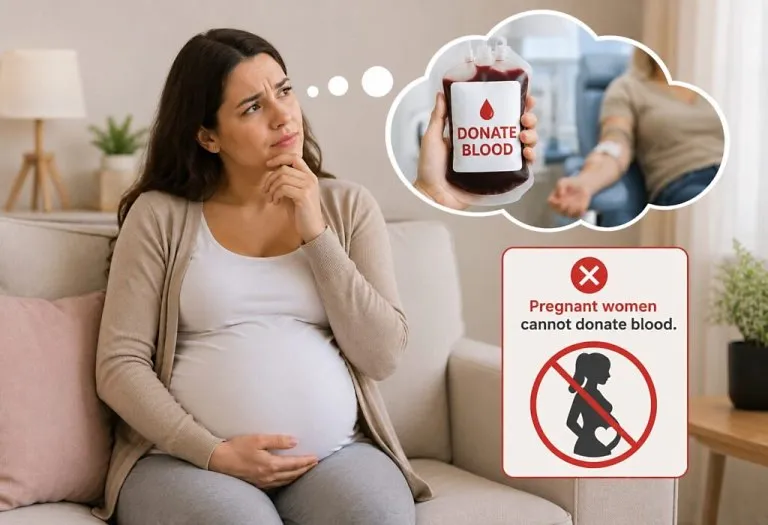
According to the American Red Cross, women are not eligible to donate blood during pregnancy. The organisation also advises pregnant women to wait at least 6 weeks after giving birth before donating blood (2).
The reason for the ineligibility of pregnant women to donate blood is the safety of the baby and the mother herself. Although when pregnant, the amount of blood in the body increases by almost 50% by the third trimester, the growing baby and the mother need it for the metabolism maintainence and nutrition.
However, there’s an exception. If you have a high-risk pregnancy or delivery, you might need a blood transfusion, for which you may be asked to bank some blood for yourself in case you require it later. This may be allowed if you opt for a planned C-section or if you have high-risk conditions like placental abruption, placenta previa, high blood pressure, or multiple pregnancy.
Why Can’t You Donate Blood During Pregnancy?
A woman’s body produces at least 50% more blood during pregnancy than it does normally. Despite the fact, a woman should not donate blood while pregnant. When pregnant, you need to ensure that your baby grows healthily inside your womb, and if you donate blood in pregnancy, you jeopardise your wellbeing as well as your baby’s wellbeing. Anaemia is a common problem during pregnancy (3), and if you donate blood, the chances of anaemia increase by manifold due to iron deficiency in pregnant women (4). According to the British pregnancy charity, Tommy’s, anaemia can further trigger significant issues like premature delivery, low birth weight, and placental abruption (5). Hence, donating blood is best avoided during pregnancy. In fact, you should avoid donating blood till the time you are breastfeeding your child.
When Can You Donate Blood After Pregnancy?
As per the World Health Organization (WHO), new mothers should wait for at least nine months after delivery to donate blood, but if you plan to continue breastfeeding after this period, you need to wait until the time you wean your baby off breast milk (1). As your little one will be dependent upon the nutrients and vitamins present in the breast milk, if you donate blood during this time, your baby might miss out on these vital nutrients. Once your body replenishes the iron content in your blood, and you have stopped breastfeeding and you are not anaemic, you can go ahead and donate blood after checking with a doctor (6).
Please remember that eligibility rules, including the waiting period after delivery and during breastfeeding, can vary between countries and blood services.
What Can Happen If You Donate Blood Before You Know You Are Pregnant?
If you are a regular donor, it might happen that you may have donated blood when you are totally unaware of your pregnancy. This may happen only during the initial phase of your pregnancy, and it will not raise any issues if you donate blood at this stage. Also, before donating blood, a quick test is done to ensure that your blood pressure, haemoglobin levels, pulse and temperature are normal. Hence, donating blood at this stage when your health condition is normal will not be a problem. In the case of anxiety, it is better to consult your doctor (7).
What Should You Do If You Happened to Donate Blood Before a Confirmed Pregnancy?
If you happened to donate blood before your pregnancy was confirmed, you must let your doctor know about the donation right away. Remember, you can donate blood only when your health condition is normal; you shouldn’t worry much. Certain changes in the diet, such as increasing the consumption of green leafy vegetables and fresh fruits, along with some medical attention, can help you deal with it. Having said that, since your body will be going through a major transformation, you must keep track of all the health issues you notice and consult your doctor whenever needed.
FAQs
1. Can you donate blood while breastfeeding?
As per the American Red Cross, breastfeeding women can donate blood after waiting for 6 weeks after delivery, whereas the Canadian Blood Services and NHS Blood and Transplant only allow breastfeeding women to donate blood 6 months after delivery (8) (9). As per the WHO and Australian Red Cross, postpartum women must wait for at least 9 months and until your baby is significantly weaned (1) (10).
2. Can you donate cord blood after pregnancy?
Yes, after childbirth, women can donate the blood that remains in the umbilical cord and placenta. The cord blood is highly special as it contains stem cells, which have proven life-saving in many treatments. Stemcells take cord blood can help treat lymphoma, leukaemia, sickle cell disease, bone marrow failure, and certain immunodeficiency disorders (11).
Donating blood and saving someone’s life is definitely a good deed, but you shouldn’t donate blood while pregnant and risk your and your unborn baby’s life. If you are a regular blood donor, you can continue donating blood after pregnancy or once you have stopped breastfeeding your baby. For now, you should slow down and take good care of yourself. After all, it’s your time to be pampered and taken care of!
Also Read:
Infections in Pregnancy
Donate Plasma while Pregnant
Boost Immunity during Pregnancy
Was This Article Helpful?
Parenting is a huge responsibility, for you as a caregiver, but also for us as a parenting content platform. We understand that and take our responsibility of creating credible content seriously. FirstCry Parenting articles are written and published only after extensive research using factually sound references to deliver quality content that is accurate, validated by experts, and completely reliable. To understand how we go about creating content that is credible, read our editorial policy here.
1. World Health Organization – Who can give blood
2. The American National Red Cross – Eligibility Criteria: Alphabetical
5. Tommy’s – Anaemia and pregnancy
6. La Leche League International – CAN I DONATE BLOOD WHILE I AM BREASTFEEDING?
7. Our Blood Institute – Can You Donate Blood While Pregnant?
8. Canadian Blood Services – Eligibility: pregnancy
9. NHS Blood and Transplant – Pregnancy
10. Australian Red Cross Lifeblood – I’m breastfeeding. Can I donate?
11. Bloodworks Northwest – Bloodworks Northwest Cord Blood Program
- Author
- Expert Reviewer