
Baby Swaddle vs Sleep Sack: Differences, Benefits and Safety
Swaddles and sleep sacks both help keep babies comfortable and warm, but they differ in design, movement, and safety.




Key Facts
-
Swaddling can help newborns feel cosy and settled during sleep.
-
AAP recommends stopping swaddling when a baby starts showing signs of rolling.
-
Arm-free sleep sacks can be used as babies become more mobile.
-
The NHS recommends a comfortable room temperature of around 16 to 20°C.
-
Parents should choose sleepwear based on the baby’s age, size, room temperature and developmental stage.
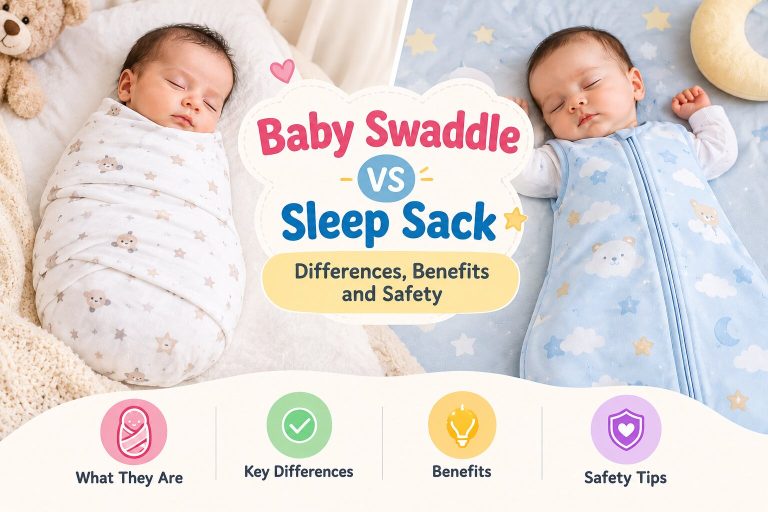
Swaddle vs sleep sack comes down to arm position and age. A swaddle holds a newborn’s arms in to calm the startle reflex, while a sleep sack leaves the arms free and stays useful after rolling begins. The American Academy of Pediatrics (AAP) says swaddling must stop at the first attempt to roll. For parents of 6 to 18 month olds, the sleep sack is the practical choice. This guide compares the two, sets out the safety limits and shows how to pick and fit a sleep sack for Indian homes.
What Is a Swaddle?
A swaddle is a thin blanket or fastened wrap that holds a newborn’s arms snug against the body. The AAP says a thin blanket wrapped snugly can resemble the womb and help soothe a newborn. Parents also use it against the Moro reflex, the startle reflex newborns are born with, which usually fades by about 6 months. In a sleep sack vs swaddle blanket comparison, the blanket also needs a wrapping technique that can loosen.
What Is a Sleep Sack?
A sleep sack, also called a wearable blanket or baby sleeping bag, is a bag worn over sleepwear that replaces loose bedding in the cot. Parents weighing swaddle vs sleeping bag are usually comparing a wrap with this product. EN 16781, the European standard, covers cot sleep bags for children up to about 24 months.
What Is the Difference Between a Swaddle and a Sleep Sack?
The difference between swaddle and sleep sack designs is arm position, age range and rolling safety. A swaddle holds the arms in for the youngest newborns, while a sleep sack leaves the arms free for as long as the baby fits. The table sets out eight points.
|
Feature |
Swaddle |
Sleep sack |
|
Typical age range |
From birth until the first signs of rolling, which some babies show as early as 2 months |
Newborn sizes upwards, fitted by weight; EN 16781 covers cot sleep bags up to about 24 months |
|
Arm position |
Arms held snug against the body |
Arms free in arms-free designs |
|
Primary purpose |
Resembles the womb and helps soothe a newborn |
Gives warmth without a loose blanket in the cot |
|
Safe after baby starts rolling? |
No. Stop at the first attempt to roll |
Yes for designs that let the baby move freely; designs that compress the arms or chest must also stop |
|
Warmth control |
Set by the thin fabric, so warmth is adjusted with clothing layers underneath |
Rated in TOG, where a higher number means warmer |
|
Closure and ease of use |
Wrap folds, or Velcro or zip designs |
Zip or button closure with no wrapping technique |
|
Fit as baby grows |
Short window of use that ends at the first attempts to roll |
Usually fitted by weight rather than age, so check the maker’s weight range |
|
Best suited for |
Newborns who startle awake and are not yet rolling |
Nightly sleepwear from newborn to toddler, including 6 to 18 months |
What Are the Benefits of Swaddling?
Sleep sack vs swaddle for newborn choices favour the swaddle when a baby startles awake and is not yet rolling.
-
Calming: the AAP says correct swaddling can calm infants and promote sleep.
-
Startle control: a snug wrap keeps the arms from flinging outward when the Moro reflex fires.
What Are the Limitations of Swaddling?
Swaddling has firm limits, and the evidence on risk is strongest for babies who end up on their fronts.
-
Position risk: the 2016 Pediatrics meta-analysis by Pease and colleagues found swaddling risk was highest for front sleeping (odds ratio 12.99) and lowest for back sleeping (odds ratio 1.93), compared with unswaddled babies in the same position. The authors note few studies and imprecise definitions of swaddling, so the figures need careful reading.
-
Age risk: limited evidence in the same analysis linked swaddling to a twofold risk in babies older than 6 months.
-
Sleep, heat and hips: the AAP says swaddling may make it harder for a baby to wake, raises the chance of overheating, and can harm hips if the legs are wrapped tight, so legs should bend up and out.
-
Weighted products: the AAP advises against weighted swaddles and blankets, which can press too hard on a baby’s chest and lungs.
What Are the Benefits of a Sleep Sack?
A sleep sack gives warmth without loose bedding, and its main advantage appears once a baby starts to roll.
-
Safe through rolling: the AAP says sleep sacks that let the baby move freely can be used as long as wanted.[1]
-
No loose bedding: the AAP prefers wearable blankets to loose coverings for keeping a baby warm.
-
Stays put: The Lullaby Trust notes that a sleep bag helps stop a baby wriggling down under covers.[6]
What Are the Limitations of a Sleep Sack?
Sleep sacks also have limits, and most of them relate to fit, warmth and choosing the right product.
-
Fit: in a sleep bag vs swaddle comparison, sizing differs, because most bags are fitted by weight and a loose neck lets a baby slip down inside.[6]
-
Warmth: the NHS lists too much bedding or clothing as a cause of overheating, so a high TOG over thick clothing in a warm room is a risk.[3]
-
Nest-style bags: padded carry-nest bags work as portable nests, and the NHS advises keeping pods and nests out of the cot.
-
Weighted bags: The Lullaby Trust does not recommend weighted sleeping bags for babies under one year.[6]
-
Standard: a bag that names no standard, such as EN 16781, gives parents nothing to check.
Is a Swaddle or Sleep Sack Better for Baby?
Sleep sack vs swaddle is settled mostly by rolling stage. A sleep sack is better once rolling begins, and a swaddle only suits the youngest newborns.
1. Rolling stage
Swaddling must stop at the first attempt to roll, which some babies show as early as 2 months, so a sleep sack takes over from then. Arms-out swaddling does not change this, because the AAP says there is no evidence on SIDS risk related to arms swaddled in or out.[1] If a baby rolls onto the front, the NHS advises moving them back onto the back until they can roll both ways alone.[3]
2. Room temperature and TOG
The NHS advises a room of about 16 to 20°C, and says to feel the chest or back of the neck and remove a layer if the skin is hot or sweating.[3] A lower TOG suits a warmer room, and The Lullaby Trust gives no universal TOG chart, so follow the maker’s guide. Do not double up sleep bags or add blankets over a bag, because air trapped between layers adds warmth. Where a bedroom runs warmer, for example in an Indian summer without air conditioning, choose the lightest layer; the Lullaby Trust says that above 20°C a lightweight bodysuit can be enough, so a sack is not needed on every hot night.[6]
3. Closure and caregiver routine
For swaddle blanket vs sleep sack, closure matters. A zip needs no technique, which helps when grandparents or night carers share duties, and a swaddle that comes unwrapped can cover the face.[1]
|
Baby’s stage |
What the guidance says |
Practical option |
|
Newborn, no sign of rolling |
Swaddling is allowed on the back with monitoring |
Swaddle or arms-free sleep sack |
|
First attempts to roll (as early as 2 months) |
Stop swaddling; sacks that compress the arms also stop |
Arms-free sleep sack only |
|
6 to 18 months |
Sacks that let the baby move freely can stay in use |
Arms-free sleep sack sized by weight |
How Do You Choose Between a Swaddle and a Sleep Sack?
Deciding on a sleep sack or swaddle takes four checks: stage, size, fabric and label.
Match the product to the stage
-
Knowing when to use sleep sack vs swaddle removes most guesswork: swaddle only before rolling, sleep sack after.
Check the size by weight
-
Most bags are fitted by weight, and the neck and shoulders should be snug so the baby cannot slide down.
Pick breathable fabric for warm months
-
Plain cotton in a low TOG suits Indian summers better than fleece or velour.
Read the label
-
Look for the standard the bag was tested to, such as EN 16781, plus a stated size by weight and a TOG.[4]
A plain cotton zip sack in the right weight band, with a named standard and a stated TOG, passes those checks. FirstCry.com lists Babyhug’s 100% cotton sleeping bags, but most are listed for 0 to 6 months at 70 x 30 cm. For a 6 to 18 month old, use the 6 to 9 and 9 to 12 month filters, then check the product page for arm openings, TOG and weight range before buying.
FAQs
1. When Should You Stop Swaddling Your Baby?
Stop swaddling at the first sign of trying to roll. The AAP says some babies start working on rolling as early as 2 months, but every baby is different, so check daily for attempts to turn.
2. When Should You Transition From a Swaddle to a Sleep Sack?
Move to a sleep sack at the first sign of rolling, or sooner if the baby fights the wrap or has outgrown it. The AAP says sacks that let a baby move freely can be used as long as wanted, so the practical limit is the maker’s size range.
3. What TOG Rating Should You Choose for a Newborn Sleep Sack?
Match the TOG to the room. A higher TOG is warmer, and The Lullaby Trust gives no universal chart, so follow the maker’s guide. The NHS advises about 16 to 20°C and checking the chest.
4. Are Weighted Sleep Sacks or Swaddles Safe for Babies?
No. The AAP says not to use weighted swaddles or blankets, which can press too hard on a baby’s chest and lungs. The Lullaby Trust does not recommend weighted sleeping bags for babies under one year.
5. Is Arms-In or Arms-Out Swaddling Safer for a Baby?
The AAP states there is no evidence on SIDS risk related to arms swaddled in or out. Both styles must stop at the first attempt to roll, so arms-out suits babies who resist arms-in.
6. How Do You Transition From a Swaddle to a Sleep Sack?
Try one arm out for a few nights, then both arms, then switch to an arms-free sleep sack. Keep the bedtime routine and the back-to-sleep position unchanged while the baby adjusts.
7. Can You Use a Swaddle and Sleep Sack Together?
Not for sleep. A wrap under a sack is doubled-up layering, and The Lullaby Trust warns that air trapped between layers increases warmth, which is why it advises against doubling up bags. Choose one product per sleep.
8. Can a Baby Use a Sleep Sack After Learning to Roll?
Yes, if the sack leaves the arms free. If the baby rolls onto the front, the NHS advises moving them back onto the back until they can roll both ways alone.
9. What Should a Baby Wear Under a Sleep Sack?
One light layer, such as a cotton bodysuit, chosen for the room. The NHS advises removing a layer if skin is hot or sweating. Do not add blankets over a bag.
10. Can a Baby Overheat in a Swaddle or Sleep Sack?
Yes. The AAP lists sweating, damp hair, flushed cheeks, heat rash and rapid breathing as signs of a baby being too hot. The NHS advises feeling the chest or back of the neck.
11. How Should a Sleep Sack Fit a Baby?
The bag should fit well around the neck and shoulders so the baby cannot wriggle down inside. Most bags are fitted by weight rather than age, so check the maker’s guide.
12. Can Newborns Use an Arms-Out Sleep Sack?
Yes, if the bag matches the newborn’s weight. Most bags are fitted by weight, so check the maker’s guide. Startle-prone newborns may settle better in a swaddle before rolling starts.
13. Where Can You Buy Swaddles and Sleep Sacks in India?
Look for a plain cotton zip sack with a snug neck, a stated TOG and a size by weight. Check the listing for EN 16781, which covers cot sleep bags up to about 24 months. FirstCry.com lists Babyhug cotton sleeping bags, mostly for 0 to 6 months.
Sources and References
1. American Academy of Pediatrics (HealthyChildren.org)
2. Pediatrics (via PubMed, US National Library of Medicine)
3. NHS (UK National Health Service)
4. NEN (Netherlands Standardization Institute, CEN member)
6. The Lullaby Trust (UK safer sleep charity)
Was This Article Helpful?
Parenting is a huge responsibility, for you as a caregiver, but also for us as a parenting content platform. We understand that and take our responsibility of creating credible content seriously. FirstCry Parenting articles are written and published only after extensive research using factually sound references to deliver quality content that is accurate, validated by experts, and completely reliable. To understand how we go about creating content that is credible, read our editorial policy here.
- Author


Related Articles
-
Baby Skin Care Ritual
-
How to Make DIY (Homemade) Baby Wipes
-
11 Month Old Sleep Schedule – Sample, Bedtime and Nap Schedule
-
5 Types of Kitchen and Pantry Must-Haves for Your Baby This Winter!
-
This Common Household Item Can Make The Inside of your Baby's Nose Black
-

Do Babies Have Nightmares – Signs, Causes, and Solutions


.svg)