
Baby Bouncer Buying Guide: What Parents Should Know
Choosing the right baby bouncer becomes easier with this buying guide covering essential features, safety tips, comfort, and factors parents should consider.




Key Takeaways
- A baby bouncer suits awake, supervised play for babies who cannot yet sit up, so choose a seat that matches your baby’s current weight and stage.
- Pick a seat with a snug harness and a wide, non-slip base.
- Check the fabric, washability and mosquito protection for warm weather.
- Use the bouncer on the floor, and move a sleepy baby to a flat cot.
- Compare return and warranty terms before ordering online.
This baby bouncer buying guide helps you choose a seat that keeps your baby comfortable during awake time and fits your home. A good bouncer has a snug harness, a wide non-slip base and a clearly stated weight limit, and the seat suits babies who cannot yet sit unassisted. The trade-off is simple: bouncers give you a secure spot to set your baby down, yet they are not a place for sleep. Below, you will find the types, key features, safety rules, buying checks and answers to common questions.
What Is a Baby Bouncer and Who Is It For?
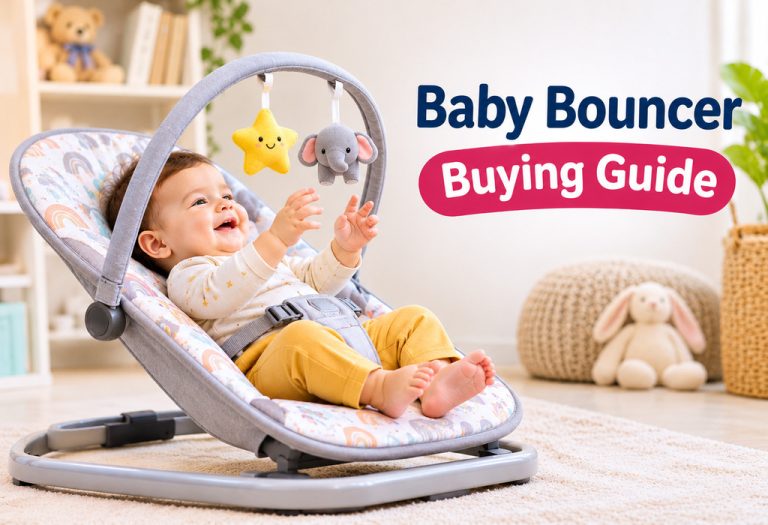
A baby bouncer is a lightweight, freestanding seat that holds a baby in a reclined position and lets the baby bounce gently with kicks or with a caregiver’s help. Bouncers are designed for infants who have not developed the ability to sit up unassisted, which is roughly the first six months.[1] Most parents use one for short stretches of awake time, such as while they cook, bathe or tidy up nearby.
Quick Fact
Buy a bouncer for the stage your baby is in now. A baby who already sits up unassisted has outgrown the seat, however new it is, so check this before you order one.
How Can a Baby Bouncer Help Parents?
A baby bouncer gives caregivers a secure spot to set the baby down during awake time, with several practical benefits.
- Hands-free moments: Parents can wash up, cook or reply to messages while the baby stays in sight.
- Gentle motion: Many babies enjoy the soft bounce that follows their own kicks.
- Easy to move: Lightweight frames travel from room to room, which suits small flats and shared rooms.
- Compact storage: Foldable models tuck behind a door or under a bed when the baby is not using them.
Types of Baby Bouncers: Which One Fits Your Home?
Four main designs cover most needs: manual bouncers, battery bouncers with vibration, bouncer rockers and bouncer swing combinations. The table shows how each moves, who it suits and what to check first.
|
Type |
How it moves |
Best for |
Check before buying |
|
Manual bouncer |
Moves with the baby’s own kicks on a flexible frame |
Families who want a simple, light seat with no batteries |
Frame feels sturdy and the base grips the floor |
|
Battery bouncer |
Gentle vibration, and sometimes music, powered by batteries |
Parents who want extra soothing features |
Spare batteries are easy to find and the vibration can be switched off |
|
Bouncer rocker |
Switches between a bouncing mode and a rocking mode |
Parents who like a seat with two modes |
Locks for each mode are easy to see and set |
|
Bouncer swing combination |
Detachable seat sits inside a swing frame |
Larger homes with room for a frame |
Frame size suits the floor space, and the swing mode has its own age and weight limits |
Baby Bouncer vs Swing: What Is the Difference?
A bouncer is a compact seat that moves with the baby, while a swing is a larger frame with powered, repeating motion. Bouncers take less space and travel easily, and swings suit parents who want powered motion and can spare a power point. Swings, rockers and bouncers are all play seats.
Features to Check Before Buying
Five checks on the product page or the label help you compare bouncers quickly and avoid a wrong purchase.
1. Harness and Straps: Choose an adjustable harness that every caregiver can fasten snugly in seconds, and read the instructions together before the first use.
2. Base and Floor Grip: Tile and marble floors can be slippery, so check for a wide base with rubber feet that grip when the baby kicks.
3. Weight Limit and Stop Point: Read the age band and the weight limit side by side on the label, and plan the stop point for when the baby can sit up unassisted.
4. Fabric, Heat and Mosquito Protection: Breathable, removable, machine-washable covers cope better with heat and sweat, and a net sold for the same model helps keep insects away.
5. Power and Batteries: Manual bouncers keep working through power cuts, while vibrating models need batteries, so pick one whose batteries are easy to buy locally.
Quick Fact
Some babies reach the weight limit before the age band ends, so weigh your baby just before you buy. A baby close to the limit needs a seat with a higher one.
Baby Bouncer Safety Tips and Limitations
A bouncer works well when the seat sits on a flat floor, holds an awake baby in a fastened harness and stays within the maker’s age and weight limits.
- Awake and supervised only: AAP explains that bouncers hold babies upright or inclined, so a baby who falls asleep can slump forward and struggle to breathe.[2] The AAP also says any surface that inclines more than 10 degrees is not safe for sleep.[3]
- Move a sleepy baby: Lift the baby to a firm, flat cot or crib as soon as possible if the baby dozes off.
- Floor only: Keep the bouncer on a flat floor and follow the maker’s manual for placement and carrying.
- Short sessions: Short bouncer sessions mixed with floor play and cuddles suit most daily routines.
- Know the stop point: Stop using the bouncer once the baby sits up unassisted or reaches the weight limit on the label.
Quick Pre-Purchase Checklist
This checklist covers the points that matter most at the moment of buying.
- The age band and weight limit are stated clearly and match your baby today.
- The harness adjusts easily and fastens snugly.
- The base is wide and grips tile or marble floors.
- A named safety standard appears in the description.
- The fabric is breathable, removable and washable.
- A mosquito net or cover is included or available for the same model.
- Powered models list their battery needs, and spare batteries are easy to find.
- Return, exchange and warranty terms are clear.
Common Buying Mistakes to Avoid
Four mistakes cause most disappointing bouncer purchases.
- Relying on the age band alone: Babies grow at different rates, so the weight limit on the label matters too.
- Ignoring floor space and storage: A large frame can crowd a small flat or a shared room.
- Skipping assembly and instructions: A loose fitting or an unlocked mode is easy to miss when several caregivers use the seat.
- Overlooking return and warranty terms: Clear terms help when the seat does not suit the baby or arrives with a fault.
Buying Online or In Store: What to Check
A reliable buying route gives you product details you can verify and a clear way to return the seat if it does not suit your home.
- Read the listing closely: Look at the photos, the fabric description and the list of what comes in the box.
- Look for a named standard: BIS, the Bureau of Indian Standards, does not appear to list a bouncer-specific mark, so a named safety standard and clear limits are the signals to look for.
- Test in store: Press down on the frame, fasten the harness buckles and fold the seat once to see how easy the locks are to use.
- Choose genuine sellers: Prefer sellers that show the brand name, model number and an invoice, and keep the invoice for warranty claims.
- Plan for after-sales: Ask whether replacement covers and harness parts are available.
- Check hand-me-downs: Look for missing parts, worn straps and recall notices from the maker or Consumer Affairs before using a second-hand bouncer.
FAQs
1. At what age can a baby use a baby bouncer?
A baby can use a bouncer from the minimum age the maker states until the baby can sit up unassisted, which is roughly the first six months according to CPSC guidance. Always check the stated age and weight limit.
2. Can a baby sleep in a bouncer?
No. Bouncers are for awake, supervised time, and both AAP and CPSC guidance say inclined products such as bouncers are not for sleep. Move a sleepy baby to a firm, flat cot or crib.
3. How long can a baby stay in a bouncer?
Bouncer time has no single rule that suits every baby, so keep sessions short, awake and supervised, and mix them with floor play and holding. Ask your paediatrician if you are unsure.
4. When should I stop using a baby bouncer?
Stop using a bouncer when the baby can sit up unassisted or reaches the weight limit on the label, whichever comes first. Weigh the baby every few weeks and compare the figure with the label.
5. Is a battery bouncer better than a manual one?
Neither type suits every home. Plug-in models stop during a power cut, battery models need spare batteries and manual bouncers need no power. Pick the type that fits your routine.
6. Does a baby bouncer need a mosquito net?
Not every bouncer includes a mosquito net, so check the listing before buying. Choose a net made for that model, fit it snugly and keep loose fabric away from the baby’s face.
7. What should I look for in a baby bouncer?
Look for a stated age and weight range, an adjustable harness, a wide non-slip base, breathable washable fabric and a named safety standard. Compare these features first, then check folding and storage space.
8. Which are the best baby bouncer brands in India?
Some popular baby bouncer brands in India include Babyhug, BAYBEE, Fab N Funky, and Mastela. You can explore baby bouncers from these brands to compare their features, comfort, safety, and prices before making a choice.
9. Where can I buy a baby bouncer?
You can buy baby bouncers online from popular platforms such as Firstcry, Amazon, and Flipkart. You can also visit offline baby product stores to check the available options. Firstcry has offline stores as well, where you can explore different baby bouncers before making a purchase.
10. Can I use a second-hand baby bouncer?
A second-hand bouncer is worth using only if every part, the harness and the label are present and undamaged. Check for recall notices from the maker or Consumer Affairs, and skip any seat with frayed straps or loose fittings.
Manual, battery and combination bouncers each suit a different home and routine. Every bouncer is a play seat for awake, supervised time on the floor. Before buying, check the age and weight limits, the harness, the base grip and the return policy. Fabric, mosquito protection and battery supply deserve a quick look in warm weather too. If you are unsure which seat suits your baby, ask your paediatrician or doctor.
Sources and References
1. Consumer Product Safety Commission – Infant Bouncer Seats Business Guidance
2. American Academy of Pediatrics – Baby Products to Avoid: Unsafe Registry Picks & Secondhand Gear
3. American Academy of Pediatrics – How to Keep Your Sleeping Baby Safe: AAP Policy Explained
Was This Article Helpful?
- Author


Related Articles
-

Top 8 Online Jobs For Stay-At-Home-Moms You Can Do Sitting Right Next to Your Baby!
-
Summer Baby Shower - Themes, Invitations & Games
-
Congenital Diaphragmatic Hernia in Newborn Baby
-
13 Best Home Remedies for Tooth Decay and Cavities
-
Robot Coloring Pages - Free Printable Pages and Images
-
Taking Your Child To The Work Day - Tips To Make It Successful