
Blended Learning – Is It Good for Your Child?
Blended learning combines online tools with classroom teaching to boost engagement, flexibility, and personalized learning for your child.




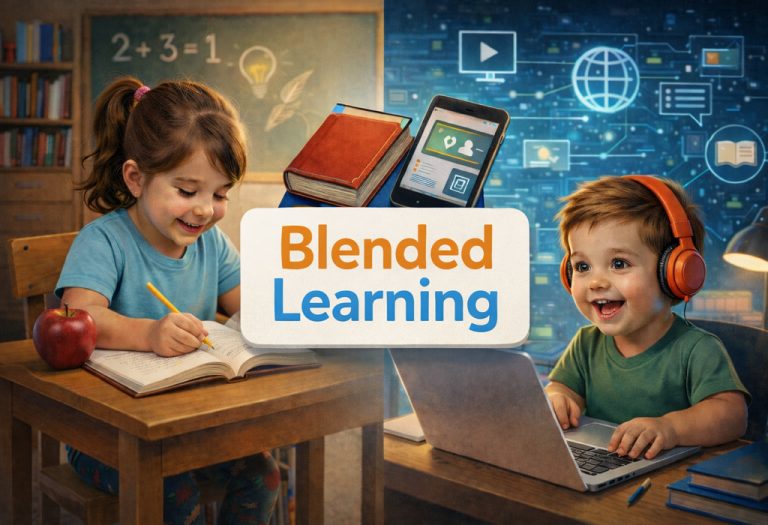
Image Source: AI-Generated Image
Raising children in today’s world means we have to make decisions our parents never had to consider. One of the biggest decisions many families make behind closed doors is how much technology should be incorporated into a child’s education. Technology is ubiquitous, schools are changing rapidly, and learning no longer takes place in the four walls of a classroom. Between traditional education and online education is blended learning, which promises flexibility, customisation, and 21st-century skills—but doesn’t abandon the concept of structure entirely.
If you’re a parent wondering if this is really the best way to educate your child or if it’s just another way to add more screen time to an already screen-saturated world, you’re not alone. It’s not just about academic success. It’s about attention spans, emotional intelligence, socialisation, and long-term outcomes. This article is for parents who want answers, not jargon. We’re going to examine what this style of education really means in real homes and real classrooms, where it succeeds and where it falls short, and how to determine if it’s right for your child, not just children in general.
What Is Blended Learning?
But essentially, this model thoughtfully combines classroom instruction with technology. Children are still learning from actual teachers and peers, but are also using technology to help them learn. It won’t replace the classroom but will make it flexible and able to choose the way instruction is given. In short, defining blended learning means to combine the human element of traditional education with the convenience of digital learning.
Different Types of Blended Learning Models
Not all children learn in the same manner, and this is something that schools are aware of now more than ever. This is why this approach appears in different ways based on age, learning type, and resources available. Some models allow children more autonomy while others retain a strong teacher-led component. It is something that can help parents recognise what may work for their child as opposed to what looks good on paper.
1. Rotation Model
The kids get to move from classrooms, teaching group activities, and computer tasks in a predetermined rotation. It is very effective for children who enjoy following a routine and a structured schedule. The teachers remain actively involved, which gives many parents peace of mind.
2. Flex Model
The children do most of their learning online, but they can always turn to teachers for assistance and guidance. This model is very effective for older children who have better time management skills but still require some assistance. It provides flexibility without leaving the children alone.
3. Flipped Classroom Model
The children learn concepts at home through video lessons, and classroom sessions are utilised for practice and discussions. Many children feel less stressed because they can pause and rewind the lessons. It also helps the teacher to give more individualised attention in the classroom.
4. Enriched Virtual Model
The children do most of their learning online but attend school on designated days. This model enables the children to stay connected with their peers while still enjoying flexibility. It is very effective for families who require flexible schedules.
5. A La Carte Model
Children do one or more subjects online while attending school for other subjects. This is useful when a child requires advanced learning or additional support in a particular subject. This can help build confidence if managed carefully.
6. Individual Rotation Model
Children follow a personalised schedule according to their learning needs. Teachers determine what combination is best for each child. This feels more nurturing because it’s tailored to the child, not the other way around.
7. Project-based Blended Model
Online resources assist with research, and classroom time is spent on project work. Children learn by doing, which makes learning feel more relevant. This model of learning often inspires creativity and insight.
8. Self-directed Blended Model
Children get to decide how and when to use online resources in addition to classroom learning. This teaches children responsibility and self-awareness. This is best suited for children who are self-motivated and have supportive adult supervision.
Benefits of Blended Learning
One question parents commonly ask is whether this method actually benefits children or simply increases their screen time. While implemented thoughtfully, it can actually help in learning in a way that a traditional classroom setting may not be able to on its own. The key is in balance, not technology. The advantages of blended learning can be better understood by looking at its effects on children.
1. Allows learning at a comfortable pace – Children can pause, rewind, or repeat learning without feeling rushed. This helps reduce stress and boosts confidence over time.
2. Gives teachers more time for personal support – Technology assists with mundane tasks, allowing teachers to dedicate time to children who require special attention. Children feel noticed and cared for.
3. Supports different learning styles – Some children learn by observing others, reading, or doing. This approach provides children with different ways to grasp the same subject.
4. Encourages independence and responsibility – Children gradually learn to take charge of their own work and time. These skills benefit children long after they leave school.
5. Makes learning more engaging – Interactive videos, quizzes, and activities tend to capture children’s attention better than textbooks. Children remain curious when learning is fun.
6. Helps shy children participate more – Children feel more secure sharing their thoughts through technology. This helps boost confidence before speaking up in class.
7. Offers flexibility for families – Learning doesn’t have to stop when children are down with travel bugs or schedule changes. This helps alleviate daily stress at home.
8. Prepares children for real-world skills – Using technology responsibly is part of modern life. Children gain digital awareness in a guided, safe way.
9. Supports personalised learning paths – Teachers can adjust lessons based on progress. Children do not feel left behind or held back.
10. Encourages better use of classroom time – Class hours focus more on discussion, practice, and creativity. This makes school feel more meaningful.
11. Builds a stronger home-school connection– Parents often get better insight into what their child is learning. This helps families support learning more confidently.
Disadvantages of Blended Learning
Although this method has many benefits, it is not suitable for all children or families. Some problems may arise gradually and go unnoticed at first. Recognising potential problems can enable parents to make calculated decisions instead of reactive ones. Knowing the cons of blended learning can help families to prepare for support in the right place.
1. Increased screen time – Spending more time on devices can worry many parents. Without clear limits, it may affect focus, sleep, or eye health.
2. Requires strong self-discipline – Not all children can manage independent tasks easily. Some may struggle without close supervision.
3. Unequal access to technology – Reliable devices and the internet are not available in every home. This can create gaps in learning.
4. Reduced face-to-face interaction – Some children need daily social connections to thrive. Too much digital work can feel isolating for them.
5. Dependence on parental involvement – Younger children often need help staying on track. This can be challenging for working parents.
6. Technical issues and distractions – Internet problems or device glitches can interrupt learning. Online distractions are also harder to control.
7. Teachers need proper training – Not all educators are equally comfortable with digital tools. Poor implementation can reduce learning quality.
8. Not suitable for every learning need – Children with certain learning or attention difficulties may feel overwhelmed. They often need more structured support.
9. Risk of learning becoming passive – Watching content without active engagement can reduce understanding. Guidance is needed to keep learning meaningful.
What Blended Learning Looks Like at Home?
For many families, this type of learning style becomes most apparent after school. It may appear in small ways rather than large ones. A child may alternate between using notebooks and a tablet when learning the same thing. With a blended curriculum in place, parents will see a combination of screen time, teacher instruction, and practice that combine to create a balanced blended learning approach.
Tips for Parents Using Blended Learning Successfully
Parents have a behind-the-scenes role in making this effective at home. Small daily practices are more important than large ones. The aim is not to control but to guide and be present. When the home environment is supportive of the blended learning experience in the blended classroom, children feel safer and more confident, even in the middle of the blended training routine.
1. Choose age-appropriate content
Make sure lessons match your child’s attention span and emotional maturity. When content feels right, learning becomes enjoyable instead of stressful.
2. Sit with your child when possible
Your presence reassures them even if you are not actively helping. It also gives you insight into how they are learning.
3. Set clear time limits
Clear start and end times help children stay focused. This also prevents learning from blending into endless screen use.
4. Balance screens with outdoor and creative play
Movement and creativity support healthy development. Learning improves when the mind gets breaks.
5. Stay flexible and observant
Every child responds differently. Adjust routines based on what you see rather than what sounds ideal.
FAQs
1. Is blended learning suitable for young children?
Yes, it can work well when screen time is limited and guided by adults. Younger children benefit most when digital activities are short and interactive.
2. How much screen time is too much in this learning style?
It depends on the child’s age and routine. Balance with physical play, rest, and offline learning is key.
3. Do children still develop social skills with this approach?
Yes, when schools and parents ensure regular group activities. Face-to-face interaction remains an important part of learning.
Blended learning is not a one-size-fits-all approach, and that is just fine. Blended learning can be a great option for many kids, but it may require careful guidance to be effective for others. The key is not how cutting-edge the approach is but how well it is implemented. The most important factor is that parents remain engaged and committed to their child’s learning. By doing so, they can make a world of difference in their child’s life. Routine learning and play can have more significance when combined with blended learning. The most effective strategy will be the one that makes your child feel confident, curious, and supported every day.
Also Read:
STEM Education for Kids
Learning Activities for Kids
What Is Connected Learning?
Was This Article Helpful?
Parenting is a huge responsibility, for you as a caregiver, but also for us as a parenting content platform. We understand that and take our responsibility of creating credible content seriously. FirstCry Parenting articles are written and published only after extensive research using factually sound references to deliver quality content that is accurate, validated by experts, and completely reliable. To understand how we go about creating content that is credible, read our editorial policy here.
- Author
 About the Author








.svg)