
How to Give an Enema to Babies and Kids: Types & Safety
Understanding when enemas are needed and how to use them safely for children.





Constipation is a common concern among babies and young children, often causing discomfort, irritability, and distress for both the child and parents. In certain situations, doctors may recommend an enema to help relieve severe constipation when dietary or lifestyle changes have not worked. While enemas can be effective, they must be used carefully, especially in babies and toddlers. Understanding when an enema is appropriate, how it works, and the precautions involved is essential for ensuring a child’s safety. This guide explains everything parents need to know about giving an enema for babies and kids, including types, dosage, side effects, and when medical advice is necessary when considering a baby enema.
What Is an Enema?
An enema is a liquid solution introduced into the rectum to help stimulate bowel movement and relieve constipation. It works by softening stool or triggering intestinal contractions, making it easier for the child to pass stool. Enemas are usually recommended only for short-term relief and under medical guidance (1).
Is Enema Safe for Your Child?
An enema might seem like quite an invasive process at the outset. Letting fluid enter your child’s colon in a reverse direction may also seem non-biological. But enemas are absolutely safe for children. An enema is only used when all the other remedies that facilitate bowel movements fail to cause any effect (2). However, it is always necessary to make sure you get your doctor’s go-ahead before administering an enema to your little baby. Most of the time, if constipation seems chronic, then the doctor will possibly give you a demonstration on how to administer an enema the right way for your baby. He will also keep you informed when to administer it next and under what conditions.
How Does an Enema Work?
An enema is a process to stimulate the bowels to empty themselves. The aim is to help soften the stools, which is achieved by flushing fluids into the rectum. Usually, a tube is used for this process. Once the fluids enter the bowels, they soften all the hard stools that are present, effectively turning everything inside into mush. This can then be passed out easily by the bowels, through the rectum, out of the anus, without causing much pain or harm (3).
What Are the Different Types of Enemas?
Generally, there are three types of enemas that can be administered to children using specific fluids. Different enemas are used depending on a child’s age, medical condition, and severity of constipation.



1. Saline Enema
A saline enema uses saltwater to draw water into the intestine, softening stool and promoting bowel movement. It is commonly used for short-term relief. Saline solutions can be purchased from the medical store, or they can be prepared at home as well, using the right proportion of lukewarm water and salt, and preparing it the right way (4).
2. Glycerin Enema
Often recommended for infants, glycerin enemas help lubricate the rectum and soften stool gently. They are usually considered milder than other types.
3. Oil Retention Enema
This type coats the stool and intestinal lining, making it easier to pass hard stool. It may be suggested for severe constipation under medical supervision. Mineral oil enemas come in a specific dosage amount, which needs to be given to the child depending on his age.
4. Phosphate Enema
Phosphate enemas stimulate bowel movement by increasing intestinal activity. These are typically not advised for very young children unless prescribed by a doctor. Enemas based on phosphate solutions are available in medical stores, and they come with all the paraphernalia required to administer them.
It is important to remember that an enema given using a phosphate solution needs extreme precaution since the quantity needs to be precise. If the dosage is not exactly as it needs to be, it could cause harm to the baby.
5. Tap Water Enema
Tap water enemas help soften stool but must be used cautiously, as excess water absorption can disturb electrolyte balance in children.
6. Medicated Enema
Medicated enemas may contain specific drugs and are only used when prescribed for particular medical conditions.
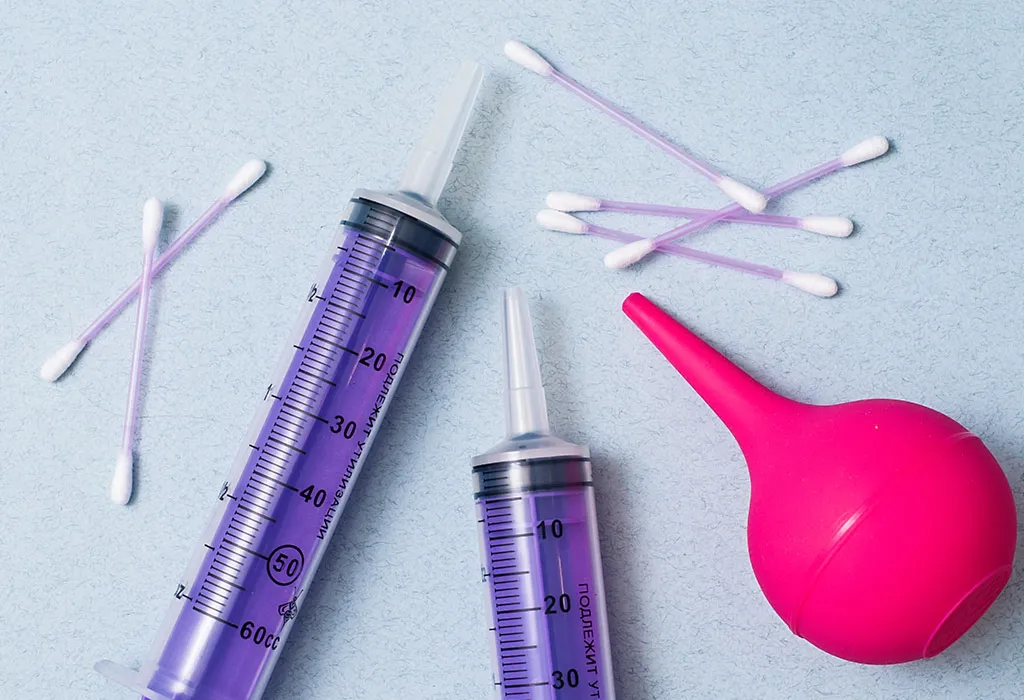
What Is the Dosage of an Enema for Kids?
The dosage of an enema depends on the child’s age, weight, and overall health. Parents should always follow medical advice, as incorrect enema volume by age can cause complications (5).
- Infants usually require very small volumes and only specific products approved by a doctor.
- Toddlers may be given a low-dose enema suitable for their age. Children aged 2 to 4 years old use one-half (1/2) of a child-size enema.
- Children aged 5 to 10 years use one bottle of a child-sized enema.
- Children aged 11 to 19 years use one bottle of an adult enema
How to Give Enemas to Your Child?
Enemas for babies might require a doctor to do them first, so that you have an idea of how best to give them. After that, giving an enema won’t seem as complicated as before (6).
What You Will Need
- An enema bottle
- Some lukewarm water
- Mineral oil
- An enema tube that has a soft tip
- Gloves, unpowdered
- A small lubricant
Steps
- Open the enema bottle and connect the tube to its mouth. Now use this arrangement to fill the bottle with some warm water and the mineral oil. This could be provided by the enema kit itself as well. Affix the insertion tip for an enema on the other end of the tube. Your administering arrangement is complete.
- Let your little one lie down, resting on his left side. Bend his right leg towards his chest, exposing his anus.
- Wear gloves properly and apply some lubricant on the insertion tip attached to the tube.
- Very gently, push the tip into your baby’s anus. He will feel a little awkward and try to move or start crying. Soothe him and keep the tip properly inserted.
- Start pressing the enema bottle to push the liquid into your baby. This will push the fluid preparation up through his colon.
- Remove the tip and let your child be for about 20 minutes. This will be time enough to soften all the hard stool inside his bowels. If your baby is young, he might end up pooping out the fluids before they have a chance to affect the stools. In this case, hold his butt together to prevent him from doing so.
- Once enough time has been given, let your child go to the toilet or allow the baby to poop it out.
Tips
For a young child, holding the liquid inside the bowels can be quite difficult. He will start feeling the need to go to the toilet even before the requisite time is complete. When this happens, ask your child to breathe in deeply and breathe out regularly. This helps reduce the stress to poop immediately and delay it for some time.
Side Effects of Enemas on Kids
While enemas are generally safe when used correctly, some children may experience mild side effects.
- Abdominal cramps or discomfort.
- Rectal irritation or soreness.
- Diarrhoea after use.
- Temporary dependence, if it is used frequently.
- Rare electrolyte imbalance with improper use.
Precautions to Take While Giving an Enema
Keep the following precautions in mind before administering an enema to your child.
- Make sure the insertion tip is lubricated properly and in a decent amount. While inserting the tip into your baby, do not forcibly try to do so. This can lead to the anal tissues tearing apart, causing even more damage and pain. Let your child relax and soothe him while keeping the tip pressed gently against the anus. It will be easily pushed inside the moment your baby relaxes.
- Enemas are rarely recommended if your baby is less than 2 years old. However, in certain severe cases, your doctor might proceed with one if he deems it necessary.
- Although enemas can help relieve constipation, they should not be made as a habit. The constant insertion of the tip in the anus, however lubricated it might be, can lead to the anus getting irritated and harming the tissues. Furthermore, his body can get into a habit of relying on the enema far too often to relieve the bowels, thus failing to develop any release mechanisms of its own.
- If your baby starts vomiting, or shows signs of nausea, swelling, or fails to urinate or poop, combined with pain, take him to the doctor immediately to prevent the situation from getting worse.
When to Consult a Doctor?
If your child experiences any of the following, make sure to contact your paediatrician without any delay (7):
- If constipation persists despite home care and dietary changes.
- If the child experiences severe pain, vomiting, or rectal bleeding.
- If enemas are needed frequently to pass stool.
- If there is no bowel movement after giving an enema.
FAQ
1. Do dietary or lifestyle changes help to avoid the necessity for enemas in kids?
Yes, in many cases, simple dietary and lifestyle changes can reduce the need for a kid’s enema or an enema for an infant. Increasing fibre-rich foods, offering plenty of fluids, encouraging regular toilet habits, and promoting physical activity often help improve bowel movements naturally. These measures are especially effective when started early and maintained consistently.
An enema for a toddler is the last course of action that is taken when passing poop isn’t possible in the usual way and with any other non-invasive measures. Do not be afraid to administer it, especially if your doctor recommends so. A few enemas can help in resetting the bowel function to normalcy, and your baby will be back to being absolutely fine.
Also Read:
Gassy Baby
Remedies for Constipation in Infants
Natural Remedies for Acid Reflux in Infants
Home Remedies to Improve Digestion in Babies and Toddlers
Common Baby Digestive Problems That You Need To Know
Was This Article Helpful?
Parenting is a huge responsibility, for you as a caregiver, but also for us as a parenting content platform. We understand that and take our responsibility of creating credible content seriously. FirstCry Parenting articles are written and published only after extensive research using factually sound references to deliver quality content that is accurate, validated by experts, and completely reliable. To understand how we go about creating content that is credible, read our editorial policy here.
- Author
 About the Author
Anisha Nair
Related Articles
-

Cloth Diapers Versus Disposable Diapers - Which One You Need to Choose?
-
Measles in Infants: Causes, Symptoms, & Treatments
-
The What and How of Constipation in Babies and Remedies for It!!
-
This 13-Year-Old Girl's Rape in TN Highlights a HUGE Internet Danger For Our Kids
-
Tay-Sachs Disease: Symptoms, Causes, Treatments & Prevention
-
Dyspraxia in Children - Reasons, Symptoms, and Treatment






.svg)