

21 Moral Values for Kids to Build Good Character
Best Moral Values for Kids to shape positive attitudes and strong character.




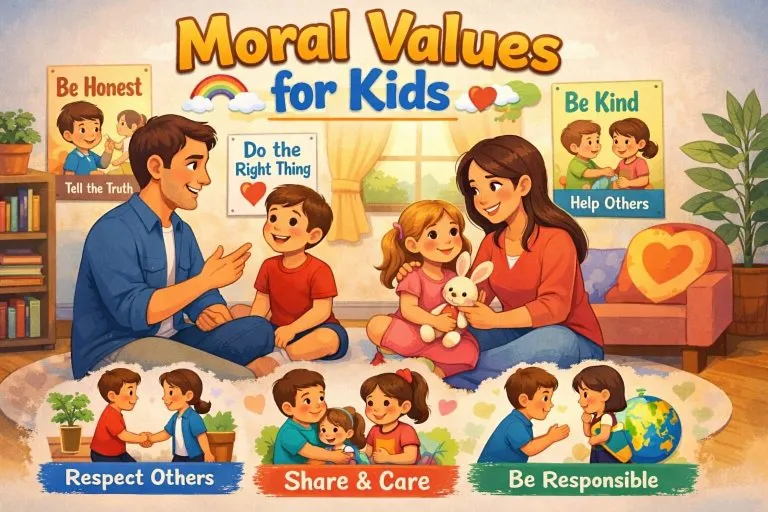
Image Credit : AI Generated Image
In this Article
- What Are Moral Values?
- Importance of Imbibing Moral Values in Kids
- 21 Moral Values for Children to Lead a Great Life
- Ways to Inculcate Moral Values in Your Kids
- Infographics: 10 Moral Values You Must Teach Your Kids
View More
Parenting is not just about caring for a child’s physical growth but also about enhancing mental growth. Parents, arguably, play the largest role in the character formation of their child and have the most impact on how the child turns out to be in life as they grow up.
Children need to understand moral concepts from an early age. Moral values for kids are fundamental principles that shape behaviour and decision-making. They act as rules that help a person distinguish between what is good and evil. Making ethical decisions in daily life requires an understanding of these principles, which are best learned through guidance, consistency, empathy, and example.
Some people argue that children learn morals on their own, or that preschool is too early for children to be learning about moral values and ideas. However, that is false; it is best to teach children values at a young age, so that it becomes a part of their personality as they got. Let’s look at some moral values every parent must teach their children.
Also read: Important Life Lessons You Should First Teach Your Kids.
What Are Moral Values?
A moral value is a lesson or principle that directs one’s behaviour, choices, and deeds. Moral values include lessons like learning right from wrong and exhibiting moral behaviours like bravery and honesty.
Importance of Imbibing Moral Values in Kids
The benefits of instilling moral ideals in children are as follows.
- Moral values help develop positive character traits, including humility, respect, compassion, and kindness.
- It teaches youngsters to discern between good and bad or right and wrong. It may finally encourage unbiased judgment and sensible thought.
- It provides a perspective that shapes how people feel and what they believe about many aspects of life.
- It increases their self-confidence and helps them stay upbeat despite adversity.
- It enables kids to focus their energy in the correct direction.
- As adolescents develop into teenagers or adults, it serves as a moral compass to guide them away from the harmful influence of classmates, social media, or society.
- Moral values help children build strong and healthy relationships by promoting honesty, trust, and empathy.
- They encourage responsibility and accountability for one’s actions, helping kids understand consequences.
- Moral values support better decision-making skills, especially in challenging or confusing situations.
- They foster a sense of social responsibility, motivating children to contribute positively to their community and society.
21 Moral Values for Children to Lead a Great Life
Moral values help children understand right from wrong and shape their character.
1. Respect
Many parents make the mistake of teaching their children only about respect for elders, but that is wrong. Everyone deserves respect, regardless of age or social standing. Respect is an essential moral value that your child must know about at a young age, as it plays a critical role in their behaviour around strangers and elders. Toddlers that learn respect their peers and elders from a young age will benefit from this, in the future. Even when the times get tough in the future, your child will be more solicitous of others.
Also Read: Ways to Teach Your Child About Respect
2. Family
Family is an integral part of kids’ lives. It shapes and nurtures them into adults. Therefore, it is essential to give your children a sense of family and help them understand why family is important. Do that, and it’s more likely your children will grow up respecting and loving their family through thick and thin.
3. Adjusting and Compromising
It is important that children know that not everything works according to them. Teach them from a young age that when it is necessary, they may have to try and adjust. Your child must be taught to adapt and to compromise, only if their own life is not at stake here. While adjusting sounds great in principle, there is a thin line where it crosses over to compromise. If the child ends up on the losing end because of a compromise, it is not only detrimental but also curbs identity.
4. Helping Mentality
Your child must be taught to help others from a young age, even if it may be a complete stranger. You have to teach your child why helping others is so important and how you always get it back when you help someone. To be a functional part of society, your child must be empathetic to others’ needs.
5. Respecting Religion
Your child should be brought up, not just to respect his own religion, but also to understand that every person has the right to choose his/her religion. Teach your children, from a young age, that all humans are equal, regardless of their religion or the festivals they celebrate.

6. Justice
A moral compass and a sense of justice are two of the most important values that any child must have from a young age. Your children must always be encouraged to speak up when they perceive wrongdoing, for their own benefit or for the benefit of others.
7. Honesty
From a young age, honesty should be instilled as one of the most important values for kids. Honesty is always the best policy, and your child must be encouraged to tell the truth regardless of whatever mistakes they may have committed.
8. Never Hurt Anyone
Explain to your child that hurting someone is not just a physical problem- any hurt can also have a psychological and emotional effect. Remember to teach your children how to apologise and encourage them to apologise if they ever hurt someone, either physically or verbally.
9. Theft
Theft is wrong, no matter what the justification behind it may be- this is one of the good values for children. Teach your child that theft is a wrong thing, not just legally, but also morally as well, as it means that he/she will be taking something that belongs to someone else.
10. Cultivate Love for Education
Education is the biggest weapon one can have, and the thing that has the most impact on where you end up in life. A love for education must be cultivated in the child, right from preschool, and you should also try to get your child to understand the importance of education in life.
11. Appreciation and Gratitude
Having gratitude means being willing to express your appreciation and gratitude for your possessions. Contentment is the first step. Teach your child to be grateful for what they have in life to help them develop contentment and thankfulness. Never allow anyone or anything to be taken for granted.
12. Sharing
Sharing is being kind. A youngster must therefore understand the value of giving to those in need. Sharing is a behaviour that ought to result from selflessness. You can encourage your youngster to share their possessions and resources with people who might be in dire need of them. Encourage them to give some of their toys to their cousins and siblings or to donate some books, food, and clothing to the less fortunate kids.
13. Empathy
The ability to comprehend another person’s problems, issues, and concerns are referred to as empathy. It is comparable to trying to walk in someone else’s shoes. You must demonstrate empathy toward them to raise an empathic child. Try to assist them while you listen to their difficulties, challenges, and concerns. Create mutually acceptable solutions.
14. Cooperation
Cooperation is the act of offering assistance to others to achieve a common goal. The first step to fostering a sense of cooperation is collaboration at home. A family should cooperate by helping each other with chores around the house and listening to each other’s difficulties. Such behaviours encourage a child to think in terms of “us” rather than “me.”
15. Acceptance
It is the ability to acknowledge another person’s different point of view. It helps the child see things more broadly and allows them to perceive situations differently. For instance, if a child and their sibling have different perspectives on something, ask them to quietly and impartially listen to each other’s viewpoints. Teach children to respect the views of others and to engage in dialogue to find the best answer.
16. Responsibility
Responsibility teaches children to be accountable for their actions, words, and duties. When kids learn to take responsibility early, they understand that their choices have consequences. This habit helps them become dependable individuals who can be trusted by parents, teachers, and friends. Responsible children are also better at managing tasks such as homework, chores, and personal commitments. Over time, this value prepares them to handle real-life challenges independently.
17. Patience
Patience helps children understand that not everything happens instantly. It teaches them how to wait calmly, manage frustration, and control their emotions during difficult situations. Children who practice patience are less likely to react impulsively or aggressively. This value also helps them perform better academically, as learning often requires time and repeated effort.
18. Discipline
Discipline helps children develop self-control and consistency in their daily routines. It teaches them the importance of following rules, managing time wisely, and completing tasks on schedule. A disciplined child learns to balance play and responsibilities effectively. This value also helps children set goals and work steadily toward achieving them. Discipline builds a strong foundation for success in both personal and professional life.
19. Courage
Courage teaches children to face their fears instead of avoiding them. It encourages them to speak up for themselves and others when something feels wrong. Courage also helps children try new activities without fear of failure. By developing courage, children gain confidence and resilience. This value prepares them to handle challenges with strength and determination.
20. Forgiveness
Forgiveness teaches children to let go of anger, resentment, and negative feelings. It helps them understand that making mistakes is a natural part of learning and growing. Children who forgive easily are emotionally healthier and experience less stress. Forgiveness also strengthens friendships and family relationships. It teaches children kindness, understanding, and emotional maturity.
21. Humility
Humility teaches children to stay grounded even when they achieve success. It helps them respect others, accept criticism, and recognise their own limitations. A humble child understands that learning never stops and that everyone has something valuable to teach. This value prevents arrogance and promotes cooperation. Humility helps children grow into respectful and thoughtful individuals.
Ways to Inculcate Moral Values in Your Kids
Moral values are the foundation of a child’s personality and decision-making. Parents can nurture these values through everyday guidance and example.
1. Practice What You Preach
Children learn from the people around them, so in order to teach your kids good values, you must model them in your life, first. You may verbally explain multiple values, but your kid will only pick up the ones you showcase through your behaviour.
2. Narrate Personal Experiences
Personal experiences are like stories, and all kids love hearing stories. Share stories from your own life, where abiding by a moral value had a positive experience in your life, and your child is bound to understand better.
3. Reward Good Behaviour
Come up with each day you reward your child for using the daily in their life. Praise and rewards are positive reinforcement that works incredibly well in shaping children.
Also Read: Ways to Teach Children Good Manners
4. Communicate Effectively
Converse with your child, each day, about how these moral values work in day-to-day life. For example, you can discuss an article in the newspaper and ask your child what they would have done in the same situation.
5. Monitor Television and Internet Use
There’s no escape from the television and the internet, but you can definitely monitor what your child watches. Make sure the show promotes good values and morals, and is appropriate for his/her age.
Moral values must be instilled in children right from the beginning, and no age is too early to start. They play a huge role in building the personality of the child and have the most significant say in how your child shapes his/her life.
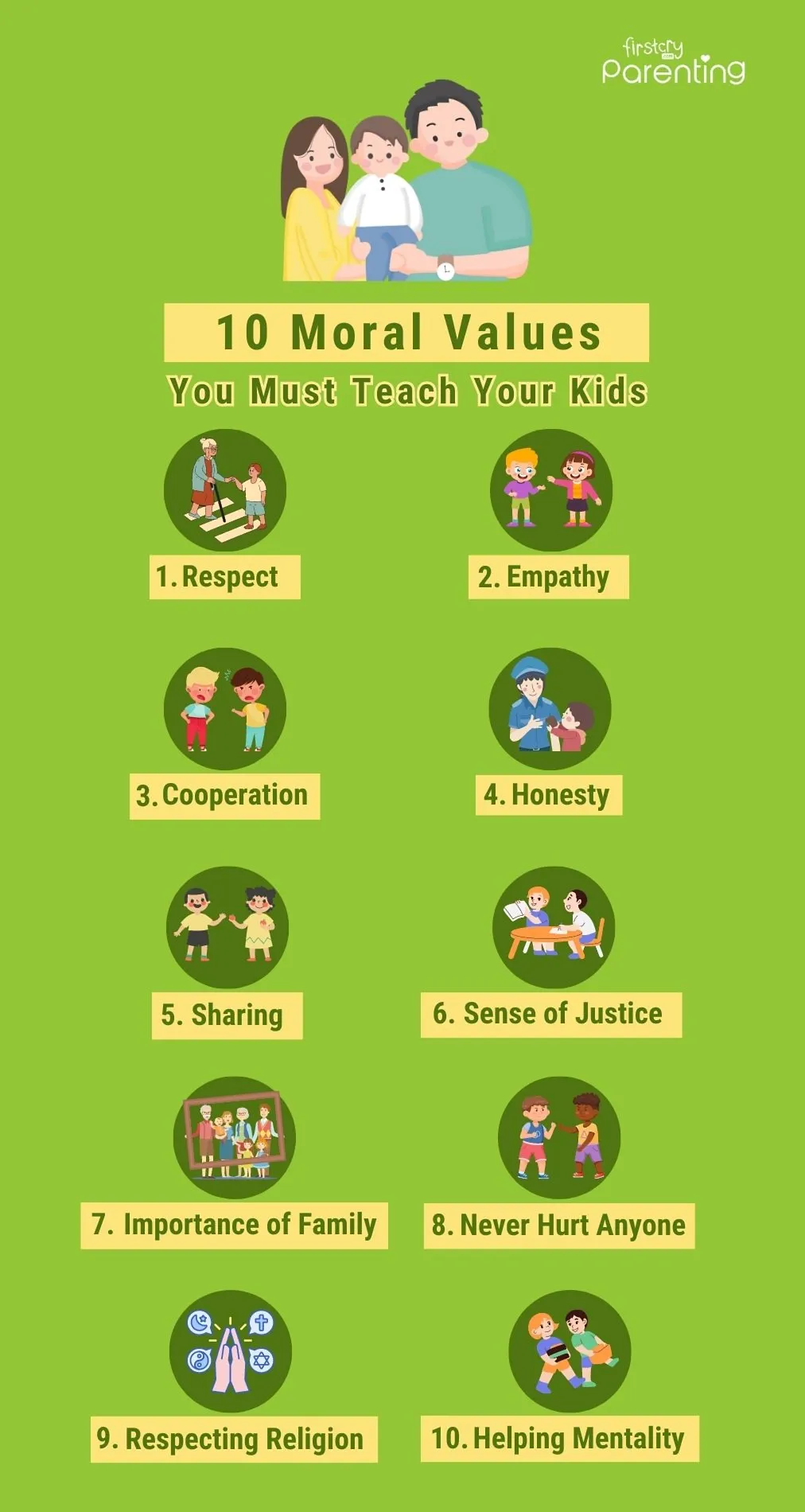
Infographics: 10 Moral Values You Must Teach Your Kids
Also Read:
Good Habits to Teach your Kids
How to Teach Kids to Behave Well
Tips for Teaching Children Gratitude
Was This Article Helpful?
Parenting is a huge responsibility, for you as a caregiver, but also for us as a parenting content platform. We understand that and take our responsibility of creating credible content seriously. FirstCry Parenting articles are written and published only after extensive research using factually sound references to deliver quality content that is accurate, validated by experts, and completely reliable. To understand how we go about creating content that is credible, read our editorial policy here.
- Author
 About the Author
Mrunal
Related Articles
-
Saying ‘NO’ to your Child
-
Imaginary Friend and Kids - How to Deal with It?
-

How to Convey the Right Message When Your Child Makes Mistakes
-

How to Help Kids Cope with Cyberbullying
-

Natural and Logical Consequences - Using Them As Child Discipline Strategy
-

Common Behavior Disorders In Children - Causes and Treatment