


Gentle Parenting vs Authoritative Parenting: Which Style Is Better?
Gentle parenting vs. authoritative parenting: Compare their strengths, challenges, and impact on your child's growth.




In this Article
- What Is Gentle Parenting?
- What Is Authoritative Parenting?
- How the Two Approaches Actually Differ in Practice
- Which Style Is Better? How to Choose for Your Family
- FAQs
View More
Choosing a parenting style can feel like picking a side in an ongoing debate, and the comparison of gentle parenting vs authoritative parenting comes up constantly in parenting forums, paediatrician visits, and family group chats. Both approaches reject harsh discipline and both value a strong parent-child bond, yet they part ways on how much structure a child actually needs.
Gentle parenting asks parents to lead with empathy first, often minimising rules and consequences in favour of validating feelings. Authoritative parenting, by contrast, keeps that same warmth but wraps it around firm, consistently enforced limits. So, which parenting style truly helps children thrive? Is one better than the other, or is the answer somewhere in between? In this article, we’ll take a closer look at Gentle Parenting versus Authoritative Parenting, explore what sets them apart, and help you discover which approach may be the best fit for your parenting journey.
What Is Gentle Parenting?
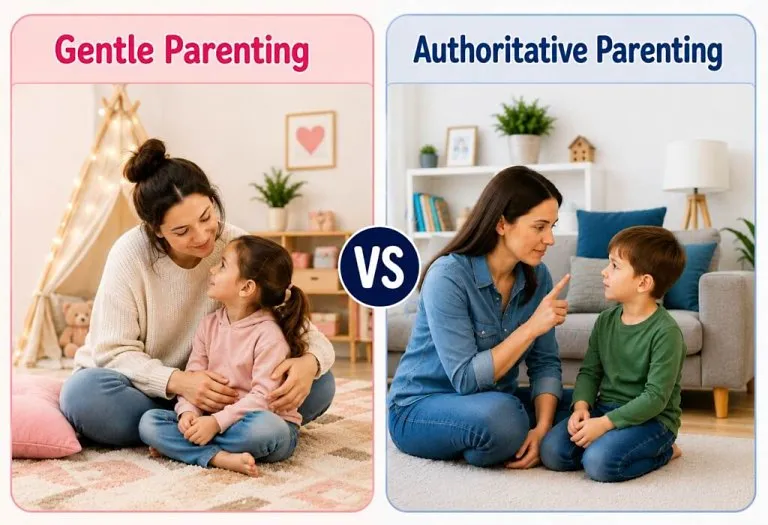
Gentle parenting is a child-rearing philosophy built on empathy, respect, and understanding rather than punishment or control. The core idea is that children behave better when they feel understood, so parents focus on naming emotions, offering choices, and avoiding shame-based discipline like yelling or timeouts (1).
A gentle parenting household might see a parent kneel down during a toddler tantrum, describe what the child seems to be feeling, and gently guide them toward a calmer state without imposing a strict punishment. Rules still exist, but they tend to be flexible and are usually explained through conversation rather than enforced through consequences (2).
What Is Authoritative Parenting?
Authoritative parenting, a term coined by developmental psychologist Diana Baumrind in the 1960s, combines high warmth with high expectations. Parents using this style are responsive to their child’s emotional needs, but they also set clear rules, explain the reasoning behind them, and follow through with consistent, logical consequences (3).
A typical authoritative response to the same tantrum might involve acknowledging the child’s frustration, then calmly restating the boundary, such as explaining that screen time is over for the day, and holding that limit even if the child protests. The parent stays warm throughout, but the rule doesn’t move.
How the Two Approaches Actually Differ in Practice
The difference between gentle parenting and authoritative parenting comes down to one question: what happens after a boundary is set? Gentle parenting tends to treat the boundary as a starting point for conversation, sometimes adjusting it based on the child’s emotional response in the moment (2). Authoritative parenting treats the boundary as fixed once it’s communicated, using empathy to soften the delivery rather than to change the outcome (4).
This distinction matters most during conflict. A gentle parent might extend bedtime because a child is upset about it, prioritising emotional comfort in that instant. An authoritative parent would validate the upset feelings while still following through with the original bedtime, trusting that consistency teaches the child more than flexibility does. Neither response is wrong, but they send different long-term messages about how negotiable rules actually are.
Which Style Is Better? How to Choose for Your Family
There isn’t a single winner between these two approaches, because the better fit depends on specific factors in your household. Use this framework to decide:
- Consider Your Child’s Temperament: Highly sensitive or anxious children often respond well to gentle parenting’s emotional focus, while children who thrive on routine may need the predictability authoritative parenting provides.
- Think About Consistency at Home: If your household already runs on structure, such as fixed mealtimes and routines, authoritative parenting will likely feel like a natural extension.
- Assess Your Own Bandwidth: Gentle parenting can be time-intensive during conflict moments, since it relies on in-the-moment conversation rather than pre-set consequences.
- Match the Approach to Your Child’s Age: Authoritative parenting’s structure tends to matter more as children enter school and face more complex social situations.
- Watch How Your Child Responds: If a chosen approach isn’t reducing conflict or improving cooperation over several weeks, it’s reasonable to adjust rather than force consistency for its own sake.
FAQs
1. Is gentle parenting the same as permissive parenting?
No. Gentle parenting still involves expectations and limits; it simply places more emphasis on emotional validation and less on enforced consequences than authoritative parenting does. Permissive parenting, by contrast, generally lacks consistent boundaries altogether (5).
2. Can I switch from gentle parenting to authoritative parenting later?
Yes. Many parents adjust their approach as children grow, particularly as school-age children need more structure and predictability. Introducing clearer boundaries gradually, while keeping the same warmth, tends to work better than an abrupt change.
3. Which style is recommended by child development experts?
Authoritative parenting has the strongest body of research behind it, largely because it combines warmth with consistency. That said, many child development professionals note that gentle parenting techniques, such as emotion coaching, can be incorporated within an authoritative framework rather than treated as a separate, opposing style, particularly with strong-willed children who benefit from both empathy and predictability.
Rather than treating this as a strict either-or decision, the most effective path for many families is to borrow from both, using empathetic communication to deliver consistent, predictable boundaries. Paying attention to your child’s temperament, your family’s routines, and how your child actually responds over time will guide you toward the approach that works best, whether that’s one style, the other, or a thoughtful blend of the two.
Also Read:
Bad Parenting Signs and Its Impact on Children
Creative Punishment Ideas for Kids
Good Manners to Teach Students & Kids
Was This Article Helpful?
Parenting is a huge responsibility, for you as a caregiver, but also for us as a parenting content platform. We understand that and take our responsibility of creating credible content seriously. FirstCry Parenting articles are written and published only after extensive research using factually sound references to deliver quality content that is accurate, validated by experts, and completely reliable. To understand how we go about creating content that is credible, read our editorial policy here.
1. Brown University Health – Gentle Parenting: What It Is, How It Can Help, and Possible Drawbacks
2. Cleveland Clinic – What Is Gentle Parenting?
4. National Library of Medicine – Types of Parenting Styles and Effects on Children
5. Wellspring Center for Prevention – Gentle Parenting vs. Permissive Parenting: What’s the Difference?
- Author










.svg)