








.svg)
.svg)
.png)


Best Products
Suggested articles for you

10 Best Baby Strollers & Prams in India to Buy (2026)
Parents carrying their little ones in prams or strollers is a common sight these days. That’s because it’s one of the most convenient ways of taking your child outside. Parents always want to ensure that they provide the best care and comfort to their kids. Carrying a child in a stroller keeps them protected from sunlight and rain. It also allows you to easily bring along your kid’s necessities like diapers, milk bottles, etc. If you are looking for the best stroller and prams in India, choosing from the wide range available can feel overwhelming. That’s why we’ve rounded up some of the best baby strollers and baby prams to make outings safer, easier, and more comfortable for you and your little one.
Top-Rated Baby Strollers
Best Overall Choice: Babyhug Cosy Cosmo Stroller
Best Lightweight Choice: Bonfino AirLuxe Cabin Stroller
Most Stylish Pick: R for Rabbit – The Chocolate Ride Designer Pram
Best Value for Money: LuvLap Galaxy Baby Stroller
Most Versatile Design: Babyhug 2 in 1 Rock and Roll Stroller Cum Rocker
Effortless Folding Design: Bonfino Quick Fold Magic Stroller
Reliable Compact Option: Chicco Glee Uneven Stroller
Practical Reversible Option: StarAndDaisy Stroller With Reversible Handle
Best Twin Stroller: Babyhug Easy Foldable Twin Stroller With Adjustable Leg Rest
Smoothest Ride Pick: Chicco New Echo Stroller With Bumper Bar
10 Best Baby Strollers & Prams in India
It is vital to take your little one for some fresh air every day. A newborn pram and stroller makes this easier, offering safety and comfort right from the start. Strollers for six months and older are also lightweight, convenient, and easy to manage on daily outings.
1. Babyhug Cosy Cosmo Stroller
Rating: 4.0/5 ★
Product Description:
The Babyhug Cosy Cosmo Stroller combines comfort, safety, and convenience for both parents and little ones. With a reversible handle, multi-position reclining seat, and extended canopy, it keeps your baby cozy and protected on every stroll. Smooth swivel wheels, a 5-point harness, and ample storage make outings effortless, while the quick folding design ensures easy travel and storage.
Stroller weight: 7.6 kg
Weight limit: Up to 20 kg
Dimensions: 24 × 53 × 84 cm (folded); 65 × 53 × 98 cm (unfolded)
Recline: 3 positions (sit, rest, sleep)
Harness: 5-point safety belt
Handlebar: Reversible
Canopy: Double-layer with peek window
Fold: Compact, lockable
Storage: Large basket + back pocket
Key Features
Reversible handlebar for facing-in or facing-out mode
Multi-position recline including flat sleep mode for nap comfort
Double-layer canopy with peek-a-boo window for shade & supervision
Swivel front wheels + brake locks for control
Spacious under-basket + back pocket for storage
Compact fold design for easier transport & storage
Why Parents Love It
This stroller keeps babies comfortable in every position while offering handy storage for essentials. Its compact fold, sturdy build, and smooth push make outings safe and stress-free.
Perfect For
Newborns to toddlers (0–3 years) • Daily walks • Travel • Shopping trips
Price
Approx ₹2,900 – ₹3,000 (Prices may vary based on ongoing offers and deals)
Customer Feedback Highlights
Customers describe this stroller as sturdy, comfortable, and travel-friendly. Reviewers especially appreciate the easy folding, safety harness, and storage options that make outings stress-free.
2. Bonfino AirLuxe Cabin Stroller
Rating: 4.9/5 ★
Product Description:
The Bonfino AirLuxe Cabin Stroller is a lightweight and stylish choice for parents who want comfort and convenience. With its tri-fold system, compact design, and premium materials, it offers a smooth, cozy ride for little ones while being easy to fold, store, and carry—even fitting in cabin storage.
Stroller weight: Net 6.61 kg (Gross 7.91 kg)
Weight limit: Up to 20 kg
Dimensions (open): 76.5 × 51.5 × 102.5 cm; (folded): 44.5 × 58.5 × 27.5 cm
Recline: Multi-position reclining backrest (including flat sleeping)
Harness: 5-point safety harness
Canopy: Adjustable double-layer canopy with peek-a-boo window
Fold: Tri-fold, one-hand easy fold, self-standing
Storage: Large basket + back pocket
Wheels: 14 cm diameter, swivel with 360° rotation + lock; concealed linked brake system
Key Features
Lightweight, tri-fold cabin stroller with easy one-hand folding for travel convenience
Self-standing design when folded for hassle-free storage
Adjustable backrest with flat sleeping position for on-the-go naps
Adjustable footrest for growing child’s comfort
5-point safety harness with adjustable straps for secure seating
Double-layer canopy with peek-a-boo window for shade & supervision
Concealed linked brake system for safe stopping
360° swivel front wheels with suspension and locks for smooth maneuvering
Soft padded seat cushion for cozy rides
Premium aluminium frame with linen fabric finish for durability & style
Why Parents Love It
Parents love its compact tri-fold design that makes it travel and cabin-friendly. The lightweight build, smooth wheels, and premium finish make it both stylish and practical.
Perfect For
Babies from 0 months • Daily strolls • Air travel & city commutes • Parents seeking a compact cabin stroller
Price
Approx ₹8,699 – ₹13,499 (Prices may vary based on ongoing offers and deals)
3. LuvLap Galaxy Baby Stroller
Rating: 3.9/5 ★
Product Description:
The LuvLap Galaxy Baby Stroller is designed for a royal and secure strolling experience with high-quality fabric, a sturdy frame, and EN safety certification. It features a reversible handle, 3-position reclining seat, extended double canopy with peek-a-boo window, and a large storage basket for all essentials. With swivel wheels, rear foot lock brakes, and an easy one-hand folding mechanism, it offers both comfort for your baby and convenience for parents.
Stroller weight: 13 kg
Weight limit: Up to 15 kg
Dimensions: 78 × 54.2 × 26 cm
Recline: 3 positions (sit, rest, sleep)
Harness: 5-point safety belt
Handlebar: Reversible
Canopy: Extended double canopy with peek-a-boo window
Fold: Easy one-hand fold
Storage: Spacious under-basket + front handle bar
Key Features
Reversible handlebar for parent-facing or forward-facing strolls
3-position reclining seat for baby’s comfort
Extended double canopy with peek-a-boo window for shade and supervision
Swivel front wheels with lock and suspension for smooth maneuvering
Rear foot lock brakes for safety on uneven roads
Easy one-hand folding mechanism for quick storage and travel
Large storage basket accessible from all sides for convenience
Why Parents Love It
Parents love its stylish build, cushioned seat, and smooth ride that works well on city roads. Its safety certification and easy folding design make outings stress-free.
Perfect For
Infants to toddlers (6 months–3 years) • City strolls • Shopping trips • Travel with convenience and comfort
Price
Approx ₹5,299 – ₹8,999 (Prices may vary based on ongoing offers and deals)
Customer Feedback Highlights
Parents praise its sturdy frame, comfortable cushioning, and easy folding, with many noting the reversible handle and canopy as highly useful. Some mention it feels a bit heavy, but overall it’s rated highly for safety, style, and everyday convenience.
4. Babyhug 2 in 1 Rock and Roll Stroller Cum Rocker
Rating: 4.0/5 ★
Product Description:
A stroller that doubles as a rocker – the Babyhug 2-in-1 Rock and Roll Stroller Cum Rocker offers ultimate versatility for parents and little ones. It features 3 reclining positions, a swivel front wheel, adjustable canopy with peek-a-boo window, and a twin cup holder tray for snacks on the go. With its sturdy frame, plush cushioning, and easy switch between strolling and rocking modes, it ensures comfort, safety, and convenience every day.
Stroller weight: Net 9.8 kg (Gross 11.1 kg)
Weight limit: Up to 15 kg
Dimensions: 63 × 55 × 99 cm
Recline: 3 positions (sit, rest, sleep)
Harness: 5-point safety harness
Handlebar: Reversible handlebar
Canopy: Adjustable with peek-a-boo window
Fold: Compact / easy foldable design
Storage: Large under-seat basket + twin cup holder tray
Key Features
2-in-1 design: works as stroller and rocker for versatile use
3 reclining seat positions for baby’s comfort
Swivel front wheel for easy handling
Adjustable canopy with peek-a-boo window for shade and supervision
Twin cup holder tray for feeding/snacking
Sturdy frame with plush cushioning for safety and comfort
Smooth foldable design with storage basket for easy travel
Why Parents Love It
Parents love the dual function of strolling and rocking in one product, along with its comfort and easy handling. The snack tray and canopy add convenience for daily use.
Perfect For
Infants to toddlers (0–3 years) • Daily strolls • Nap time rocking • Shopping trips • Parents wanting one stroller with dual purpose
Price
Approx ₹7,000 – ₹8,599 (Prices may vary based on ongoing offers and deals)
Customer Feedback Highlights
Customer call it a “good heavy duty product” that feels strong and reliable. Many mention their little ones “loved it so much” and enjoy the rocking function. Reviewers also appreciate its design and sturdiness, saying it’s “good quality” and worth it for the comfort and convenience it brings.
5. Bonfino Quick Fold Magic Stroller
Rating: 4.5/5 ★
Product Description:
Experience the perfect combination of quality, comfort, and style with the Bonfino Quick Fold Magic Stroller. This versatile baby pushchair offers total versatility with its easy folding options and spacious landscape design for added comfort. Loaded with value-enhancing features, it’s crafted from premium fabrics with generous padding to ensure a smooth ride for you and your child. Choose quality and comfort for your little one.
Stroller weight: 6.8 kg
Weight limit: Up to 22 kg
Dimensions: 102 × 47 × 87 cm
Recline: Multi-position backrest
Harness: 5-point safety harness
Canopy: Adjustable double canopy with mesh window
Fold: Quick single-hand fold, self-standing when folded
Storage: Large under-seat basket + trolley handle
Frame / Material: Aluminium frame, melange padded fabric
Key Features
Quick single-hand folding mechanism with self-standing design for hassle-free storage
Spacious landscape-style seat with plush padding for cozy rides
Adjustable backrest & footrest for comfort
5-point safety harness & removable safety bar for secure seating
Front swivel wheels with lock + linked rear brakes for smooth control & safety
Double canopy with mesh windows shade and ventilation
Trolley handle for easy carry when folded
Why Parents Love It
Parents highlight its premium melange fabric, sturdy aluminium frame, and thoughtful touches like the trolley handle and linked brakes. The easy one-hand fold and self-standing design make outings and storage hassle-free.
Perfect For
Infants to toddlers (0–3 years) • City walks & shopping • Travel & day outings with ease
Price
Approx ₹10,000 – ₹15,590 (Prices may vary based on ongoing offers and deals)
6. Chicco Glee Uneven Stroller
Rating: 4.2/5 ★
Product Description:
Glee is the perfect stroller to walk around the city in total freedom thanks to its practicality and lightness. The self-folding light frame and wide seat satisfy both baby’s and parent’s needs. Its comfortable seat and jaunty soul make everyday outings brighter and more enjoyable with your little one!
Stroller weight: 5.9 kg
Weight limit: Up to 22 kg
Dimensions: 66 × 50 × 106 cm
Recline: Infinite adjustable via one-hand ribbon adjuster
Canopy: Extendable UV50+ canopy with mesh window
Fold: Self-folding in one movement
Storage: Under-seat basket + back pocket
Key Features
Self-folding design for quick portability
Infinite recline with one-hand ribbon adjustment for customized comfort
High-performance wheels with suspension + front locking for smooth control
Extendable UV50+ canopy with mesh “peek-a-boo” window for sun protection & airflow
Wide padded seat with comfort kit for cozy, secure rides
Why Parents Love It
Parents appreciate its ultra-light frame and smooth manoeuvring on uneven paths. The self-folding feature and extendable canopy make it both stylish and practical.
Perfect For
Infants to toddlers (0–3 years) • Urban walks • Shopping trips • Travel and day outings
Price
Approx ₹15,000 – ₹17,990 (Prices may vary based on ongoing offers and deals)
7. StarAndDaisy Stroller With Reversible Handle
Rating: 3.8/5 ★
Product Description:
StarAndDaisy brings you the all-new Baby Comfort Stroller with a broad seat/bed, multiple adjustments, full sun shade, and many exciting features. Its shock-absorbing high-grade rubber wheels keep your child safe and comfortable. Built with aluminium alloy tubes, it’s sturdy yet lightweight, and designed to support a load up to 45 kg for lasting use.
Stroller weight: 12 kg
Weight limit: Up to 25 kg
Dimensions: 103 × 78 × 46 cm
Harness: 5-point safety harness
Handlebar: Reversible
Canopy: Adjustable full sun shade
Fold: Foldable design
Storage: Large under-seat basket
Key Features
Reversible handlebar for carrying baby facing parent
Broad seat/bed with multiple adjustments for sitting, lounging, or sleeping
Shock-absorbing rubber wheels for smooth rides on any terrain
Strong aluminium alloy frame for durability and stability
High load-bearing capacity (up to 45 kg) for long-term use
Full sun shade / canopy with mesh / vents for protection and airflow
Foldable / compact storage design for easy portability
Why Parents Love It
Parents admire its premium look, sturdy aluminium build, and smooth shock-absorbing wheels. The broad seat, reversible handle, and easy fold make every outing feel stylish, safe, and hassle-free.
Perfect For
Infants to toddlers (0–3 years) • City walks • Shopping outings • Parents wanting an adjustable, long-lasting stroller
Price
Approx ₹6,599 – ₹10,000 (Prices may vary based on ongoing offers and deals)
8. Babyhug Easy Foldable Twin Stroller With Adjustable Leg Rest
Rating: 4.1/5 ★
Product Description:
An efficient stroller that will let you take your twins out for a ride while keeping them comfortable. With a carrying capacity of 15 kg per seat, swivel wheels with locking function, 2 reclining positions, and a double canopy, it’s a perfect choice for parents of twins. The large storage basket makes it easy to carry toys, diapers, or other essentials during outings.
Stroller weight: 13 kg
Weight limit: 15 kg per seat
Dimensions: 67 × 51 × 93 cm (open)
Recline: 2 reclining positions (sitting & relaxing / sitting & sleeping)
Harness: 5-point safety harness for each seat
Handlebar: Fixed (non-reversible)
Canopy: Double canopy with rear window
Fold: Easy and compact fold
Storage: Large under-seat basket + front tray for both seats
Key Features
Designed for twins with padded cushioned seats for cozy rides
2 reclining positions for both front & rear seats
Swivel wheels with locking function for safety
Large adjustable double-layer canopy with peek window for shade & supervision
Suspension on front wheels for comfort on uneven roads
Large storage basket for essentials
Compact folding design for easy portability
EN1888 safety certified for trusted protection
Why Parents Love It
Parents find it practical and safe for twins, with good storage and comfortable seats. The folding mechanism and smooth ride make outings much easier.
Perfect For
Twins aged 7 to 36 months • Daily walks • Shopping trips • Travel and outings with two little ones
Price
Approx ₹9,599 – ₹14,599 (Prices may vary based on ongoing offers and deals)
Customer Feedback Highlights
Customer describe it as a “strong product” that handles twins well, noting the comfortable seats and smooth reclining. Many appreciate the easy folding mechanism and sturdy build, calling it a dependable option for daily use.
9. Chicco New Echo Stroller With Bumper Bar
Rating: 3.9/5 ★
Product Description:
Taking a stroll with your little one in the city can be tricky, but the Chicco New Echo Stroller makes outings easy, safe, and stylish. This lightweight stroller has swivel wheels, a sturdy frame, and a compact fold with carrying strap for convenience at home or while travelling. With its overhead canopy, 5-point harness, wheel suspension, and multiple reclining positions, your child stays secure and comfortable whether resting or sitting up to enjoy the view.
Stroller weight: 7.6 kg
Weight limit: Up to 22 kg
Dimensions: 47 × 82 × 108 cm (open); 27 × 26 × 108 cm (folded)
Recline: 5 positions, including near-flat
Harness: 5-point safety harness
Handlebar: Fixed (non-reversible)
Canopy: Large foldable canopy with overhead shade
Fold: Single-hand umbrella fold with strap for carrying
Storage: Basket underneath
Leg rest: Adjustable leg rest
Wheels: Swivel with suspension + lockable front wheels
Brakes: One-tap rear brake
Key Features
Lightweight stroller with single-hand umbrella fold and carry strap for easy travel
5-position reclining backrest with 180° flat recline option for naps on-the-go
Adjustable leg rest for comfort
Large foldable canopy for sun protection
Swivel front wheels with suspension and lock for smooth, stable rides
5-point safety harness for secure seating
Compact, easy-to-store design for hassle-free storage
Why Parents Love It
Parents appreciate its light weight and compact fold, making it ideal for travel and daily city use. The smooth suspension and multiple reclining positions ensure babies ride in comfort.
Perfect For
Newborns (0 months) • Urban walks • Shopping trips • Travel and holidays
Price
Approx ₹9,099 – ₹13,000 (Prices may vary based on ongoing offers and deals)
Customer Feedback Highlights
Customer call it a “solid product” with smooth wheels and easy assembly. Many note it’s lightweight yet sturdy, with comfortable reclining positions. A few mention that extra cushioning would make it even better, but overall it’s praised as a stylish and practical stroller.
10. R for Rabbit – The Chocolate Ride Designer Pram
Rating: 4.3/5 ★
Product Description:
Strollers / Prams have now become the prime need for parents after baby’s birth. Parents are now more mobile leading to the need of good quality and safe stroller for their newborns. R for Rabbit brings Chocolate Ride – the first designer stroller which is safe, excellent quality and with all the needs that parents have for their baby. From safety certification to excellent suspension system and easy fold, it has everything that is needed by parents and makes it the best choice for baby and parents.
Stroller weight: 9.5 kg
Weight limit: Up to 20 kg
Dimensions: 53 × 69 × 102 cm (unfolded); 49.5 × 80.5 × 102 cm (folded)
Recline: 3 positions (sit, rest, sleep)
Harness: 5-point safety belt
Handlebar: Reversible
Canopy: UV-protected with peek-a-boo window
Fold: Compact pull-button, self-standing
Storage: Large basket + cup holder + front tray
Key Features
Reversible handlebar for parent-facing or world-facing mode
3-position recline including near-flat sleep mode for on-the-go naps
UV-protected canopy with peek-a-boo window for shade & easy check-ins
Swivel front wheels with suspension + rear link brake for smooth control
Removable child tray with bottle holder and parent cup holder for convenience
Spacious under-seat basket for storage
Quick fold with self-standing design hassle-free storage & transport
Why Parents Love It
Parents value its sturdy build, reversible handle, and compact fold that makes traveling easier. The stroller balances comfort for babies with practical storage and safety for parents.
Perfect For
Infants to toddlers (6 months–3 years) • Smooth city rides • Daily strolls • Travel and shopping outings • Parents looking for a stylish yet sturdy pram
Price
Approx ₹8,000 – ₹10,000 (Prices may vary based on ongoing offers and deals)
Customer Feedback Highlights
Customer love its sturdy build, smooth ride, and easy folding with ample storage, though a few mention it’s harder to push in parent-facing mode.
Things to Consider When Choosing Strollers and Prams for Your Baby
Safety First: Look for a 5-point harness, sturdy brakes, and EN/ASTM safety certification to keep your baby secure.
Age & Weight Suitability: Ensure the stroller supports your baby’s current age and offers enough capacity as they grow.
Comfort Features: Reclining seat, cushioned padding, adjustable canopy, and smooth suspension make rides enjoyable.
Ease of Use: Opt for lightweight frames, one-hand folding, and swivel wheels for easy handling and travel.
Storage & Extras: A spacious basket, parent tray, or cup holders add convenience for daily outings and shopping trips.
Baby Pram and Stroller FAQs
Below, we answer some questions asked by parents when buying a stroller for the baby.
1. What Is the Difference Between a Baby Pram and Stroller?
A wheeled carrier or perambulator is called pram in short. These are best suited for newborn babies. The baby can sleep inside it if needed. The strollers, also known as pushchairs, are carriages in which the baby can sit upright. The safety belts, harness, and crotch straps ensure the safety of babies.
2. When Can I Start Sitting My Baby Up in a Pram?
By the time your baby is six months, his head and neck strength would have developed, making it easier for him to sit up on his own. Once you see your baby lifting his head and or sitting up, you can make your baby sit up in the pram without any worries.
3. Three Wheeler vs Four Wheeler – Which Type of Baby Pram Is Safer?
Though three-wheeler strollers are easier to push around and manoeuvre, four-wheelers are much safer. Three-wheelers have the risk of tipping dangerously, toppling over, or rolling away unexpectedly. They also tend to tip sideways. Four wheeler strollers are comparatively more stable. You should buy a stroller that suits your requirements.
4. Why Isn’t It Good to Use Second Hand / Used Pram for Babies?
A used stroller, no doubt, will cost a little less, but there are also potential risks that come with it. If you still decide to go for a used stroller, then you must ensure that it is in good condition. The risk of child death and fingertip amputation are quite likely if the stroller is in bad shape.
5. When Should I Stop Using a Stroller?
Children outgrow the stroller at the age of three. Many parents make their older children sit in strollers and be chauffeured around. This just gives rise to a generation of lazy kids. Paediatricians say that strollers used past toddlerhood can only do a disservice to growing children.
6. How Long Can My Infant Lie Flat in a Pram?
Newborn babies shouldn’t be propped up on an inclined seat or placed in a bucket-shaped seat. They should be made to lie flat in the pram so that they can breathe properly, and their hips and spine are in the correct posture.
7. Do All Baby Prams Come With Storage Baskets?
Not all prams come with storage baskets, though most modern models include them for convenience. For example, the Babyhug Twinster has a large under-seat basket to carry essentials, while the Chicco Echo Stroller offers a compact basket suitable for daily outings. Always check basket size and accessibility before buying.
8. Is a 5-Point Harness Better Than a 3-Point Harness?
Yes, a 5-point harness is generally considered safer than a 3-point harness. A 5-point harness secures your baby at the shoulders, waist, and between the legs, preventing them from slipping or leaning forward. A 3-point harness secures only at the waist and crotch, offering less upper body support. For infants and younger babies, the 5-point harness provides better overall protection.
9. Where can I buy good quality prams and strollers in India?
You can buy good quality prams and strollers in India from trusted brands and platforms like FirstCry, Bonfino, Amazon, and Flipkart, which offer a wide range of options to suit every budget and style. These stores provide convenient shopping with reliable delivery and genuine products.
10. Which are the best baby stroller brands in India?
Parents often choose trusted stroller brands like Bonfino, Chicco, LuvLap, and Graco for their comfort, safety, and easy usability. These brands offer a variety of designs to suit every budget and need, and they’re conveniently available on FirstCry, Amazon, and Flipkart.
Strollers are the perfect option when you want to take your baby outside without causing discomfort to either one of you. They offer convenience and safety throughout the ride. Choose the one which suits your child from the range of options given here.
You May Also Like:
10 Best Baby Swings
10 Best Baby Walkers
10 Best Baby Carriers
10 Best Baby Car Seats
Offers & Deals
Baby Gear Products
Baby Gear Products Brands
Baby Gear Products Offers & Deals
Baby Gear Products on Sale
Also Read:
Important Tips for Travelling with Baby
Why Do Babies Always Want to Be Held?
Styles of Carrying Baby Which are Not Recommended
Read more




10+ Best Baby Diapers Brands in India (2026)
Choosing the right diaper can make everyday baby care easier. A good diaper should offer a comfortable fit, reliable absorbency, leak protection and materials that feel gentle against your baby’s skin. With so many options available, parents often wonder which are the best baby diapers in India and which brands are worth considering.
To make the choice simpler, we have shortlisted 10+ popular baby diaper brands, including Pampers, Huggies, MamyPoko, Babyhug, Little’s, LuvLap and others. The list considers factors such as comfort, absorbency, fit, diaper styles, sizing and features that matter during everyday use.
Quick Picks: Best Baby Diaper Brands in India
Brand
Best For
Popular Diaper Types
Pampers
Everyday and premium options
Pants, taped diapers
Huggies
Comfortable everyday use
Pants, taped diapers
MamyPoko
Pant-style diapers
Pants
Babyhug
Variety and value
Pants, taped diapers
Little’s
Everyday essentials
Pants, taped diapers
Teddyy
Absorbency-focused options
Pants, taped diapers
LuvLap
Soft, skin-conscious options
Pants
Himalaya Babycare
Skin-focused baby care
Pants
Babyoye
Softness and comfort
Pants
Mylo
Modern diaper features
Pants
R for Rabbit
Lightweight diaper options
Pants
Bonfino
Absorbency-focused options
Pants, taped diapers
Chicco
Premium baby care
Pants, taped diapers
What Makes a Good Baby Diaper?
Before choosing a brand, it helps to understand the features that can make a difference in everyday use.
Good Absorbency
A diaper should absorb urine efficiently and help keep moisture away from the baby’s skin. For overnight use, parents may prefer diapers designed for longer wear, while daytime diapers can be changed more frequently.
Soft and Comfortable Materials
Since diapers remain in close contact with a baby’s skin, a soft inner surface and comfortable leg and waist areas are important. Babies with sensitive skin may benefit from simpler, skin-conscious options.
Secure Leak Protection
Leak guards around the legs, a flexible waistband and a good overall fit can help reduce leakage. However, even a highly absorbent diaper can leak when the size or fit is not right.
Comfortable Fit
A diaper should sit securely without digging into the baby’s waist or thighs. Frequent leaks, gaps around the legs or noticeable red marks can indicate that it is time to reassess the size or style.
Wetness Indicator
Some diapers include a wetness indicator that changes colour when the diaper becomes wet. This can be particularly convenient for newborn parents who are still getting familiar with diaper changes.
Top 10+ Best Baby Diaper Brands in India
The following brands offer different combinations of absorbency, softness, fit, styles and price points. Consider the features that matter most for your baby rather than choosing a brand based only on popularity.
1. Pampers
Pampers is one of the most recognised diaper brands in India and offers options for different stages, from newborns to active toddlers. Its range includes both taped and pant-style diapers, with options focused on everyday comfort, softness and absorbency.
Best for: Parents looking for a wide selection across different baby stages.
Popular options include: Premium Care, Active Baby and All Round Protection.
Why consider it: Pampers offers multiple ranges, making it easier to switch between different features as your baby’s needs change.
2. Huggies
Huggies is another widely recognised baby diaper brand with a strong presence in the Indian market. Its diaper range includes pant-style options as well as products designed for younger babies.
Best for: Everyday use and parents looking for a familiar, widely available brand.
Popular options include: Wonder Pants and premium diaper ranges.
Why consider it: Huggies focuses on comfortable fit, absorbency and movement-friendly designs for growing babies.
3. MamyPoko
MamyPoko is particularly well known for its pant-style diapers. Its range includes options designed for everyday use as well as variants focused on longer-lasting absorbency.
Best for: Parents who prefer pant-style diapers for active babies and toddlers.
Popular options include: Pants Extra Absorb, Skin Breathe Care and premium pant ranges.
Why consider it: The pant-style format makes changing easier once babies become more active and start crawling or walking.
4. Babyhug
Babyhug offers a variety of baby diapers in both pant and taped styles to suit different needs. Parents can choose from everyday and premium options based on their baby’s size, comfort, fit, and level of absorbency needed.
Best for: Parents looking for variety across different diaper styles and stages.
Popular options include: Babyhug Advanced and Pro Bubble Care ranges.
Why consider it: The brand offers several options across sizes and styles, making it convenient to compare different features within one brand.
5. Little’s
Little’s is an Indian baby-care brand offering diapers designed around everyday comfort, absorbency and leak protection. Its range includes different sizes and styles for babies at various stages.
Best for: Parents looking for practical everyday diapering options.
Popular options include: Premium FluffySoft, Comfy Night and pant-style diapers.
Why consider it: Little’s combines everyday diapering features with soft materials and convenient designs.
6. Teddyy
Teddyy from Nobel Hygiene is an Indian diaper brand offering both taped and pant-style options. Its products focus on absorption, dryness and a secure fit for babies at different stages.
Best for: Parents looking for an Indian brand with multiple diaper formats.
Popular options include: Easy Diaper Pants, Easy Tape Diapers and premium taped diapers.
Why consider it: The availability of both tape and pant styles makes the range useful as your baby moves through different developmental stages.
7. LuvLap
LuvLap offers a range of baby-care products, including diapers designed with softness, absorbency and comfortable movement in mind. Its diaper options are available in several sizes and are suitable for everyday use.
Best for: Parents looking for a comfortable diaper from an established Indian baby-care brand.
Popular options include: LuvLap diaper pants and premium diaper ranges.
Why consider it: Features such as soft materials and lightweight construction can make the diapers comfortable for everyday wear.
8. Himalaya Babycare
Himalaya Babycare brings its established baby-care focus to its diaper range. Its diapers are designed with features aimed at keeping babies comfortable while helping parents manage everyday wetness and leakage.
Best for: Parents who prefer a baby-care brand with a skin-focused approach.
Popular option: Total Care Super Absorb Baby Pants.
Why consider it: The brand’s baby-care positioning and focus on gentle care make it an option parents may consider when skin comfort is a priority.
9. Babyoye
Babyoye offers baby diapers with an emphasis on softness, comfort and everyday protection. Its Air Soft range is designed for babies who need a comfortable pant-style diaper during the day and night.
Best for: Parents who prioritise softness and a comfortable feel.
Popular option: Air Soft Premium Pant Style Diapers.
Why consider it: The soft, lightweight feel can be useful for babies who spend long periods wearing diapers.
10. Mylo
Mylo offers modern baby-care products developed around the everyday needs of parents. Its diapers feature an Acquisition Distribution Layer (ADL), which is designed to help distribute liquid through the absorbent core.
Best for: Parents interested in diapers with absorption-focused design features.
Popular option: Baby Diaper Pants with ADL Technology.
Why consider it: The ADL is designed to support more even liquid distribution, helping the diaper manage wetness efficiently.
11. R for Rabbit
R for Rabbit is an Indian baby-care brand known for its range of thoughtfully designed baby products. Its Feather Diapers focus on a lightweight construction while providing the absorbency needed for everyday diapering.
Best for: Parents looking for lightweight diaper options.
Popular option: Premium Feather Diapers.
Why consider it: A thinner diaper profile can provide babies with greater freedom of movement, particularly when they become more active.
12. Bonfino
Bonfino offers baby diapers in both taped and pant-style formats. Its products focus on absorbency, dryness and comfortable fit across different baby stages.
Best for: Parents looking for absorbency-focused diaper options.
Popular options include: Premium Tape Style and Premium Pants.
Why consider it: The brand offers multiple formats, allowing parents to choose between taped and pant-style designs depending on their baby’s stage.
13. Chicco
Chicco is an established Italian baby-care brand with a broad range of products for babies and young children. Its diaper range focuses on softness, comfort, absorbency and ergonomic fit.
Best for: Parents looking for premium baby-care options.
Popular options include: Comfypro and Ultra Soft & Light diaper ranges.
Why consider it: Chicco’s focus on soft materials and comfortable construction makes it an option for parents who prioritise a premium feel.
Types of Baby Diapers
Understanding the different diaper types can make choosing the right product much easier.
Taped Diapers
Taped diapers have adjustable fastening tabs that allow parents to customise the fit around the baby’s waist. They are particularly convenient for newborns and younger babies who spend much of their time lying down.
Pant-Style Diapers
Baby diaper pants can be pulled on like underwear and are convenient for active babies. They are especially useful when babies start crawling, standing and walking because they make changes quicker and easier.
Disposable Diapers
Disposable diapers are designed for single use and are widely preferred for their convenience, absorbency and ease of disposal.
Cloth Diapers
Cloth diapers are reusable and can be washed and used repeatedly. They are an alternative to disposable diapers for parents who prefer reusable baby-care products.
How to Choose the Best Baby Diapers for Your Baby
1. Choose the Right Size
Always check the weight range printed on the diaper pack rather than choosing based only on age. Babies of the same age can have very different body shapes and weights.
A diaper that is too small may leave marks or cause leaks, while an oversized diaper may create gaps around the legs.
2. Consider Your Baby’s Activity Level
Taped diapers can be convenient for newborns and younger babies. Once your baby becomes more active, diaper pants can make changing easier.
3. Look at Absorbency
If your baby tends to stay dry for longer periods, consider a diaper designed for extended wear. For newborns, frequent changes are still important regardless of the diaper’s advertised absorbency.
4. Check the Fit Around the Legs
The diaper should sit comfortably around the thighs without leaving excessive gaps. If leaks repeatedly occur around the legs, check the size and fit before changing brands.
5. Consider Skin Sensitivity
If your baby has sensitive skin, pay attention to how their skin responds to a particular diaper. Look for comfortable, breathable materials and avoid continuing with a product that appears to cause irritation.
6. Decide Between Pants and Tapes
There is no universal winner between pant-style and taped diapers. Taped diapers provide adjustable fastening, while pants are convenient for active babies.
7. Think About Day and Night Use
Some parents use the same diaper throughout the day and night, while others prefer a diaper designed for longer wear at bedtime. The choice should depend on your baby’s wetting pattern, comfort and how frequently you change diapers.
8. Try a Smaller Pack First
Before buying a large pack, trying a smaller pack can help you check whether the diaper fits your baby comfortably and works well with their skin and movement.
Baby Diaper Size Guide
Diaper sizing varies between brands, so always follow the weight range provided on the specific pack.
Newborn (NB)
Up to 5 kg
Small (S)
4–8 kg
Medium (M)
6–11 kg
Large (L)
9–14 kg
Extra Large (XL)
12–17 kg
XXL and above
15 kg+
Tip: If your baby’s weight falls between two sizes, consider the fit, thigh area, waistband and frequency of leaks rather than choosing purely by the size label.
Pant Diapers vs Taped Diapers: Which Is Better?
Neither option is automatically better. The right choice depends on your baby’s developmental stage and your preferred changing routine.
Taped diapers may work well for:
Newborns
Babies who are mostly lying down
Parents who want adjustable fastening
Babies who need frequent diaper changes
Pant-style diapers may work well for:
Crawling babies
Standing babies
Toddlers
Quick changes
Parents who find fastening tabs difficult with an active baby
How Often Should You Change a Baby’s Diaper?
Diapers should be changed regularly and whenever they are wet or soiled. Newborns may need more frequent changes because they feed and urinate frequently.
For older babies, the exact number of changes can vary depending on feeding, fluid intake, activity and individual wetting patterns.
A diaper’s advertised long-hour protection should not be taken to mean that a baby should remain in a wet or soiled diaper for that entire period.
Can Diapers Cause Diaper Rash?
Diaper rash can have several causes, including prolonged contact with urine or stool, friction, moisture, sensitive skin and reactions to certain products.
Changing diapers regularly, cleaning the diaper area gently and allowing the skin to stay dry can help support healthy skin. If a rash is persistent, severe or worsening, parents should speak with a healthcare professional.
Best Baby Diapers in India: Which Brand Should You Choose?
There is no single best baby diaper brand in India for every baby. A diaper that fits one baby perfectly may not work as well for another because babies differ in body shape, skin sensitivity, activity and wetting patterns.
For example, parents who want a broad range of options may consider Pampers or Huggies. Those looking for pant-style options can consider MamyPoko, Babyhug or Babyoye. Parents interested in Indian baby-care brands can also compare Little’s, Teddyy, LuvLap and R for Rabbit.
The most useful approach is to start with the correct size, try a suitable variant and observe your baby’s comfort, skin and leakage pattern.
FAQs About Baby Diapers
1. Which is the best baby diaper brand in India?
There is no single best brand for every baby. Pampers, Huggies, MamyPoko, Babyhug, Little’s and other brands offer different combinations of fit, absorbency, softness and diaper styles. The best choice is the one that fits your baby well and keeps them comfortable and dry.
2. Which diaper is best for newborn babies?
Newborns generally need a properly sized diaper with a comfortable fit around the waist and legs. Taped diapers can be convenient at this stage because they allow parents to adjust the fit while the baby is lying down.
3. Are pant diapers better than taped diapers?
Not necessarily. Taped diapers offer adjustable fastening and can be convenient for newborns, while pant diapers are easier to pull on and can be useful for active babies. The better option depends on your baby’s age, movement and fit.
4. How do I know if my baby’s diaper is the right size?
A well-fitting diaper should sit securely without being excessively tight. Frequent leaks, gaps around the legs or persistent red marks can indicate that the size or fit needs to be reassessed.
5. Which diaper is best for overnight use?
Parents may prefer diapers designed for longer wear at night. However, the right choice depends on your baby’s wetting pattern and the fit of the diaper. A good fit is just as important as absorbency when reducing overnight leaks.
6. How many diapers does a newborn need in a day?
Newborns generally need frequent diaper changes, so parents may go through several diapers each day. The exact number varies depending on feeding, bowel movements and individual wetting patterns.
7. Can I use pant diapers for a newborn?
Some brands offer pant-style diapers in smaller sizes, but taped diapers are often convenient for newborns because they can be adjusted while the baby is lying down. Always follow the manufacturer’s size and weight recommendations.
8. Should I size up if my baby’s diaper is leaking?
Not always. Leakage can result from an incorrect fit, gaps around the legs, an overfull diaper or incorrect positioning. If the diaper feels tight or leaves marks, moving up a size may help. If it fits loosely, another size or style may be more suitable.
9. Are expensive baby diapers better?
Not necessarily. Higher-priced diapers may offer additional features, but an affordable diaper can work very well if it fits your baby properly and provides adequate absorbency and comfort.
10. How often should I change a baby’s diaper?
Change the diaper regularly and whenever it is wet or soiled. Newborns usually require more frequent changes than older babies.
11. Can I use the same diaper during the day and night?
Yes, provided the diaper is suitable for your baby’s needs and is changed regularly. Some parents prefer a higher-absorbency option at night for convenience.
12. Do diapers prevent diaper rash?
No diaper can guarantee that a baby will not develop diaper rash. Regular changes, gentle cleaning, keeping the area dry and choosing a comfortable-fitting diaper can help reduce factors associated with irritation.
13. What should I look for in diapers for sensitive skin?
Look for a soft inner surface, comfortable fit and materials that your baby’s skin tolerates well. If a particular diaper repeatedly causes irritation, consider trying another variant or brand.
14. Are wetness indicators useful?
Yes. A wetness indicator can give parents a quick visual cue that a diaper is wet, which can be particularly helpful with newborns and during nighttime checks.
15. How do I choose diapers for an active baby?
Pant-style diapers can be convenient for crawling, standing and walking babies because they are easy to pull on and take off. A flexible waistband and secure leg fit are also important for active babies.
16. Should I buy a large pack of diapers?
It can be convenient to buy larger packs once you know which size and variant suit your baby. For a new brand or size, trying a smaller pack first can help you check the fit and comfort.
17. Why does my baby’s diaper keep leaking?
Common reasons include an incorrect size, poor positioning, gaps around the legs, an overfull diaper or a diaper that does not suit the baby’s body shape. Check the fit before assuming that the brand itself is the problem.
18. Can I use different diaper brands for my baby?
Yes. Parents can try different brands and variants to find the combination of fit, comfort and absorbency that works best for their baby.
19. What is the most important factor when buying baby diapers?
Fit is one of the most important factors. A well-fitting diaper should be comfortable around the waist and thighs, provide adequate absorbency and allow the baby to move freely.
Final Word
Choosing among the best baby diapers does not have to be complicated. Start with your baby’s weight and size, then consider fit, absorbency, softness, diaper style and skin comfort.
Pampers, Huggies, MamyPoko, Babyhug, Little’s, Teddyy, LuvLap, Himalaya Babycare, Babyoye, Mylo, R for Rabbit, Bonfino and Chicco all offer different options worth comparing.
Rather than choosing a diaper simply because it is popular, pay attention to how it works for your baby. The right diaper should fit comfortably, help manage wetness and allow your little one to move, play and sleep comfortably.
Ready to choose? Browse the baby diapers collection on and compare sizes, styles and brands to find the right option for your little one.
Read more

Rocker Swing Buying Guide
What is a Rocker Swing?
A rocker swing has a detachable seat that can be used as a rocker. The bottom of this fabric seat has a curved support, making a rocking motion possible. When the seat is harnessed onto the swing frame, it can move at various speeds in a swinging motion.
Features of a Rocker Swing
Rocker Swing
Must Haves
Removable Rocker Seat: After detaching from the swing frame, the seat converts into a rocker, as the base of the seat frame allows rocking motion.
DC Battery Slot: The battery-operated swings work cordless and offer portability.
Motion, Speed, Sound and Light Control Unit: Most baby swings offer a control panel which allows motion, speed, sound and light settings in accordance to your baby’s preference.
5- point Safety Harness: To keep the baby secured in the swing seat.
Removable and Washable Seat Cover: To maintain hygiene, just in case baby throws up or spills foods and liquids.
Sturdy Frame: To ensure even weight distribution of the growing child and allow for some safe movement within the harness.
Good to Haves
AC Adapter: For a battery-free operation.
Mobile Toys with Light: Felt or cloth toys for the baby’s entertainment and stimulation.
Canopy: Provides shade if the baby wants to take a nap.
Pros and Cons of a Rocker Swing
Pros
Cons
Rocker swings offer a versatility of usage – If babies want to swing excitedly, they can swing; if they want to rock gently, they can rock too.
Babies can become increasingly dependent on their rocker swings to go to sleep and relax.
They are easy to handle and highly portable.
Their weight specification usually restricts their use. Babies between 2.5 to 11kg can safely rock or swing in them.
Built-in music tracks and toy accessories can help babies spend a lot of creative time in their rocker swings.
The swing setting consumes a lot of power and may use up an average set of batteries in about a week’s time.
Economical buy: A 2-in-1 product – a cradle and a swing.
The constant rocking or swinging motion may calm colicky babies, but they might take longer to develop motor functions if they spend excessive time in their rocker swings.
Read more

Glider Swing Buying Guide
What is a Glider Swing?
A glider swing combines all the requisites of a swing with the gliding feature, which makes it all the more attractive. It comes with a wide array of options like music, removable infant supports, roomy and extremely comfortable seats, and has vibration features to comfort babies when they are restless or agitated. It is an excellent gift for baby showers since parents will love using it every day – mostly to keep their baby occupied and quiet while they are busy with other chores. It can be used for children weighing 2.5 kg to 13.5 kg, which is right from birth to approximately 1.5 years.
Features of a Glider Swing
Glider Swing
Must Haves
Motion, Speed, Sound and Light Control Unit: Most baby swings offer a control panel which allows gliding motion, speed, sound and light settings in accordance to your baby’s preference.
5-point Safety Harness: To keep the baby secured in the swing seat.
DC Battery Slot: The battery operated swings offer portability.
Sturdy Frame: To ensure even weight distribution of the growing child and allow for some safe movement within the harness.
Removable and Washable Seat Cover: To maintain hygiene, just in case baby throws up or spills foods and liquids.
Good to Haves
Mobile Toys With Light: Felt or cloth toys for the baby’s entertainment and stimulation.
Detachable Seat: To carry the baby with you and keep it by your side.
AC Adapter: For a battery-free operation.
Canopy: Provides shade if the baby wants to take a nap.
Non-toxic Fabric: Given the baby’s inclination to chew at its seat covers, a non-toxic fabric is good to have.
Pros and Cons of a Glider Swing
Pros
Cons
Compact design: Takes up less space as compared to other baby gear.
Music might irritate babies and parents.
Detachable seat allows you to carry your baby across the home.
Noisy operation can interfere with your baby’s sleep pattern.
The plug-in charging facility saves battery life and cost.
Babies might break flimsy toy bars/ canopies, making them safety hazards.
Has a removable toy bar for the baby’s entertainment.
As the baby grows, it becomes difficult to rock/ swing owing to weak motor capabilities.
Its gentle rocking action soothes the baby and provides comfort.
The gliding motion of entire swing seat consumes batteries frequently.
Easy to maintain and clean.
Good value for money and space saver substitute to the nursery glider chair.
Read more

Full-size Baby Swing Buying Guide
What is a Full-size Swing?
A full-size swing is primarily designed to be used indoors. It offers a sturdy frame and is the most stable among the different types of swings. This makes it quite heavy, and less portable. It comes with a lot of add-on features such as music, mobile toys, dancing lights, etc. Also, with a full-size swing, you have the option of plugging it to the power source, so you don’t always have to depend on batteries and get vexed when they get drained out. It can be used for children from birth to up to 1.5 years old, i.e., 2.5 kg to 14 kg.
Features of a Full-size Swing
Full-size Swing
The following are some must have and good to have features in a full-size swing:
Must Haves
Large Child Seat: A full-size swing usually boasts of a spacious child seat, which smaller, portable swings cannot offer.
5 – Point Safety Harness: To keep the baby secured in the swing seat.
Sturdy Frame: To ensure even weight distribution of the growing child and allow for some safe movement within the harness.
Motion, Speed, Sound and Light Control Unit: Most baby swings offer a control panel which allows gliding motion, speed, sound and light settings in accordance to your baby’s preference.
AC Adapter: For a battery-free operation, frequent battery replacements can be costly.
Reclining Seat: The seat can recline in 2 or 3 positions, depending on whether the baby has just had his feed and wishes to sit up or wishes to sleep.
Removable Head Support: Head support is a must-have feature for infants whose head and neck are still not stable.
Removable and Washable Seat Cover: To maintain hygiene, just in case baby throws up or spills foods and liquids.
Child Tray: A child tray is a handy feature for when you want to place something in front of your baby to eat or play with while swinging slowly.
Mobile Toys with Light: Felt or cloth toys for the baby’s entertainment and stimulation.
Good to Haves
Portability: Not all full-size swings come with the portable option, but those that do are definitely good value for money.
Music and Nature Sounds: Provides the baby with a range of soothing lullabies, entertaining tunes and nature sounds.
Toy Bar: To hang soft toys for your baby’s entertainment.
Mirror: An attached mirror for self-recognition.
Detachable Seat: To carry the baby with you and keep it by your side.
Canopy: Provides shade if the baby wants to take a nap.
Non-Toxic Fabric: Given the baby’s inclination to chew at its seat covers, a non-toxic fabric is essential.
LCD Display: Easily navigate between motion, speed and sound using the integrated LDC control panel.
Built-in MP3 Player: Some models come with built-in MP3 players, so you can play CDs and DVDs to keep babies entertained.
Standard USB Port: Many baby swings provide an option of plugging in your MP3 player or USB device, to play your baby’s favourite music while the baby is enjoying the swing.
iPhone, iPad Hook up: To play music and sounds that you think both you and your baby will enjoy.
Pros and Cons of a Full-size Swing
Pros
Cons
Battery-free operation: No need to worry about batteries constantly dying out and the high cost of their replacement.
Too much motor/swing noise: The noise disturbs the baby’s sleep pattern.
Provides a number of features to keep the babies comfortable and entertained.
The swing slows down as the baby grows older and heavier.
Better swinging action.
They can weigh up to 27 kg, rendering them impossible to carry around easily.
Provides a number of different movements.
Read more

The Complete Baby Swing Buying Guide
Overview of Baby Swing Buying Guide
Baby swings are effective alternatives to carrying babies in your arms and providing them soothing movement. They have multiple uses � to secure babies while you are busy working, to soothe them when sleep or tiredness sets in, and to entertain them. Baby swings can be used for newborn babies to toddlers. There are several kinds of baby swings available in the market, based on various factors such as age, weight limits and movement types. Choosing the right swing will keep your baby safe, secure and entertained while you get your work done.
What is a Baby Swing?
You little one is still not yet able to move around. Looking after newborns and keeping them entertained while attending to daily chores is quite difficult. Baby swings are a safe and secure place for your baby to sleep or play. Baby swings have safety harnesses to make sure your baby stays safe when the swing moves or vibrates. The ergonomic seat of a swing keeps babies comfortable in the swing while you finish off daily chores.
Baby swings have features that keep little ones entertained and occupied, such as music, dancing lights and music. Features like these attract babies’ attention and keeps them stimulated as they reach for toys, watch their own reflections in the mirror, listen to soothing music or look at the dancing lights.
A baby swing can also be a comfy place for a baby to take a nap. Because of the portability of swings, parents can move their babies around the house.
When to Start and Stop using a Baby Swing?
Baby Swings are excellent companions for babies and a friendly solution for moms looking to provide a perfect comfort zone for their infants. However, you need to be aware of their specifications and limitations, so as to not misuse them, for the sake of your child’s safety. Consider the following pointers before you decide to use a baby swing for your child.
Age Limit
Baby swings can be used right from birth till your child reaches toddlerhood. However, if your baby is a preemie, you might want to consult your paediatrician to ascertain if a swing will be suitable for your child. Every baby swing comes with a prescribed age limit. Check if the age limit specified in a model is suitable for your child.
Weight Limit
Most manufacturers claim that their swings can hold up to 13.5 kg. However, it is recommended to stop using swings when the baby reaches around 11-12 kg. Bigger and heavier babies run the risk of upending the swing or breaking it and getting injured in the process.
Duration
Although there is no doubt that baby swings can be great companions to babies, you must resist the temptation to let them hang around in the swing for longer periods of time. Experts recommend not more than 15 minutes per day of swing time, keeping in mind the safety of children and the emotional and physical bonding with the parents that is so necessary at their tender age.
A baby swing can be used to:
Calm down your baby 1½ It provides the right swinging motion to keep your baby calm and comfortable.
Help your child sleep � If your baby starts becoming restless while you are busy cooking or cleaning, just shift your baby to a baby swing and allow the baby to take a nap. You can also move this gadget anywhere around your house, so you can keep an eye on your baby without disturbing baby’s nap while working.
Entertain your child 1½ You can add fun accessories to the swing to entertain your child. Features like music, toys, lights, etc. can help develop your baby’s observational skills while letting the child have a great time.
Why You Need a Baby Swing?
As new parents, you might be finding it hard to manage both baby and house. Tending to your newborn probably consumes most of your time and energy, and those household chores just seem to be piling up. In that case, Baby Swings are the perfect solution to all your problems. A Baby swing keeps your child entertained while you finish your work around the house. It lets you keep your baby close while you’re working, so you can always rest assured that your baby is safely nestled in the swing. When your baby is restless or colicky and crying inconsolably, the soothing motion of the swing will calm your little one. Its coziness helps relax and put your baby to sleep. A baby swing is pure fun, and more. It helps develop your baby’s sense of sight, sound, and touch.
Don’t worry, a baby swing is perfectly safe to use for your little darling.
A Baby Swing has two primary uses:
1. To Entertain Your Baby When The Baby is Awake
You probably find yourself spending the whole day entertaining your baby. Why not sit back for a while and let a baby swing do it for you? Leave your baby in the swing and take that time to either relax or finish off those chores around the house. You can even take the swing to where you’re working. This way, you get to keep your baby close, know your little one is safe, and still get the work done. A baby swing comes with an assortment of accessories that will keep your baby engaged and amused.
Mobile hanging toys with light: The hanging, rotating toys with colourful dancing lights will provide the baby with visual stimulation and help develop baby’s motor skills.
Built-in MP3 Player: The built-in MP3 players will let you play CDs and DVDs to keep your baby entertained.
iPhone, iPad hook up: Some baby swings let you play music and sounds directly from your iPhone or iPad. This way, you get to choose something that both you and your baby will enjoy.
Standard USB port: Many baby swings provide an option of plugging in your MP3 player or USB device to play your baby’s favourite music while the baby is enjoying the swing.
2. To Soothe and Put Your Baby to Sleep
If you’re struggling to get your baby to sleep or calm your little one, getting a baby swing would be a lifesaver! If your baby is colicky or crying incessantly, a swing helps soothe the baby. The semi-recline position of a swing lets your baby take short naps comfortably, more so if the baby has a stuffy nose or other breathing issues. Also, babies love the gentle, rhythmic motion of a swing.
The Types of Motions Different Baby Swings Offer,
Swinging Motion: Babies love swaying about in a swing, and thoroughly enjoy the traditional head-to-toe motion in a swing.
Vibrating Motion: The gentle vibrations of a swing calms babies when they are erratic or unable to sleep.
Gliding Motion: A gliding motion ensures that the swing moves smoothly, without any jerks, and calms the baby.
Cradling Motion: In addition to the swinging, gliding or bouncing motion, some swings come with a typical cradle-like motion too.
Bouncing Motion: Many baby swings have an add-on bouncing feature to further make the baby’s experience enjoyable. A detachable swing seat converts into an independent bouncer.
Rocking Motion: Many baby swings come with a detachable swing seat that converts into an independent baby rocker.
Canopy: A canopy provides your baby with a cozy environment and creates the necessary ambiance for baby to fall asleep.
AC Adapter: While some swings come with a built-in DC battery slot, others have an attached cord to connect them to an AC power source. So if the swing stops due to the batteries running out, just plug the power cord into a socket and let your baby continue enjoying the swing.
Portability: A foldable nature makes the baby swing movable within the house and outside too.
A baby swing is incredibly handy for new parents. You can place your baby in it and know that your little one is safe. With a baby swing at home, you’ll no longer have to spend all your time and energy in keeping your baby engaged. Let the baby swing entertain your baby for some time and finish off your daily chores meanwhile. Allow the swing to soothe your baby and let your little one take short naps in it during the day. All in all, a baby swing will not just make your life a lot easier, but also keep your baby happy and occupied. So what are you waiting for? Take a baby swing home and gift yourself and your child an exceptionally amazing experience.
Basic Features of a Baby Swing
Basic Features of a Baby Swing
Baby swings are not a new concept when it comes to baby care, but they certainly have undergone a sea of transformation over the past decade. You can now choose from a range of features while buying a swing for your little one. From the simplest designs to the most accessorized models, the choices in the market are numerous. Knowing the features that will best suit your child’s needs can help you decide which swing to buy.
Ergonomic Seat
Although most swings are designed in a standard cradle-shape, a good baby swing will have an ergonomic shape to ensure complete support to the baby’s head, neck, and back. As a baby uses the swing in very early stages of development, it is essential to select a swing that has the right shape, to ensure the baby’s safety.
Safety Harness
Swings come with safety harnesses, such as 5-point harnesses or 3-point harnesses to keep your baby secure inside the swing’s seat.
Removable Head Support
A removable head support will help your baby comfortably recline when playing with the toys hanging overhead. Since baby swings can be used right from a baby’s birth, it is necessary that they provide adequate head and neck support till the baby develops neck balance.
Reclining Seat
Most swings provide at least 2 reclining positions -an upright one, a lying down one. These can be used according to when you baby wants to sit or sleep.
Child Tray
A child tray is a handy feature for when you want to place something in front of your baby to eat or play with while swinging slowly.
Removable and Washable Seat Cover
Most baby swings come with removable, machine-washable seat covers. Ease of washing the seat cover is of utmost priority since it is inevitable that there will be some spillages or soiling when you are using the baby swing.
Toy Bar
A toy bar is an arch-shaped fixture that runs above the child seat, from which you can hang your baby’s favourite soft toys, colourful dancing lights, etc. to amuse your little one. Almost all good brands of baby swings provide a toy bar.
DC Battery Slot
Some swings come with a built-in DC battery slot. Most of the battery-operated swings offer portability. As you will have to spend a lot on the batteries later, look for a baby swing that is battery-operated and can run with electrical power.
Motion, Speed, Sound and Light Control Unit
Most baby swings offer a control panel which allows specific Motion, Speed, Sound and light settings in accordance to your baby’s preference.
Sturdy Frame
Most swings come with a sturdy, stable structure, that is capable of supporting your baby’s weight and staying firm on the surface you place them. Even in portable or lighter versions, you can choose designs that provide greater stability to the entire swing.
Pros and Cons of a Baby Swing
Baby swings are a staple equipment for parents struggling through their children’s development stages. The reassuring swinging motion of a baby swing not only soothes fussy babies, but also provides a brief reprieve to parents. But while it is a tried and tested contraption for babies, there are both positives and negatives associated with the usage of baby swings.
Pros
Cons
The ergonomic shape and design of baby swing better suits the developing spine of babies and supports them well, while they are resting or playing in it.
Babies start preferring baby swings over cribs and beds, forcing you to let them stay in it for longer periods than advisable.
They are available in a wide range of prices, depending upon the added accessories and features, allowing for parents to select the swing best suited to their needs.
As babies use swings only for a few months, pricier swings can leave a burning hole in your pockets.
The additional musical features and soft toys keep babies engaged for a long time. The music tracks create both an exciting mood and a soothing atmosphere.
The humming noise of a swing in motion, plus the add-on musical distractions can be quite noisy when you need some quiet around the house.
Most baby swings can operate on both AC and DC power sources.
Baby swings consume a lot of power – be prepared to change their batteries every so often, or for elevated electricity bills.
Baby swings are sturdy. They can sustain swinging motions in varied speeds and still ensure that babies don’t topple out of the swing.
The sturdy frame makes them quite heavy. Some large baby swings are as heavy as 27 kilos, making them less portable.
Baby swings are designed with safety harnesses and have inbuilt weight limits. You can start using them for babies as young as 8 months old without the fear of them being uncomfortable in the swing or falling out.
As baby swings are designed for average baby sizes, taller babies may find their feet scraping the ground within few months of using the swing.
Many branded baby swings have built-in timers, allowing parents to regulate the amount of time their baby should spend in the swing.
What to Look for in a Baby Swing?
The baby’s comfort and safety is what every parent looks for in any baby product. Understand the features of a baby swing before making the purchase for your little one.
Size
Baby swings come in various sizes. If you have a lot of space in your house, go for a full-size baby swing. If not, choose a small-sized baby swing.
Portability
If you are the travelling type, opt for a portable baby swing. The compact fold makes it easy to carry or store. It will also help you if you have space constraint in the house.
Operational Mode
Baby swings are either battery-operated or run with electrical power. All portable baby swings are battery-operated. However, frequent change of batteries could be expensive. So look for the type of baby swing that would save your money on the batteries.
Safety Harness
All full-size baby swings come with a mandatory three-point harness, to prevent babies from slipping out of their seat. However, a five-point harness with over-the-shoulder straps is considered to be a safer option.
Multiple Recline Positions
All baby swings should have a reclining position for the baby’s comfort. Put your newborn in a reclining position during rest and in an upright position during play.
Speed and Motion
Most baby swings offer a back-and-forth motion, some offer a side-to-side motion, and the rest offer both. Choose one that will easily soothe your baby. Also, some swings offer up to eight speeds. Starting from the lowest speed, find out the suitable speed for your baby.
Entertainment
If you want your baby to stay awake and entertained, go for a baby swing with special features like sound, light, toys, etc.
Easy to Clean
Your baby’s spitting, drooling and overflow of the diaper can cause you extra work. So look for an easy to clean and machine washable seat cover.
Safety Standards
Check whether the product meets all safety standards and has a seal of approval from a recognized authority.
Types of Baby Swings
Swings can broadly be classified into two categories – for babies and for toddlers. Baby swings can be used up to 18 months (or 14 kg), starting from birth, while toddler swings are usable from 6 months to about 2 years. Swings for smaller babies can be further classified based on their sizes and functions, into:
1. Full-size Baby Swings
Full-size baby swings come loaded with various features and provide the best comfort and swinging motion for your child. These swings are what parents opt for when space is not an issue and they are looking for something that is roomy, with more options for speed and motion and a longer life span.
2. Portable Baby Swings
Portable swings can be carried along wherever you go. They are simple, devoid of the entrapments that come with full-size swings, are lightweight and easy to carry around. Placing babies in it to calm them down is a definite plus. Portable swings can be used for babies weighing from 2.5 kg to 12 kg (newborns to 1 year olds). Some portable swings convert into stationary seat to enable baby feeding.
3. Combination Baby Swings
A combination swing is a dual-purpose swing that can double up as a bouncer, rocker, glider or cradle. As the name suggests, the main attraction of these swings lie in the combination factor – they save space, are more convenient and can be put to use better. Combination swings integrate the best of two features to provide parents with relief and some time away to complete other chores. They are compact and occupy very little space. They are mostly battery-operated, so they generate a low churning noise that can affect the baby’s sleep patterns. These can be used for babies up to one and half years of age.
4. Glider Swings
Glider swings are innovative baby products designed to comfort the baby in a soothing manner. They move in a gentle manner akin to that of a soft cuddle of a nursery glider. They are very easy to move around the house or along with you and help keep your baby near you at all times.
5. Cradle Swings
Motherly warmth and care are ascertained when babies are placed in cradle swings. Cradle swings aptly entertain infants when they are awake and tenderly sway them to sound sleep when needed. Comprising of a delicate interior made of soft materials and protective pads, your child stays fully safeguarded in this baby swing.
6. Bouncer Swings
Entertaining little ones while still ensuring their safety is the biggest challenge for any parent. Baby bouncers provide solutions to both these requirements while also providing you relief for a short duration. Bouncer swings combine the bouncy fun of bouncers with the serene motions of a swing to bring babies a perfect companion through their different moods and preferences.
7. Rocker Swings
If there were a simple solution to soothe colicky babies and give parents a breath of relief, it would be nothing short of a miracle. Rocker swings are just that. Their dual function of rocking and swinging makes them your baby’s favorite place on earth. You can have a swing as well as a rocker in one space saver bundle.
8. Toddler Swings
When it comes to soothing babies, swings make life a lot easier and convenient for parents. Toddler swings are for the children aged between 6 months to 3 years old. They are the best place for your baby to play while you complete your tasks. Toddler swings are mostly of the hanging type.
9. Hanging Swings
A hanging swing is a toddler swing that can be used both indoors and outdoors, by attaching it to an overhead support.
Each type of swing has its own age/ weight specifications. Depending on the flexibility and comfort your baby needs, select swings with different functions. Combination swings offer gliding, cradling, bouncing or rocking functions along with the usual swinging. You can select a swing that offers multiple speed settings, different seat positions, etc. for greater comfort. Online purchase remains one of the best choices to probe into the options available and to make a safe and relaxed purchase of baby swings.
Dos and Don’ts
While Buying a Swing
Dos
Make sure that your baby falls under the age and weight range specified for the model.
Check that the seat is spacious enough for your tot to have sufficient breathing space.
Always go for a baby swing that best suits your usage patterns – indoors or outdoors, small size or big, etc.
Go for swings with harnesses attached. A five-point harness is best. Swings with no harnesses or straps might turn out to be a risky proposition for your baby.
Look for sturdy frames, posts and legs to ensure that the swing remains stable when in operation.
Check the seat texture and ensure that it is well-cushioned and easily washable.
If you go for a cradle swing, make sure the cradle part gets firmly fixed to the frame.
Always choose to buy new, unused swings over second-hand ones.
Check for safety certifications on the baby swings from the appropriate authorities, like the JPMA or CPSC.
Baby swings with musical accessories are a great option, but make sure that the sound adjustment and settings
aren’t a disturbance to your baby.
If you prefer to buy baby swings online, try to check forums and get some good suggestions about the right type of baby
swing to buy.
Don’ts
Do not buy a baby swing with limited recline positions for newborn babies, as it may cause the baby to experience
breathing problems.
Although a budget is important, do not allow it to take precedence over your baby’s safety and comfort. There are several
choices that are of good quality while still fitting modest budgets.
Don’t buy a swing that has been recalled by the certifying authority.
While Using a Swing
Dos
Always use the instruction manual provided with the product and follow the guidelines for assembling infant baby swing parts. Be sure to attach all necessary components. Ascertain that the necessary parts, like hooks on elastic straps, seat tubes, etc.,
are adequately fixed.
Make sure that a newborn is placed in the swing in a reclined position so as to avoid chances of a slump over. As the baby grows older, an upright position is preferable.
Always use shoulder straps in case the swing has an adjustable seat, to protect the baby from coming out.
Closely watch the baby’s comfort and safety during the initial days. Make sure that the baby gets familiar with the swing.
Regularly check for any unfastened screws and tighten them instantly. Repair or change any damaged parts.
Wash the seat pad regularly as per the instructions provided. Put on a diaper to ensure that the seat pad doesn’t get messy.
Avoid using the swing after the baby outgrows its age / weight limits.
Don’ts
Don’t let your baby sleep in the swing for a long time. Move the baby to a bed soon after falling asleep.
Don’t switch on a high-speed motion before checking the baby’s comfort level. Start with a low speed and increase it till the baby is comfortable.
Don’t place the swing on a wet surface. It should not be used near wet areas like washroom, basin, shower, bathtub, etc.
Harness covers provided with the swing should not be used for any other purpose.
Don’t use bleach to wash the seat pad.
If the product is anticipated to be idle for some days or weeks, don’t let the batteries remain therein. Batteries lying unused in the swing may leak and invite operational issues.
Don’t move or shift the swing with the baby in it.
Swings are good, but not to the extent of becoming a habit. Don’t keep your baby in the swing for long durations. Let the baby play on the floor or bed too.
FAQs
1. When Should I Use a Baby Swing?
Use a baby swing to soothe, comfort or manage your baby when you have chores to do. However, keep an eye on your baby from wherever you are working. Also, baby swings that can double up as bouncers are good for babies who can’t lie down completely owing to breathing problems or a puffy nose. They will help babies stay in a semi-erect position.
2. Is It Safe to Leave My Baby Unattended in The Swing?
Most swings are battery-operated. It is not advisable to leave babies unattended for long in them, as they may end up feeling dizzy.
3. What Should I Keep in Mind While Buying a Swing?
Most swings are battery-operated. It is not advisable to leave babies unattended for long in them, as they may end up feeling dizzy.
4. Are Baby Swings Secure?
Baby swings are secure and come with safety harnesses to ensure that babies don’t slip from the swing seat. The CPSC1 has given its nod and approval for new safety guidelines for baby swings to improve their security standards and prevent accidents and fatalities. A 5-point harness is recommended by the CPSC to ensure your baby’s safety.
5. Can I Let My Baby Fall Asleep in The Swing?
You can let your baby take short naps in the swing. Make sure the swing is not operational, causing discomfort or dizziness to your baby.
6. How Long Can I Use a Swing on a Given Day?
It is recommended that you use the swing for not more than an hour every day because a baby needs to be held and played with to develop an emotional connection, and also to grow physically.
7. Till What Age Can My Baby Use a Swing?
Baby swings are recommended for infants to babies up to the age of 18 months. You might have to go in for an upgrade or move to another baby product for older babies.
8. Where Can I Buy Baby Swings?
You can buy them in stores that specialize in baby products or in supermarkets that sell baby products. However, if you find online shopping more convenient, there are many websites dedicated to selling baby products online. You could purchase them there after going through various reviews, feedback from other customers and product ratings. With the online medium, you get to leverage the advantage of the internet and use it to suit your shopping purposes.
9. How Long Will It Take to Assemble A Baby Swing?
Some products are easy to assemble and can be done within 15 minutes while some take around half an hour. Check out the installation guide before getting the swing set up.
Reference:– 1- http://www.cpsc.gov/en/Regulations-Laws–Standards/Voluntary-Standards/Topics/Baby-Swings/
Read more

Bouncer Swing Buying Guide
What is a Bouncer Swing?
The ingenious baby bouncer swing is one of the most coveted baby gears currently available in the market. Flexible, soothing, entertaining and cozy, it is conceived to give babies quality time and help the mothers get on with their chores with their precious tots close-by and safe.
Essentially, a bouncer swing consists of a removable swing seat that doubles up as a bouncer. The bouncer can support babies up to 8 kg and the swing can normally accommodate babies up to 13 kg.
Features of a Bouncer Swing
Bouncer Swing
Must Haves
Reclining Seat: The bouncer seat needs to be spacious to accommodate the possibility of a full recline position.
Removable Head Support: An infant head support is essential for babies under six months.
Motion, Speed, Sound and Light Control Unit: Most bouncer swings offer a control panel which allows motion, speed, sound and light settings in accordance to your baby’s preference.
Safety Harness: A five-point harness is the ideal safety belt to keep your baby snug and secure, to prevent injuries that could be serious or potentially fatal.
Removable and Washable Seat Cover: A removable and machine-washable cover, that is also dryer-friendly, is easy to clean and maintain.
Frame: To ensure even weight distribution of the growing child, and allow for some safe movement within the harness. As the baby’s weight increases, sturdiness of the frame becomes an essential feature to carry the extra kilos.
Battery Slot: A fully battery-operated bouncer swing allows for more options in music, vibrations and swinging.
Portability: Easy to carry, fold and store away. Good portability would require a light frame, smooth, but stable articulations and a body that is easy to assemble and dismantle.
Good to Haves
AC Adapter: It comes in handy when the batteries wear out. It allows the swing to operate on electricity instead of batteries.
Toy Bar: To hang up your child’s favourite toys or mobiles for the child to play with.
Canopy: To provide shade if the baby wants to take a nap.
Pros and Cons of a Bouncer Swing
Pros
Cons
Swing seat in the baby bouncer swing is made of delicate soft material for better comfort.
Infants run the risk of slumping and damaging their spines if not positioned correctly inside the swing.
Option to run on battery, where power is not available, is a handy facility.
Regular monitoring is required to ensure that babies have enough breathing space.
The seat is quite spacious to provide the baby enough room to move the limbs when inside the swing.
The swing starts making noise when infants above 9 kg occupy it.
The swing can be easily carried around and stored, owing to its foldable feature.
Batteries installed in the stipulated slot can jangle as they can touch the plastic for want of any pads.
Economical buy as two products in one – it’s a Swing and a Bouncer.
Read more
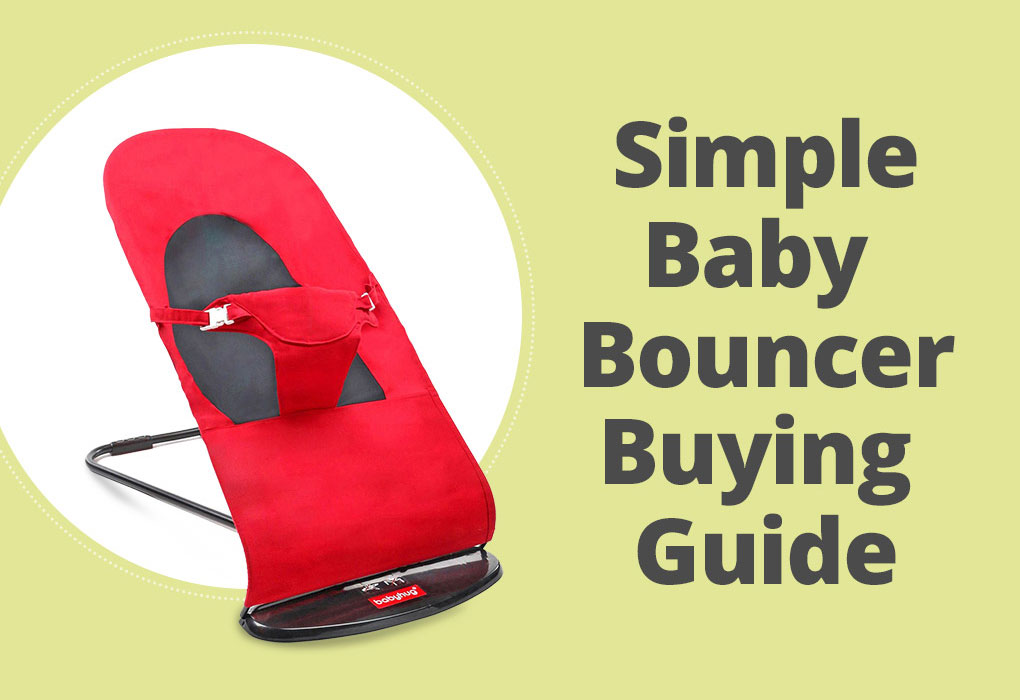
Simple Baby Bouncer Buying Guide
What is a Simple Baby Bouncer?
It is a bouncer with a simple back and forth movement and is suitable for babies who can enjoy it on their own. It needs some manual effort to get the right bouncing movement. It helps babies actively move their limbs about and expend energy, without you having to keep rocking them.
Covered with a soft, removable, washable pad that conforms to a baby’s shape, bouncer seats are springy and bounce or rock when your baby moves. Most models have a detachable, bent-wire play bar (sometimes covered with padding) or an overhead mobile of toys.
Features of a Simple Baby Bouncer?
Simple Baby Bouncer
Must Haves
Frame: A sturdy frame to support both the baby’s weight and the gentle up-and-down motion.
Safety Harness: Safety straps to secure your baby in the bouncer seat and keep the baby from rolling or slipping out of the seat.
Reclining Seat: To put the bouncer in a semi-upright position when the child is awake and in a reclining position when the baby has fallen asleep.
Removable and Washable Seat Cover: A removable and machine-washable cover, that is also dryer-friendly, is easy to clean and maintain.
Canopy: To protect your child from the harsh sun when taking the child out to the park or garden.
Fabric: Children have a tendency to lick or chew anything, so it is best to ensure that the bouncer fabric is not toxic and non-hazardous.
Good to Haves
Handle: A strong handle to safely carry your baby and the bouncer around the house or even outside.
MP3 player/iPhone/iPod hook up: To listen to soothing music, sounds of your baby’s choice while you take a relaxing shower.
Removable Head Support: A head rest attached to the bouncer seat to support the baby’s delicate head and neck. It also helps to avoid any head injuries by cushioning the hard frame of the bouncer.
Toy Bar: To hang up your child’s favourite toys or mobiles for the child to play with.
Pros and Cons of a Simple Baby Bouncer
Pros
Cons
Provides babies with physical exercise since they have to kick to rock the bouncer.
Has a limited range of motion. Does not offer the same rocking motion of a swing, that is more calming for babies.
Can replace a baby seat and baby swing, thus reducing the clutter of baby gear in your home.
Can’t be used for longer periods.
Lighter and easier to move than swings.
It is designed according to an average baby size. Thus, babies who are born big in size may not fit in the bouncer after 2 months of age.
Perfect for storage and transport and require little space to set up.
Need to use a head rest for babies under 6 months of age.
Helps develop the child’s motor skills and balance.
Easy to assemble or dismantle.
Easy to clean.
Read more
The Complete Baby Bouncer Buying Guide
Overview
Nothing beats holding your baby in your arms. But as a new mother, you need some ‘me’-time to get back to your prime physical and emotional state. A baby bouncer is the perfect answer to the times when you want to have your hands for yourself � to put up your feet and catch up on your reading, or to whip up a nutritious meal for yourself and your family, or to attack those pending emails and tasks from work. Baby bouncers are comfy and entertaining accessories for your baby and you. They ease the stress of early motherhood by being the ‘mother’s arms’ for her child when she needs her arms for herself.
What is a Baby Bouncer?
A Baby bouncer, in simple words, is a soft, comfortable bassinet fixed over a metal frame, which bounces with the movement of your baby.
Baby Bouncer – A safe, comfort zone for your bundle of joy
Baby bouncers are useful baby products for babies in their early stages of development, providing them with a safe and secure environment in both your presence and absence. It is a place where babies find comfort in the padded seat with a sturdy frame, allowing them to recline at ease in a comfortable position. The design of a baby bouncer comfortably provides full support to the baby’s entire body. When the baby kicks, the seat responds with a springy up-and-down motion. This not only satisfies the baby’s desire for movement, but also helps the baby develop the muscles necessary for crawling.
Some baby bouncers come with added features that help in soothing and entertaining your baby. The battery-operated music boxes play happy or peaceful tunes to calm your baby into a restful state. The vibration feature helps relax your baby when in a fussy mood. You can even hang soft toys within your baby’s arm’s reach. Some bouncers have dancing lights that flash according to your baby’s movements in the bouncer.
When to Start and Stop Using a Baby Bouncer?
Baby bouncers indeed make your life a lot easier by holding and entertaining the apple of your eye while you complete your daily chores. However, over-use of any gadget can spell harm to the baby, and you certainly do not want that to happen. There are various factors you need to consider to determine whether it is ok to use a bouncer for your baby or not.
Weight
Every baby bouncer comes with a manufacturer’s guidelines specifying the exact weight capacity of the bouncer. Most manufacturers specify an upper weight limit of 9 to 11 kg. (A heavier child may tip off the seat.) Some seats do accommodate toddlers and bigger kids, with weight limits ranging from 5 to 8 kg. One must refer to these specifications at the time of purchase.
Age
The ideal age of using a baby bouncer, specified on the bouncer seat guide, ranges from 0 � 7 months. However, the use of the baby bouncer is subject to change depending on factors other than age, i.e. baby’s weight and development.
Growth and Development
Every baby reaches developmental milestones at different ages – some might learn to sit up unassisted by the age of 5 months while others might accomplish the same at 7 months of age. Look out for signs of development in your baby. If you baby is attempting to climb out of the seat, or has learned to sit up unassisted, it is time to stop using the bouncer seat, irrespective of your child’s chronological age.
With Preemies
Premature babies require greater neck, back and tummy support than normal babies. Also, being smaller in size than normal newborns, preemies will not be the right fit for a bouncer. Therefore, it is best to avoid using bouncers for premature babies. If you feel that your baby is healthy enough to enjoy a bouncer, please consult your paediatrician before starting to use the bouncer for your baby.
Don’t Make it a Habit
It becomes very tempting for mothers to keep their babies in the bouncer for longer periods of time as they get to use both hands and get a lot of work done then. However, letting your baby spend too much time in the bouncer might not be a great idea. Babies remain in a reclined position in a bouncer at all times, and this prevents them from indulging in other playful activities necessary for their growth and development.
Reclining Seat
You should place your newborn in the bouncer only when it is in a full reclining position. This is the safest position for your baby. A semi-reclined position might press on the chest and block your baby’s airflow.
Features and Characteristics of a Baby Bouncer
Features of a Baby Bouncer
Baby Bouncer
Having a detailed knowledge of the major features of a baby bouncer will help you make an informed buying decision. With that aim in mind, we have listed below some of the important features provided by the various baby bouncer manufacturers.
Frame
A basic bouncer seat consists of a lightweight frame made of metal wire, tubular metal or heavy-gauge plastic. Covered with a soft, removable, washable pad that conforms to a baby’s shape, bouncer seats are springy and bounce or rock when your baby moves. The frame also adds to the sturdiness of the bouncer.
Safety Harness
The second most important feature in a baby bouncer is the safety harness. Bouncers come with three-point or five-point harnesses. Most baby bouncers have a soft three-point safety belt that goes around babies’ waist and in-between their legs. This keeps them from falling or slipping out of the seat.
Reclining Seat
Bouncers offer you three different reclining positions to choose from. You can quickly transit your baby’s playtime to sleeping time by changing the bouncer’s reclining position – all you have to do is adjust the bouncer’s upright position to a reclined one. However, be sure to transfer your baby to a crib or bassinet after the baby falls asleep.
Head and Neck Support
Head and neck support is of utmost importance for newborns. Until the age or 3-4 months, babies cannot hold their heads up. Their skull bones are soft and fragile. A head rest attached to the bouncer seat supports baby’s delicate head and neck. It also helps to avoid any head injuries by cushioning the hard frame of the bouncer.
Padded Seat
Seat padding can vary from basic to extra thick to comfortably thin. A nicely padded baby bouncer will be very comfortable for your little one.
Removable and Washable Seat Cover
Many types of baby bouncers come with removable seat covers suitable for machine washing. This is an important feature, as the bouncer is guaranteed to get dirty. Easy to wash feature maintains the cleanliness of your baby bouncer.
Toy Bar
Simply lying down in a bouncer will bore any baby. Most bouncers come with an attachable toy bar. When attached within reach of your baby’s arms, it will entertain your baby and provide sensory stimulation. Toy bars allow you to add toys like soft plush animals, teethers and squeaking toys, and only begin to amuse babies once they have crossed the age of 4 months.
Canopy
Sometimes, when you take your baby outdoors to the park, etc., the rays of the sun could prove to be hazardous to the baby’s skin and delicate eyes. Canopies provide the necessary shade to babies while they are still comfortably seated in their bouncers.
Music and Vibration Unit
Most bouncers come with an inbuilt music, vibration unit, which when turned on adds gentle vibrations to the bouncer seat, helping to pacify and relax the baby. The bouncer plays happy or peaceful sounds to lull your child into a restful state.
Characteristics of a Baby Bouncer
Bounciness
Bouncers, well, have to bounce, don’t they? The bouncing movement can be provided in two different ways – naturally or through a battery operated mechanism. Natural bouncing helps strengthen the motor skills of babies. Their movement bounces the chair, causing them to have lots of fun. However, if your baby is extremely active and loves extra fun, you can choose the battery-operated alternative that will increase the fun quotient. For younger babies, gently help them bounce using your hand and feet.
Fabric
The fabric used on the bouncer seat comes in direct contact with your baby’s delicate skin, and needs to be soft, non-slippery, smooth and comfortable. It also needs to be free from health-hazardous substances and allergens. The most preferred material would be soft cotton. Such a fabric is gentle on the skin and safe to chew or suck on, making it a perfect material for little babies to relax and play in.
Body Support
The bouncers are designed to provide comfort to your baby, by ensuring proper head and back support. Headrests prevent your baby’s head from flopping around when trying to wriggle.The fitted, padded fabric of the seat moulds itself to your baby’s weight and size, ensuring that your baby is comfortable and protected.
Grippers
Grippers provide a firm grip on the surface and keep the bouncer stable when vibrating mode is on.
Portability
Bouncers are compact and easy to carry along with your luggage. Their size and simple design make them ideal for storage and transport. If you are going to be waiting at the airport or relaxing on a vacation, your baby can enjoy too, on the bouncer.
Multi-Utility
An advantage of bouncers is that they can be used as bouncers as well as chairs. Once your baby has outgrown the bouncer’s age or weight limits and can sit upright unattended, you can turn the fabric around and use the bouncer as a chair.
Comfort
A soft, comfortable fabric used in a bouncer provides maximum comfort to babies. They experience the freedom to bounce, swing and enjoy the world outside your arms while still being ensconced in the soft luxury of the fabric. Leading baby bouncer manufacturers ensure that the fabric is eco-friendly and made of non-hazardous material, so it is even ok if your baby ends up inadvertently teething it.
MP3 Player/iPhone/iPod Hook Up
MP3 player/iPhone/iPod hook up are of great help to listen to soothing music, sounds of your baby’s choice while you take a relaxing shower.
Compact Fold
It should be easy to pack up and store when not required.
Motion, Speed, Sound and Light Control Unit
The bouncer which allows swing motion offers a control panel which allows motion, speed, sound and light settings in accordance to your baby’s preference.
Trendy
Baby bouncer seats come in a variety of sizes, colours, themes, etc. Some even offer changeable seat covers and matching toy bars. These little angels are probably going to be tomorrow’s fashionistas, so why fence away from trends and colours? Let them be today’s trendsetter too.
As the competition in the market is increasing, manufacturers are coming up with new never-thought-before features for their bouncers, trying to make their product stand out from the rest.
Pros and Cons of a Baby Bouncer
Baby bouncers are fast becoming one of the staples in the baby development arsenal of new parents. Here are the pros & cons of a baby bouncer to help you choose the right one for your bundle of joy.
Pros
Cons
Vibration unit: Many bouncers come with an inbuilt vibration mechanism with adjustable speed. The calming vibrations can effectively soothe crying and fussy babies and lull them to sleep.
Weight restrictions: Baby bouncers can be used only for a very specific weight range (up to 12kgs).They cannot be used for premature babies, who are below the weight limit. It can prove hazardous to them.
Music box: Baby bouncers come with additional features like a built-in music box or soft plush animals hanging from a play bar that babies can easily grab and play with. These keep the babies engaged in other developmental activities, when in bouncers.
Age restrictions: Bouncers can be used only till the baby is about 6 to 7 months old.
Portable: Unlike cribs and elaborate swings, most baby bouncers are portable. They allow new parents to get out of their homes and spend time outdoors without worrying about engaging their babies.
Preference over cribs or beds to sleep in: Babies tend to stay in their bouncers for as long as possible and even like to sleep in them. This can be a hindrance for crib training. You can resolve this by restricting your baby’s bouncer time and encouraging intermittent usage of the crib.
Fabric: All recognized brands of baby bouncers undergo a quality check by JPMA (Juvenile Products Manufacturers Association) and adhere to the usage of skin friendly fabrics and materials. This ensures that a baby doesn’t get a rash or skin problem by staying in the bouncer for a long time.
Wide base placement hazard: A baby bouncer is considered to have a good design and balance if it has a wide enough base to absorb jerky motion. However, this wide base can become a placement hazard, so be careful about placing the baby bouncer around the house.
Ergonomic design: Baby bouncers are designed to better suit the delicate, growing spines of babies. So your baby can lie in the bouncer comfortably, without experiencing any discomfort or ill effects at a later stage.
Reference:- 1-http://jpma.org/
What to Look for in a Baby Bouncer?
There are many variants of baby bouncers available in the market for varied price ranges. Even the most basic ones are approved by JPMA or similar governing authorities before being sold for retail. The more advanced ones are designed with paediatric help and undergo numerous quality checks to ensure the development of best possible products. You must, therefore, clearly know what to look for in a baby bouncer and how to look for it.
So here is mentioning those critical features you should keep an eye out for:
Safety Features
Baby bouncers come with safety belts (and water hooks if you intend to use them in a paddling pool) to ensure that the baby isn’t hurt due to any erratic movement. Parents must check the tensile strength and ruggedness of the safety features at the time of buying a baby bouncer.
Weight Capacity
Since the calming mechanism of a baby bouncer involves bouncing and vibrating, most baby bouncers come with a weight restriction. If the baby is below the specified weight limit, the vibrations can be uncomfortable or topple the baby. If the baby is above the specified weight limit, then the baby bouncer may not work properly. Thus, parents must check the weight restriction for a baby bouncer, determine the usage term of the bouncer and then decide how much to invest in it accordingly.
Body and Base Design
The body of a bouncer must be pliant and designed in such a way that the delicate frame and developing spinal cord of the baby is sufficiently supported. A wide base is also essential to ensure that the contraption remains balanced while the baby is in it. Thus, parents must check for these features while selecting a baby bouncer.
Quality Textile and Materials
As a baby spends a good amount of time in the baby bouncer, it is quite important to have a bouncer with good quality textile and materials, which are baby skin-friendly. Many baby bouncers even ensure that the surface material is chewable and doesn’t cause any rash or skin problem for babies. A bouncer can get messy in no time, and the fabric must therefore be easy to clean. Check to see if the seat cover can be removed easily for cleaning, and whether or not it is machine washable.
Portability
Little babies get used to a particular routine, schedule and space much more quickly than you think they do. If they do fall in love with the comfort of their new bouncer, they will probably want to be in it all the time. Thus, it should be lightweight and easy to move around with. Check to see if the bouncer can be folded or easily taken apart for storage or travel. If you are planning a family, you might want to dismantle and store it away until your next sweetheart arrives into this world.
Interactive Features
Baby bouncers come with additional interactive features such as felt toys and music boxes, which can keep a baby engaged on a bouncer for long intervals of time. Parents must consider these carefully before selecting a baby bouncer.
Price
Lastly, a baby can only use the bouncer in the initial developmental months. Parents must keep this in mind, consider the competitive prices offered in the market and select a baby bouncer that doesn’t burn a hole in their pocket yet serves their purpose sufficiently.
Types of Baby Bouncers
Bouncers can fulfil your newborn baby’s need for constant movement. Their gentle motion calms babies and lulls them to sleep, making your life easier.
While there are a number of brands available in the market, they can all be categorized into three broad categories:
1. Simple Baby Bouncers
Simple baby bouncers have a simple design that helps babies have fun while also letting them get some physical action by moving their arms and legs.
2. Battery-operated or Vibrating Baby Bouncers
In contrast to simple baby bouncers that have only a limited range of movement, battery-operated bouncers offer a lot more options. These are quite similar to the simple, non-powered bouncers, with the difference that they produce a vibrating motion with a battery-operated motor. These are an excellent choice if your baby enjoys constant motion.
3. Combination Baby Bouncers
Combination bouncers, as the name suggests, are bouncers combined with another baby device.
There are two types of combination bouncers:
Bouncer Rockers
Bouncer rockers are a combination of bouncers and rockers. These bouncers can be easily converted into rockers, by providing a variation in the type of movement offered to the baby. Basically, the movement pattern of a bouncer is low in intensity – perfect for infants. But as infants grow, they require a more intense movement and therein comes the need for a rocker. Bouncer rockers can thus be used right from the early days of your baby’s life until toddler-hood.
Bouncer Swings
Bouncer swings are a combination of bouncers and swings. Such bouncers have a detachable bouncer seat. So when children learn to sit by themselves, the bouncer seat can be placed into a swing frame, thereby converting it into a swing.
Dos and Don’ts
Baby bouncers are a must buy for all parents. However, it is important for you to consider its usability, comfort and convenience, and the cost associated with it, before making an informed buying decision.
While Buying a Bouncer
Dos
Think well about how you would be using the bouncer before deciding on which type of bouncer to buy. If you want to be completely hands-free while still keeping your baby engaged, then go for a battery-operated model.
Study brand reviews and look at the major features of all the models. Most big brands offer plenty of attractive features like, a toy tray along with toys in multiple colours, selection of fabric for bouncer seat, durability, etc.
Make sure that the bouncer you are planning to buy has passed the safety standards of organizations like JPMA.
Look out for sharp edges, frayed ends or loose fittings.
Buy combination bouncers according to your baby’s preference. If your baby does not like to swing, go for a bouncer rocker instead.
If buying offline, take your baby along and try a bouncer model by placing the baby in it. If buying online, be sure to buy from trusted websites that are capable of providing you with all the necessary information and are also capable of recommending a good model suited to your needs.
Don’ts
Don’t buy a bouncer model if your baby is already over or nearing the upper weight limit specified for the model. Before buying one, check that the age and weight limits specified are appropriate for your needs for your child.
Don’t buy bouncers without asking for a demonstration. Check out the music volume levels and ensure that it isn’t too loud or brash, as it could end up irritating babies instead of soothing them. Similarly, check for other functions like speed, different motions, etc.
While Using a Bouncer
Dos
Use baby bouncers only up to six or seven months or until your baby begins to sit independently.
Make sure that the fittings have been made properly and that there are no sharp edges left unnoticed while assembling the baby bouncer.
Make sure the fabric is dry and clean.
Wrap your baby properly and make sure that your baby is not placed inside the bouncer without a diaper.
Make sure to always keep the bouncer within your reach.
When placing the baby bouncer on the floor, make sure that it is kept away from hazardous things like cables, cords, heaters, sharp things, etc. Place your baby in the bouncer only after you are sure that you have completely understood and followed the manufacturer’s instructions.
Don’ts
Don’t use bouncers for babies weighing above 11 kg or above the specified weight limit of a bouncer.
Don’t place the baby bouncer with your baby inside, on an elevated surface like tabletop or soft surfaces like bed, sofa or couch. The bouncing movement could slide the bouncer to the edge and lead to a fall.
While shifting bouncer chairs along with baby from one place to another, don’t carry it by frame or the toy bar. These features are almost brittle and aren’t supposed to be used as handles.
Avoid leaving your baby in the bouncer for long periods of time and give the baby some floor time, in your supervision. Experts recommend mandatory time for natural movements such as crawling, tummy time, etc. for the growth of your baby’s limbs and other organs.
FAQs
1. My Child Sleeps Better in The Bouncer Than on The Bed. Is it Safe to Let Her Sleep in The Bouncer?
Most baby bouncers are designed to provide babies with a soothing and comforting ambiance. The bouncing motions and vibrations, along with soft music, are most conducive to a happy baby sleep. However, bouncers are not designed for a long period usage. Hence, it is not recommended to let your baby sleep in the bouncer. What you can do, is transfer the baby to a bed or crib once she sleeps.
2. I am Worried If There Will Be Any Issues Related to Spinal Alignment if My Baby Sits in a Baby Bouncer.
There has been no strong proof of spinal alignment associated with baby bouncer usage. However, letting your baby remain in bouncers for long periods can hamper the spine development13. Hence, use the bouncer only for short periods of time, under your supervision, and your baby should be just fine.
3. Can I Use Bouncers for Both My Kids?
Most bouncers can only be used for kids who cannot yet sit independently, so you might want to check the bouncer’s weight limit before letting both your kids use them. In any case, a bouncer can, and should, hold only one kid at a time. However, using a bouncer for one child in combination with a baby carrier or stroller for another can help you easily manage both your kids simultaneously, without getting too harrowed.
4. Is It Ok If I Use The Bouncer for My Two Months Old Baby?
Bouncer can be used for baby right from birth. However, if your child is a preemie, you might want to consult your paediatrician before determining whether the bouncer is suitable for your baby.
5. My Baby is So Attached to her Bouncer That She is Reluctant to Play on The Floor. What Do I Do?
Bouncer or not, floor time is highly important for babies. Most bouncers are compact, foldable and lightweight. So try distracting the baby with a toy or book while putting away the bouncer for some time to give the baby adequate floor time. You can always set up the bouncer back quickly when you need to attend to something else and require the baby to be safe while you are distracted.
6. My Daughter is Colicky. Can a Bouncer Help Her Feel More Comfortable?
The vibrations/ movements of a bouncer are a godsend for colicky babies. Placing them on a bouncer works more effectively than comforting them by holding them in the arms or putting them down on their tummy.
7. Is It Safe to Feed My Four-month-old on a Bouncer?
Bouncer seats are not designed for feeding. Babies can choke or get injured by the feeding utensil. This is unavoidable on any moving baby seat, including swings. You are supposed to hold baby when feeding using a bottle, and for solids, you are supposed to use high chairs or convertible baby boosters/feeding chairs to prevent injury to your baby.
Reference:–
12-//www.healthlinkbc.ca/healthfiles/hfile107.stm
13-http://blog.intellidance.ca/blog/2-15-2011/c-s-how-nurture-your-babys-spine-development
Read more

Stroller Frame Buying Guide
What is a Stroller Frame?
Stroller frame is a lightweight metal frame designed to carry specific types of infant car seats. You just need to separate the car seat from its base, snap it onto the stroller frame, and voila, you get a stroller. This is very convenient, especially when you need to take a sleeping baby out of the back seat.
Types of Stroller Frames
Car Seat Stroller Frames
These strollers have a minimalist design and rely completely on the car seat to hold the baby. It can attach the car seat to the frame using either a click-in or a strap-in system.
Stroller Frames with Car Seat Adaptors
These stroller frames come with adaptors to attach the car seats to them, using either a click-in system or a strap-in system.Let us now look into how the car seats attach themselves to the stroller frames-
Car Seat Attachment Methods
The single most difference between frame strollers is how the car seat is attached to the frame. There are two types of attachment methods
Click-In Systems
These systems are designed in such a way that they automatically latch the frame and seat together when the seat is lowered onto the stroller frame. These systems can be used with one hand and are characterized by an audible click to alert the user that I have made a connection. These systems provide the benefit of speed, simplicity and reliability.
Simple and easy to use.
Strap-In Systems
These systems utilize a belt or strap to retain the car seat. The strap is fed through the seat belt notch in the car seat, which is then tightened down to secure the car seat. This system is widely compatible with many models of car seats. However, it is lot more complex and cumbersome than the click-in system.
Complex to use. Involves too many extra steps at every transition in/out of the frame.
Reference:- 7-http://www.babygearlab.com/Car-Seat-Stroller-Reviews/buying-advice
How is a Stroller Frame Useful?
Stroller frames are a great choice if you’d like to use your baby’s car seat as a travel system, but don’t want the large, bulky stroller that comes with one. These lightweight stroller frames are easy to fold up, thereby giving you all of the convenience of a travel system, at a fraction of the weight and trunk space. The only downside is that once babies hit 12 kg or so by their first birthdays, they would outgrow the infant car seats and you won’t be able to use them anymore.
Why You Need a Stroller Frame?
Stroller frames are right for you if –You are looking for an alternative to a travel system, or to separately buy a pram, stroller and car seat for your child.
Features List
Compiled here are some features you should look for when you buy a stroller frame. The ‘Must Haves’ point to the essential features, while the ‘Good to Haves’ are add-on features you may or may not choose to install.
Must Haves
Metal Frame – The protective sturdy metal frame ensures that your baby has a stable and comfortable ride.
Frame Locks – Check that the stroller frame locks into position naturally, and that this mechanism prevents it from accidentally collapsing.
All Wheel Brakes – Make sure that the brakes work properly, and that the wheels lock when the brakes are engaged.
Front Wheels Swivel – Some jogging strollers come with swiveling front wheels too, and they are more suitable for a combination of walking and jogging.
Adjustable Canopy – to provide sun shade when the baby is resting.
Car Seat Adapter – For ease of connecting with car seats.
Click-in System – To connect the car seat to stroller frame.
Good to Haves
Child Tray and Cup Holder.
Adjustable height handle – The stroller frame’s handles should be at the pusher’s waist level. Remember that most of the strollers are built for a woman of average size. If you do not fit this description, you might want a stroller with adjustable handles. You can also buy stroller handle extenders.
Strap-In System – To harness the car seat to stroller frame.
Pros and Cons of a Stroller Frame
Know the advantages and disadvantages of a stroller frame, so you can make an informed buying decision.
Pros
Cons
A lack of seat mechanism and padding makes stroller frames lightweight and easy to fold. This makes them smaller and more compact.
The convenience of a stroller frame depends on the ease of taking the infant car seat out of the car. Once your baby is past 9 kg, moving the infant car seat around can get tiring, and you may prefer to just take the baby out of the car instead of the entire car seat.
Lighter weight translates into better steering, provided the overall quality of the frame is good.
Stroller frames have lesser storage space when compared to full-sized strollers.
Most infant car seat manufacturers also make stroller frames to go with their car seats. This arrangement works out very well for new parents, who are inexperienced and don’t want to invest in a sophisticated travel system.
The lack of a seat limits the useful life of a stroller frame. Once your baby outgrows the infant car seat, the stroller frame would be of no use. If your baby’s car seat is designed for babies up to 13.6 kg or a higher weight limit, the stroller frame would only last for a year or so.
Most of these stroller frames come with detachable cup holders, canopies and baskets.
What to Look for in a Stroller Frame?
Here are some pointers to keep in mind while buying a stroller frame for your bundle of joy-
Maneuverability – A standalone frame might be a bit clunky to move around. Ensure that the frame moves easily with/ without the car seat in it.
Compatibility – Some frames are compatible with only certain brands of infant car seats. Make sure your frame is compatible with the car seat you are using or planning to buy.
Car Seat Attachment – Make sure that there are no crevices or sharp edges jutting out, after the car seat has been attached to the frame.
Frame – Make sure that the frame is free of sharp edges and protrusions.
Bumper Bar – Bumper bar is a must but make sure that the infant won’t accidentally slip through the leg opening.
Extra Features – Consider the number of extra features the frame provides. Does it have cup holders, parent trays and side storage?
Read more

Double Stroller Buying Guide
What is a Double Stroller?
Twin stroller or Double stroller is a boon to parents with multiple kids, and come in two models.
1. Side-by-side Model
In side-by-side model, as the name suggests, two or more children can sit side by side. The seats are comfortable for all babies, but it’s difficult for parents to maneuver through narrow doors and busy streets.
2. Tandem Model
Tandem strollers sit one child behind the other. Although the rear seat lacks leg space, these strollers are easier for parents to handle.
How is a Double Stroller Useful?
As parents, you understand that while handling a single child is in itself a significant task, handling twins or more children can be quite overwhelming – visiting a mall with three little children in tow is sure to leave you exhausted. In such cases, using a double/twin stroller is highly convenient and provides great relief.
Why You Need a Double Stroller?
You need a double stroller, if –
You have more than one kid in your family and plan to take them all outside together.
You are the only person available to push the stroller. If you were to go for two separate strollers, instead of a double stroller, you’ll need another person to push the second stroller.
You have plans to add to the family. Double strollers offer an extra seat for your second child as an add-on accessory, so you don’t have to invest in a second stroller.
Features List
Compiled here are some features you should look for when you buy a Double stroller. The ‘Must Haves’ point to the essential features, while the ‘Good to Haves’ are add-on features you may or may not choose to install.
Must Haves
An Adjustable Canopy.
Reclining Seat – For multiple reclining positions.
A 5-Point Safety Harness.
Compatibility with infant car seats.
Car Seat Base Adapters – That allow users to attach infant seats directly to the stroller without having to unbuckle the baby.
Rubber or Foam or Air filled tires.
Front Wheel Brake – Lockable front wheels for stability.
Adjustable Footrest.
Storage Basket.
Good to Haves
Toy Attachments – To keep your child entertained.
I-Pad Hookup.
Rubber or Foam height-adjustable handles.
A Cup /Bottle Holder.
Parent Tray – To organize bottles, keys, teething rings, and other accessories.
Child Trays – To give babies a place to eat, while on the go.
Bag Hooks – That can be placed on the front to hold shopping and tote bags, leaving the parent’s hands free to push the stroller.
Front Wheel Swivel – Some jogging strollers come with swiveling front wheels too, and they are more suitable for a combination of walking and jogging.
Pros and Cons of a Double stroller
Know the advantages and disadvantages of a Double stroller, so you can make an informed buying decision.
Pros
Cons
Makes managing multiple children infinitely easier.
Large and bulky, difficult to accommodate in a car.
Most double strollers can be used in various modes – for a single child, for children of different ages (including infants), and for children of the same age.
The number and quality of features are reduced.
Variety of models to suit your lifestyle – side-by-side, tandem, sit-and-stand, etc.
Side by side models are difficult to maneuver through narrow spaces.
What to Look for in a Double Stroller?
Here are some pointers to keep in mind while buying a double stroller for your twins-
Type
Determine the type of double stroller you are comfortable with side-by-side one or tandem one. Side-by-side would be more suitable when both your children are of the same age, while tandem would be best when they are of different ages.
Weight Considerations
Keep in mind the weight limit of not just the total stroller, but also that of the individual seats. Some strollers, especially those for children of different ages, allow a higher weight for the front seat and a lower weight for the rear one.
Detachable Features
Double strollers come with different features for both the seats, like child tray, bottle holder, etc.
Read more

Jogging Stroller Buying Guide
What is a Jogging Stroller?
As the name suggests, jogging stroller is ideal for outdoors. It has three bicycle wheels on a lightweight frame, which makes it sturdy. If you intend to take your child on long walks or uneven trails, or on runs or hikes through the woods, then this is the stroller for you, because it absorbs shocks on rough terrain. In a city environment, jogging strollers can help you navigate over curbs. However, their size and bulk make it difficult to maneuver them up and down the stairs, into elevators, or on crowded supermarket aisles or sidewalks. They also do not fold up as compactly as other models do.
How is a Jogging Stroller Useful?
Traditionally, people have been using a standard stroller to take their child along when they go for a jog. However, with a standard model, you have to be very careful about running surface – you can cover only flat, smooth surfaces, and your baby has to be secured with great care, since the 4-wheel strollers have a tendency to skitter here and there as you run. All these problems are eliminated with a jogging stroller, as it comes with 3 large wheels, shock absorbers and a 5-point harness. These features ensure that your baby stays secure in the stroller, even when you run on rough surfaces.
Why You Need a Jogging Stroller?
You will need a jogging stroller, if –
You want to take your baby out with you for an everyday activity like jogging or brisk walking, and want to make sure that your child is safe as you run.
You are an adventure junkie who likes to go on hikes or treks on rough surfaces, and would like to take your child with you.
Features List
Compiled here are some features you should look for when you buy a jogging stroller. The ‘Must Haves’ point to the essential features, while the ‘Good to Haves’ are add-on features you may or may not choose to install.
Must Haves:
Large wheels – for smooth, shock-free ride.
Suspension – Good suspension to provide smooth ride.
Hand Brake.
Tether Strap – Wrist tether strap to control the accidental roll over.
Deep Child Seat – Provides safety in case of collision.
A 5-Point Safety Harness.
Front-Wheel Fender – It keeps dirt, mud, and water from spraying up at the two of you.
Front Swivel Wheel – Some jogging strollers come with swiveling front wheels too, and they are more suitable for a combination of walking and jogging.
Good to Haves
Height adjustable handle.
I- pad hook up.
Reclining Seat – Full-reclining capability in case you plan to run with an infant (although not advised).
A Cup /Bottle Holder.
Removable, Machine Washable Cover.
A Canopy.
Storage Basket.
Pros and Cons of a Jogging Stroller
Know the advantages and disadvantages of a jogging stroller, so you can make an informed buying decision.
Pros
Cons
A fixed front wheel ensures the stroller stays on a straight path when you jog.
A fixed front tire makes the stroller different to turn.
Good safety features ensure that your child is safe when you are on the run.
High-end models, although sturdier and safer are difficult to fold and transport.
Low-end models are foldable and easy to carry along, but their safety features might not be up to the mark.
What to Look for in a Jogging Stroller?
Here are some pointers to keep in mind while buying a jogging stroller for your bundle of joy-
1. Size
Jogging strollers come with 3 wheel sizes – 12″, 16″ and 20″. The 12″ one is more suitable for walks and usage on smoother surfaces, while the 20″ one is suitable for long runs and off-road uses.
2. Alloy or Steel Wheel
Steel wheels might be cheaper, but they are more prone to rust, in case you live in a place that has a salty air.
3. Swiveling Front Wheel
If you are a hardcore jogger, a fixed front wheel will help you keep your baby’s stroller on track as you bolt ahead. The swiveling feature is more helpful for people who walk, along with just a little jogging.
4. Suspension and Shock Absorbers
You need to ensure that the stroller has a good quality suspension, so your baby does not get rattled when you are jogging.
5. Tether Straps
You can never be too careful, and tether straps give your child that extra protection against accidents.
6. Frame Construction
Jogging strollers are made of a welded aluminum frame, which makes them sturdy and lightweight.
Read more

Lightweight Stroller Buying Guide
What is a Lightweight Stroller?
As the name suggests, lightweight stroller is, well, light in weight. Some of them weigh as little as 5.5 kg. Understandably, these do not come with too many frills and have just the adequate features.
Some lightweight strollers can be folded like an umbrella, so they are also called as umbrella strollers. They become very compact when folded and are easy to carry as well as store.
How is a Lightweight Stroller Useful?
Since they are less expensive, people buy lightweight strollers as a backup, or for traveling purposes. They are not bulky, and this makes them ideal for long distance travel or where heavy baggage is an issue. They are better for babies and toddlers who can sit without need of head support. Also, they are compact and do not consume much space.
Why You Need a Lightweight Stroller?
You need a lightweight stroller, if –
You are going to be traveling a lot. A lightweight stroller is easier to fit into the luggage and carry along wherever you go.
You are going to be using the stroller to take your child with you for quick errands, since it is easier to set up than other strollers.
You are going to be walking around crowded places and narrow store aisles, or if you need to use the public transport. A lightweight stroller is handy, since it is easily collapsible and light to carry.
Features List
Here are a few features to consider when you buy a lightweight stroller. The ‘Must Haves’ point to the essential features, while the ‘Good to Haves’ are add-on features you may or may not choose to have.
Must Haves
Adjustable Handles – You can change the stroller height depending on who’s pushing.
One-hand Fold – You can hold your baby and close the stroller at the same time.
Frame Lock – Check that the stroller’s frame locks into position naturally, and that this mechanism prevents it from accidentally collapsing.
Umbrella Fold – For easy fold and compact storage.
Shoulder Strap – To carry the stroller when not in use.
Child Tray.
Storage Basket.
Good to Haves
Umbrella Fold – For easy fold and compact storage.
Shoulder Strap – To carry the stroller when not in use.
Child Tray.
Storage Basket.
Pros and Cons of a Lightweight Stroller
Just as there are advantages to a lightweight stroller, there are some disadvantages too.
Pros
Cons
Quick Folding and portable.
Might be flimsy and not last long.
Easy to Carry, can even fit into your luggage.
The storage space is usually very small, just enough to fit a diaper bag.
Cost-effective.
The wheels are small, so maneuvering is hard.
Might easily tip over if you hang anything heavy on the handle.
Does not have much padding, may not be very adjustable and does not fully recline – so not suitable for small babies.
What to Look for in a Lightweight Stroller?
Here are some pointers to keep in mind while buying a lightweight stroller for your bundle of joy-
1. Size
A lightweight stroller’s biggest advantage is its compact size. However, if you go for a stroller that is too small, you might have to give up on features like storage space or sunshades. Choose a stroller that provides you with adequate storage space, while still being moderate in size.
2. Weight
Another USP of the lightweight stroller is its weight. Touted to be the lightest one around, this type of stroller can border on flimsiness if the weight is too low. Make sure the stroller is uncompromising on the sturdiness despite its lower weight.
3. Age and Weight Limit
While most strollers provide age ranges to determine the suitability of usage, go with the weight limit as your primary guide. Also, if your 6-month old baby is still not able to sit independently, you might want to wait a couple of months before putting her into a lightweight stroller.
4. Wheels
The wheels of this type of stroller are typically smaller, but ensure that they are still sturdy and have grooves to provide better traction
Read more

Standard Stroller Buying Guide
What is a Standard Stroller?
Standard stroller is generally large in size and comes loaded with features. It is quite durable and is designed for everyday use. Many standard strollers are compatible with infant car seats too. The seats are usually wide and cushioned, giving ample space and comfort to your baby. They can serve multiple purposes, such as a travel system, a shopping cart and a high chair. These strollers are the best buy if your use is limited to an evening stroll in the nearby park or shopping mall.
How is a Standard Stroller Useful?
A standard full-size stroller is the big daddy of all the strollers in the market, with the largest number of features available. It is sturdy, easy riding, and comes loaded with baby and parent-friendly features. You can use these strollers right from the baby’s initial months up to the time they are too big for it.
Why You Need a Standard Stroller?
You need a standard stroller because-
Your baby is now an ‘independent sitter’, is curious about all the sights and sounds around and doesn’t need to lie in a reclined position anymore in a pram. Outdoor visits in a standard stroller will help your little one to socialize.
Your baby can’t walk yet, but is becoming increasingly heavier to carry around. A stroller allows your baby to be secured in a safe carriage while you move around.
Walking can easily tire children. It can put unnecessary strain on their tender feet and legs. Small children can walk only short distances for the first 3-4 years, but that shouldn’t stop you from taking them to the mall or for a walk in the park. A stroller is the perfect solution in this case, that provides the child and you with greater mobility, without tiring out your young one.
Standard strollers come with adequate storage space at the bottom, making them ideal shopping companions, while giving your child a safe, comfortable ride.
A standard stroller has the maximum features and is the most comfortable strolling option for your child.
Features List
There are a few features to consider when you buy a standard full-size stroller. The ‘Must Haves’ point to the essential features, while the ‘Good to Haves’ are add-on features you may or may not choose to install.
Must Haves
An adjustable canopy.
Reclining Seat – Fully reclining position is best for babies who have not developed head and neck support.
3-Wheel System or 4-Wheel System – A 3-wheel pram is lighter and easier to maneuver than a 4 wheel one. This is useful for parents who wish to jog with their newborns in tow. However, the 3-wheel structure makes the pram less sturdy and stable.
Reversible Seat It lets babies enjoy the world or look at you when they are cranky.
Good to Haves
Toy Attachments – To keep your baby entertained.
I-Pad Hookup.
Height-adjustable handle.
Child tray and Parent tray- For easy storage.
Storage Basket – To hold the diaper bag/purse/grocery bags.
A Reversible Handle – That lets babies enjoy the world or look at you when they are cranky.
Pros and Cons of a Standard Stroller
Know the advantages and disadvantages that come with a standard stroller, so you can make an informed buying decision.
Pros
Cons
Comes with plenty of features.
Bulky, feels like moving around furniture.
Can be used from childbirth to preschool years.
The stroller might get worn out by the time it reaches toddlerhood and it is not advisable to use a worn out stroller.
Is sturdy and very safe for the child.
Assembling can be complex, since there are a lot of parts. Also, moving through narrow doors and spaces would be a problem.
What to Look for in a Standard Stroller?
We have listed here some pointers you should keep in mind while buying a standard stroller for your bundle of joy-
1. Weight Considerations
Ensure that your baby lies within the recommended weight ranges for the stroller, which usually is up to 22kgs.
2. Adjustability
Check if the seat openings at the front are adjustable, so you can adjust them according to your baby’s girth.
3. Transportability
Check if the stroller is relatively easy to fold and fits into your car’s rear compartment.
4. Straps
Ensure that the straps are at least 20mm in width.
5. Base
Strollers with wider bases are safer as they prevent children from tipping over when they look out of the sides.
6. Baby Facing Position
Standard strollers will offer you 3 kinds of positions – front facing, rear-facing and reversible.
Rear-facing – These strollers allow children to face you while you are pushing the stroller. This helps with older babies, who are independent enough to sit on their own, but need to face their caregiver for an assurance and protection.
Front-facing – As children grow out of infancy and into toddlerhood, they will be more interested in taking in the surroundings. A front-facing position will help them enjoy their ride in the stroller better.
Reversible – These are strollers where you can change the handle position to make them either front-facing or rear-facing, according to the mood or age of your child.
Read more

The Ultimate Prams Buying Guide
What is a Pram?
The word ‘Pram’ is derived from the word perambulator, more suited to carry babies from birth till they grow into independent sitters. Newborn babies do not have control over their neck, which needs to be gently held in place when the babies are lifted from their lying positions. Therefore, they require a carriage where they can comfortably lie and look at the world above them. The pram bassinets are ideal for babies to lie down on their backs, when the parents step outside. The canopy of a pram covers more than half of the bassinet, thereby shielding babies from dust and heat and giving them a cozy atmosphere. Since prams allow babies a fully reclining position, straps and harness belts are usually absent. However, you can customize your pram to add these features if you feel that they are necessary.
How is a Pram Useful?
While it is true that the bonding between the caregiver and baby increases by holding the baby close to your body, in reality, how long can you really keep your hand propped up holding up the little one? You obviously need your hands free for other tasks, and need to move around, going about your daily routine. There is the option of wearing your child, but that still constricts your movements to some extent since you cannot bend down to make swift movements. The answer to this dilemma then is, Prams!
A full sized four-wheel pram has a full range of options for bassinet, travel systems, accessories, and large wheels and generally come with rubber tires. They also have a wide canopy and usually cover up to half the carriage protecting the infant from dust and harsh light. A pram has wheels which allows you to easily push it around while strolling.
Why You Need a Pram?
Most moms prefer to use prams for their babies because –
Babies like to explore the world and all its sights and sounds, and shouldn’t have to wait till they find their feet.
Taking babies in a pram and going for long walks helps them shed that pregnancy weight while giving their back a much-needed respite from strain.
With a pram, newborns get to enjoy warmth and comfort, even when outdoors.
Most prams allow rear-facing option, giving them the chance to maintain eye contact or sing to their baby wherever they go.
Features List
There are a few features to consider while buying a pram. The ‘Must Haves’ point to the essential features, while the ‘Good to Haves’ are add-on features you may or may not choose to go for.
Must Haves
An adjustable canopy.
Reclining Seat – Fully reclining position is best for babies who have not developed head and neck support.
3-Wheel System or 4-Wheel System – A 3-wheel pram is lighter and easier to maneuver than a 4 wheel one. This is useful for parents who wish to jog with their newborns in tow. However, the 3-wheel structure makes the pram less sturdy and stable.
Reversible Seat It lets babies enjoy the world or look at you when they are cranky.
Good to Haves
Toy Attachments – To keep your baby entertained.
I-Pad Hookup.
Height-adjustable handle.
A Storage Basket-To hold the diaper bag/ purse/ grocery bags.
Reversible Handle – Strollers come with reversible handles that can be positioned to make your child face you on the rear, or forward, according to the child’s age and mood.
Reference:- 4-http://www.essentialbaby.com.au/forums/index.php?/topic/796558-reversible-pram/
Pros and Cons of a Pram
Just as there are 2 sides to a coin, prams have their advantages and disadvantages.
Pros
Cons
A sturdy frame with 3 or 4 wheel options.
Can be heavy and bulky.
You can make the baby lie facing you or away from you.
Can be difficult to fold.
Storage spaces allow you ease of shopping with your baby.
Traveling through small spaces can be hard.
Prams can be customized with extra accessories, and converted into stroller to extended period of use.
Might not be ideal to use when traveling short distances (say, to a mall or a park).
What to Look for when Buying a Pram?
Here are some points to keep in mind while buying a pram for your bundle of joy-
Look for quality materials and sturdy wheels.
Ensure that it fits into the boot of your car.
Look for a balanced design and suspension.
Look for durability, extra padding for babies, reversible seats and a large storage capacity.
Read more

The Complete Pram and Stroller Buying Guide
Overview
Congratulations on welcoming a new member into your family and into your life. Those little bundles of joy, how they completely change your life! Your life now revolves around your baby, and while it is joyful, you find your movements restricted all of a sudden! Even a small task like visiting the grocery shop seems a cumbersome process.
Yet, motherhood can still be a breeze. You can get back to your normal routine, take your walk in the park, go shopping or even work out, with your baby tagging along with you all the time. A Baby Carriage, such as a pram or a stroller, can help you put your life back on track, and give your body and you some much-needed breathing space.
There are numerous models of strollers available in the market, depending on your specific needs. Our comprehensive shopping guide will help you evaluate the various models and arrive at the one that is just perfect for you and your baby. This guide will tell you what to look for, and the things to remember while buying a carriage system for your child. It will also provide you with tips for buying the best Strollers in India.
What is a Baby Carriage?
The Merriam-Webster dictionary defines any baby carriage system such as a stroller, a pram, or a pushchair as “a small carriage with four wheels that a baby or small child can ride in, while someone pushes it”. While prams are typically used for newborns and infants, strollers are used to carry one year old children up to the age of 3-4, when parents have to move around for a substantial distance. When you want to go for a walk or a jog, when you want to visit the supermarket, when you want to take a stroll in the park and introduce your little love to the sights and sounds of the world, a stroller comes as a very handy piece of equipment to have. I called strollers as push chairs or buggies in British English.
Reference:- http://www.merriam-webster.com/dictionary/buggy
Why You Need a Pram or a Stroller?
Simply put, a pram or a stroller can make your life a great deal easier. It will help you get back to your routine more quickly, and not feel bogged down by the baby being attached to you 24*7. Choosing appropriate carriage for each stage can ensure that you and your baby can have a great time together.
For Newborns
Newborns will need a carriage to lie down flat and face you, while going out for a small walk or to the supermarket. They will soon become supported sitters and start sitting with your help. Prams with fully reclined seats or bassinets are suitable for babies at this stage.
At 6 months or so, babies begin to sit upright and become independent sitters. They don’t need to lie in a reclined position anymore, and are curious to take in all the sights and sounds around them. Taking them outdoors in a stroller will help you introduce them to the world around them.
For Toddlers
Walking can easily tire children. It can put unnecessary strain on their tender feet and legs. Small children can walk only short distances for the first 3-4 years, but that shouldn’t stop you from taking them to the mall or for a walk in the park. A stroller works as a perfect solution by providing greater mobility without tiring out the little ones.
Most strollers come with a storage space at the bottom, making them ideal shopping companions, while giving your child a safe, comfortable ride.
If you are itching to get back to your workout routine, there are strollers that are designed just for the purpose of jogging, so your child can accompany you as you jog around the park.
What Makes Prams and Strollers Safe?
Child safety is a top priority for every parent. Strollers and prams provide a safe and comfortable environment for your little one, thanks to the number of features they come with.
Metal Frame
The protective sturdy metal frame ensures that your baby has a stable and comfortable ride.
Wheel Locking Mechanisms
Most Prams and Strollers come with locking mechanisms on the wheels. Therefore, when you take your hands off the handle to pick up an item at the grocery store, you can lock the wheels and be sure that your baby won’t roll away.
Safety Harness
The safety harness and crotch straps make sure that the baby is secure inside the carriage, and does not fall over, or to the sides, while riding. They also act as protection against any sudden halts or unexpected accidents.
Tether
As an additional safety measure, some strollers also come with safety tethers, where you can tether the carriage to your hand and be doubly sure that the carriage won’t roll away from you.
Bumper Bar
Some Prams and Strollers come with a detachable bumper bar, which provides additional frontal protection for the child. This bar prevents the child from falling over, in case the carriage is pushed with sudden force or the child tips forward.
Protective Shades/Canopy
The sunshade or canopy keeps the sun away, giving your child a cool place to ride under, even during summers.
Water Resistant Fabric
The fabric used to cover the frame, bassinet and canopy is usually water repellent, so your baby stays dry during the rains too.
Reference: 2-http://www.google.co.in/patents/US6671926
Features & Characteristics of Prams and Strollers
Basic Features of Prams and Strollers
I based features of Prams and Strollers on safety, comfort, convenience and practicability of them.
You will find that convenience and practicability are categories that are parent-specific (ease of folding, maneuverability, etc.), whereas safety and comfort are oriented more towards the child (braking system, padding, etc.).
Height Adjustable Handle
If more than one person is going to push your child’s stroller then height of each person is obviously going to differ from the other. Then the height adjustable handle stroller could be ergonomically practical for you. The handle should be waist-high or slightly below. A single bar-handle is easy to maneuver with one hand, leaving your other hand free. A soft rubber/foam grip is comfortable, absorbs the sweat from your palms and helps you get a firm grip.
Brake Mechanism
Some strollers have brakes you can engage while on the move or at a standstill. Just be careful not to stub your toes while walking. Some strollers feature an optional speed control, which can be helpful in ensuring that the safety of your little one lies in the hands of the person pushing the carriage.
Hand Brakes
Hand brakes are convenient where pressing the brake lever by foot is not possible. Most of the Jogging strollers come with hand brake.
Foot Brakes
Foot-action brakes make a convenient option for when you’ve got your hands full.
Front Wheel Brakes
Front wheel brakes make sure stability by controlling roll over.
Back Wheel Brakes
Back wheel brakes are very common, are very easy to exercise quick control.
All Wheel Brakes
All wheel brakes gives supreme control.
Frame
Frame should be light and manageable for you to handle, yet sturdy enough to provide ample protection to your child. There are plenty of light-weight yet sturdy-framed carriers available in the market to handle the combined weight of baby, and the contents of the storage basket.
Safety Harness
A safety harness helps secure babies in the stroller seat, even as they try to turn to their sides and peek out at the world. While the harness should be easy to unhook, it should also be comfortable and secure for the child. Some harnesses come with extra padding for added comfort.
Type of Straps
Chest Straps
Minimum width of 20mm. It must either be directly secured to the frame, or to the back, which in turn is secured to the frame.
Waist Straps
Minimum width of 20mm. It must either be directly secured to the frame, or to the seat, which in turn is secured to the frame.
Crotch Straps
Minimum width of 20mm. It must be attached to the front of the waist strap and must be not more than 200 mm away from the back rest.
Types of Harnesses
5-Point Harness
It has 5 safety straps that are 2 chest straps, 2 waist straps and 1 crotch strap available to secure your baby. A 5-point harness is considered as the safest, for smaller babies.
3-Point Harness
It has 3 safety straps that are either 2 chest straps or 2 waist straps and 1 crotch strap available to secure your baby. A 3-point harness is considered as the safest for independent sitters and toddlers.
2-Point Harness
It has 2 safety straps at waist that are available to secure your baby. A 2-point harness is considered as the safest for toddlers and older children.
Tether Strap
A tether strap works the same way as tethering your dog – it keeps the stroller bound to you at all times, whether or not parking brakes are applied. This acts as an extra but necessary precaution while your stroller is stationary, and will be very useful in case the brakes give away or the stroller slips away. The strap should be designed such that it is neither too long to become a potential strangulation hazard, or too short to be inconvenient.
Padding
Strollers tend to have less cushioning as compared to prams. Some models have ergosoft cushioning with a fabric that can breathe, making them more comfortable for your baby. You may also notice a few strollers with padded shoulder straps, for added comfort.
Head Barrier
A head barrier is necessary to ensure that the child’s head does not loll over and get entrapped between the frames. This is especially useful while placing small babies, who are not independent sitters yet, in strollers that have a reclining position of an angle greater than 150°. This also applies to strollers that have multiple recline positions or twin seating.
Reclining Seat
Any Pram or Stroller that bends beyond 150° should be good from newborn (their necks aren’t yet strong enough to sit upright) to toddler phase (because they get sleepy). Recline options include a lever, buttons, and a strap or drawstring or a back bar- some smoother than others. The best ones can be operated with one hand and are easy to use, even with a child in the seat.
Large Wheels
Larger wheels provide more stability, but can be a nuisance when it comes to storage space.
Tires
For giving your baby the best quality ride, ditch the plastic tires and opt for the following types of tires –
Air-Filled Tires
Air-filled tires are the most comfortable of all, but they can get punctured. They need time to time maintenance.
Foam-Filled Tires
They ensure fewer jerks and shocks, especially for younger babies. They cannot get punctured.
Suspension
If you plan on taking your baby out for walks, you’ll have to watch out for bumps (especially if it’s a newborn). Look for large wheels and a good suspension, so the baby doesn’t get rocked a lot.
Wide Wheel Base
A wider base makes for a sturdier, hardier stroller; the seating is far more comfortable too. A longer wheelbase would add to stability, but decrease the turning radius, making it hard to turn in tight spaces. And of course, every inch you add will reduce that much of boot space.
Protective Shade / Canopy
Most Prams and Strollers come with adjustable shades or canopies to protect your baby from the sun, but there are other interesting accessories you can pick up, like a rain cover or a UV-protective sun shade, to protect your baby during outdoor trips. Some canopies come with a peek-a-boo window, so you can keep an eye on your baby while on the go. You’ll be especially thankful for a detachable one, when it needs cleaning.
Footrest
This is a feature that you won’t need until your baby grows a little older. A footrest adds to the length of the seat and provides calf support for your toddler. Most footrests are adjustable, with anywhere between 2 and 6 positions, and can be adjusted at the press of a button, release of a lever or can simply be pulled into position.
Mosquito Net
Most Prams and Strollers come with an attachable mosquito net to protect your baby from mosquito bites and that of other insects.
Folding Mechanism
If you are looking for a Pram or Stroller that is easier to fold and handle, there are options that provide simple folding mechanisms. Check the folded dimensions of your carriage against the boot space in your vehicle (most strollers are between 95cm and 115cm long when folded).
One-Hand Fold
A quick one-hand motion could mean that you can stow the carriage into the boot of your car while balancing your baby on your hip. It’s easier to store a carriage that stands independently upright (or locks easily) when folded than one that doesn’t.
Umbrella Fold
Some lightweight strollers can be folded like an umbrella, so they are also called umbrella strollers.
Compact Fold
Some strollers are made in such a way that they become very compact when folded and are easy to carry as well as store.
Parent Tray and Child Tray
To organize bottles, keys, teething rings, and other accessories for parents. Child trays give babies a place to eat, while on the go.
Toy Attachments
To keep your baby entertained.
Reversible Seat
In most modern Prams and Strollers, the direction of the seat can be reversed. Prams are typically rear-facing, while stroller frames are compatible with rear-facing bassinets or car seats for newborns.
Reversible Handle
Strollers come with reversible handles that can be positioned to make your child face you on the rear, or forward, according to the child’s age and mood.
Storage Basket
Many Prams and Strollers come with storage baskets. These baskets, of variable sizes, are situated under the seat, and when loaded, help increase your carriage’s center of gravity, thereby giving it additional stability. Some strollers provide a rear pocket to store quick essentials, like your purse or mobile phones, so you don’t have to bend to reach your phone or purse, every time you want to use it.
Swivel Wheels
Swivel wheels make a stroller easy to maneuver, while fixed wheels make handling easier over rough surfaces. A stroller that has swiveled wheels should be locked, for extra stability. Some jogging strollers come with swiveling front wheels too, and they are more suitable for a combination of walking and jogging.
Important Characteristics of Prams and Strollers
Whether you are buying a pram or a stroller, or any of the different hybrids in between, there are some characteristics you need to look for in the carriage to ensure your convenience and your child’s safety. The most important things to look out for are:
Weight
Some strollers tend to be lighter and less sturdy than others. You will find that umbrella strollers, jogging strollers and stroller frames weigh much less than prams, travel systems or standard strollers. Also, double or triple strollers are inherently bulky and occupy a lot of space, owing to their dimensions. The lack of stability in light-weight strollers makes them unsuitable for newborns, whose delicate necks need the steadiness of a sturdy carriage. Strollers are more suitable for toddlers and older kids.
Quality of Ride
Larger wheels, better suspension and more comfortable seating make a ride smooth. These are best for a newborn because newborns are delicate. Strollers for toddlers and older kids have comparatively smaller wheels.
Maneuverability
While strollers with narrower width and smaller wheels are lighter and easier to manage in crowded spaces, prams and strollers that are more sturdy tend to have larger and better swivel/locking wheels, making them easier to maneuver and more convenient over longer distances.
Flexibility
More flexibility means more comfort. Babies need not wake up when being moved from car to home or the other way around, because the stroller itself acts as a baby carrier or a bassinet.
While there may be key differences between types of strollers and prams, there are plenty of hybrids with cross-features. There are strollers with reclining seats and reversible handles and prams with larger wheels and comfortable suspension.
Reference: 3- http://www.parents.com/baby/gear/strollers/cutting-edge-strollers/#page=2
Different Types of Prams and Strollers Available in The Market
It is quite common to use the terms prams, strollers, buggies, and push chairs interchangeably. However, there exist subtle differences between them. Being aware of what distinguishes one from the other, will help you to better choose the right carriage for your child.
Prams
Prams allow for a flat recline, making them more suitable for newborns, since they will only be able to hold their heads upright, after they’re about 6 months old. However, prams have limited reclining positions, making their use impractical once babies are able to sit upright.
Strollers
Strollers are ideal for independent sitters. Strollers are also called as push chairs or buggies in European countries. They present a lighter, less bulky travel option, which makes sense once your baby starts to grow and wants to explore the world. Strollers are lighter than traditional prams. Some strollers have multiple reclining positions that bend as far as 150°, making them appropriate for newborns too. Strollers come with a variety of features depending upon their use.
Standard Strollers
These could be front-facing, rear-facing or reversible, and come with an entire gamut of features.
Lightweight Strollers
These are mostly front-facing strollers with lesser features than standard strollers, but these have an easier transportability.
Jogging Strollers
These, as the name suggests, are built to facilitate activities like jogging or hiking with the baby in tow.
Travel Systems
These are strollers combined with car seats and child carriers, providing a one-stop solution for all your mobility needs for your child.
Double Strollers
Have twins? Worry not! You can travel with both (or all) of them in a single stroller.
Stroller Frames
These are just the stroller frames sans the seating base (not really full-fledged strollers), into which you can attach your infant car seats, and viola! You have your stroller.
Dos and Don’ts
When Buying a Stroller
Dos
Don’ts
Research a little. Before buying a stroller, search on the Internet to find out reviews about the types and models that you like.
Don’t go after brands. While good brands offer a host of features, they may not all be of use to you. Take a look at all the options available and compare them with the features you need the most.
Take advice. If your friends or neighbors are already using a stroller, ask them about it. They might be able to throw light on some basic features that you are unaware of.
Don’t look for a stroller with all the features. It might be hard to find one and might also not fit into your budget. However, you can purchase most of the parts separately.
Prefer safety, comfort and convenience to style.
Stick to your budget. Remember, babies spend a very short time in these strollers. Hence, be wise while purchasing them.
Sometimes, it’s more practical to buy two strollers than to carry a heavier fullfeatured stroller everywhere and feel helpless. Think of buying a low-cost umbrella stroller along with a full-sized or jogger stroller.
Tether straps must have conspicuous markings and warnings that are clearly visible.
Appropriate instructions for attaching and using the tether straps, brakes, etc. should be clearly marked all over the strollers.
When Using the Stroller – Safety Considerations
Dos
Don’ts
A responsible and qualified adult should assemble the stroller. Keep children away while assembling, as there would be a number of small parts and sharp edges around.
Never leave the stroller without applying parking brakes and holding on to the tether straps.
Always remove and discard the packing material before assembling, as they might cause a choking hazard.
Do not carry more than one child in a stroller meant for a single child, and not more than two in a double/twin stroller.
Always use the waist restraints or crotch straps to ensure that the child doesn’t slide out of the stroller.
Never leave a baby sleeping in the stroller or a car seat unattended. Strollers are meant for traveling and even if you bring your sleeping baby home in the stroller, it is absolutely not safe to leave the baby sleeping there unattended. Always use a crib for unattended sleep.
Before using the stroller, make sure that it is fully assembled and locked in its unfolded position.
Never use the cup holders to hold hot scalding liquids such as tea, coffee etc. Even a slight jerk can cause a spill and harm your baby’s delicate skin.
To avoid injuries to his/ her fingers or limbs, ensure that the child’s hands do not reach joints or crevices that are sharp or narrow.
Never leave the child unharnessed in the stroller. Always use the safety harness.
Always exercise care when going over curbs or steps, and never use the stroller for anything other than transporting your child.
DO NOT carry or roll the stroller on the stairs or escalator with your child in it.
Push the stroller at a normal pace – a faster pace can cause a loss of control and leads to child injuries
DO NOT hang items on the handle bar or place them on the canopy as they can tip the stroller over and injure your child.
To avoid serious injury to the child, when a child car seat is in the stroller, make sure the car seat is securely snapped on to the car seat adapter.
DO NOT load the console or pockets with over 2.5 lbs. (1.1 kg) total. DO NOT load the main cargo basket with over 10 lbs. (4.5 kg) total. DO NOT load side/rear cargo pockets (if present) with over 2 lbs. (0.9 kg) per side/rear. The stroller may become unstable and tip over.
Some infant car seats have a blanket/boot option that must be removed for proper attachment to the stroller.
To avoid serious injury from falling out of stroller, DO NOT raise or recline the seat with your child in the stroller.
To avoid entrapment when making adjustments to the stroller, ALWAYS ensure that all parts of the child�s body are clear of any moving parts of the stroller.
DO NOT use the stroller if any of its parts are missing or broken.
DO NOT allow your child to climb on, into, out of, or around the stroller. The stroller may tip over and injure the child.
DO NOT allow your child to stand on the footrest. The stroller may tip over and injure the child.
DO NOT place stroller anywhere near cords from window blinds, draperies, phone, etc.
DO NOT suspend strings or toys from the canopy.
DO NOT place items with a string, such as hood strings or pacifier cords, around your child’s neck.
FAQs
It’s natural for parents to be wary and skeptical about things that their children might use. From baby food to diapers, from toys to strollers, they have questions galore.
That is the reason we have compiled a list of questions that are most frequently asked by parents while choosing a stroller.
1. Can Umbrella Strollers Be Safely Used for Infants?
Umbrella strollers are not recommended for newborns and infants up to 6 months of age. They are not well equipped to provide support to the delicate necks and backs of small babies. As such carriers have only a thin sheet of fabric and no cushioning, an infant’s head will suffer jerks as the vehicle moves, which could damage the infant’s vulnerable body parts. Some babies develop these muscles later than 6 months, hence parents should be fully sure of their child’s ability to hold his/her neck and back, before using an umbrella stroller.
2. Can I Hang a Bag onto The Stroller? Is it Safe?
It is not recommended to hang a bag/purse onto the stroller as it may cause the stroller to become less stable, thereby increasing the risk of the stroller toppling over and causing injury to your child inside. You may stow your belongings in the storage basket that most strollers come equipped with.
3. Can I Use My Stroller If It is Broken?
For the safety of your little child, it is advisable that you do not use a stroller if any of its part is broken, torn or missing.
4. Does My Child Need to Use The Harness When Seated in the Stroller?
Never take your child out (even on short walks) in a stroller without properly fastening him first. Children get excited quickly and may act faster than you can react. A harness helps keep your little one in place and thus prevents him from falling or getting hurt.
5. What is The Difference between a Buggy, a Pushchair, and a Pram?
Buggies and pushchairs are the same thing. They are more useful when your baby can sit up (normally around 6 months) to enjoy the world around. Prams are more like a Moses basket/bassinet on wheels where your child can lie down fully and face you.
6. I was Recently in an Accident. Do I have to Replace My Child’s Car Seat? There doesn’t Appear to Be Any Damage.
Yes. You need to replace your child’s car seat if it was involved in any kind of accident (big or small). Even though there is no visible damage on the surface of the car seat, the impact and force of a collision can cause unseen structural damage. Such a damage can prevent your car seat from properly protecting your child in the event of a crash.
Some insurers reimburse for the replacement of a new car seat if it was involved in a crash. Check with your insurance company/provider for more details on your policy.
7. Does My Car Seat have an Expiry Date?
Yes. All car seats have a suggested expiry date or “useful life”. Look for the information on the bottom or the back of the seat. You need to check for the recall information. Also because of general wear and tear of a car seat, it is advisable to replace your car seat after the expiry date.
8. Do I Need to Buy a Car Seat of The Same Brand as My Stroller?
This will depend upon the brand of stroller or car seat. Some strollers may work with car seats of different brands, while other brands might want you to buy only from them, and so their strollers might be compatible only with the car seats made by them. However, several stroller brands provide you with a car seat adaptor, in addition to the stroller, that will work for select car seats. Before purchasing a stroller, check the product specifications so as to know whether you need to buy the car seat from the same brand or if you can buy it from elsewhere.
9. Are Double/ Triple Strollers Really Necessary?
Double/ triple strollers are especially useful for parents of twins or triplets. They need a stroller with the ability to carry two or three little ones of similar ages and needs. Instead of buying two or three separate strollers, such parents can decide to buy a double stroller with side-to-side or tandem facility. However, if the children are of different ages, instead of buying these double/triple strollers, parents can buy a single stroller for one child and let the older child walk alongside or get a stand-up combo, which is a stroller with a footstep for the older child to stand upon.
10. How Do You Check-in Strollers at The Airport?
This will vary greatly depending upon the airline. Some airlines treat carriages as luggage, requiring passengers to check-in the stroller at the ticket counter along with checked luggage. Other airlines ask passengers to check-in the stroller at the gate, and keep it ready when the passengers disembark from the plane. Some airlines accept umbrella strollers as hand luggage, as its folded dimension is within the hand luggage limit and it can be stowed in the over-head cabins. However, it is advisable to check with your airline before deciding on which stroller to take.
11. Do Airlines have Size Restrictions for Strollers?
Yes. Some airlines may have weight and size restrictions associated with their stroller policies. Parents of toddlers and older children are encouraged to use umbrella strollers. For newborns and infants, as umbrella strollers do not fulfill the needs, parents should take care to choose a lightweight, compact travel stroller.
12. Can I Buy a Used or Second-hand Stroller Safe for My Baby?
Not unless you know the thorough history of the stroller. It should not be more than five-six years old, should not have been involved in a crash, should not have any visible scars/ dents, and all the labels should be readable. Make sure you know the previous owner, who can tell you the history of the stroller honestly. Purchasing strollers from garage sales, re-sale shops and online portals for used goods is not recommended.
13. Should I Buy an Expensive Stroller?
Well, it depends on your needs and lifestyle. Expensive strollers may give you some additional features, but if you are buying them for their durability, then mid-range strollers are just as durable. It is advisable to buy two strollers (full-size or jogging stroller as per your needs, and an umbrella stroller for when the child grows up) instead of splurging on one
14. Can You Get Away with One Stroller or Do You Need More?
It depends a lot on your lifestyle and requirement. If you are parents who are always on the move, who love to travel or walk around the neighborhood or visit malls/zoos etc., then it does make sense to invest in more than one stroller. Buy a jogging stroller to tackle the sidewalks, bumpy roads etc., and get a lightweight umbrella stroller for the trips to the mall or zoo and invest in a good travel system for your off-road trips.
15. How Easy is it To Keep The Stroller Clean?
It is quite easy to keep the stroller clean, if it has removable, machine-washable seats. However, not all strollers have them. The seat can get really dirty over time. Make sure you are able to spot clean, if the seats are not removable. Buy a darker color stroller to hide the stains.
16. What kind of wheels should I choose for the stroller/Do I need to look for special type of wheels for the stroller?
Make sure the wheels are not air-inflated as they puncture easily. Choose solid rubber. Also, ensure that the wheels have watertight ball bearings instead of nylon ones (nylon bearings make irritating squeaking noises).
Common Stroller Myths Busted
1. Myths
Larger Wheels Won’t Work well for Jogging.
Fact: Typically, big wheels are more secure than smaller wheels, and are also easier to push. Most jogging strollers come fitted with 20″ wheels. However, nowadays you also find strollers with 16″ wheels with shocks fitted on then, which work as perfectly as the 20″ ones. Still, the wheels cannot be too small, like say 6″, in case you want to use the stroller while jogging.
2. Myths
I can’t Take My Child Out When it is Raining, or When There are a lot of Bugs Outside.
Fact: Most strollers come with sun guards and bug guards that allow you to keep you child dry during rains, and keep bugs from biting your child. Manufacturers also provide rain shelters that help keep your child warm and comfortable in a cool drizzle. However, it is safe to avoid taking your child outdoors during heavy rains or snow, unless you absolutely have to.
3. Myths
I Can Use Any Stroller for Jogging.
Fact: Jogging requires faster movement of wheels and a firmer grip on the handles, so that you are always in control of the stroller, even while running. Your child should not experience too many jerks and bumps while you are running and should be comfortable during the jog. Standard lightweight strollers might not be equipped with the safety features that are necessary for the specific requirements of jogging. It is therefore better to use a stroller specifically designed for joggers in case you intend to take your child out with you while you work out.
4. Myths
Jogging Strollers are Very Bulky.
Fact: While it is true that a completely fitted jogging stroller is bulky, the frames and the wheels are usually removable and easy to fit again. Therefore it is easily portable.
5. Myths
The More Costly a Stroller is The More Features it Will Have. Cheap Stroller Won’t Have The Necessary Features.
Fact: All strollers adhere to a minimum standard and provide all the essential features necessary to ensure the safety of a child. More expensive strollers would have more good-to-have features.
6. Myths
It is Enough If I Ensure That My Child is Properly Restrained in The Stroller. I Need Not Keep An Eye on Her At All Times.
Fact: Restraining the child properly is not enough to ensure your child’s complete safety, since dangerous parts might still be accessible to her. Your child could put her fingers between the moving parts or sharp edges and hurt herself. Make sure to buy a stroller that has the least number of potentially harmful parts.
7. Myths
You Will Be Able to be in Control of The Stroller At All Times.
Fact: No matter how vigilant you are, there could be times when the stroller could roll away from you all of a sudden. You can never be too careful, therefore, ensure that you always have the tether straps in your grip and are holding the handles too. Make sure that the parking brakes are put on without fail.
8. Myths
I can’t Wait to Get Started on My Workout Routine Again. I Will Begin Jogging as soon as My Baby Arrives.
Fact: Newborns and infants have limited or no control over their head, neck and spine. They need to be seated in strollers that provide them with a proper reclining position and ensure their safety. However, jogging strollers are designed to seat children in an upright position only. So wait till they achieves that milestone, i.e., are able to sit upright, before putting them in a jogging stroller and taking off for a run in the park.
Read more

Forward Facing Car Seat Buying Guide
What is a Toddler Forward-Facing car seat?
A toddler car seat is for children who have outgrown their infant car seats. These seats are Forward-Facing, and allow the child, room to sit in an upright position and look outside the window, while still anchoring them through various protective features.
Why Should I Choose a Toddler Forward-Facing Car Seat?
As a child enters into toddler hood, your child’s head, neck and spine have firmed up nicely. He is now ready to face the world and take in newer sights and sounds. A toddler car seat enables your child to do just that, while still providing the protection needed, using harnesses and impact shields.
Which One Will Fit My Infant?
On the basis of characteristics, a Toddler Forward-Facing car seats have been broadly categorized into two categories:
1. Group 1 & 2
A Forward-Facing car seat has a five-point (or a three-point) harness or an impact cushion meant to secure your toddler. These car seats come with an adjustable harness and side impact wings, which distribute unexpected impact over a wider area, while at the same time keeping the shoulder straps hooked onto the child’s shoulders.
Cushioned seats distribute the impact using the three-part seat belt. Such seats have an adjustable back, as well as a headrest. Some front facing car seats have a detachable base, which can be strapped to the seat using the car’s seat belt or by using ISOFIX. This makes it easy for them to maneuver in and out of the car.
Group 2 is larger in design than Group 1; similar in features, but with enhanced capacity to accommodate older or heavier children.
Specifications
Position sitting
Sitting, Forward-Facing, curtain airbags in a few select models
Recommended weight
Group 1 – 09 to 18 kg (20 to 40 lbs)
Group 2 – 15 to 25 kg (33 to 55 lbs)
Approximate age
Group 1 – 09 months to 04 years
Group 2 – 4 to 6 years (Few can accommodate older children too)
Recommended Height
As per seat construction
Best Buy Period
Buy it as soon as your child outgrows standards of infant car seat.
Lasts About
06 to 08 years depending upon the growth rate of your baby and size of the seat.
2. Convertible Car Seat
What is Convertible Car Seat?
A convertible car seat is one that you can use throughout different stages of your child’s early life. For this reason, a convertible car seat is probably the most practical and economical car seat.
This kind of car seat transitions from a Rear-Facing position to a forward-facing position, and you can continue to use it for your child as she moves from infancy to toddlerhood. A few car seats even double up as booster seats and extend their support till your child’s preteen phase. Such seats are often known as ‘All-in-One/Combination Seats’.
Why Should I Choose Convertible Car Seat?
A convertible car seat is an economical choice for parents with a limited budget allotted for car seats. However, a convertible is less safe than an infant or toddler car seat and also comes with limited features as compared to infant car seats.Like other forward-facing seats, these seats are also equipped with an adjustable harness and side impact wings which distribute the impact force, evenly spreading it over a wide area, keeping shoulder straps hooked onto the child’s shoulders. Convertible cushioned seats even out the impact using the car’s three-point seat belt and usually have an adjustable back and/or headrest too.
A convertible car seat is economical in the long run, but has limited use for newborns. It might not be ideal for newborns because the slots might not fit well to secure them snugly into the car seat.
Convertible car seats are heavier and thus not easily portable. Once installed, you cannot snap it in and out of the car, and this can be an inconvenience, especially if your baby is sleeping in it. However, it is good choice if your baby fits well in the harness and if you don’t plan on moving the baby in and out of the car often. Experts recommend that you use infant car seats for newborns before moving on to convertible car seats or that you use convertible car seats with low bottom harness slots suitable for infants. Low bottom harnesses could fit well to your newborn, keeping him secure in the seat.
Specifications
Position
Lie back orientation in rear facing and sitting in forward facing, curtain airbags in a few select models
Approximate Weight
Rear facing limit – up to 13 kg (29 lbs) Forward facing limit – 9- 18 kg (40 lbs) Up to 33 kg (73 lbs) for All-in-one/combination car seats
Approximate Age
Birth to 04 years (Few can accommodate older children too)
Approximate Height
As per seat construction
Best Buy Period
Keep it ready before arrival of your baby for his/her first ride home or buy it as soon as your child outgrows standards of the infant car seat- if you want to start with an infant car seat (recommended).
Lasts About
04 to 06 years depending upon the growth rate of your child and size of the seat.
Benefits & Limitations
Here is a comparative analysis for forward facing and convertible child car seats. This will give you a bird’s eye view of all the pros and cons and help you with your buying decision.
Benefits
Forward Facing Group 1
Forward Facing Group 2
Convertible
Handling Convenience
X
X
X
Portability via detachable base
X
X
X
Adjustable Multi-recline positions
X
Yes
Yes
Enhanced Security
X
Yes
X
Higher weight and age limits
X
X
Yes
Convenient for multiple cars
X
X
X
Convertible to infant carrier
X
X
X
Pocket Friendly
X
X
X
Limitations
Forward Facing Group 1
Forward Facing Group 2
Convertible
Not portable
X
X
X
Cannot remove the back
X
X
X
Heavy and Bulky
X
X
Yes
Low Security Levels
X
X
X
Cannot be used at different stages of your child’s life
X
Yes
X
X – Positive X – Negative Yes No
How to Buy
Now that you know what to look for in a group 1 and 2 Forward-Facing car seat and a convertible car seat let’s find out how to go about determining whether these features are really suitable for your child –
Check if your child fits well in the seat, and if the seat fits well in your car.
Operate the safety harness and check for ease of operation in the least possible time. Check the car seat for all safety features.
Look for ease of conversion to Forward-Facing from rear-facing and vice-versa. Conversion should not require un-installation of the car seat.
Recline in all positions mentioned, to check for child comfort in all positions.
Check if the car seat has a strong comfortable base.
Look for a low shoulder harness if buying a convertible car seat starting from the infant stage.
Use pillows to check the maximum width the seat can accommodate.
Change the headrest positions and check for comfort.
If you are going to be switching cars often, try transferring the car seat to a different car to check for easy portability.
Check to see that the chassis and tether provide maximum safety.
Read the recommended feature labels, safety instructions and user manual.
Buying car seats online from a trusted website will save you the trouble of testing all these details yourselves, as the website will provide the images of all the necessary features and certify the product before putting it up for sale. You can also access reviews, opinions of other users, ratings etc. from the comfort of your home. Just ensure that you choose a product with a reasonable return policy, so that in the event you require a replacement, the process is easy.
The Truth About Those Common Myths of a Toddler Forward-Facing Car seat
1. Myth
All Forward-Facing child safety seats are the same, so it doesn’t matter which one I buy.
Fact: Car seats differ in features, comfort and convenience to a large extent. Each car seat has its own benefits and limitations. Therefore, it is important to choose judiciously.
2. Myth
A child car seat is required only till 2 years of age.
Fact: A child, who is above 2 years, does not have the disposition or the frame to fit into a regular car seat belt. Without a toddler car seat, your child is exposed to injuries and trauma in the event of an unexpected car accident or impact.
3. Myth
I had purchased a car seat at the time of my child’s birth. It is from a trusted brand and I need not purchase another toddler car seat.
Fact: You should continue with the same car seat only if it meets all the requirements for your child’s weight and height. If your child has outgrown the standards of the infant car seat, then you must get a replacement and look for a toddler car seat.
FAQs
1. I Found Many Cheap Forward-Facing Car Seats in The Market. They Meet All Requirements of a Child Car Seat. However, They have a 3-Point Harness Instead of 5–point Harness. Can I Go for Any of Them?
A 5-point harness secures the child through five straps. A 3-point one secures the child through only three straps. The 5-point harness is more secure and effective than a 3-point one. Even seats with an overhead shield are not considered as safe as seats with 5-point harnesses. Many manufacturers have stopped manufacturing car seats which have a 3-point harness. However, there are several economical options available in Forward-Facing seats with 5-point harness, which you could choose from as well.
2. My Baby is Low on Weight. Can I Use a Convertible Car Seat?
No, you must not use a convertible car seat if your baby is low on weight. Babies with low weight require extra care. Infant Group 0 will be the best fit for your baby.
3. How Soon I Can Move My Toddler to Forward-Facing Car Seat?
Your child should ideally be in rear-facing position for as long as possible. Do not hurry to move your child to a Forward-Facing car seat. Keep your child in the rear–facing position, till your child outgrows the safety standards of a rear–facing car seat.
Read more

Rear-Facing Car Seat Buying Guide
What is a Rear-Facing Car Seat?
A Rear-Facing car seat, also known as infant car seat, is a portable safety seat consisting of a base and a shell like infant carrier into which your baby can be secured. When compared to leaving your infant unrestrained, these car seats reduce the risk of death/ injury to your baby by almost 90%.
Why Should I Choose a Rear-Facing Car Seat?
A newborn’s joints and spinal cord are very delicate and are at risk while travelling. A Rear-Facing car seat not only secures these joints, but also provides enhanced protection for your baby’s head, neck and spine, which are not firm as yet. The Rear-Facing car seat shields the baby from any direct impact. In the event of a collision, the shell shaped interior absorbs the energy of the impact and the integral harness keeps the baby snuggled, as compared to a forward-facing car seat. For this reason, experts recommend Rear-Facing car seats for as long as possible, that is, until the child is able to sit on own or has exceeded the prescribed weight limit for the specific category.
Reference: 5-Childcarseats.org.uk
Which One Will Fit My Infant?
On the basis of characteristics, infant car seats have been broadly categorized into three categories:
1. Group 0
Infant Carriers or Carry Cots which can be secured by seat belts in the rear seat of the car are used for this group. These car seats are designed for vulnerable infants like premature babies, babies who suffer from apnea, or weak babies with low birth weight. Experts however recommend that these car seats be used for your baby’s early months, even if your baby is healthy and not suffering from any of the above problems.
Specifications :
Position
Lying (in carrycot), rear facing, lie-back orientation, no airbags (with the exception of curtain airbags in selected models).
Recommended Weight
Up to 09 kg(20 lbs)
Approximate Age
Birth to 09 months
Recommended heights
per seat construction
Best Buy Period
Keep it ready before your child arrives. You would need to use this when you take your baby home for the first time, from the hospital.
Lasts About
09 to 15 months depending on the child’s growth.
2. Group 0+
As a surrogate of Group 0 car seats, these car seats have been designed to last longer and are meant for healthy children. These car seats administer front & side impact protection and cater to greater protection for the baby’s head, neck and spine. These carriers also secure the baby in Rear-Facing position using a standard adult seat belt and/or with an ISOFIX fitting and are equipped with handles for moving the car seat in and out of the car with ease. Turning up the given handles makes it a carrycot and clicking onto the stroller frame converts it into a pushchair. And all this can be done without so much as waking the baby up.
Specifications :
Position
Sitting, rear facing, no airbags (with the exception of curtain airbags in selected models).
Recommended Weight
Up to 09 kg(29 lbs)
Approximate age
Birth to 15 months
Recommended Height
As per seat construction
Best Buy Period
Keep it ready before your baby arrives.
Lasts About
09 to 24 months depending upon the growth rate of your baby and size of the seat.
3. Group 0+ & 1
Conventionally equipped with chassis, these car seats are integrated with handles and are strapped using an adult seat belt. They are bulky, and are recommended only for big vehicles, since they occupy a relatively large space in your car. Like other infant carriers, these car seats also offer Rear-Facing positions and provide robust features and enhanced security for your child. Although these larger car seats secure your child’s head effectively during a moment of sudden deceleration. and also require space for additional straps. These car seats are meant for specific vehicles, which makes them less sought after, though they are available.
Specifications
Position
Sitting, rear facing, no airbags (with the exception of curtain airbags in selected models).
Recommended Weight
From birth 2-3 kg (4-6 lbs.) Up till 13 kg (29 lbs.)
Approximate Age
Birth to 15 months
Height
As per seat construction
Best Buy Period
Keep it ready before your baby arrives, and use it for his/her first ride homewards.
Lasts About
09 to 24 months depending upon the growth rate of your baby and size of the seat.
Benefits & Limitations
Here is a comparative analysis of all the categories under the Rear-Facing child car seats. This will give you a bird’s-eye view of all the pros and cons and help you with your buying decision.
Benefits
Group 0
Group 0+
Group 0+ & 1
Portability
Yes
Yes
X
Handling Convenience
Yes
Yes
X
Convertible to infant carrier
Yes
Yes
X
Convenient for multiple cars
Yes
Yes
X
Individual harness tensioner
X
X
Yes
Multi-recline – 4 recline positions
X
X
Yes
Enhanced Security
X
X
Yes
Offers both Rear-Facing and forward-facing positions
X
X
Yes
Limitations
Group 0
Group 0+
Group 0+ & 1
Most kids outgrow the seat within few months
Yes
X
X
Should only be used for travel via car and not for any other activity outside the car
Yes
Yes
X
Non-portable and Bulky
X
X
Yes
Cumbersome
X
X
Yes
Expensive
X
X
Yes
X – Positive X – Negative Yes No
How to Buy
Now that you know what to look for in a Rear-Facing car seat across the groups 0, 0+, 0+and 1, find out how to go about determining whether these features are tailor made for your child to take an informed buying decision.
Make sure to push back the seat padding as though pushed back by child’s weight and measure the seat using a measuring tape.
Look out for a low shoulder, small and adjustable harness. It is always better to choose according to your child’s measurements.
Check for adjustable buckles. Check how convenient it is open and put back.
Look out for the distance of the adjustable crotch buckle from the seat’s back surface. Check how convenient it is to open and put back.
Look out for an adjustable handle as most car seat models require that the handle be lowered during travel.
Make sure to recline in all defined positions and check for comfort in each.
Look for robust security features and a strong comfortable base.
Check if the seat fits well in your car and can be customized according to your baby’s needs.
Look out for portability or use in multiple vehicles. Check by converting it into a carrier and pram etc.
Check recommended feature labels, safety instructions and user manuals.
Buying car seats online from a trusted website will save you the trouble of testing all these details yourselves, as the website will provide the images of all the necessary features and certify the product before putting it up for sale. You can also access reviews, opinions of other users, ratings etc. from the comfort of your home. Just ensure that you choose a product with a reasonable return policy, so that in the event you require a replacement, the process is easy.
The Truth About Those Common Myths of a Rear-Facing Car Seat
1. Myth
I grew up fine without a car seat, so will my child. I think my child is safe even without one.
Fact: You were fortunate enough to endure without a car seat, but it was not the safest of moves. Also, this does not imply that you can expose your baby to dangers. Safety is mandatory for everyone.
2. Myth
My child would not be travelling much in the car, so buying a car seat seems such a waste.
Fact: It does not matter how frequently your child travels with you. Even if your child will travel with you just once, when you go home from the hospital, it is your responsibility to ensure his/her safety. Accidents never come with a forewarning. You must be ready with a car seat before your child arrives for his/her first journey homeward.
3. Myth
A child car seat is not comfortable for my child.
Fact: This will not be a concern if you are using the correct child car seat for your child’s age and weight. Also, make sure you are following all the guidelines correctly. Safety and comfort, are the key factors kept in mind while designing and manufacturing any child car seat. Car seats are designed to keep your baby comfortable even during long journeys.
4. Myth
A child car seat never works. Securing it is a hazard too!
Fact: This will not be a concern if you are using the correct child car seat for your child’s age and weight. Also, make sure you are following all the guidelines correctly. Safety and comfort, are the key factors kept in mind while designing and manufacturing any child car seat. Car seats are designed to keep your baby comfortable even during long journeys.
5. Myth
My baby’s legs are too big for a Rear-Facing car seat.
Fact: Rear-Facing car seats are designed keeping baby’s body structure in mind. Your baby is absolutely safe, even if his/her legs are bent at the knees or he/she can touch/kick the vehicle seat.
6. Myth
I can carry my infant in forward-facing position too.
Fact: It is strictly recommended to avoid forward-facing position for infants. Your child must travel in a Rear-Facing position for as long as possible.
7. Myth
We shall not cover long distances. Safety seat is not required for small distances.
Fact: Whether you’re travelling cross country or just around the corner, your baby needs to be safe, and there’s no telling when disaster might strike. Routine trips are often the ones that are deceptively dangerous.
Reference: 6-Durbin, D. R. (2011). Technical report—Child passenger safety. Pediatrics, 127(4). Advance online publication. doi:10.1542/peds.2011-0215
FAQs
1.Why is Rear-facing Position Important for a Baby?
In a frontal crash (the most common and most severe type of crash), the head is thrown forward, but the body is held back. While older children and adults are protected with seat belts, a baby’s delicate neck, head and spinal cord are protected by spreading force through the back, which is not possible in a forward-facing position.
2. Do I Need a Base with My Infant Car Seat?
A base is an accessory to the infant car seat and need not necessarily be installed along with it. In certain situations like air travel, you may even be required to remove it to get a secure fit.
3. What is The Proper Recline Angle for My Child’s Infant Seat?
For an accurate angle, you should match the level lines on the side of the plastic shell with the ground level. The angle arrived at with this method, works best, even for older children. If your car seat model has a ball as an angle indicator, then the ball should be between the two marks on the indicator that matches the weight of your child. In most cases, it is found to be a maximum of 45 degrees.
4. I have an Airbag in The Front Seat of My Car. Should I Place My Child’s Car Seat in Front of The Airbag? Would it be The Safest Place for The Child Car Seat?
No, a child car seat is always the safest in the back seat, as opposed to the front seat, despite the car being equipped with an airbag in the front. The back seat reduces the chances of injury and death by more than 30%.
Read more

The Ultimate Car Seat Buying Guide
1. Overview
When your baby coo-chi-coos and smiles at you with love, all you want to do is make the world a safe place for your bundle of joy! You childproof your home, but what about when you take the baby out in your car? Mishaps don’t come with a forewarning, and you wouldn’t even dream of harm coming your child’s way. A child car seat is an indispensable aide to help you secure your child’s car travel. The motive of this guide is to act as your trusted friend and ready reckoner for everything you need to know about car seats for your child.
2. What Exactly is a Car Seat?
Car Seats for children, also referred to as child safety seats, are seats which are designed to protect your child from possible car crash injuries. A Car Seat comes equipped with a restraining system, which helps absorb the impact of the crash to a large extent, thereby protecting your child in the event of a collision. Car Seats have various features which help you provide not just safety, but also comfort for your child while traveling in a car.
3. Do I Really Need a Car Seat?
Child car seats are a relatively new phenomenon in India. Chances are that you’re thinking, “When we never knew the need for a child car seat during our childhood why should we bother about it now?” That’s a good question.
As a parent, safety for your baby is, no doubt, one of your primary concerns. Extensive testing indicates that the force of impact during an accident, is thirty to sixty times stronger when the passenger is unrestrained, compared to when using a child car seat or a seat belt (in case of adults). Since a baby has no way of exercising self restraint, it’s at a greater risk of being hurtled around the car or even worse, thrown out of the vehicle. Using a child car seat helps you overcome these risks and ensures that your child is safely restrained when travelling by car.
Did you know India has the dubious distinction of the record for the worst road safety in the world, and that at least one death occurs on Indian roads every six minutes1? Of these, the National Crime Records Bureau reports that nearly 20 children under the age of 14 die daily in the country2. Scary, isn’t it? But this is the unfortunate truth a parent in India faces today. If you travel by car, using a car seat for your child is the best thing you can do to ensure that your child doesn’t become a part of the unfortunate statistics.
Reference:
1- Dr.S.Rajasekaran, Alarming Facts of Road Accidents in India
2- UCAN India, More School Children Dying in Road Accidents in India
4. What Makes Car Seats Safe?
Car seat manufacturers perform intensive crash tests on their products before putting them through a certification process to ensure quality. This means that you can be sure of your child’s safety when restrained within a car seat. These seats are designed after careful research and contain a number of safety features that play a vital role in ensuring your little one’s safety. The most important features that render car seats safe for your child are:
5. Other Safety Features of a Child Car Seat:
Seat Belt Guides
In some car seat models, you can secure your child via the car’s seat belt system. The seatbelt guides in such models ensure that the seatbelts are threaded through the seat so that your child is in the best possible position.
Side Impact Protection
Car seats with side impact protection, maintain the alignment of the baby’s head, neck and spine, in case of an accident. The energy-absorbing foam evenly distributes the force of the crash, keeping the baby safe.
Impact Protection Shield
An impact protection shield is equivalent in safety to a 5-point harness, but is shaped like a bar, and is placed across the chest and midsection of your baby. In case of an accident, it disperses the force away from your child, reducing the risk of injury.
Performance Chest Pads
In addition to dispersing the energy in case of a crash, these pads ensure that the baby is held securely and does not lurch forward.
Lateral Headrests
The lateral headrests cushion the baby’s head from the sides, while keeping it in a central position- this is all the protection you’ll need when you hit those potholes.
Pitch Control System
A pitch control system helps reduce your child’s forward movement in the seat3. This is especially useful in heavy traffic, where a lot of braking is involved and passengers are subjected to a lot of jerks. Also, in the event of an accident, this ensures that your child is not thrown forward.
Removable Pillow
A baby’s head is extremely sensitive to shocks. A pillow offers added protection, so the back of his head remains protected no matter what the condition of the road.
Side Wings
Side wings are those padded sections on the car seat that are about the height of the baby’s chest and shoulders. When seated, the baby gets to rest snugly between the padding, which means longer rides just became more comfortable.
Multiple Harness Slots
When choosing a taller model, look for well-spaced harness slots which can be raised as your baby grows. It is utmost important for the safety of the child to check that harness should be fitting your child snugly and is not too tight or loose. Some car seats feature as many as 3 sets, placed 1-2 inches apart.
Head Impact Protection
Many car seats come with head impact protection, maintain the alignment of the baby’s head and neck in case of a collision. The energy-absorbing foam evenly distributes the force of the crash, keeping the baby’s head safe.
Safety Harness
All car seats are essentially equipped with safety harnesses. There are several kinds of harnesses – padded, un-padded, height adjustable, etc.
5-point safety harness: This is to secure the baby through five straps. Two at the shoulders, two at the hips and one at the crotch, all connected through a buckle release mechanism.
3-point safety harness: This is a Y-shaped straps arrangement. Two straps securing both shoulders and one at the crotch. All are connected through a buckle release mechanism.
2-point safety harness: This is a lap belt that goes over the waist.
The safest one for your baby among these is the 5-point harness, as it ensures that your baby is restrained at shoulders, hips and pelvic region. This will take away the impact of the crash from baby’s more delicate parts.
Adjustable Multi-recline Position
Any angle less than 150 degrees will be unsafe for an infant, since babies can’t sit in an upright position until they’re about 6 months old. Be careful to note the various reclining angles before making your purchase.
Extra Padded Inner Lining
Considering the many naps your baby will be taking in the car, you might want to spend a little extra attention on the car seat’s padding, especially if you’re considering a convertible, which you will end up using for a longer period.
Thermotex Fabric Padding
The padding in some car seats are made of breathable fabric, so whether it’s hot or cold, your baby will be dry and comfortable. (You’ll thank us later when you take that long road trip out of the city.)
Seat Height
The general thumb rule is – the taller the model, the longer it’s likely to be in use. It’s only as your child grows older that weight becomes a primary consideration.
Wide Age Bracket
All factors, like build material, foam quality, etc., have an impact on the longevity of a car seat. When making your choice, consider the fact that plastic is less sturdy than metal, and EPS foam more brittle than EPP foam. However, all child car seats have an expiry date- 6 years on average- and will vary from manufacturer to manufacturer.
Weight Capacity
As your baby grows older, he will start to get heavier, and not all car seats are designed to handle that equally well. If you’re buying a convertible/booster, it makes sense to look for higher weight capacity. All car seats come with a defined weight capacity, and it should be considered while making a choice.
Durable Cover
It made some covers of more durable fabric, which will increase the life of your car seat. Some even feature extra padding and extra protection for your car, with additional pockets for storage.
Multiple Uses
Some car seats are built to double up as carry cots, rockers, can be integrated into pushchairs or used inside aircraft (although not all applications will be possible within the same model).
EPS(Expanded Polystyrene) / EPP(Expanded Polypropylene) Foam
EPS or Expanded Polystyrene foam (also found in bicycle helmets and portable freezers) absorbs energy, protecting the baby in case of a crash. Its more modern variant, EPP or Expanded Polypropylene foam, is more durable and flexible, making it the safer of the two options.
Absorbing Material
Babies can get messy wherever they are, and the car is no exception. So whether you’re dealing with spilled fluids, wet pants or sweaty backs, an absorbent material for the base will ensure that your car seat stays dry, and the baby stays comfortable.
Combination of Baby Seat & Child’s Car Seat
Convertible car seats combine the features of both an infant carrier and a toddler car seat, although they lack the portability offered by an infant car seat.
Slim Base
Some car seats have contoured, narrow bases, while others are flatter and broader. While broader is sometimes better, preferably the ones in the back. You’ll be better off if you first check the specifics of your car seats, before making up your mind.
Lightweight Design
This feature applies to infant car seats, since those are likely to be the only ones you will be transferring to and from the car. But be careful when choosing an infant car seat for its weight alone. While lighter is more convenient, the sturdier, safer models are generally made of a tougher, more durable material.
Adaptable to Wide Variety of Cars
The car seat should compatible to variety of the car, if the baby travels in your car, or your dad’s or your friend’s car, or for that matter in a cab. It helps to have a car seat that adapts well with multiple cars.
Aircraft Approved
Some car seats are built to airline specifications, so the baby won’t have to deal with an ill-fitting seatbelt, and you won’t have any worries should you encounter turbulence.
Retractable ISOFIX Connectors
ISOFIX – International Standards Organization Fix
This is a standard for attachment parts in a car. An ISOFIX connector is a fixed point on your car’s seat that anchors your child’s car seat. Since not every car has this facility, retracting them allows you to install the child car seat even in non-ISOFIX cars.
Seat Belt Integration
Most boosters are built to integrate with the car’s seat belt system. Before making your purchase, just make sure that your booster seat comes with seat-belt adjusters, which will ensure that the belt is always in the right position, as your baby grows.
5-Function Handle
The 5-function handle is especially handy for a carry cot-car seat combination, as it enables mounting, reclining, sitting, rocking and carrying.
Integrated Diagonal Seat Belt
This feature is exclusive to boosters, particularly backless boosters that use the car’s seat belt system to secure the baby. They provide a slot to insert and position the seat belt, so the car seat stays in place.
Harness Retainer
The harness retainer secures the harness in place, so you can get your baby in and out of the seat without the buckle and harness getting in the way.
1-Pull Frontal Harness Adjustment
A frontal harness adjustment is a strap that lets you adjust the harness from the front. The single-pull mechanism makes it easy to adjust your baby’s position even while seated in the front seat (provided you can reach it, of course).
Seat Belt Locking
Some car seats have an extra lock that engages with the car’s seat belt to secure the child more firmly. If you’re getting a booster seat, you won’t have to worry about this feature- the integrated diagonal seatbelt should do just fine.
Single-hand Recline Adjustment
If your car seat comes with the recline facility (boosters generally don’t have this feature), you would want something that’s easy to handle. Look for recline adjustments that mention ease of use, like single-hand recline adjustment.
Single Button Shoulder Belt Adjustment
Seat belts can get tangled, especially in case of booster seats. To fix this problem, some car seats have a shoulder belt adjustment, which while adjusting the harness for your child’s changing height, also helps keep the seat belt from twisting.
Easily Removable Washable Covers
Babies are messy, and over time, the car seat’s covers will accumulate food crumbs, stains, dirt and eventually germs. So look for removable covers that are machine-washable.
Detachable Seat Cushioning
Some car seats take the detachable bit a step further, with removable padding that can be machine-washed at will.
LATCH System
The LATCH system (Lower Anchor and Tethers for Children) is a kind of car seat standard in western countries. A metal bar is mounted between the lower back portion of the car’s seat and cushion, and can be attached to the child car seat with special buckles.
Reference: 3- Defination of Pitch Control System
6. Different Types of Car Seats
Car seats come in diverse models, pertaining to the various age groups of children and according to their height and weight. Some of the major types of car seats you will find available are:-
Rear-facing Infant Seats
This is the car seat you should ideally bring your infant home in, for the first time, from the hospital. As the name suggests, the child is seated facing the rear in this model, which provides maximum protection to the highly vulnerable and extremely fragile body of your newborn.
Forward-facing Toddler Seats
When your little one enters toddlerhood, he is ready to turn about and face the world – literally! This forward facing model allows your toddler to explore the world racing past through the window, while still restraining him firmly from unwanted movements and unnecessary injury.
Booster Seats for Older Children
Booster seats do not have any restraints to hold children in place. Instead, they only raise their position such that the car’s seat belt fits them properly. These are best for preschoolers and older children- those who have outgrown the forward facing seats.
Convertible & Combination Car Seats
I designed some car seats to work in both rear-facing and forward-facing modes. However, these seats are not suitable for newborns, are heavier and less portable.
Please note:– all car seat models discussed here are made by manufacturers in accordance with the regional norms prescribed by that particular state/region. Most adhere to United Nations & European Safety Standard ECE R44/04. I design these seats to meet the specific safety needs for every stage of your child’s early years.
While the types mentioned above are based on the characteristics of various car seats, norms in US and UK classify the child car seats into various groups, as shown in the table –
Approximate Weight Range
Approximate Age Range
Group
Stage
From birth to 9 kg (20 lbs)
Newborn to 9 months
0
Infant
From birth to 13 kg (29 lbs)
Newborn to 15 months
0+
Infant
2-3 kg to 13 kg (4-6 lbs to 29 lbs)
Newborn to 24 months
0+ & 1
Infant
09 kg to 18 kg (20 lbs to 40 lbs)
9 months to 4 years
1
Toddler
15 kg to 25 kg (33 lbs to 55 lbs)
4 years to 6 years
2
Toddler
22 kg to 36 kg (48 lbs to 76 lbs)
4 years to 11 years
3
Grown up Child
7. Choosing The Best Car Seat for Your Child
We have discussed in brief the different types of car seats available in the market and the features you should look for in the one you buy. In this section, let us venture deeper into the various types. We will explore each type in all its detail, and consider all you need to know about a particular model before you’re ready to make a buying decision. We will also help you choose the model that suits your child best through our Buyer Recommendation Form (link to the form). Make sure you go through all the details thoroughly before arriving at the model you think is perfect for your little one.
8. How to Install a Car Seat?
All child car seats come with their own instruction manuals. Keep the manual safe at all times, preferably along with the car seat, so that you can refer to it whenever you have any doubts. Fitting instructions might vary from manufacturer to manufacturer, so be sure to follow the instructions specific to the car seat you’ve bought. In case you lose the manual, check the manufacturer’s website to access necessary information.
Most cases of discomfort when using car seats occur because the instructions are not properly followed. In fact, many organizations claim that at least 8 out of 10 car seats are installed improperly. Therefore, you need to pay great attention to the fitting and upkeep of your child’s car seat.
Here are a few general guidelines for installing child car seats –
Fitting a Rear-Facing Car Seat
Place the child car seat in the back seat, facing the rear window of the car. Avoid fitting the rear-facing car seat in the front passenger seat. In case you absolutely must, make sure the passenger airbag is turned off.
Attach the seat belts to the car seat’s base. Usually, there are guides on the child car seat for the car’s seat belts to pass through it. Make sure the belt passes through all the right slots. Ensure that the car seat is tight when you attempt to pull it from side to side. It must not shift more than an inch.
Recline the seat enough to ensure that the baby’s head doesn’t flop forward during a jerk.
Ensure that the shoulder straps are away from the neck. You can place a towel between the crotch strap and the baby so that the baby does not feel any discomfort.
Fitting a Forward-Facing Car Seat
Place the child car seat on the rear seat, facing the front. The base should sit firmly on the rear seat and the back should be firm against the cushion.
Pass the tethers through the belt path on the child car seat and attach them to the car’s tether anchor.
The lap belt must go over the child’s thighs and not over baby’s tummy.
Installing Booster Car Seats
Ensure that the booster seat has both shoulder and lap belts.
Make sure the seat belt goes over the child’s shoulder. It should not cut into your baby’s neck.
The lap belt must go over the child’s thighs and not over baby’s tummy.
Position the car seat such that the child is sitting in an upright position.
9. Things to Remember When Installing Child Car Seat
It is recommended you get the car seat installed by the manufacturer for the first time. If this is not possible, then ask for a demo from the manufacturer.
Whether you are using a rear-facing child car seat or a forward-facing one, the best position to place it is in the middle of the rear seat of your car. However, in case it does not fit properly there, try securing it behind the front passenger seat and finally behind the driver.
Make sure you don’t fit the car seat anywhere near the airbags, either the ones on the side, or the ones installed for the passenger seat in the front. In case of an accident, the force from the airbag can cause injury to the child.
Always check the car seat’s compatibility with your vehicle. For example, if you have a car seat that works on the LATCH system, your vehicle needs to have the necessary anchorage and tethers too. It’s best to buy a car seat that is compatible with the make and model of your car.
Keep the instruction manuals handy in case of a combination or convertible car seat. You may need them when changing positions.
Never make any modifications by yourself in the car seat. In case you need something changed, approach the manufacturer.
Read more
How to Keep Baby Cool in Summer: 12 Tips for Parents
Summer is here, and so is your desire to get outside and enjoy it! But as a new mom, you must be concerned about your baby’s safety in the heat, and for good reason. Even small amounts of water loss can affect infants, and dehydration can become serious quickly. That’s why knowing how to keep your baby cool during hot weather is essential. A simple but important step is to keep your little one out of direct sunlight. Learning these strategies will help ensure your newborn stays comfortable, safe, and happy as the temperatures rise.
To enjoy the season without worry, check out these expert tips for keeping baby cool in summer.
How to Keep a Newborn Cool in Summer?
Here are some smart ways to help your baby beat the heat. And the best part? You can try all of these ways to keep baby cool in summer without breaking a sweat!
1. Stay Out of Direct Sunlight
You should always follow one mantra: “Keep your baby out of direct sunlight.” Babies are extremely sensitive to heat, and since their immune system is in the development stage, they are not capable of regulating their core body temperature (1). So, keep your baby covered whenever you go out. One of the best ways to keep your baby out of direct sunlight when you head out of home is a baby stroller. Invest in a stroller that comes with an adjustable sun canopy or shade to give the best protection to your little one. Also, make sure of some important features, like safety standards, age suitability, seat compatibility, etc.
2. Dress Your Baby Smartly
When it’s hot outside, loose-fitting, lightweight cotton garments are your best bet as they absorb perspiration better than synthetic fabrics and are gentler to the skin (2). You can even opt for a light onesie during the summer months. Ditch the layered (however cute they may be) outfits as your baby’s comfort is your topmost priority. Remember this good rule of thumb: “Dress your little one the way you’re dressed.” Now, you wouldn’t be wearing extra layers of clothing during the summers, would you?
3. Provide Good Ventilation
One major issue with the summer is the stuffy feeling and humidity. This combination is a sure-shot way to make your baby very cranky! To avoid this, ensure your home is well-ventilated. Fans help circulate air, so they might be more effective than an air conditioner in getting rid of the stuffiness (3).
4. Ensure Your Little One Is Hydrated at All Times
Even if you don’t see beads of sweat rolling off your infant’s forehead, she can be losing precious fluids in the hot weather. Staying hydrated is the key to keeping cool, particularly during the year’s warmest months. And this applies to you, too, if you’re breastfeeding your little one. If bottle-feeding or weaning, make sure your baby drinks plenty of cooled boiled water even at night (4). If your baby has transitioned to using a sipper cup, you can have more than one spout cup or sippy cup and place them at different locations in the house accessible to your baby to encourage her to drink more fluids and stay hydrated.
Pro tip: Do not give your baby anything other than water, like juice, in a sipper as it can lead to tooth decay.
5. Apply Baby-Safe Sunscreen
Before heading out with your baby, you check if all things are in place. Stroller-check, full-sleeve cotton dress-check, summer cap-check! Sunscreen-check? After your little one turns six months old, make sure to apply a suitable amount of sunscreen to your baby’s skin. A good-quality sunscreen will give your baby the sun protection she needs. Why? Because babies have delicate skin that burns easily! Reapply the sunscreen every few hours, as it may be effective only for a couple of hours (5).
When buying sunscreen for your baby, look for active features, like a mineral base, either with zinc oxide or titanium oxide, as these don’t require many chemicals to protect the skin. Also, consider sun protection factor (SPF) with a minimum from 15 to 30.
6. Use a Summer-Friendly Baby Carrier
Your body heat and the baby carrier’s enclosed space can make your little one hot and bothered within minutes. Choose a carrier made from lightweight fabric rather than a heavy fabric like denim. If your baby’s face starts to look flushed, get her out of the carrier at once.
7. Get a Wide-Brimmed Hat
For the short amounts of time that your baby will be playing outside in your garden or even balcony, keep her head protected with a sun hat. Get one with a broad brim to keep the sun off her face. A hat with strings will ensure it stays put and that your baby doesn’t fidget and toss it away. Also, make sure that the hat is made of breathable and non-irritable material so that your baby’s head doesn’t get overheated.
8. Time Outdoor Activities Wisely
The worst time for your baby (and anyone, for that matter) to be outside is between 10 a.m. and 4 p.m. (6). That’s when the sun does the most damage to the skin. To be on the safer side, plan outdoor activities prior to or after this timeframe. This has got to be the simplest way to protect your baby from getting heatstroke or severely dehydrated.
9. Apply Talcum Powder
This is an essential part of your baby’s skincare routine during summer. The mild fragrance of talcum powder can add oodles of freshness to your little one. Talcum powder refreshes and protects your little one’s skin, leaving it soft, supple, and cool without clogging the pores. While applying the powder, keep the powder away from your little one so that she doesn’t accidentally inhale any of it.
10. Get an Inflatable Pool
This is one of the best ways of keeping baby cool in summer. Most babies love splashing around in the water, especially during the summer! Get your baby an inflatable tub and let her enjoy playing in the water. You can get her some bath toys, too, so that she has a gala time in the tub! A tub works better than a sponge bath on a very hot day.
11. Choose Breathable Car Seat Covers
Car seats can get very hot, especially when left in the sun. Thick or padded covers can trap heat, making your baby uncomfortable or even causing overheating. Instead, use breathable covers made of mesh or lightweight cotton, which allow air to flow and help keep your baby cool. Always check that the seat and cover feel cool before putting your baby in.
12. Use Cooling Accessories
During hot weather, small accessories can help your baby stay comfortable. Lightweight muslin wraps, stroller fans, or breathable pads allow air to circulate and prevent your baby from getting too warm. Always supervise your baby when using these items, and make sure nothing blocks airflow or creates a safety risk.
FAQs
1. Can I use a cooling gel pad or mattress for my baby during summer?
While cooling gel pads or mattresses might seem like a good idea, they are not recommended for babies. These products can become too cold and may cause discomfort or even hypothermia in infants. Instead, opt for breathable, lightweight bedding and ensure the room is well-ventilated or air-conditioned.
2. Should I avoid using a stroller fan for my baby?
Stroller fans can be helpful to keep your baby cool, but they should be used with caution. Ensure the fan is securely attached and positioned at a safe distance to prevent little fingers from reaching it. Also, avoid pointing the fan directly at your baby’s face to prevent dryness or discomfort. Opt for a gentle breeze instead.
3. How can I tell if my baby is too hot?
Signs of overheating include flushed or red skin, sweating, rapid breathing, restlessness, or unusual fussiness. If you notice these, move your baby to a cooler area, remove layers, and offer fluids if age-appropriate.
During summer, it’s not very easy to beat the heat, especially when you’re outside. And with a baby on board, you’ll want to take added precautions while spending time under the sun. But that doesn’t mean you can’t enjoy the warm weather while it’s here. Follow these tips for summer safety for baby, and it will all be smooth sailing, even on the hottest day!
Also Read:
Summer Baby Photoshoot Ideas
Summer Skincare Tips for Babies
Newborn Baby Care Tips in Summer
Read more
Sort By
 Latest
 Most Popular
 Trending
Please select atleast one Filter