
















.svg)
.svg)
.png)


Potty Training
Suggested articles for you
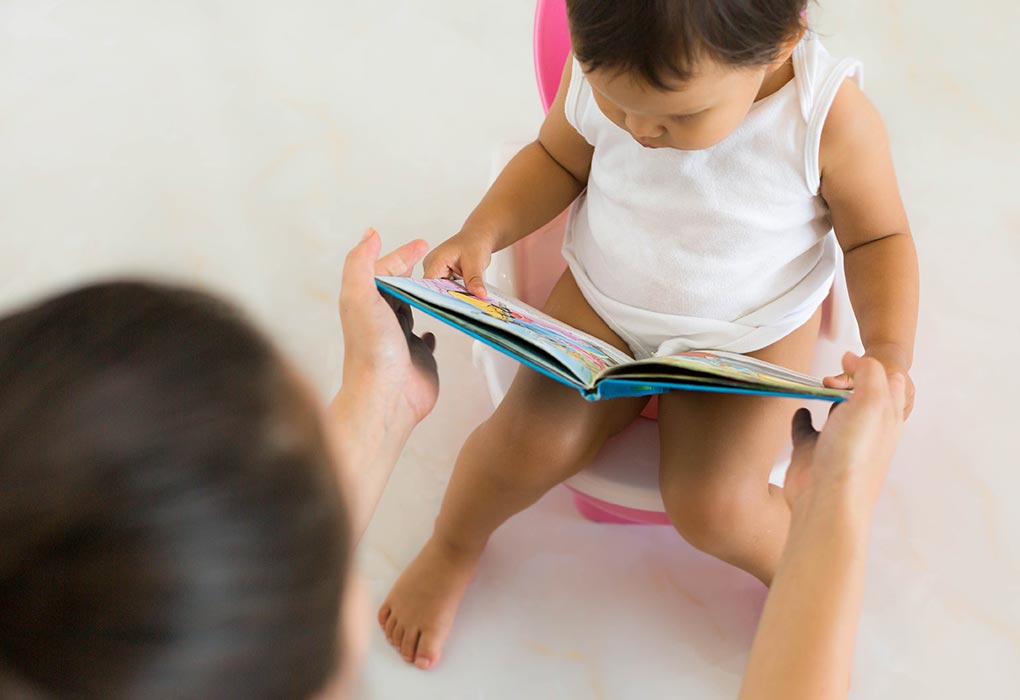
20 Potty Training Games for Toddlers
Potty training is a challenge, and it can be frustrating for both the parent and the child while going through this process. There are bound to be minor triumphs, a few setbacks, and plenty of accidents along the way, so it is important to keep a positive attitude and make the learning process fun for you and your child. Incorporating potty training games into your routine can make the experience more engaging and less stressful. These games to play while potty training encourages your child to practice regularly while keeping them entertained. Patience, consistency, and a playful approach can help create a smoother transition during this important developmental milestone.
Fun Potty Training Games to Play With Your Toddler
Children are naturally curious and are willing to learn if things are presented to them in a fun way, and potty training is no different. Teach your child how to use the potty with these fun and simple toilet training games.
1. Magic Potty
Add a bit of blue food coloring to the water in your potty, and watch the fun as your child notices the water turn green after yellow pee is added to it. You can also get potty training stickers that are blank when dry, but when your little one pees on it, it will show the image of a butterfly, train, flower, and others. These make for some exciting baby potty training games that will keep your little one interested in using the bathroom.
2. Potty Scavenger Hunt
Curious children will enjoy playing potty scavenger hunt as they will need to seek out the potty-related objects that you have hidden around the house. You can explain what they are for once all the items are found. Showing your child what these things are used for will also make her more interested.
Image Credit: Pinterest
3. Bathroom Explorer
Make a game out of exploring the bathroom and talking to your child about what certain things are for. You can even allow her to come to the bathroom with you and watch how things go. Once she is a bit more familiar with the objects and their names, you can always ask her to assist you by asking for simple things like to give you some toilet paper or help you to flush the pot.
4. Potty Training Race
Keep your child’s potty chair in an easily accessible room. Show it to your child and say “time to potty!” You both need to race to the potty chair. Whoever sits down first will be declared the winner. You can mix things up by moving the potty chair to different rooms or more challenging places. Your child can also be encouraged to beat her previous timing if she is competitive.
5. Potty Seek and Find
Children who are uncomfortable when they are outside the home and refuse to go potty anywhere else can be made to feel comfortable with this game. All you need to do is allow your child to pick out a toy to help her find the potty. Place her potty chair in a room without her knowledge. When she finds the potty with the help of her friend, you can then show her how to use the potty with the same toy. Get her to use the potty chair in the new room the same way her Potty Time friend did. This technique can also be used outside.
6. Which Is Faster?
When you are changing your child’s diaper, set a timer on your phone and talk to her about how long it takes to change the diaper and how messy it can be. After changing your child into pull-up diapers, you can ask her if she wants to try playing “Time to Potty” so that she can see that going potty in the potty chair with her new pants is faster and cleaner than going potty in her diapers.
7. Sing a Song
It is not an easy transition to make for a child when she has to shift from the soft and comfortable diapers to the cold and hard potty. You can encourage and make this transition more relaxed and fun by making up a song about it. The song can explain the role of food going in from the mouth, and what happens to it on the way down until it comes out as a potty.
8. Blow Bubbles
When first sitting on the potty, your child is not going to be comfortable, nor is she going to be interested in keeping still. You can hand your child a bottle of bubbles and allow her to blow some bubbles to pass the time. Blowing bubbles stimulate the same abdominal muscles that are used to help push when taking a poop, so if your child is unable to go due to discomfort, this method will help.
9. Chuck the Nappy
Children can grow comfortable with their nappies, but it is not something that they can hold onto forever. Get your little one used to the idea of discarding her own nappies by placing a basket in the living room and asking your child to throw in as many diapers as possible.
10. Log It
Children sometimes need to know that going to the potty is a normal thing to do. To help with this, you can make a chart with all the family members’ names on it, including the pets, and ask your child to record every time someone goes to the potty. Children soon learn that everyone does it.
11. Teach Your Toy
Have your child explain to her favourite toy why she needs to go potty in the potty chair, and have her train her toys. Children will undoubtedly make a game of it, but it will also help them understand the concept of using the toilet themselves. It is, as they say, you learn while you teach.
12. Potty Phone Call
Pretend to make a “phone call” to a favorite family member, friend, or even a toy after your child successfully uses the potty. You can act out the conversation, sharing the exciting news of their accomplishment. This adds an element of fun and reward, as toddlers love the idea of sharing their achievements with others, making potty training a more joyful experience.
13. Decorate the Potty Chair
Having your child decorate the potty chair will make her feel more comfortable and special when she needs to go potty. In fact, it will give her a sense of pride and excitement every time she sees it.
14. Aim for the Cheerios
This is one of the more fun potty training games for boys. Toss a few Cheerios into the potty and then have your little one aim for the cheerios.
Image Credit: Pinterest
15. The Scent of Potty Time
Most girls are fascinated by scented soaps so tell your daughter that she can use the fancy scented soaps to wash her hands after she uses the toilet correctly. This makes for one of the more motivating potty training games for girls.
16. Potty Chart
Create a colorful potty chart where your child can add stickers or draw a small image each time they successfully use the potty. Every time they reach a certain number of stickers, they can earn a small reward, like a favorite snack or extra playtime. This visual representation of their progress will keep them motivated and excited about potty training, making it a fun and rewarding experience for both you and your child.
17. Potty Prizes
Incorporate a reward system with small prizes for every successful potty trip to motivate your toddler. Set up a basket filled with inexpensive toys, stickers, or healthy snacks, and allow your child to choose a prize each time they use the potty. This positive reinforcement encourages consistent use of the potty while making the process exciting and rewarding, turning potty training into a fun game that keeps your little one eager to participate.
Image Credit: Pinterest
18. Understanding Wet and Dry
Help your child understand the difference between being wet and dry by using simple, tactile activities. Take two small towels, one wet and one dry, and let your child feel the difference between the two. Explain that staying dry is the goal during potty training, and they should aim to keep their clothes dry. You can reinforce this concept with fun games, like asking them to spot dry areas on a towel after using the potty, making the learning process more interactive and engaging.
19. Potty Puppet Show
Use puppets or stuffed toys to put on a potty training show for your toddler. Act out different potty situations, like using the potty or washing hands afterward, with the puppets. Your child can participate by helping the puppets learn, making it a creative way to teach the steps involved in potty training.
20. Potty Song and Dance
Create a special potty song or dance routine that you and your child can perform each time they successfully use the potty. This makes potty time feel celebratory and fun. You can even let your child come up with their own moves or lyrics, making them feel more involved in the process while reinforcing positive behavior.
How Do These Games Help With Potty Training?
Potty training games help by turning a potentially stressful process into an enjoyable one for your child. They encourage regular practice without making it feel like a chore, helping your child develop positive associations with using the potty. These games also promote consistency, which is key to successful potty training. By incorporating fun elements, your child may become more motivated to participate, reducing resistance or fear. Additionally, potty training games can improve communication between you and your child, making it easier to track progress and address any challenges that arise.
How to Use These Games Effectively
Using potty training games effectively can make a significant difference in how quickly and smoothly your child adapts to the process. The key is to use these games in a way that keeps your child engaged while reinforcing good habits. Below are a few tips on how to use these games to their full potential.
1. Keep the Games Age-Appropriate
Make sure the potty training games you choose are suitable for your child’s age and developmental stage. Simple, easy-to-understand games are more likely to capture your child’s interest and encourage participation.
2. Integrate Rewards and Positive Reinforcement
Incorporate small rewards like stickers or praise when your child successfully uses the potty during a game. This will motivate them to continue practicing and build confidence in their abilities.
3. Stay Consistent
Use the games regularly as part of your daily potty routine. Consistency helps your child understand the importance of the task while making it feel like a normal part of their day.
FAQs
1. Can potty training games be used for nighttime training?
Yes, potty training games can be adapted for nighttime training by focusing on activities that encourage your toddler to recognize their body’s signals during the night. Simple games like sticker charts for dry nights or small rewards for using the potty before bed can be effective.
2. Are potty training games suitable for reluctant toddlers?
Potty training games are ideal for reluctant toddlers as they help reduce the pressure of training. Games that involve role-playing with toys or interactive potty apps can make the process feel less intimidating and more playful.
3. Can potty training games work without rewards?
Yes, potty training games can still be effective without rewards. Games that involve visual cues like matching potty times to clock hands or fun songs can motivate toddlers by making the process enjoyable without needing physical rewards
4. How long should a potty training game last?
The duration of a potty training game should be short—around 5-10 minutes—to keep your toddler engaged without losing focus. Toddlers have limited attention spans, so quick, fun games that fit into their routine are most effective.
These were some of the many potty training tips and tricks. Children need motivation and encouragement when learning, so remember to be patient with them. Though it can be challenging, children are often easily distracted by the smallest and simplest of things, and training can always be made fun for them by using these games to your advantage. Using potty training games for kids will make it less stressful for both of you, so pick a game your child will like and get started.
References/Resources:
1. Potty training: How to get the job done; Mayo Clinic; https://www.mayoclinic.org/healthy-lifestyle/infant-and-toddler-health/in-depth/potty-training/art-20045230
2. How to potty train; NHS; https://www.nhs.uk/conditions/baby/babys-development/potty-training-and-bedwetting/how-to-potty-train/
3. Toilet Training; Nemours Kids Health; https://kidshealth.org/en/parents/toilet-teaching.html
4. Five do’s and don’ts of potty training your toddler; UC Davis Health Children’s Hospital; https://health.ucdavis.edu/children/patient-education/potty-training-children
5. Potty Training; American Academy of Pediatrics; https://www.healthychildren.org/English/ages-stages/toddler/toilet-training/Pages/default.aspx
6. Toilet Training; Johns Hopkins Medicine; https://www.hopkinsmedicine.org/health/wellness-and-prevention/toilettraining
7. The Right Age to Potty Train; American Academy of Pediatrics; https://www.healthychildren.org/English/ages-stages/toddler/toilet-training/Pages/The-Right-Age-to-Toilet-Train.aspx
Also Read:
Potty Training Ideas For Toddlers
Best Age for Potty Training Your Child
Potty Training Methods – Choose the Best One for Your Child
Potty Training with Underwear – When, Why and How to Start It?
Read more




20 Best Potty Training Reward Ideas That Will Work
Potty training is one of those monumental parenting milestones that come with a mix of excitement, patience, and the occasional, let’s be honest—headache. The process is often unpredictable, and every child responds differently. As a parent or caregiver, you want to make the experience as positive and smooth as possible, right? That’s where potty training rewards come in handy.
Offering a little reward when your child successfully uses the potty can go a long way in motivating them. But what exactly are the best potty training rewards, and why do they work? From small treats to creative ideas that don’t require spending a dime, we’ve compiled a list of rewards that are fun, effective, and encourage good habits. So, let’s dive into some ideas that will make potty training a breeze!
Should You Use Rewards for Potty Training?
Using rewards for potty training can be a great way to motivate and encourage your child, but it’s important to use them wisely. While potty rewards can create positive reinforcement, overdoing it can lead to an expectation of rewards for every little action.
The key is finding a balance that works for your child and helps them develop good habits without becoming too dependent on rewards. Let’s explore the benefits and things to consider when using rewards for potty training.
Effective Potty Training Reward Ideas
Finding the right potty reward ideas can make the potty training process a lot easier and more enjoyable for your child. These rewards should be motivating, age-appropriate, and fun. Below are 15+ reward ideas that can help your child feel proud of their achievements and stay on track.
1. Sticker Charts
Sticker charts are a popular option for a reason. They are simple and let your child visually track their progress. Every time your child successfully uses the potty, they get to place a sticker on the chart. You can even use different stickers for different accomplishments—such as stars for going #1 and smiley faces for going #2.
Why It Works: It’s all about creating a sense of achievement. When they see the chart filling up, they feel proud and motivated to continue. Plus, it’s a great way to involve your child in the process and let them pick out their own stickers.
2. Mini Prizes Box
Create a small box of goodies that your child can choose from after each successful potty session. These can be small toys like plastic animals, little cars, or even items from the dollar store.
Why It Works: Children love the element of surprise and having choices. Knowing they’ll get to pick something out of their special box can keep them interested in the potty training process. Keep the items small and inexpensive to maintain enthusiasm without overspending.
3. Sweet Treats
Offering a small treat, such as a piece of chocolate or a gummy bear, can be a great way to reward your child occasionally. The idea is to give these treats sparingly, perhaps when they accomplish a major milestone like staying dry for a whole day.
Why It Works: Kids love sweets, and the immediate reward is very motivating. Just make sure not to overuse this method so it doesn’t turn into an expectation every time.
4. Extra Playtime
Sometimes, extra playtime or a favorite activity can be the perfect reward. For example, let your child have an extra 10 minutes on their favorite game or spend a little more time outside.
Why It Works: Playtime is already enjoyable for kids. Adding extra time to their favorite activities makes them feel like they’ve earned something special without having to buy anything new.
5. Special Outing
A special outing like going to the park, having a picnic, or visiting the zoo can be a great way to celebrate a week of successful potty use.
Why It Works: It turns potty training into something worth working toward. The anticipation of an outing can be a powerful motivator, and it’s a memorable way to celebrate progress.
6. Praise and Encouragement
Sometimes, a simple, enthusiastic “Great job!” or “I’m so proud of you!” can be enough. Verbal encouragement helps build confidence and makes your child feel loved and supported.
Why It Works: It’s easy, effective, and free. Positive reinforcement through words helps your child understand that they’re doing something good and that you’re proud of them.
7. Potty Books or Coloring Books
Introduce a new potty-themed book or coloring book as a reward. Let your child flip through it while they’re on the potty, making it part of the training process.
Why It Works: Books help your child stay engaged and entertained while they’re learning to use the potty. They can also be a great tool to help them understand potty training in a fun way.
8. High-fives and Hugs
A simple high-five or a big hug can go a long way. Your child needs to feel celebrated and appreciated for their efforts, no matter how small.
Why It Works: Physical gestures like high-fives and hugs can make children feel valued and happy, creating a positive association with using the potty.
9. Potty Song or Dance
Create a special potty song or dance that you and your child do together whenever they successfully use the potty. Make it fun and silly!
Why It Works: Music and movement create joy and make the experience lighthearted. It’s a great way to turn potty training into a fun activity instead of a chore.
10. Temporary Tattoos
Kids love temporary tattoos. Reward them with a tattoo of their favorite character or a cute design after a week of successful potty use.
Why It Works: Temporary tattoos are fun and can be worn with pride. It’s like wearing a badge of honor for mastering a new skill.
11. Reward Coupons
Make some fun “reward coupons” that your child can cash in for special privileges like choosing the family movie, having breakfast in bed, or picking what’s for dinner.
Why It Works: Reward coupons give your child some control and make them feel special. It’s also a great way to keep them engaged throughout the training period.
12. Potty Training Apps
There are apps specifically designed to help with potty training, complete with fun games, rewards, and tracking features. Use these as digital rewards for your tech-savvy little one.
Why It Works: Technology can be a great motivator. The interactive nature of apps helps children stay interested while learning at their own pace.
13. Collectible Cards
If your child is into collectible cards, use them as a reward. Give them a new card after a week of successful potty training.
Why It Works: Collectible items give children something tangible to work towards. They’ll be eager to add to their collection, making them more likely to stay consistent.
14. Movie Night or Family Time
Host a family movie night with your child’s favorite film and snacks as a reward for their potty training success.
Why It Works: Family activities are always special for kids. They enjoy the attention and the opportunity to spend time together in a way that celebrates their accomplishment.
15. Special Potty Toys
Designate a few toys as “potty toys”—these are toys that your child gets to play with only when they’re on or have successfully used the potty.
Why It Works: It adds an element of exclusivity. Having toys that are only available during potty time can make your child look forward to using the potty more frequently.
16. Potty Training Certificate
Create a fun, personalized certificate to celebrate major potty training milestones, such as going a full week without accidents.
Why It Works: Kids love the recognition and it gives them something they can show off to family members. It’s a cute keepsake to commemorate their achievement.
17. Fun Bath Time with Bubbles
A special bubble bath or bath toy can serve as a relaxing reward after a long day of potty training.
Why It Works: Baths are already fun, and adding bubbles or toys makes it even more exciting. It’s a good way to end the day on a positive note.
18. Personalized Song or Video
Make a short video or song dedicated to your child’s potty training success. It doesn’t have to be professional—just something personal and fun!
Why It Works: Kids love seeing and hearing things about themselves. A personalized song or video will make them feel like a star.
19. Extra Bedtime Story
Let your child pick an extra bedtime story as a reward for using the potty all day.
Why It Works: It’s a sweet and calming way to wind down and gives your child more quality time with you.
20. Create a “Potty Hero” Cape
Make a special cape that your child can wear whenever they use the potty. Call them a “Potty Hero” to celebrate their success.
Why It Works: Kids love costumes and role-playing. Being called a “Potty Hero” can make them feel empowered and excited about potty training.
How to Use Rewards for Potty Training
Using rewards for potty training can help motivate your child and make the experience more enjoyable. But it’s important to use them in the right way. Here are some tips on how to effectively use good rewards for potty training:
Begin with simple rewards like stickers or extra hugs. Gradually introduce bigger rewards as your child makes more progress. This helps your child understand that bigger accomplishments deserve bigger rewards.
Use the same reward system every time your child successfully uses the potty. Consistency helps reinforce good habits and makes the training process smoother.
Choose rewards that match your child’s interests. This will keep them engaged and excited about using the potty. For example, if your child loves animals, animal-themed stickers can be a great choice.
While it’s good to celebrate successes, try not to over-reward. Balance praise and tangible rewards to avoid creating dependency on rewards for every potty session.
Pair tangible rewards with verbal praise like, “Great job!” or “You’re doing amazing!” This helps your child feel proud and builds their confidence.
As your child gets better at using the potty, gradually reduce the rewards. This will help them transition from needing external rewards to being motivated by their own success.
Use special rewards like a family outing or a new toy when your child reaches a big milestone. This shows them how much you appreciate their hard work and consistency.
What Kinds of Rewards Don’t Work for Potty Training
While using rewards for potty training can be helpful, not all rewards are effective. Choosing the wrong type of reward can confuse your child or even slow down the process. Here are some kinds of rewards that don’t usually work well for potty training:
Expensive Gifts: Big-ticket items like expensive toys or gadgets can create unrealistic expectations. Your child may start expecting large rewards for small achievements, making it harder to keep them motivated without these items.
Too Many Sweets: While a small treat is okay now and then, relying too much on sugary rewards can lead to health issues or create a habit of expecting food as a prize for every accomplishment.
Irregular Rewards: If you only give rewards sometimes and not others, it can be confusing for your child. Inconsistency makes it harder for them to understand what they’re being rewarded for and can reduce their motivation.
Punishments Disguised as Rewards: Telling your child they can avoid losing privileges (like screen time) if they use the potty can feel like a punishment rather than a reward. This approach can create negative feelings around potty training.
Overly Complex Rewards: Using a system that’s too complicated, like requiring your child to earn points or tokens, can be confusing for younger children and take the fun out of the process. Keep rewards simple and clear.
Choosing the right rewards can make a big difference in your potty training journey, so stick to those that encourage positive feelings and are easy for your child to understand.
FAQs
1. How long should I use rewards for potty training?
You can use rewards throughout the initial stages of potty training until your child becomes consistent with using the potty. As they get better, start phasing out rewards gradually. The goal is for your child to feel motivated by their own success without needing rewards every time.
2. Can rewards cause bad habits during potty training?
If used too much, rewards can create dependency or make your child expect a prize for every small success. To avoid this, use rewards wisely and mix them with praise and encouragement. Gradually reduce rewards as your child becomes more confident.
3. What if my child doesn’t respond to rewards?
Every child is different. If your child doesn’t respond to traditional rewards, try switching to more personalized options like extra bedtime stories or special one-on-one time. Focus on what makes them happy and feel valued.
Potty training can be challenging, but using the right rewards can make it a more positive experience for both you and your child. Choose rewards that match your child’s interests and keep them motivated without going overboard. Remember that consistency is key, and make sure to offer plenty of praise and encouragement. Avoid rewards that are too complicated, expensive, or unhealthy. As your child makes progress, slowly reduce the need for rewards so they become more independent. Celebrate each success, no matter how small. Potty training will become a smoother journey for everyone with patience and the correct approach.
Also Read:
Night-Time Potty Training Tips
Sleep Training For Babies
Chair Sleep Training Method for Babies
Read more
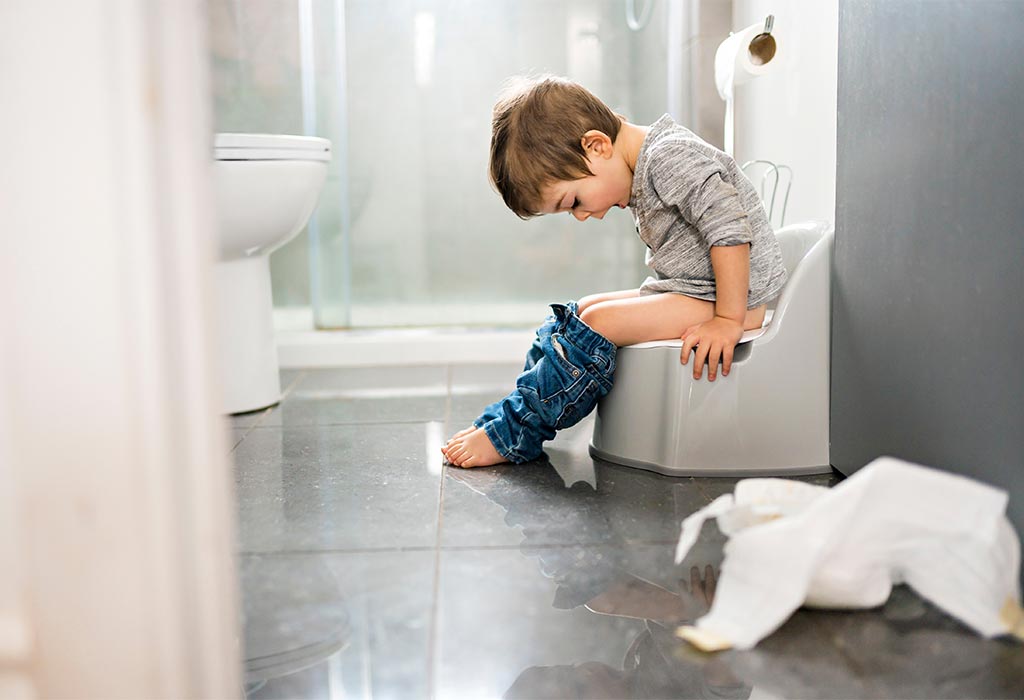
Oh Crap Potty Training Method: How It Works, Pros, Cons, and Tips
The potty training journey is often as much of a rite of passage for parents as it is for children. One of the many methods that have gained popularity in recent years is the “Oh Crap” method. It’s a technique many parents swear by, but, as with any approach, it has its supporters and sceptics. So, let’s dive deep into this method, understand its nuances, and help you decide if it’s the right approach for your little one.
What Is the “Oh Crap” Potty Training Method, and Does It Work?
The “Oh Crap” potty method is a popular approach developed by Jamie Glowacki, a social worker and potty training expert. Her book, “Oh Crap! Potty Training: Everything Modern Parents Need to Know to Do It Once and Do It Right” provides a comprehensive guide on this method.
The method recommends that parents should look for signs of readiness instead of setting a strict age. These include showing interest in the toilet, hiding poop, or telling a caregiver they’ve soiled their diaper. The method suggests completely removing diapers (except during nighttime and naptime) once you decide to start. This can make accidents more noticeable and create a natural incentive for the child to use the potty.
Does It Work?
Many parents have found success with the “Oh Crap” method, praising its straightforwardness and emphasis on natural consequences. These parents often appreciate the structured approach and the clarity it provides. Like any method, it only works for some children or families. Some parents find going ultimately diaper-free too stressful, while others feel their child needs more time to be ready for the suggested age range.
At What Age Should You Start “Oh Crap” Potty Training for Kids?
Transitioning from diapers to the potty is a significant milestone in a child’s developmental journey. For parents who opt for the “Oh Crap” approach, understanding the optimal age to embark on this transition can make the process smoother for both the child and caregivers.
Jamie Glowacki, the brain behind this method, emphasises a ‘golden window’ for potty training, typically between 20 and 30 months old (1). This age range is believed to be when children are most receptive to the process, showing a mix of independence, curiosity, and cognitive awareness that facilitates the transition. However, it’s essential to remember that every child is unique, and parents should be attuned to their child’s specific readiness cues rather than strictly adhering to a particular age.
Oh Crap Method Potty Training Blocks
The potty training journey can sometimes feel like navigating a maze without a map. Thankfully, the “Oh Crap” potty training approach simplifies this by breaking down the process into distinct stages, or “blocks”. These blocks sequentially guide parents and children through the oh crap potty training steps, ensuring that each aspect of training is covered comprehensively.
Block One: Commando at Home
Oh Crap potty training method block 1 stage focuses on the child being at home without any bottoms. The idea is to let them recognise the sensation of having to go without the barrier of a diaper. During this phase, parents should be vigilant, observing for cues that the child needs to pee or poop.
Block Two: Introducing Clothes Without Underwear
This block introduces a clothing challenge once the child demonstrates mastery in recognising their need to go. However, underwear is still avoided as it can mimic the tight feel of a diaper, which might confuse the child.
Block Three: Mastering Self-Initiation
Here, the emphasis is on the child’s ability to initiate the process independently. While parents can remind or ask occasionally, the primary goal is for the child to recognise and act on their need to use the potty without prompting.
Block Four: Overcoming Outings and Challenges
Stepping out of the house can introduce new challenges, such as unfamiliar toilets or distractions. This block helps the child and parent navigate such situations, ensuring the child feels confident using the potty outside the home environment.
Block Five: Introducing Underwear
Underwear will be introduced only after the child has become comfortable and consistent with the previous steps. The transition should be slow, and the child should understand the difference between underwear and diapers.
Block Six: Nighttime Training
The final block addresses the challenge of nighttime potty training. It’s essential to remember that nighttime control often takes longer than daytime control, as it’s influenced by the child’s physical development and deep sleep patterns.
Pros of Oh Crap Potty Training
Introducing the benefits of the Oh Crap Potty Training Method, which has gained popularity for its straightforward approach and successful outcomes. Below are the seven key advantages of this method:
Gentle Transition: Oh Crap Potty Training promotes a gradual and gentle transition from diapers to using the potty. This can reduce stress and anxiety for both the child and the parents, making the process smoother.
Effective Timing: This method encourages potty training at an earlier age (around 20–30 months), taking advantage of the child’s natural curiosity and receptiveness to learning new skills.
Empowerment: Oh Crap Potty Training empowers the child by involving them in the process and allowing them to take ownership of their bodily functions. This can boost their confidence and sense of accomplishment.
Communication: The method emphasises open communication between the parent and child, fostering a deeper understanding of the child’s cues and needs during the potty training journey.
Cost Savings: By transitioning away from diapers sooner, parents can save on the ongoing costs of diapers, contributing to potential long-term financial savings.
Environmental Impact: Reduced diaper usage associated with Oh Crap Potty Training can have a positive impact on the environment by decreasing the amount of disposable diapers in landfills.
Family Independence: Successful potty training promotes greater independence for both the child and the family, eliminating the need for constant diaper changes and enhancing overall convenience.
Cons of Oh Crap Potty Training
While the Oh Crap Potty Training method has its merits, it’s essential to consider potential drawbacks as well. Exploring both sides of the approach can help parents make an informed decision. Here are five notable concerns associated with this method:
Intensive Commitment: Implementing the Oh Crap Potty Training method requires a high level of commitment and vigilance from parents or caregivers, which can be challenging for those with busy schedules or multiple children to attend to.
Early Start: Starting potty training at a younger age may not align with every child’s developmental readiness. Some children might need more time to be mentally and physically prepared for this process, leading to frustration and setbacks.
Accidents and Stress: The method’s no-pants approach and emphasis on learning from accidents might cause stress and embarrassment for the child, potentially affecting their confidence and attitude towards potty training.
Individual Variability: Every child is different, and what works well for one child may not work for another. The one-size-fits-all approach of Oh Crap Potty Training might not accommodate the unique needs and personalities of all children.
Parental Pressure: The intense focus on timely potty training might inadvertently pressure the child and the parents. This pressure can lead to frustration and negative associations with the potty training process.
How Long Will It Take to Potty Train Your Child With the Oh Crap Method?
The duration of potty training using the Oh Crap method can vary significantly from child to child. Factors such as the child’s age, temperament, readiness, and consistency of implementation all play a role in determining how long the process will take (4). On average, some parents have reported successful potty training within a few days to a few weeks, while others might take longer.
It’s important to note that the Oh Crap method focuses on a quick initial phase, during which the child learns to recognise bodily cues and use the potty. However, achieving complete independence and consistency might take more time. Some children might experience setbacks or resistance along the way, which can extend the overall time frame.
What Are Some of the Biggest Mistakes Parents Make With Oh Crap Potty Training Methods?
When implementing the Oh Crap Potty method, there are several common mistakes that parents should be aware of to ensure a smoother potty training experience. Here are five notable mistakes to avoid:
1. Rushing the Process
One significant mistake is rushing through the process without giving the child enough time to adapt. Pushing a child to advance too quickly through the stages can lead to frustration and resistance.
2. Lack of Consistency
Applying the method’s principles inconsistently can confuse the child. Skipping steps or maintaining a consistent routine might help their progress and understanding.
3. Ignoring Cues
Recognising and responding to the child’s cues and signals is essential for their development. Ignoring signs that the child needs to use the potty might lead to accidents and setbacks.
4. Overreacting to Accidents
Reacting negatively or with frustration to accidents can create a stressful environment for the child. Overreacting might make them anxious about using the potty and impact their confidence.
5. Neglecting Communication
Effective communication between parent and child is crucial. Not explaining the process, not involving the child in decision-making, or not addressing their concerns can hinder their cooperation.
How Different Is “Oh Crap” Training Method From “3-Day Potty Training”?
Both the “Oh Crap” potty training method and the “3-Day Potty Training” approach aim to expedite the potty training process, but they have differences in their strategies and philosophies. Here’s a comparison of the two methods:
“Oh Crap” Potty Training Method:
Approach: The “Oh Crap” method, introduced by Jamie Glowacki, emphasises gradual learning and understanding of bodily cues. It involves observing the child’s behaviour and signals to initiate the potty training process.
Timeline: The method does not strictly adhere to a specific time frame. Rather than a fixed three-day period, it focuses on the child’s readiness and progress.
Nudity Phase: The method includes letting the child go without pants or diapers to help them connect bodily sensations with the potty need.
Communication: “Oh Crap” emphasises open communication between parent and child, allowing the child to take ownership of the process.
“3-Day Potty Training” Method:
Approach: Lora Jensen popularised the “3-Day Potty Training” method, which involves an intensive three-day period during which parents focus solely on potty training with little to no distractions.
Timeline: The central idea is to achieve potty training success within three days, with the understanding that accidents may still occur afterwards.
Intensive Phase: During the three days, parents closely monitor the child’s cues and prompt them to use the potty frequently.
Rewards System: Positive reinforcement and rewards play a significant role in this method, with parents offering praise and small treats when the child successfully uses the potty.
Some Common Problems Parents Experience While Oh Crap Potty Training
While the Oh Crap Potty Training method offers a practical approach to potty training, parents may encounter particular challenges along the way. Understanding these common problems can help parents better navigate the process and address potential setbacks. Here are three prevalent issues parents might face:
1. Accidents and Setbacks
During the no-pants phase of Oh Crap Potty Training, accidents are to be expected. However, some parents might find that their child continues to have frequent accidents even after the initial stages. These accidents can be frustrating and might lead to doubts about the method’s effectiveness.
2. Resistance and Fear
Some children might resist or fear using the potty, especially if they’ve experienced accidents or discomfort. This resistance can manifest as tantrums, refusal to sit on the toilet, or increased anxiety around bathroom-related activities.
3. Nighttime Training Challenges
Oh, Crap Potty Training mainly focuses on daytime training. Transitioning to nighttime dryness might pose challenges, as children might not have developed the physical ability to hold urine throughout the night.
How to Deal With Oh Crap Potty Training Regression?
Dealing with potty training regression while using the Oh Crap method requires a thoughtful and patient approach. Regression can occur due to various reasons, such as changes in routine, stress, or developmental shifts. To address regression effectively:
1. Identify Triggers: Reflect on recent changes or events that might have triggered the regression. Identifying the cause can help you address the underlying issue.
2. Maintain Calm: Stay calm and supportive when accidents happen. Reacting negatively can increase your child’s stress and hinder their progress.
3. Revisit the Basics: Briefly revisit the initial potty training steps. Remind your child about cues, potty use, and staying consistent.
4. Positive Reinforcement: Offer praise and rewards when your child successfully uses the potty. Positive reinforcement encourages them to regain confidence.
5. Consistent Routine: Stick to the potty training routine you established. Consistency provides stability and reassurance for your child.
6. Address Anxiety: If your child is anxious, address their concerns. Use gentle communication, potty-related books, or a comfort item to alleviate anxiety.
7. Patience is Key: Regression is temporary and a normal part of the process. Maintain patience and avoid expressing frustration.
8. Seek Guidance: Consult resources related to the Oh Crap method for additional guidance. Books, online forums, or even professional advice can offer valuable insights.
How is the Oh Crap Potty Training Method Applied During Nighttime and Nap Periods?
The Oh Crap Potty Training method primarily focuses on daytime training, and transitioning to nighttime dryness may require a different approach. During nighttime and nap periods:
1. Nighttime Diapers: Initially, continue using diapers or training pants during sleep. Most children achieve nighttime dryness later in the potty training as their bodies develop the ability to hold urine overnight.
2. Limit Fluids: Limit your child’s fluid intake in the evening to reduce the likelihood of nighttime accidents. Encourage them to use the potty before bed.
3. Consistency: Continue fostering a consistent routine. Encourage your child to use the potty before sleep and immediately upon waking up.
4. Transitioning: As your child shows more consistent dryness during naps or wakes up dry in the morning, consider transitioning to training pants or underwear during sleep.
5. Patience: Nighttime dryness might take longer than daytime dryness. Be patient and avoid stressing your child or yourself over occasional accidents.
How to Use the “Oh Crap” Training Method for Twins?
Applying the Oh Crap Potty Training Method to twins requires careful planning and coordination. While it can be challenging to potty train two children simultaneously, the method can still be effective:
1. Individual Focus: Initially, focus on training each twin individually. Follow the Oh Crap Potty Training method for one child at a time to provide dedicated attention.
2. Staggered Timing: Stagger the training periods for each twin by a few weeks. This can help avoid overwhelming both parents and children.
3. Consistency: Keep routines consistent between both children. Maintain open communication and consistent potty breaks for each twin.
4. Support System: Enlist the help of family members or caregivers to assist with one child while you focus on the other. This can provide a balance of attention and support.
What to Avoid While Training Your Twins?
Potty training twins presents a unique set of challenges and opportunities. To navigate this journey successfully, it’s essential to be aware of potential pitfalls and things to avoid. Here are two key points to consider:
Introducing Competition: Avoid creating a competitive atmosphere between your twins. Comparing their progress or achievements can lead to rivalry and negatively impact their learning motivation.
Ignoring Individual Needs: Twins may have different potty training readiness levels and personalities. Avoid assuming that both twins will progress at the same pace. Tailor your approach to each child’s unique needs and abilities.
Signs of Potty Training Readiness in Your Toddler
Recognising the signs of potty training readiness is crucial when considering the application of the Oh Crap toilet training method. Before embarking on this journey, ensuring your toddler is physically and emotionally prepared is essential. Here are five key indicators that your child might be ready for potty training:
Interest in Using the Toilet: Your toddler might show curiosity about the toilet, ask questions, or express a desire to imitate older family members.
Physical Signs: Look for signs such as staying dry for extended periods, indicating improved bladder control, or discomfort when the diaper is wet (3).
Communication Skills: If your toddler can communicate basic needs, express discomfort, or understand simple instructions, they are more likely to grasp the concepts of using the potty.
Awareness of Bodily Functions: Your child may start indicating when they are about to pee or poop, whether through words, gestures, or changes in behaviour (2).
A desire for Independence: If your toddler expresses a desire to do things on their own or shows an interest in dressing and undressing themselves, it might indicate readiness for potty training.
Tips for Preparing Your Child for Potty Training
Preparing your child for potty training using the Oh Crap method involves setting the stage for a smooth and positive transition. Taking specific steps before you begin can increase the likelihood of success. Here are five essential tips to help you prepare your child for potty training:
Introduce the Concept: Begin by casually introducing your child to the idea of using the potty. Read potty-related books, watch videos, or talk about the toilet in a positive and fun way.
Choose the Right Equipment: Invest in a child-sized potty chair or a seat reducer for the regular toilet. Allow your child to become familiar with the equipment before starting the training process.
Set a Routine: Establish a consistent routine for potty breaks. Encourage your child to sit on the potty regularly, such as upon waking up, after meals, and before bedtime.
Use Positive Language: When discussing potty training, use positive and encouraging language. Avoid any negative connotations or pressure that might cause anxiety.
FAQs
1. Do boys take longer for Oh Crap potty training?
The duration of potty training can vary among individual children, regardless of their gender. While it’s commonly believed that boys might take longer to potty train than girls, a strict rule doesn’t apply to all children. Factors such as developmental readiness, temperament, and consistency of the potty training approach play a more significant role in determining the timeline for success. Some boys might catch on quickly using the Oh Crap method, while others might take a bit longer to grasp the concepts thoroughly.
2. How can you know if the Oh Crap method isn’t working?
If you’re using the Oh Crap potty training method and find that your child is not making the expected progress, there are a few signs that might indicate the approach isn’t working as intended:
Consistent Accidents: If your child is having frequent accidents even after the initial stages of potty training, it could be a sign that they are struggling to understand the connection between bodily cues and using the potty.
Resistance or Fear: If your child shows increased resistance or fear of using the potty, it might indicate that they are uncomfortable with the training approach.
Lack of Progress: If you see significant progress over an extended period and your child seems to adapt to the method, it could be a sign that it’s not the right fit for them.
Potty training using the Oh Crap method can be an effective and practical approach for many parents and toddlers. You can embark on a successful potty training journey by understanding the method’s principles, recognising signs of readiness, and being prepared for potential challenges. Remember that every child is unique, and their progress will unfold at their own pace. Whether you choose the Oh Crap method or another approach, patience, consistency, and a supportive environment are critical factors in achieving positive outcomes in the potty training process.
References/Resources:
1. Mockensturm. L; Oh Crap Potty Training: A Guide for Parents; WonderBaby.org; https://www.wonderbaby.org/articles/oh-crap-potty-training
2. Potty Training; C.S. Mott Children’s Hospital; https://www.mottchildren.org/posts/your-child/potty-training
3. Potty Training Children with Special Needs; American Academy of Pediatrics; https://www.healthychildren.org/English/ages-stages/toddler/toilet-training/pages/Toilet-Training-Children-with-Special-Needs.aspx
4. Oster. E; The Best Potty Training Advice; ParentData; https://parentdata.org/potty-training-best-advice/; July 2023
Also Read:
14 Innovative Ideas to Potty Train Kids Quickly
Potty Training Games for Children
Potty Training Essentials for Toddlers
Read more
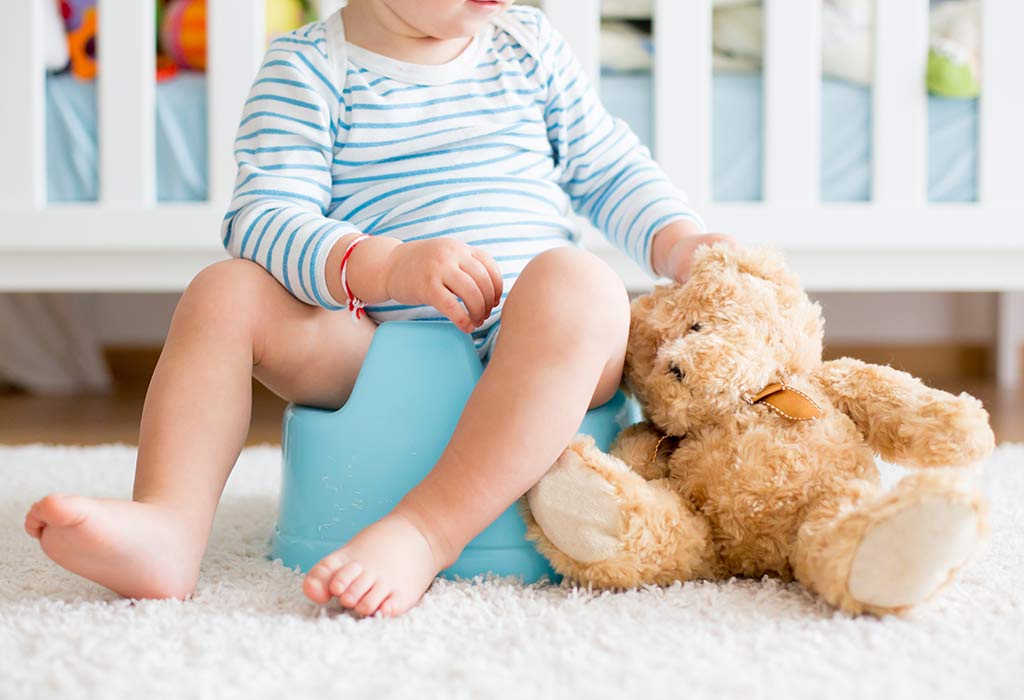
Toilet Training the Kids With Autism Spectrum Disorder
Toilet training can be a daunting task for the parents, and when it comes to potty training or toilet training a child with autism, it can get more taxing for the parents. However, there are some measures and tips that you can take to make the training an easier and more comfortable experience for your child and you. Read on to learn unique ways of toilet training kids with autism disorder and how to overcome their fears.
When to Toilet Train an Autistic Child?
The first and foremost step when you plan to potty train an autistic child is to look for signs of readiness. Here are some signs that you should look for in your child:
There are no medical reasons that may interfere with the child’s training.
The child is approximately four years old and with no medical condition that may hamper the training.
The child has regularly formed bowel movements.
The child has become aware of the need to go to the toilet.
The child stays dry most of the night.
The child fidgets or gets uncomfortable when peeing or soiling the diaper or pants.
The child has reached the cognitive age of 18 to 24 months.
There is no added stress at home, such as a change of place, major illness, divorce, death, etc.
You can manage toilet training or autism bowel movements if your child exhibits some of the above-mentioned signs.
How to Prepare the Autistic Children for Potty or Toilet Training?
Preparing the autistic child for potty training or toilet training is more or less similar to training a normally developing child. However, for a child with ASD or autism spectrum disorder, the parents will require some strategies, or they may be required to put in more effort according to the needs and requirements of their child. The most important thing to remember is that communication with the child and being on the same page as your child for the success of the training. Take one day at a time, which means making smaller goals and trying and achieving them rather than aiming at bigger unachievable goals. To begin with, you can start talking to your child about going to the toilet and familiarising him with the concept of toilet training.
How to Toilet Train Autistic Kids?
Here are some toilet training strategies that you can adopt:
1. Communicate
It is important to start talking to your child about toilet training. No, we are talking about making elaborate explanations or commands. You can start by giving visual signs or prompts, and these can further be assisted with direct language. Keep the communication simple by saying “time for poo-poo” rather than making any elaborate statements or conversations.
2. Refrain From Fussing Over Accidents
Accidents are bound to happen, and all you need to do is not fuss over it or make a big deal of it by showing anger, teasing, cajoling, or even discussing it with your child. Leave the discussion and talking for the time when your child shows signs of readiness.
3. Get Your Child In Underpants
Though most parents may feel intimidated by the mere thought of shifting to underpants without proper toilet training, however, it is important to understand that it is an important part of training. The modern-day diapers are so good that the child does not even realize that he has urinated. Whereas shifting to underpants will make him realize when he pees or soils himself, and thus the child may feel the need to change.
4. Social Stories
One of the most effective ways of toilet training autistic children with social stories. This strategy aims at developing behaviour and responses that may help children cope with confusing or challenging situations. There are trained professionals that may help in making social stories for your child for toilet training.
5. Rewards and Encouragement
There are no better learning strategies than praising and encouraging your child for his efforts. Words like “well-done baby” and non-verbal actions, such as thumbs up or high five, are great ways of enforcing a good toilet training routine in your child.
How to Toilet Train Nonverbal Kids With Autism?
If you think it will be tedious to train nonverbal kids with autism or how to potty train a nonverbal autistic child, well, most parents may struggle with it because such children do not show usual signs when they may want to go to the toilet like other children. However, taking the following measures may help:
Using visual support, such as pictures or other visual aids, may prove to be helpful.
Being direct and crisp in asking children with nonverbal autism may prove to be helpful. Instead of asking too many questions, you can simply ask a direct question – whether or not he needs to go to the washroom or not.
Help your child to communicate by using visual support, such as showing a picture of the toilet seat.
Try and know the signs as sometimes the child may not say or do anything but still will be letting you know that he needs to go to the toilet. For example, he may look at you and then towards the toilet. Try and understand the hints.
Tips to Overcome Toilet Training Challenges of Children With Autism
If you are wondering can autistic toddlers be potty trained or how to toilet train autistic girl or toilet train autistic boy, well, here are some tips that may help you overcome the potty training challenges of children with autism:
Pick one word or phrase whenever you want your child to go to the toilet. You can also ask the other family members to do the same.
In case you feel your child is experiencing any difficulty with the potty training stage, skip it for a while and try again when your child feels comfortable.
Use clearer instructions and language to make your child understand what you want him to do rather than making ambiguous statements. This may help a great deal for potty training autistic 4-year-old or younger children.
Using reusable underpants or liners may come in handy as it would help your child know when he needs to go to the toilet.
Help your child to let you know when he needs to use the toilet. This need not necessarily mean verbal communication, but it can be non-verbal too.
Do not make your child sit on the toilet seat for long. Make him sit for a few minutes rather than sitting for longer durations, as it may make him think that he is being punished for something.
Maintain your calm and patience with your child. It will take time, but your child will be on the right track soon.
Always be warm and kind towards your child’s efforts, no matter how trivial or big they are. Encouraging behaviour goes a long way in helping the child learn better.
Additional Tips to Make Toilet Training a Success
Here are additional tips for children with autism and potty training:
Try and make your child comfortable with the potty training experience by making him sit on the potty seat for a few minutes every day before you actually begin potty training.
If your child is scared of sitting on the seat, you can use a training seat that is specially designed for children.
Try using a stool to provide leg support to your child.
Children may feel scared of the loud flushing sound; make them aware of such things beforehand itself.
There is no denying that toilet training can get a bit taxing for both the child and the parents. However, consistent efforts will help in yielding positive results. If you are not able to manage the training, it will be a good idea to seek professional guidance from your doctor.
References/Resources:
1. Parent’s Guide to Toilet Training Children with Autism; Autism Speaks; https://www.autismspeaks.org/sites/default/files/2018-08/Toilet%20Training%20Guide.pdf; May 2012
2. Toilet training: autistic children; raisingchildren.net.au; https://raisingchildren.net.au/autism/health-wellbeing/toileting-hygiene/toilet-training-autism
3. Seven toilet training tips that help nonverbal kids with autism; Autism Speaks; https://www.autismspeaks.org/expert-opinion/seven-toilet-training-tips-help-nonverbal-kids-autism; February 2016
4. Potty Training A Child With Autism; Autism Response Team; https://autismresponseteam.com/potty-training-a-child-with-autism/; April 2022
5. Nunez. A; Potty Training For Autism – The Ultimate Guide; Autism Parenting Magazine; https://www.autismparentingmagazine.com/autism-potty-training-guide/; February 2023
6. Toileting – a guide for parents and carers; National Autistic Society; https://www.autism.org.uk/advice-and-guidance/topics/behaviour/toileting/parents
Also Read:
Myths & Facts About Autism Spectrum Disorder
Interesting Games and Activities for an Autistic Child
Educational Options for Children With Autism Spectrum Disorder
Read more
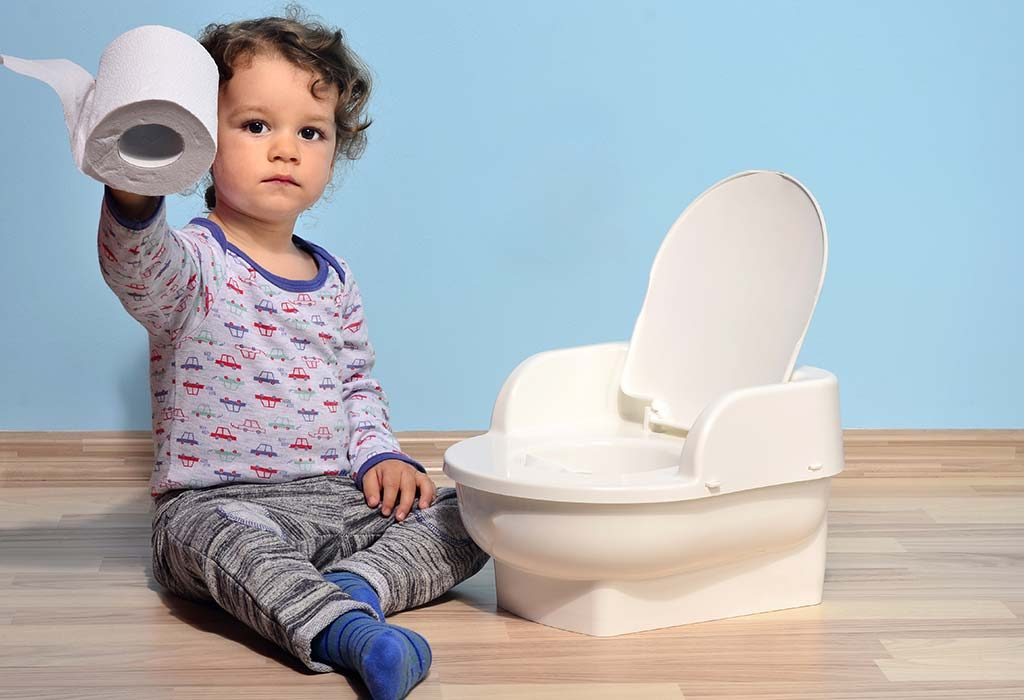
Potty Training Methods – Choose the Best One for Your Child
You could have reached the end of your patience spectrum after spending on diapers. Your child is about to start an activity or school that requires them to be mandatorily potty trained. Once you begin, you will realise that there are a lot of specifics that you are unaware of.
Unfortunately, potty training is not as simple as directing your child to the toilet and getting them to use it. As you speak to peers or start your own research, you will start feeling overwhelmed with the difference of opinions and approach to styles of training. So, how do you decide what works best for you? Well, we cannot say what potty training techniques will work and what will not, but we could list the pros, cons and steps involved in a few of the most popular potty training methods.
What Is Potty Training?
Potty training is the process of teaching young children to use the toilet for urination and bowel movements instead of relying on diapers (1). It involves introducing the child to a potty chair or toilet, encouraging them to recognise bodily signals, and gradually helping them develop the skills to use the toilet independently. Successful potty training typically requires patience, consistency, and positive reinforcement from caregivers.
Which Are the Best Toilet Training Methods for Children
If you are ready as a parent to start potty training your child, the next stage is to consider which style is best suited for you and your child. There is no bespoke method that will guarantee results and every method to potty train comes with its fair share of advantages and disadvantages. There are different potty training methods. Listed below are a few and we have elaborated the advantages, disadvantages, process involved and who it is suitable for.
1. Child-oriented Potty Training
Introduced by T Berry Brazelton, a paediatrician, this is the most successful potty training method for toddlers and takes into consideration the readiness of the child to train (2). Parents who are happy to wait for their children to be ready to cooperate will highly benefit from this method.
Suitable For:
Suitable for 2-3 years of age, preferably 3 years when the child can tell you when they want to use the toilet or go to the bathroom.
Pros
Does not require a parent to put their entire focus on this task or set aside dedicated time for it.
Instigated by the child, this method involves less resistance and regression.
Cons
Not a plan which yields quick results.
Parents may have to continue paying for diapers for long, unlike other potty training methods.
Process
Parents must talk about using the toilet with their children and encourage them to use it.
No extensive efforts must be made to push the child towards it.
Parents should continue to talk to the child and keep a watch on the child’s natural interests to develop and encourage the child to act on their own instincts.
Parents can also use themselves as models and get children to mimic them.
Parents let kids take the lead in making their trips to the bathroom and continue using diapers or pull-up training pants until a child goes to the toilet before wetting or soiling their diapers.
2. Training Pants
A shopping milestone- a mother will always cherish buying her kid’s first pair of underpants. Training pants are slightly padded to absorb the liquid in case of any accidents and is one of the best methods to potty train a boy.
Suitable For:
It will be suitable for kids aged 4 and above who are not yet potty trained. 4-year-olds are a little wiser, communicate and understand better.
Pros
When a child wees or poos, the child will understand the sensation and how it feels to be wet or soiled.
The child will be more inclined to use the toilet.
Cons
Be ready for soiled areas- carpets, rugs, mats, floors will probably be covered in wee and poo.
Resist the temptation to scold the child and tell them that if they want to use the toilet you can take them.
Process
Get rid of the diapers and get your child to wear the training pants.
Take them to the toilet at regular intervals to see if they want to use the toilet.
Make sure you take them to the toilet after they have wet or soiled their pants so that they know what the feeling is like.
3. Three-Day Potty Training
Psychologists Nathan Azrin and Richard Foxx rooted for this train-in-days method and research suggest that this is also equally successful.
Suitable For:
It is suited for parents who wish to potty train their children quickly. It works best when a child is about 22 months old.
Pros
A quick training plan, it is best suited for parents who wish to send their children to playgroup, school or activity.
Cons
Takes away a significant amount of time from the family as the focus is entirely on potty training the child.
This method also has plenty of window for accidents as it is a fast-paced method.
Process
All diapers are thrown out on Day 1. Children are dressed in a big T-shirt and big size underwear. ( Make sure you have a large stock of underwear).
Encourage the child to have lots of liquids to start peeing.
Show the child the toilet and where they need to go if they need to pee.
Accidents are inevitable and parents must make sure they pick the child up halfway through the incident and get them to finish in the toilet.
This process must continue until parents are able to achieve success. Parents must stay calm, encourage children at every step and ensure that accidents are used as an example to teach the child.
4. Elimination Communication
One of the early potty training methods for girls and boys, Elimination Communication or Infant led method is very popular among families in Asia and Africa (3).
Suitable For:
It is generally begun when the child is months of age and finished by the time the child is able to walk.
Pros
Less expenditure on nappies.
Babies suffer fewer rashes because of soiled or wet nappies.
Parents feel more attached to their children.
Cons
Involves a substantial amount of time to train and wholly depends on catching cues from kids all the time.
It will not work if carers, caretakers or nannies change frequently.
Process
Disposable diapers are completely avoided and cloth nappies are used for the night. This helps the child to realise that they have wet themselves.
Parents rely on timing, patterns, gestures, sounds or just intuition to take their child to the toilet. The moment parents receive a signal they rush the child to the bathroom to relieve themselves.
5. Parent-led Potty Training
Organized toilet training techniques, this method will appeal to you if you love schedules.
Suitable For:
It is ideal for parents who like to stick to a schedule and when a child has multiple caregivers. It can be started whenever the child is ready.
Pros
Ideal for different people looking after the child to follow the schedule.
There is no need to change the schedule or earmark days to focus solely on potty training.
Cons
As the visits to the toilet are not initiated by the child themselves, they may not learn to recognise the bodily signs of nature’s calls.
Process
Parents could develop their own schedule for the child to visit the toilet. It could vary as per the family’s convenience.
Parents could also encourage times when the child expresses interest to visit the toilet by themselves.
6. Wait-and-Pee/Wait-and-Poop
This method is simply following the scheduled clockwork approach with a little more precision.
Suitable For:
Ideal for children who are still on a nappy and need to be trained ( but there is some more time for them to be completely independent).
Pros
Fewer chances of accidents as your child is still on nappies.
You child will learn the instinct slowly and gradually when a pattern emerges slowly.
Cons
Children may not always cooperate to sit on the pot.
With nappies still on, the child may not learn to understand their natural instincts.
Process
With your child in pull-up diapers, get them to sit on the pot after waking up, before a nap, before meals and before bedtime.
There may be chances that the pot is empty. Flush it still for the child to know what follows next.
7. Potty Planner
A slow and steady approach, this method follows the child’s lead and takes into consideration the readiness of the child to train.
Suitable For:
It is suited for those children who need to be prepped before any task or training.
Pros
Training is easy if your child is ready.
A casual approach, some kids could be quick learners.
Cons
This method could take a while if the kid is not ready.
Process
Set up a potty seat in the bathroom or living room. The idea is to get the child to get used to the idea of sitting at a different place to empty their bladder or bowels.
Gradually introduce the idea by reading potty training books or watching videos
For the first few days, the child may sit on the pot and do nothing. But with continuous effort, you will achieve the end result.
Once the child has gotten used to peeing or pooing in the small pot, you can make the next step of sitting on the toilet seat.
8. Eyes on the Prize
This method relies on rewards to entice your little one.
Suitable For:
Works well for children who love to work towards a goal or earn a reward for something they have done well.
Pros
Low-stress approach as there is no pressure to learn quickly.
Cons
There may be a demand after every successful trip to the toilet. It may take some time to wean off.
Process
Stock on things that your toddler or little one loves.
A reward chart ( at the bathroom door) might also help to track the progress and they can see their achievement as they work along.
9. Bare-Bottom
One of the effective potty training methods for girls, it catches on really quick.
Suitable For:
Ideal for girls and boys over 2.5 years of age.
Pros
Inexpensive as you do not need to spend on diapers.
Cons
Not good for parents who do not like their kids to remain naked for a long time.
Process
A great method for summers, let your child roam naked and encourage them to drink a lot of water.
Like the underwear, once the wee or poo rolls down their leg, your child will discover their Eureka moment.
How to Choose the Best Potty Training Methods
Every child is unique, so selecting an approach that aligns with their temperament and your family’s routine is key. Here are some tips to help you decide on the right toilet training methods (4):
1. Assess Your Child’s Readiness
Look for signs that your child is ready, such as showing interest in the toilet, staying dry for longer periods, or being able to follow simple instructions. Starting too early can lead to frustration, so timing is important.
2. Consider Your Child’s Personality
Some children respond well to structured methods like the “three-day potty training” approach, while others may need a more gradual, child-led process. Tailor the method to your child’s comfort level and pace.
3. Choose a Method That Fits Your Lifestyle
Evaluate your family’s schedule and choose a method that works for you. For example, if you have a busy routine, a slower, more flexible approach might be better than an intensive, time-consuming one. Consistency and patience are essential for success.
Tips Before You Begin Potty Training
Before starting potty training, preparation and a positive mindset can set the stage for success. Here are some tips to help you get started. Every child is different, so finding the best potty training techniques that work for your little one can make the process easier and less stressful. (5):
Look for cues like staying dry for longer periods, showing interest in the toilet, or being able to communicate their needs. Starting when your child is ready makes the process easier.
Have a potty chair or toilet seat adapter, training pants, and easy-to-remove clothing on hand. Let your child pick out their potty chair to build excitement.
Use encouraging language and avoid pressure or punishment. Celebrate small successes to keep your child motivated and confident.
FAQs
1. Can potty training cause constipation?
Yes, some children may hold in bowel movements during potty training due to fear or discomfort. To prevent constipation, ensure your child stays hydrated, eats fibre-rich foods, and avoids pressuring them. If the issue persists, consult a paediatrician.
2. How do I handle potty training while travelling?
When travelling, bring a portable potty seat or disposable seat covers for public restrooms. Stick to your routine as much as possible, and keep extra clothes and cleaning supplies handy for accidents.
3. Can siblings or pets influence potty training?
Yes, siblings or even pets can play a role! Younger children often learn by observing older siblings, so involving them in the process can be helpful. Some parents even use pets to demonstrate bathroom habits, though this is more about making the process fun and relatable.
4. Should I worry if my child pretends to use the potty with toys?
Not at all! Pretend play, like having dolls or stuffed animals “use the potty,” is a positive sign. It shows your child is processing the concept and can make them more comfortable with the idea of using the toilet themselves.
Most children potty train between the age of 18-24 months. Some, however, are not ready until the age of 3. The average age for potty training is said to be 27 months. Potty training must not be a punitive process and reprimanding a child is not an ideal solution. Stay calm and encourage your child to visit the toilet to learn how to use it as a natural process.
References/Resources:
1. Stanford Medicine – Toilet Training
2. National Library of Medicine – Toilet learning: Anticipatory guidance with a child-oriented approach
3. National Library of Medicine – Delayed elimination communication is a crucial factor in disposable diaper dependence in Chinese preschool-aged children
4. American Academy of Pediatrics – Toilet Training: Which Method is Best?
5. Nemours Kids Health – Toilet Training
Also Read:
Games for Potty Training a Toddler
Potty Training Clothes for Toddlers
Potty Training Chart to Train Your Child
Innovative Ideas to Potty Train Kids Quickly
Read more
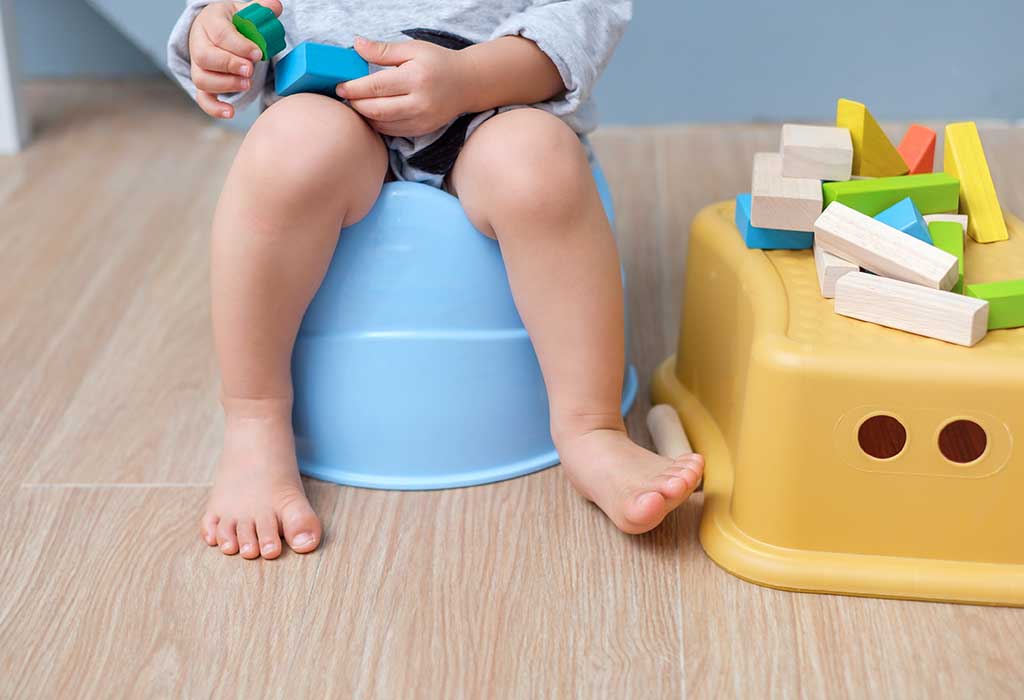
10 Songs That Will Add Some Fun to the Potty Training Process
One of the most challenging times as a parent is getting your little one to potty train. It’s a tedious process where the child needs to concentrate and feel at ease so they can go potty on their own. There have been thousands of techniques that show you how you can make potty training fun for your little one. Incorporating songs into the process have witnessed some great results.
There are many poop songs for potty training a child and they can actually be super fun to sing. The child too feels at ease singing the song and it helps them poop out better, and speeds up the overall process.
Here’s a list of super simple songs for easier potty training –
Best Potty Training Songs That Your Child Will Enjoy
There are plenty of poop songs for training your child, and we’ve broken it down to the top ten. You can also click on the video links to view it and teach it to the little ones –
1. Potty Training 101 Poop Song
This is one of the best toilet training songs you can teach your kids and help them expedite the process. Made by Growing Sound, the Potty Training 101 Poop Song is a one-stop-shop of everything related to potty training and poop for the little ones. It covers every step of the process and doesn’t leave much to the imagination. It’s a great way to get them to understand the whole process and incorporate it into their daily lives.
For example, the lyric, “I sit and wait until poop plops down, then I wipe and wipe ‘till brown leaves town” pretty much sums up how the rest of the song sounds as well. Kids get a good idea about what they’re being asked to do and since it’s pretty short, it can be learnt soon so kids can quickly absorb the lyrics and have fun.
https://youtu.be/Vtq1XV6ZVOc
2. Ginneh’s Potty Song
This is another one of those creatively simple and super fun songs you can teach your little one. Back in 2016, Stacia Wright, a mother from Maryland came up with a great idea to get her 2-year old daughter to poop and get potty trained. This super catchy potty song for kids is an excellent way to teach kids about communicating when they want to do the business. Wright came up with the idea after having already gone through the same with her elder son. She knew what she was in for and wanted to avoid occurrences of accidents and the likes. She also wanted to make the whole training process fun for herself and her little daughter, and devised this absolutely fun song, with a cute video to go along with it.
3. Elmo Potty Time
How do you get stubborn kids to learn about pooping? You get one of their best friends to help you in the process. In this case, their friend is the ever adorable Elmo from Sesame Street and kids will trust any song he sings them. He’s a super curious chap and looks at the world the same way the kids who watch Sesame Street do.
Watch him and his dad walk through the many steps of using the toilet correctly and try to get your little one interested in the process too. They sing a song that’s jazzier than what you’re expecting, but ultimately it gets the work done.
4. Two Little Hands: Potty Time
This is another super interesting and great video that has an upbeat tempo. It’s a great potty rhyme for toddlers to learn all about pooping and finishing the job soon. The popular kids’ YouTube channel, Funtastic TV made a video that’s extremely cute and adorable. It’s a song that everyone in the family can sing and enjoy. The bonus is that the video also teaches you how to say “potty time” in sign language.
https://youtu.be/9wadtd38Qb8
5. Daniel Tiger: Stop and go Potty
Sometimes, kids might face trouble when it comes to potty training because they just don’t want to stop playing and having fun. A bathroom break might seem like a major inconvenience for them and can be annoying. You need to get them interested in the process and Daniel The Tiger reassures them that there won’t be any stop in the fun. This potty video song is a great way to help anxious or excitable kids to take a break and complete pooping, and their toys will be waiting right where they left them.
https://www.youtube.com/watch?v=zYipJTAXJFE
6. I Can Pee and Poop on the Potty
This is another one of those super catchy and fun songs that make for great potty training music for your little ones. This is a song about a kid superhero who’s really smart and good at one thing – going to the potty. He can poop, pee and wash his hands too. There’s not much going on with regards to the video but this is an excellent way to get your kids excited. The simple and quick song explains the basics of all the training steps.
7. You’ll Use the Potty
Sesame Street is back at it again, and this time the whole crew’s involved. They simplify a complicated thought – we are all slaves to our bodily functions and potty too, is one of them. Kids can absorb this lesson better coming from the likes of Big Bird and co. and since this is a Cole Porter song, you’re sure to appreciate the melody and lyrics it comes with.
8. Bear in the Big Blue House
The Bear in the Big Blue House is another pee pee potty song and handles the subject with the gentlest tone possible. It is approached more like a primer to allow kids to get used to the idea of being potty trained than actual instructional songs. It’s a three-minute-long song but we’re sure your kid doesn’t spend that much time.
https://www.youtube.com/watch?v=gHdBsTYCQbI
9. Toilet Time Is Fun
The animation is pretty wild, but the song has its heart in the right place. This cute little panda-inspired song has a kid that poops in the right place and ultimately, that’s what it’s all about.
10. Little Baby Bum: Potty Song
Potty training the kid requires repetition and patience, from both yours and their end. There are accidents that are bound to happen in the initial stages and when they do, kids might feel disappointed or frustrated. Little Baby Bum, a YouTube channel specializing in nursery rhymes teaches kids all about being happy and building poo-poo resilience until they can get the process right.
These are some of the fun ways you can get your children more involved and interested in the entire potty training process. Make sure you sing along with them so they feel more secure and try to be patient with them throughout the process. The more fun you make it, the more fun they’ll have and the whole potty training process becomes a fun task rather than a chore.
Also Read:
Potty Training Games for Toddlers
What is the Best Age for Potty Training Your Kid
Dressing Up Your Kid For Toilet Training
Read more
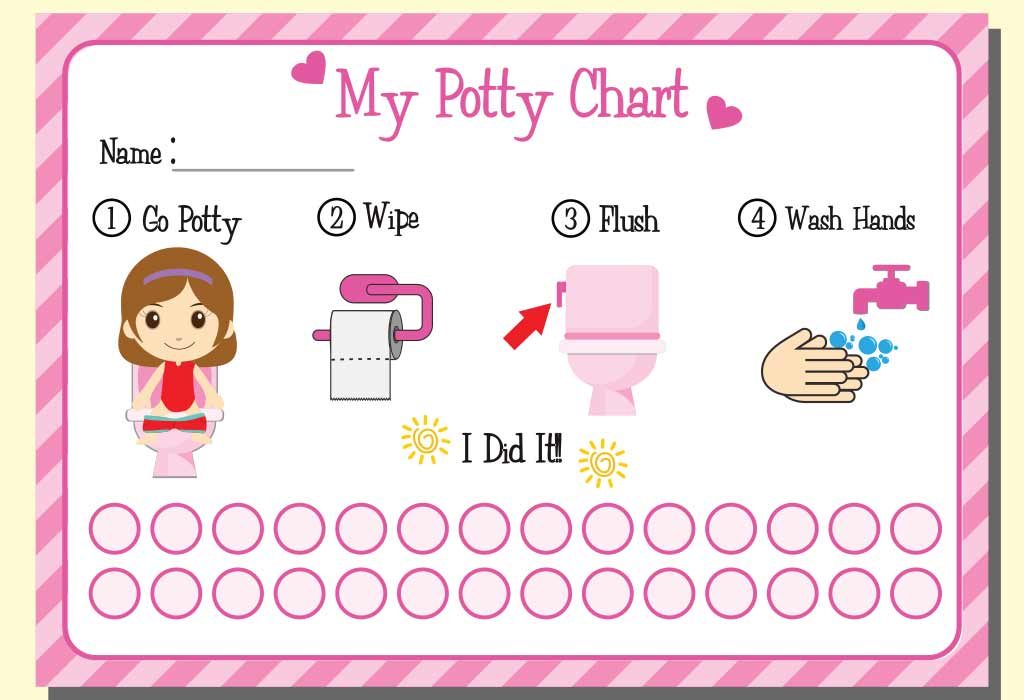
Potty Training Chart – How It Helps in Toliet Training Your Child
The early years of your baby are filled with beautiful milestones, such as the charming first smile, the first steps, teething, and potty training! It is often challenging to teach babies how to use the toilet instead of diapers, but it is still one of the most important and rewarding milestones the kid must reach. There is no specific age to start potty training; some children would be ready to begin training at 2 years of age, and others may go as late as 4 years. Either way, you may want to maintain a potty training chart that will help you train your little one more efficiently and also make the learning process fun for him. When you start potty training your child, it can feel difficult. But using potty training charts can help. Read on for some ideas for toilet training chart printables.
What Is a Potty Training Chart?
A potty training chart is a fillable calendar or chart that helps celebrate the bathroom successes of your child. It is a way to document each time the child uses the potty successfully and does not have an accident. This is done by filling an empty box on the chart with check marks or stickers. When the chart is full at the end of the week or at the end of the day, he gets a reward.
How to use/fill the chart and track the potty schedule is completely up to you and your child. Personalisation is a great place to start from! You can help the child checkmark the box or draw a fun star to encourage participation. You can get cute little stickers, too, of your child’s favorite superhero, animal, or movie character to increase his excitement.
When it is time to reward, you can give a delicious treat, a small toy, or another fun activity that you are sure your child will love! You can keep the kid motivated to continue the chart as long as he or she is happy!
A potty training chart is a great tool to keep the toddler happy and motivated while learning to use the bathroom! Let’s take a look at some more benefits of potty training charts.
Benefits of Potty Training Charts
Potty training charts are not just helpful for training the child to use the potty, but they are also incredibly helpful for the parent. These charts can help keep track of the number of accidents and successes your little one has had over a period of time. It can help you keep your child motivated by giving him a sense of realisation and self-awareness that there is a wrong and a right way to do something. The reward system also attracts the child to potty train soon. In addition to this, the information can be extremely helpful when updating the child’s pediatrician about his bowel movement schedule.
Signs That Your Child Is Ready for Potty Training
Let’s take a quick look at some signs that indicate your little one is ready to be potty trained.
Fewer diaper changes: Once your kid can stay dry for more than an hour, then it means they are able to control their bladder and are physically ready to potty train.
The child is more expressive about using the bathroom: You will be able to notice facial and verbal expressions from the kid when they need to use the bathroom.
The bowel movements of your child become more consistent: If you can predict when the child has to go, then it is another indicator that he is ready to potty train.
Your child dislikes dirty diapers: Many toddlers reach a stage of disliking their personal messes, and these would include dirty diapers. This is an amazing opportunity to get them out of their diapers and help them start using the bathroom.
How to Use Potty Charts
It is important to have a visual representation for your child to give a sense of achievement for potty training successes. Here are some tips that will help your little one get excited about the chart while understanding what the chart is about.
1. Hang the Chart on the Wall
Constantly seeing the chart will remind the kid to use the potty seat and not go in their training pants or diapers. Your child might need many reminders to tell you when he wants to go because it is a new concept, and the chart is another visual reminder.
2. Use Stickers
An amazing way for your child to check their potty training success is to use stamps or stickers. The excitement children witness when seeing the stickers on the potty training chart drives them to train quickly and efficiently.
3. Discuss
It is important to explain to your child why he is getting his favorite stickers. This will motivate him, and he would want to potty train to increase the number of stickers on the charts.
4. Constant Reminders
Children need constant reminders from their parents to let them know when they need to go. Therefore, ask your kid as many times as possible and as often as possible to let you know when he has to go and show the chart so he knows what exactly you are asking for. Children understand when their attention is directed to the chart and instantly tell their parents when they want to use the potty.
5. Using Frequently
It is also important to ensure the kids fill up the potty reward chart with frequent trips to the toilet. Give them plenty of fluid on the potty training days and keep them on the schedule so that the number of stickers increases, building up their excitement.
These tips should get your little one excited about using the potty; however, some children may take more time than expected. Also, some might need a better explanation for doing it. Read below to know how you can explain the training chart to your munchkin.
How to Explain Toilet Training Charts to Kids
While using the chart for potty training, the most important part is to make sure your kid understands it. Here are some ways you can help your child to cooperate and learn faster.
1. Describe the Use of the Chart
When the kid sees a potty chart with stickers, they only notice their favorite characters. Explain to them how the chart works and that a sticker would be put on the chart each time they use the potty. This way, the child will understand how to earn rewards and will constantly keep trying.
2. Get Your Child Involved
You could ask your child to put up a stamp or a sticker or simply mark off each box with a crayon. This will get him so excited, and he would rush to do it on the chart every time he makes a successful trip to the bathroom.
3. Pick the Perfect Reward
You could pick a reward that is sure to pique your child’s interest and encourage his participation. For example, handing a sticker every time your little one keeps his pants dry by using the toilet after, or letting him play with his favorite toy after using the potty, or giving him his favorite treat immediately after if he is up for it.f
These tips are sure to help you get started, but they might not always be useful when you are training your child. That’s when the additional ways to pair rewards given below will come in handy. Read on to know more.
Additional Ways to Pair Rewards With Potty Training Charts
Instead of punishment, the use of positive reinforcement would be more effective while training your little one to use the toilet. However, it is important to choose the perfect reward that you think works best with your kid. Here are additional ways to pair a few more rewards along with the potty training sticker charts.
1. Each Square
In the beginning, being able to put the sticker on the potty training chart is an amazing reward for children who love stickers. Otherwise, you could consider a small reward like a new crayon or a small piece of chocolate for each square.
2. Each Row
If your child is given a sticker to show he has completed a square, then think about giving him a small treat every time he completes a row in the chart. This will keep the child motivated to use the potty to complete the row. If you do not want the reward to be a physical item, then you could try a happy jar that would allow your little one to pick a favorite activity.
3. The Sheet
When each sheet is filled with stickers, give your child a big reward. Here are some ideas to choose from but you can go as creative as you want.
A trip to the park.
A new toy.
A half-hour of screen time.
4. Mystery Box Rewards
Create a small “mystery box” filled with a variety of small items—such as toy cars, mini figurines, stickers, or small crafts. Each time your child completes a square or row, let them pick a surprise from the box. The anticipation of a mystery reward keeps them excited about their progress!
5. Skill-Building Tokens
Instead of toys or treats, offer tokens that your child can collect and trade in for activities that build independence or skills, like helping in the kitchen, choosing a family game to play, or picking out an outfit for the next day. This approach not only rewards potty progress but also encourages them to take on other “big kid” responsibilities.
Potty Training Chart Free Printables
Using a printable potty training chart adds a fun visual element, making the process more engaging for both you and your child. Here are some free printable potty charts.
1. Simple Starter Potty Chart
Ideal for beginners, this basic potty chart uses days of the week as a guide, letting you and your child add a sticker each time they successfully use the potty. The chart is blank, so your child can customize it with drawings or favorite stickers, making it uniquely theirs and adding a touch of creativity to their progress.
2. Step-by-Step Sticker Chart
This sticker-based potty chart breaks down each step of the potty process, from sitting down to washing hands. As your child completes each step, they earn a sticker, helping you keep track of which parts they’ve mastered and where they may need extra encouragement. Reaching the end of the chart could mean a special treat or reward, reinforcing their efforts.
3. Unicorn-Themed Potty Path
For an adventurous twist, this chart features a fun, character-themed path (like unicorns) where each potty success brings them closer to the end. Each time your child uses the potty, they can place a sticker or color in a section along the path, building excitement as they get closer to a special reward at the finish line.
4. Weekly Goal Potty Chart
Set up a chart with weekly goals to help your child develop consistent potty habits. Each successful potty trip is marked with a sticker, and by the end of the week, your child can look back on their achievements. This weekly focus helps build a steady routine, which is key to long-term success.
5. Reward-Based Progress Chart
This reward-focused chart allows you to set up a simple tracking system with stickers or smiley faces each time your child uses the potty. Once the chart is full, they can receive a pre-selected reward or a surprise treat, giving them a clear goal to work toward and a reason to feel proud of their progress.
FAQs
1. How long should I use a potty training chart?
You can use the chart until your child consistently uses the potty on their own, which could take several weeks to a few months. Gradually phase out the chart as they become more confident and independent in their potty habits.
2. How do I use a potty training chart if my child has setbacks?
If your child experiences regressions, adjust the chart to celebrate smaller successes, like attempting to sit on the potty or telling you when they need to go, even if they don’t always make it in time. This reinforces their effort without focusing on setbacks, keeping their motivation positive.
3. Can a potty training chart help with nighttime training?
Though many charts focus on daytime training, you can create a separate section or chart specifically for nighttime potty habits. A sticker for each dry night or an attempt to use the potty before bed can encourage them to work toward being fully trained both day and night.
Rewarding potty training will go a long way. There are so many potty training charts online that parents can download and use to potty train their children. You can also find many ideas to potty train boys and girls along with using the potty training charts online. You could also design your own fun homemade chart with your child’s favorite characters and animals! There are various ways to make this easier for both the parents and the kids. Using fun training charts can help get positive results sooner!
References/Resources:
1. Toilet Training; Nemours Kids Health; https://kidshealth.org/en/parents/toilet-teaching.html
2. Positive Reinforcement Through Rewards; American Academy of Pediatrics; https://www.healthychildren.org/English/family-life/family-dynamics/Pages/Positive-Reinforcement-Through-Rewards.aspx
3. How to Use Rewards to Motivate Kids; Cleveland Clinic; https://health.clevelandclinic.org/how-to-use-rewards-to-motivate-kids
4. Potty training: How to get the job done; Mayo Clinic; https://www.mayoclinic.org/healthy-lifestyle/infant-and-toddler-health/in-depth/potty-training/art-20045230
5. How to potty train; NHS; https://www.nhs.uk/conditions/baby/babys-development/potty-training-and-bedwetting/how-to-potty-train/
6. Five dos and don’ts of potty training your toddler; UC Davis Health; https://health.ucdavis.edu/children/patient-education/potty-training-children
7. Toilet Training; Johns Hopkins Medicine; https://www.hopkinsmedicine.org/health/wellness-and-prevention/toilettraining
Also Read:
Oh Crap Potty Training Method
Must-Have Items for Potty Training Your Toddler
Innovative Ideas to Potty Train Children Quickly
Successful Potty Training Games for Toddlers
Read more
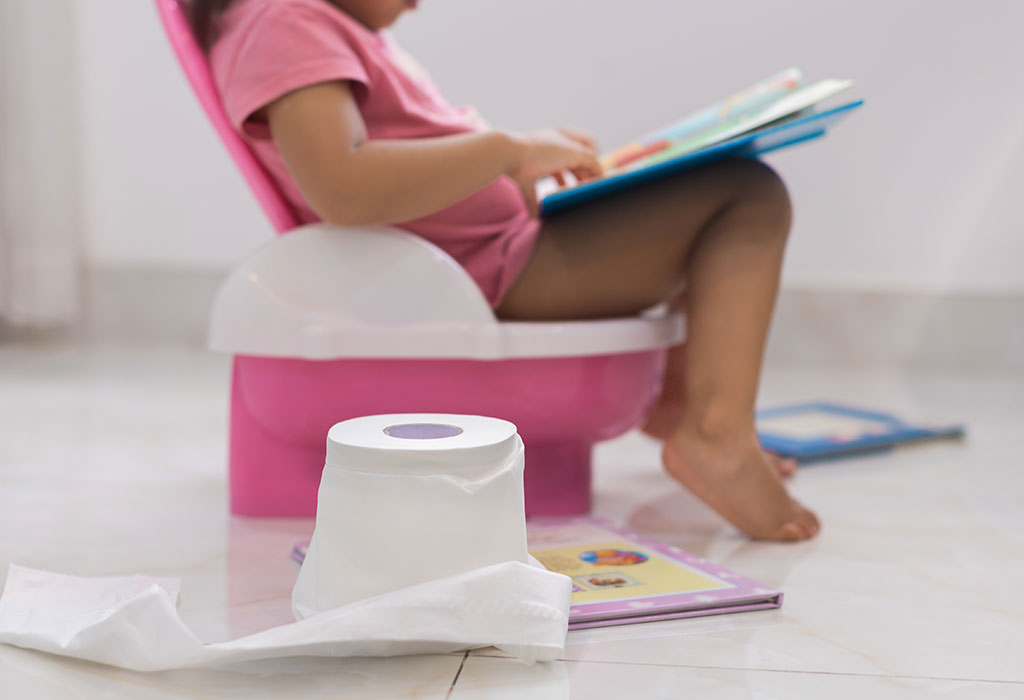
15 Best Potty Training Books
Potty training is perhaps the most necessary evil that exists in the parenting world. No matter if you are the CEO of a multi-million-dollar company or a popular sports superstar, you will find yourself singing potty rhymes and celebrating this milestone in your baby’s life.
Best Books to Ease the Potty-Training Process
Here’s a list of some awesome potty-training books for parents with tips and tricks to potty train your little one. The illustrated and colorful potty-training books for kids provide step-by-step guidance to make the potty-training process easy. Keep them engaged with rhymes and special books on this sensitive subject. Make a small potty-training basket with colorful illustrious books, toilet paper rolls, reward stickers, colorful underpants, fragrant soaps and more to help the little one overcome the fear of potty time.
There are special potty-training books for toddlers to make the pooping time less stressful for mommy and more exciting for the baby. Say bye-bye to diapers and hello to pooping like a big baby.
1. A Potty for Me!
Written by – Karen Katz
What’s Good About It
Ease in the idea of using the chamber pot for pooping with this interactive children’s books about potty training. The playful rhymes, detailed lift-the-flaps instructions narrated from a child’s point of view make it easy to explain the little one about this important body function.
2. Big Boy Underpants
Written by – Fran Manushkin
What’s Good About It
There are special books for boys to help them upgrade from the diapers to the undies. The idea of being able to pick their own pants is a pretty grown-up feeling for the pre-schooler.
3. Big Girl Panties
Written by – Fran Manushkin
What’s Good About It
This one is among the most popular potty-training books for girls. Motivate the young lady to step out of her diapers and get on with big girl pants like mommy. Let her choose her dresses and panties, and say no to wearing diapers.
4. Dinosaur vs The Potty
Written by – Bob Shea
What’s Good About It
The potty dance moments when the toddlers resist sitting on the throne till the last minute are hilarious. This super fun dinosaur book drives away from the fear of potty time.
5. Everyone Poops
Written by – Taro Gomi
What’s Good About It
Reassure your little one that pooping is a natural process. Everyone got to eat and everyone got to poop. There is nothing embarrassing about what happens inside the diapers. And sooner or later, the little one will accept the pot too.
6. Mommy I have to Go Potty!
Written by – Jan Faull
What’s Good About It
Everything that a parent needs to know about potty training their little one. There are practical tips and tried and tested strategies for easy transition from the diaper days to the pot.
7. Once Upon a Potty!
Written by – Alona Frankel
What’s Good About It
This best-selling book is available in boy’s and girl’s versions. The simple language and anatomically correct illustrations explain how Joshua and Prudence overcome the fear of using the potty.
8. P is for Potty
Written by – Sesame Street Series
What’s Good About It
Everyone loves Elmo and Albie. This super interactive book has over 25 flaps to flip and explore the mystery around potty training. Keep your little one occupied as they sit on the big people’s pot and understand the basic routine of making poop and cleaning it. Learn about the toilet paper, running water, washing hands, wiping the bum with potty training experts of Sesame Street.
9. Potty
Written by – Leslie Petricelli
What’s Good About It
Your little toddler’s mind has hundreds of questions about the potty. This classic book on potty-training will have mom and baby chuckling and giggling every time the baby makes the poop. Find answers to the questions like, “Should I go in my Potty?”, “Where do kitty and doggy go potty?” and “Why no diaper anymore?”. Soon you will reach the stage when baby says “Mommy, I did it!”
10. Potty Training in 3 Days: The Step-by-Step Plan for a Clean Break from Dirty Diapers
Written by – Brandi Brucks
What’s Good About It
Written by a former nanny, this book offers a three-day concrete plan to potty train your little one. Potty training need not be a long and tiring process that goes on for months together and bring tons of unwanted stress to the baby and the parents.
11. Potty Training in 3 Days: The incredible Potty-Training Guide to De-stress Results in just 3 days
Written by – Lisa Karr
What’s Good About It
Potty train your baby like a professional with this e-book that offers practical solutions to all your queries related to potty training. While there are tons of illustrated books for babies, this one is exclusively for parents to overcome the stressful period of transition from diapers to the toilet.
12. The Potty Book
Written by – Alyssa Satin Capucilli
What’s Good About It
Available in gender-specific versions for boys and girls, the writer takes us through the story of Henry’s and Hannah’s journey of graduating from diapers to pants. Let the kids know it’s okay to have a potty accident, but you gotta keep trying.
13. The Princess and the Potty
Written by – Wendy Cheyette Lewison
What’s Good About It
Story of a spoiled Princess who refuses to shed her diapers and keeps rejecting the fancy potty seats. Eventually, the baby will accept the bathroom routine.
14. Uh Oh! Gotta Go! Potty Tales from Toddlers
Written by – Bob McGrath
What’s Good About It
A well-illustrated book with humorous captions to helps kids and parents cope with potty-training challenges.
15. Tinkle-Tinkle Little Star
Written by – Chris Tougas
What’s Good About It
The colorful book with cute rhymes teaches baby potty and pee etiquettes. This fun book will have you and the baby singing in unison at potty times:
“Tinkle-Tinkle little tot, there you sit upon the pot.
Any second you will see, sprinkle, splash as you pee.
Tinkle-tinkle little tot, there you sit upon the pot.”
Go diaper free with the help of these awesome books and see your baby cross the potty-training milestone with ease.
Also Read:
Best Potty Training Games for Toddlers
How to Potty Train Toddler with Underwear
Potty Training Tips and Tricks for Toddlers
Read more
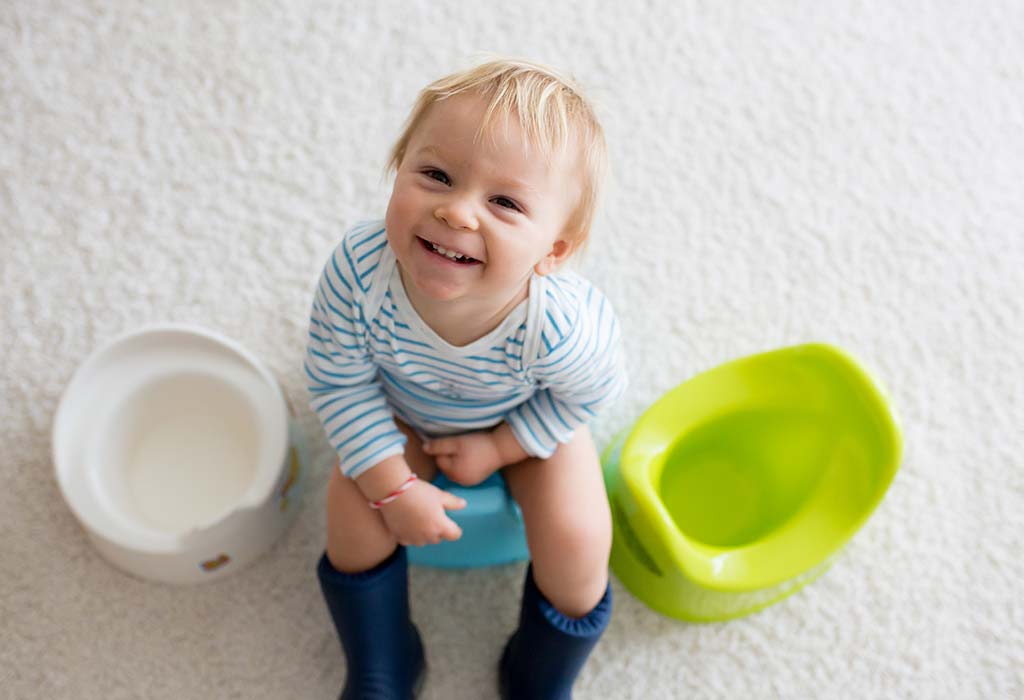
8 Must-Have Items for Potty Training
One baby, so many different milestones; and among them, one of the most dreaded – potty training! It sounds simple enough – you’re trying to train your child to use the toilet and grow out of his diapers. But what it also means is that you’re relinquishing any control you’ve had over your baby’s bladder and bowel movements, and that can be super scary. Especially when you know the trusty diaper can no longer be your backup plan! But mommies, you know that with the great powers of motherhood comes the greater responsibility of dealing with every challenge that can come your way. And potty training is no different!
8 Potty Training Essentials You Need
Rule Number 1 of potty training your child (and of course, motherhood in general) – be prepared! There are a few essential items you’ll need to stock up on before embarking on this mission. Keeping these handy is going to make your life (and your baby’s!) much easier – trust us on this one!
1. Potty Chair
This is the most common choice parents make when they begin potty training their babies. With its fun colours, designs, and characters, a cute potty chair can make the whole process a lot more fun for your little one, and cancel out the associated ‘challenge’ factor. Most potty chairs are usable from around 6 to 24 months of age. They’re also portable, which makes them great in times of a ‘can’t hold it in’ emergency!
2. Potty Seat
A potty seat is a great option if you want your little one to get used to the adult toilet and not be too intimidated by it in the first go. This seat can be attached to the toilet, (making it travel-friendly as well) and is usually cushioned to provide your baby comfort. They also have handles that can help your baby balance himself, and won’t tip over when he’s trying to get off. To make another case for potty seats, they help your child get accustomed to the adult toilet faster, and don’t require much of a transition period – plus, lesser clean-up duty is always a bonus! But this is applicable only if your baby is ready to get on a toilet without much of a fuss; if he isn’t, it’s always best to go through the chair-to-seat route.
3. Step Stool
Unless your toilet is quite near ground level, your baby won’t be able to get up on it if he’s using a potty seat. Solution? The step stool, of course! Not only does it make it easier for your kid to reach the toilet or washbasin, but it also grants him a certain level of independence, because he doesn’t have to depend on you to use the washroom. Look for an option that suits your toddler’s height and has a sturdy grip to prevent any unfortunate accidents.
4. Baby Wipes
Let’s be real – toilet training can take a while and there will be messy accidents aplenty. Your kid may not reach the potty in time to relieve himself and there’s a good chance that he (and different parts of your house) will require clean-up constantly. Enter baby wipes to your rescue! This handy little product is easily going to be your best friend during your baby’s potty training days. They’re gentle on your little one’s skin and make the clean-up process a whole lot easier, especially if you’re travelling and can’t stop at a restroom soon enough.
P.S – Getting scented disinfectant wipes for your floor and other surfaces is also a great idea to ensure that your house doesn’t reveal your potty training struggles!
5. Training Pants
Training pants are a great ‘in-between’ training tool for your baby while he’s potty training. They look and feel like underwear that can provide your child with a ‘big kid’ vibe he’ll love, but also has a protective layer that ensures no messes or dribbles get past you! The only issue here is that the diaper-like feel of the training pants can confuse your little one into thinking that it’s okay to pee and poop in them, which is why it’s advised to let babies go pants-free during the day while potty training. However, at night, you can definitely let your baby wear these pants, till he can transition to wearing regular underwear. Additionally, clothe your child in non-fussy pants that come with a stretchy waistband, so that he can pull them down without needing to fiddle with buttons and zips!
6. Mattress Protector
Your child’s mattress need not get messy during his potty training days, or nights, rather. A waterproof mattress protector can keep his bed dry and stain-free, and in most cases, doubles as a changing sheet too. Get yourself a machine-washable sheet to make your job easier.
7. Potty Time Activities
Yes, these are toys and books, but those restricted to potty time alone, such that your baby has something to look forward to. It could be stories about cartoon characters using the potty and little interactive toys that keep him occupied and make the whole process less daunting. And as tempting as it may seem to bribe your baby with some screen-time, it’s best to keep your smartphone away!
8. Tracking Chart & Rewards
We all work well with a bit of positive reinforcement, don’t we? Well, you’ll see the same applies to your baby during potty training. With cheers, praise, and encouragement, he’s bound to feel proud of himself and cooperate with you! Design a cute little tracking chart with actions like ‘I said I needed to go!’, ‘I washed my hands’, ‘I didn’t wet myself today’, and so on, and reward him with a star for every action he fulfils. For little ones who are too young to grasp the concept of a progress chart, little rewards like candy or inexpensive collectable toys can work well too.
Apart from these items, there is the one essential you really cannot miss out on, and that is having truckloads of patience! Remember, kids are all different and comparing your baby’s progress to that of his peers isn’t going to do anything but make you worry. Some babies may potty train in 3 days, some may take up to a year – but your words of encouragement and positive techniques sure can push things along. Now, grab on to these handy helpers ASAP and let the training begin!
Read more
Potty Training Boys – Tips, Dos and Don'ts
Someone has very rightly said, ‘Having a kid is like continually having to clean up after a party you didn’t attend,’ and that clean-up starts with diaper duties! Although most potty training tips are common for boys and girls, training boys to use potty seats is a little more challenging. Potty training boys requires patience, consistency, and a good strategy to make the process smoother for both parents and toddlers. One of the most common questions parents ask is, ‘How to start potty training a boy?’ The key is to introduce the concept gradually. With the right approach, your little one will soon be diaper-free!
What Is Potty Training?
The process of training little children to use the toilet for peeing and pooping is what potty training is all about (1). As babies, children are used to diapers. But as they grow into toddlers, it is important to train them to use toilets, and this must be done at the right age.
Potty training doesn’t start with making children use toilets right away. They learn to do that gradually. The complete phase of transitioning from diapers to using proper toilets is called potty training. So, here is a systematic guide that clearly states all the dos and don’ts of potty training boys.
When to Start Potty Training for Boys?
There is no definite time defined by any expert to start boy potty training. The average age to potty train a boy has been roughly put around 18 months to 3 years old, and there may also be some children who are receptive to potty training only when they are close to 4 (2). But before you start, you must look out for certain signs that will indicate that the child is ready.
Signs of Potty Training Readiness for Children
To make it easy for new parents, experts have put together some definite signs to look out for before you start making plans to potty train their kids These signs of potty training readiness have been categorised into physical, behavioural and cognitive signs (3).
Physical signs: Firstly, you may want to check if your baby boy is physically developed enough to walk. You may also want to wait till your baby pees a fair amount at one go and also has a well-formed bowel movement at a foreseeable time. Also, having a dry time of at least 2 to 3 hours or so during nap time will come very handy while making your plans around potty training your son.
Behavioural Signs: You need to wait until your baby can sit quietly in one place for at least five minutes. He should also be able to pull his pants up and down on his own When a child starts disliking the feeling of being in a wet diaper or starts giving physical or verbal signs of bowel movement, it is a good indication to start with potty training. Also, if you observe him showing an interest in other’s bathroom habits, it is time to chalk out a plan to help him form his own. Other important behavioural traits include demonstrating a desire for independence, taking pride in his accomplishments and being cooperative.
Cognitive Signs: The following cognitive development milestones are also important while potty training a 2-year-old. The child should be able to understand physical signals and should also be able to give signals themselves whenever necessary. Being able to follow simple and straightforward instructions is another cognitive development milestone that is necessary before starting any training at all. Experts also emphasise that learning to tidy up their toys is more important for children than learning to keep themselves clean. They should also have some code word for stool and urine which they can use to communicate whenever they must pee or poop.
The signs mentioned above can help parents to determine the potty training age for boys.
How to Potty Train a Boy?
Potty training a toddler boy requires a lot of patience, as they often stay in diapers longer than girls. If you’re wondering about the best way to potty train a boy, the following tips will guide you through the process (4).
1. Choose the Right Age to Start
Age plays a huge role in successful potty training. Start when your son is physically and emotionally ready—some boys may be ready by age 2, while others may need until after their third birthday. Forcing training too early can lead to setbacks, so wait until he shows signs of readiness.
2. Avoid Major Life Changes
If your toddler is coping with changes like a new sibling, starting daycare, or moving, delay potty training until he adjusts. Introducing too many changes at once can make the process stressful.
3. Start with a Small Potty Seat
Begin by teaching your boy to poop and pee in a child-sized potty seat. Let him get comfortable sitting on it fully clothed first, then gradually transition to using it without diapers.
4. Create a Consistent Potty Training Plan
Before starting, decide on a structured approach—when to begin, how to handle accidents, and when to take breaks if needed. Consistency is key, so ensure all caregivers follow the same routine.
5. Use Positive Reinforcement
Praise and rewards (like stickers or small treats) can motivate your child. Avoid punishment for accidents, as this can create anxiety around potty training.
6. Seek Advice from Experts
Consult your child’s pediatrician or daycare provider for tips. Their experience can help tailor a plan that suits your son’s needs.
7. Be Patient with Nighttime Training
Daytime potty training is usually easier than nighttime. Staying dry overnight takes longer, so use training pants and limit liquids before bedtime.
8. Demonstrate Proper Technique (For Standing Up)
Once your boy masters sitting, teach him to pee standing up. Use targets (like cereal pieces in the toilet) to make it fun and encourage aim.
9. Expect Regression and Stay Calm
Progress isn’t always linear—some boys regress due to stress or distractions. If this happens, take a break and try again later.
10. Celebrate Small Successes
Every step forward is progress! Celebrate milestones to keep your child excited about using the potty.
How Long Does It Take?
Potty training boys typically takes 3 to 6 months for daytime control, though some may learn faster while others take longer. Nighttime training often extends beyond this, sometimes up to age 5 or older, as staying dry overnight depends on bladder maturity. Factors like temperament, parental consistency, and whether he’s coping with other changes (e.g., a new sibling) can affect timing.
Potty Training Tips for Boys
As parents, it is important to be fully prepared to help the baby achieve each milestone with confidence. These toilet training ideas will help you to get over this phase of your child’s development without much hassle (5).
Children love to imitate. Hence, the best way to potty train a boy is to let him observe his daddy using the toilet when peeing. Very soon he will be intrigued and would like to try it out himself.
It is important to go about the training step by step. Experts suggest that it is always helpful to train the child to go potty in a child-sized potty where he can sit comfortably, and his legs touch the ground. This will also give him a sense of possession, and he may just think of it as a new toy where he can poop peacefully. This needs to be followed if you are starting as early as 18 months old. However, if you start the training at the age of 3 or older, then you can just buy a comfortable adapter seat for your toilet. In this case, though, you will also have to put a footstool in front of him, so that he sits comfortably without his legs dangling. This will also come in handy to get on and off the potty easily and independently.
An extra piece of advice is to buy a potty seat without a urine guard.
The next phase is to help the child get comfortable with the potty. Create a sense of possession for the potty seat in your child. Write your boy’s name on it or even decorate it with some stickers. Let him playfully sit on it for a week or so before you suggest that he takes his pants off and sits on it. You can also do a role-play on how to use the potty seat. Use his favourite stuffed doll or animal toy for demonstration. This makes the whole process of potty training enjoyable for him and easier for you.
Motivate your child to become like his dad or elder brother. Tell him that he can choose his favourite underwear and wear it like his father and brother do. If he is initially uncomfortable, let him try wearing them on top of the diaper. Slowly he should be willing to ditch the diaper and wear only underwear.
Setting up a training schedule based on your personal schedule and your son’s time table is very important. If your son goes to a daycare or pre-school, do share your potty training strategy with them. Since your son will take his own time to learn, keep some diapers and disposable pants handy for night time and travel.
Bowel movements and the tendency to urinate usually come at the same time. Hence, it is advisable to make your son sit first. Avoid making him sit for too long as he will avoid trying it from very next time. Once your son starts pooping and peeing in a sitting position, teach him how to stand and pee. Once again, a demonstration from daddy will be helpful. You can also float some oval-shaped object for target practice, but please remember that should be your last resort as it can become very messy.
Around the time he usually has bowel movements, take off his pants and let him be for some time. Keep the potty seat handy so that as soon as you see the signs you can make him sit on it.
Celebrate each success by rewarding him with stickers or stars. That will keep him inspired. If you don’t succeed the first time, do try repeatedly till you get there; but remember to do so with lots of love, patience, innovation and positive reinforcement. You can also buy him picture books and cartoon CDs around potty training and let him watch them. They are usually fun, and children love watching and learning from them.
Once your baby boy has learned to stay dry all day, it is time to move to night-time training. This will take a longer time as it will require him to hold his urine for a certain period. If your little boy wants to sleep without diapers, let him do that. A few days will be experimental, and he may wet the bed, but slowly he will learn to wake up for peeing and then eventually will hold his urine for the rest of the night. This training may take weeks or even months.
Dos & Don’ts While Potty Training Boys
The above-mentioned potty training steps will clear any doubts that new parents may have about toilet training boys. Here are some dos and don’ts to summarise what we have discussed so far.
Dos:
Show a lot of patience
Look out for physical, behavioural and cognitive signs before you start
Take valuable tips from his preschool teachers or daycare providers before chalking out a plan
Make it fun and motivational by trying out various innovative methods. Get books and CDs around it and let him watch. Also, celebrate each achievement by rewarding him
Don’ts:
Don’t push him or constantly insist once you start
Do not try to achieve all levels at one go
Do not chide him or compare him to someone else
Do not show any signs of frustration. That will make him regress
FAQs
1. Can a boy potty train standing up without sitting first?
While most experts recommend starting with sitting (to avoid confusion between pooping and peeing), some boys successfully learn to pee standing up from the beginning. However, this approach may delay bowel training since sitting is still needed for pooping.
2. Do boys who start potty training later take longer to learn?
Not necessarily. While earlier starters (around age 2) may take longer overall, boys who begin closer to age 3 often grasp the concept faster due to better physical and cognitive readiness. The key is starting when your child shows signs of readiness.
3. Should you avoid public restrooms during potty training?
Some parents worry about germs or their child’s fear of loud flushes, but avoiding public toilets can hinder progress. Instead, carry a foldable travel seat or let him practice standing (if he’s trained that way) to build confidence in different settings.
4. Is there a link between potty training and future bedwetting?
No evidence suggests that early or late potty training causes bedwetting—it’s usually tied to genetics or deep sleep patterns. However, pressuring a child or punishing accidents can create anxiety, which may contribute to delays in nighttime dryness.
Nothing about parenting is a cakewalk, but we hope the potty training tips for boys, penned down in detail in this article, will help young parents to get over this patience-testing time easily.
References/Resources:
1. American Academy of Pediatrics – Potty Training
2. Mayo Clinic – Potty training: How to get the job done
3. C.S. Mott Children’s Hospital – Potty Training
4. Johns Hopkins Medicine – Toilet Training
5. Cleveland Clinic – How To Potty Train: Our Best Tips
Also Read:
Potty Training Chart
Potty Training for Girls
Potty Training Methods
3-Days Potty Training Method
Oh Crap Potty Training Method
Read more
How to Potty Train a Girl – Tips, Dos and Don'ts
Changing diapers is an important part of parenting. However, most parents are eager to train their toddlers to use the toilet. It’s important that you initiate potty training your little one just when the time is right, neither before nor after. If you have a little girl, there’s good news – girls potty train earlier than boys! Expert research has proven that boys take longer to potty train than girls (1). So, if you are worrying too much about potty training a little girl at your home, let go of your worries and rejoice because you will not have to try too hard! With patience and consistency, potty training girls can be a smoother and quicker process, allowing you to celebrate this milestone sooner. Remember, every child is unique, so stay positive and encouraging throughout the journey.
What Is Potty Training?
The process of bringing children out of the diapers and training them to use toilets for peeing and pooping is called potty training (2). As babies, children are used to diapers, but as they grow into toddlers, it is important to train them to use toilets. This must be done at the right age as kids cannot be made to use the toilet right away; they learn to do that gradually.
When to Start Potty Training for Girls?
Here’s what you need to know about the potty training girls age. Since little girls are usually less distracted than boys of a similar age, toilet training them is easier and can be accomplished faster. Having said that, you will still have to wait for the right time and observe the necessary signs to ensure that your daughter is ready to start using the toilet. Also, if your little girl is going through any changes in her surrounding environment, you must wait for her to settle down before you start to train her. The approximate potty training age for girls, specified by experts, is between 18 months to 3 years (3).
Signs of Potty Training Readiness for Children
To make it easy for new parents, experts have put together some definite signs of potty training readiness in children. These signs have been categorised as physical, behavioural, and cognitive signs. Look out for them before you start making plans to potty train your little one (4).
1. Physical Signs
Firstly, you may want to check if your baby is coordinated enough to walk. You may also want to wait till your baby pees a fair amount at one go and has a well-formed bowel movement at a foreseeable time. Also, having a dry time of at least 2 to 3 hours or so during nap time will come very handy while making your plans to potty training your daughter.
2. Behavioural Signs
You need to wait to train your toddler till she can sit quietly in one place for at least five minutes. Experts say that this is easier to achieve in girls than in boys. She should also be able to pull her pants up and down to some extent.
When a child starts disliking the feeling of being in a wet diaper or starts giving a physical or verbal sign of bowel movement, it is a good indication to start potty training. Also, if you observe your baby showing interest in others’ bathroom habits, it is time to chalk out a plan to help her form her own bathroom habits. Other important behavioural traits include demonstrating a desire for independence, taking pride in her accomplishments, and being cooperative.
3. Cognitive Signs
A considerable amount of cognitive development is also important to start potty training. Children should be able to understand physical signals and should also be able to give signals themselves whenever necessary.
Being able to follow simple and straightforward instructions is another cognitive development that is desirable before starting any training. Experts also emphasise that children who start tidying up their toys on their own are prepared to go through training to keep themselves clean. They should also have some code word for stool and urine, which they can use to communicate whenever they must pee or poop.
All the signs mentioned above will help parents determine the right time to start toilet training their toddlers.
How Long Does It Take to Potty Train a Girl Child?
The time it takes to potty train a girl child can vary widely depending on the child’s readiness, temperament, and consistency in training. On average, potty training girls can take anywhere from 3 to 6 months, though some may learn in a few weeks, while others might take longer. Research suggests that girls tend to potty train earlier and faster than boys, often showing readiness between 18 to 24 months (1).
How to Start Potty Training a Girl
A very relevant question that might be lurking in your mind is, ‘How do I train my daughter to use the toilet?’ Here are the best ways to potty train a girl (5):
1. Wait for the Right Time
All children show some physical, behavioural and cognitive signs that indicate your baby is ready for the training. Wait till you see those signs because even if you start earlier, the overall potty training time remains the same.
2. Chalk Down a Plan
It is crucial that you plan it all out before you even start the trials. The plan must be comprehensive and must consider all factors like materials required, how to handle accidents, and when to back off. Consulting the child’s paediatric or daycare provider will yield positive results for you can get many valuable tips from years of their experience. Also, looping them in is important as their contribution will be necessary to carry out the training plan successfully.
3. Let It Take Time
Someone very truly said, “Manners require time, and there is nothing more vulgar than haste.” Don’t try to push your precious little girl to adapt to this new skill faster than she can. Remember that while some may get trained in a few days, others may take months.
4. Motivate Your Child
Praise your child for every single effort she puts in. Complimenting her each time will motivate her to try it out every day.
5. Be Ready for Accidents
There are going to be numerous accidents during the process of toilet training. Do not lose your cool or scold your daughter for not learning sooner. Any negative comment from you may slow down the process or even make your baby regress.
Best Potty Training Tips for Girls
Potty training methods adopted by you for your little girl can be fun, too. These tips will help make the process smoother (6).
1. Imitate
Most little girls aspire to be like their mothers when they grow up. You may observe that they copy their mum’s dressing style and make-up most of the time. Since little girls love to imitate their mothers, it is a good idea to let them watch their mums use the toilet and learn from them. And if there is an older sister at home, she can watch her sister, too, and pick the tricks of using the toilet.
2. Buy What’s Necessary
To start with, buy your baby girl a child-sized potty which she can call her own. It is always advisable to start the training with a child-sized potty before using the bathroom as bathrooms are accident-prone and need constant supervision.
If you want your girl to get trained in the toilet straight away, buy an adapter seat that is comfortable and attaches firmly. Also, provide a stool along with it to rest her feet. She can also use it to climb up and down independently.
You can also buy a few picture books and videos about toilet training kids. There are many available in the market, and you can choose an appropriate one.
3. Make Her Feel Comfortable
There are various ways to make your daughter feel comfortable with the idea of potty training. Firstly, personalise the potty seat for her by writing her name on it and decorating it with her favourite cartoon stickers. Let her spend one week just playing with it. Then show her a few demonstrations using her favourite doll on how to use the potty seat. She is really going to enjoy it. You can then suggest her to try using the potty seat herself to poop.
4. Cool Underwear Instead of a Diaper
Motivate your little girl by promising her to buy new underwear in the patterns and colours of her choice. Little girls always get excited about adding new things to their wardrobe and also trying them out.
5. Put a Training Schedule in Place
Keeping your little girl’s preschool and daycare timings in mind, you will have to strategise a schedule and share the same with the preschool and daycare providers. You also need to make up your mind about whether you will adopt a back and forth method of switching between diapers and underwear or will directly shift to underwear. Experts suggest that switching directly to cotton underwear during the day is a better option, though, at night, you will have to continue with a diaper.
6. Train to Wipe
While toilet training a girl, it is very important to train her to sit in the potty seat comfortably. Once that is achieved, the next step would be to train her to wipe herself clean. Now, this is going to be tricky, and she may take some time to learn this, especially after pooping. So, to start with, just tell her to pat the area dry after peeing.
7. Allow Diaper-Less Time
When children are allowed to spend some time without a diaper, they learn to give signals to use the toilet. With diapers on, children never really realise when they pee and poop. Taking them off diapers and letting them move around freely during the day is a crucial step in toilet training.
8. Celebrate Achievements and Don’t Give-Up
Celebrate each milestone by rewarding her with a star, a sticker, or even a toy in special cases. It is important to keep in mind that there will be a few accidents during this phase. Embrace them and do not scold your child for the accident. The important thing is not to give up and to continue trying.
9. Add a Fun Factor
Make the experience of toilet training fun for your little girl by adding some soluble colour to the water in the pot. You can also place a rack in the toilet with her favourite books and magazines, or offer her toys to keep her busy and entertained.
10. Start Training for the Night
Once your little girl is securely trained for potty during the day, start checking her diaper in the morning to see if she is keeping dry throughout the night, too. Night training may take a little longer than the day training, but she will eventually get there. You must wait for her to be able to hold her bladder for 2 hours at a stretch before you take her off diapers at night. You can speed up night-time potty training by making little changes, like cutting down on fluids in the late evening. It is also a good idea to make your daughter use the toilet before bedtime.
Dos & Don’ts While Potty Training Girls
Dos
Wait for the right time.
Look out for the appropriate signs.
Keep a potty training plan handy.
Consult a paediatrician for tips.
Motivate your child by rewarding her for every milestone.
Add a fun element to the training.
Don’ts
Don’t be in a hurry.
Don’t expect the result too soon.
Don’t chide her in case of accidents.
Don’t discourage her by comparing her to other kids.
Potty Training Girls Vs Boys – The Real Differences
According to experts, potty training girls is much easier than boys as they are usually less active and restless than boys of a similar age. Here are a few important differences between potty training girls vs boys:
Wiping: One important difference is to teach your little girl to wipe from front to back, especially after she poops. This will keep her away from any bladder or urinary tract infection. She also needs to pat herself dry after peeing, which boys don’t have to do.
Pointing downward: You will need to teach your little girl to point downward while peeing so as not to get sprayed in the face.
Peeing while standing: Your toddler girl may also want to try and pee in a standing position. She may have seen her brother or a boy at school do that. Let her try and learn on her own that it is uncomfortable to stand and pee like boys. She will eventually sit down for all her toilet endeavours.
What Happens If It Doesn’t Work?
If potty training for girls isn’t working, don’t worry—it’s completely normal! Some kids take longer than others, and forcing it can make things harder. Here’s what you can do:
Take a Break – If your child resists, pause for a few weeks and try again later.
Check for Readiness – Some kids aren’t physically or emotionally ready yet. Look for signs like staying dry for longer periods or showing interest in the toilet.
Make It Fun – Use rewards, stickers, or fun underwear to encourage her.
Rule Out Medical Issues – Constipation or UTIs can make potty training uncomfortable. If accidents are frequent, check with a doctor.
Stay Patient – Frustration can slow progress. Encourage her without pressure, and celebrate small wins.
FAQs
1. Can using a potty chair vs. A toilet seat affect potty training success for girls?
Parents often wonder whether a standalone potty chair or a toilet seat adapter is better for potty training girls. While both options work, some girls may feel more secure and comfortable using a potty chair initially, as it’s smaller and less intimidating. Transitioning to a toilet seat can come later once they gain confidence.
2. How can I handle my daughter’s fear of flushing during potty training?
Many toddlers, including girls, develop a fear of the loud noise from flushing the toilet. To address this, let your child flush the toilet themselves when they feel ready, or flush after they leave the bathroom. Gradually introducing them to the sound can help ease their anxiety and make the process smoother.
3. Is it normal for girls to regress in potty training after initially succeeding?
Yes, regression is common and can happen due to changes in routine, stress, or even the arrival of a new sibling (7). If your daughter starts having accidents after being potty trained, stay patient and avoid punishment. Reassure her and gently remind her to use the toilet, as this phase is usually temporary.
Potty training in itself raises several concerns and questions, especially in the minds of new parents. However, parents can manage it with some knowledge and help their little ones get trained to use the toilet. Do not be afraid to seek help from a paediatrician or the daycare to help your little girl get through this phase.
References/Resources:
1. ResearchGate – Sequential Acquisition of Toilet-Training Skills: A Descriptive Study of Gender and Age Differences in Normal Children
2. Stanford Medicine – Toilet Training
3. NHS – How to potty train
4. Nemours Kids Health – Toilet Training
5. Mayo Clinic – Potty training: How to get the job done
6. Cleveland Clinic – How To Potty Train: Our Best Tips
7. American Academy of Pediatrics – Potty Training Regression
Also Read:
How to Potty Train Boys
Potty Training Games for Toddlers
Potty Training Ideas For Toddlers
Best Age for Potty Training Your Child
Potty Training Methods – Choose the Best One for Your Child
Potty Training with Underwear – When, Why and How to Start It?
Read more
8 Tips to Handle Potty Training Regression and Get Your Child Back on Track
Just when you thought your child’s potty training days were over and you didn’t have to spend extensively on diapers, your baby starts backsliding! You may feel disheartened and lose your patience too, but it is a very normal phenomenon for kids to experience or go through potty training regression. Well, there are no fixed reasons for the same, and every child may experience a setback because of a different reason. However, what is important is to get your kid back on track, and if you are thinking how to go about it, well, this article discusses that in detail, read this article to know more!
Why Do Children Regress?
Well, no specific or single reason can explain this phenomenon. But the main reason could be the inconsistency and lack of motivation. Sometimes parents may not even realise that in their eagerness and efforts to train their child, they may hurry up with the process but in reality, their kid may not be ready yet, thus leading to regression. Apart from the parent’s approach, sometimes it may be the child’s negligence or change in diet that may trigger the regression.
What Can Trigger Regression?
As discussed above, not a single reason is responsible for the regression. Here are some common reasons that may lead to toilet training regression in kids:
The child may be suffering from UTI or urinary tract infection.
There may be a new addition in the family, baby brother or baby sister.
If the child has faced some unpleasant toilet experience.
If the child has recently joined a daycare or kindergarten.
If the child is suffering from any kind of anxiety or stress.
If there is some abrupt or sudden change in the child’s routine.
If there is some major change in the child’s life such as change of place or house.
If the child is being bullied or severely disciplined at school or daycare.
These are some of the reasons that can shake your child emotionally, and thus potty training regression could appear as one of the side-effects of such scenarios.
Tips To Deal with Potty Training Regression
Do not feel disheartened, because there are ways to correct potty-training regression. We bring you some tips that may help you to deal with your kid’s potty-training regression:
1. Be Positive about It
The first and foremost thing for you to understand is that is it absolutely okay for kids to experience this kind of situation. Being positive about the situation will help both you and your kid, however, if any kind of negativity crops up it will only discourage your kid, and this means slow or no progress at all.
2. Be Consistent
Do not worry if you could not achieve it on the first go, there is always a second time. Make sure you are consistent with your efforts, and this means making it a habit and using positive re-enforcement to achieve the same. Also, after you feel your child has been trained, keep sticking to the basics until it becomes a habit for your kid. Never skip or be lenient with your rules.
3. Make Changes in Your Kid’s Diet
One of the main reasons of regression could be constipation, and young children dread to pass a hard stool. They may not want to do potty fearing that it will hurt them. Make sure you include a lot of fibre in your child’s diet. Also, ensure that your kid is drinking enough water and also takes other kinds of liquids too. Refrain from giving more liquids close to bedtime.
4. Watch For Some Medical Issue
Sometimes it may not be you or the child who may be at fault, but it may be some underlying medical issue because of which your kid may be experiencing a setback. It is very common for children to have threadworms, stomach infections, bladder infections or type-1 diabetes and thus experience toilet mishaps. Get your child thoroughly examined to know the exact cause.
5. Do Not React
It is how you react to a situation that may sometimes prove to be helpful to your child or do just the opposite too. If your child exhibits this behaviour, do not make a big fuss out of it. Instead, deal with it calmly. It is quite possible that such mishaps are just a one-time thing and kids bounce back to their progress. However, if you make a big deal out of it, your kid may get adversely affected and may keep repeating the same mistake.
6. Never Punish
Never punish or get angry at your child. It is the worst thing that you can do to your kid. This may scare the child, and sometimes it may cause so much fear that the child may begin resenting going to potty. This may further lead to health complications like constipation and other issues too. Try and understand that it is not in your child’s control and such accidents are common happenings.
7. Reward Your Child
When your child starts showing progress after the episode of regression, you must reward your child. You may shower your kid with some words of appreciation or treat him with his favourite food. Let your child understand that his efforts are appreciated and he is doing a good job.
8. Sympathise with Your Child
Let your child know that you understand their plight and state of mind. Tell them that you are there and you will help them deal with this situation. You can also narrate or share your personal experiences or talk about the similar experiences of the siblings. This will help the child understand that he is not the odd one out and it is normal to experience what he may be going through.
We hope these tips help you in getting your child back on track with his potty training!
Also Read:
How to Prepare Toddler for Potty Training
Potty Training Ideas for Toddler
Potty Training Problems with Young Kids
Read more
Potty Training Twins – 10 Useful Tips
Do you remember that golden moment when you came to know that you are going to have twins? Your happiness would have known no bounds. There’s no doubt that twins double the happiness of being parents, but when it comes to raising them together, it’s something that will leave you exhausted. Handling two little munchkins at the same time is not that easy, not for all! And when it comes to potty-training them, you’re bound to get confused, and that’s alright. It may not be a piece of cake, but it is certainly not an impossible mission to achieve. There is no doubt it would require more time and more patience on your part, but you will be able to train your babies. We shall be discussing some useful tips that may make potty training your twins easier and more convenient. Read the post to know more!
Is Potty Training Twins Different from Potty Training a Child?
Yes, of course! It is very different to potty train twins in comparison to training a single child because you are not dealing with one kiddo but two kids of the same age. Potty training two kids of the same age at the same time will be challenging, but we know, being a mother, you will be able to do it. You can make it a fun time for your kiddos. Get two potty seats, preferably similar looking or identical so that babies don’t get confused or squabble over it. You can help your little ones decorate it too using colourful stickers to help them identify their own potty seat.
What to Do If One Twin is Potty Trained Faster Than the Other?
Every child is different and unique and thus may get potty trained at his own time and pace. When you are training your kids, one child can show better progress than the other, and it is very normal. Whenever one child shows the readiness to go to the bathroom, make sure you take the other sibling along. This way the other child will observe and learn what he may be expected to do. You should follow a set routine to train them. You can also make your kids sit on the potty seat every half hour, this way you save yourself from the trouble of going to the bathroom too often.
What Should You Do if One Twin is Ready for Potty Training and the Other Isn’t?
We have discussed above that all twins are different and do things at a different pace, same holds true regarding potty training too. You may notice, usually when potty training twin boy and girl, one would show the readiness but others may not be ready. There is no need to hit the panic button because potty training twins (where one is ready and the other is not), is a very common problem that parents of twins face. However, you can follow some of our potty training tips for twins, which are discussed in the next segment.
Helpful Tips on Potty Training Twins
Here are some tips that may help the parents in potty training their twins:
1. Prep Your Children
Before your children are ready for the physical changes, you can prepare them mentally for the coming changes. This means, if you plan to start their training a week from now, you can start talking about how grown up they are now and what grownups are expected to do. You can get them books of their favourite cartoon characters wearing underpants. You can also take them on a shopping trip and buy underpants and potty seats of their choice. All this will help the kids in preparing for the potty training session.
2. Make Sure That the Timing is Right
You have to look for signs of readiness in your child. The average age for potty training twins is around 18 months, but if your kids do not show signs of readiness, there is no need to force them. It is important to introduce the habit in a positive manner. They should not resent the entire process. If your kids are not wetting their diapers for a longer duration or peeing and pooping when you take them on their occasional loo visits, it may be an indication that your kids are ready.
3. Dress Them Appropriately
If you are planning on potty training twins at 18 months or later than that, make sure you dress them appropriately. Dressing your kids in clothes that they won’t be able to pull down (if required) on their own is not recommended. Make them wear clothes that they can remove in case of an emergency. Also, if you do not want your kids’ beautiful clothes to get all soiled, do not dress up them in such clothes during this phase. Some parents prefer warmer months for potty training their kids because kids are dressed up in lesser clothes, which can be easily removed. Also, there would be lesser dirty or soiled clothes for washing, in case of mishaps.
4. Make Similar Schedules
You need to follow a similar schedule for your kids, whether it is their feeding, sleeping, or pooping schedule – all have to be in sync. It is seen that if one child shows readiness or goes at a faster pace than the other, the other child may get inspired and may pick up the pace. Also, when kids know what they are expected to do things at a particular time, they prepare their mind accordingly and adjust well to it too. This means if the kids know that they have to sit on the potty seat after drinking milk in the morning, they may become consistent and get into this habit.
5. Be Flexible
Although sticking to the schedule is important to maintain consistency, sometimes, you may have to try different approaches for both the kids. This is because sometimes one approach may not work for both the kids. One may like privacy, whereas the other may be okay with his bodily functions. One may love to listen to your words of appreciation, whereas the other may not sway by your words. Therefore, sometimes you need to understand your kids’ requirements and function accordingly.
6. Be Prepared for the Mess
Potty training is something that you may have to struggle with, especially in the case of twins. Be prepared to deal with the mess because it is normal for kids to have accidents or setbacks. Have ample supplies of clean clothes; protect the things which you don’t want to get soiled or dirty, secure the areas with gates or if your kids understand the ‘off-limits’ then you can make these areas off-limits. In short, you need to prepare them mentally and also prepare your house to deal with the mess that may occur.
7. Get Two Potty Seats
Sometimes twins may not settle with sharing, whether it is their potty seats or toys. With just one potty seat in the house, you may notice that your kids may want to use it at the same time and then the squabble would begin. To evade such situations, make sure you get two seats, we suggest identical seats for your kids to save you from the unnecessary trouble.
8. Offer Rewards
Everyone likes rewards, it keeps us pepped up. Your kids are no exception to the rule and therefore if your kids exhibit good potty training behaviour, you should offer rewards for their efforts. The only glitch to this is, sometimes when one child shows progress and keeps getting all the rewards, the other may feel left out, or this may lead to resentment towards the sibling. This may turn out to be a setback for the other child, and he may take longer to get trained. On the contrary, if your kiddos enjoy competition, then rewarding may be a great way of achieving good progress. You can also reinforce positive competition by keeping it healthy. Do not compare or demean the child who is making slower progress. Make it more fun for both the kids.
9. Ask for Help
We do not deny that the potty training phase can take a toll on the mommy, but if you are not able to handle the pressure alone it will be a wise decision to seek help. Ask your partner for help; you can also ask any family member to come and stay with you for that period. If you can afford, hiring a nanny for this phase will the most viable thing to do. This is a temporary phase, and there is no need to feel hassled. Also, do not be too harsh on yourself, if you cannot deal with it, it is absolutely fine. Do not take it as a challenge and test your limits. Seek some help and be a happy mommy for your kiddos.
10. Seek Expert Advice
If your efforts fail after a week to ten days of trial, you can seek your doctor’s advice on the same. Your doctor may help you guide what you may be doing wrong. Your doctor may also see if your kids or kid is suffering from a medical condition such as constipation, which can make potty training as tedious as it may sound. Follow what the expert tells you to do, but you know what may be best for your child. Follow your instinct when in doubt.
Potty training twins can get tedious for new parents. However, we hope that the tips mentioned above will help you to an extent.
Also Read:
Potty Training Twins
How to Potty Train a Girl
How to Potty Train a Boy
Read more
Potty Training with Underwear – When, Why and How to Start It?
Potty training your toddler can be a challenging task. Your little one is used to being in diapers, and the transition from diapers to underwear can be difficult. However, with the right approach, you can make this process smoother for both you and your child. Being patient and consistent is important, as every child learns at their own pace. One effective method is potty training with panties, which allows your child to feel the difference between wet and dry, encouraging them to use the toilet more consistently. Learn how to potty train your child with underwear, and discover tips and tricks that can make the experience less stressful and more successful.
What Is the Right Time to Start Potty Training With Underwear?
Each child is different, and yours may not be ready for potty training when you are. Here are some tips to find out the right time to start potty training with underwear:
1. Can Stay Dry for a Long Time
If your child can keep a diaper dry for at least 2 hours, she is ready for potty training with underwear.
2. Is Able to Pull Her Own Diapers Up and Down On Her Own
If your child can pull down and pull up her own diaper, training pants or underwear, she can be potty trained.
3. Child is Between 2 and 3 Years of Age
Most toddlers are ready to be potty trained between the ages of 2 and 3.
4. Child Can Get On and Off a Potty Seat Without Help
If your child is able to sit on a potty seat and get up on her own, she can start potty training.
5. Child Can Follow Simple Instructions
If your child can tell you when she needs to pee or poop and can follow simple instructions, she is ready to start potty training with underwear.
Why Start Potty Training With Underwear?
The following are some reasons why you should start potty training with undies:
1. It is Affordable
Diapers are expensive. Potty training with underwear will reduce your diaper expenses.
2. It Is Good for the Environment
Disposable diapers are responsible for over 3.5 million tons of waste and take 500 years to decompose, posing a serious threat to the environment. Underwear is, therefore, good for the environment.
3. Diapers Delay Potty Training
Diapers and pull-ups draw the wetness away from the baby’s skin so that your baby does not experience discomfort. This eliminates the baby’s incentive to keep from peeing or pooping by herself.
4. Makes Them Independent
Potty training with underwear will get your child ready for daycare and preschool. It will make her self-sufficient and independent.
Things to Look for When Choosing a Potty Training Underwear
Choosing the right potty training underwear for your toddler can make a significant difference in the success of the training process. Here are some key points to consider when selecting potty training underwear.
1. Absorbency
Potty training underwear should offer a good balance between absorbency and the sensation of wetness. Look for options that can handle small accidents without soaking through immediately, but still allow your child to feel when they are wet, helping them recognize the need to use the toilet.
2. Fit and Comfort
Ensure the underwear fits snugly but comfortably on your toddler. The waistband and leg openings should be soft and stretchy to prevent any irritation or discomfort. Proper fit is crucial as it helps your child move freely and encourages them to wear the underwear without fuss.
3. Easy to Pull Up and Down
Choose underwear that your toddler can easily pull up and down on their own. This independence is important for their confidence and helps them feel more in control of the potty training process. Look for designs with elastic waistbands and avoid any complicated fastenings.
Potty Training Undergarments – Pros and Cons
Here are the different types of potty-training undergarments with their advantages and disadvantages:
1. Underwear
Regular underwear is an excellent choice for potty training.
Pros
Affordable
Can be re-used
Easy to pull up and down
Thin enough to allow the child to feel wetness
Similar to adult underwear
Cons
Generates too much laundry
If the child pees or poops in the underwear, a complete change of clothing may be required
Does not protect other surfaces like car seats or sofas
2. Cloth Training Pants
Cloth potty-training underwear is a popular choice for potty training toddlers.
Pros
Can be washed and reused
More affordable than diapers
Thick enough to occasionally protect surfaces, but still allows child to feel the wetness.
Cons
Not thick enough to protect outer layers of clothing sometimes
Generates excessive laundry
Tougher for the child to pull up and down
May not always protect outside surfaces like a car seat or chair
3. Disposable Training Underwear
These are similar to diapers.
Pros
Disposable
Does not create laundry
Protects outer surfaces and clothing in case of a peeing or pooping accident
Cons
Expensive
Very similar to a diaper, hence delays potty training
Difficult to pull up and down
Child does not feel wet and is thus not aware that she has soiled herself
Very different from adult underwear
Tips for Potty Training Your Child with Underpants
Here are some tips for potty training your child with underpants:
Let the child wear only underpants around the house initially. Then try a few short trips outside.
Carry spare clothes, undies, and a wet bag with you if you are going out in case your toddler has an accident and needs a change of clothes.
Make sure your toddler is ready. Do not force her to get potty trained.
Be prepared for accidents in the initial stages of potty training. Handle accidents calmly.
Teach your child to tell you when she needs to go so that you can supervise her toilet visits.
Are Potty Training Pants for Boys and Girls Different?
Potty training with underwear for boys and potty training with underwear for girls are pretty much the same. There is no difference in training pants for boys and girls.
FAQs
1. How many pairs of potty training underwear should I have?
When it comes to potty training with training underwear, it’s a good idea to have at least a dozen pairs of these training underwear. This ensures you have enough for frequent changes, especially in the early stages of training when accidents are more common.
2. What should I do if my child has frequent accidents while wearing underwear?
Frequent accidents are normal in the beginning. Stay calm and patient, and avoid scolding your child. Instead, gently remind them to use the potty and offer encouragement. If accidents persist, consider if your child is fully ready for underwear and if additional readiness signs should be looked for.
3. Should I use training pants or regular underwear?
Training pants, also known as pull-ups, can be a helpful transitional tool as they offer more absorbency than regular underwear while still allowing your child to feel wetness. However, regular underwear can be more effective for some children as it makes accidents more noticeable, encouraging quicker learning.
Potty training is different for each child and can take patience and time. A positive attitude will help both you and your baby cross this milestone together without too many difficulties.
References/Resources:
1. The Right Age to Potty Train; American Academy of Pediatrics; https://www.healthychildren.org/English/ages-stages/toddler/toilet-training/Pages/The-Right-Age-to-Toilet-Train.aspx
2. When Are Kids Ready to Toilet Train?; Nemours Kids Health; https://kidshealth.org/en/parents/toilet-teaching.html
3. How to potty train; NHS; https://www.nhs.uk/conditions/baby/babys-development/potty-training-and-bedwetting/how-to-potty-train/
4. Potty training: How to get the job done; Mayo Clinic; https://www.mayoclinic.org/healthy-lifestyle/infant-and-toddler-health/in-depth/potty-training/art-20045230
5. Five do’s and don’ts of potty training your toddler; UC Davis Children’s Hospital; https://health.ucdavis.edu/children/patient-education/potty-training-children
6. Potty Training; American Academy of Pediatrics; https://www.healthychildren.org/English/ages-stages/toddler/toilet-training/Pages/default.aspx
7. Toilet Training; Johns Hopkins Medicine; https://www.hopkinsmedicine.org/health/wellness-and-prevention/toilettraining
Also Read:
Potty Training Ideas For Toddlers
Oh Crap Potty Training Method
Best Potty Training Games for Toddlers
Potty Training Methods – Choose the Best One for Your Child
Read more
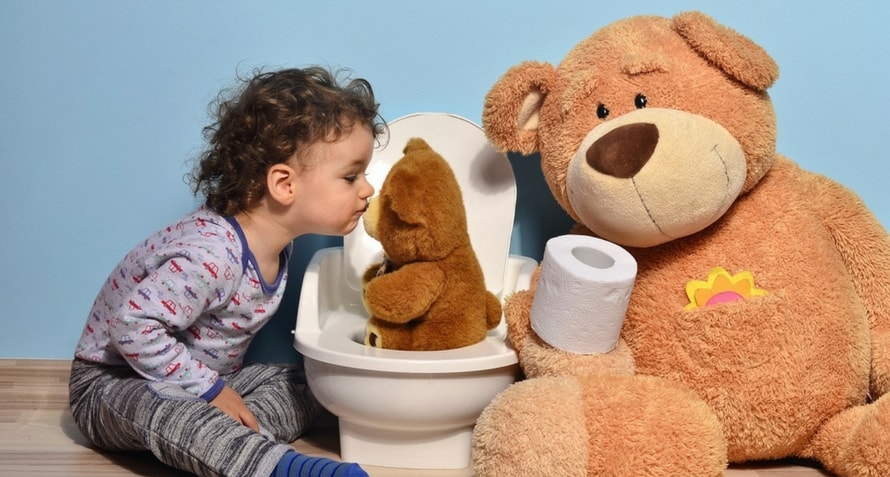
3-Days Potty Training Method – A Step by Step Guide
Together with sleep time woes, crankiness, breastfeeding concerns and eventually toddler tantrums, there’s something else that scares us all. Potty training! It can be a long, frustrating exercise and results just don’t seem to happen! But wait, what? Are we really saying potty training is possible in only three days?
Primarily because potty training is an area of frustration for most new parents, researchers are always on the lookout for a breakthrough. One of these is the 3-day potty training method. And no, it isn’t a lie!
What Is the Three-Day Potty Training Method?
The Three-Day Potty Training Method is a structured approach designed to help toddlers transition from diapers to using the toilet in a short period of time. It requires a focused, consistent effort over three consecutive days, during which parents or caregivers dedicate their time to teaching their child to recognise and respond to the need to use the bathroom. This method is often used for children who show signs of readiness for potty training, such as staying dry for longer periods, showing interest in the toilet, or communicating about their bodily functions (1).
Benefits of Three-Day Potty Training
The 3-day method of toilet training is an intensive, focused approach designed to help toddlers transition from diapers to using the toilet quickly. Below are the key benefits:
1. Quick Results
The three-day method is designed to yield noticeable progress in a short time frame. By dedicating three full days to focused training, many children begin to understand the concept of using the potty and may even start using it independently by the end of the period. This accelerated timeline can be especially appealing for parents who want to move past the diaper stage quickly.
2. Builds Consistency
Consistency is key to successful potty training, and this method emphasizes frequent practice. By having your child sit on the potty every 20–30 minutes and encouraging them to try, they develop a routine and learn to associate the potty with relieving themselves. This repetition helps reinforce the habit and makes it easier for them to remember.
3. Encourages Independence
The three-day method encourages children to take ownership of their potty training journey. By letting them go diaper-free and teaching them to recognize their body’s signals, they learn to act on their own when they need to go. This fosters a sense of independence and boosts their confidence as they master a new skill (2).
4. Cost-Effective
Diapers and pull-ups can be expensive, and the longer potty training takes, the more money is spent on these products. By successfully potty training in a short period, parents can save money by reducing or eliminating the need for diapers sooner. This makes the three-day method a financially practical option.
5. Minimises Confusion
Prolonged or inconsistent potty training can confuse children, as they may struggle to understand expectations. The three-day method’s intensive approach ensures that the child receives consistent messaging and practice, reducing confusion and helping them grasp the concept more quickly.
When Is Your Child Ready for the 3-Day Potty Training?
Determining when your child is ready for the Three-Day Potty Training Method is crucial for success. Look for specific signs that indicate your toddler is prepared to take this big step toward independence (3).
Physical Readiness: Your child can stay dry for at least two hours, has regular bowel movements, and can walk to the potty independently.
Cognitive Readiness: They understand simple instructions, recognize the sensation of needing to go, and can communicate their needs (e.g., saying “pee” or “poop”).
Interest in the Potty: Your child shows curiosity about the toilet, wants to imitate others using the bathroom, or expresses a desire to wear “big kid” underwear.
Emotional Readiness: They are cooperative, willing to sit on the potty, and show a positive attitude toward the process.
Supplies You’ll Need to Start 3-Day Potty Training
Before diving into the Three-Day Potty Training Method, it’s important to gather all the necessary supplies to ensure a smooth and stress-free experience. Here’s a list of essential items you’ll need to get started:
1. Potty Chair or Toilet Seat Insert
A child-sized potty chair or a toilet seat insert with a step stool can make the process more comfortable and accessible for your toddler. Letting your child choose their potty can also increase their excitement and willingness to use it.
2. Training Pants or Underwear
Ditch the diapers and opt for training pants or underwear during the three days. This helps your child feel the sensation of being wet, which reinforces the connection between their body’s signals and using the potty.
3. Cleaning Supplies
Accidents are inevitable, so be prepared with cleaning essentials like paper towels, disinfectant wipes, and a waterproof mattress cover (for naps and bedtime). Having these items nearby will make cleanup quick and hassle-free.
4. Rewards and Motivation Tools
Small rewards, such as stickers, stamps, or a treat jar, can motivate your child to use the potty consistently. A reward chart to track their progress can also add an element of fun and encouragement.
How to Potty Train Your Child in 3 Days
For the 3-Day Potty Training Method to work, follow the given steps very carefully over a period of three days. Make sure you select this time carefully, preferably a long weekend, so you can focus entirely on the task at hand. At the end of this 3-day potty training schedule, we can assure you you’ll definitely see progress.
Warning: Before embarking on this method, please make sure your child shows signs of readiness. Check out this complete list to see if your child meets the criteria.
Step 1: Remove All Diapers From Home
This is mental preparation – more for you than your baby. Not having diapers within your reach will save you from the vicious cycle of getting frustrated and resorting to a diaper, say on the second day.
Step 2: Dress Your Child Only in Underwear
Yes, there will be accidents and plenty of underwear is going to get dirty. But this also means your child will learn a crucial lesson – wet underwear can be very nasty! They will learn to pull it down well in advance. Here’s an expert tip – why don’t you get them underwear like these with their favourite Chota Bheem or Disney character? These guys don’t like to get wet at all!
Step 3: Make Sure Your Child Drinks a Lot of Liquids
Water, juice, smoothies, milk…try anything that gets their bladder full and makes trips to the bathroom frequent. This will ensure they get enough practice of going to the bathroom and getting about their business. You can even try and keep the frequency as high as every 30 minutes or so – yes, taxing for you, but very beneficial in the long run. This means you’ll need to keep pressing them to go to the bathroom every now and then.
Step 4: Teach Your Child to Sit Properly on the Potty – and for Quite Some Time
What happens when your child complains he doesn’t want to go? Persuade him to still sit on the potty for at least a couple of minutes. Teach him to sit comfortably. Preferably, get a potty seat that’s specially designed for toddlers. It helps if the seat is colourful and attractive! Potty seats are also available with handles for firm grip. You can select some fab and funky multifunctional potty seats here. If your child gets bored and fusses while sitting, get him some distractions, such as a bubble blower or even a favourite toy.
Step 5: Congratulate Your Child When He Manages to Stay Dry for Some Time
As your child gets the hang of this rigorous bathroom routine, congratulate him when he is dry for longer than half an hour. And yes, peeing now, and then again after five minutes, just because they didn’t empty their bladder fully, is not something that gets a reward! You can use the occasional candy bar, a sought-after toy, or Mamma’s special hug to serve as the reward.
Step 6: Express Your Disappointment When There Are Accidents
Don’t refrain from doing this out of fear of upsetting your child. It is important for him to know when an accident makes you unhappy. Don’t be harsh and angry, but gently convey that you wish he’d try harder. This will encourage him to try and please you the next time.
Step 7: Make Sure You Keep Everything in This List Handy
We are talking about this: paper towels, room freshener, stain remover, fresh underwear, fresh sheets and wet wipes. Try as you will, accidents are bound to happen, especially in the beginning. Better be armed!
Step 8: Finally, Prepare for Nightime as Well
It is as important (possibly, more) to train for night time as for during the day. Not doing this will make your child assume that it’s okay to take it easy at night or perhaps use a diaper. After dinner, avoid any liquids and foods. Go through one potty round before going to bed, and then once again in the middle of the night. You can set an alarm for this one. Disturbing, yes, but very effective!
Tips to Measure the Success of 3-Day Potty Training
The Three-Day Potty Training Method is designed to help your child make significant progress in a short amount of time, but success may look different for every child. To measure the success of the method, focus on observable milestones and behaviours that indicate your child is on the right track. Here are some tips to help you evaluate their progress:
Consistent Use of the Potty: Your child is successfully using the potty for both pee and poop by the end of the three days.
Fewer Accidents: The number of accidents decreases significantly over the three days, showing improved awareness of their body’s signals.
Self-Initiation: Your child starts telling you when they need to go, rather than relying on you to prompt them.
Dry Periods: They stay dry for longer stretches, indicating better bladder control.
Comfort with the Potty: Your child willingly sits on the potty without resistance or fear.
Independence: They can pull down their pants, sit on the potty, and pull their pants back up with minimal assistance.
Nighttime Progress: While nighttime training may take longer, your child shows signs of staying dry during naps or overnight.
Positive Attitude: Your child feels proud and excited about using the potty, showing enthusiasm for their new skill.
Fewer Reminders Needed: They require fewer prompts from you to use the potty, demonstrating growing independence.
Consistency Over Time: After the three days, your child continues to use the potty regularly without reverting to old habits.
What to Do if 3-Day Potty Training Doesn’t Work?
While the Three-Day Potty Training Method works well for many families, it may not be successful for every child. Some toddlers may need more time, a different approach, or simply aren’t ready yet. Here are some steps you can take if the three-day method doesn’t work:
Your child may not be physically, emotionally, or cognitively ready for potty training. Look for signs of readiness and consider trying again in a few weeks or months.
If the three-day method feels too intense, switch to a more gradual approach, such as letting your child practice using the potty at specific times of the day.
Avoid showing frustration or disappointment, as this can create negative associations with potty training. Celebrate small successes and keep the experience encouraging.
If accidents are frequent or your child resists using the potty, try to pinpoint the issue (e.g., fear of the toilet, discomfort, or lack of interest) and address it accordingly.
If you’re struggling or your child shows signs of potty training resistance, consult your paediatrician or a child development expert for guidance.
FAQs
1. Can the three-day potty training method work for older toddlers or preschoolers?
While the method is often targeted at younger toddlers (around 2-3 years old), it can also be effective for older children who haven’t yet mastered potty training. However, older children may have established habits or resistance that require additional patience and encouragement.
2. What should I do if my child refuses to sit on the potty during the three days?
If your child resists sitting on the potty, try making it more fun by incorporating books, songs, or toys. You can also let them decorate their potty chair or use a sticker chart to motivate them. If resistance continues, they may not be ready, and it’s okay to pause and try again later.
3. Is it normal for my child to regress after the three days?
Yes, regression is common, even after a successful three-day training period. Stress, changes in routine, or simply testing boundaries can cause temporary setbacks. Stay consistent, offer reassurance, and avoid punishment to help them get back on track.
There, you got this! Potty training is a massive and difficult experience for both the mom and her child. But this method has been tried and tested to work – especially if you add to it a generous sprinkling of patience (4)! Of course, the training will not be over on Day 3. You need to keep going for your child to understand this properly, but yes, this is definitely a fantastic headstart!
References/Resources:
1. National Library of Medicine – Toilet training children: when to start and how to train
2. American Family Physician – Toilet Training
3. Mayo Clinic – Potty training: How to get the job done
4. American Academy of Pediatrics – Toilet Training: 12 Tips to Keep the Process Positive
Also Read:
Oh Crap Potty Training Method
Must-Have Items for Potty Training Your Toddler
Innovative Ideas to Potty Train Children Quickly
Successful Potty Training Games for Toddlers
Potty Training Methods – Choose the Best One for Your Child
Read more
A Definitive Potty Training Guide For Twins
Potty training of twins can be a tough task to accomplish, as there are chances that both twins will react differently to the training. Follow some easy steps to ensure that both toddlers are able to understand, learn and follow the steps for training properly.
Tips to Potty Train Twins
Initially, parents have to gauge if the twins are ready to be potty trained. Generally, the toddlers are ready by the age of two and a half years, and in some cases toddlers are ready at 18 months too.
It is easier to potty train both the toddlers together. Both of them will be influenced by each other and will give each other company as well. The kids may benefit from each others’ companionship, and you can encourage both of them by challenging each others’ success and setbacks.
Rewards can be put to use while potty training. The parent can challenge both the twins on who learns to poop properly in the pot and the winning twin will receive a reward.
Two separate potty seats should be bought, because the twins may not want to use the same potty seats with each other, even if used interchangeably.
During the potty training of twins, there will be setbacks and accidents. However don’t freak out, as like every other experience, the twins will learn from their mistakes.
While potty training, the parent has to be flexible enough to understand that both the twins require different ways in which they can be potty trained. Implementing flexibility in behavior is the key to success!
So, if you have been getting nightmares about how to potty train your twins, it is time to implement these tips in your daily routine. Soon your little ones will be a pro on using the potty seat when they need it, without your help.
Read more
Potty Training Ideas For Toddlers
Potty training a toddler can be stressful – ask any toddler mom! You need to recognize the signs that your toddler is ready to say good-bye to the diapers – let’s figure out how.
Potty training basics are an essential routine to be taught to each and every toddler when they want to come out of their nappy phase. Children master peeing in the potty pretty quickly, but they take time to poop in it. Some children master it within days, but others can take several months. In general, the younger a child is when his parents start to toilet train, the longer it takes.
Signs That Your Toddler is Ready For Potty Training
1. Physical Signs
He is well coordinated to walk and run steadily.
He is urinating a fair amount.
He has regular and predictable bowel movements.
He has dry periods, for around 2 hours, during his naps. This indicates that the muscles of his bladder are mature enough to hold urine.
2. Behavioural Signs
He is able to sit quietly in one position for 2-5 minutes.
He is able to pull his pants up and down.
He is able to give a verbal or physical sign, like a grunt, when he is having a bowel movement.
He does not hesitate to learn to use toilet.
3. Cognitive Signs
He is able to control his bowel movements and tell you before it happens.
He is able to follow instructions, such as “open the door, sit down on the seat” etc.
He understands the importance of putting things where they belong.
Effective Tips to Potty Train Your Child
Understand your toddler’s cues to know when he is ready to start training. Some children start very early with potty training, when they’re about 18 months old, while others are not even ready till they’re 3. But usually, most parents begin training their child when he is about 2 and a half years of age.
Buy a right-sized, comfortable potty chair for your child. Buy one with attractive colors and a fun shape, so your child would like to sit on it and explore it. You can pick one from a wide variety available here. If you’re buying a potty chair for your son, look for one without a urine guard or one with a removable one so as to avoid scraping his penis.
Follow a routine. Potty training should be done once in the morning and once in the afternoon, every day. Parents have to sit patiently with the toddler for a few hours in order to train him. Demonstrate the process for your kid in a subtle way. He’ll learn faster by imitation, when things are shown to him.
The habit of pooping in the potty chair should be fostered in your child. Explain to him, and teach him, that big kids and grown ups use only the toilets and potty seats to go potty. The next time he feels the urge to poop, he should ask one of his parents to help him on the potty chair.
If accidents happen, don’t be harsh on your child and handle the set back gracefully. Remember, in the initial stages, the potty training procedure is tough on both you and your child.
A toddler is still very immature, physically, to realize if he has to go poop or pee in the potty chair at night. So, the bed-wetting at night may continue even after your child is fully potty trained for the day-time.
Make your child go to the washroom at night before bed time, and put a plastic sheet on his mattress, under the bed-sheet beneath him to avoid letting the mattress wet. Bed protector sheets come in attractive colours, various sizes and prints. Make him wear an underwear instead of a diaper and ask him to let you know when he feels like pooping at night.
Keeping these simple tips in mind will help you potty train your little one efficiently. Also, remember to be patient with him. Every child does not follow the training session with precision, so if he is taking longer to learn, support him and do not lose your cool.
Read more
7 Excellent Bathroom Hacks For Kids (Bonus: They Also Simplify Potty Training!)
When there are small children in the house, it can be very difficult to maintain a clean and tidy bathroom. This is especially true for the time your child is learning potty training and there are several unintentional accidents…
Potty training is one of the biggest challenges every parent faces and no matter how much help you get, it’s never enough. Whether you jump right into it with the three day potty training trick or take it slow and steady, you’ll need to go all out with the tricks to make sure your child doesn’t stay dependent on diapers for too long. You’ve tried all the potty training tricks available…but what if there were simple bathroom hacks that make the process a whole lot easier?
Read on to find out simple bathroom hacks that not only beautify and maintain your bathroom but also make your little one’s ‘business’ easier for him and you!
1. Step Stool
Your little one might find it tough to use a toilet or wash basin built for adults – which may interfere with his potty training as well. A simple provision of a step stool can make things easier for both of you in this challenge.
2. Add a Picture Book Rack
Quite a few adults use phones or read newspapers when doing their daily business – why not do the same for your little one? Add a book rack filled with picture books that will keep your child engaged long enough.
3. Add a Toilet Paper Marker
Adding a marker with words or pictures that communicate ‘Do Not Pass This Line’ to you little one will guide him about using the right amount of toilet paper. In addition to this hack acting as an aid for potty training, you’ll be doing yourself and the environment a favour by avoiding wastage! You can use the same method to mark the water mug and avoid water wastage as well! ||
4. Portable Toilet Paper Stand
Using a portable toilet paper stand that is set at a lower level will make it easier for your child to reach the toilet paper and build the habit of using it early.
5. Faucet Extender
Avoid the watery mess your little one makes while trying to reach the faucet in the wash basin by using a faucet extender! You can make your own as well by repurposing an old shampoo bottle to create a faucet extender that makes it easy for your kid to wash his hands! All you need to do is cut an old lotion bottle into the shape shown in the picture – make sure to use sandpaper and soften the sharp edges!
6. Low Level Towel Racks
Just like the toilet paper stand, make the towel racks reachable for your kid by investing in low-level towel racks and instill in him the habit of washing and wiping his hands early on!
7. Use a Sticker Board For Motivation
Add a simple sticker board to motivate your little one. Every time he successfully completes all the steps – from using the toilet to washing his hands, ask him to add a sticker of his choice on the board and watch him make the effort on his own!
With hacks like these, you’ll soon have a well-maintained bathroom and a potty trained angel on your (extremely clean) hands! Go ahead and try them and let us know what helped you!
Read more
5 Things Making Potty Training Difficult for Today's Parents – Here Are 3 Tips That Help
Toilet training your child is a very important step towards his growth. It not only makes him independent, but also instills in him a sense of confidence. But toilet training is also one of the most challenging tasks for a parent, especially if you’re doing it for the first-time.
For parents of any time and age, getting kids to use the toilet and not dirty the diapers (and the floor!) has been a challenge. But the interesting thing is, if you ask your parents, they will tell you it wasn’t all that difficult. You learnt to use the potty eventually. So, is this just the glossing effect of nostalgia or do we really have things more difficult?
Well, according to child development experts, toilet training has indeed become harder for parents in today’s generation.
Here, There are Five Main Reasons for Potty Training Resistance:
1. Diapers have gotten Better and Drier
This sounds a bit counter-intuitive, but the fact that we now have diapers that are gentle on the skin and super-absorbent can actually make things trickier! Modern diapers are so good that our children don’t feel wet and uneasy after urinating or passing stool. And when they don’t feel discomfort, the chances of their wanting to use the toilet instead of the diaper get dim.
2. Many Moms are Finding it Hard to Make the Training Continuous
We have stressed out lifestyles, far more than what our parents experienced. This often means disjointed care for our kids. We spend time away from our children when we go out to work and leave them in the daycare or with a caregiver. If you had started potty training at home, but your child wears a diaper in the daycare, there is no continuity in the training ar all. This lack of consistency makes things more difficult for us and for our kids.
3. There’s Less Advice Pouring in on What Worked for an Older Generation
Yes, it is true: hacks and ‘grandma’ tips really do work at times. You may have been a child resistant to potty training and then the three-day method worked for you. Maybe you needed a little reward or motivation to keep going. We all have our own tricks and tips tailored to us. But today, many families are geographically dislocated. This means that as new mothers, we end up getting less time and opportunities to discuss things with others who have more experience. There’s only so much that the internet can achieve.
4. We are Feeling more Pressured, which is making our Efforts more Strained
Experts also believe that modern parents are likelier to feel guilty or pressured about potty training. If a colleague or a neighbour’s kid has achieved this, we end up pressuring our child too, never mind their differences in age or growth. And, because each child develops at a different pace, this usually fails. The only thing that happens is that our efforts get more strained and our kids also sense the pressure. End result: they don’t learn.
5. Finally, We are Reading the Signs of Readiness Wrong
For your kids to learn to use the potty properly, they need to have the required readiness – both in language and in motor skills. They also need to feel a sense of ownership about their own bodies and start seeing this as something that liberates them from diaper changing, or nudging mom when they feel ‘uneasy’. If we misread these signs, or start imagining they are there when they aren’t, we will choose the timing incorrectly. This is the biggest reason for potty training failures.
Source:
https://www.telegraph.co.uk/family/parenting/why-do-todays-parents-find-potty-training-so-tough/
Look Out for These Signs to Start Potty Training in Children
Some parents don’t deal with the task of potty training their children till they’re 3 to 4 years old. It is important to remember that you need to watch out for signs to start potty training your child. You too may think that you should start only when your toddler’s bladder control has become more reliable. While there is no set age, there are a number of physical, behavioural and cognitive signs that determine when you should start potty training. Keep a track of the following signs to know when the right time arrives:
Physical Signs
When your child is coordinated enough to walk and even starts to run steadily
When your toddler starts having regular and well-timed bowel movements
When he starts to urinate a fair amount at once. This clearly implies that he’s ready to do it on his own
When he begins to have control of his potty habits, for example, when he’s able to take a 2-hour nap without wetting his pants or waking up to go. It means that his bladder muscles have developed
Behavioural Signs
He’s able to sit down in one position for a couple of minutes at a time
He’s able to dress and undress himself somewhat
He starts giving a physical or verbal sign when he’s having a bowel movement. The sign could be anything such as grunting, squatting or actually informing you that he has to go for potty
He tries hard to be independent. He even gets a little embarrassed when you take him to the washroom to urinate or defecate
He stops being resistant to learning how to use the toilet or potty seat
Cognitive Signs
When your toddler starts to understand the physical signs that mean he has to go to the toilet
When he can follow simple instructions and actually completes them
When he knows which object belongs where in the house
When he knows how to say the words for urine and stool
3 Tips to Make Potty Training Easier and Faster
Make your child sit on the potty seat for 30 minutes everyday after meals
Ditch the distractions. Ensure your child is only focused on the task so keep the TV shut and those toys away
Encourage and Reward. It is important to acknowledge your child’s efforts and encourage them to become better at it. Chocolates as a treat always work!
Potty training is a tricky, but important milestone. It’s not how early you start to potty train your child that matters; it’s starting it at the right time. If you force it upon him too early, he could take longer than usual to learn it and get accustomed to it. On the other hand, if you delay the process for too long he might develop low self-esteem because of embarrassment. Since all kids are different, you don’t need tick off all indications in this potty training readiness checklist. Just look for a general overall trend towards your tot being independent and self-sufficient. That done, you should be able to overcome the challenges and ensure you ace this parenting responsibility very well.
Read more
Potty Training in Your 2-Year Old
While some toddlers are fast learners, others take their time. Most parents start to potty train their toddlers when they cross the two-year-old mark. Keeping a potty training readiness checklist for 2-year-old is essential to chart her progress.
When charting your toddler’s potty training progress, look out for her need to be independent. There are strategies you can employ to ensure potty training is a natural progression.
Potty Training Signs to Look Out For
1. Discomfort
You need to watch out for physical signs of potty training readiness in a 2-year old. Your toddler will soon feel discomfort and could be propelled to take off her diaper herself. If she wants to see what you do to the diaper, let her. Show her where dirty diapers go. Soon enough, you can lead her to her personal potty. Also, try and make her understand that she needs to use to toilet when she gets that icky feeling.
2. Predictable Bowel Movements
There are some behavioural signs of potty training readiness for 24-months-old you must look out for. One of the main signs is a predictable bowel movement. You may see a pattern that is after meals or right before bed. This will allow you to keep a track of your little ones potty habits.
3. Follows Instructions
Cognitive signs of potty training readiness for a 2-year-old child can also be ascertained. Your little one will be able to follow instructions if you ask her to sit on her potty. She may also understand when you tell her “it’s time to go potty” or when you ask her to hold it till the right time to go potty. These potty training readiness cues will help make the transition from diapers to the potty simpler.
How to Potty Train a 2-Year-Old
1. Practice
You need to have patience with your toddler. Even if you have to visit the toilet every ten minutes with your little one, do it. When she learns the ropes, she will not hesitate to visit the toilet on her own. Even when she doesn’t have to go, keep showing her where she needs to visit when she need to “go potty”. This is one of the best toilet training techniques for toddlers.
2. Praised Efforts
You need to encourage your little one by heaping praise on her for a job well done. A lot of guidance, positive reinforcement and love will ensure that your little one learns how to potty train. Bribing should never be an option. A gold star for a job well done, maybe! This is among the best tips on toilet training a toddler.
3. Fighting Fear
Some toddlers are afraid of doing “the hard part”. You need to ensure that you help her fight the fear. Talk to her, in baby lingo, about how the digestive system works. A nudge in the right direction is what she needs.
Most parents are always in a quandary about when to potty train a child? The right answer is: There is no perfect time, just find the right opportunities.
Read more
Sort By
 Latest
 Most Popular
 Trending
Please select atleast one Filter