Pregnancy Week By Week
Suggested articles for you
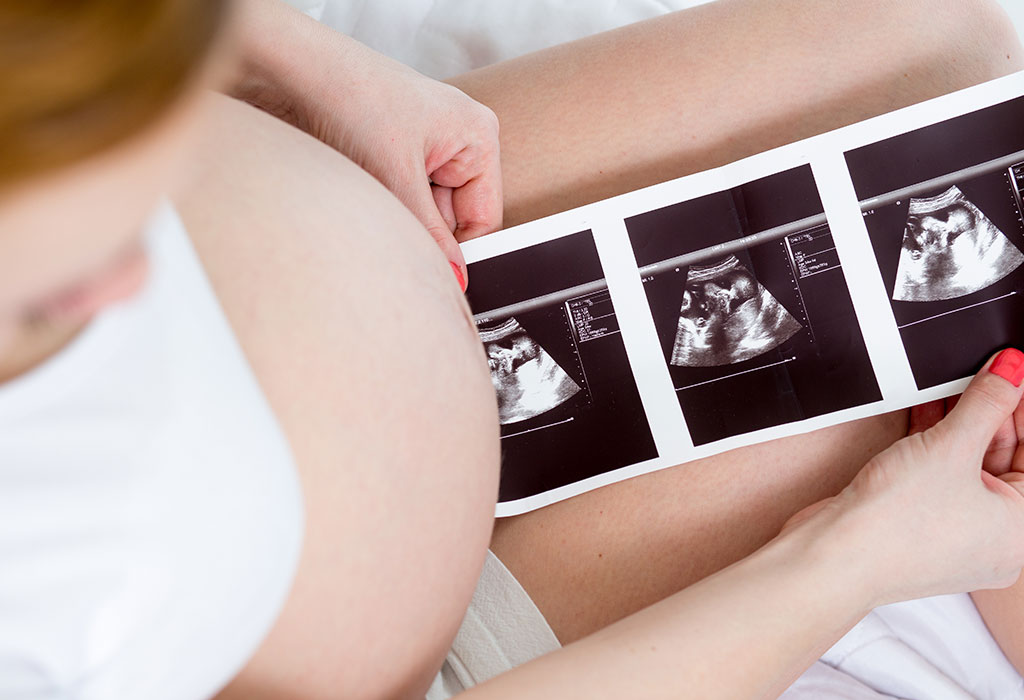
Foetal Growth Chart Week by Week – Length & Weight
The foetus grows right from the earliest days of pregnancy. Ultrasound scans are done at regular intervals during pregnancy and help determine the approximate weight and length of the baby. The growth of the foetus in the womb leads to an increase in the size of the bump too. Every parent-to-be is excited about foetal growth and, therefore, must be aware of the fetal growth chart, that help to know the baby’s weight in a particular week. In this article, we have covered this information along with other things that you must be aware of as a parent. Let’s read!
How Babies Are Measured in the Womb?
When you get an ultrasound scan during pregnancy, the height and the weight of the baby are measured every single time. They are measured from head to bottom from eight weeks to 19 weeks of pregnancy. The average Indian baby weighs anywhere between 2.5 kg – 2.9 kg when born at full term.
Video: Foetal Growth Chart Week by Week – Length & Weight
Foetal Weight Chart
The fetal weight growth chart below shows the average increase in the weight of the foetus on a week-by-week basis. The numbers are only averages, and the actual weight and length of the foetus may vary significantly. These are general guidelines, and your baby’s weight may not be an exact match to what you see in the table. However, this should not be a cause for worry. Let’s look at this fetal growth chart by week.
Pregnancy Week
Average Weight
8 weeks
1g
9 weeks
2g
10 weeks
4g
11 weeks
7g
12 weeks
14g
13 weeks
23g
14 weeks
43g
15 weeks
70g
16 weeks
100g
17 weeks
140g
18 weeks
190g
19 weeks
240g
20 weeks
300g
21 weeks
360g
22 weeks
430g
23 weeks
501g
24 weeks
600g
25 weeks
660g
26 weeks
760g
27 weeks
875g
28 weeks
1kg
29 weeks
1.2kg
30 weeks
1.3kg
31 weeks
1.5kg
32 weeks
1.7kg
33 weeks
1.9kg
34 weeks
2.1kg
35 weeks
2.4kg
36 weeks
2.6kg
37 weeks
2.9kg
38 weeks
3.1kg
39 weeks
3.3kg
40 weeks
3.5kg
Foetal Length Chart
Along with the weight, the doctor keeps a record of the foetal length as well when maintaining a pregnancy growth chart. This chart is a rough guide of the foetal length on a week by week basis. The length of the foetus is measured from the crown till the bottom, because of the position he’ll be in, i.e., legs curled up against the torso, which makes it difficult to measure his length from head to toe. From the 20th week onwards, the length of the foetus will be calculated from the crown to the heel.
Pregnancy Week
Average Length
8 weeks
1.6cm
9 weeks
2.3cm
10 weeks
3.1cm
11 weeks
4.1cm
12 weeks
5.4cm
13 weeks
7.4cm
14 weeks
8.7cm
15 weeks
10.1cm
16 weeks
11.6cm
17 weeks
13cm
18 weeks
14.2cm
19 weeks
15.3cm
20 weeks
25.6cm
21 weeks
26.7cm
22 weeks
27.8cm
23 weeks
28.9cm
24 weeks
30cm
25 weeks
34.6cm
26 weeks
35.6cm
27 weeks
36.6cm
28 weeks
37.6cm
29 weeks
38.6cm
30 weeks
39.9cm
31 weeks
41.1cm
32 weeks
42.4cm
33 weeks
43.7cm
34 weeks
45cm
35 weeks
46.2cm
36 weeks
47.4cm
37 weeks
48.6cm
38 weeks
49.8cm
39 weeks
50.7cm
40 weeks
51.2cm
Ultrasonic Foetal Measurement Standards
The gestational age chart is used to determine the biometric measurements and determine if the foetal growth is normal. If the mother-to-be is able to provide the date of the last menses before conception, it gives a much better estimate of EDD, which is the estimated date of confinement (also known as Expected Date of Delivery). The EDD can be estimated to plus or minus 5 days.
The method of using ultrasound scans to estimate the gestational age is done under the assumption that the baby is growing normally and as per the foetus weight chart. If any condition alters the growth of the foetus, it will also make the estimate less reliable. The ultrasound method lets one measure the number of foetal and embryonic structures, but only a few of them are reliable and easy to carry out repeatedly. The ultrasound foetal measurements are done using various foetal graphs and calculators.
Estimated Foetal Weight Calculator
The foetal weight calculator lets you calculate the percentile of the foetal weight as well as the estimated foetal weight at the time of delivery. The inputs that you need to enter are the gestational age, biparietal diameter, humerus, head circumference, femur length, and the abdominal circumference. The calculator then calculates the percentile for each factor, as well as the estimated foetal weight at the time of delivery.
Suppose the foetus is in the 60th percentile for weight, at 30 weeks. This means that 60% of foetuses weigh the same or less than the baby at 30 weeks. This means that 40% of foetuses weigh more than the baby at 30 weeks.
It is a common practice to opt for an ultrasound scan to estimate the weight of the foetus towards the end of pregnancy. The accuracy rate of this method is very low and the calculated weight may lead to changes in the way the mother and the physician may perceive the delivery. Therefore, the method has been questioned in medical circles, and is not recommended until there is a medical condition.
The foetal weight calculator calculates the foetal weight as well as the estimated foetal weight at the time of delivery as per ultrasound data using many formulas like Warsof, Shepard, Hadlock, Campbell, and so on.
The calculation is carried out using the four basic parameters which are: head circumference (HC), biparietal diameter (BPD), abdominal circumference (AC) and femur length (FL).
The calculated foetal weights may be 16% plus or minus the average weight. The actual weight can be either higher or lower than 16%.
Around 68% of babies will be within the range of 1 standard deviation (SD), and 2 SD should encompass around 95% of the actual weight. However, about 5% of the babies will be either higher or lower than 2.5%, thus making this an inaccurate calculator of foetal weight.
Foetal Growth Percentile Calculator
The growth percentile calculator calculates how big or small the baby is as compared to the average value. If the baby is in the 40th percentile for growth, this means that the baby is larger than 40% of babies who are of the same age, and smaller than 60% of babies of the same age. 50 is the average value and a value below 50 means that the baby’s growth is below the average value. A value above 50 means that the baby has an above-average growth rate.
A foetus that measures between the 10th and the 90th percentile is considered normal.
The different terms used in tracking or calculating the growth of the foetus in the womb are briefed upon below for better understanding:
1. Crown-Rump Length
The embryonic crown-rump length is a parameter that dates the embryo and estimates the foetus’ average length. It can be measured to an accuracy of plus or minus 3 to 5 days. The limbs and the yolk sac are excluded from this calculation. The crown-rump length can also be used to calculate the gestational age, wherein doctors can estimate your due date.
2. Biparietal Diameter and Head Circumference
The BPD or the Biparietal Diameter is the transverse width of the head at the widest part. The measurement is done from one leading edge to the other leading edge of the bone on the opposite side, as it is the most distinct. The scope for error in this measurement is not a lot as the oval shape of the head does not leave a lot of room for mistakes. This makes it easy to use the method over and over again. The size of the head is determined by the growth of the brain and does not take into account other aspects of the brain’s development.
3. Femur and Humerus Length
The femur length method is also reliable and can be repeated. Skeletal dysplasias tends to affect it but this condition is very rare. The measurement confirms the head’s measurement and the best value can be obtained after 14 weeks. To estimate the gestational age, at least 2 or sometimes even 4-5 measurements may be required.
4. Estimated Foetal Weight
There are different types of computer software and charts that help the doctor calculate the foetal weight, along with measurements such as the abdominal circumference, biparietal diameter, the femur length and so on.
5. Abdominal Circumference
This is a measurement taken in the second half of the pregnancy and is used to assess foetal growth. It is an approximate method and it is used to see if the growth proportions of the foetus are normal. It is measured at the level of the liver and the stomach along with the left portal vein at the umbilical region.
6. Gestational Sac
This is measured in early pregnancy and is measured in three dimensions. The ‘Mean Sac Diameter’ is the average that is used to estimate the gestational age. The method can be applied between the 5th and the 8th week of pregnancy and has an accuracy of plus or minus 3 days.
The gestational sac surrounds the embryo and can be seen in the early ultrasound scans. The sac encloses the embryo as well as the amniotic fluid. It allows the doctor to measure the number of weeks of pregnancy (with a margin of plus or minus 5 days).
7. Yolk Sac
This is a membranous sac and is attached to the embryo. The sac can be spotted between the embryo and the gestational sac. It offers nourishment to the embryo before the circulatory system and the placenta develops to give the foetus the required nourishment.
8. Foetal Pole
This is a mass of cells and can be seen before the embryo becomes visible. The rate of growth is approximately 1 mm a day and starts at the 6th week of the gestational age. It is used to date an early pregnancy and also, to estimate the gestational week.
The gestational age is calculated in most cases by using BPD, femur length, head circumference, and abdominal circumference. It may not be very important to see how they are combined. The modern ultrasound machines have a computer biometric analysis program that calculates the estimated due date.
The doctor may conduct a multiparameter assessment of the gestational age after the first trimester of pregnancy. The basic ones are the biparietal diameter and the femur length. The other parameters such as occipitofrontal diameter, head circumference or humerus length are also considered.
The early measurement to calculate gestational age is usually taken as a definite assessment. There is a reduced accuracy after 20 weeks. The doctor would evaluate further if the ultrasound foetal measurement standard parameters are not in agreement at any time. This is done to average all the values to get an estimated gestational age.
Please note that these are the international standards of weight and length using guidelines from the UK. The average weight and length of an Indian baby may differ from the international standards.
How Many Times Can the Baby Be Measured in Pregnancy?
A parent-to-be might wonder about how many times their baby can be measured during pregnancy. Here are some points that will help you understand the same:
In pregnancy, your baby’s growth will be monitored at first between six to nine weeks of pregnancy.
Between the 11th to 13th week of pregnancy, a nuchal translucency scan is performed.
Between 18 and 20 weeks, an anomaly scan is performed.
The doctor will measure many regions of the baby’s anatomy during this scan, including his head circumference, abdominal circumference, and thigh bone length.
Between 28 and 32 weeks, you’ll get a growth scan or foetal wellness scan.
FAQs
1. What Does It Mean If the Baby Is Not of Expected Size at the Stage of Delivery?
Intrauterine growth restriction is when a baby in the womb does not grow as expected or is not as big as expected for the pregnancy stage. This timing is called an unborn baby’s “gestational age.”
2. Does The Foetal Size Get Double Every Week of Pregnancy?
You will be surprised to know that babies grow tremendously in the later stages of gestation. They almost get double in size between 28 weeks and the time they’re born.
3. Is It Possible That My Baby Be Bigger or Smaller Than the Average?
Every baby is different, and factors like the size of the parents also contribute to the size of the baby. So, your baby can be bigger or smaller than the average baby.
4. Can Fetal Weight Predict the Gender of Baby?
No, the foetal weight cannot predict the gender of the baby.
The foetal growth chart is an important indicator of the progress of the pregnancy and the growth of the baby. Any anomaly detected during the regular measurements is addressed by the doctor to see if intervention is necessary. It is advisable to go for all the mandatory checkups and scans during pregnancy to ensure that the charts are tracked correctly.
References/Resources:
1. An Alcohol-free pregnAncy is the best choice for your bAby.; cdc.gov; https://www.cdc.gov/ncbddd/fasd/documents/fasdbrochure_final.pdf
2. Fetal development: The 3rd trimester; mayoclinic.org; https://www.mayoclinic.org/healthy-lifestyle/pregnancy-week-by-week/in-depth/fetal-development/art-20045997
3. Baby Development Month By Month; americanpregnancy.org/; https://americanpregnancy.org/healthy-pregnancy/week-by-week/baby-development-month-by-month/
4. Fetal Growth Calculator; srhr.org/; https://srhr.org/fetalgrowthcalculator/#/
5. Fetal Development; clevelandclinic.org; https://my.clevelandclinic.org/health/articles/7247-fetal-development-stages-of-growth
Also Read:
How to Increase Fetal Weight in Pregnancy?
Baby Growth during Pregnancy in Each Trimester
Baby Size — Week by Week Comparison with Fruits and Veggies
Read more




Baby Size Week By Week Comparison With Fruits and Veggies
From the moment of conception to delivery, your baby grows by leaps and bounds inside you. It’s a joyous feeling to try to guess what size your baby would be inside your womb at different stages! The gestational age of a baby is initially determined using ultrasound scans using markers like sac length and length from crown to rump. This is because every baby grows at the same pace only up to a certain stage of pregnancy. Here, we attempt to explain how big your baby is getting and the uterus size by week with fruits and veggies as examples. Read on to know the baby fruit size by week comparison and get a glimpse into which fruits or vegetable size your little one may represent currently!
How Big Is Your Baby?
Studying your baby’s size during pregnancy is fascinating. At the time of conception, your baby is discernable. The size of the foetus at every stage during pregnancy is used as a benchmark to determine if the pregnancy is progressing normally and if your baby is growing as she ought to be. When you’ve just become pregnant, your baby is barely the size of a seed. From this size, your baby will gain up to 3.5 kilos of weight by the time she is born.
Baby Size: Weeks 1 to 3
At this stage, the fertilisation of the egg happens in the mother’s body and the zygote attaches itself to the uterus. Your baby has just been formed at this stage and begins growing from two cells.
Week 4 Baby Size
In medical terms, the baby is called a blastocyst. If one had the chance to look at the baby, it would look like a group of cells bunched up together like a ball. It would be comparable to the size of a poppy seed.
Baby Weight:
The baby’s weight is barely discernible at this stage, weighing in at less than a gram.
Baby Length:
Your baby is very tiny at this stage and can be identified as a sac in the ultrasound scan. The baby would be less than 3mm in length.
How You Will Feel:
This is the start of the first signs that you are pregnant – bleeding and mild cramping, for example. However, most women dismiss these symptoms as they can easily be confused with the symptoms of the start of the menstrual cycle.
Week 5 Baby Size
Your baby is roughly the size of an apple seed. During this phase, organs such as the liver and kidney begin to form.
Baby Weight:
The baby’s weight at this stage is negligible; it is less than a gram.
Baby Length:
At this stage, the baby is about 0.13 inches long.
How You Will Feel:
You will start experiencing some of the more apparent symptoms of pregnancy, such as morning sickness and frequent urination.
Week 6 Baby Size
Your baby’s size can be compared to that of a sweet pea. During this phase, the eyes, nose, tongue, and vocal cords begin to form.
Baby Weight:
Your baby will be too small to have any significant weight.
Baby Length:
Your baby will measure just 0.25 inches in length at this stage.
How You Will Feel:
Your baby bump may still not be visible, but you may experience pregnancy-related issues like mood swings, cramps, and sore breasts.
Week 7 Baby Size
The size of your baby is comparable to that of a blueberry at this stage, and the brain will grow by almost a third of its full size.
Baby Weight:
The baby’s weight is still negligible.
Baby Length:
At this stage, your baby measures between 13 and 18 mm in length.
How You Will Feel:
A few moms-to-be might get lucky and not experience any symptoms at all, but most pregnant women will experience nausea, food cravings, and acne.
Week 8 Baby Size
As you approach the 8-week mark, your baby will be half an inch in length and the size of a kidney bean. The baby has just about ‘lost its tail’ and has fingers that are webbed in nature.
Baby Weight:
Your baby will weigh around 1.1 grams (0.04 ounces) at this stage.
Baby Length:
Your baby will measure half an inch in length at this stage.
How You Will Feel:
Moms-to-be usually begin feeling the symptoms of early pregnancy during this stage. A rush of hormones can make one sensitive to the faintest of smells, and dream about things that are stranger than usual. Other issues that one might face include nausea, lightheadedness, and bloating.
Week 9 Baby Size
Your baby will be the size of a grape. Its milk teeth will be forming at this point, along with hair follicles.
Baby Weight:
The baby weighs 1.9 grams (0.07 ounces) at this stage.
Baby Length:
The foetus is usually 0.9 inches long at this stage.
How You Will Feel:
One will experience the usual pregnancy symptoms such as headaches and morning sickness.
Week 10 Baby Size
At this stage, your baby is the size of a tiny tangerine. Your baby has a fully functioning heart and will begin to grow a set of arms and legs.
Baby Weight:
The baby weighs approximately 3.9 grams (0.14 ounces) at this stage.
Baby Length:
The baby’s length will be 1.25 inches at this stage.
How You Will Feel:
Apart from the regular symptoms, you may also experience pain in the abdomen as your uterus grows larger to accommodate the foetus.
Week 11 Baby Size
Your baby is as big as a fig now and is well on its way to developing its arteries and veins.
Baby Weight:
Your baby will weigh 7 grams (0.25 ounces) at this stage.
Baby Length:
At 1.61 inches, your baby is growing rapidly in length.
How You Will Feel:
Along with the regular symptoms, you may experience issues with gas, which is why you should avoid beans and fried food, and focus on fibre-rich food.
Week 12 Baby Size
Your baby is the size of a lime at this stage, and its soft body is gradually developing bones.
Baby Weight:
Your baby will weigh 14 grams (0.49 ounces) at this stage.
Baby Length:
Your baby will be 2.13 inches long at this stage.
How You Will Feel:
You should see a reduced bout of morning sickness and increased energy. However, you are likely to experience headaches due to changes in blood pressure.
Week 13 Baby Size
Your baby is now the size of a pea pod from head to toe. You can clearly view the hands, legs and head in an ultrasound scan. You will also see that the baby is constantly moving and very active at this stage.
Baby Weight:
Your baby will weigh 23 grams (0.81 ounces).
Baby Length:
At 2.91 inches in length, your baby will be very visible on an ultrasound scan.
How You Will Feel:
This will be the best phase of your pregnancy period as nausea will go down, your energy levels will increase, and there will be a spike in your libido.
Week 14 Baby Size
Your baby is now the size of a big lemon and is in the process of exercising its facial muscles which will change its expressions ever so often.
Baby Weight:
Your baby will weigh over 42 grams (1 and a half ounces) at this stage.
Baby Length:
Your baby will measure 3.9 inches in length.
How You Will Feel:
You will have surprisingly thick, silky hair and won’t feel lethargic anymore.
Week 15 Baby Size
Your baby can be compared to the size of an apple or small pear at this stage. Your baby’s sense of hearing is getting developed, and it can most probably hear the soothing rhythm of your heartbeat.
Baby Weight:
Your baby weighs 68 grams (2.4 ounces) at this stage.
Baby Length:
Your baby will be closing in on 4 inches of length at this phase.
How You Will Feel:
If you are a second-time mother, you may begin to feel your baby move around this time. It may take much longer for new mothers to recognise or feel the baby move.
Week 16 Baby Size
Your baby is now the size of an avocado and has a fully functional circulatory system in place.
Baby Weight:
At 100 grams (3.53 ounces), your baby is gaining weight rapidly.
Baby Length:
Your baby will be over 4.5 inches in length at this stage.
How You Will Feel:
At this stage, you will be dealing with a mixed bag of symptoms. On one hand, you’ll be dealing with backaches and constipation, and on the other, you will have radiant and glowing skin.
Baby Size 17 Weeks
Your baby is now the size of a pear and has developed its unique fingerprint by this point.
Baby Weight:
At 140 grams (4.94 ounces), your baby is slowly filling in your uterus.
Baby Length:
Your baby will have stretched to nearly 5.12 inches in length at this stage.
How You Will Feel:
As the baby is growing at a rapid pace, you might experience strange dreams, weight gain, and increased fluids in your body.
Baby Size 18 Weeks
Your baby’s size is comparable to that of a sweet potato, and the sex of the baby will become clear.
Baby Weight:
The baby weighs 190 grams (6.70 ounces) at this stage.
Baby Length:
Your baby would be well over 5.5 inches in length.
How You Will Feel:
If you haven’t already, you should start to feel the baby move.
Baby Size 19 Weeks
Your baby will be nearly as big as a mango and the sensory organs will continue to develop at a rapid pace.
Baby Weight:
Your baby weighs nearly 238 grams (8.4 ounces) at this stage.
Baby Length:
Your baby will be 6 inches long at this stage.
How You Will Feel:
Ligament pains aren’t unusual at this stage. As your uterus expands and puts pressure on your body, you may feel dizzy and lightheaded. Some women may also experience leg cramps and hip pain at this stage.
Baby Size 20 Weeks
Your baby is almost as big as a banana now. Second-time mothers can usually feel the baby move at this stage as the baby becomes more active every day.
Baby Weight:
Your baby weighs 283 grams (10 ounces) at this stage.
Baby Length:
Your baby is over 10.5 inches in length at this time.
How You Will Feel:
Swelling and shortness of breath are common at this stage. You may also experience high bursts of energy at times.
Baby Size 21 Weeks
Your baby is the size of a bulky carrot. At this point, the baby’s rate of growth will begin to outpace the placenta.
Baby Weight:
Your baby weighs nearly 340 grams (12 ounces).
Baby Length:
Your baby will be 10.58 inches long.
How You Will Feel:
Your baby bump should be rather noticeable at this stage. Leg cramps can feel more severe. You may also experience vaginal discharge, which is normal.
Baby Size 22 Weeks
Your baby will be the size of a squash at the 22-week mark.
Baby Weight:
At over 425 grams (15 ounces) in weight, your baby is now nearly half a kilogram.
Baby Length:
Your baby will be nearly 11 inches long.
How You Will Feel:
Your skin may become itchy, and you may experience heartburn. Your body may also prepare for the impending delivery by experiencing Braxton Hicks contractions, a type of pre-labour uterine contraction.
Baby Size 23 Weeks
Your baby is as big as a grapefruit at this stage, and its bone marrow has begun to produce red blood cells on its own.
Baby Weight:
Your baby will weigh 498 grams (1.1 pounds) at this stage.
Baby Length:
Your baby’s size will be nearly 11.4 inches from head to heel.
How You Will Feel:
Lingering backaches, swollen gums and ankles are all common discomforts experienced by pregnant women during this phase of their pregnancy.
Baby Size 24 Weeks
Your baby is now the size of an ear of corn.
Baby Weight:
Your baby is nearly 589 grams (1.3 pounds).
Baby Length:
Your baby is now a whole foot long, and much bigger than when it was first formed.
How You Will Feel:
The linea nigra or the line that runs along the centre of your belly will darken and be very visible at this stage. You may also see stretch marks as your baby pushes your uterus out, and your skin expands to accommodate this change.
Baby Size 25 Weeks
Your baby is comparable to an acorn squash at this stage and is active enough to respond to unpleasant sounds with an occasional kick or two.
Baby Weight:
Your baby is nearly 680 grams (a pound and a half) in weight.
Baby Length:
Your baby will be 13.6 inches in length.
How You Will Feel:
You may have trouble sleeping and may have the urge to urinate more frequently.
Baby Size 26 Weeks
Your baby resembles a head of kale in size and has a fairly developed spinal cord.
Baby Weight:
At a whopping 771 grams (1.7 pounds), your baby is now much heavier than when first seen on a scan.
Baby Length:
Your baby will be over 14 inches in length.
How Will You Feel:
Your blood pressure may elevate at this point – make sure to track it. You may find that you have difficulty remembering things, unlike before. Your belly will be much bigger, and this may be the right time to switch to comfortable-fitting maternity clothes.
Baby Size 27 Weeks
Your baby is as big as a cauliflower. Its ears have developed and it can distinguish your sound at this stage.
Baby Weight:
Your baby weighs 861 grams (1.9 pounds) at this stage.
Baby Length:
Your baby is a little over 14.4 inches in length.
How You Will Feel:
The regular discomfort of the second trimester will continue, but as you step into the third trimester, you will also experience stronger fetal movements as your belly expands.
Baby Size 28 Weeks
Your baby is now the size of a large eggplant and you may hear hiccups often, which is normal.
Baby Weight:
Your baby will weigh nearly 997 grams (2.2 pounds).
Baby Length:
Your baby will be about 15 inches long.
How You Will Feel:
As your baby grows and your stomach expands, you will experience several difficulties. The growing size of your uterus will create pressure on your bladder, thus creating frequent urges to empty it. Your baby’s movements will also be stronger, and will probably keep you up at night.
Baby Size 29 Weeks
Your baby is as large as a butternut squash, and a large part of it constitutes the brain which is developing at a rapid pace.
Baby Weight:
Your baby will easily reach 1.1 kg (2.5 pounds) of weight at this stage.
Baby Length:
Your baby will be 15.2 inches long.
How You Will Feel:
You may experience constipation, haemorrhoids and itchy skin at this point. It will be difficult to get a good night’s sleep, and you will be recommended to sleep on your side to avoid straining your back with your growing stomach size.
Baby Size 30 Weeks
Your baby is as big as a large cabbage at this stage, and the growth of the baby in terms of size is likely to decelerate.
Baby Weight:
Your baby weighs 1.3 kg (2.91 pounds).
Baby Length:
Your baby’s length is 15.7 inches at this stage.
How You Will Feel:
Your baby’s size has reached up to your rib cage and you will feel shortness of breath and exhaustion at this stage of your pregnancy.
Baby Size 31 Weeks
Your baby could be comparable to a large coconut at this stage, and it would have a sense of taste that is developed enough to taste the amniotic fluid.
Baby Weight:
Your baby will weigh over 1.4 kg (3 pounds) at this time.
Baby Length:
The baby will be 16.2 inches in length.
How You Will Feel:
An achy back, heartburn, swelling of your extremities, and light contractions are normal pregnancy symptoms at this stage.
Baby Size 32 Weeks
Your baby is now the size of a Chinese cabbage and has a complete set of toes and fingernails.
Baby Weight:
Your baby will weigh 1.7 kg (3.8 pounds).
Baby Length:
Your baby will be over 16.7 inches in length.
How You Will Feel:
During this time, a pregnant woman is likely to experience vaginal discharge, dark nipples, and leaky breasts.
Baby Size 33 Weeks
Your baby is now the size of a pineapple and is well on its way to having an immune system.
Baby Weight:
Your baby weighs nearly 1.9 kg (4.2 pounds) at this stage.
Baby Length:
Your baby will be 17.2 inches long now.
How You Will Feel:
You may have headaches as you grow increasingly exhausted. Always stay hydrated, and be careful when you move around.
Baby Size 34 Weeks
Your baby is now the size of a melon and has probably developed a layer of fat to insulate itself from losing too much heat.
Baby Weight:
Your baby is 2.1 kg (4.7 pounds) in weight.
Baby Length:
Your baby will be over 17.7 inches long.
How You Will Feel:
You may feel your stomach lower than it was a few weeks ago. This is because the baby would have descended to the pelvis for delivery.
Baby Size 35 Weeks
Your baby is now as big as a honeydew melon and you will experience a lot more movement during this time.
Baby Weight:
Your baby is 2.4 kg (5.3 pounds) heavy.
Baby Length:
Your baby will measure 18 inches in length.
How You Will Feel:
One might need to go to the bathroom more frequently because the baby would be pressing down on the bladder as it would have moved to the pelvic region by now.
Baby Size 36 Weeks
Your baby is as big as a Romaine Lettuce at this stage, and there is a chance that the baby’s head has shifted down to the pelvis.
Baby Weight:
Weight gain slows down, and the baby will weigh 2.6 kgs (5.78 pounds) at this stage.
Baby Length:
Your baby will measure 18.6 inches in length at this stage.
How You Will Feel:
The baby’s descent will be putting pressure on your pelvic floor. On the bright side, your ability to breathe will improve as the lungs have more space to expand.
Baby Size 37 Weeks
Your baby is now as long as a bunch of Swiss chard leaves – the baby’s brain and lungs will continue to mature during this time.
Baby Weight:
Your baby will be 2.8 kg (6.3 pounds) on average at this stage.
Baby Length:
Your baby is roughly 19 inches long at this stage.
How You Will Feel:
You will experience Braxton Hicks contractions which may be confused with labour pain. You may notice increased discharge and vaginal spotting.
Baby Size 38 Weeks
At 38 weeks, your baby is the size of a stalk of rhubarb.
Baby Weight:
Your baby may weigh 3 kg (6.8 pounds) on average.
Baby Length:
Your baby will be roughly 19.5 inches long by this phase.
How You Will Feel:
Your contractions may come closer together. Pay attention to make sure you do not confuse labour pains with Braxton Hicks contractions. One may also experience anxiety as one anticipates the baby’s delivery.
Baby Size 39 Weeks
Your baby now resembles the size of a small watermelon and develops a new layer of skin which is much tougher than its older skin.
Baby Weight:
Your baby will weigh nearly 3.1 kg (7 pounds).
Baby Length:
Your baby will easily measure 20 inches in length.
How You Will Feel:
Along with Braxton Hicks contractions, one will experience thick, mucous-like discharge along with blood.
Baby Size 40 Weeks
You have officially come to the end of your pregnancy. Your baby will be as big as a watermelon, and your pregnancy will soon culminate in the delivery of your child.
Baby Weight:
A full-term baby weighs 3.4 kg (7.6 pounds) on average.
Baby Length:
Your baby will be 20.2 inches long from head to toe at this stage.
How You Will Feel:
You made it! Now, just hang in there till your body decides it is time for the birth. Get as much rest as you can, for your body needs the energy and strength to push out a little being.
FAQs
1. Does the Size of the Baby in the Womb Affect Delivery?
Yes, the baby’s size does have an effect on delivery. A larger baby might need help in terms of vacuum or forceps assistance or a caesarean. On the other hand, a smaller baby could have other delivery complications like a decrease in blood flow or a dip in oxygen levels.
2. Can a Baby Be Larger or Smaller Than the Average Size in the Womb?
Yes, even with the above-depicting pregnancy sizes in fruit, a baby could be larger or smaller than the average size. This is because genetics plays a great role in the baby’s size. Also, gestational growth rate and nutrition consumed during pregnancy influence the baby’s size.
3. What does Fundal Height Measurement Mean and How Is It Used to Determine Fetal Size?
Fundal height refers to the distance between the pubic bone and the uterus’s top. This differs from person to person. A larger than normal indicates a large baby with or without adequate amniotic fluid, while a smaller fundal height than expected signifies slow fetal growth and low amniotic fluid levels.
Now that you’ve seen your baby’s size compared to fruit week by week, understand that after a certain stage, every baby takes her own pace of growth. Hereditary factors, maternal nutrition and health come into play at this stage, and this is why every baby has a different size, weight and head circumference at the time of birth. Eating right and healthy is the key to a successful pregnancy. This vegetable pregnancy comparison information will also help you enjoy these natural changes in your body! Have a happy pregnancy!
References/Resources:
1. Your Baby’s Development: The First Trimester; American Academy of Family Physicians; https://familydoctor.org/your-babys-development-the-first-trimester/
2. Your Baby’s Development: The Second Trimester; American Academy of Family Physicians; https://familydoctor.org/your-babys-development-the-second-trimester/
3. Your Baby’s Development: The Third Trimester; American Academy of Family Physicians; https://familydoctor.org/your-babys-development-the-third-trimester/
4. Pregnancy – week by week; Victoria State Government Department of Health; https://www.betterhealth.vic.gov.au/health/healthyliving/pregnancy-week-by-week
5. Large for Gestational Age; University of Rochester Medical Center; https://www.urmc.rochester.edu/encyclopedia/content.aspx?ContentTypeID=90&ContentID=P02383
6. Small for Gestational Age; University of Rochester Medical Center; https://www.urmc.rochester.edu/encyclopedia/content.aspx?ContentTypeID=90&ContentID=P02411
7. Fetal development: The 1st trimester; Mayo Clinic; https://www.mayoclinic.org/healthy-lifestyle/pregnancy-week-by-week/in-depth/prenatal-care/art-20045302
8. Fetal development: The 2nd trimester; Mayo Clinic; https://www.mayoclinic.org/healthy-lifestyle/pregnancy-week-by-week/in-depth/fetal-development/art-20046151
9. Fetal development: The 3rd trimester; Mayo Clinic; https://www.mayoclinic.org/healthy-lifestyle/pregnancy-week-by-week/in-depth/fetal-development/art-20045997
Also Read:
Pregnant Belly Week by Week
Baby Growth in Each Trimester
Week by Week Foetal Growth Chart
Read more
Pregnant Belly Pictures – Week By Week Photos
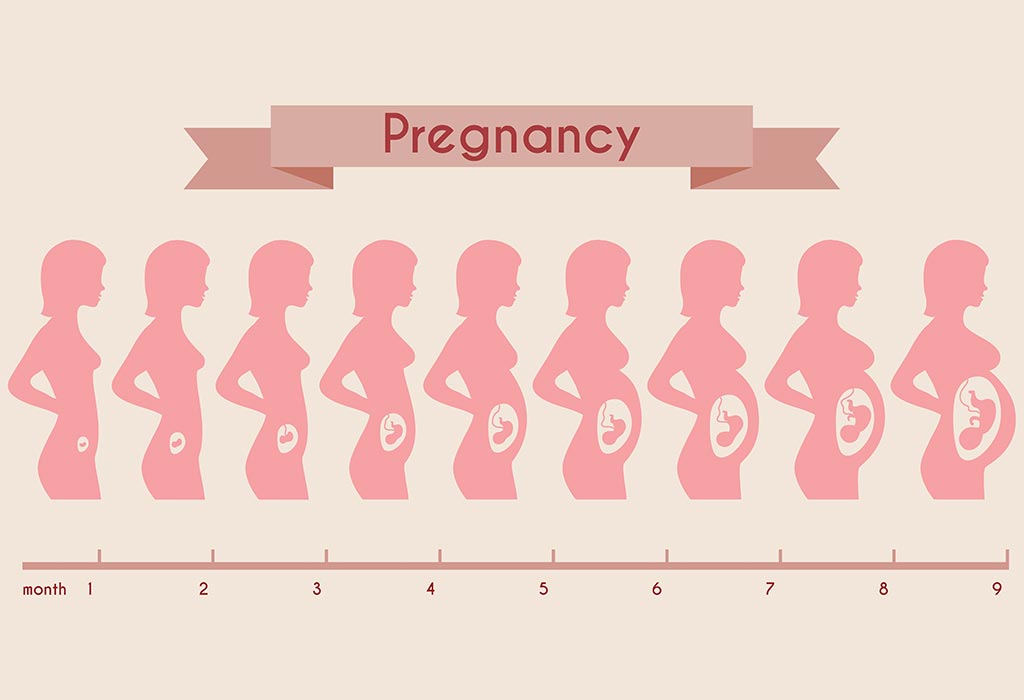
Pregnancy is one of the most beautiful experiences in the life of a woman. It is a unique and special bond of love that starts even before the baby is born and will only grow as time passes by. Parents-to-be are anxious to welcome their bundle of joy. As the baby bump keeps growing week by week, you might wonder what changes lie ahead and seek information to prepare for them. Other than personal experiences and medical information, pregnant belly photos of other moms-to-be can help you gauge the progress of your own growth. Pregnant belly pictures are a beautiful keepsake that you can cherish tomorrow. In this article, you’ll find pictures of a pregnant belly week by week to help you compare and be prepared for the coming months.
When Will Your Pregnant Belly Start to Show?
Isn’t it exciting to know when you will actually start showing your precious little bump? Well, for most women, they start showing at around 16-20 weeks of gestation. However, this depends on woman to woman and for some, their bump may not be noticeable until the end of the second trimester and even into the third trimester. A lot of woman start showing sooner during their second pregnancy.
Pregnant Belly Images Week-By-Week
Celebrate your baby bump love as you scroll down these pictures that help you know the week-by-week progress of a pregnancy. Every baby is unique, and so is the pregnancy bump. A mini bump that barely shows signs of pregnancy in the first trimester will eventually grow to the size of a large watermelon or pumpkin as the pregnancy progresses. These images range from super small baby bumps to plus-size pregnancy belly bump pictures showing the week-by-week pregnancy development. Flaunt your baby bump in style in ‘belfies’ or bump selfies. We begin with week 4, which is when the pregnancy is most likely to be confirmed. Although there may not be a visible baby bump, it is the time when the changes in the body can be experienced.
4 Weeks Pregnant Belly Picture
Life has just begun. The cells are multiplying.
5 Weeks Pregnant Belly Picture
The little one is as tiny as an apple seed.
6 Weeks Pregnant Belly Picture
Baby is now as big as a blueberry.
7 Weeks Pregnant Belly Picture
Baby has grown to the size of a raspberry.
8 Weeks Pregnant Belly Picture
Baby now resembles a kidney bean.
9 Weeks Pregnant Belly Picture
Baby is now like a jiggly jelly bean, but the belly still doesn’t show a bump.
10 Weeks Pregnant Belly Picture
So far, there are not many physical changes visible to others. However, your baby is growing and at week 10, and measures about an inch-and-a-half, and is probably the size of a prune. Your belly still won’t show a bump.
11 Weeks Pregnant Belly Picture
Now the baby is the size of a little lime. A little bit of the bump will also be visible this week, but it can be concealed with proper clothing.
12 Weeks Pregnant Belly Picture
Ok. Now the baby bump is visible. Make way, please!
13 Weeks Pregnant Belly Picture
Mommy is now eating for two or probably three. Never mind, one more ice cream, please!
14 Weeks Pregnant Belly Picture
The second trimester is here. The baby is as big as a peach.
15 Weeks Pregnant Belly Picture
Morning sickness could last all day! And the little one is still the size of a peach.
16 Weeks Pregnant Belly Picture
Can’t stop touching my tummy! The baby is growing, and the bump is further visible as the uterus is growing, too.
17 Weeks Pregnant Belly Picture
The below at week 17 is usually as big as a pomegranate. Mama is still tired and needs to pee often as the baby grows!
18 Weeks Pregnant Belly Picture
It’s time to shop for new clothes. My baby needs room for growth! In week 18, the baby is as long as a cucumber and expands the uterus to approximately the size of a sweet potato.
19 Weeks Pregnant Belly Picture
Visibly pregnant, your belly would be as big as a mango. People start noticing the bump, so don’t be surprised when they started offering a seat on the bus!
20 Weeks Pregnant Belly Picture
Almost halfway through. See you soon, my little one! At week 20, the baby measures about 22 centimetres. As pregnancy progresses, your weight and belly will grow in size.
21 Weeks Pregnant Belly Picture
The baby is now the size of a burger. Now, get me some fries with extra mayonnaise!
22 Weeks Pregnant Belly Picture
Mommy’s loving all the attention! The baby continues growing at week 22, and so does the belly, but the size remains almost as big as it was in week 20 or 21.
23 Weeks Pregnant Belly Picture
Mommy can feel the tummy stretching. The belly also measures about 21 to 25 centimetres from the top of the uterus to the public bone. A little more belly is visible as the pregnancy weight also increases.
24 Weeks Pregnant Belly Picture
Cannot fit in my denims. Is it ok to be all day in my PJ’s? Yes, it is, because your baby is now roughly the size of a cantaloupe.
25 Weeks Pregnant Belly Picture
And the stretch marks are growing. Just like my baby. As the bump grows further, you could also experience back pain due to the bump.
26 Weeks Pregnant Belly Picture
Clothes! Mommy needs new clothes. We are nearing the third trimester. The baby is approximately 14 inches.
27 Weeks Pregnant Belly Picture
The skin is glowing, and mommy is waiting for her little one’s arrival. The belly won’t appear much bigger than what it was in the 26th week.
28 Weeks Pregnant Belly Picture
The tummy looks like a melon. A large melon! The belly also hangs down as the baby is now preparing to enter the world.
29 Weeks Pregnant Belly Picture
Baby’s kicking up a storm inside, and the belly button pops out as the baby has now grown about 16 inches long.
30 Weeks Pregnant Belly Picture
The nursery is ready. Should I paint it blue or pink? It’s time to pace work on the child’s nursery, but with caution. Your belly measures 28 to 32 centimetres and needs you to slow down to avoid accidents.
31 Weeks Pregnant Belly Picture
The scan shows baby as big as asparagus (a little over 16 inches). Wonder why mommy is getting so big!
32 Weeks Pregnant Belly Picture
Feels like carrying a watermelon! The belly now hangs a little lower, and the size is substantially bigger than the past few weeks (32 to 34 centimetres).
33 Weeks Pregnant Belly Picture
Baby is now as big as a Napa cabbage. Mommy’s tummy is much bigger, too!
34 Weeks Pregnant Belly Picture
Hey, bestie! Can we please go shopping for bigger clothes? That’s because the expectant mother’s belly now measures 32 to 36 centimetres.
35 Weeks Pregnant Belly Picture
The baby is now as big as butternut squash!
36 Weeks Pregnant Belly Picture
Need to rub my belly with some almond oil. It is stretched and itchy! The baby is now approximately 19 inches long.
37 Weeks Pregnant Belly Picture
Yay! I can’t stop clicking pictures of my journey to motherhood. The belly won’t seem any bigger now, because the baby is preparing to enter the world.
38 Weeks Pregnant Belly Picture
Baby’s coming anytime now! The baby is approximately 35 centimetres and weighs roughly 3.3 kilograms.
39 Weeks Pregnant Belly Picture
We are closer. Hope I reach the delivery room on time! The baby’s weight has increased a bit (approximately 3.6 kilograms) and measures about 21 inches long.
40 Weeks Pregnant Belly Picture
Waiting to hold you in my arms! The baby is now about 22 inches long.
Mommy-to-be will feel the stomach tightening as early as the first trimester when the uterus starts expanding. The baby bump will start to show from 12th to 16th week of pregnancy. As the baby develops, it needs more space in the belly. The skin around your stomach will stretch to accommodate the little one.
How Can You Love Your Pregnant Belly?
There are many ways you can show your love to your pregnant belly and the baby growing on the other side. It may be difficult to accept your growing size, but remember that you are bringing life into this world! Here are some ways you can show your love to your growing belly:
Massage your baby bump
Try out an aqua natal class or go swimming
Try out yoga
Practice hypnobirthing
Keep a picture of your baby’s scan nearby
Take pics of your pregnant belly
FAQs
1. When does the belly button pop out during pregnancy?
For many women, this happens in the second trimester, often later on as the belly stretches. Some notice their belly button slowly flattening, while others see it turn outward. Not everyone experiences this change, and both are completely normal (1). If you sense there is something weird with your pregnancy, don’t hesistate to consult your doctor.
2. How often should I take my baby bump photos?
It’s completely your choice when you want to start taking pic of pregnant belly. Some women enjoy taking weekly pictures to capture every small change, while others prefer monthly updates. Pick a schedule that fits comfortably into your routine and doesn’t feel like a chore.
3. When should I start taking baby bump pictures?
You can start whenever you feel ready. Some women begin documenting their journey early in the first trimester, while others wait until their bump becomes more noticeable in the second trimester. There’s no right or wrong time; just choose what feels meaningful to you.
4. What pose looks most flattering during pregnancy?
Well, a side profile is usually the most flattering to highlight the picture of a pregnant woman’s belly. You can gently hold your belly while slightly angling your shoulders toward the camera to create a soft, loving feel. Put on your small smile and relaxed posture to capture that natural pregnancy glow as well as a beautiful image of pregnant belly.
5. What should I wear to show my baby bump nicely?
Go for clothes that feel good on your body and gently follow your curves. Stretchy fabrics help define your bump without being tight. If you enjoy colour, try bright shades or subtle prints to add personality to your pictures. Feeling good in what you’re wearing always makes a difference.
6. What should I wear for bump progress photos?
Choose outfits that feel comfortable but gently outline your shape. A soft, stretchy dress or a snug top paired with leggings works beautifully. The idea is to highlight your growing belly without feeling restricted. Pick something that makes you feel relaxed and confident; you’ll see that comfort reflected in your photos.
7. Why am I not showing yet?
It’s common for the bump to become noticeable closer to the middle of pregnancy, though timing varies widely. Body shape, muscle tone, and whether it’s your first pregnancy can all play a role. Sometimes, due dates are slightly off, too. Each pregnancy unfolds differently, and that’s perfectly normal.
The size of the baby bump depends on many parameters, such as the height and build of the mother, the development of the baby, multiple fetuses, etc. Although in the article above, we have mentioned the approximate weight and size at certain weeks, your baby may not weigh or measure as much, but still be healthy. You must get all your checkups on time to confirm your little one is doing absolutely fine inside your womb. Then all you have to do is enjoy each phase as you are greeted with smiling faces and priority treatment. Click a lot of pictures of your journey towards motherhood, too, and share them with your loved ones and other mommies to be.
Also Read:
Body Changes In Pregnant Women – Week By Week
Week by Week Chart of Belly Size during Pregnancy
Week by Week Baby Size Comparison with Fruits and Veggies
Read more
Body Changes During Pregnancy – Week By Week
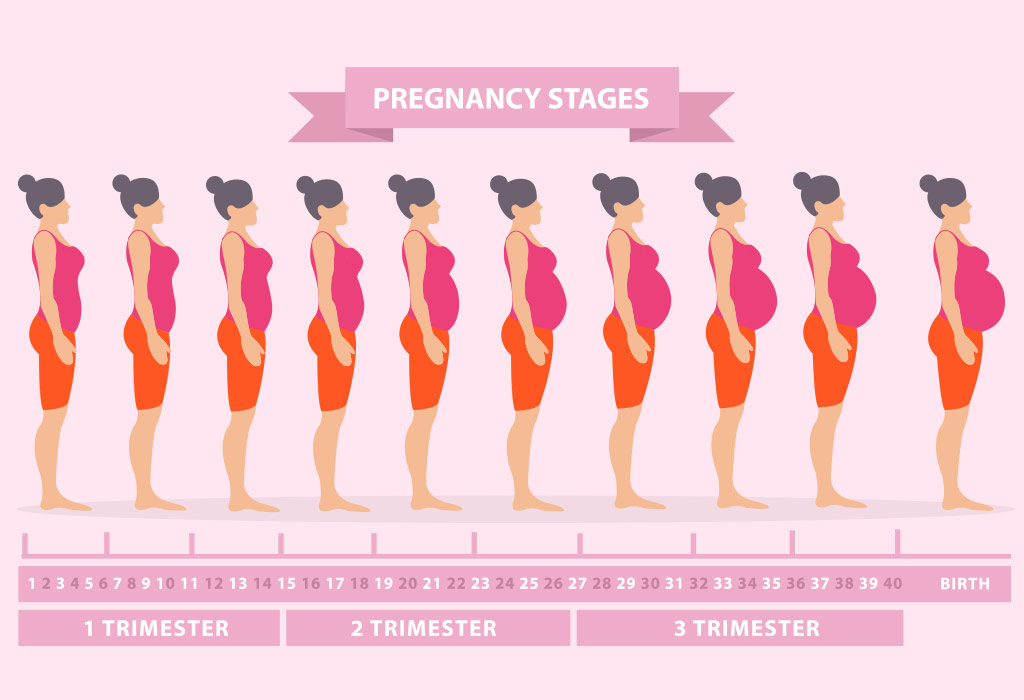
Since you are on this page, we take it you are pregnant. Congratulations are in order! Your body will undergo many changes in the nine months of your pregnancy. Yes, you are getting used to being pregnant and being a mom, but the bodily changes during these nine months will prepare you for the same. Pregnancy is a major life event, perhaps a life-changing event, and we are sure you must be curious to discover what changes will happen in your body during this time. So, we have a pregnancy week-by-week guide that will give you a fair idea of the pregnancy body changes that will take place in your body. Read on to understand the physical changes during pregnancy!
Common Physical Changes During Pregnancy
Throughout pregnancy, a woman’s body undergoes several physiologic changes. There are some common changes that everyone knows about and expects to experience. However, there are also some body changes while pregnant that not many women are aware of. To everyone’s relief, most changes in a woman’s body are the primary markers of finding out whether she is pregnant and are easily recognisable. Watch out for these body changes during pregnancy:
Missed Period – One of the most obvious symptoms of pregnancy is missed periods (1). Although it can be a misleading symptom for a woman who has irregular menstrual cycles, a missed period can often denote that she is pregnant. If your menstrual cycle hasn’t yet begun despite the stipulated time having passed since your last period, then you may be pregnant.
Tender and Swollen Breasts – Sensitive breasts accompanied by soreness and slight discomfort are another sign of pregnancy. The discomfort occurs from hormonal changes occurring inside the body and gradually decreases with time (2).
Nausea – Nausea can strike at any time of the day or even at night. For pregnant women, nausea can begin as early as two weeks after conception (3). A pregnant woman may also have a heightened sense of smell.
Frequent Urination – Pressure on the bladder and uterus increases as the baby grows in the womb (4). This leads to frequent trips to the bathroom.
Increased Fatigue – A pregnant woman may also feel tired and dizzy. In the early stages of pregnancy, a woman may also faint due to low blood sugar.
Shortness of breath – Breathlessness or shortness of breath is another common sign in pregnancy (5).
Back Pain – As the baby grows, the mother’s centre of gravity shifts forward, causing the back muscles to work harder to maintain balance. This can lead to lower back pain, which is especially common in the later stages of pregnancy. Hormonal changes, such as increased levels of the hormone relaxin, can also cause the ligaments in the pelvis to loosen, further contributing to back pain (6).
Varicose Veins – As blood volume increases during pregnancy, the veins in the legs may become enlarged and twisted, resulting in varicose veins. This can cause discomfort, itching, and aching in the legs. Elevating the legs, exercising regularly, and wearing support stockings can help reduce symptoms (7).
Heartburn – The hormonal changes during pregnancy can relax the muscle separating the stomach from the oesophagus, allowing stomach acid to flow back into the oesophagus. This can cause a burning sensation in the chest and throat, known as heartburn (8). Eating smaller, more frequent meals and avoiding spicy or fatty foods can help alleviate symptoms.
Swelling – During pregnancy, the body retains more fluid than usual, which can cause swelling in the feet, ankles, and hands (9). This is often most noticeable in the third trimester. Elevating the feet, staying hydrated, and avoiding standing or sitting for long periods can help reduce swelling. However, sudden or severe swelling should be reported to a healthcare provider, as it can signify a more serious condition such as preeclampsia.
Although the above-mentioned common symptoms can be indicators of other health problems or issues in the body, when you experience a mix of these symptoms simultaneously, you may be pregnant, and that’s when you need to take a home pregnancy test to confirm if you haven’t already.
Body Changes During Pregnancy Week By Week
Your due date will be calculated from the day of your last menstrual cycle. In just 40 weeks, your body will prepare for conceiving a baby. There are many weekly body changes during pregnancy. Let’s take a look at what your body shall go through during the course of pregnancy, week by week.
Week 1
If you are 1 week pregnant, you are not pregnant at all! The sperm meets the egg between week 1 and week 2. Generally speaking, week 1 is usually the start of your pregnancy from the due date. Either of the two ovaries matures and releases an egg during this period. If both ovaries release eggs, you may bear non-identical twins. This is also the week from when you start taking your prenatal vitamins. In this week, the egg is swept into the fallopian tube, travels down the fallopian tube, and awaits the arrival of sperm.
[Also Read: 1 Week Pregnant]
Week 2
Ovulation occurs during week 2. Two or three days before the second week is the best time to have intercourse to increase the chances of a successful pregnancy. The breasts begin to glow as the glands produce oestrogen and progesterone, causing hormonal surges and tender breasts.
[Also Read: 2 Weeks Pregnant]
Week 3
The sperm finally meets the egg and penetrates it out of 200 million competitors. At this stage, the egg becomes the zygote and shuts down, preventing other sperm from penetrating it. Although physical changes are not imminent, changes on a biological level are happening at this stage. The nuclei set fuse with your zygote and assign it its gender and genetic characteristics, including eye colour, hair colour, and amongst 200 other similar genetically-determined characteristics.
[Also Read: 3 Weeks Pregnant]
Week 4
Bodily changes in the first month of pregnancy start manifesting at this stage. During early pregnancy, some bodily changes include swollen and sore breasts, tiredness, frequent desire to urinate, and nausea. The formation of the placenta and the umbilical cord begins and the fertilised egg can dig into the uterus and place pressure, causing it to shed a few drops of blood. Testing should be done after a week since false negatives are common when tests are done on the first day of the end of the menstrual cycle.
[Also Read: 4 Weeks Pregnant]
Week 5
The embryo begins to form and grows to the size of a grain. Changes and development of the embryo’s brain, organs, and blood vessels take place from this week. A groove develops on the back of the baby, which seals itself to develop the neural tube, which later becomes the baby’s spinal cord.
[Also Read: 5 Weeks Pregnant]
Week 6
The neural tube becomes the spine, and the heart starts pumping more blood into the embryo. The C-shape of the embryo becomes more pronounced, and you may be susceptible to nausea and fatigue. Your blood pressure may also drop as a result of the changes in hormonal levels. The embryo gets surrounded by a protective membrane and becomes attached to the yolk sac. Exercising will help you cope with stress and provide relief to an extent. At this time, pregnant women need to get enough folic acid. It is very important for developing the fetus’s spinal cord and brain. Folic acid deficiency can cause severe birth defects, known as neural tube defects. The recommended dietary allowance for folate during pregnancy is 600 micrograms per day
[Also Read: 6 Weeks Pregnant]
Week 7
Morning sickness worsens by this time and the brain and face of the embryo start forming and taking shape. The baby’s eye lenses develop, nostrils form, and arms begin to form into a paddle-like shape. Mucus near the cervix thickens and seals the entrance to the womb. Fingers and toes form and signs of brainwave activity in the embryo start showing. You will experience mood swings, crankiness, and feel sick. This is a good sign as it indicates that your pregnancy hormones are in motion.
[Also Read: 7 Weeks Pregnant]
Week 8
The start of brainwave activity in the embryo is marked from the eighth week. The pelvis may experience sharp pain when you stand. The doctor checks for signs of heartbeat or embryo activity using ultrasound imaging. Once the embryo is confirmed, chances of a miscarriage drop to 2%, and an official due date is given from this point onward. During the first trimester of pregnancy, you may experience bleeding.
[Also Read: 8 Weeks Pregnant]
Week 9
At 9 weeks, the embryo will develop, and as a result, you might feel pressure on your bladder. This could result in the leakage of urine. Around this week, the baby’s heart and eyelids will develop. His hair follicles and nipples will form too. Your baby will no longer be an embryo but a foetus. The 9th week of pregnancy is critical for arm and leg development. Your little one’s liver, gall bladder, spleen and adrenal glands are also starting to develop. As the baby’s respiratory system develops, the baby’s ability to inhale or exhale amniotic fluid can cause hiccups, a significant of good diaphragm development. However, you won’t be able to feel fetal hiccups for a few more months. You may feel dehydrated – it is advised that drink plenty of water during this week since it’s considered the roughest patch in the pregnancy, according to most doctors.
[Also Read: 9 Weeks Pregnant]
Week 10
By week 10, almost all of your baby’s vital organs will fully develop and start functioning. Your baby will officially be called a ‘foetus’. The baby’s cartilage and bones will keep forming, and the genitals will form too. The eyes of the foetus will become more pronounced. The foetus will receive oxygen through the umbilical cords, and occasional breathing movements may be noticed in the womb.
[Also Read: 10 Weeks Pregnant]
Week 11
By week 11, the foetus can breathe, suck its thumb, and sigh. The baby’s facial development continues during this time, and the head of the foetus is larger than the body. Food cravings become pronounced during the 11th week, and you may find yourself craving for things unrelated to food such as pica, which may indicate a deficiency in your diet. Consuming folate, fibre, and iron is essential and eating chives can help with this. The first-trimester ultrasound scan will be performed between weeks 11 and 13 to test for chromosomal abnormalities alongside a Nuchal translucency test.
[Also Read: 11 Weeks Pregnant]
Week 12
Now 3 inches in length, your baby will start growing even more. Your baby’s face will look more human and weigh about half an ounce, i.e.around 14gms and crown to rump length of 2 to 2 1/4 inches, about the size of a lime. The rest of the body will continue to grow and the growth of the head will slow down to accommodate the proportions of other body parts. The baby’s posture will change into a curling and upright position. You may have trouble passing stools. You may also have a gassy stomach and an increased heart rate. You may notice your hips widening to accommodate the growing size of your uterus. Since the uterus has difficulty fitting into the pelvis, it puts pressure on the abdomen and pushes into it to accommodate space.
[Also Read: 12 Weeks Pregnant]
Week 13
You and your baby have made it through the first trimester. Congrats! As you have entered the second trimester of your pregnancy, the changes in your body will be in full swing. Eating healthy and drinking lots of fluids is important from now on. You will feel slightly better as nausea and morning sickness will subside. Swimming exercises and low-impact yoga workouts are often recommended to pregnant women at this stage. The baby will experience prenatal hiccups, which help clear up diaphragm passage and facilitate breathing function. Kidney function inside the baby begins, and the bone marrow starts white blood cell production to fight against various diseases. The pancreas, gall bladder, and thyroid will have also developed during this week.
[Also Read: 13 Weeks Pregnant]
Week 14
By this time, the baby’s organs will begin functioning, and you’ll actually be able to see individual facial characteristics through ultrasound scans. The intestine will move into the baby’s body, and insulin production will begin. You may experience your baby’s kicks for the first time. Baby’s kicks, also known as quickening, are usually felt around 16-18 weeks, but women who have already given birth have more relaxed muscles, and for them, fetal motion can sometimes be felt as early as 14 weeks. The baby can now make subtle facial expressions as the facial muscles develop. During this week, your doctor may recommend an ultrasound scan to check for neural tube defects like spina bifida and Edward’s syndrome in your baby.
[Also Read: 14 Weeks Pregnant]
Week 15
Screening tests for blood proteins and signs of Down syndrome or genetic defects are done at this stage. Female foetuses show more mouth movements compared to males. The foetus is about 5 inches in length and 2 ounces in weight. A noticeable bump appears near the belly button. You may also experience Braxton-Hicks contractions in your abdomen. Contact a doctor if you experience more than four contractions an hour and uncomfortable and frequent discharge of mucus in the vagina.
[Also Read: 15 Weeks Pregnant]
Week 16
A growth spurt begins, followed by bone formation. You may gain a pound per week during the rest of your pregnancy, i.e. around 0.454 kg per week. Your pelvic area will feel hard and firm. You’ll also notice signs of your baby’s movement becoming more prominent by now.
[Also Read: 16 Weeks Pregnant]
Week 17
You may experience lucid dreams, which are often bizarre. This reflects anxiety or worries regarding childbirth and parenthood, which is normal. By this time, the baby will weigh more than the placenta. The brown fat responsible for heat generation in the baby’s body will be deposited. Your breasts will grow, becoming sensitive and tender; sometimes, they may even ache. You’ll even experience the “pregnancy glow“, a form of radiance on your face that shows increased blood circulation. Your baby’s first kicks are usually experienced from this week onward till week 22. The placenta will now function fully. It will absorb and distribute nutrients while eliminating waste.
[Also Read: 17 Weeks Pregnant]
Week 18
More ultrasound tests can be done at this point to determine the gender of the baby. However, the doctor may not inform you about it. Fluttery kicks can be felt even more, and the baby may react to certain sounds. The baby’s retina will develop and become sensitive to light. The baby can change positions and even cross his legs. Teeth formation and fat deposition also begin. Pain in the legs, tailbone and in other muscles will also be felt.
[Also Read: 18 Weeks Pregnant]
Week 19
Ultrasound scans of your baby may reveal pictures of the baby holding the membrane of the amniotic sac, sucking thumbs, or making movements in the womb. If the baby is a girl, then follicle formation inside her body will begin by this point, with half of your genetic material being formed inside her. Be sure to eat foods rich in B vitamins and healthy fats since it contributes to the proper brain development of your baby.
[Also Read: 19 Weeks Pregnant]
Week 20
Your uterus will grow towards your rib cage at 1 centimetre per week. This is when mothers enrol in childbirth classes to learn techniques for easing anxiety and sliding smoothly through labour. Your mood will greatly improve since you’re halfway there to give birth to your baby. Immunities are transferred into the foetus from the uterus.
[Also Read: 20 Weeks Pregnant]
Week 21
From this point on, if you’re 35 or older or if you have diabetes and other chronic conditions, you should be a little concerned about how your body changes during pregnancy. Signs of being at risk of eclampsia begin to show from the third trimester of pregnancy. You should take walks and relax daily in order to avoid these problems.
[Also Read: 21 Weeks Pregnant]
Week 22
You are in the fifth month of your pregnancy. At week 22, your baby’s brain will develop rapidly, and you may experience haemorrhoids or constipation. Yeast infections around the vagina and frequent vaginal discharges are common signs in the body during this week. Douching is warned against and vaginal discharges are marked by redness, itchiness, and yeast smell. The baby’s organs develop fully, and blood travelling through the umbilical cord supplies the foetus with oxygen and other nutrients.
[Also Read: 22 Weeks Pregnant]
Week 23
Your baby’s eyes will be formed by now, but there will be no colour due to a lack of pigmentation. Your doctor may advise you against long-distance drives or travel not because it’s unsafe, but to ensure that they are ready to help you if you go into labour.
[Also Read: 23 Weeks Pregnant]
Week 24
Your body will experience heartburn during this week. The indication of heartburn equates to hair growing on your baby’s head. If you don’t experience heartburn, your baby will probably turn out to be bald. Muscle aches, sore feet, fatigue, and dizziness are other bodily changes that you may experience during this week.
[Also Read: 24 Weeks Pregnant]
Week 25
Exercise is crucial from this point on to enhance the recovery process after childbirth. Your baby will have regular sleep cycles and his nostrils will open up. The baby’s lungs will develop ‘surfactant’, which helps with inflation and keeps the tiny air sacs open inside the lungs for better breathing. You may experience back, hip, and leg pain in the body. Fatigue and dizziness might resurface during this time.
[Also Read: 25 Weeks Pregnant]
Week 26
The baby’s hearing system will develop during this time and will be responsive to noises. You will experience discomfort during your sleep. Sleep on your side rather than the back because sleeping on the back will block blood flow to the baby due to the positioning of the uterus over a major artery. You may notice stretch marks forming near your abdomen.
[Also Read: 26 Weeks Pregnant]
Week 27
You are in the third trimester of your pregnancy and should be prepared to deal with back pain. During this time, you might feel intense back pain. You may experience shooting pain, known as sciatica. Lifting, bending, and walking worsen the pain, and amniotic fluid volumes lessen. The point ends of toes, knees, or bony edges can be seen when the baby moves. Your heart rate may increase, and you may feel flushed.
[Also Read: 27 Weeks Pregnant]
Week 28
As you are in the third trimester of your pregnancy, be prepared to experience Braxton-Hicks contractions near the abdomen, which is a tightening sensation of the muscles in the abdomen. The rate you gain weight will increase, and the baby’s body fat percentage will increase to 2 to 3 per cent. Avoid standing too long in hot weather or for long periods of time, as it can make you feel dizzy. You may also have low blood pressure. Drink plenty of water, and don’t go out too often if you’re pregnant during summer. Your belly will also grow in size, making your body uncomfortable. You can also expect leg cramps and aches during this time.
[Also Read: 28 Weeks Pregnant]
Week 29
Frequent trips to the bathroom and napping are common during the 29th week. Your baby’s breathing system and organ functions will be fully developed by now and require no breathing assistance. Prolactin production increases, and your breasts will start secreting colostrum. The baby’s adrenal glands produce estriol.
[Also Read: 29 Weeks Pregnant]
Week 30
Your uterus will continue to grow and begin crowding your diaphragm. You may feel breathless. Difficulty in breathing and pressure on your bladder can lead to frequent urination. You should continue with your childbirth classes and they should end around week 36.
[Also Read: 30 Weeks Pregnant]
Week 31
The room in your womb will decrease as your baby grows further and your belly expands even more. Ten kicks per hour denote the healthy rate of baby growth in the foetus and doctors assign women to keep track of the baby’s kicks. If you notice inactivity, drink a glass of fresh, natural fruit or vegetable juice.
[Also Read: 31 Weeks Pregnant]
Week 32
By this time, your baby’s five senses will be fully developed. Your baby will experience REM cycles during sleep, and his breathing movements will intensify inside your womb, thus preparing to come out into this world.
[Also Read: 32 Weeks Pregnant]
Week 33
The baby’s position becomes head-down, indicating it may be ready to go through the motions of childbirth. This position also delivers more blood into his brain, and you may experience more abdominal contractions.
[Also Read: 33 Weeks Pregnant]
Week 34
The pupils react when the light is shone on the stomach and dilate and constrict. Your baby will sleep a lot during this week inside your womb as his brain develops continuously. The baby will also experience REM cycles more profoundly during sleep and can have dreams, too.
[Also Read: 34 Weeks Pregnant]
Week 35
Measuring roughly 16 to 20 inches, your baby’s size will suggest that he is ready for childbirth. The baby’s nervous and immune systems mature this week, and your body will experience your baby’s weight. You may need to take breaks and sit briefly when walking around or doing normal, everyday tasks. For the next two weeks, from the 35th week onward, you will be tested for the presence of Group B Streptococcus, which lives in the vagina and can pass on the infections to the baby. The test usually involves a gentle dab in the rectum with a cotton swab.
[Also Read: 35 Weeks Pregnant]
Week 36
Your baby’s movements should slow down by now, and you should notice the movements of the foetus around 20 times a day. If you are concerned, you can drink a glass of orange juice and lie on your side. This will help the baby to wake up and move around for a while.
[Also Read: 36 Weeks Pregnant]
Week 37
The baby’s intestine will generate meconium. This will help with his first bowel movement once they come out of labour into the open. The foetus will now be around 20 to 21 inches, and the baby will weigh between 6 and 7 pounds, i.e. around 2.7- 3.1 kg. Your baby may also begin to practice breathing in anticipation of labour. Your breasts will discharge colostrum, which will be your baby’s nutritional source, and your belly will feel bulging.
[Also Read: 37 Weeks Pregnant]
Week 38
The lanugo, the hair on your baby’s body, will disappear by this time. Your baby will be fully developed by now; however, connections in the brain will continue to form, which will even continue after childbirth. Your baby’s nails may mature and reach the ends of fingers and toes. Frequent bouts of back and neck pain are common. Decreased mobility is also common, and you will have difficulty with the increased fatigue. Have small but frequent healthy meals to get quick relief.
[Also Read: 38 Weeks Pregnant]
Week 39
Your baby will now weigh between 6 and 10 pounds, i.e. around 2.7-4.5 kg, and measure between 17 and 23 inches long in size. Your baby will continue to develop more neural connections and experience hair growth and weight gain. You may consider taking maternity leave a few weeks before entering the last week. Relax, watch a movie, and do hands-and-knees stretches and pelvic tilting exercises to get relief.
[Also Read: 39 Weeks Pregnant]
Week 40
At week 40, your baby will be ready to be born from this week on. If your baby hasn’t been born yet or hasn’t gone into labour this week, doctors will monitor you for another two weeks. Pregnancies close at this stage; however, if it continues, they are termed ‘post-dated’. Your labour date will soon approach, and you will have your baby in your arms.
[Also Read: 40 Weeks Pregnant]
Week 41
If your baby hasn’t been born yet, your doctor will talk about inducing labour. It is deemed unsafe for the mother and the baby if the pregnant woman doesn’t go into labour by week 42.
[Also Read: 41 Weeks Pregnant]
Week 42
If your baby is not born until now, your doctor will induce labour and suggest either a C-section or vaginal delivery. If your cervix hasn’t softened, your doctor will induce labour by introducing hormones to ripen the cervix for baby delivery. Procedures such as stripping and rupturing the membranes are used. The common labour induction methods involve using drugs like oxytocin to begin vaginal contractions. If vaginal contractions don’t occur despite the manual labour induction method, you’ll need a C-section procedure for delivering the baby.
[Also Read: 42 Weeks Pregnant]
FAQs
1. When do you start noticing changes in body while pregnant?
Many women notice body changes during the first few weeks of pregnancy. This can include missed periods, breast tenderness, and nausea, appearing early, a few days after conception. However, the timing of when changes become noticeable can vary from woman to woman.
2. What are the first body changes you notice in early pregnancy?
In early pregnancy, many women may notice changes in their bodies due to hormonal shifts. These body changes in pregnancy can include nausea, vomiting, food cravings, or aversions. The changes in the respiratory, urinary, and gastrointestinal systems during pregnancy produce symptoms like acid reflux, the urge to urinate frequently, or feeling out of breath. Additionally, some women may experience mild spotting or cramping as fertilised egg implants in the uterus.
Other early signs of pregnancy can include an increased sense of smell or taste sensation. Changes in the body of a pregnant woman can become more apparent, as the pregnancy progresses, such as a growing belly and weight gain. However, every pregnancy is unique, and the timing and severity of symptoms can vary.
3. Why do some women experience skin darkening or unusual pigmentation during pregnancy?
During pregnancy, hormonal changes—especially increased levels of estrogen and progesterone—can stimulate excess melanin production. This may lead to conditions like the “mask of pregnancy” (melasma), where dark patches appear on the face, or a dark line running down the abdomen called the linea nigra. Some women may also notice darkening of nipples, inner thighs, or underarms. These changes are usually harmless and often fade after childbirth, although in some cases they may persist longer.
4. Can pregnancy affect your gums, teeth, or oral health?
Yes, pregnancy can bring surprising changes to oral health. Increased hormone levels can make gums more sensitive, leading to swelling, bleeding, or a condition called pregnancy gingivitis. Some women may also notice a metallic taste in their mouth or increased saliva production. Maintaining good oral hygiene and regular dental checkups during pregnancy is important to prevent complications.
Once your baby is born, it is important to facilitate recovery by optimising your diet, exercise, and nutrition. It is recommended to avoid smoking, drug usage, and alcohol consumption before you get pregnant, even before week 1, to improve the chances of a successful pregnancy and a hassle-free delivery.
Also Read:
Skin Changes while Pregnant
How Does a Woman’s Face Change in Pregnancy?
Emotional and Psychological Changes during Pregnancy
Read more

When Can You Hear Your Baby’s Heartbeat in Pregnancy?
Pregnancy is a time filled with excitement, curiosity, and countless questions. From the moment you see those two pink lines, you may start imagining your growing baby and eagerly wait for reassuring signs that everything is progressing well. While physical changes like a visible baby bump take time, especially in the first trimester, many expectant mothers look forward to one unforgettable milestone: hearing their baby’s heartbeat for the first time.
As your pregnancy progresses, you might notice gentle pulsing or rhythmic sensations in your abdomen, which can make you wonder: can you feel your baby’s heartbeat with your hand, or is it just your own pulse? While it’s exciting to imagine feeling your little one’s heartbeat at home, in reality, detecting it usually requires medical equipment. Let’s find out when a baby’s heartbeat can first be heard, how it’s detected, and what those early sensations in your womb really mean.
Is It Possible to Feel Your Baby’s Heartbeat in Your Stomach?
One of the most magical moments during pregnancy is to feel a baby’s heartbeat in the womb, even before a visible baby bump appears. However, this sensation should not be confused with the rhythmic pulsing you may notice in your abdomen. Many pregnant women experience a pulse in the stomach, which is usually caused by increased blood flow rather than the baby’s heartbeat.
This pulsing sensation is most often the pulse of the abdominal aorta, a large artery that carries oxygen-rich blood from the heart to the lower part of the body (1). During pregnancy, blood volume increases and blood vessels become more relaxed, making this pulse more noticeable, especially in the second and third trimesters.
While it can feel reassuring, this sensation is not your baby’s heartbeat. A fetal heartbeat can usually be detected around 6 to 8 weeks of pregnancy through an ultrasound, and it cannot be felt by hand without medical equipment for several more weeks (2).
When Does a Fetus Have a Heartbeat?
You can hear a fetus’ heartbeat once its cardiovascular system has started forming. This usually occurs 5 weeks into the pregnancy (3). Once the fetus’ cardiovascular system is formed, the heart starts beating shortly.
When Can Fetal Heartbeat be Heard?
The earliest a fetal heartbeat can be heard is at 5-6 weeks of gestation or pregnancy. This is detected via vaginal ultrasound. However, the fetal heartbeat can better be assessed at 6-7 weeks of pregnancy (2).
Reasons Why You Cannot Feel Your Baby’s Heartbeat
As mentioned above, if you feel the pulsing sensation, it will be the pulsing of your abdominal aorta, which will be more prominent during pregnancy. In the early stages of pregnancy, you won’t feel your baby’s heartbeat in the stomach because your baby is protected by his own body, then further shielded by amniotic fluid, the amniotic sac, your uterus, muscles, and the skin of your body.
During the first four weeks of your pregnancy, you will not feel his heartbeat in your womb because his heart will begin to develop roughly three weeks after conception and will develop completely by four to five weeks. Also, the force of contraction in such a minuscule heart will virtually be indiscernible because of so much cushioning around it. Even at full-term gestation, when your baby’s heart will most likely be beating at 110 to 150 beats per minute, it will be impossible for you to feel his heartbeat without an external device (4).
Can You Hear a Baby’s Heartbeat With a Stethoscope?
Although it is possible to hear the heartbeat of a baby in the womb using a stethoscope, you may not be able to hear it as clear as you do at the doctor’s clinic. You can hear your baby’s heartbeat using a stethoscope after the 18-20th week of gestation.
How Does a Doctor Check Baby’s Heartbeat?
During pregnancy, your doctor will conduct a transvaginal scan. A transvaginal ultrasound uses high-frequency sound waves to project as-is images of a pregnant woman’s internal organs. The sound waves help create the image of the foetus (5). Your doctor will most likely suggest a Doppler scan to check your baby’s heartbeat around the twelfth week of your pregnancy. He will detect the baby’s heartbeat using a Doppler device, which helps detect the heartbeat of the foetus easily (6).
Reasons Why the Doctor May Not Be Able to Detect the Baby’s Heartbeat
The first rule is to not panic. There are many reasons why your doctor may not be able to detect your baby’s heartbeat. Here are some reasons why (4):
It’s too early to detect a heartbeat.
You may have a retroverted uterus, due to which the baby can be just a little further away and harder to detect.
You’re overweight, causing there to be extra padding between the ultrasound wand and the baby.
You may have experienced a miscarriage.
You may be having an ectopic pregnancy.
FAQs
1. Can you hear a heartbeat at 5, 6, 7, and 8 weeks?
At 5 weeks, it’s usually too early to hear a fetal heartbeat with a Doppler; the embryo is still very small. By 6 weeks, an ultrasound may sometimes detect the heartbeat, but it can be faint and difficult to pick up. At 7 to 8 weeks, most pregnancies show a clear heartbeat on a transvaginal ultrasound, making this the earliest reliable window for hearing your baby’s heart (2).
2. How soon can you hear a heartbeat of twins?
For twins, the timeline is similar to a singleton pregnancy. Each baby’s heartbeat can typically be detected by 6 to 8 weeks using an ultrasound. However, because there are two heartbeats, it may take a slightly longer scan to distinguish each one clearly, especially in the very early weeks.
3. Does the heartbeat indicate the baby’s health?
A steady, normal heartbeat is a good sign of a healthy pregnancy, but it’s only one part of monitoring. Doctors also consider growth, movement, and other tests.
It is important that you monitor your baby’s heart rate during pregnancy to rule out any anomalies. It can help in detecting an anaemic baby, abruption of the placenta, and poor oxygen supply. Go for timely scans to monitor your baby’s heartbeat and to keep track of his growth. Also, keep track of your baby’s kicks, and let your doctor know if you notice anything unusual.
Also Read:
Foetal Kick Counts
Quickening in Pregnancy
Decreased Foetal Movement
When Do Pregnant Women Feel Fetal Movements
Read more

Impact of Birth Method on Long-Term Immunity: C-Section vs. Vaginal Delivery
As parents, we want to do everything possible to give our babies the best start in life. We think about feeding, sleep, and care, but one thing we don’t always realise is that the way a baby is born can also affect their immune system. Surprising, right? When a baby is born, the focus is often on the first cry, tiny fingers, and the joy in the room.
But little do most people know the method of delivery can have a lasting impact on the baby’s health. The way your baby enters the world plays a bigger role in their immunity than many might think. Keep reading to find out how the birth method affects your baby’s immune system and how you can support them in the best way possible.
Vaginal vs. C-Section Delivery
During a vaginal birth, babies pass through the birth canal and pick up beneficial bacteria from their mother (1). These friendly microbes start building the baby’s gut microbiome; a community of bacteria that helps with digestion, nutrient absorption, and, most importantly, training the immune system (2).
Breastfeeding adds another layer of support. Breastmilk contains prebiotics, which are special fibres that feed the good bacteria in the baby’s gut, helping them grow strong and multiply (3).
Together, this early exposure and nutrition helps to shape a baby’s natural defences from day one.
However, babies born via C-section enter the world without passing through the birth canal. That means they do not come in contact with the first natural bacteria’s present in the mother vagina (4). Instead, their early gut bacteria may be similar to the bacteria present in the the hospital, which can sometimes mean less good quality bacteria in the gut.
This difference doesn’t mean anything is “wrong”; but it may influence how the immune system matures.
Why the Gut Microbiome Matters for Immunity?
Inside all of us is something called the gut microbiome, a collection of bacteria that lives in our intestines. These bacteria help us digest food, protect us from infections, and strengthen our immune system (2) (5).
For babies, the gut microbiome starts forming even before birth. A strong and healthy microbiome helps build a stronger immune system and may even reduce the risk of allergies, asthma, and other illnesses later in life.
How C-Sections May Affect Immunity?
Babies born by C-section may have a slower start in building their gut bacteria, and that might affect how their immune system develops. Some studies suggest that babies born via C-section may have a slightly higher risk of developing allergies, asthma, and possibly infections early in life (6).
But this isn’t something to stress about. We can support their gut and immune health through smart nutrition, especially with Synbiotics.
How Do We Support the Infants Born via C-Section?
In such cases, breastmilk plays a key role. It provides not just key nutrients like fats, proteins, carbohydrates, vitamins and minerals, but also good bacteria (probiotics) and food for those good bacteria (prebiotics) which help to build gut health and also boost immunity. This is especially important for babies born via C-section. Breastmilk, is naturally rich in Synbiotics and together, they create a healthy gut environment for the baby, making digestion easier and helping the body fight infections better. Research shows that including Synbiotics in a baby’s diet at the right time can support their overall health, by boosting their immune system.
What Are Synbiotics?
Synbiotics are a powerful combination of probiotics (the good bacteria) and prebiotics (the food that helps them thrive). When taken together, they work in harmony to support a healthy gut and a strong immune system (7). For babies born via C-section, Synbiotics can help bring their gut microbiome closer to that of babies born through vaginal delivery (8).
Specific Synbiotic combinations help mimic the benefits of naturally available bacteria. These Synbiotics can be especially helpful for babies born via C-section or those with sensitive digestive systems.
While Synbiotics aren’t a replacement for the natural process of birth, they can be a valuable way to help bridge the gap, giving your baby’s immune system the support it needs during those early, important months. If your baby was born through C-section, you might want to ask your doctor about how and when to introduce Synbiotics for better gut health and build strong immunity.
Well, not every parent can choose how their baby is born, and that’s completely okay. What matters is how we support them after birth. With the right nutrition, care, and a little help from science, your baby’s immune system can grow stronger every day.
References/Resources
1. American Museum of Natural History – Building Your Microbiome from Birth
2. Cleveland Clinic – Gut Microbiome
3. PubMed Central – The Prebiotic and Probiotic Properties of Human Milk: Implications for Infant Immune Development and Pediatric Asthma
4. National Library of Medicine – Vaginal Delivery
5. Harvard T. H. Chan School of Public Health – The Microbiome
6. PubMed Central – The infant microbiome development: mom matters
7. PubMed Central – Synbiotics: a technological approach in food applications
8. PubMed Central – Clinical outcomes following pre-, pro- and synbiotic supplementation after caesarean birth or antibiotic exposure in the first week of life in term born infants: A systematic review of the literature
Read more
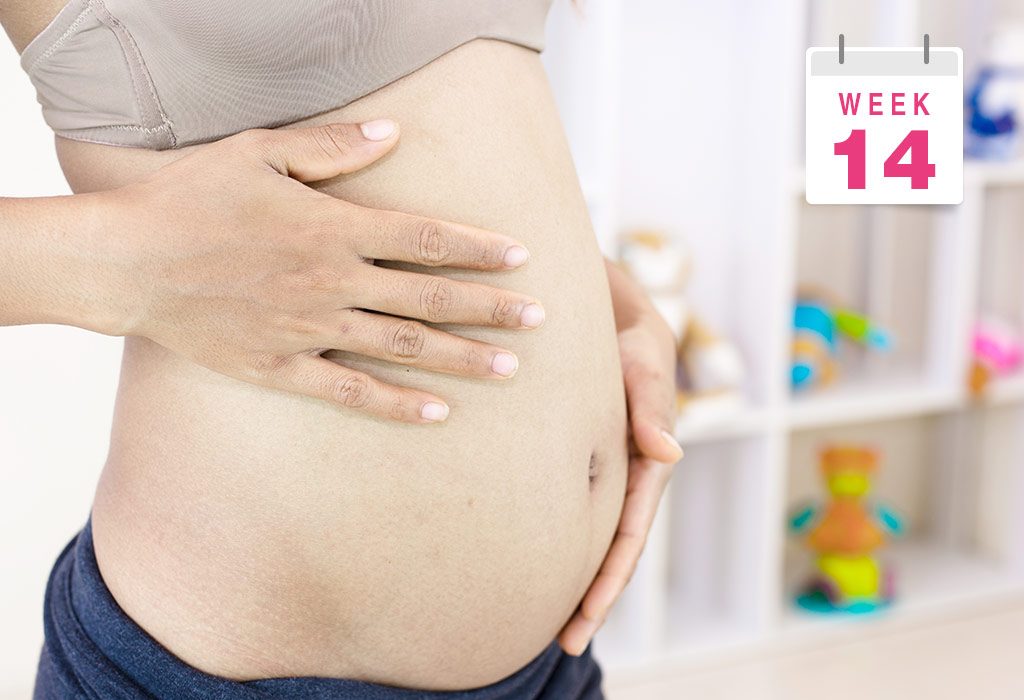
14 Weeks Pregnant: Symptoms, Ultrasound & Belly Size
The 14th week is the beginning of a new phase in your pregnancy. After completing a successful first trimester, you’ve now stepped into the second one with 14 weeks of pregnancy! Considering everything is on track, you must have already started sporting a cute little baby bump that’s probably visible to most people. However, even if you are not showing that you are fourteen weeks pregnant, there is no need to fret, ladies. The coming weeks will be equally exciting while your baby embarks on a rapid journey of growth. More importantly, your body will undergo quite a few changes; a nice big baby bump is one of them!
Baby’s Growth at 14 Weeks of Pregnancy
By the 14th week, your baby will have successfully transitioned into a phase where she/he can pull faces, right inside your belly. He will be as big as your clenched fist and will be moving all the time. Though you may not be able to see or feel much, your baby can grimace, squint and even frown. Your baby’s kidneys have started producing urine, owing to the amniotic fluid that the foetus will inevitably sip (1). His neck will grow longer, and he will actually be standing without any prodding. Apart from these changes, your baby’s heartbeat will be clearer, though this can only be heard or felt by an expert medical practitioner.
Baby’s Size at 14 Weeks of Pregnancy
By now, you can compare your baby’s size to that of a kiwi, peach or lemon. Your little peach weighs around 50 to 60 grams inside your tummy. Also, your baby is anywhere between 3-4 inches long (2). Although the baby’s size may seem rather unexciting, even the kiwi-sized structure is more than enough to make its presence known by creating changes in your body and contributing to pregnancy symptoms.
Common Body Changes at 14 Weeks of Pregnancy
As hinted above, once you are pregnant, you are bound to experience many changes. And it’s only fair that your rapidly growing baby will contribute to your body changes during pregnancy.
Your second trimester will certainly be smoother than your first one. Most women feel less tired, have lesser bouts of morning sickness and in general feel better and more energetic. You should watch out for weight gain or loss. It’s advised to gain a kilo or two. However, ensure that you are not losing weight, as that could be worrisome.
Of course, the most exciting part of the 14th week of pregnancy is that you will definitely show a bit. Also, the chance of a miscarriage has gone down quite a bit; therefore, you should be okay to announce the big news.
Fourteen Weeks Pregnancy Symptoms
Every week of pregnancy brings along a new symptom, but there will always be some recurring symptoms from the preceding weeks that will continue into your 14th week and the weeks to come. Some of these commonly observed signs of pregnancy at 14 weeks are listed below (3):
Ligament pain
Thick and shiny hair
An increase in energy
An increase in appetite
Mood swings
A decrease in breast tenderness
Nausea
Considerable weight gain
Pain in the stomach
Varicose veins or enlarged veins in legs and feet
Congested nose
Belly at 14 Weeks of Pregnancy
You should be able to feel your uterus jutting out of your pelvis and showing in your abdomen. As mentioned, most of you will be sporting a baby bump with an evident but subtle size of belly at 14 weeks pregnant. You are bound to feel a sore and rather aching stomach owing to the fact that your body is trying hard to accommodate your rapidly growing belly.
Since it is recommended to gain some weight, make sure that you also exercise a little to stay fit and deal with those aches and pains that should have already started to manifest.
14 Weeks Pregnancy Ultrasound
It is rather rare to schedule an ultrasound in the 14th week of your pregnancy. Nevertheless, if you do get a 14-week pregnancy scan, you could be in for some cute surprises. Your little one could show off his new skill of sucking his cute little thumb!
A closer look will also reveal that your baby can now wiggle his toes. The spleen and liver should be functioning fine, and of course, your little one’s kidneys are producing urine. Your little peach-sized miracle will also show the formation of peach fuzz or lanugo, a protective layer made of hair that is going to help him stay warm.
Diet at 14 Weeks of Pregnancy
Wondering what to eat when 14 weeks pregnant? The choices of food during the 14th week of pregnancy should be varied and full of nutrients that both you and your baby need. In fact, during the entire course of your pregnancy, it’s rather important to eat a rainbow of foods, meaning a food variant having every colour of the rainbow. These include beetroots, green leafy vegetables, proteins, and foods rich in calcium.
A common misconception during pregnancy is that you need to overeat because your baby is getting nutrition from you. Make sure you disregard this idea because what you really need to do is eat for two! It may sound confusing, but your doctor will surely chart a diet for you that can supplement both you and your baby without you having to overeat.
Meanwhile, if you frequently crave snacks, keep some fruits handy. Make sure that you stock up on nuts and yoghurt because it’s wise to make healthy choices for snacks. Eat foods that are rich in folic acid to prevent birth defects, and don’t forget oily fish varieties that contain the required amounts of Omega-3 fatty acids. Milk and milk products should be a part of your diet because bone strength is important, too.
Tips & Care
In a nutshell, the entire process of pregnancy is to keep yourself and your baby safe and healthy. Since you have successfully completed the 1st trimester and come so far, ensure you practice healthy habits for this one as well.
Go through our list of dos and don’ts that will certainly come in handy not only during the 14th week of your pregnancy but also for the coming weeks (4).
Dos
Get plenty of rest and regular hours of sleep.
Get a body pillow that should provide you with some comfort.
Think positive and stay cheerful.
Read some nice parenting books.
Have sex with your partner unless your doctor advises against it.
Take care of oral hygiene.
Take care of personal hygiene.
Ensure that you eat good food that is properly cooked.
Exercise and do some yoga.
Don’ts
Smoke or drink alcohol.
Stay in conditions that stress you.
Worry too much.
Overdo your exercises.
Expose yourself to radiation.
Expose yourself to places with questionable hygiene conditions.
Starve yourself or your baby.
Forget to take your medication as advised by your doctor.
What You Need to Shop For at 14 Weeks of Pregnancy
In the fourteenth week of pregnancy, you need to keep yourself as comfortable as possible. Therefore, buy cotton clothes that are loose and let you breathe. Investing in stylish maternity wear will be a good call considering you are going to need it later. There is a range of maternity wear available in the market, including tops, trousers, ethnic kurtis, dresses, nighties, and night suits. These will provide the comfort you need for now and also be useful as your pregnancy progresses. More importantly, it’s time you switched to comfortable flats, preferably with padding, and ditch your stilettos and fancy shoes. Stock up on lotions as well because your skin may tend to feel dry. Buy good stretchy bras because your breasts will soon grow bigger. You may also want to invest in nursing bras as you are going to need them soon.
FAQs
1. How should you sleep in the 14th week of pregnancy?
It is fine to sleep on your stomach in the early days of pregnancy, but it is not always advised. Your baby bump will not start showing until the second trimester, so sleeping on your stomach won’t be very uncomfortable. Continuing with the second trimester and the third will require you to sleep on your side, preferably left. Sleeping on the left side is a preferred side of sleeping during pregnancy as it provides proper blood flow to the growing foetus and reduces the risk of stillbirth. At 14 weeks of pregnancy, if you accidentally wake up on your back, don’t worry; just change the side and resume sleeping (3).
2. 14 weeks pregnancy is how many months?
When you are 14 weeks pregnant, you have completed three months of pregnancy and are beginning your second trimester.
3. Can I get a flu shot during pregnancy?
The flu vaccination is considered safe for pregnant women. Timely administration of the flu vaccine also ensures protection for the newborn baby. The mother passes on the antibodies to her baby and keeps them protected until her infant is 6 months old, as babies can only get the flu vaccine after 6 months of age (5).
4. How many calories should I take during 14 weeks of pregnancy?
It is essential to maintain a good weight throughout pregnancy. Eating too little for fear of becoming overweight or eating too much for two is not advised (6). Depending on which stage you are in your pregnancy, you are required to consume between 340 and 450 calories a day.
5. Can women at 14 weeks of pregnancy get a prenatal massage?
In general, prenatal massages are safe during the first and second trimesters, given the caution that the prenatal massage is done by a certified and trained massage professional and done only after a go-ahead from the doctor (7). However, many massage therapists providing prenatal massages don’t often accept clients up until the second trimester of pregnancy because of the increased risk of miscarriage (8). Thus, talking to your doctor is advised.
Since you’ve just about entered the second trimester, the new changes might make you anxious. Reading and gaining knowledge about how a normal pregnancy progresses and what changes you should expect in your body will help you calm down and enjoy the journey.
References/Resources:
1. 14 weeks pregnant: baby’s development, anxiety and quitting smoking; Tommy’s; https://www.tommys.org/pregnancy-information/im-pregnant/pregnancy-week-by-week/14-weeks-pregnant
2. 14 Weeks Pregnant; American Pregnancy Association; https://americanpregnancy.org/healthy-pregnancy/week-by-week/14-weeks-pregnant/
3. Week 14; NHS; https://www.nhs.uk/start-for-life/pregnancy/week-by-week-guide-to-pregnancy/2nd-trimester/week-14/
4. Do’s and don’ts during the first trimester of pregnancy; Sanford Health; https://news.sanfordhealth.org/womens/dos-and-donts-during-first-trimester-pregnancy/
5. Pregnancy week by week; Mayo Clinic; https://www.mayoclinic.org/healthy-lifestyle/pregnancy-week-by-week/expert-answers/influenza/faq-20058522
6. Pregnancy and diet; BetterHealth Channel; https://www.betterhealth.vic.gov.au/health/healthyliving/pregnancy-and-diet
7. Prenatal Massage Therapy; American Pregnancy Association; https://americanpregnancy.org/healthy-pregnancy/is-it-safe/prenatal-massage/
8. Is massage safe during pregnancy?; UT Southwestern Medical Center; https://utswmed.org/medblog/massage-pregnancy-guidelines/
Previous Week: 13 Weeks Pregnant
Next Week: 15 Weeks Pregnant
Read more
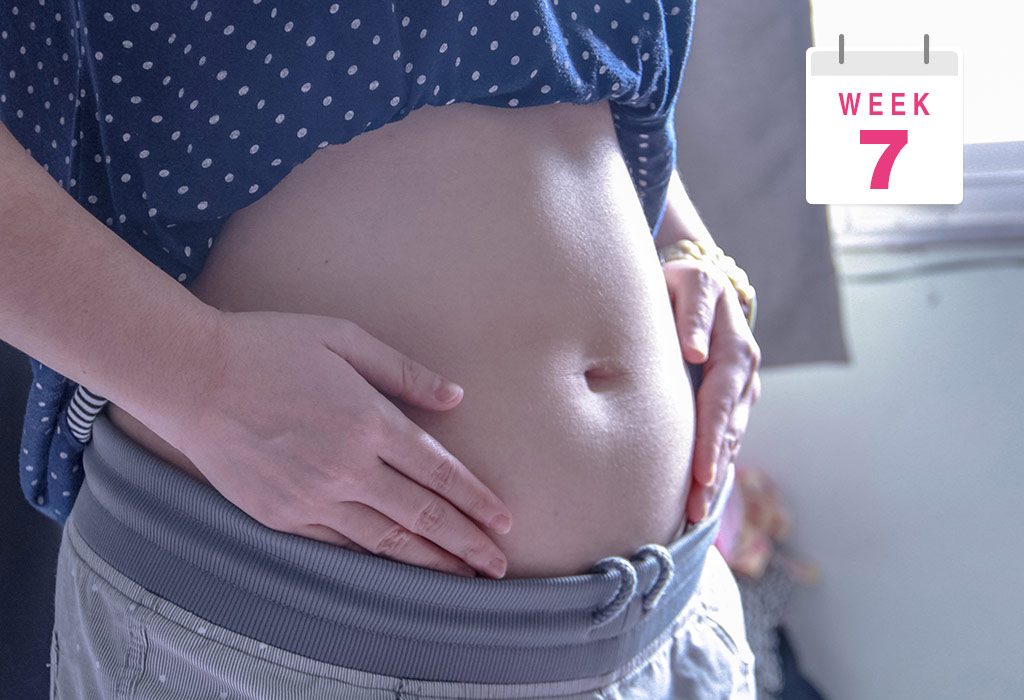
7 Weeks Pregnant: What to Expect
You’ve recently discovered that you are pregnant, and you must be ecstatic. In week 7, you must be experiencing the symptoms of pregnancy, such as morning sickness, nausea, and more, but you don’t quite look pregnant yet. Your baby is growing rapidly inside your 7 weeks pregnant body. This is the period of major developmental changes for you and your baby. Your body will start preparing itself to nurture the growing foetus. This is also when you have to be very careful about what you eat and avoid and how you take care of yourself. If you have any doubts, we recommend reading this article to learn how your little one is developing and what changes you can expect in your body during this week.
Your Baby’s Growth During Pregnancy – Week 7
Your baby’s legs and arms will begin to emerge by this time. The umbilical cord has formed and your baby will have a small tail, which is more like an extension of the tailbone (1). However, this will disappear as the pregnancy progresses. The foetus has almost doubled in size in the past week. Your baby will experience rapid developmental changes. Both the hemispheres of the brain will start forming now. The tiny liver will begin to function by forming red blood cells till the bone marrow is formed. The eyelids, limb buds, and digestive organs like the pancreas and appendix start to form, too (2). At this stage, your baby may technically be called an embryo.
What Is the Size of the Baby?
Your baby is approximately the size of blueberry or a grape by this time. The 7 weeks pregnant baby size is almost an inch according to the American Pregnancy Association (3). There has been tremendous development from the time of conception as your baby has grown a lot since then and will continue to grow and develop as they should. At this time, the growth is mostly concentrated in the generation of brain cells.
Common Bodily Changes
You may not look pregnant, but several changes are happening inside your body. You can expect the following changes at around 7 weeks of your pregnancy (4).
Nausea and food aversions: You may experience nausea and food aversions by this time. Some odours or smells may trigger nausea. On the other hand, you may also find yourself craving for foods such as pickles.
Excess formation of saliva: You may notice the formation of excess saliva in your mouth. Try chewing sugarless gum to avoid the pooling of excess saliva in your mouth.
Changes in the breasts: Your breast size may increase this week. This is due to the increase in blood flow and fat build up around your breast.
More frequent bathroom visits: There is an increase in blood flow around your pelvic region because of the hCG hormone, resulting in frequent urination.
Skin breakouts or acne: You may also notice acne on your face. This is due to the hormonal changes happening in your body (5).
7 Weeks Pregnant Symptoms
Wondering what the seven weeks pregnancy symptoms are? Well, there may not be evident physical signs by 7 weeks of pregnancy, but you may notice the following symptoms this week (6):
You may start to feel sick in the mornings (nausea and vomiting), experience headaches and other pains, and notice fatigue and lethargy.
Your breasts may become tender, and the areoles will become darker than usual.
You may crave certain food items and develop an aversion to some.
You may not fit too well into your favourite pants or jeans. This is not due to weight gain but due to bloating.
You may also experience mild pelvic cramping. There might be occasional spotting, too.
One of the important developments in your body during this time is the development of your mucous plug. The mucous plug helps seal the cervix and protects the opening of the uterus till the birth of your baby.
You may find yourself battling with changing moods. This is due to the changing hormones in the body.
Belly at 7 Weeks of Pregnancy
Your belly at 7 weeks won’t give away that you are pregnant even though you might be experiencing a lot of changes in your body. So, you will have to wait for some time to be able to flaunt your baby bump. All that you feel is bloating around your belly by week 7 of your pregnancy. Most mothers-to-be start to show the baby bump by the middle of their second trimester. However, if you are carrying twins or more babies, then your belly may start to show earlier than the standard time.
Ultrasound at 7 Weeks of Pregnancy
By week 7, you may be ready for your first ultrasound scan, though many doctors may wait till 8 to 10 weeks of pregnancy for the scan. Your doctor will ask about your medical history and your doctor’s recommendation. An ultrasound will help the doctor take various measurements of your baby and determine the development of the foetus. Though your baby is too tiny for you to spot in the 7-week ultrasound scan, the embryo is generating almost one hundred brain cells per minute. The embryo is developing its heart, kidneys, arms and leg joints. If you are carrying twins, the scan will show two gestational sacs in the ultrasound scan. You will also be required to give urine and blood samples for various tests.
The blood samples of the mother carrying twins or multiple babies may show increased levels of hCG hormone, this increased levels of hormone may result in morning sickness.
What to Eat?
It is very important for you to eat a healthy and balanced diet in pregnancy. Your 7th-week pregnancy food should include the following (7):
A healthy mix of green, red, yellow and orange vegetables is a must include in pregnancy diet. Have 3 to 5 serving of vegetables in day. Spinach, broccoli, tomatoes, red peppers, pumpkin, carrots, yellow peppers and corn are some of the fresh vegetables you may include in your diet.
It is suggested to opt for fresh fruits over canned or preserved food as preserved food may contain harmful bacteria which can be harmful to you and the baby. You should take 3 to 4 servings of fresh fruits in a day.
Consume milk, cheese, yoghurt and other milk products to meet the calcium demands of your body. Around 3 servings a day is recommended.
You should include 2 to 3 serving of protein in the form of eggs, meat and poultry in your diet. Lentils, beans, seeds and nuts are excellent sources of protein for the vegetarian moms-to-be.
You should opt for whole grains instead of refined food products. Whole grains provide fibre to your body. It is suggested to have 3 serving of whole grain food items in a day.
Tips & Care
Morning sickness and nausea can take a serious toll on your health during this time. Here are some dos dos and don’ts that you should stick to for a healthy pregnancy:
Dos
Eat bland food and eat often as it is easier to digest.
Keep yourself hydrated.
Drink lemonade or eat watermelon to ease nausea.
Take adequate rest throughout the day.
Wear a good bra to ease breast soreness.
Take prescribed vitamin supplements.
Don’ts
Avoid spicy food.
Strictly skip alcohol and smoking.
Avoid skipping meals.
What You Need to Shop For?
Your shopping list at 7 weeks of pregnancy should include the following:
A Pregnancy Journal: To note down your feelings and emotions during pregnancy.
Good Lotions: You can buy good lotions or oils to moisturize your skin as it may become drier than before.
A Comfortable Brassier: Now that your breasts are tender and swollen, wearing a comfortable bra may be helpful.
Comfortable Bottom Wear: A must, might we say. It is recommended to opt for stretchable fabric as your size will constantly be changing in the coming months.
Good Pregnancy Books: You may buy good pregnancy books to know more about pregnancy.
FAQs
1. Is it safe to eat processed foods like instant noodles to ease cravings during pregnancy?
All processed foods have a very negligible amount of nutrition, including instant noodles, due to the presence of low-quality ingredients, food colours, preservatives, additives, and flavour enhancers. All these are harmful for a pregnant woman if she eats them frequently. However, eating instant noodles once in a blue moon won’t harm much, but that, too, should be in moderate quantity. It is important to be aware of high sodium levels in processed foods, which could jeopardise a pregnant woman’s health. Therefore, pregnant women are advised to have healthy snacks, like carrot sticks, whole-wheat buns, homemade pasta or noodles, etc., if they have intense food cravings.
2. What is the usual “feeling” of being 7 weeks pregnant?
It is possible to probably feel nothing to some pregnancy symptoms, like bloating, cramps, mood swings, and fatigue, when you are seven weeks pregnant.
3. How does your tummy feel when you are 7 weeks pregnant?
If you’re dealing with morning sickness in the 7th week of pregnancy, it’s common for it to peak during the end of your first trimester. You might also have some gastrointestinal discomfort that makes your stomach feel unsettled.
4. Can pregnancy symptoms subside at 7 weeks of pregnancy?
Pregnancy symptoms often begin to ease after the first trimester. While you may notice a decrease in symptoms around this time or in the following weeks, every pregnancy is unique. Symptoms may linger for a shorter or longer duration, so they might not disappear entirely.
Your body will undergo a lot of changes in the 7th week of your pregnancy. But it’s just the beginning. You may feel nauseous, fatigued and lethargic. Things will get better in the second trimester, and morning sickness and nausea may return in the third trimester. But by staying positive and following a healthy lifestyle, you can have a healthy pregnancy. If you experience any discomfort, connect with a doctor immediately.
References/Resources:
1. Week 7; Nemours KidsHealth; https://kidshealth.org/en/parents/week7.html
2. Week 7; NHS; https://www.nhs.uk/start-for-life/pregnancy/week-by-week-guide-to-pregnancy/1st-trimester/week-7/#look-like
3. 7 Weeks Pregnant; American Pregnancy Association; https://americanpregnancy.org/healthy-pregnancy/week-by-week/7-weeks-pregnant/
4. 1st trimester pregnancy: What to expect; Mayo Clinic; https://www.mayoclinic.org/healthy-lifestyle/pregnancy-week-by-week/in-depth/pregnancy/art-20047208
5. Skin Conditions During Pregnancy; ACOG; https://www.acog.org/womens-health/faqs/skin-conditions-during-pregnancy?utm_source=redirect&utm_medium=web&utm_campaign=otn
6. Pregnancy at week 7; Pregnancy Birth & Baby; https://www.pregnancybirthbaby.org.au/pregnancy-at-week-7
7. Nutrition During Pregnancy: Foods To Include and Foods To Avoid; Cleveland Clinic; https://health.clevelandclinic.org/pregnancy-diet; November 2023
Previous Week: 6 Weeks Pregnant
Next Week: 8 Weeks Pregnant
Read more
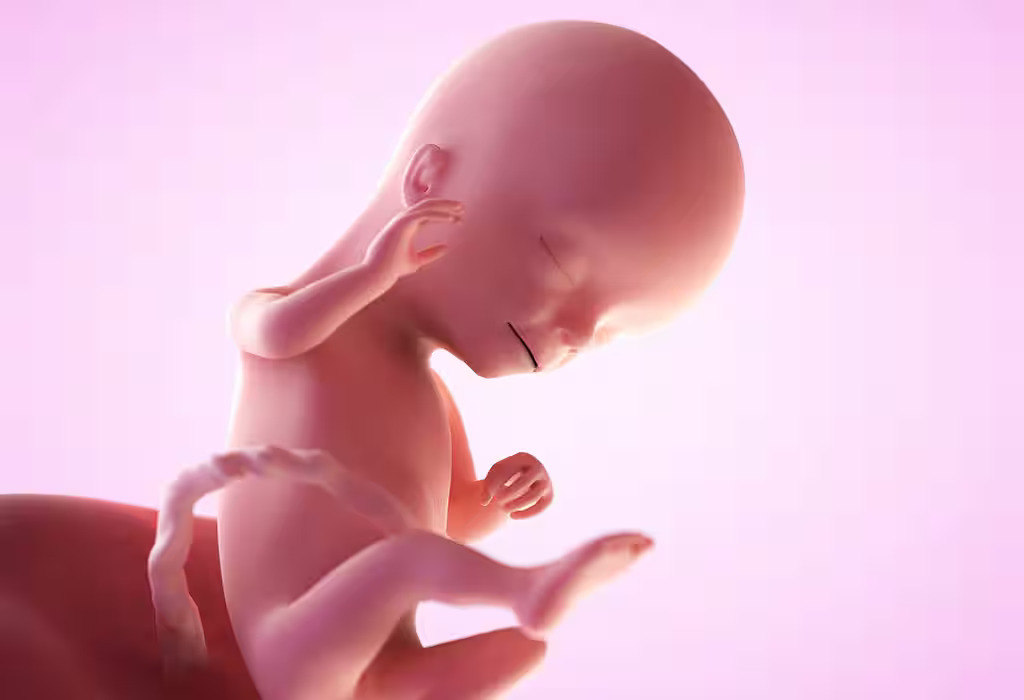
16 Weeks Pregnant: Symptoms, Baby Development, Diet & More
Hurray! You have entered the second trimester of pregnancy. Being sixteen weeks pregnant is an exciting period of life. At the onset of the 16th week of pregnancy, your body will expand and change in terms of size as well as functionality. This is yet another exciting part of your pregnancy, as you should be able to feel your baby move in some week’s time. Another huge development that happens during this time is that the baby may start recognising voices. It’s the perfect time to start talking to your little one. There’s a lot that will happen this week. Read to find out!
Growth of the Baby at 16 Weeks of Pregnancy
This week is the real deal, as your baby is likely to have fully formed genitals and eyes that are still fused but sensitive to light. Your baby may also start yawning inside your tummy now. The tiny muscles and backbone have gained strength, which means that your baby can now straighten their head and neck further than in the last few weeks. Your baby’s facial features have matured, thereby enabling him to frown or squint (1). However, your baby’s skin will still be transparent (2).
Size of the Baby
This is probably the most exciting part, as your tummy is now home to a 4-5-inch foetus that weighs around 100 grams (3). The other exciting part of your baby’s size is that your doctor will now know if your baby is a girl or a boy as the genitals are fully formed. Let’s just say that your avocado-sized baby is as good as a fully functional human being (4). Keep in mind that at 16 weeks pregnant, the baby’s size may also vary depending on different medical factors.
Common Bodily Changes
Since your baby’s body and weight have already changed at the onset of 16 weeks, it is hardly a surprise that you will face certain changes in your body during pregnancy at the end of this week. For starters, you will be curvier than before and may have to wear bigger clothes.
You will notice that you have fewer mood swings and a beautiful glow on your face, and you will feel less nauseated (5). Your biggest worry at this point will soon be stretch marks besides the well-being of your baby.
Symptoms of Pregnancy at Week 16
By this time, you are likely to get adjusted to the usual symptoms of pregnancy. It is, of course, safe to say that some symptoms are likely to continue until the end of pregnancy, while new ones will develop as each week progresses.
You may experience backache now owing to the weight of the foetus (6).
Your breasts will certainly be bigger and will continue to be sensitive.
Your eyes will be more sensitive owing to the changing hormones.
You may end up being constipated more often (4).
You may also be forgetful owing to the hormonal changes that your body is constantly undergoing.
You might also get varicose veins or cramps in your legs (1).
Belly at 16 Weeks of Pregnancy
At times, you might struggle to catch your breath. This is because your baby is growing, gaining weight and generally feels free to move around your belly. More importantly, there will be quite a bit of activity inside your belly as your baby might have started kicking or simply moving around, and you might want to be careful because muscle twitches and gas are still common in the 16th week of pregnancy.
16 Weeks Is How Many Months in Pregnancy?
16 weeks gestation is four months pregnant. It is important to note that doctors track pregnancy progress in weeks, not months.
Ultrasound Scan at 16 Weeks of Pregnancy
The ultrasound at the 16th week will show the maturation of organs. Your baby’s taste buds will form, and so will his eyebrows, hair, and eyelashes. Since your baby can now identify voices and sounds, it indicates that the tiny bones of the ears, as well as the tympanic membrane, will have developed.
In addition to the 16-week sonogram, your urine might also be tested during this week to check for diabetes and other diseases. Besides that, the usual signs of your baby’s growth, such as heartbeat, maturing organs, movement and sensitivity towards light, can all be charted.
What to Eat
Apart from the well-being of your child, the other thing you will mostly worry about at the 16th week of your pregnancy is food. While most of you may have overcome the aversion or cravings for certain kinds of food and smells and started eating in the usual manner, some may find it difficult even now. Listed below is a suggestion of what you should be eating. Ensure that you eat at regular intervals so as not to starve or make your baby starve.
A bite of chocolate may do you good, but as a regular practice, continue eating fruits and yoghurt, which aid digestion and provide necessary nutrients.
String cheese is an excellent choice for those craving salty foods, as it is rich in calcium and proteins.
Include a range of fresh fruits and vegetables in your diet to make sure your baby gets the nutrients essential for growth (7).
Make sure you consult a doctor and take proper vitamin supplements. These ensure that you get the nutrition that food can alone not suffice.
Lean meat, little red meat, fish, eggs, and pulses are all good choices to include in your diet as they contain easily digestible proteins.
Make sure you include iron, vitamin C, and calcium in your diet to supplement it.
Care Tips
This is the time when you should start taking extra care of yourself. Eating properly will benefit your weight gain, as it is important to have the strength to bear the weight of your baby. Make sure you do not perform any task in excess as this may have a negative effect on your unborn baby.
Dos
Exercise mildly or walk, at least for 30 minutes each day, to relieve your backache or leg cramps (8).
Remember you aren’t eating for two. You are simply providing nutrition to yourself and your baby. So, go for mindful eating and do not overeat.
Get plenty of rest and adequate sleep.
Stay hydrated without increasing soft drink consumption.
Think positive and stay cheerful, as that will go a long way to improving mental health.
Don’ts
Drink too much caffeine as it can have a negative impact on your baby’s overall health.
Indulge in heavy workouts, as they may leave you exhausted.
Starve yourself or your foetus.
Stay in an unhygienic state.
Ignore your oral health.
Stress yourself out.
Shy away from asking for help as and when required.
What You Need to Shop For
Pregnancy doesn’t need to be boring; flaunt your baby bump in style. If you prefer stylish, shop for bright maternity dresses that make you feel comfortable and good. Invest in good shoes, preferably with soft padding that will relieve the muscles of your feet. Comfortable tops and button-up maternity kurtis look great and are very convenient, too. Bella Mama has a lovely range of maternity night suits and nighties that are ideal as comfortable sleepwear. Get a good anti-stretch mark cream or oil because your skin will keep expanding. Do buy some lotions and creams because your skin will feel dry. Don’t forget to invest in a practical handbag that can stock up your essentials. Also, purchase eye drops that provide a cooling effect that can help relax your eye muscles. Oral care products are important,t too. Finally, don’t forget to purchase good parenting books.
When to Consult the Doctor?
During the second trimester, you may have prenatal appointments with your doctor every 3-4 weeks or differently depending on your progress. However, if you feel something unusual or any sudden discomfort, it is advised that you don’t wait for your scheduled appointment and consult a doctor as soon as possible to get your concerns checked.
At 16 weeks of pregnancy, you should immediately consult a doctor if you experience:
Vaginal bleeding (should always be informed to the doctor) (9)
Severe cramping
Fever
Dizziness or fainting
Changes in vaginal discharge
Foul-smelling discharge
Severe vomiting
FAQs
1. Where is your baby positioned at 16 weeks of pregnancy?
By 20 weeks, the uterus slowly reaches the belly button. In most pregnant women, the 16-week fetus is usually below the belly button.
2. Can you feel the baby when 16 weeks pregnant?
Most pregnant women feel the movements of their babies for the first time between 16 and 20 weeks of pregnancy (10). This phenomenon is called quickening (11). The movements may feel like a little fluttering, tiny pulses, or bubbles in your tummy. However, if you don’t feel your little one’s movements between 16 and 20 weeks, please remember that it is normal. Some women experience it a little late, around 20 to 24 weeks of pregnancy, especially when it is their first baby. If you haven’t felt your baby’s movements yet but are aware of your little one’s steady through regular doctor’s appointments, don’t panic. Have patience and enjoy your journey.
3. Why do I frequently feel so constipated?
Constipation in pregnancy is a common pregnancy symptom throughout the pregnancy, which is caused by a combination of factors, like prenatal vitamins or low activity levels (12). Although not dangerous, it could lead to discomfort and other issues, like haemorrhoids and anal fissures. Contact your doctor for a suitable remedy.
4. How can I prevent pregnancy stretch marks?
Honestly, there’s not much you can do to avoid pregnancy stretch marks, as it is genetic. But the best you can do to stay away from them is to stay hydrated by consuming water and water-rich foods and moisturising your skin regularly.
A thorough idea of what to expect during pregnancy can keep you ready to overcome the challenges that you may likely face during this period. Don’t stress; enjoy each and every moment, and have a great pregnancy!
References/Resources:
1. 16 weeks pregnant: baby’s development, your mental health and antenatal appointments; Tommy’s; https://www.tommys.org/pregnancy-information/im-pregnant/pregnancy-week-by-week/16-weeks-pregnant
2. How Your Fetus Grows During Pregnancy; ACOG; https://www.acog.org/womens-health/faqs/how-your-fetus-grows-during-pregnancy
3. Pregnancy Calendar: Week 16; Nemours KidsHealth; https://kidshealth.org/en/parents/week16.html
4. Week 16; NHS; https://www.nhs.uk/start-for-life/pregnancy/week-by-week-guide-to-pregnancy/2nd-trimester/week-16/
5. 16 Weeks Pregnant; American Pregnancy Association; https://americanpregnancy.org/healthy-pregnancy/week-by-week/16-weeks-pregnant/
6. Pregnancy at week 16; Pregnancy Birth & Baby; https://www.pregnancybirthbaby.org.au/pregnancy-at-week-16
7. Have a healthy diet in pregnancy; NHS; https://www.nhs.uk/pregnancy/keeping-well/have-a-healthy-diet/
8. Exercise in pregnancy; NHS; https://www.nhs.uk/pregnancy/keeping-well/exercise/
9. Bleeding During Pregnancy; ACOG; https://www.acog.org/womens-health/faqs/bleeding-during-pregnancy
10. Quickening in Pregnancy; Cleveland Clinic; https://my.clevelandclinic.org/health/symptoms/22829-quickening-in-pregnancy
11. The Second Trimester; Johns Hopkins Medicine; https://www.hopkinsmedicine.org/health/wellness-and-prevention/the-second-trimester
12. Pregnancy Constipation; Cleveland Clinic; https://my.clevelandclinic.org/health/diseases/21895-pregnancy-constipation
Previous Week: 15 Weeks Pregnant
Next Week: 17 Weeks Pregnant
Read more
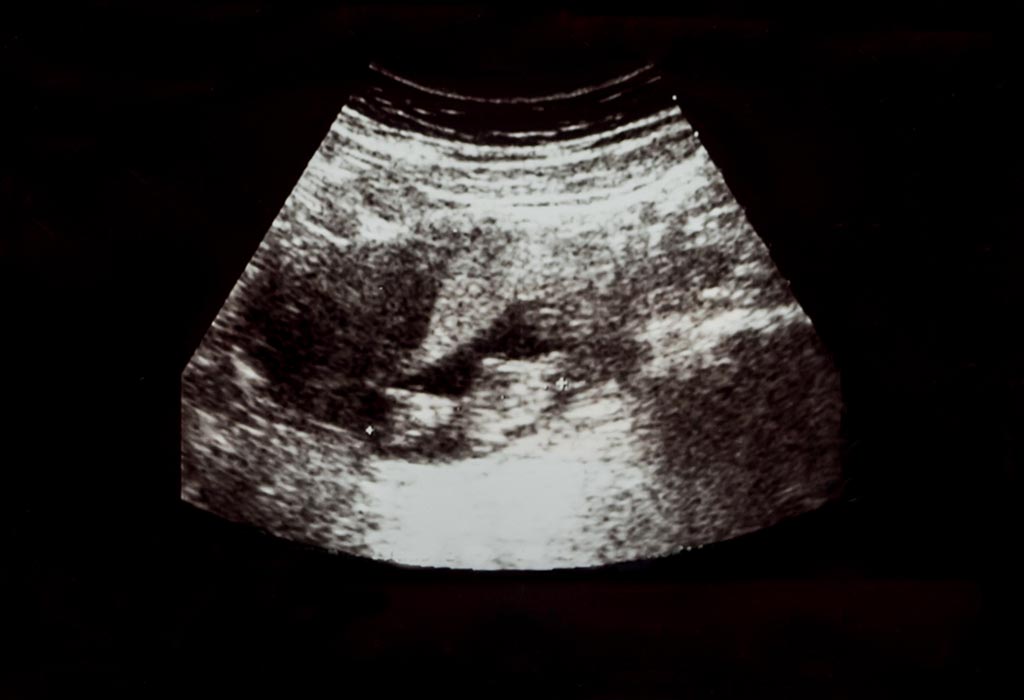
9 Weeks Ultrasound – Fetus Size & Important Insights
Congratulations! You’ve reached the third month of your pregnancy. Two months have passed, and now you must be used to the feeling of being pregnant. Well, you can’t feel your baby now, but that tiny one will soon start making small movements (though you may not be able to feel them). No doubt, you must be curious to know everything you can about your baby. In your ninth week of pregnancy, your doctor will recommend an ultrasound to know the size of your growing baby. In the ultrasound scan, you will get to see a tiny blob with a heartbeat in your uterus, which will eventually grow to become your baby. Read on to know more about a 9-week ultrasound scan.
Why Should You Have an Ultrasound at 9 Weeks?
The first ultrasound scan, which will be conducted, is called a dating and viability scan. This 9-week scan is performed for the following purposes.
To check whether the baby is in the right position inside the uterus or not.
To rule out ectopic pregnancy and confirm that it is uterine (1).
A baby’s heart starts beating around 6 weeks into the pregnancy. And by the 9th week, his heartbeat can be sensed. Therefore, to check the baby’s heartbeat, an ultrasound will be conducted – it also helps a doctor determine whether the pregnancy is viable or not.
If you experience spotting or bleeding during this time, an ultrasound scan can help determine the cause of the same.
It can show the number of babies you are carrying. If you are having twins, it can be determined during the 9-week ultrasound scan.
Couples who have had an IVF treatment need scans to determine successful implantation and viability of the pregnancy.
Signs of a Healthy Pregnancy at Nine Weeks
There are many signs of pregnancy at 9 weeks, even though it is quite an early stage of pregnancy. Here are some signs of a healthy pregnancy (2):
Nausea
Fatigue
Moodiness
Headaches
Mood swings
Sore breasts
Development of the Baby at Nine Weeks Pregnant
Your baby is the size of an olive right now. Here are some developmental stages of your baby at 9 weeks (3).
The face is slowly forming
Eyes are bigger and have pigment in them
The mouth is formed with tiny taste buds
Hands and feet are developing
Internal organs like the heart, kidneys, lungs, etc, are developing
How to Prepare for Your 9th Week Pregnancy Scan?
If you are having a scan around 9 weeks, it will normally be a transvaginal scan (TVS). This is because at this time your baby will be too low in the abdomen or too small for an abdominal scan in early pregnancy. A TVS will allow your doctor to scan the uterus through the vagina. To prepare for the scan, first, you will need to empty your urinary bladder. A full bladder can get in the way of a clear picture during the scan, so a nurse will ask you to use the restroom while she prepares for your scan (4).
Since the probing is vaginal, you will need to undress from the waist down. It’s suggested that you wear loose clothing, such as a long top with slacks or loose pants, to avoid being fully undressed.
How Long Does it Take to Perform an Ultrasound Scan?
A typical scan would last for about 20 to 30 minutes. However, if the doctor has a hard time getting clear pictures, it might take a little longer. But, there’s no need to worry about it, as women find transvaginal scans more comfortable than abdominal scans.
What Happens During an Ultrasound Scan?
During the ultrasound scan, you will be asked to lie down on an examination table or a bed. You will need to raise your knees in a position where the soles of your feet are flat on the bed. Your legs need to be kept apart, so the doctor has space to perform the scan. This is about the same position you’d take during an internal examination.
The probe will be covered with a sterile latex sheath that resembles a condom, and a lubricant gel will be applied to it so that it passes through the vagina with ease and generates clear pictures. The probe will be inserted two to three inches into the vagina to perform the scan. Although the procedure might feel a bit awkward, if you relax, it will be easier for your doctor to insert the probe. If you tense up your muscles, it can become uncomfortable and painful. So remember to take deep breaths and try to relax (5).
What Will You See on the Scan at the Ninth Week of Your Pregnancy?
Here is what you can expect in your 9-week ultrasound scan (6):
Your baby will measure about 2.3 cm and weigh close to 2 grams.
You will be able to see his head, body, and limbs. By now, your baby will no longer be an embryo and will be a foetus.
The heartbeat of a foetus can also be picked up in a nine-week ultrasound scan. It will usually be around 130 to 150 beats per second.
Your doctor will carefully examine the region around the gestational sac for any bleeding, a condition called subchorionic hematoma.
What Does It Mean to Have an Empty Yolk Sac During the 9th Week of Pregnancy?
The yolk sac envelops the developing foetus and the amniotic fluid. The yolk sac is contained within the gestational sac and is a source of nutrition for the developing foetus in early pregnancy. It is not visible until about 5 to 6 weeks into the gestation; hence, it is a marker of the age of the foetus. When no yolk sac is seen around 6 weeks, it may be because there has been an error in remembering the dates of your last period. The doctor will then schedule another scan in a week or two to confirm the presence of a yolk sac. If it is still not seen around 9 weeks of pregnancy, then it could be a sign of miscarriage. Sometimes there is no need to wait until the follow-up scan, if the 9-week ultrasound pictures show the gestational sac of about 25 mm or more, and there’s no yolk sac or embryo, the doctor will diagnose a miscarriage immediately (7).
What If Some Abnormalities Are Discovered in the Scan?
Scans can sometimes be inconclusive; there are strict guidelines that should be followed. Since doctors adhere to these guidelines, their findings are absolutely sure. Doctors look for minor abnormalities in the scans called “markers” that can indicate a more serious problem or could be just a variation of what is considered normal. So, if they find anything unusual, they may ask you to take tests such as CVS or amniocentesis to check if the chromosomes in the baby are normal.
If the foetus does have a serious problem, you can take time to think through your choices. They may include termination of pregnancy, preparing for a baby who might have special needs, or, in extremely rare cases, carrying out a surgery on the foetus.
FAQs
1. Can an ultrasound predict the gender of a baby at the 9th week of pregnancy?
9 weeks is too early for an ultrasound to predict the gender of a baby.
2. Can ultrasound show twins at pregnancy 9th weeks?
Yes, ultrasounds can show whether or not you’re having twins at the 9-week ultrasound scan.
3. Can a 9-week ultrasound detect early developmental delays in the embryo?
A 9-week pregnancy sonography mainly checks the fetal heartbeat, position, and growth. If the embryo measures much smaller than expected or the heartbeat is slower than normal, doctors may monitor the pregnancy more closely. However, most developmental issues cannot be confirmed this early.
4. Is it possible to see the baby move during a 9-week ultrasound?
Tiny movements can sometimes be seen during a nine-week scan. These movements happen because the embryo’s muscles and nerves are beginning to develop. However, the mother will not feel these movements until much later in pregnancy.
Ultrasound scans are extremely important to rule out problems and confirm a healthy pregnancy. So do not skip any. Go for ultrasound scans, get everything checked, and have a healthy and safe pregnancy!
Previous Week: 8 Weeks Pregnant Ultrasound
Next Week: 10 Weeks Pregnant Ultrasound
Read more
Sort By
 Latest
 Most Popular
 Trending
Please select atleast one Filter